Nest Cam stopped charging in the cold, a doorbell gone dark after a storm outage, or a barn camera that cannot find the Wi-Fi? Book a Hudson Valley Nest install or fix: (800) 486-0943
Home › Google Nest Camera Installation › Hudson Valley
Stone Houses in the Kingston Stockade · Brick Rowhouses in Newburgh's East End · Farmhouses and Barns · Lake Houses · Main Street Shops · Licensed Low-Voltage
Google Nest Camera Installation in the Hudson Valley
Wired Power Planned for Winter · Wi-Fi Checked at Every Camera · Paired Before It Goes on the Wall
Google Nest camera installation in the Hudson Valley is a different job from the same camera in a city apartment. Between Yonkers and the northern edge of Ulster County the houses run from Dutch stone colonials in Kingston to brick rowhouses in Newburgh's East End, post-war houses in Rockland and Putnam, farmhouses with barns in Dutchess and cottages around the lakes. Google itself says a Nest battery will not charge below 32°F, so a camera that works well in October can be flat by January unless it has wired power. Long driveways let Wi-Fi fade before it reaches the garage, and parts of Ulster are still waiting on state-funded fiber. We plan the power, the wall, the Wi-Fi and any historic-district paperwork before we drill, and we price the work at your county's published rate across Westchester, Rockland, Orange, Putnam, Dutchess and Ulster.
Reviewed and updated November 4, 2026 by Anwar Timothy, NYS license #12000287431 · Sources: Google Nest Help pages on cold-weather charging, setup and mounting, the Google Store Nest Doorbell specifications, the Google Nest Community forum, the Google Nest Pro blog, TechHive, Android Police, Security.org, HomeCamCafe, Spectrum News, the City of Beacon Code Chapter 134, the City of Hudson code, the City of Kingston Historic Landmarks Preservation Commission (including its January 2025 minutes), the City of Newburgh East End Historic District Design Guidelines, Dutchess County Community Connect, Stacker's September 2025 county housing-age report from U.S. Census data, the Ulster County newsroom, the Times Union, Hudson Valley One, the Daily Freeman, the Times Hudson Valley, Mid Hudson News, Patch Mid-Hudson Valley, Hudson Valley Post, WPDH, CBS New York, News 12 Hudson Valley, the Federal Reserve Bank of New York's Teller Window, county electrical licensing codes for Westchester, Rockland, Orange, Putnam and Ulster, the Village of New Paltz and Village of Cold Spring lighting standards, NYS DEC, Teatown, Earth Networks, Justia Ask a Lawyer, the Hudson River Valley Heritage Area, Wikipedia, Dia, Storm King Art Center and Walkway Over the Hudson · Dispatched from 460 E Fordham Rd
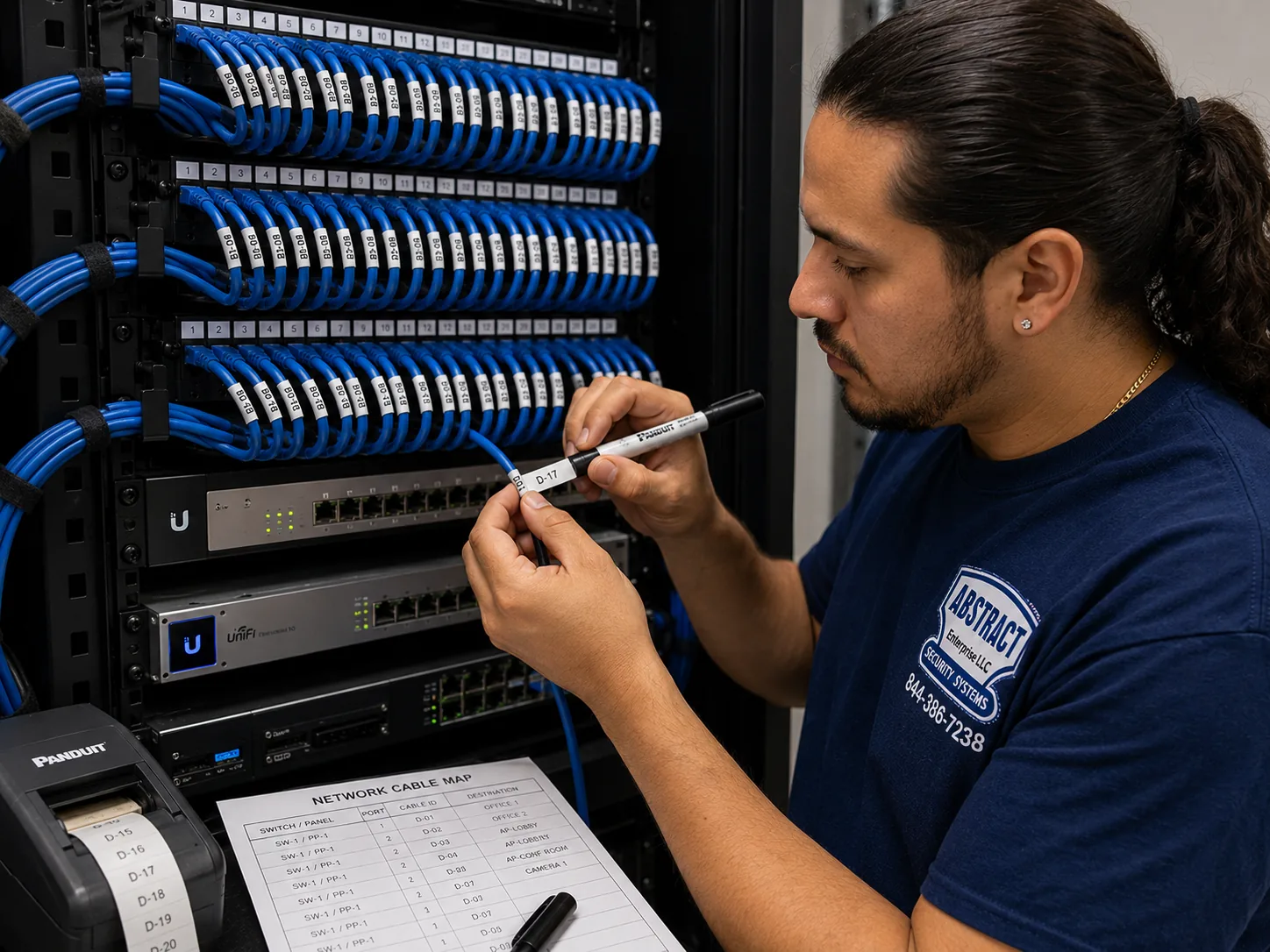
Photo from the AESS job library, not taken in the Hudson Valley: a technician printing cable labels at a patch panel, with a printed port map beside it. A Nest Cam is only as reliable as the network behind it, so on a Hudson Valley property with a house, a garage and an outbuilding we label every cable and access point the same way, which is what lets the next person find a fault without guessing.
Hudson Valley Nest Camera Install
Tell us the county, the house type and which Nest devices you have or want
✅
Request Sent!
We'll get back to you within 2 hours to book your Hudson Valley Nest install.
25+
Years Experience
✓
Same-Day Estimates
100%
Licensed & Insured
4.7★
201 Google Reviews
Owner-operated since 2002 · Thousands of jobs completed · Booked within 2 hours
Quick answer: Google Nest camera installation in the Hudson Valley is priced at your county's published rate, from 1.25 times our Brooklyn base in Westchester up to 1.53 times in Dutchess and Ulster, with every line set out on our Hudson Valley Nest camera price page. A visit covers pairing each camera and doorbell in your Google Home app before it is mounted, fixing it into wood, brick or stone with anchors that suit the material, running wired power wherever winter would otherwise flatten a battery, and measuring the Wi-Fi at every camera spot before anything is drilled. Requests are booked within 2 hours. Call (800) 486-0943 or use the form.
Rates follow the county on your tax bill: Westchester 1.25, Rockland 1.30, Orange 1.40, Putnam 1.45, Dutchess and Ulster 1.53 times the Brooklyn base, with each county's own price page linked further down
Every battery model is reviewed against Google's own cold-weather rule before we mount it, because a Nest battery stops charging at 32°F and a Hudson Valley January sits below that for long stretches
Low-voltage work under NYS license #12000287431; line-voltage connections such as a Nest Cam with Floodlight are left to an electrician licensed for your county, and the written quote names who does which part
Why Hudson Valley Properties Need Google Nest Camera Installation
The Hudson Valley is not one place, and an honest Nest install starts by admitting that. Wikipedia describes the region as stretching from the Capital District around Albany and Troy south to Yonkers on the New York City line. We work its six southern counties: Westchester, Rockland, Orange, Putnam, Dutchess and Ulster. The Hudson River Valley Heritage Area traces the region's building story to Dutch homesteaders who spread out from Kingston into Ulster and Dutchess and up from New York City into Westchester and Rockland, with each town center developing its own version of Dutch architecture. Dutchess County was created in 1683 as one of New York's original twelve counties. By 1750, the Heritage Area says, most of the region had been settled in a network of small local communities that still survives today. That network of old villages, river cities, farms and later suburbs is the reason a camera job here can mean an eighteenth-century stone house on a Kingston corner in the morning and a 1960s house on a cul-de-sac in the afternoon, with completely different walls, power and Wi-Fi.
Census figures compiled by Stacker in September 2025 put numbers on how old the housing is. In Westchester the median home was built in 1958, and 28.0 percent of homes, about 109,608 of them, date from 1939 or earlier. Putnam's median year is 1968, with 17.9 percent built before 1940. Rockland's median is 1970, with 11.5 percent. Dutchess's median is 1971, with 18.0 percent. Stacker did not return figures for Orange or Ulster in the report we read, so we do not quote any. For a Nest install, age shows up in four specific ways. Older doorbell transformers were often sized for a mechanical chime and not for a video doorbell. Masonry and fieldstone will not hold the plastic anchors that come in the box. Wiring in old houses has usually been extended more than once, so the outlet nearest a camera spot may not be where anyone expects. And in the river cities, many front facades sit inside historic districts where what you attach to the outside is reviewed. Kingston real-estate guides list stone Stockade colonials, Victorian row houses, mid-century cottages and renovated multis, and warn buyers to expect questions about roofs, masonry and wiring. Those three words, roof, masonry and wiring, are almost exactly the three things that decide where a Nest Cam can go on a Hudson Valley house.
People here are not putting up cameras out of idle curiosity. In Poughkeepsie, a Hudson Valley Post reader described a thief taking a package from a house on Fitchett Avenue and then from a porch on De Laval Place an hour later, with both houses' doorbell cameras catching him. WPDH reported a Newburgh package theft on Carter Avenue recorded the same way, and Hudson Valley One covered a Kingston package stolen from a McEntee Street porch and caught on the homeowner's security camera. In December 2024 Mid Hudson News reported City of Poughkeepsie detectives recovering numerous stolen items after searching 94 South Hamilton Street. In January 2025 State Police warned about residential burglaries in Dutchess, Westchester and Putnam and listed installing or activating security systems and cameras among their tips. After a run of car break-ins, Patch reported troopers in Poughkeepsie asking people on Hoofprint Road in Union Vale, Fountain Place and Weatherford Lane in Millbrook, and several roads in the town of Washington to check their home camera footage. In Rockland, CBS New York showed doorbell video of two masked men at a house on Coe Farm Road in Montebello. News 12 reported in June 2026 that police data showed package thefts in Westchester going down, which is welcome, but the same report featured a Yonkers resident's footage of a package taken from a porch on Yonkers Avenue. The cameras in those stories were not all Nest, and we do not claim any of those homes as customers. They show what local residents and police both expect a doorbell or porch camera to do: catch a clear face at the door and keep the clip long enough for someone to use it.
A great deal of the value of a Nest camera in this region is seeing a house you are not standing in. The Federal Reserve Bank of New York's Teller Window blog, writing about Newburgh and Kingston, recorded housing advocates' concern about downstate residents buying second homes upstate and about the rise of short-term vacation rentals. We cannot put a number on how many Hudson Valley homes are watched from an apartment in the city, and we will not guess. What we do see in the questions people send is a house checked from a phone on a Sunday night, a cabin that sits empty for weeks in winter, or a rental between guests. Nest suits that use well because it lives inside the Google Home app on the same phone as the thermostat and the speakers. It also means the camera is only as useful as the internet connection and the power supply at a property where nobody is home to notice when either fails.
That is the weak point, and it is a local one. Nest cameras keep their recordings in Google's cloud, so they need power and a working internet connection at the property. The Daily Freeman reported nearly 50,000 Central Hudson customers without power after storms in early July 2026, and the Times Hudson Valley counted 41,323 customers affected across 669 active outages at noon on the Sunday. Mid Hudson News reported Central Hudson restoring power to more than 24,000 customers after a nor'easter in late September 2026. On the internet side, Hudson Valley One quoted a local official saying that in most of Ulster County the available provider is Spectrum, and the Times Union reported that Ulster residents had struggled for years with unreliable access before a state ConnectALL award brought Verizon fiber plans for about 1,300 remote households and businesses. A New York warning reported by Spectrum News in December 2025 added another wrinkle: some package thieves carry Wi-Fi jammers to disrupt doorbell camera video. None of this makes Nest a poor choice here. It means a Hudson Valley Nest install has to be planned around the cold, the outage and the weak signal, not only the camera angle.
Cold deserves its own sentence because it surprises people every year. Google's help page on charging says that between 32°F and -4°F a Nest battery can still power the device but will not charge. A battery camera that starts December at full charge slowly runs down through a cold spell and cannot refill until the weather warms. Wired power changes that: Google says that as long as wired power is available, a wired Nest Cam (battery) can keep operating down to -4°F. Most of the rest of this page is about how to get that wire to the camera on stone, brick and clapboard walls without making a mess of an old house.
We also want to be plain about what our research could not find. We searched r/hudsonvalley and related forums for threads about Nest cameras or Nest installs in the region and found none. We could not capture Google's People Also Ask boxes, related searches, Bing or DuckDuckGo results or Answer the Public data from our build environment, so we do not pretend to quote them. The questions on this page come from Google's own help pages, the Google Nest Community forum, publisher and installer FAQs and Yelp. Where we describe how a Dutch stone wall or a Newburgh brick facade behaves under a drill, we are describing what we find in buildings of that type and age generally, not a survey of your street.
Hudson Valley facts that shape a Nest camera install
Old housing stock: Stacker's Census-based figures put Westchester's median home at 1958 with 28.0 percent built in 1939 or earlier, and Dutchess at 1971 with 18.0 percent; Putnam and Rockland fall between.
Batteries and cold: Google says Nest batteries do not charge between 32°F and -4°F, and that a wired Nest Cam (battery) can keep running to -4°F on wired power.
Storm outages: the Times Hudson Valley counted 41,323 Central Hudson customers affected at the peak of the July 2026 storms; Mid Hudson News reported more than 24,000 restored after the September 2026 nor'easter.
Rural internet: a state ConnectALL award is funding Verizon fiber for roughly 1,300 remote Ulster households and businesses, and Mid Hudson News reported awards aimed at unserved locations in Putnam, Dutchess, Orange, Ulster and Westchester.
Historic facades: Newburgh's East End alone has 2,239 resources, the most of any federally recognized historic district in the state according to Wikipedia, and Kingston has five local historic districts.
Police use of home video: Dutchess County runs a free camera registry through Flock's Community Connect, and State Police in Poughkeepsie have asked residents on named roads to check their home camera footage after break-ins.
What owners often add once the cameras are up. After a Hudson Valley house has its Nest Doorbell and cameras working, the most common follow-up is better Wi-Fi at the edges of the property: a wired access point in the garage, or a link out to the barn so the camera there stops dropping offline. That is network work we do in the same visit if it is planned at booking, so tell us how far the farthest camera is from the router.
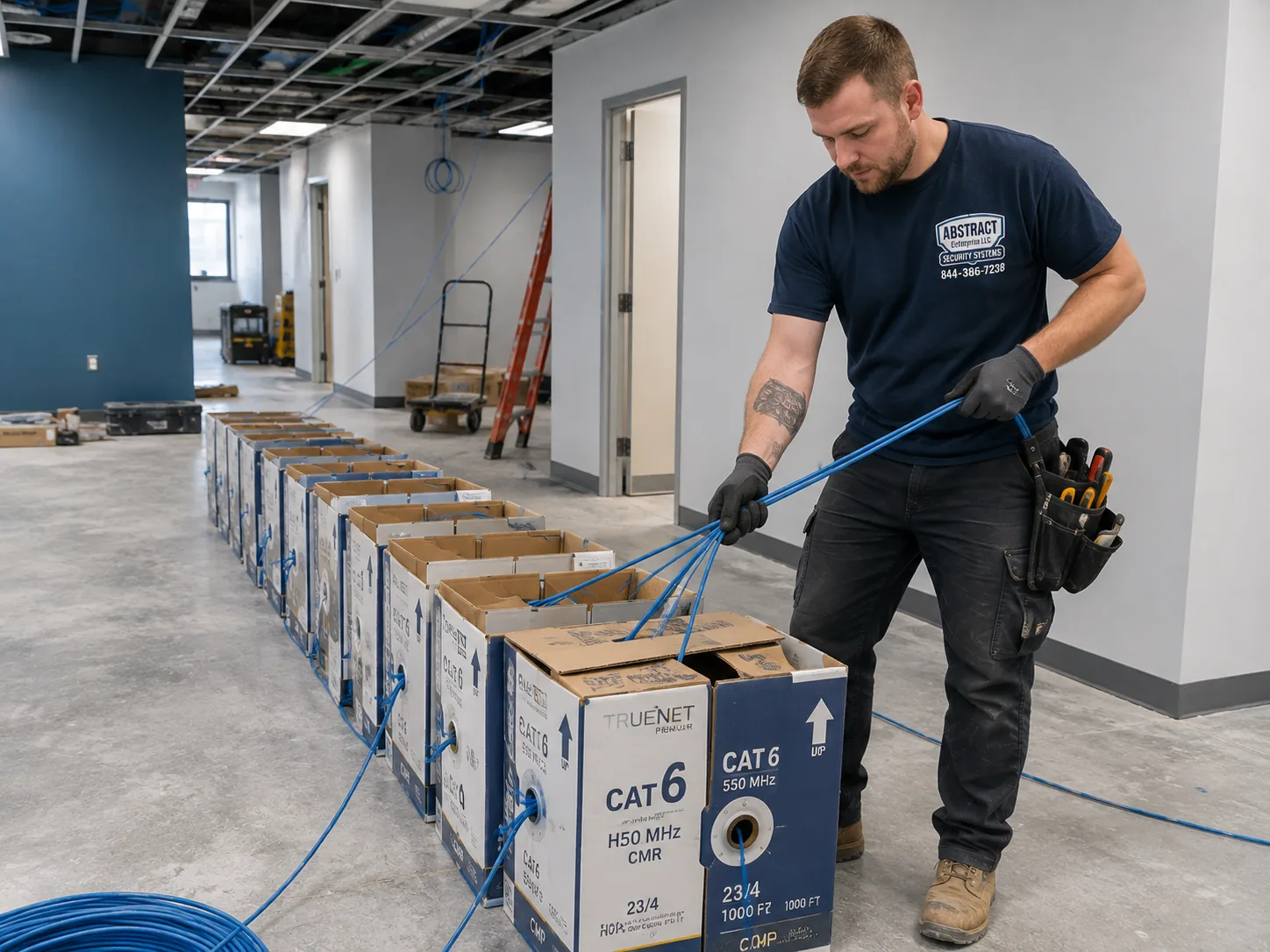
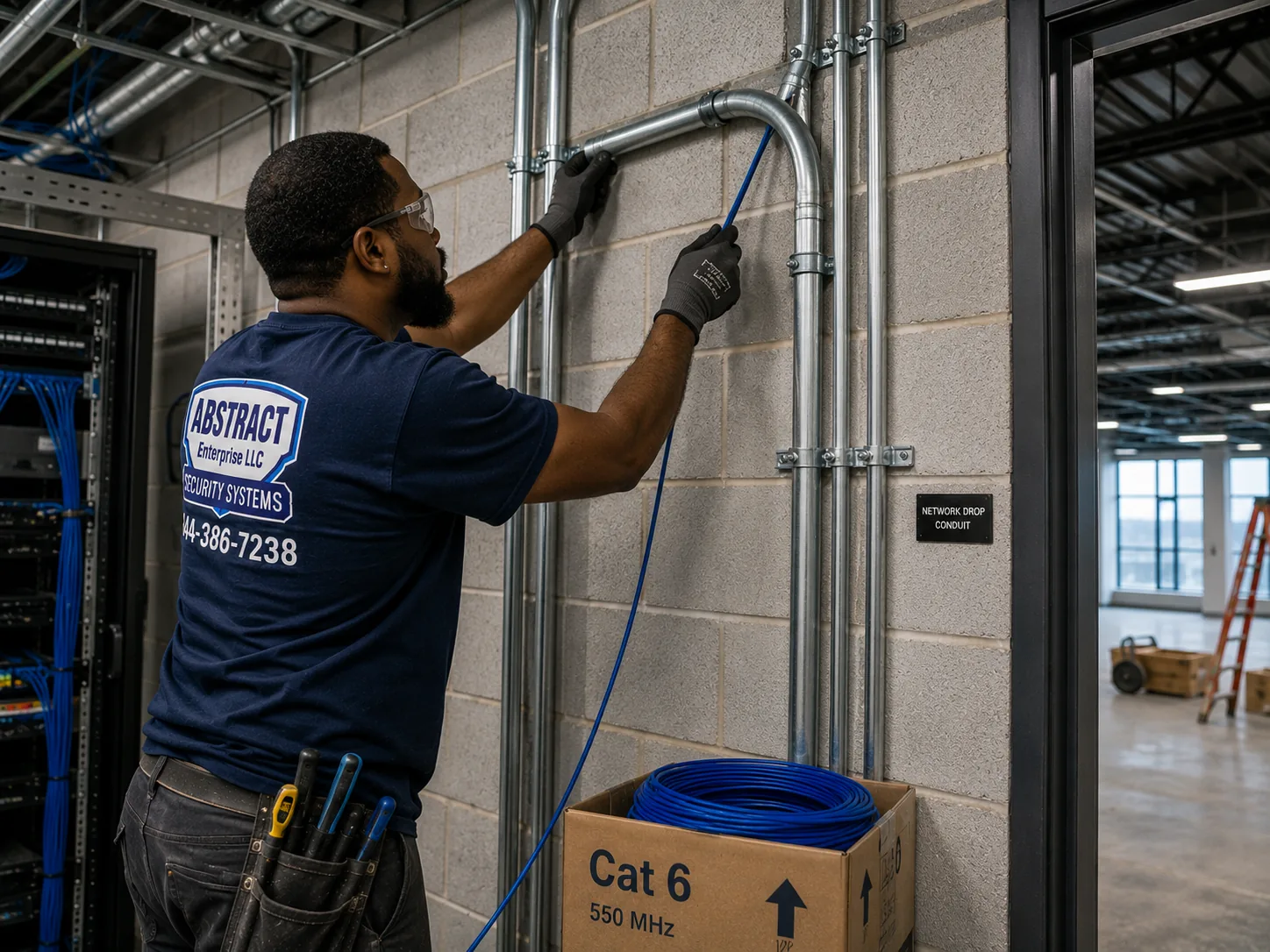
Photo from the AESS job library, not taken in the Hudson Valley: boxes of network cable staged on the floor of a working premises before a multi-drop pull. A Nest Cam on a detached garage or a barn behind a Dutchess farmhouse often fails because Wi-Fi from the kitchen router never reaches it; cable laid out like this, run to a wired access point in the outbuilding, is usually the real fix.
Six Counties
One Nest Cam, Six Counties: How the Same Install Changes From Westchester to Ulster
Driving north from the Bronx line to Saugerties, the camera in the box stays the same but almost everything around it changes: the age of the house, the utility that keeps it powered, who is allowed to connect a light fixture, the strength of the internet and the rules on the front facade. The table sets out the differences our sources support. Where a source was silent, the cell says so rather than filling the gap. The licensing column refers to line-voltage electrical work, which on a Nest job usually means a Nest Cam with Floodlight or a new outlet; our own work is low-voltage under NYS license #12000287431.
County
Housing age (Stacker, Census data)
Electric utility named in our sources
Line-voltage licensing found
Nest price page
Westchester
Median 1958; 28.0% built 1939 or earlier
Con Edison; NYSEG in Bedford, Lewisboro, North Salem, Poundridge and Somers
Westchester: close neighbors and older transformers
Westchester has the oldest housing of the four counties Stacker measured, and the densest lots. That combination shapes a Nest job in two ways. First, a house built before the war often still has the bell transformer that was fitted for a mechanical chime decades ago, and a video doorbell may want more than that transformer can give. Second, the lots are close, so the camera's field of view easily runs across a neighbor's driveway or into a side window. In Port Chester, News 12 reported neighbors sharing doorbell footage of car break-ins around 4 a.m. on and near Tower Hill Drive. In Scarsdale, police in the Lower Hudson Valley confirmed that burglars had hidden camouflaged cameras in bushes to watch homes. Rye police told News 12 that all 99 vehicle thefts they had recorded since 2020 involved unlocked cars with the key fob inside. A Nest Cam aimed at the driveway records that kind of thing well, but on a Westchester lot we draw the activity zones tightly around your own ground so your alerts are about your car and not the street.
Rockland: suburban streets that back onto woods
Rockland's housing is younger, with a median year of 1970 and 11.5 percent built before 1940, so the walls are more often modern framing and the doorbell wiring more often usable. What Rockland adds is the woods behind the houses. The CBS New York report from Coe Farm Road in Montebello and the News 12 report of a bike walked off a porch near Jerben and Major Andre Drive in Stony Point around 12:20 a.m. are both the kind of event a front doorbell and one side camera catch. NYS DEC's black bear guidance describes the southern bear range reaching southern Orange and Rockland at the New Jersey border, which matters for a Nest camera in a quieter way: animals walking across a back lawn at night trigger motion all season, and person-only alerts in the Google Home app are what keep a phone from buzzing every hour.
Orange: brick rowhouses, open land and lightning
Orange runs from the brick rowhouses of Newburgh's East End to farmland and long drives. Newburgh's design guidelines for the East End say security features should be integrated with the architecture, should not obscure architectural features and should not damage historic building fabric when they are attached. That reads almost like a mounting instruction for a doorbell camera on an Italianate rowhouse, and we follow it. Earth Networks' 2020 New York lightning report ranked Orange first among counties with 275,059 lightning pulses over 41 thunder days. A Nest Cam does not run on long copper network cable the way a wired camera system does, but the router, the modem and the access points that it depends on do, and a surge protector on that equipment is part of how we set up an Orange County property.
Putnam: lake houses and long outages
Putnam's lake communities and wooded lots bring Nest's two dependencies, power and Wi-Fi, into sharp focus. Daily Voice reported that during Tropical Storm Isaias in August 2020, NYSEG had 34,150 of its 38,693 Putnam customers without power at one point that morning. A Nest Cam (battery) carries on for a while on its battery when power goes, but the router and modem it reports through go dark immediately unless they are on a battery backup. On a Putnam lake house we talk through a small uninterruptible power supply for the router and modem, and we explain plainly that a long outage will still take the cameras offline once that backup runs down. In Cold Spring, the village's lighting chapter requires fully shielded fixtures, which affects the Nest Cam with Floodlight; more on that below.
Dutchess: estates, farms and a county camera registry
Dutchess holds a large share of the Hudson River National Historic Landmark District, which the Hudson River Heritage organization says was designated in 1990 and is the largest such district on the mainland of the contiguous United States, made up of towns, hamlets, villages and more than forty riverfront estates. It also holds working farms with barns well away from the house. Those outbuildings are where a Nest Cam most often loses Wi-Fi. Dutchess County runs a free camera registry through Flock's Community Connect, which the county says makes it easier for officers to locate nearby cameras and collect evidence. Registering is a choice for you to make after reading the terms, not something we do on your behalf, but we can show you where your camera locations are recorded in the app so you have the details ready.
Ulster: stone houses, Spectrum and fiber still coming
Ulster combines the oldest masonry in the region, in Kingston's Stockade, with some of its thinnest internet service in the hills. The Kingston Historic Landmarks Preservation Commission, in its January 2025 minutes, recorded staff recommending that an owner paint all externally mounted lines or line hides to match the facade's existing color, which is a useful precedent for any surface-run doorbell or camera cable on a Stockade house. Out of the city, the internet question decides whether Nest is the right camera at all. We test the actual upload speed at the house before recommending cloud cameras on a slow line, and if the answer is no, we say so.
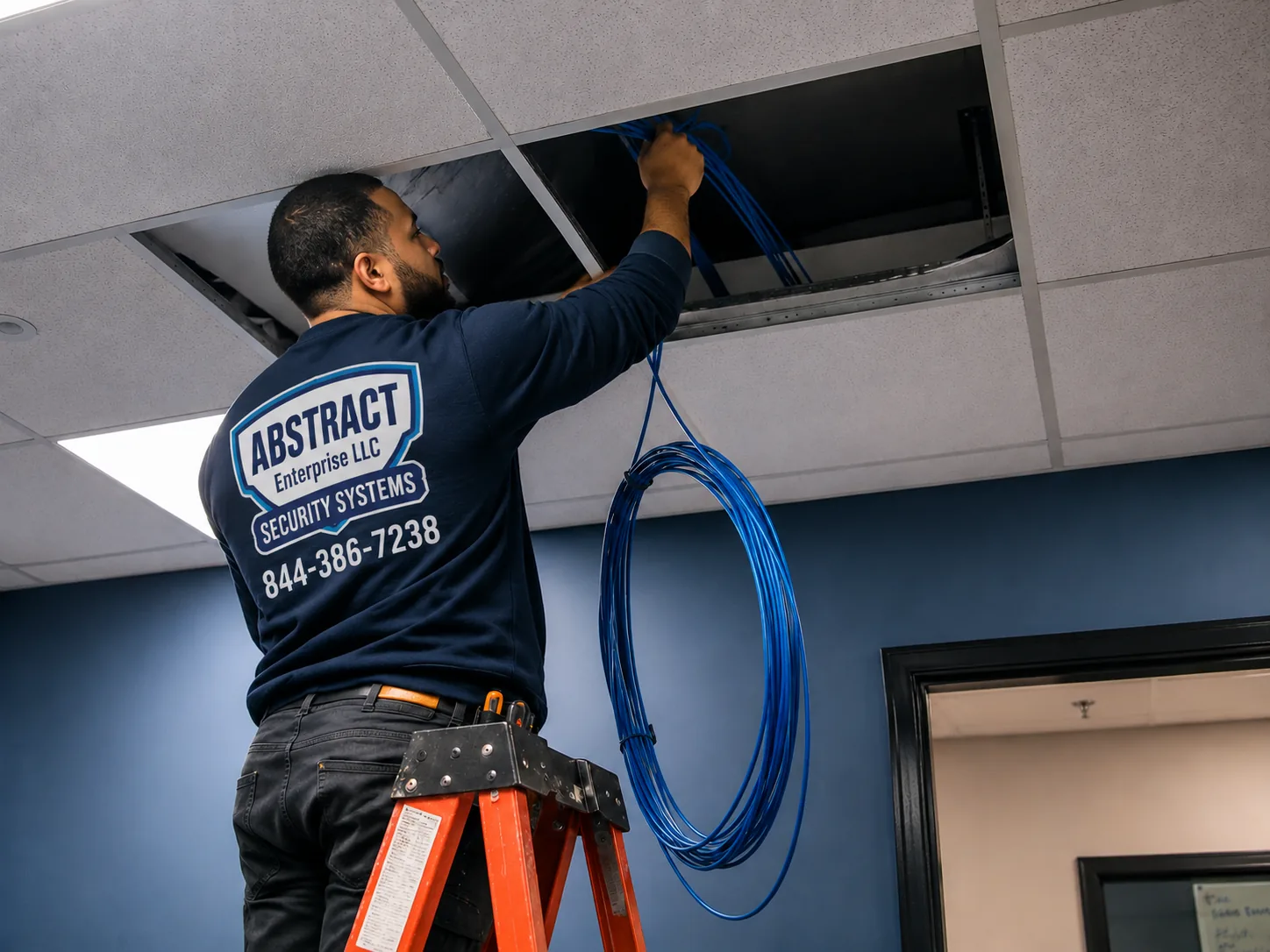
Photo from the AESS job library, not taken in the Hudson Valley: a technician feeding cable through an open ceiling while the space stays in use. The same careful pull applies above the ceiling of a shop on a Hudson Valley main street, where a ceiling access point gives indoor and outdoor Nest Cams a strong signal without tearing up finished plaster.
Winter Power
Below 32°F: Planning Nest Power for a Hudson Valley Winter
Nearly every Hudson Valley Nest problem we hear about in January traces back to one sentence in Google's help pages: at temperatures between 32°F and -4°F, the battery can still power the device, but it won't charge. Battery convenience is real in summer. Over a winter it becomes a schedule of ladder trips. The table below sets out how each type of Nest device behaves in the cold, using only what Google and the reporting we cite actually say. Where a source is silent, we do not fill the gap.
Device and power
What happens below freezing
Source
What we usually do here
Nest Cam (battery), on battery only
Keeps running on its stored charge but will not recharge between 32°F and -4°F
Google Nest Help
Use it only where a winter of slow drain is acceptable, or plan wired power
Nest Cam (battery), wired
Wired power runs the camera directly; Google says it can operate down to -4°F as long as wired power is available
Google Nest Help
Our default outdoors in all six counties
Nest Cam (battery) with the solar panel accessory
The panel only charges the battery and does not power the camera directly, so the cold-charging limit still applies
Android Police, quoting Google
Not treated as a winter solution
Nest Doorbell (battery), wired
TechHive reported that a wired Nest Doorbell of the battery type still stops once its battery dies in freezing weather
TechHive
On exposed doors, consider the wired doorbell instead
Nest Doorbell (wired)
Google's installer guidance calls it the better fit where temperatures are likely to drop below 32°F
Google Nest Pro blog
Preferred where the house has bell wiring we can use
Nest Cam Indoor (wired)
Indoors and plugged in, so outdoor cold does not apply
Google Store
Inside windows, hallways and outbuildings that are heated
Getting the weatherproof cable to the camera
Google sells a Nest Cam weatherproof cable that lets the battery camera stay plugged in outdoors, and its help pages describe running the power cable to an outdoor outlet or to an outlet inside the house through an existing vent or hole. On a modern house with vinyl siding that is often simple: a small hole, a sealed grommet, an indoor outlet on the other side. On a Hudson Valley stone or brick house it is the hardest part of the job. A Google Nest Community user wrote that the cable is very difficult to get through an exterior brick wall because the power cable is not standard and needs more than half an inch of clearance. That matches what we expect: the connector end is bulky, so the hole through the masonry has to be larger than a plain wire would need, drilled with the right bit, angled slightly downward toward the outside so water runs away, and sealed after the cable is through. On old stone we look for a mortar joint, an existing vent or a wooden window frame before we drill the stone itself.
Doorbell transformers in older houses
The Google Store specifications say the wired Nest Doorbell needs a doorbell transformer rated 16 to 24 volts AC and 10 to 40 VA, with a chime. On the Google Nest Community forum, many owners of the second-generation wired doorbell have reported that a 10 VA transformer was not enough and that upgrading to a 30 VA transformer fixed it. In a Westchester or Dutchess house built before the war, the bell transformer may be original, undersized or buried somewhere in the basement near the boiler. We measure the voltage with a meter before we promise anything. Where the house has no bell wiring at all, Google's own options are the Indoor Power Adapter or the battery doorbell, and on a stone facade that cannot be drilled freely, those options are often the kinder ones for the building.
When a battery is still the right answer
We do not insist on wires everywhere. A battery camera makes sense on a covered porch of a house that is lived in all winter, where someone can bring the camera inside to charge on a cold weekend, or on a summer cabin that is shut from November to April. It also makes sense where a wire would mean drilling through a protected facade in a historic district. What we will not do is mount a battery camera on the north side of a barn at a second home in Ulster and let the owner assume it will still be working in February. We tell you which of your cameras will need attention over the winter and roughly when.
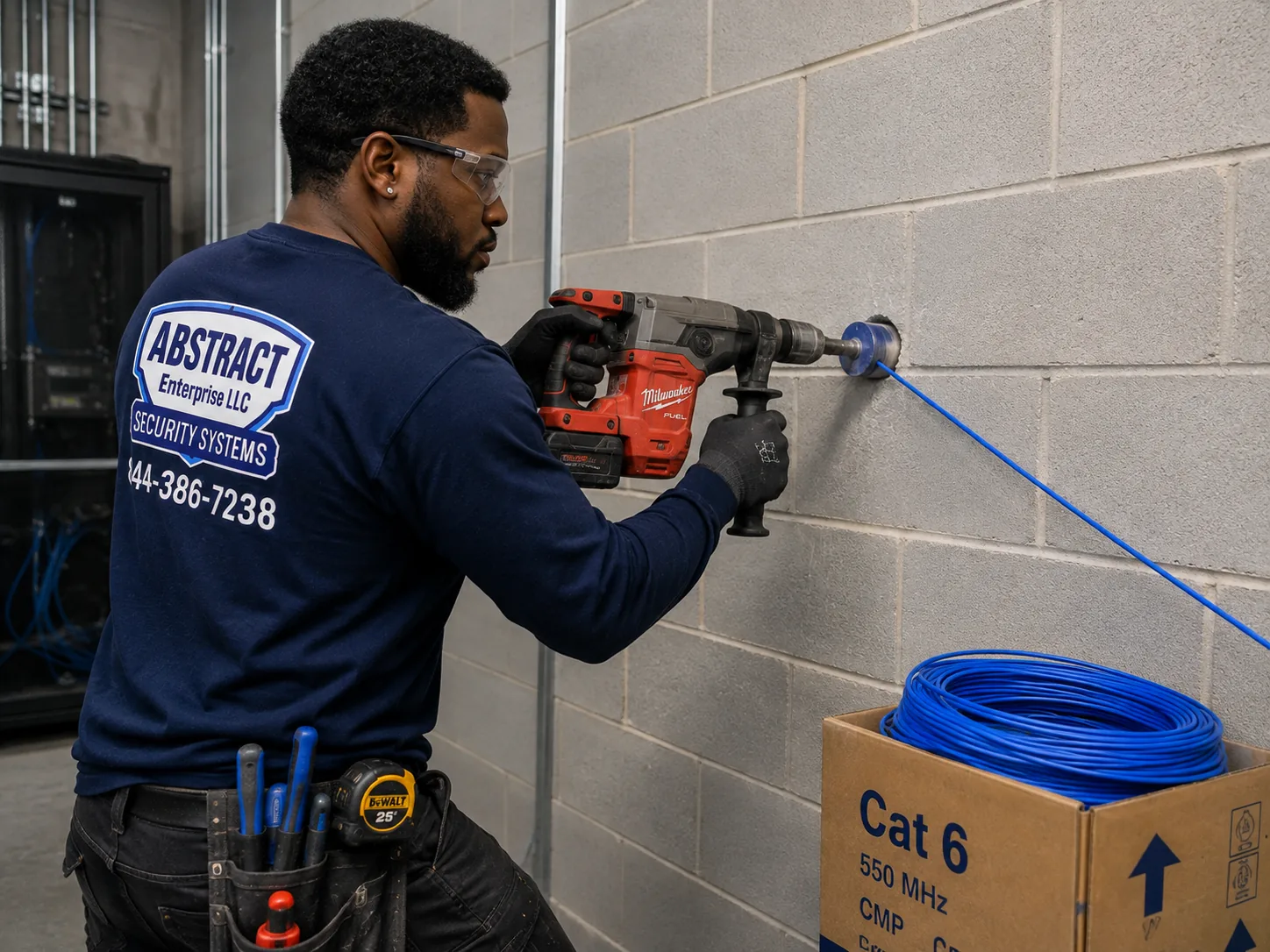
Photo from the AESS job library, not taken in the Hudson Valley: a technician core drilling through a block wall to carry cable through to a network room. Passing a Nest weatherproof cable through the brick of a Newburgh rowhouse or the stone of a Kingston colonial takes the same approach: the right bit, a hole large enough for the bulky connector, and a seal afterward so winter water does not follow the cable inside.
Nest Cam Offline After a Storm, or Dead in a Cold Snap? Fast Help Across the Hudson Valley
The calls we move on first are the ones where a property is being watched remotely and the cameras have gone dark: a second home in Ulster after a Central Hudson outage, a doorbell that died during a freeze, or a camera that stopped reporting after the internet provider swapped the router. Before you call, open the Google Home app and note which devices show offline and when they last connected, check whether the house has power and internet, and if someone is on site, ask them to look at the router lights. Then call (800) 486-0943. Requests are booked within 2 hours, and if the cause is the internet provider or the power company rather than the cameras, we will tell you so before anyone drives out.
Google Nest Camera Installation Services in the Hudson Valley
These are the Nest jobs Hudson Valley homeowners, second-home owners, rental hosts and small businesses book with us. Each is priced from the county price pages linked on this page. Where a job needs something extra, such as an access point at the barn or an electrician for a floodlight, the written quote names it before you agree.
🔔
Nest Doorbell, Wired or Battery
Wired doorbells on existing bell wiring with the transformer measured first and upgraded where the old one is undersized; battery doorbells or the Indoor Power Adapter on stone and brick fronts with no wiring.
📷
Outdoor Nest Cams With Winter Power
Nest Cam (battery) on the weatherproof cable or the wired outdoor model, fixed into wood, brick or stone, with the power route planned so it keeps working when a battery could not charge.
💡
Nest Cam With Floodlight
Camera, app and zones set up by us; the line-voltage connection made by an electrician licensed in your county; aim and shielding checked against village lighting rules such as New Paltz's and Cold Spring's.
🏠
Indoor Nest Cams
Hallways, mudrooms, garages and heated outbuildings, placed for coverage while respecting the privacy rules for bedrooms and bathrooms, with privacy modes set for when you are home.
📶
Wi-Fi That Reaches Every Camera
Signal measured at each camera spot, then mesh points or wired access points added where the house's router cannot reach the porch, garage, barn or boathouse.
🔋
Outage Resilience
Battery backup for the router and modem, surge protection for network gear in lightning country, and a plain explanation of what keeps recording and what goes dark when the power is out.
🏛
Historic-District Installs
Discreet positions, painted line hides and mounting that avoids historic fabric on Kingston, Newburgh and Beacon facades, with photos and product details ready if your city asks for them.
🔑
Second Homes and Rentals
Cameras set up for owners who are hours away, shared access for a caretaker, alerts tuned so a weekend away does not mean a phone full of deer.
🔧
Fixes, Moves and Re-Setups
Nest devices someone else installed, cameras that dropped offline after a router change, doorbells that reboot, and systems moved over after a house sale.
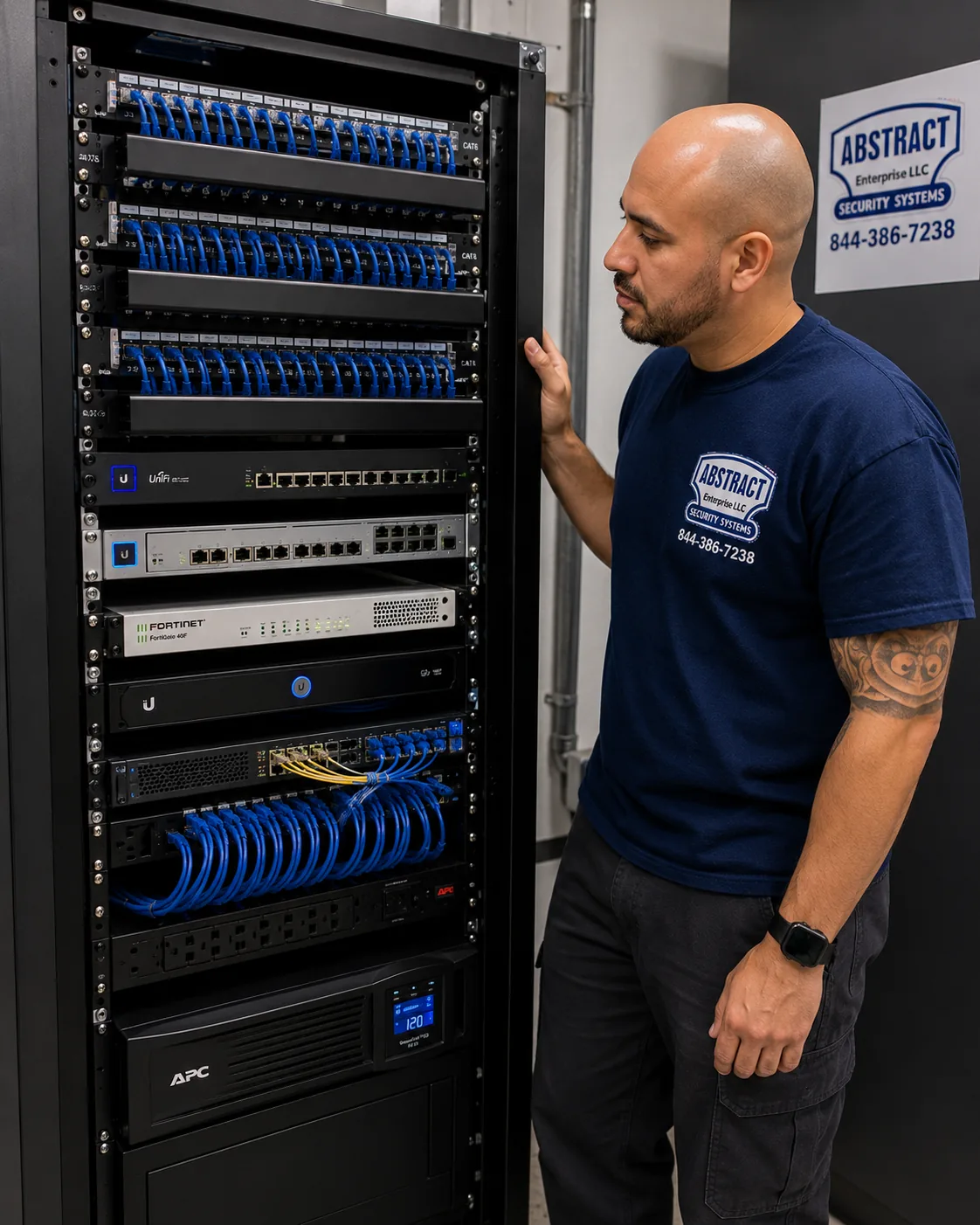
Photo from the AESS job library, not taken in the Hudson Valley: a finished network rack with patch panels, switching, a firewall and a battery backup unit at the bottom, everything dressed and labeled. A house is not a rack room, but the same idea holds for a Putnam lake house: put the modem and router on battery backup, and the Nest cameras keep reporting through a short outage instead of going dark the moment the lights flicker.
Building Specialists
Google Nest Camera Installation for the Hudson Valley's Architecture
The same Nest Cam mounts very differently on a 1700s stone wall, a brick rowhouse cornice, a clapboard farmhouse and a vinyl-sided split-level. Each building type changes three things: what the mount is fixed into, how the power reaches the camera, and whose approval is needed before we drill. These are the types our sources describe in the six counties.
Dutch Stone Houses
The colonial stone houses of the Kingston Stockade, where Crown and John Streets have early Dutch stone houses on all four corners. Thick, irregular walls, mortar joints that vary, and facades under historic review.
Brick Rowhouses in the River Cities
Federal, Italianate and Greek Revival rowhouses along Newburgh's East End ridge, with ornate cornices and decorative brackets. Brick that takes masonry anchors, and design guidelines that ask security devices not to obscure those details.
Victorian Row Houses and Renovated Multis
Kingston's Victorian row houses and converted multi-family buildings, where one front door may serve several apartments and the owner, not the tenant, decides what goes on the facade.
Post-War and Mid-Century Houses
The ranches, split-levels and cottages that make up much of Rockland, Putnam and southern Westchester. Framing and siding that take a camera easily, and usually a doorbell circuit we can work with.
Farmhouses, Barns and Estates
Clapboard farmhouses with outbuildings well away from the house, and the estates of the Hudson River landmark district. Distance, Wi-Fi reach and winter power matter more here than the wall.
Lake Houses and Second Homes
Waterfront cottages and seasonal houses around the lakes of Putnam and the hills of Ulster, watched from a distance and sometimes shut for the winter.
How the building changes a Nest install
Building
What holds the mount
How power usually reaches it
Who signs off
Dutch stone house
Masonry anchors in sound stone or a mortar joint, or a wooden window or door frame
Through an existing opening or a sealed hole sized for the cable connector; battery where drilling is unwise
Owner, and the city historic commission where the facade is in a district
Brick rowhouse
Sleeve anchors in the brick face, never the cornice or brackets
Weatherproof cable through brick, or a painted line hide to an indoor outlet
Owner; city design review where it applies
Renovated multi-family
Brick or framing depending on the wall
From the owner's circuit, never a tenant's outlet without agreement
Building owner
Post-war house
Screws into framing behind siding
Short weatherproof cable run or the existing doorbell circuit
Owner
Farmhouse and barn
Framing on the house; posts or beams on the barn
Outlet in the barn if it has power; battery if not; Wi-Fi carried out by an access point
Owner
Lake house or second home
Framing, often under an eave
Wired wherever possible, because nobody is there to charge a battery
Owner; homeowners' association where there is one
Stone walls: drill the joint, not the face, where you can
A Stockade stone wall is not one material. It is stones of different hardness held in mortar that may be centuries old in one place and a recent repointing in another. The face of a hard stone can shatter around a drill bit, and a soft one can crumble so the anchor never bites. Where the mount pattern allows, we place fixings in sound mortar joints with anchors suited to masonry, after drilling a test hole and looking at the dust that comes out. Where the wall is too fragile or too precious, we move the camera to a wooden frame, a porch post or an eave, which usually gives a better angle anyway. On the facade side of a historic house, the less we put into the stone, the better for everyone, including the next owner.
Brick rowhouses: respect the cornice
Newburgh's East End guidelines say security features should not obscure architectural features or damage historic building fabric. On an Italianate rowhouse, the features that matter are the cornice, the brackets, the window hoods and the door surround, and those are exactly where an installer in a hurry would like to put a camera. We keep the mount off them. A doorbell camera fits on the plain brick or wood beside the door; an eave camera goes on the plain soffit or a rear elevation; and any cable that has to run on the surface goes in a line hide painted to match, the approach Kingston's commission recorded in its January 2025 minutes. Brick takes a good masonry anchor well when the hole is in the brick rather than the joint, which is the opposite of the rule for stone.
Farmhouses and barns: the signal is the job
On a Dutchess or Orange farm property, the wall is rarely the hard part. The barn is a wooden building that takes a mount easily. The problem is that a Nest Cam on the barn may be a long way from the router in the farmhouse kitchen, with thick walls and open ground in between. Google's setup page says the cameras use 2.4 GHz and 5 GHz Wi-Fi, and 2.4 GHz carries further but crowds easily. We measure the signal where the camera will hang, not at the back door, and if it is weak we carry the network out with a wired access point or a point-to-point link before mounting the camera. A camera that drops offline every evening is worse than none, because you stop trusting it.
Second homes: wire everything you can
For a house that sits empty, the argument for wired power is stronger than anywhere else. Nobody is there to bring a battery camera in to charge, nobody notices when the doorbell's battery falls in a cold week, and the reason for having the cameras is precisely to know what is happening when you are away. We wire the outdoor cameras wherever the building allows, put the router and modem on battery backup, and walk you through what the Google Home app will show you if the power or internet goes out, so a dark camera does not send you driving up the Taconic at night for nothing.
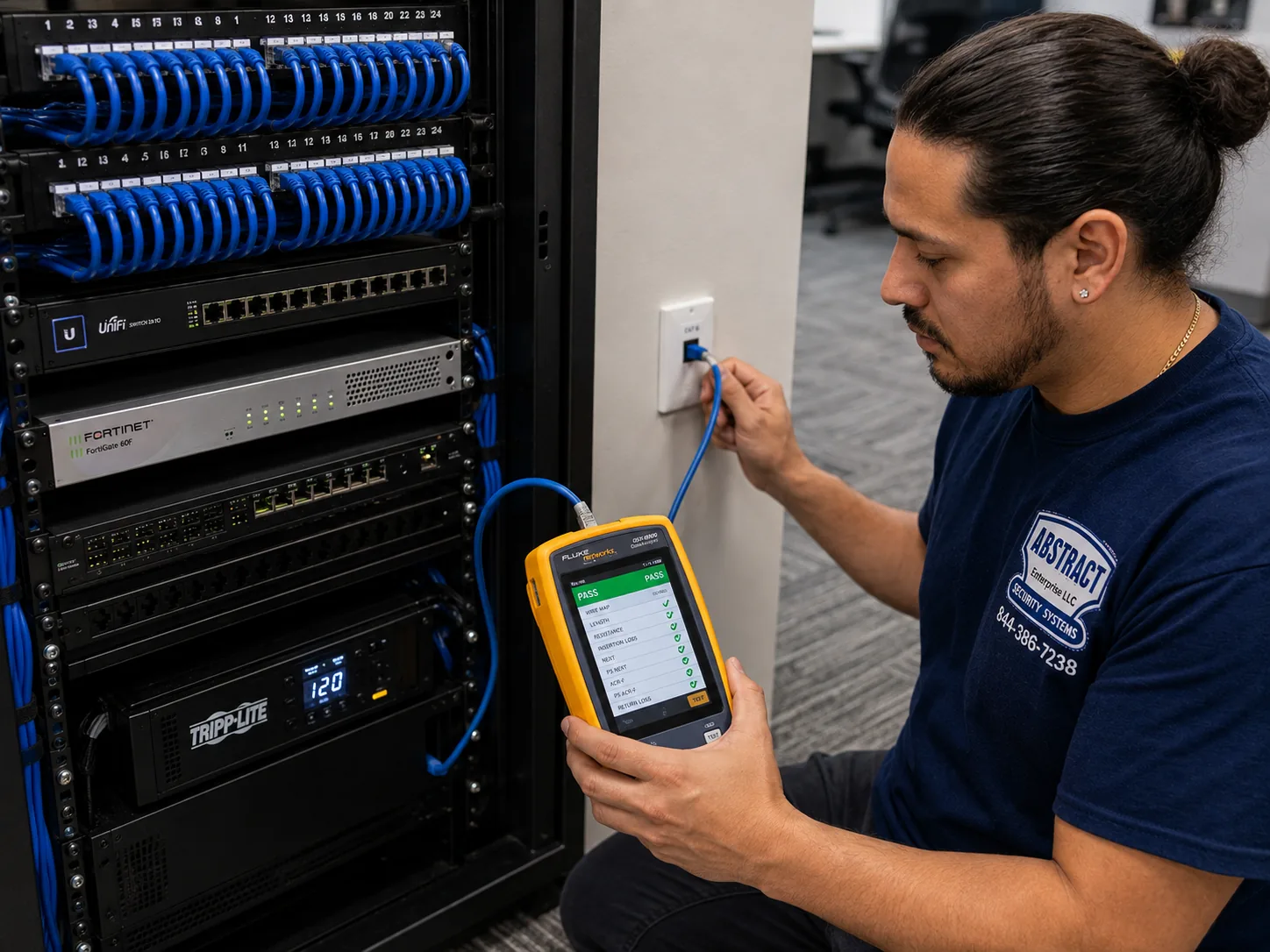
Photo from the AESS job library, not taken in the Hudson Valley: a technician certifying a data drop with a cable analyzer showing a PASS result. When we run a cable from a farmhouse out to an access point in the barn so a Nest Cam there stays online, the run is tested like this before the camera goes up, so a weak link never gets blamed on the camera.
Commercial Google Nest Camera Installation
Business Google Nest Camera Installation in the Hudson Valley
Nest is a home-first system, and we say so plainly to businesses. It fits a small shop, a tasting room, a studio or an office with a few cameras and an owner who already lives in the Google Home app. A larger business with many cameras or a need to keep weeks of footage on site is usually better served by a recorder-based system, and we will tell you if that is your case. These are the commercial stretches our sources describe; we have no information about which cameras any particular business uses and do not claim any as clients.
Beacon's Main Street
Described by a local guide as a historic Main Street almost a mile long. Beacon's code also allows arts and cultural uses and some live/work spaces in its historic district, so a single building may hold a studio downstairs and an apartment above.
Craft Beverage Tasting Rooms
Travel Hudson Valley counts more than 100 wineries, breweries and distilleries in the region. Hudson Valley Brewery's tasting room in Beacon opens Thursday to Monday, a schedule that leaves the building empty for days at a time.
Kingston's Stockade and Uptown Streets
Shops and offices in the historic districts around Fair Street, Green Street, Crown Street and John Street, where any exterior camera is a facade question as well as a security one.
Newburgh's East End
Montgomery Street mansions and the rowhouse blocks of the largest historic district in the state, with small offices and businesses in buildings that answer to the city's design guidelines.
Rockland's Route 59 Corridor
Our own Rockland page names Route 59, Route 304, Route 202 and the Palisades Center area in West Nyack as the county's commercial corridors: plazas and standalone stores where a few Nest Cams cover a register and a back door.
Poughkeepsie Offices and Shops
A Yelp user in Poughkeepsie asked what steps are involved in getting video surveillance installed for a business, which is the right question to ask first; our answer is in the questions section below.
When Nest suits a business, and when it does not
Nest suits a business that needs a handful of cameras, wants alerts on a phone, and is comfortable with footage stored in Google's cloud under a subscription. A tasting room that closes Tuesday and Wednesday, a gallery on Main Street, a small office in a converted house: these fit. It suits less well where the business needs many cameras on one screen, footage kept on site for weeks, or cameras far from any Wi-Fi. It also depends entirely on the internet connection; a shop whose connection drops during a storm loses its cameras' recording until it comes back. We walk through those trade-offs before you buy anything, and if a recorder-based system is the better choice, we say so rather than selling Nest because it is on this page.
Rules and practical limits for business cameras
Licensing for the light, not the camera. A Nest Cam with Floodlight connects to line voltage. Westchester requires electricians to hold a county trade license; Rockland's Chapter 250 covers electrical work at 50 volts or more; Orange licenses electricians under Local Law 8 of 2007, revised by Local Law 1 of 2024; Ulster has its Chapter 185 Electrical Licensing Law. We bring a licensed electrician for that part and say so on the quote.
Putnam's low-voltage license. Putnam's Chapter 145 licenses low-voltage and limited communications technicians for cabling including video surveillance up to 90 volts, starting from an outlet installed by a licensed electrician. We confirm current county requirements before work in Putnam.
Inspection in Dutchess towns. We found no county contractor license in Dutchess, but towns such as Fishkill require electrical work to be inspected by an approved independent agency, so a new outlet for a camera is inspected even where the camera itself is not.
Audio stays off by default. A Justia attorney answering a New York camera question advised disabling audio unless a consenting participant will be part of any recorded conversation. Business cameras covering staff and customers are set to video only unless the owner decides otherwise with advice.
No cameras in restrooms or changing areas. New York Penal Law 250.45 makes it illegal to record a person in a bathroom, changing room or fitting room without consent. We will not mount a camera with a view into one.
Facades in historic districts. In Kingston, the city says that once a certificate of appropriateness is approved it is sent to the applicant, owner and the Building & Safety Division, and any building permits follow. In the City of Hudson, no building permit is issued for covered work until the Historic Preservation Commission issues a certificate. We have found no explicit rule saying a surface-mounted camera alone needs a certificate in Kingston, Hudson or Beacon, so we tell owners to check with the city before exterior work on a landmarked facade.
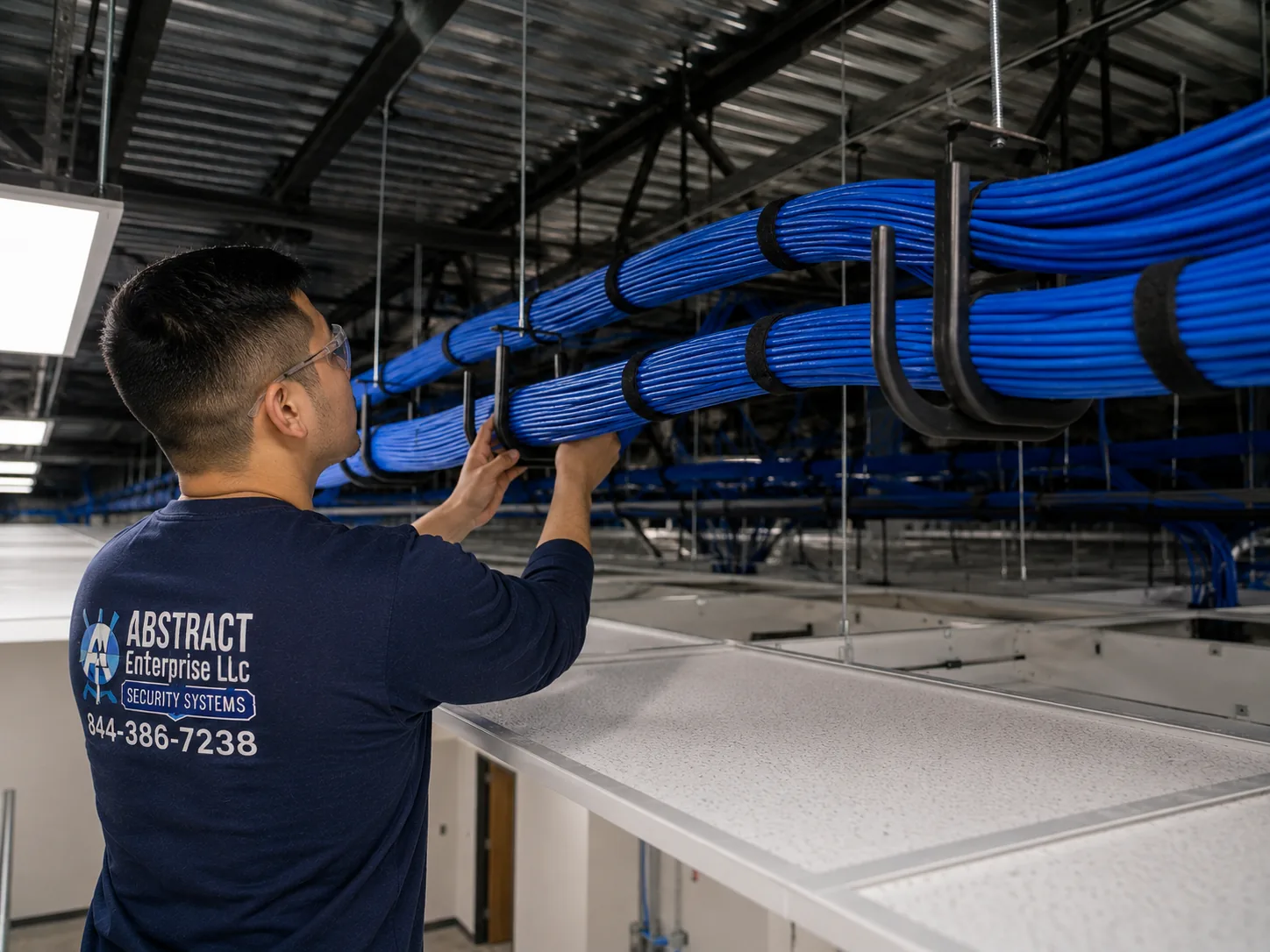
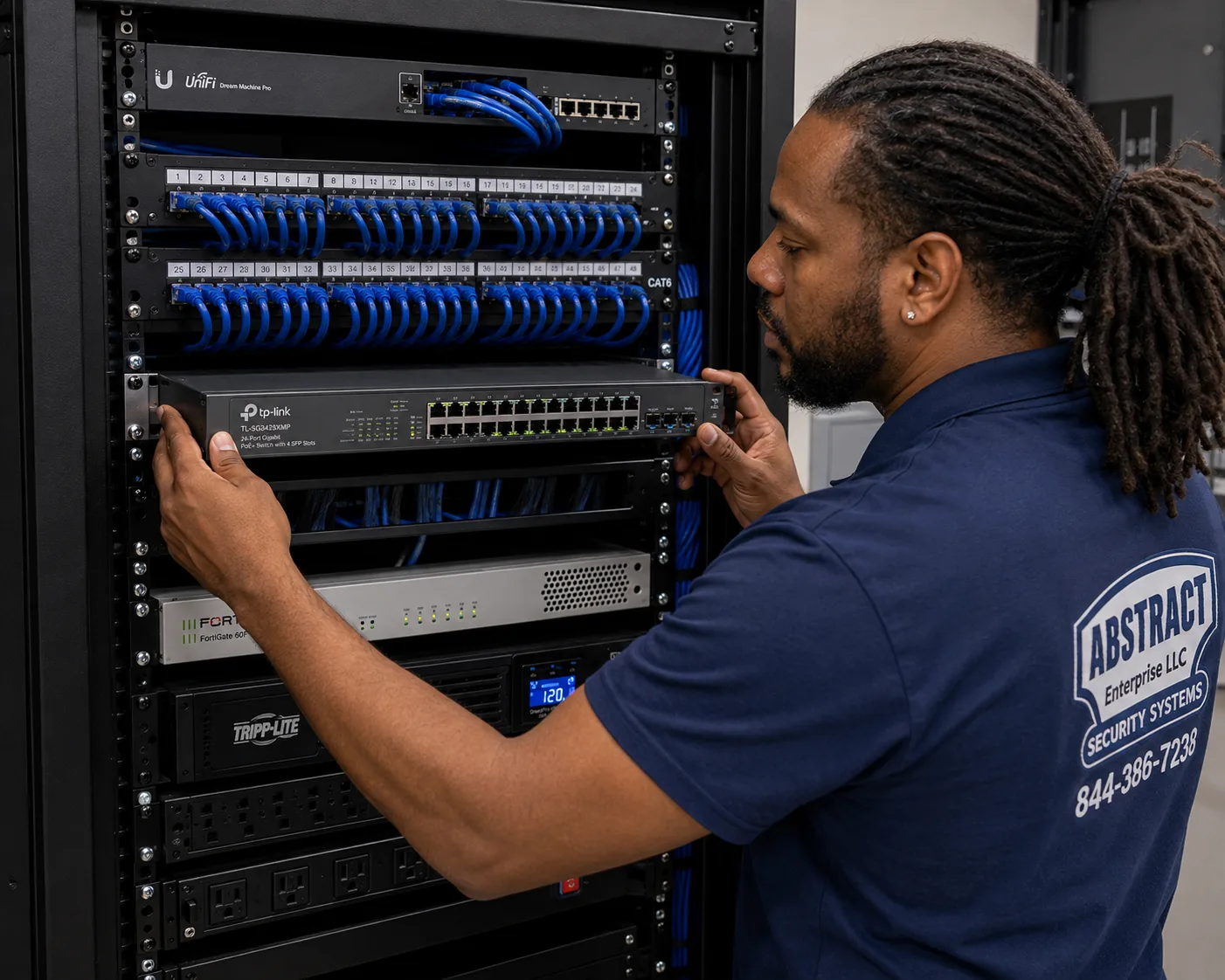
Photo from the AESS job library, not taken in the Hudson Valley: J-hooks carrying dressed bundles of cable across a commercial ceiling. Above the ceiling of a shop or tasting room on a Hudson Valley main street, a tidy pathway like this carries the cable to the access points that keep a business's Nest Cams online, rather than relying on one router behind the counter.Photo from the AESS job library, not taken in the Hudson Valley: a technician mounting a managed PoE switch below patch panels in a commercial network rack. Nest Cams themselves run on Wi-Fi, but the ceiling access points that carry that Wi-Fi through a converted Beacon or Kingston commercial building are often powered from a switch like this one.
Field Notes
Field Notes: The Walk Before the Ladder on a Hudson Valley Property
We do not publish stories about a particular customer's house unless we can document them, so this is not an account of one address. It is the routine our technicians follow on a Hudson Valley property before a single Nest Cam is mounted, because on a property with a long driveway and an outbuilding, most mistakes are made before anyone climbs a ladder.
We start at the router, not the front door. We look at where it sits, what it is plugged into and whether it is on any kind of battery backup. Then we walk out with a phone measuring Wi-Fi, stopping at each place a camera might go: the front door, the driveway corner, the garage, the barn. We note the signal at each one. We look at the wall at every stop and decide whether it is wood, brick or stone and where a wire could come through. We check the doorbell transformer with a meter. We ask which side of the house gets the north wind and which cameras you need to work in February. Only then do we pair the cameras on the kitchen table, photograph the QR stickers, and pick up the drill.
Your Questions Answered
Google Nest Camera Installation in the Hudson Valley: Questions Answered
Cold weather and power
Our battery Nest Cam on a Dutchess farmhouse stops charging every January. Will running a wire to it actually fix that?
Yes, if the wire powers the camera rather than only topping up the battery. Google's help page says that between 32°F and -4°F the Nest battery can still run the device but will not charge, and that a wired Nest Cam (battery) can keep operating down to -4°F as long as wired power is available, because the wire runs the camera directly. In practice that means the Nest Cam weatherproof cable from the camera to an outlet, either outdoors or inside through a sealed hole. On a clapboard farmhouse that is usually a short, clean run. The camera then carries on through a cold week instead of slowly draining, and the battery is there as a buffer for a short power cut rather than as the only source.
Will the Nest solar panel keep a battery camera running through an Ulster winter?
Not reliably, and Google's own explanation is the reason. Android Police, reporting Google's explanation of winter battery behavior, noted that the solar panel accessory only charges the battery and does not power the camera directly. So the panel runs into the same rule as any other charger: below freezing, the battery will not accept a charge. Add short winter days and snow on the panel, and a solar Nest Cam in the Ulster hills can run down through January just as a plain battery one would. We use solar for cameras that are fine being unreliable in deep winter, and wired power for the ones that are not.
Why did our Nest Doorbell go dark during a cold snap while the cameras kept working?
Most likely because it is the battery doorbell, and a wire does not change the cold-weather rule for that model. TechHive reported that while a Nest Cam can bypass its battery with wired power in freezing temperatures, the battery Nest Doorbell will still stop once its battery dies. Google's installer guidance, on the Nest Pro blog, says the wired doorbell is the better fit in places where temperatures are likely to drop below 32°F. If your front door faces the weather and the battery doorbell keeps going dark, the fix is usually to replace it with the wired doorbell on the existing bell circuit, after we have measured the transformer and confirmed it can supply what the doorbell needs.
Stone, brick and historic facades
How do you get the Nest weatherproof cable through a brick or stone wall without making a mess?
This exact question comes up on the Google Nest Community forum, where a user described the cable as very difficult to push through an exterior brick wall because the connector is not standard and needs more than half an inch of clearance. We start by looking for a way that avoids drilling the masonry at all: a wooden window frame, an existing vent, or a sill plate on the inside. If we must drill, we use a masonry bit sized for the connector, angle the hole slightly down toward the outside so water drains away, feed the cable, and seal both ends. On old stone we drill a mortar joint rather than the stone face. On brick we drill the brick rather than the joint. The result is one neat, sealed opening rather than several attempts.
Our house is in Kingston's Stockade. What should we sort out before a camera goes on the front?
Check with the city before any exterior work on the street side. Kingston's commission reviews exterior changes in its historic districts, and the city says that once a certificate of appropriateness is approved it is emailed to the applicant, the owner and the Building & Safety Division, with any building permits following. We found no explicit Kingston rule saying a small surface-mounted camera on its own needs a certificate, so we do not tell you it does or does not; we tell you to ask. What we can do is give you a clear description, product photos and the proposed location, choose a spot that does not cover historic features, and follow the commission's recorded preference from its January 2025 minutes that externally mounted lines or line hides be painted to match the facade.
We are inside Beacon's historic overlay. Does a doorbell camera count as changing a historic feature?
Beacon's code says a building permit that alters a historic feature in a designated district needs a certificate of appropriateness from the Planning Board, and the code text we read also refers to accessory, utility or security-related changes that do not substantially detract from the historic property. We only saw part of that section, so read the full chapter or call the city before relying on it. Our approach is to make the install as reversible and discreet as we can: a doorbell on plain trim beside the door rather than on original woodwork, cable inside the frame where possible, and indoor cameras where they can do the job. Up the river in the City of Hudson, the code says its commission does not consider changes to interior spaces unless they are specifically landmarked, which is a useful reminder that an indoor camera looking out through a window is often the lowest-risk option on a historic house anywhere.
Wi-Fi and internet
The router is in the farmhouse kitchen and the camera needs to be on the barn. Will Nest reach that far?
Sometimes, but we measure rather than guess. Google's setup page says Nest cameras use 2.4 GHz and 5 GHz Wi-Fi. A farmhouse with thick walls and a barn across open ground can lose most of the signal on the way, and a camera at the edge of the signal drops offline at the worst moments. We stand where the camera will hang with a signal meter. If the reading is weak, we carry the network out first: a mesh point in a window facing the barn, a wired access point in the barn if there is a cable route, or a point-to-point wireless link between the two buildings. Reolink's own installation guidance suggests keeping cameras at least a meter from Wi-Fi routers and other wireless devices, which is a fair general rule for Nest too when we place a new access point.
In our part of Ulster the internet is slow. Can Nest cameras work on it?
It depends on the upload speed, not the download figure on the bill, so we test it at the house. Nest cameras send their video up to Google's cloud, so a line that is fine for streaming a film can struggle to send several cameras' video at once. Hudson Valley One quoted a local official saying that in most of Ulster the available provider is Spectrum, and the Times Union reported years of unreliable rural access before the state ConnectALL award for Verizon fiber to about 1,300 remote households and businesses. If your measured upload is too weak for the cameras you want, we will suggest fewer cameras, lower recording quality, or waiting for fiber, and we will say plainly if a system that records locally would serve you better until then.
Privacy, the law and the police
Is it legal to record sound on our Nest Cams in New York?
This is a question a New York user put to lawyers on Justia, and the attorney's advice was to disable audio on outdoor and garage cameras unless a consenting participant, including you, will be part of any recorded conversation. New York is generally described as a one-party consent state for recording conversations, which is why the advice turns on whether someone in the conversation has agreed. A doorbell where you speak to the visitor is a different situation from a garden camera quietly recording two neighbors talking over the fence. We set audio recording off by default on cameras that face shared or public spaces and show you where the setting is, and we suggest you ask a lawyer if you have a specific concern.
We rent our Hudson Valley house to guests. Where can indoor Nest Cams go, and where can they never go?
Never in bedrooms, bathrooms or changing areas. New York Penal Law 250.45 makes it illegal to use an imaging device to record a person in a bedroom, bathroom, changing room or fitting room without consent. In a rental that rules out most of the house for indoor cameras. What is left is usually an entry hall or a garage, and many hosts decide outdoor cameras at the door and driveway are enough. We will not mount an indoor camera with a view into a sleeping or bathing space, and we suggest you check your rental platform's own rules on disclosing any cameras to guests.
Should we put our Nest Cams on the Dutchess County camera registry?
That is your choice, and it is worth understanding what the registry is first. Dutchess County runs it through Flock's Community Connect and says registering is free and makes it easier for officers to locate nearby cameras and collect evidence for investigations. As we read it, it is a list of where cameras are, which the county uses to know whom to ask after an incident; it is not described as giving police live access to your video. The Patch report of State Police in Poughkeepsie asking named-road residents to check home footage after car break-ins shows the kind of request it supports. Read the program's current terms before you sign up. We will give you a written list of each camera's location and view so registering takes a few minutes if you decide to.
Floodlights, DIY and business
Our village has an outdoor lighting law. Can we still put up a Nest Cam with Floodlight?
Often yes, but the light has to follow the local rule. The Village of New Paltz's outdoor lighting standards require fully shielded fixtures with no light above the horizontal, discourage floodlighting and require it to be shielded where it is used, while recommending motion-sensor security lighting. The Village of Cold Spring's chapter requires full cutoff fixtures, security lighting aimed so its light stays on the property, and motion fixtures that turn off when motion stops. A floodlight camera that throws light across a neighbor's yard can fail those rules even though the camera part is fine. We check the village's rules before choosing the fixture, aim the lights down at your own ground, and in strict villages we sometimes recommend a shielded light and a separate Nest Cam instead.
Can we put up Nest cameras ourselves, and when is it worth paying an installer?
You can install them yourself; one guide to New York camera permits notes that no state license is required for a homeowner installing on their own home. Nest is designed for that, and on a modern house with a doorbell circuit that works and Wi-Fi that reaches, many owners do it well. It is worth bringing us in when the job runs into the things this page is about: stone or brick walls, a weatherproof cable that needs to come through masonry, an undersized transformer, a barn the Wi-Fi does not reach, a historic facade, or a floodlight that needs a licensed electrician. Those are where a DIY install tends to end up with a camera that works in summer and fails in winter.
What are the steps to get Nest cameras set up for a small business in Poughkeepsie?
A Yelp user in Poughkeepsie asked this about business video surveillance, and our steps are the same for any small Hudson Valley business. First, a short call or photos to decide whether Nest suits the business at all, given the number of cameras and how long footage needs to be kept. Second, a visit to measure the Wi-Fi and internet upload at the premises and look at the walls and ceilings. Third, a written quote that names each camera, the network work, any electrician for line-voltage parts, and the Google subscription the business will need to keep video. Fourth, the install, with cameras paired to an account the business owns, not ours. Fifth, a handover showing the owner and a manager how to find and save clips.
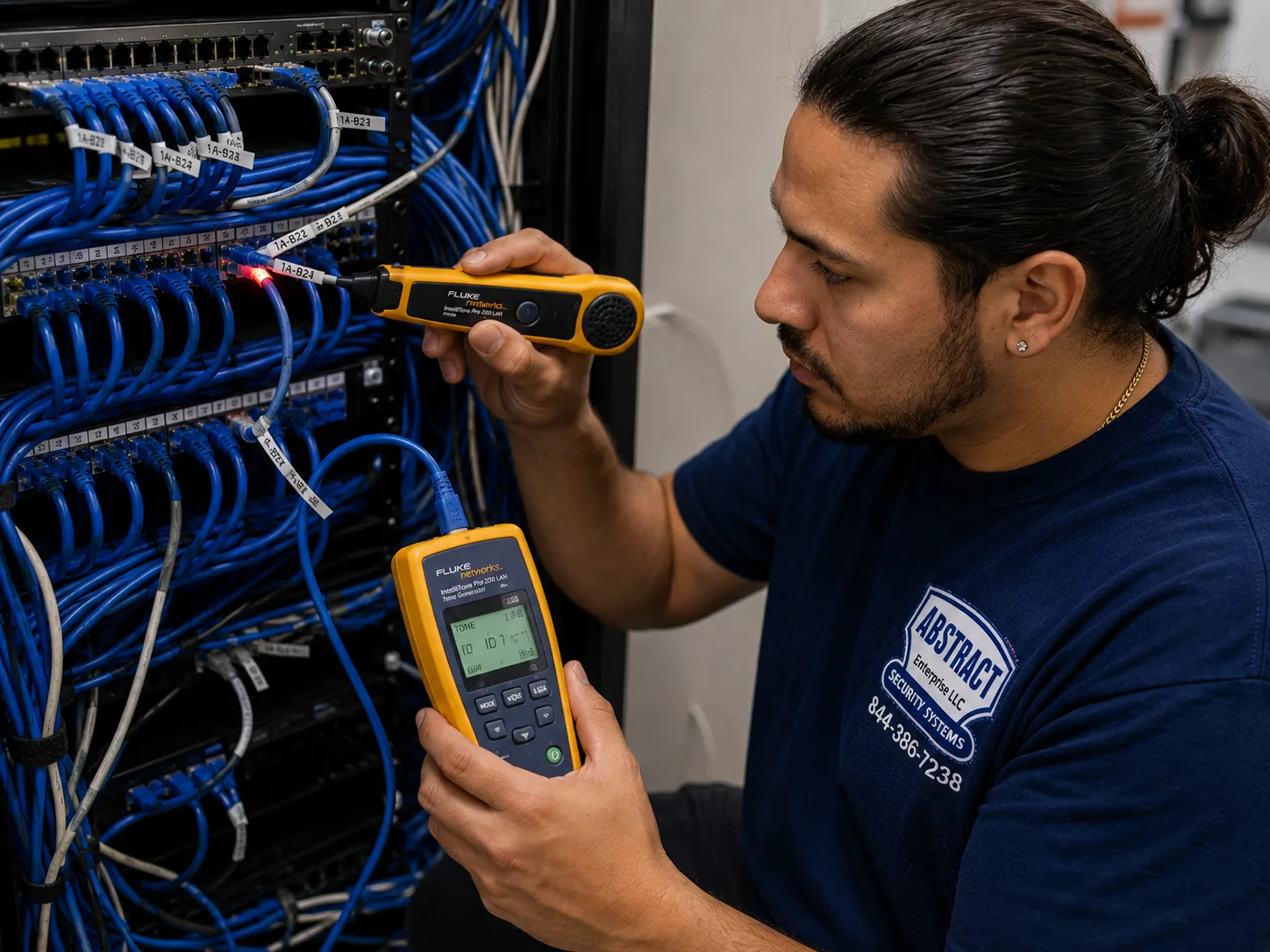
Photo from the AESS job library, not taken in the Hudson Valley: a technician tracing an unidentified cable at a patch panel with a tone generator and probe. In a pre-war Westchester or Dutchess house, the same tool helps find where the old doorbell wire actually goes, and which transformer feeds it, before a wired Nest Doorbell is connected to it.
Equipment
Types of Google Nest Camera Installation We Install
These are the Nest devices and supporting equipment we fit on Hudson Valley homes and businesses, with the local situations each one suits. You can buy the devices yourself and have us install them, or have us supply them; installed prices for each county are on the county price pages.
🔋
Nest Cam (Battery)
Indoor or outdoor, battery or wired. On its own battery it will not charge below freezing; on the weatherproof cable it becomes our default outdoor camera for houses lived in all winter.
📷
Nest Cam Outdoor (Wired)
A plug-in outdoor camera with no battery to manage, for eaves and garage walls where an outlet or a short cable run is close by.
🏠
Nest Cam Indoor (Wired)
For hallways, mudrooms, heated workshops and looking out through a window on a facade that should not be drilled.
💡
Nest Cam With Floodlight
For driveways and back doors, with the line-voltage connection by a county-licensed electrician and the light aimed to meet village lighting rules.
🔔
Nest Doorbell (Wired)
Google's recommendation where temperatures drop below 32°F, on a transformer of 16 to 24 volts AC and 10 to 40 VA, upgraded where an old chime transformer falls short.
🚪
Nest Doorbell (Battery)
For doors with no bell wiring, sheltered porches, and historic fronts where drilling for a wire is not wise; paired with the Indoor Power Adapter where Google allows.
🔧
Mounts and Weatherproof Cable
Google's mounts, third-party mounts with a standard 1/4"-20 thread where Google notes performance may be affected, and the weatherproof cable for battery cameras outdoors.
📶
Wi-Fi, Access Points and Backup
Mesh points, wired access points for barns and garages, battery backup for the router and modem, and surge protection on network gear.
Nest compared with ADT, Ring and SimpliSafe, and with a local installer
Option
What it is
What matters for a Hudson Valley house
Google Nest, self-installed
Google's cameras and doorbells, managed in the Google Home app, with video in Google's cloud
Fine on a modern wall with good Wi-Fi; harder on stone, brick, weak signal and winter batteries
ADT
A monitored security company; SafeHome reports ADT sells Nest cameras as part of its systems, installed or DIY
Brings an alarm and monitoring contract alongside the cameras; the wall and Wi-Fi problems are the same
Ring
Amazon's camera and doorbell line, with its own app and installation network
A separate ecosystem; worth comparing if you already use Alexa rather than Google
SimpliSafe
Self-install alarm kits with their own cameras
Built around its own alarm system rather than Google Home
Local licensed installer (AESS)
Installs the Nest devices you choose, plus the power, Wi-Fi and wall work around them
Reads the wall, measures the signal and plans winter power on site, under NYS license #12000287431
None of the national companies is wrong for everyone. The honest difference is that a camera system's reliability in this region is decided less by the brand than by whether the wall, the power and the Wi-Fi were planned for a Hudson Valley year. If you already live in Google Home, Nest is a sensible choice, and our job is to make it hold up through the winter.
Photo from the AESS job library, not taken in the Hudson Valley: a technician running cable into EMT conduit beside a telecom room in an industrial building. The river towns are full of brick and concrete former factories, Dia Beacon's 1929 Nabisco building among them, and in buildings of that kind cable for the access points behind a set of Nest Cams often runs in conduit like this along hard walls.
AI Overview Reality Check
What AI Gets Wrong About Google Nest Camera Installation in the Hudson Valley
We could not capture Google's AI Overview for this topic from our build environment, so we are not going to pretend to quote it. What follows are claims that appear again and again in quick online answers about Nest cameras, including cost guides on marketplaces such as Angi, HomeAdvisor and Fixr, set against what Google's own help pages and the Hudson Valley's buildings, weather and rules actually say. Those national guides are useful for a rough idea, but they are written for an average house in an average climate, not a stone colonial in Kingston in February.
"Battery Nest Cams work anywhere; just recharge them now and then."
This is the claim that causes the most January calls. It is true that a battery camera can go up anywhere in minutes, and true that it can be recharged. What the quick answers leave out is Google's own rule that between 32°F and -4°F the battery can power the device but will not charge.
In the Hudson Valley that rule matters for weeks at a time. A camera on a north wall in Ulster or Putnam can sit below freezing through a whole cold spell, slowly draining, and nothing you do with a charger outdoors will help until it warms. Bringing it inside to charge means a gap in coverage and a ladder trip in the ice.
The fix is wired power for any outdoor camera that needs to work all winter. Google says a wired Nest Cam (battery) can keep running down to -4°F as long as wired power is available. On a Hudson Valley house that is the difference between a camera that works year-round and one that works in summer.
"A solar panel solves the battery problem."
Many answers recommend the solar accessory as the cure for battery anxiety. It does help in long summer days. But Android Police, reporting Google's own explanation, noted that the solar panel only charges the battery and does not power the camera directly.
That means the panel runs straight into the cold-charging limit. Below freezing, the battery will not take the charge the panel is offering. Add the short days of a Hudson Valley December, a panel facing a wooded slope, and a coat of snow after a nor'easter, and the panel may contribute very little for weeks.
Solar is a sensible choice for a camera you can live without in deep winter, such as one on a seasonal dock. For a front door, a driveway or an empty second home, we use a wire.
"A Nest install takes fifteen minutes with the screws in the box."
On a vinyl-sided house with good Wi-Fi and a working doorbell circuit, a single Nest Cam really can go up quickly. That is the house most quick answers imagine. Stacker's Census figures put 28.0 percent of Westchester's homes at 1939 or earlier, and the river cities are built of brick and stone.
The anchors in the box are designed for wood and drywall, not fieldstone or century-old brick. The weatherproof cable, as a Google Nest Community user found, needs more than half an inch of clearance to get through a brick wall. An old bell transformer may need replacing before a wired doorbell works properly, and Google advises pairing each camera before mounting it so the QR code is still reachable.
OnTech, Google's preferred Nest installation partner, itself recommends planning for at least two hours. On a Hudson Valley property with several cameras, masonry and an outbuilding, plan for longer, and be suspicious of any quote that assumes every wall is drywall.
"Nest just needs an internet connection."
Technically true, and practically misleading. Nest cameras send their video to Google's cloud, so what matters is the upload speed at the property and whether the Wi-Fi reaches each camera. A line that streams films happily can struggle to upload several cameras at once.
Hudson Valley One quoted a local official saying that in most of Ulster the only available provider is Spectrum, and the Times Union described years of unreliable rural service before the state ConnectALL award for Verizon fiber to about 1,300 remote Ulster households and businesses. On farms and estates, the Wi-Fi often fades well before the barn.
Before we recommend Nest for a rural property, we test the upload at the house and the signal at every camera spot. If the answer is not good enough, we fix the network first or recommend a different kind of system, rather than mounting cameras that will drop offline.
"The Nest subscription is cheap and has not changed."
Older articles still describe Nest Aware at its old price. HomeCamCafe reported that Google raised Nest Aware pricing in August 2025 for both the Standard and Advanced tiers, and the service is now branded Google Home Premium.
The free tier is also thinner than many owners expect. Android Police described clips as stored for only three hours without a subscription. Security.org lists three hours of event video for the battery and floodlight cameras and six hours for the wired indoor and outdoor models. For a second home checked on Sunday evening, a three-hour history does not go back far enough to see what happened on Saturday.
We do not sell the subscription and it is not part of our price. We explain what each tier keeps before you buy cameras, so the running cost is a decision you make with your eyes open, and we check Google's current plan terms with you at the handover.
"You never need anyone's permission to put a camera on your own house."
For most Hudson Valley houses, that is close to right. For a facade inside a historic district, it is not something to assume. Newburgh's East End, with 2,239 resources, is the largest federally recognized historic district in the state, and Kingston has five local historic districts.
Kingston's commission reviews exterior changes and issues certificates of appropriateness before permits; Beacon requires a certificate from its Planning Board for permitted work that alters a historic feature; the City of Hudson issues no building permit for covered work until its commission approves. Newburgh's guidelines ask that security features not obscure architectural features or damage historic fabric. We found no rule that names a small camera explicitly, which is exactly why the honest answer is to check.
What we can control is the install itself: positions that avoid cornices and original trim, cable inside frames where possible, line hides painted to match as Kingston's commission recorded in 2025, and indoor cameras where they can do the same job.
"The Hudson Valley is just the suburbs; same rules and prices as New York City."
Online answers often lump the region in with the city. The rules alone show otherwise. Westchester requires electricians to hold a county trade license; Rockland licenses electrical work at 50 volts or more under Chapter 250; Orange licenses electricians under its own local laws, with a separate board in Middletown; Putnam has a low-voltage technician license under Chapter 145; Ulster has Chapter 185; and we found no county license in Dutchess, where towns such as Fishkill rely on independent inspection agencies.
The utilities differ too: Con Edison and NYSEG in Westchester, Orange & Rockland in the southwest, Central Hudson across the Mid-Hudson, and NYSEG again in much of Putnam. That decides who restores your power after a storm, and how long your cameras might be dark.
Prices follow the county as well. Our published rates run from 1.25 times the Brooklyn base in Westchester to 1.53 times in Dutchess and Ulster, reflecting longer drives and larger properties. Each county's lines are on its own price page, and we never quote a figure that is not on them.
Not Sure Which Nest Will Survive Your Winter? Talk It Through With a Technician
Send a photo of each wall, the distance from your router to the farthest camera spot, and the Nest models you have or want, and a technician will tell you which ones need wired power, whether your doorbell transformer is likely to be enough, and whether your Wi-Fi will reach. Call (800) 486-0943, message us on WhatsApp, or use the quick form.
Every Hudson Valley Nest job follows the same eight steps, whether it is one doorbell on a Rockland split-level or a doorbell and six cameras across a Dutchess farm. The order matters: on this kind of property, the problems that make a Nest system unreliable are usually decided before the first mount goes up.
1. Send photos, the county and the devices
Photos of each wall or eave, your street address and the Nest models you have or want. We match the job to your county's price page and flag any historic-district or village lighting rule before you book.
2. Check the Wi-Fi and the power
On arrival we measure Wi-Fi strength at every planned camera spot and decide how each device will get power through the winter: wired, weatherproof cable, transformer or battery.
3. Pair every device before mounting
Each camera and doorbell is added to your Google Home app on the bench, as Google advises, and the QR code stickers are photographed and handed to you.
4. Agree positions and angles
We hold each camera in place, check the live view on your phone with you, and agree angles that cover your ground without pointing into a neighbor's windows.
5. Mount and run power
Mounts go into wood, brick or stone with anchors that suit each material; cable passes through sealed openings or painted line hides; line-voltage connections are made by a county-licensed electrician.
6. Set zones, alerts, audio and privacy
Activity zones, person alerts, schedules and home and away modes are set with you, with audio off on cameras facing shared or public space unless you decide otherwise.
7. Test from the edges
We walk the driveway, path and yard while you watch the alerts arrive, and restart the router to confirm every device reconnects on its own.
8. Hand over the account and the winter plan
You keep full control of the Google account, the QR stickers and a written note of each device's location, power source and what to expect from any battery model in winter.
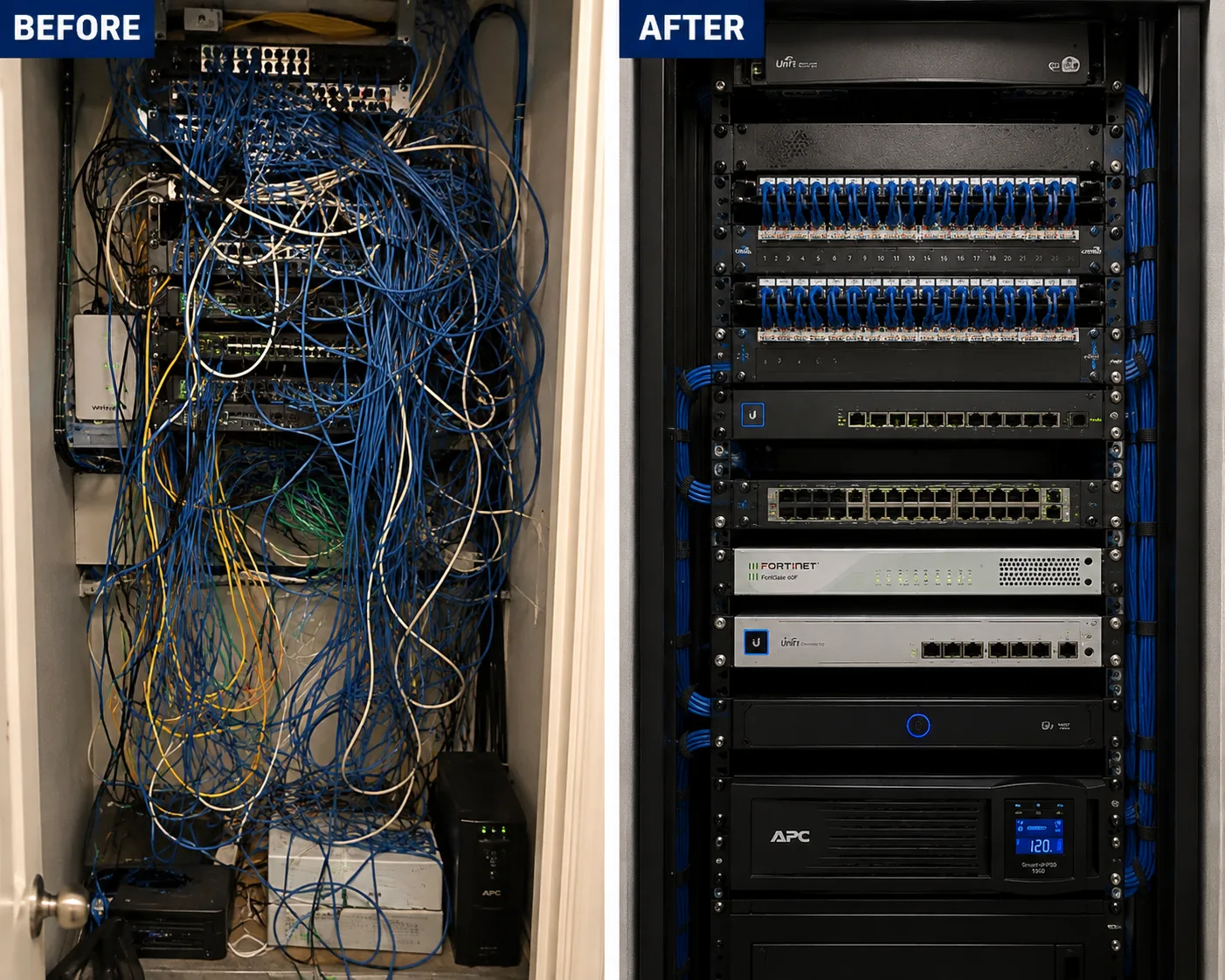
Photo from the AESS job library, not taken in the Hudson Valley: before and after views of a network rack, from a tangle of unlabeled cables to a dressed, labeled rebuild. When a Nest system keeps dropping offline in a small Hudson Valley office or a well-equipped second home, the cause is often a closet that looks like the left side of this photo, and step 2 of our process is where we find it.
Coverage Area
Google Nest Camera Installation Near the Hudson Valley's Landmarks
Across six counties, people give directions by the places everyone knows. These are the ones we use when we plan a route, with what our sources say about each.
Walkway Over the Hudson
Opened in 1888 as a rail bridge between Poughkeepsie and Highland, 212 feet tall and 1.28 miles long, described as the longest elevated pedestrian bridge.
Dia Beacon
A 1929 Nabisco box-printing factory of nearly 300,000 square feet in brick, steel, concrete and glass, now a museum in Beacon.
Kingston Stockade District
The mid-seventeenth-century Dutch settlement of Wiltwyck, a National Historic Landmark, with colonial stone houses on all four corners at Crown and John Streets.
Washington's Headquarters, Newburgh
The stone house where George Washington lived for over a year in 1782 and 1783, the nation's first publicly operated historic site, in the East End.
Storm King Art Center
A 500-acre outdoor museum at 1 Museum Road in New Windsor, Orange County.
Palisades Center
The large mall in West Nyack, Rockland County, at the heart of the county's Route 59 commercial corridor.
Google Nest Camera Installation Cost in the Hudson Valley
Every Hudson Valley Nest job is priced at the published rate for the county on your property's tax bill. The rates are set as a multiple of our Brooklyn base price list, which accounts for longer drives, larger properties and longer cable runs. We do not print a single regional number on this page, because a Nest Doorbell on a Rockland split-level and four wired cameras on a Dutchess farmhouse are not the same job; instead, every line for your county is on its own price page, so you can add up your job before you call.
A doorbell, a battery camera, a wired camera and a floodlight each take different work
The wall
Wood framing is quick; brick needs masonry anchors; old stone needs the most care
Winter power
Weatherproof cable runs, especially through masonry, add time but keep cameras running below freezing
Doorbell transformer
An old chime transformer that measures short may need replacing before a wired doorbell works properly
Wi-Fi reach
Barns, garages and boathouses may need an access point or a link before the camera
Line-voltage work
Floodlights and new outlets are done by a county-licensed electrician and shown separately
Historic-district care
Painted line hides, discreet positions and photos for the city where they are wanted
Google subscription
Not part of our price; Google bills it directly if you choose Google Home Premium
How to read the price page for your house
Open the price page for your county and start from the line for each device you want. Then add the lines that match your house: the wall material, any cable run, any transformer or network work. If your house is in a historic district or a village with a lighting law, note it in the quote form and we will tell you what that adds before you book. If anything on the day turns out different from your photos, such as stone where you expected wood, the technician shows you and names the line that applies before drilling.
Full terms — including 50% deposit, one-year parts-only warranty on AESS-supplied products, and the late-fee schedule — are set out in the service agreement.
Shop Our Systems
Google Nest Camera Installation Packages & Pricing
Three common Hudson Valley Nest jobs, described so you can find the matching lines on your county's price page. There is no package premium: each is simply the sum of its lines at your county's rate.
Starter: Front Door Covered
A wired Nest Doorbell on the existing bell circuit, with the transformer measured and replaced if it falls short, plus one Nest Cam on the weatherproof cable covering the driveway. Suits post-war houses in Rockland, Putnam and southern Westchester. See your county's page for each line, starting from the Hudson Valley Nest price page.
Standard: Four Sides of the House
Doorbell plus three or four outdoor Nest Cams, all on wired power for winter, with Wi-Fi measured at each and a mesh point added where needed, and the router and modem on battery backup. The usual job for a lived-in house anywhere in the six counties.
Premium: House, Barn and Distance
Doorbell, outdoor cameras on the house, a wired access point or wireless link out to a barn or garage, cameras on the outbuilding, and an electrician for a Nest Cam with Floodlight where the village rules allow it. For farms, estates and second homes watched from a distance.
Bring your own equipment
If you have already bought your Nest Doorbell, cameras, floodlight or mesh Wi-Fi, we install them at labor-only lines from your county's price page. We check that the devices are the right models for where you want them, especially in winter: if you have bought a battery doorbell for a north-facing door on a cold hill, or a battery camera for a barn with no power, we will tell you before mounting it so you can decide whether to exchange it. You keep the boxes, the receipts and the warranty relationship with Google for the devices themselves; our work on your walls and wiring is covered by our own terms above.
Complete Services
Every Google Nest Camera Installation Service in the Hudson Valley
Do you only install Nest cameras, or other brands too?
+
We install other camera and doorbell brands as well, including recorder-based systems that keep video on site. This page is about Nest because many Hudson Valley owners already use Google Home. If another kind of system would serve your property better, for example a rural house with a slow upload or a business that needs weeks of footage, we will say so before you buy anything.
Can you install Nest cameras at a rural Dutchess or Ulster property far off the main roads?
+
Yes. We cover all six Hudson Valley counties, including back roads and hill properties, priced at each county's published rate. For distant properties, photos of each wall and a speed test from the house help us plan the visit so the right equipment is in the van the first time.
How long does a Nest installation take once you are on site?
+
It depends on the number of devices and the walls. Google's preferred installation partner suggests planning for at least two hours for a Nest device install. A doorbell and one camera on a framed house can be quick; several wired cameras on brick or stone, a transformer change and Wi-Fi work out to a barn take most of a day. We give you an estimate when we quote.
What should we have ready before the technician arrives?
+
Your Google account login and Google Home app on your phone, the Wi-Fi network name and password, the Nest devices still in their boxes with their QR code stickers, and access to the router, the doorbell chime and the basement or wherever the bell transformer sits. Google says to keep the QR code sticker for future setup and troubleshooting, so please do not throw the packaging away.
Can indoor and outdoor Nest Cams be done in the same visit?
+
Yes. Most visits combine a doorbell, outdoor cameras and one or two indoor cameras, all added to the same home in your Google Home app. Tell us every device when booking so we bring the right mounts, cable and anchors for each wall.
Will our Nest cameras keep any video if we never pay Google for a subscription?
+
Yes, but not much. Android Police described clips as stored for only three hours without a subscription, and Security.org lists three hours of event video for the battery and floodlight cameras and six hours for the wired indoor and outdoor models. Live view still works. For a house you check from a distance, that short history is often too short, so decide about Google Home Premium before you rely on the cameras.
Is Nest still worth buying for a Hudson Valley home if we skip the subscription?
+
It can be, if what you want is live view and alerts on your phone and you are usually close enough to act on them. It is a weaker choice for a second home or rental where you need to look back over a weekend. Google raised its plan prices in August 2025 and renamed the service Google Home Premium, so compare the current terms with your needs before choosing the hardware.
Can we watch our upstate cameras from our apartment in the city?
+
Yes. Nest cameras live in the Google Home app, so you can see the live view and alerts from anywhere your phone has a connection, as long as the house has power and internet. We set up the cameras under your account, add a caretaker or family member if you want, and show you how the app tells you a camera has gone offline.
Can you fix a Nest system another installer put in?
+
Yes. Common problems are cameras dropping offline after a router change, a wired doorbell rebooting on an undersized transformer, battery cameras dying every winter, and cameras added to someone else's account. We find the cause first, and if it is the internet provider or the power rather than the cameras, we tell you before doing work you do not need.
Can a Nest Cam go on a post, a fence or a third-party bracket instead of the house?
+
Often. Google says Nest Cams can use any third-party mount with a standard 1/4 inch-20 thread, though it may affect the camera's performance. A post at the end of a driveway or a beam inside a barn works if the Wi-Fi reaches it and there is a way to power it through the winter, which is what we check before mounting.
What happens to our Nest cameras when the power goes out in a storm?
+
Battery cameras can keep running on their batteries for a time, but they still need the router and modem to send video, and those stop when the power does unless they are on a battery backup. With a small backup on the router and modem, cameras keep reporting through a short outage. In a long outage like the ones Central Hudson customers saw in July 2026, they will eventually go offline until power returns.
Can the wires be hidden so nothing hangs down the siding or the brick?
+
Yes, that is part of the job. On framed houses the cable usually passes straight through behind the camera to the inside. On brick and stone we drill one sealed opening sized for the connector, or run the cable in a slim line hide painted to match the wall. Loose cable stapled across a facade is not something we leave behind.
Get In Touch
Request a Free Quote
Tell us the county, the town and road, the type of house, which Nest devices you have or want and what the walls are made of if you know. A photo of each wall and the distance from your router make the quote exact. Prefer to talk? Call (800) 486-0943.
✅
Request Sent!
We'll get back to you within 2 hours to book your Hudson Valley Nest install.
More Google Nest Camera Installation near Hudson Valley hub
Book Your Hudson Valley Google Nest Camera Installation
From a stone house in Kingston's Stockade to a brick rowhouse in Newburgh, a split-level in Rockland, a lake house in Putnam or a farmhouse and barn in Dutchess, the job starts the same way: photos of the walls, the distance from the router, the Nest devices you want, and an honest plan for how each one will be powered through a Hudson Valley winter. Call (800) 486-0943, message us on WhatsApp, or send the quote form, and we will book you within 2 hours and tell you exactly what your property needs before anyone drills.