What are you looking for?
About Us Contact Us Careers Get a Free Quote (800) 486-0943
Pick a service
โœ… Got Your Own System?
๐ŸŽฌ Home TheatreQuote ๐ŸŽถ AV SoundQuote ๐Ÿ”‘ Access ControlQuote
Now pick your area
Pick your area
Long Island
Hudson Valley
Services available
Pricing & Tools
Pick a service for pricing
๐Ÿšช Intercom Pricing ๐Ÿ”” Buzzer Repair Pricing
Calculators
๐Ÿ“น Camera System Calculator ๐Ÿšจ Alarm Calculator โšก Cabling Quote Builder โœ… Got Your Own System?
Select your area
Package gone from the lobby, a doorbell camera knocked off the frame, or a First Alert camera that stopped showing up in the app? Book a First Alert camera visit anywhere in the five boroughs: (800) 486-0943
Home › First Alert Camera Installation › New York City
Brownstones · Walk-Up Tenements · Elevator Co-ops · Garden Apartments · Storefronts on BID Corridors · NYS Licensed

First Alert Camera
Installation in
NYC

See every First Alert camera price in NYC and build your own system →

Permissions Checked Before Drilling · PoE, AC or Wi-Fi Chosen for Your Walls · Audio and Privacy Set to New York Law

First Alert camera installation in New York City is rarely a matter of screwing a camera to a wall. The First Alert VX Series is Resideo's professionally installed video line, built to run on AC power, Ethernet, Wi-Fi or PoE and to tie into ProSeries and VISTA alarm panels, and the city it goes into is mostly old masonry: the 2023 Housing and Vacancy Survey puts 54 percent of the city's homes in buildings finished before 1947. A video doorbell on a Park Slope-style brownstone stoop, an indoor camera in a fifth-floor walk-up, and a set of lobby cameras in a hundred-unit co-op each need a different power plan, a different person's permission and, on a landmarked block, sometimes a different agency's sign-off. We work out which of those applies to your building before anyone drills, then install, enroll and test the cameras so they work on your phone the day we leave.

Reviewed and updated November 5, 2026 by Anwar Timothy, NYS license #12000287431 · Sources: Resideo's VX Series professional page, FirstAlert.com's home security page, Resideo SEC filings (the February 7, 2022 First Alert acquisition announcement and the 2025 annual report), ADI Global's spin-off notice, the Apple App Store listing and First Alert support pages for the Onelink Home app, Trunetto's Onelink Wi-Fi guide, the NYC Business licensing page for the NYS Department of State alarm installer license, Kirschenbaum Esq. on 19 NYCRR 195.2, ButterflyMX, City Smart Systems, UpCodes on Admin Code §28-105.4.7, the LPC 2018 rules amendments and Permit Guidebook Chapter 11, HPD's FY24 and FY25 self-closing door reports, HPD's tenant data privacy page, Thomson Reuters Practical Law, CaseGuard and Hinshaw & Culbertson on Local Law 63 of 2021, the Reporters Committee for Freedom of the Press, Connextivity, JustAnswer, AskALawyerOnCall, NYC 311 and NewYorkCityConnect, the NY Attorney General, Security.org's package theft report, Spectrum News, News 12, 6sqft, the 2023 NYC Housing and Vacancy Survey, CHPC, the NYC SBS business improvement district directory and NY1 · Dispatched from 1282 Troy Ave, Brooklyn

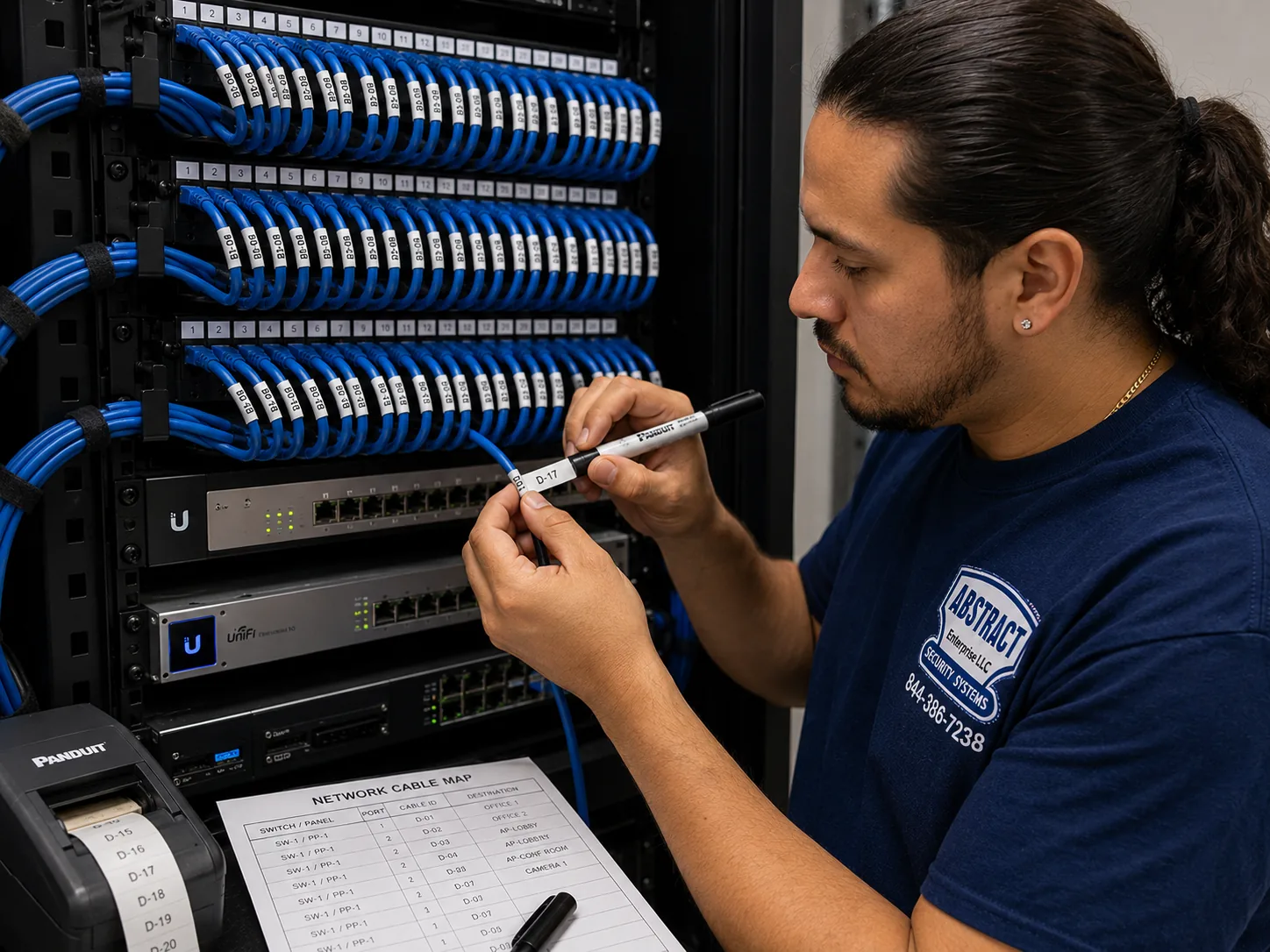
NYC hub, NYC First Alert camera installation job-library photo: technician printing cable labels at a patch panel beside a printed port map
Photo from the AESS job library, not taken at a First Alert job in New York City: a technician printing cable labels at a patch panel, with a printed port map beside him. When First Alert VX cameras run on PoE in a city apartment building, every camera's cable comes back to a panel like this, and a label on each port is what lets a super or the next technician find the lobby camera without unplugging the elevator camera by mistake.
NYC First Alert Camera Quote
Tell us the borough, the building type and what you want the cameras to watch

✅
Request Sent!
We'll call about your First Alert cameras within two hours during business hours.
25+
Years Experience
✓
Same-Day Estimates
100%
Licensed & Insured
4.7โ˜…
201 Google Reviews
Owner-operated since 2002 · Thousands of jobs completed · Booked within 2 hours

Quick answer: a First Alert camera installation in NYC is priced by borough, by how the cameras get power, and by how far the cable has to travel through brick, plaster and floors; our borough price pages list every line. A single Wi-Fi indoor camera in a rental is a short visit. A video doorbell on a brownstone, or PoE cameras pulled up a riser to a lobby, a package room and a rear yard, takes longer and costs more. We book the visit within two hours of your request, confirm who has to approve the work, and quote from the price page for your borough, not from a national average. Call (800) 486-0943 or see the First Alert camera installation prices for NYC.

  • Borough rates follow one base: Brooklyn and the Bronx at the base, Queens slightly above, Staten Island above that, Manhattan highest because of access and parking
  • Permission is settled first: landlord, co-op or condo board, and the Landmarks Preservation Commission where a facade is landmarked
  • Low-voltage work done under NYS license #12000287431; any new outlet or line-voltage circuit is left to a licensed electrician and named on the quote
The Neighborhood

Why NYC Properties Need First Alert Camera Installation

New York City is a city of shared doors, and that is the first thing a camera plan here has to deal with. The 2023 New York City Housing and Vacancy Survey counted about 3.7 million homes, roughly two-thirds of them rentals, and about one million of them rent stabilized. The same survey found 829,200 units, 22 percent of the city's housing, in buildings with 100 or more apartments. In a place like that, the door you want to watch is usually not yours alone. The lobby belongs to the owner, the hallway outside your apartment is common space, the stoop of a brownstone may be shared with the tenant upstairs, and the sidewalk in front of a store is public. A First Alert camera bought with the best intentions can end up on the wrong side of a lease, a board rule or a landmark regulation if nobody asks those questions first. That is why our first conversation with a New York caller is about who controls the wall, and only then about which camera.

The second thing is age. The survey's initial findings put 2,017,000 units, 54 percent of the city's housing, in buildings built before 1947, and another 960,200, about 26 percent, in buildings from 1947 to 1974, so four homes in five are in buildings older than the early 1970s. The Citizens Housing and Planning Council describes a housing stock that "ranges from mansions in Riverdale to small homes in Midland Beach, garden apartments in Sunnyside to high-rises near Central Park, brownstones to tenements." Almost none of those buildings were designed with a camera in mind. Tenements went up fast between 1860 and 1910, according to the Architectural League, on lots usually twenty-five feet wide, with brick party walls and narrow stairs. Pre-war elevator houses have thick plaster, steel and masonry floors and riser closets packed with decades of telephone, cable and intercom wire. When a First Alert camera needs power or a network cable, every one of those materials changes the job.

The third thing is the product itself. First Alert is a name most New Yorkers know from smoke detectors, but the cameras sold under that name today are part of the First Alert VX Series, which Resideo describes as its AI video line built to work with its smart home products, covering a video doorbell and indoor and outdoor cameras. Resideo's professional page says installers can power them with AC, Ethernet, Wi-Fi or PoE and that they integrate with ProSeries and VISTA alarm panels. FirstAlert.com presents its systems as professionally installed, with cameras, video doorbells and monitoring, and points shoppers to a local expert. In other words, this is a dealer-installed line, not a box you pick up at the hardware store and stick to a window. The choice between Wi-Fi, PoE and AC power, and how the cameras talk to an alarm panel you may already own, is exactly the part an installer is for.

The fourth thing is what people are actually trying to stop. Security.org's annual package theft report found apartment residents more than three times as likely as single-family residents to have had a package stolen in the previous three months, 10 percent against 3 percent, and noted that, depending on landlord rules, apartment residents may not be allowed to put doorbell or security cameras outside their units. The New York Attorney General's package theft tips recommend a doorbell camera or video surveillance system to deter thieves or help police identify them. Local reporting shows what that looks like on the ground. News 12 reported in December 2025 on a Morris Park resident whose package sat outside for seconds before a thief took it, all caught on his camera, and the same report mentioned a State Assembly bill that would make package theft a felony punishable by up to five years. CBS New York covered thieves cutting open packages inside a Park Slope lobby. A delivery company's blog summarized Reddit accounts of an Astoria package taken within thirty minutes of delivery and a Williamsburg resident whose footage pointed at the delivery staff. These are the moments a camera is bought for.

The fifth thing is the law around privacy, which in New York is unusually specific. New York makes it a felony to record an in-person conversation you are not part of without the consent of at least one person in it, according to the Reporters Committee for Freedom of the Press, and Connextivity notes that nobody has cleanly settled whether a camera passively picking up hallway audio counts as eavesdropping, which is why audio is usually left off. The city's Tenant Data Privacy Act, Local Law 63 of 2021, puts rules on smart access systems in apartment buildings, and its definition of authentication data, as CaseGuard explains it, leaves out footage from a camera that watches an entrance without granting entry. The Landmarks Preservation Commission protects 1,460 individual landmarks, 121 interior landmarks and 12 scenic landmarks, and its rules govern cameras on landmarked facades. A good First Alert installation in this city is one that does its job and also keeps the owner, the tenant and the board out of trouble.

The last thing is tension between neighbors, which cameras can ease or inflame. In 2019 tenants at Atlantic Plaza Towers, a 700-unit rent-stabilized complex of two brick high-rises in Brownsville, objected when the owner sought state approval for a facial-recognition entry system; the Guardian noted that the buildings already had cameras watching the grounds, doorways, elevators and halls. More recently, a West Village tenant was arrested for allegedly smashing a neighbor's doorbell camera. We take both stories as a reminder that where a lens points matters as much as what it records. When we place a First Alert camera, we show the owner exactly what it sees, we use privacy zones where the hardware supports them, and we steer away from views into a neighbor's door or window.

We also want to be clear about what our research did not turn up. We could not open live Reddit threads, Google's People Also Ask boxes, AnswerThePublic or Yelp reviews about First Alert installers specifically in New York City from our build environment, and we found no city data set of 311 complaints, HPD violations or DOB permits about cameras. Where this page talks about problems in New York buildings, it relies on the published sources named in the stamp above and on the kinds of walls, risers and doors we find in buildings of these ages generally. It does not claim a survey of your building. That is what the site visit is for.

New York City facts that shape a First Alert camera job

  • Old buildings: 54 percent of units are in buildings finished before 1947 and about four in five predate 1974, according to the 2023 Housing and Vacancy Survey.
  • Mostly renters: about two-thirds of the city's roughly 3.7 million homes are rentals, so a landlord's or board's consent decides much of what can be mounted and drilled.
  • Small buildings count too: one- and two-family buildings hold 26 percent of the city's units, more than any other building size, and those are the homes where an owner can usually wire a doorbell and outdoor cameras freely.
  • Big buildings concentrate risk: 829,200 units sit in buildings of 100 or more apartments, where one lobby, one mailroom and one package shelf serve hundreds of households.
  • Doors are regulated: HPD's self-closing door report for fiscal 2025 counted 2,937 self-closing door violations, so anything fixed to an apartment door or frame must leave the closer alone.
  • Landmarks are everywhere: more than 35,000 landmarked properties sit in 139 historic districts, by one architect's count, and most exterior changes there need LPC review.

What New York owners often pair with cameras. Once a First Alert doorbell or lobby camera is in, the next request in multi-family buildings is usually the entry system itself: a buzzer or intercom that actually works, because a camera that shows a stranger at the door is only half useful if the tenant upstairs cannot speak to them or refuse entry. In houses, owners often add the alarm panel side of First Alert, since the cameras are designed to work with ProSeries and VISTA panels. Tell us at booking if either is on your list so one visit covers the cable routes for both.

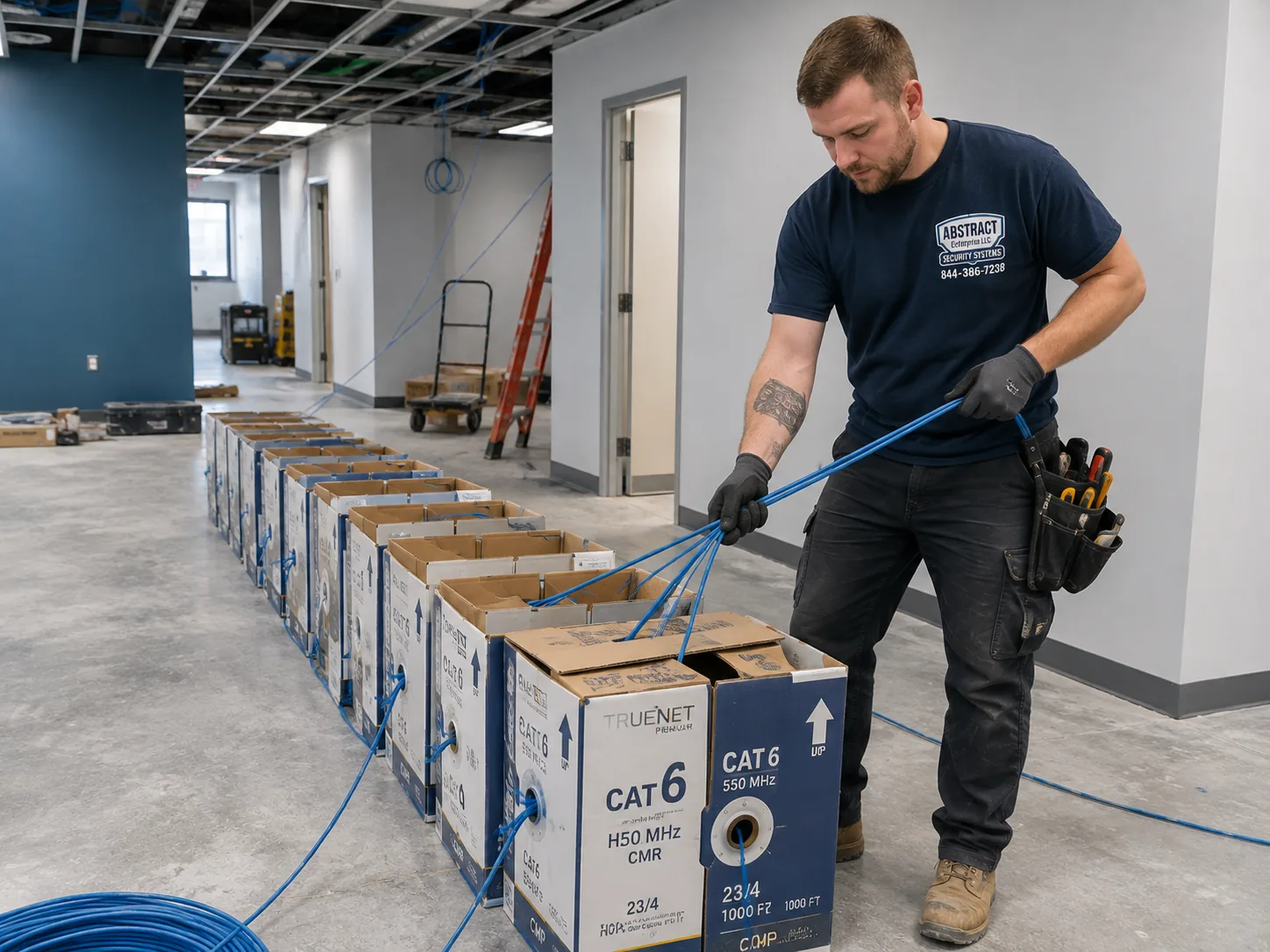
NYC hub, NYC First Alert camera installation job-library photo: boxes of network cable staged on the floor for a multi-drop pull in a working premises
Photo from the AESS job library, not taken at a First Alert job in New York City: boxes of network cable staged for a multi-drop pull inside a premises that stays open while the work goes on. In a walk-up or elevator building where lobby, hallway and rear-yard First Alert cameras all run on PoE, several cables are pulled at once like this, so the riser or ceiling is opened one time instead of once per camera.

Doorbell Smashed, Camera Offline or a Clip Needed Fast? Help Across the Five Boroughs

A camera that went dark the night a package disappeared, a doorbell pulled off its mount, or a lobby camera that has been showing a frozen picture for a week are the calls we move on first, because every hour the camera is down is an hour nothing is recorded. Before you call, do two things. Do not reset the camera or delete the app, because recordings already saved can vanish with a factory reset. And write down the time and date of whatever happened, so we can look for the right clip first. Then call (800) 486-0943 and tell us the borough, the building type and what the camera is plugged into. If police are involved, it helps to know that registering a camera with the NYPD does not hand them a live feed; it only tells investigators a camera exists so they can ask you for footage, which you control.

The Product

The First Alert Name in 2026: Smoke Alarms, VX Cameras and the Company Behind Both

Many people who call us about First Alert cameras are surprised by how the brand is put together, and the confusion causes real setup problems, so it is worth a few paragraphs. The short version: First Alert is now a Resideo brand. Its camera line is the VX Series. Its older smart smoke and carbon monoxide products run on a separate app called Onelink. Knowing which one you have, and who installed it, saves a lot of time on the day.

Who owns First Alert now

Resideo announced on February 7, 2022 that it had agreed to buy First Alert from Newell Brands, according to the press release Resideo filed with the Securities and Exchange Commission. Resideo describes itself as working with about 100,000 professional installers and taking part in more than 15 million installations a year, and it lists Honeywell Home, First Alert and BRK among its brands. On July 30, 2025, Resideo announced that it planned to spin off its distribution arm, ADI Global Distribution, as a separate public company while keeping the products business. We could not confirm from our sources whether that spin-off has been completed, so we do not say either way. For a New York customer, the practical point is that First Alert cameras, Honeywell Home thermostats and the VISTA and ProSeries alarm panels sit inside the same company, which is why the cameras are designed to talk to those panels.

What the VX Series includes

Resideo's professional page describes the VX Series as AI video built to work with its smart home products, made up of a video doorbell plus indoor and outdoor cameras. It names four power and connection options for installers: AC, Ethernet, Wi-Fi and PoE. For the VX5 indoor camera, it lists a 2-megapixel sensor with wide dynamic range, the ability to tell people from pets, and an automatic privacy shutter. We repeat only what Resideo publishes and do not add specifications for models we have not seen documented. Before we quote, we confirm the exact model you want, whether we can supply it or install hardware you already own, and how it will be powered in your building.

Onelink is not the camera app

The Onelink Home app by First Alert and BRK is the app for Onelink smart smoke and carbon monoxide alarms and the Onelink Environment Monitor, according to First Alert's support pages. On the Apple App Store it carried a 1.5-star rating from 306 reviews when our research was done. It is not the app for VX cameras. We have seen people search for help with "the First Alert app" and land on Onelink troubleshooting when their real problem is a camera, and the other way round. If you are not sure which you have, send us a photo of the device and the app's icon and we will tell you before we book.

Connection option (per Resideo)What it needsWhere it tends to fit in New York
Wi-FiA strong, stable signal at the camera spot and a power sourceInside apartments near the router; rentals where drilling must be kept to a minimum
AC powerAn outlet or supply close to the cameraIndoor cameras on a shelf or wall near an outlet; storefront interiors
EthernetA network cable run from the camera to a router or switchBrownstones and houses where a cable can follow a basement or closet path
PoE (Power over Ethernet)One network cable carrying both power and data from a PoE switch or injectorLobbies, package rooms, rear yards, roofs and storefronts where Wi-Fi is weak or easy to disrupt
Alarm panel integrationA compatible ProSeries or VISTA panelHomes and businesses that already have a Honeywell or Resideo alarm

Why the power choice matters more here than in the suburbs

In a suburban house with drywall and a garage, Wi-Fi cameras are often the simplest answer. In a city apartment building, the same choice can be fragile. Masonry walls and steel-and-arch floors weaken Wi-Fi, dozens of neighboring networks crowd the same channels, and New York authorities warned in December 2025, as Spectrum News reported, that some package thieves use Wi-Fi jammers to disrupt doorbell camera footage. A camera that loses its connection at the moment it is needed is worse than no camera, because you think you are covered. That is why, for anything watching a lobby door, a package shelf or a storefront, we lean toward PoE where the building allows a cable, and reserve Wi-Fi for indoor spots close to the router or for renters who cannot drill. We will explain the trade-off for your building plainly rather than defaulting to the cheapest option.

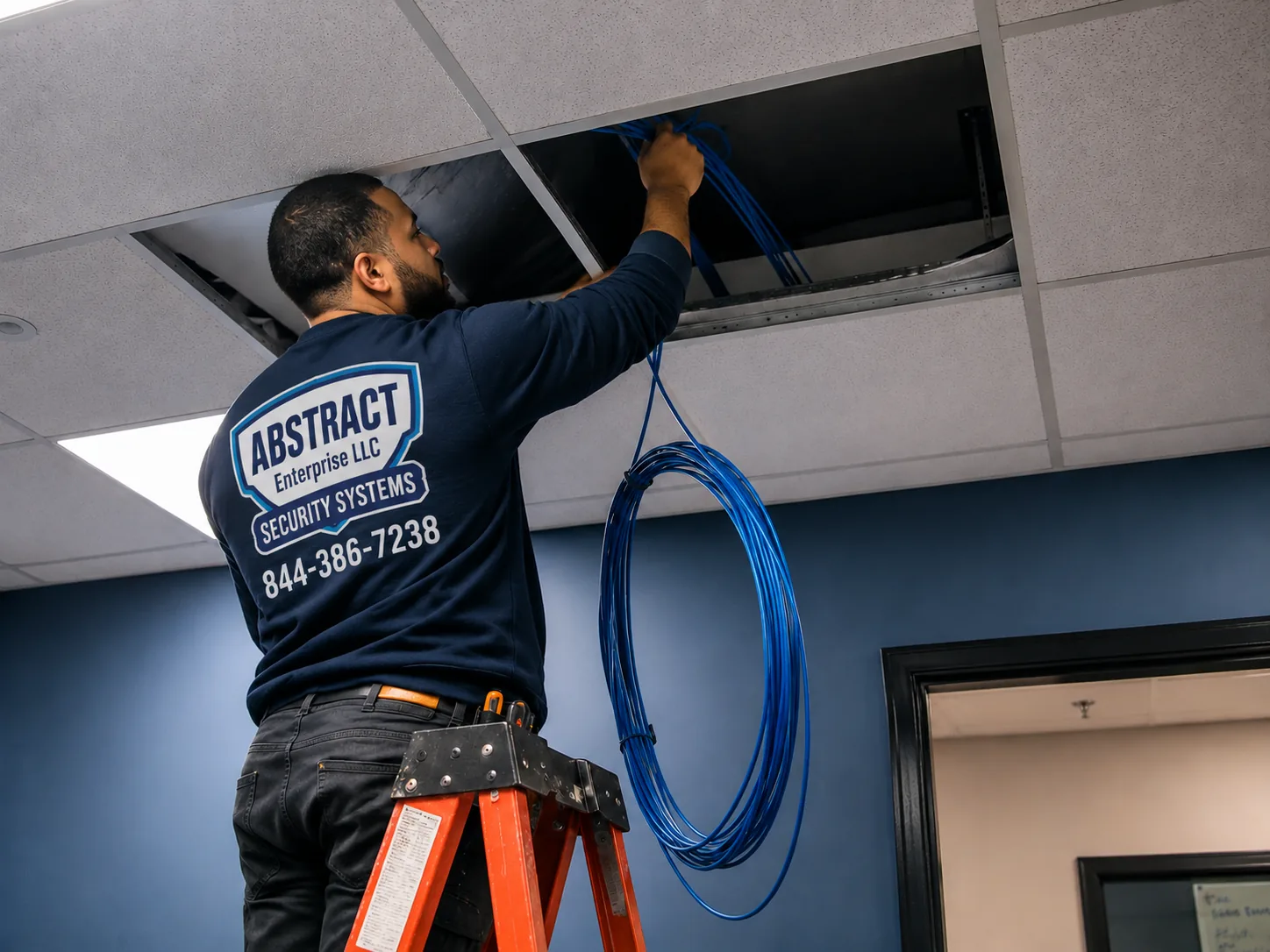
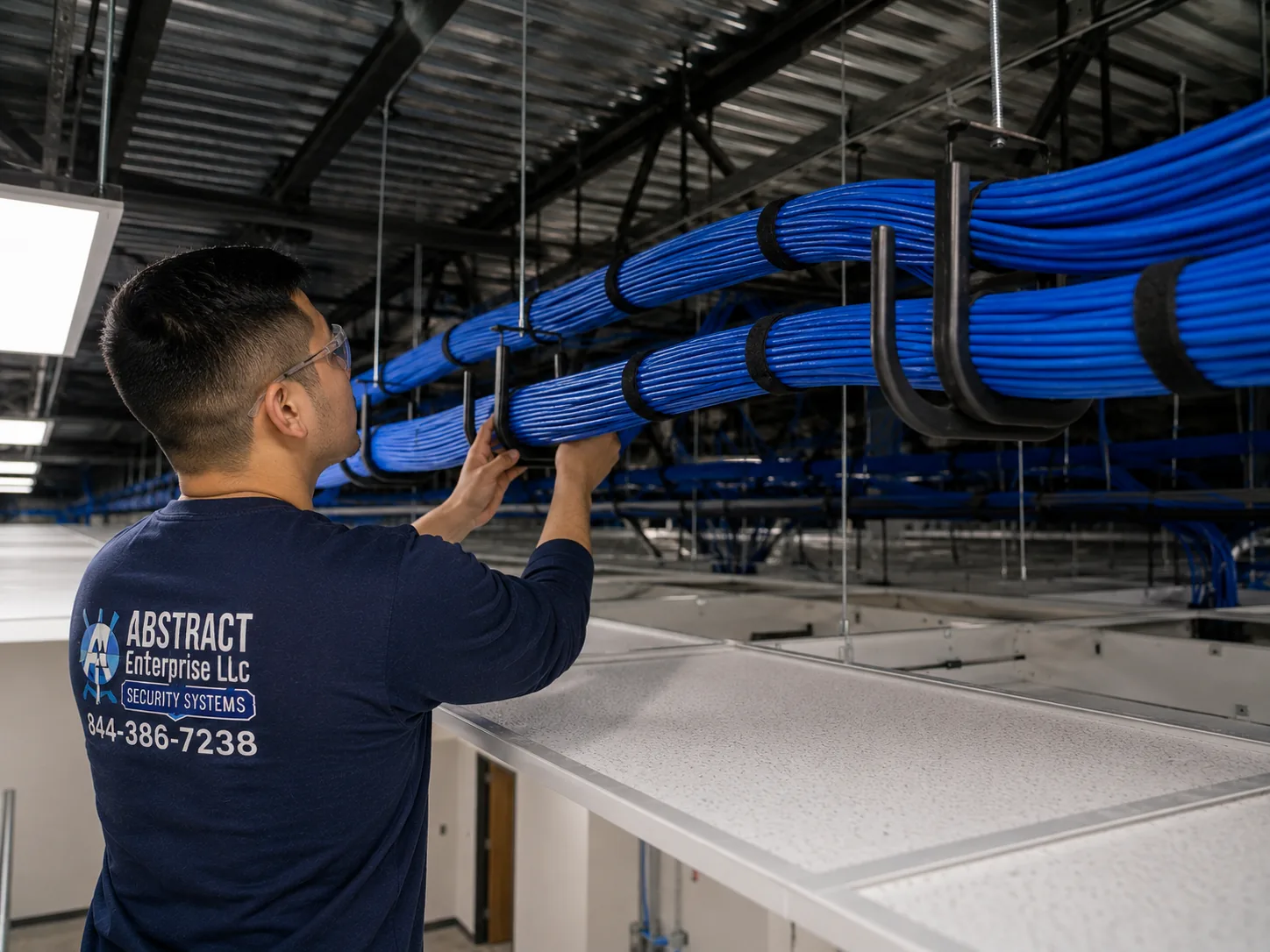
NYC hub, NYC First Alert camera installation job-library photo: technician feeding cable up through a ceiling in an occupied commercial space
Photo from the AESS job library, not taken at a First Alert job in New York City: a technician feeding cable up through the ceiling of a commercial space that is open around him. In a city store or office, the drop ceiling is usually the cleanest route for a PoE cable to reach a First Alert camera over the door, and the work is planned around the hours the space is in use.
Before You Book

Lease, Board, Landmark, Wi-Fi: Five Things to Sort Out Before a First Alert Camera Goes Up

Most delays on a New York camera job happen before the first hole: a board that wants paperwork nobody sent, a landmarked facade that needs a permit, a Wi-Fi signal that is strong in the living room and useless at the front door, or a super who did not know anyone was coming. A few minutes of checking prevents almost all of it. Please do not drill into common areas or the outside of a building you do not own while you check; just look, ask and send us what you find.

What to checkWhy it matters in the cityWhat to send us
Who owns the wall or doorHallways, lobbies, stoops and facades are usually controlled by the landlord or board, not the tenantWhether you own, rent, or hold co-op shares, and the managing agent's name
Your lease or house rulesMany leases bar drilling without written consent; some co-ops have written camera policiesA photo of any clause about alterations, drilling or cameras
Landmark statusMost exterior changes in historic districts need LPC review; 311 can tell you a building's statusThe building's address so we can check, or the LPC answer if you have it
Wi-Fi at each camera spotMasonry and crowded channels weaken signal; a camera that drops out records nothingA phone speed test or signal bars standing where each camera would go
Existing cableGood existing coax or network cable can cut labor a lot, per a city installer's cost guidePhotos of old camera, intercom or cable jacks near the door
An existing alarm panelVX cameras integrate with ProSeries and VISTA panelsA photo of the keypad and, if you can open it safely, the panel's label
Access on the daySupers, service elevators and loading rules vary; The Cooperator notes some buildings want elevator bookings 48 hours aheadThe super's number and any building hours for contractors

Decide what the camera is for

The most useful thing you can tell us is the job you want the camera to do. "Catch the face of whoever takes packages off the lobby shelf" needs a camera at face height, close to the shelf, with light on the face, which may mean a different spot from "see who rings the bell." "Know when the kids get home" is an indoor camera aimed at the entry, with the privacy shutter set for the hours you are home. "Watch the register and the front door of the store" is two views, not one. When we know the job, we can tell you whether one First Alert camera does it or whether you need two, and we can say so honestly before you spend money on the wrong position.

Think about what the lens will see that is not yours

A camera on a brownstone stoop also sees the sidewalk. A camera at the end of a hallway also sees the neighbor's door opening. A camera in a shared backyard sees the tenant downstairs having dinner. Connextivity's guidance is that hallway cameras are on firmer ground when positioned to cover corridor traffic without seeing into apartments as doors open, and that a camera installed covertly inside a unit can support a felony charge under Penal Law 250.45. We aim to cover your door, your packages and your space, and we will suggest a narrower angle, a privacy zone or a different spot when a view reaches somewhere it should not.

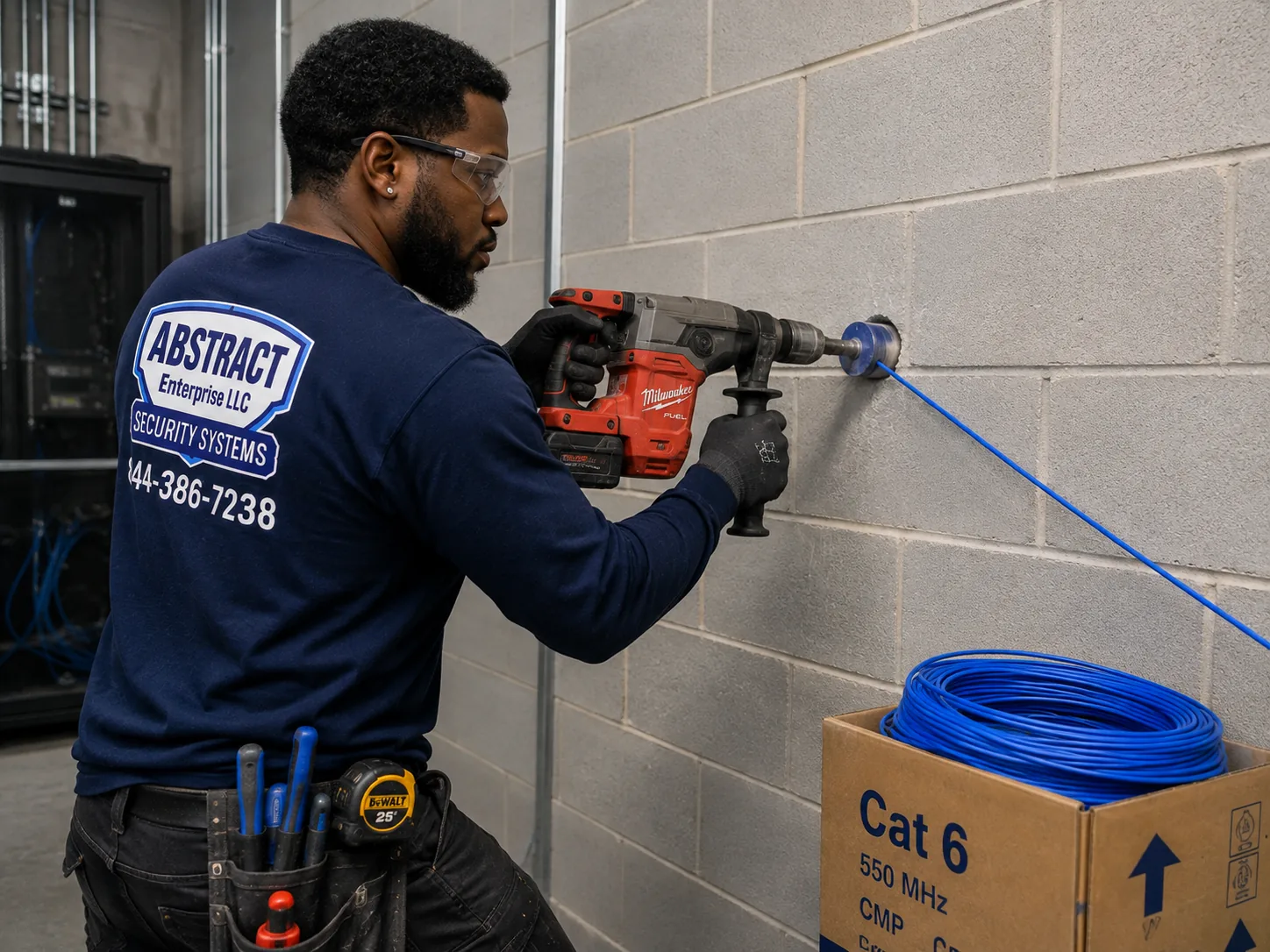
NYC hub, NYC First Alert camera installation job-library photo: technician core drilling a block wall to carry cable through to a network room
Photo from the AESS job library, not taken at a First Alert job in New York City: a technician core drilling a block wall so cable can pass through to a network room. Pre-war city buildings put brick and block between almost every camera position and the switch that powers it, and a clean, sized penetration like this, sealed afterward, is how a PoE cable gets from a basement network closet to a rear-yard First Alert camera.
What We Install

First Alert Camera Installation Services in NYC

These are the First Alert camera jobs New York owners, tenants, boards and businesses book us for. Each is priced from the price page for your borough. Where a job needs something extra, such as a core-drilled masonry penetration, a new outlet from an electrician, or LPC paperwork, the quote names it before you agree.

🔔

Video Doorbells on Houses and Brownstones

First Alert video doorbells on rowhouse stoops, two-family porches and Staten Island and Queens house fronts, with power planned around whatever bell wiring, if any, a century-old house still has.

🏠

Indoor Cameras for Apartments

VX indoor cameras placed on shelves or walls inside rentals, co-ops and condos, aimed at the entry, set up so the automatic privacy shutter and people-versus-pet alerts work the way you expect.

📹

Outdoor Cameras on Yards, Alleys and Roofs

Weather-sealed outdoor cameras covering rear yards, side alleys, areaways and roof doors, fixed into brick, stone or wood with anchors chosen after test holes.

📦

Lobby and Package Room Coverage

Cameras on lobby doors, mailboxes and package shelves in walk-ups and elevator buildings, wired on PoE through risers or drop ceilings, with views that cover traffic without looking into apartments.

🔌

PoE Cable Runs Through Old Buildings

Network cable pulled through riser closets, conduit, basements and ceilings, labeled at both ends, with penetrations through rated walls sealed after the pull.

🚨

Alarm Panel Tie-Ins

First Alert cameras added alongside an existing VISTA or ProSeries alarm panel, so camera events and alarm events reach the same people.

🏪

Storefront and Office Cameras

Cameras over registers, front doors and stockrooms on the city's business corridors, mounted behind or beside roll-down gates and scheduled for the hours the shop is closed.

🏛

Landmark-Sensitive Installs

Camera positions planned around LPC rules on landmarked buildings, keeping hardware small, off primary facades where possible and away from significant architectural features.

🔧

Reconnects, Moves and Repairs

First Alert cameras that dropped off the network after a router change, need moving to a better spot, or were damaged, diagnosed and brought back, with any wiring faults traced first.

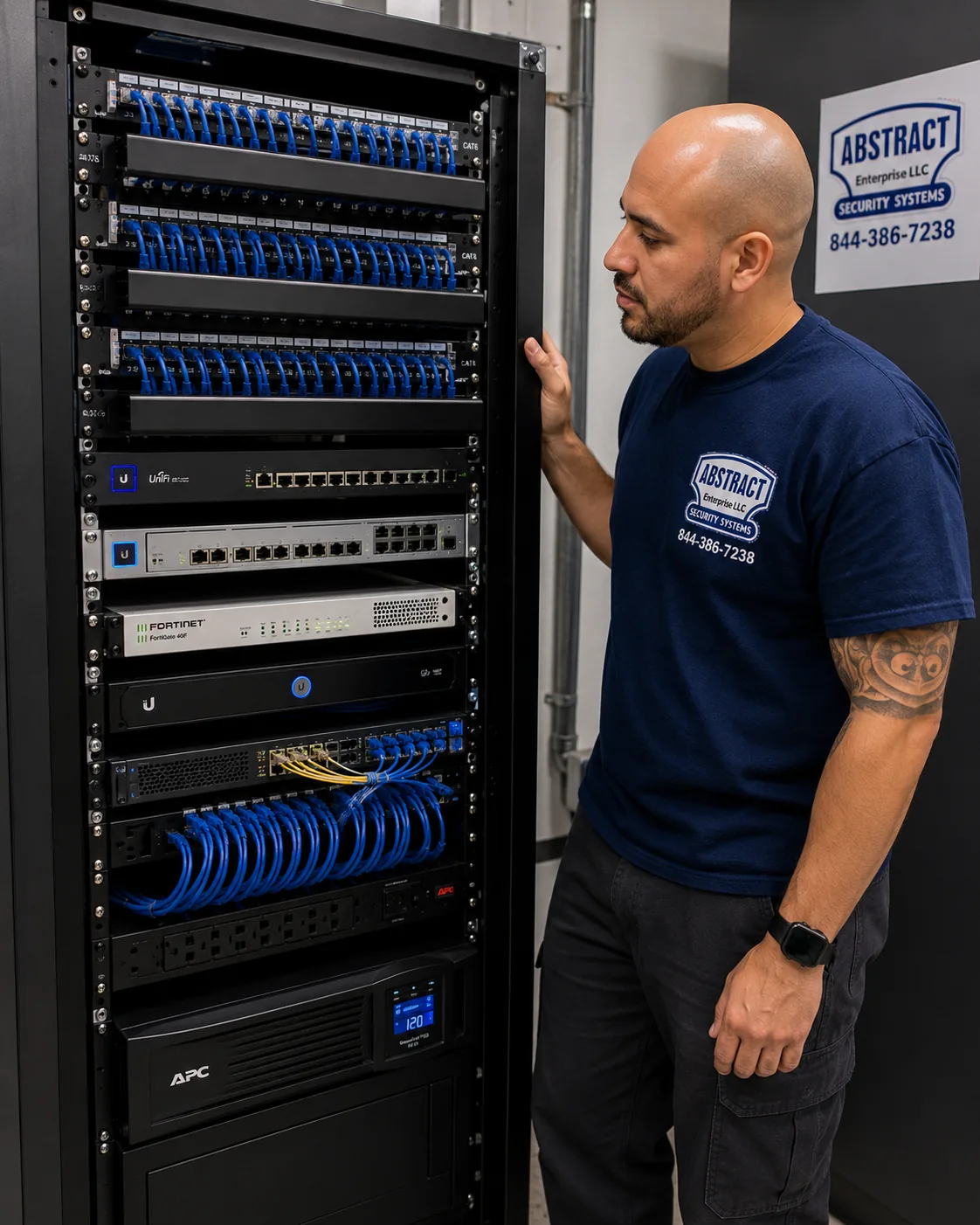
NYC hub, NYC First Alert camera installation job-library photo: finished network rack with patch panels, switching, firewall and battery backup dressed and identified
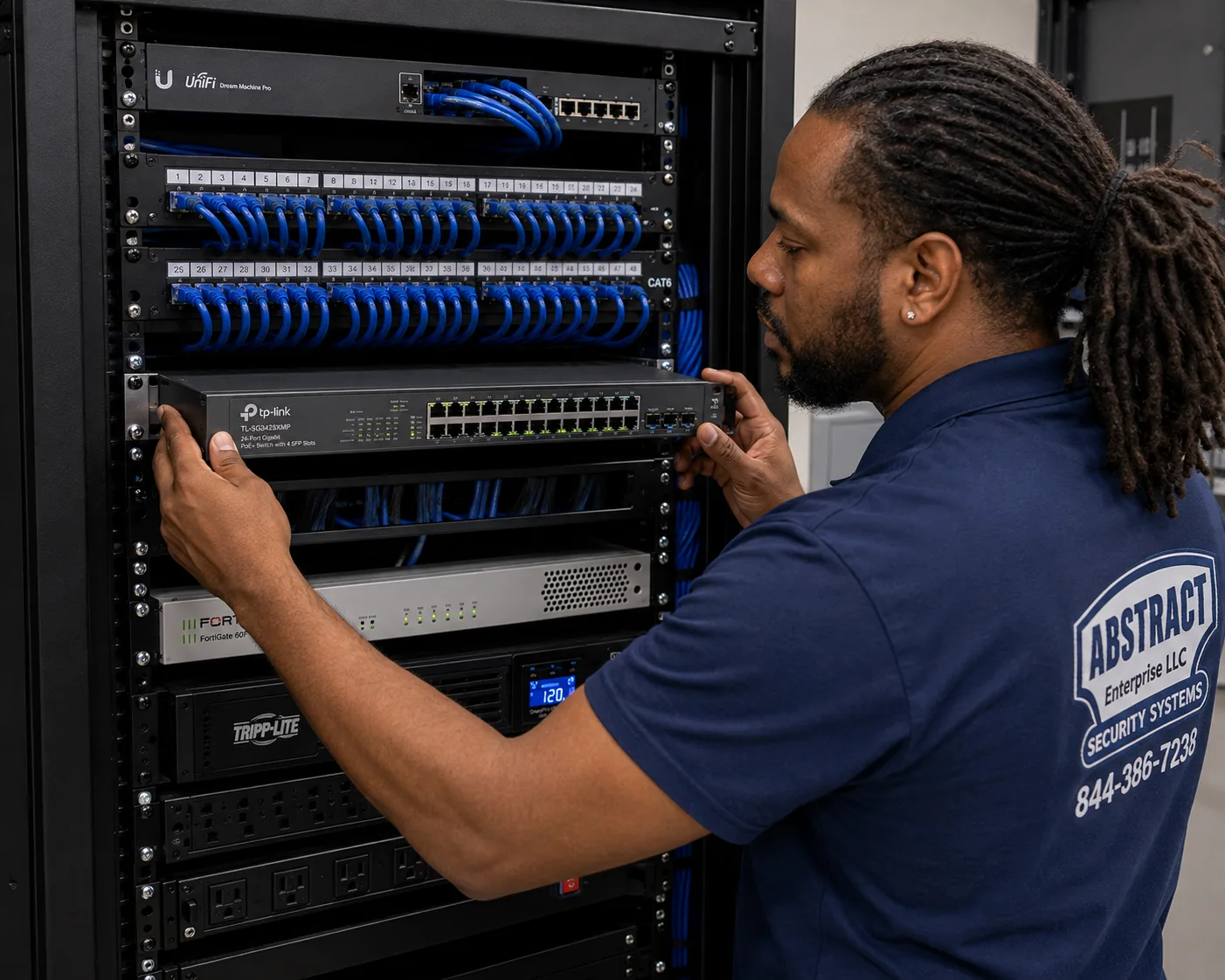
Photo from the AESS job library, not taken at a First Alert job in New York City: a finished network rack with patch panels, switching, a firewall and a battery backup, every cable dressed and identified. In a city co-op or a storefront running several PoE First Alert cameras, the battery backup at the bottom is what keeps the cameras recording through a brief outage, which is exactly when a building is most exposed.
Building Specialists

First Alert Camera Installation for NYC's Architecture

The city's building types each change three things about a First Alert camera job: how the camera gets power and data, what it is fixed into, and who has to say yes. These are the types the housing survey, CHPC and the city's own guidance describe, and how we handle each one.

Brownstones and Rowhouses

Brick or brownstone fronts, plaster inside, stoop-level and garden-level entries. Old bell wiring may or may not exist. On landmarked blocks, the front facade is the hardest place to add anything, so we look at the areaway, the vestibule and the rear first.

Walk-Up Tenements

Four- to six-story walk-ups on narrow lots, the type the Architectural League dates mostly to 1860 to 1910. Brick party walls, narrow stairs, a small vestibule with mailboxes. Cable routes are tight, so a clean riser or hallway raceway path decides the plan.

Pre-War Elevator Buildings and Co-ops

Eight- to twelve-story elevator houses from the 1910s and 1920s and larger doorman buildings. Thick plaster, masonry floors, riser closets, boards with alteration rules and contractor hours.

Post-War and Large Rental Buildings

Buildings from 1947 to 1974 and newer towers, often with block corridors, drop ceilings in lobbies and an existing camera system. Integration and placement matter more than drilling.

One- and Two-Family Houses

Over a quarter of the city's units, from Midland Beach to the Bronx. Wood frame or brick, basements and attics for cable, and an owner who can approve everything, which makes doorbells and outdoor cameras straightforward.

Garden Apartments and Planned Complexes

Courtyard buildings like the Jackson Heights garden apartments and large complexes like Parkchester and Co-op City. Shared grounds, management rules, long walks between doors and the equipment room.

How the building type changes a First Alert job

BuildingUsual power and dataWhat the camera is fixed intoWho signs off
Brownstone or rowhouseEthernet or PoE down to the cellar; Wi-Fi inside the parlor floorBrick, brownstone or plaster on masonryThe owner; LPC if landmarked and the work touches the exterior
Walk-up tenementPoE up a riser or hallway raceway for common areas; Wi-Fi or AC inside apartmentsBrick party walls, plaster, pressed-metal or plaster ceilingsThe owner for common areas; the tenant only inside the unit, within the lease
Pre-war co-opPoE through riser closets or existing conduitMasonry, plaster, steel-and-arch floorsThe board and managing agent, often through an alteration agreement
Post-war rental or towerPoE through drop ceilings to a network closetBlock, drywall on metal studs, concreteThe owner or management company
One- or two-family houseEthernet, PoE or Wi-Fi depending on distance and wallsWood frame, siding, brick or stuccoThe owner; a tenant in a two-family needs the owner's consent
Garden complexPoE to each entrance from a central room, or Wi-Fi where cable cannot cross groundsBrick courtyard walls and entry surroundsManagement, the board, or the complex's own rules

On brownstones and bell wiring. A video doorbell needs steady power. In a house built before electric doorbells were common, or one that has been rewired several times, the old bell wire may be missing, broken inside the wall, or connected to a transformer too weak for a camera doorbell. One New York electrician's guide notes that brownstones bring plaster walls, original wiring and a stoop-level entry that make placement and wiring trickier. We test what is there before choosing a doorbell power plan. If a new transformer or any line-voltage work is needed, that part goes to a licensed electrician and the quote says so. If the facade is landmarked, the doorbell's position and finish also need to respect LPC rules, which may push it into the vestibule or onto the door surround rather than the stone face.

On walk-ups and party walls. In a tenement, the building's vestibule is often barely wider than the door, with mailboxes on one wall and the intercom panel on the other. That is where packages land and where a camera does the most good, but there is little room and the walls are brick. We mount a camera high in the corner of the vestibule or just inside the inner door, angled to see faces coming in rather than the street, and run its cable in a surface raceway up the stair hall or through the cellar to wherever the switch can live. A city rule on intercoms, 1 RCNY §42-01, sets a push-button panel no higher than six feet and the speaking device between four and five feet from the floor; we keep cameras clear of that panel so it stays usable and compliant.

Material and method by wall type

Brick is the most common thing a New York camera is fixed into, and old brick varies. Some is hard and rings when drilled; some crumbles. We drill test holes, look at the dust, and set anchors in the face of the brick rather than the mortar joint wherever the camera base allows, because mortar holds less. Brownstone is softer still and stains easily, so we keep penetrations few and small and seal them. Plaster on masonry inside a pre-war building is fixed through into the masonry behind it; plaster on wood lath in a house is fixed into studs, located with a probe hole hidden behind the camera base. Block corridors in post-war buildings take sleeve anchors. Drywall on metal studs takes toggles rated for the weight. Outdoors, every hole that goes through a wall is sealed, because water following a camera cable into a wall is one of the slow kinds of damage that shows up years later.

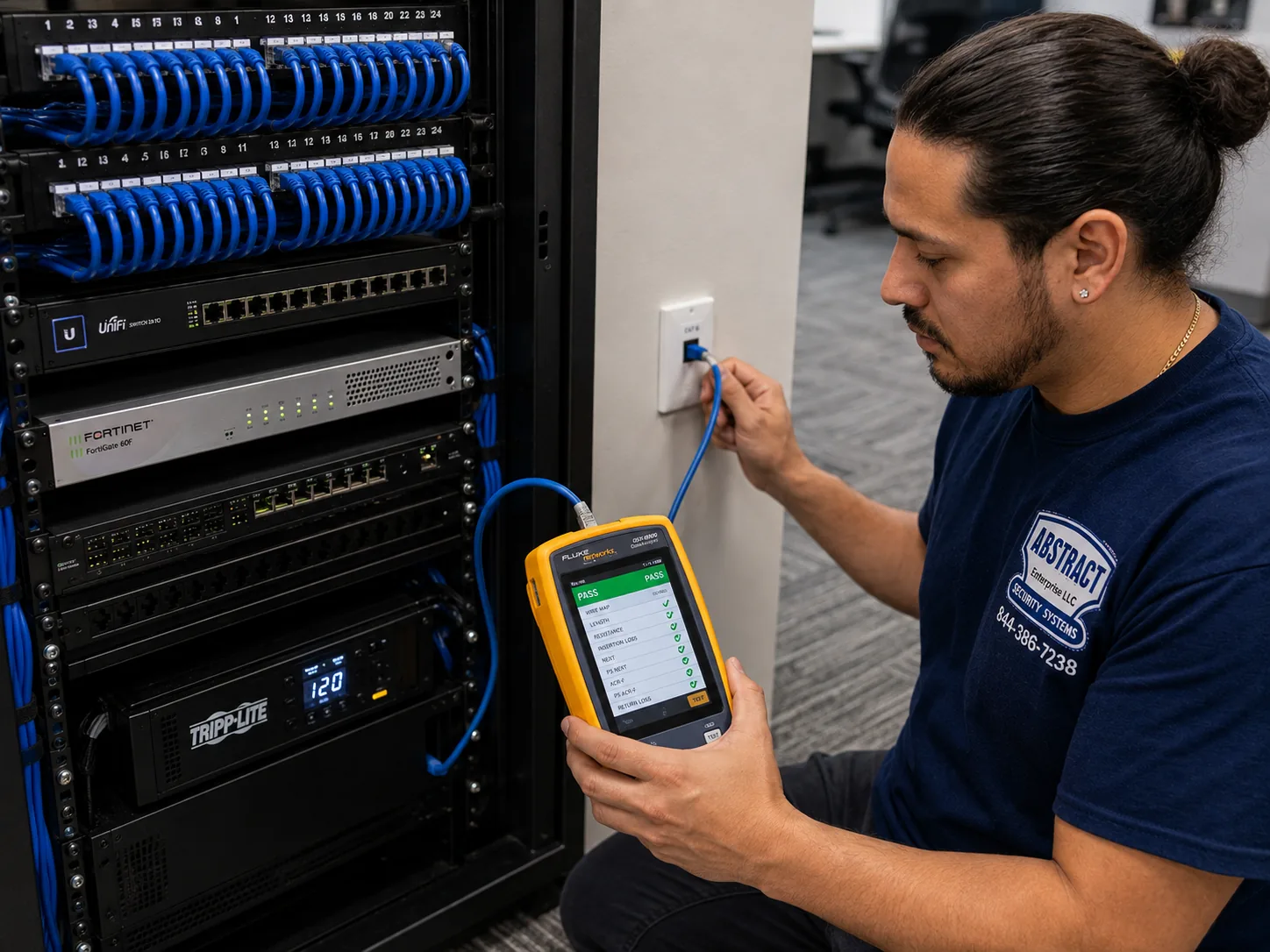
NYC hub, NYC First Alert camera installation job-library photo: technician certifying a data drop with a cable analyzer showing a PASS result
Photo from the AESS job library, not taken at a First Alert job in New York City: a technician certifying a data drop with a cable analyzer that shows a PASS result. A PoE cable pulled up five floors of an old riser can be nicked or kinked on the way, and testing it before a First Alert camera goes on the end is how we know a dropout later is the network, not the wire.
NYC hub, NYC First Alert camera installation job-library photo: J-hook pathway carrying dressed cable bundles across a commercial ceiling
Photo from the AESS job library, not taken at a First Alert job in New York City: a J-hook pathway carrying dressed bundles of cable across a commercial ceiling. Above the drop ceiling of a city lobby or store, camera cables hung on supports like these stay off the ceiling tiles and away from lighting, so they are easy to trace and nobody's renovation pulls them down.
Borough by Borough

Brooklyn to Staten Island: How First Alert Camera Jobs Differ Across the Five Boroughs

This is the city hub page, so it is worth saying how the work changes as you cross a bridge. On January 1, 1898, Manhattan, Brooklyn, the Bronx, Queens and Staten Island joined as the City of Greater New York after a referendum that passed 64,744 to 64,467, according to the city's archaeology timeline, and the subway that opened in 1904 tied them together. But each borough kept its own building habits, and those habits show up in every camera install. Our borough price pages carry the exact figures; here is what changes on the ground.

Brooklyn

Brooklyn is rowhouse country. The Brooklyn Heights Historic District, designated on November 23, 1965, was the city's first historic district, according to the Historic Districts Council, and blocks of nineteenth-century brownstones run from there through Park Slope, Fort Greene and beyond. That means many Brooklyn doorbell and front-camera jobs start with a landmark check and a look at old bell wiring. Brooklyn also has large rental complexes such as Atlantic Plaza Towers in Brownsville, where entry technology has been a public dispute. A Brooklyn tenant's legal question about putting a camera on an apartment door facing the hallway is one of the questions we answer further down this page. Brooklyn is our base-rate borough; see the First Alert camera installation prices for Brooklyn.

Manhattan

Manhattan concentrates the extremes: Lower East Side and East Village streets still lined with five-story pre-law and six-story Old Law tenements, and pre-war co-ops like the Dakota, built from 1880 to 1884 to Henry J. Hardenbergh's design, made a co-op in 1961 and a city landmark in 1969. In the Dakota, Wikipedia notes, the floors are rolled steel beams with brick or terracotta arches between them, the kind of construction that eats Wi-Fi and makes cable routes slow. Boards often limit contractor hours; The Cooperator describes the traditional window as weekdays 9 a.m. to 5 p.m. Manhattan carries our highest borough rate because of access and parking; see the First Alert camera installation prices for Manhattan.

Queens

Queens mixes planned communities, garden apartments and new towers. The Jackson Heights Beautification Group dates the Jackson Heights garden apartments to 1917. The Cultural Landscape Foundation describes Forest Hills Gardens, planned by Frederick Law Olmsted Jr. and Grosvenor Atterbury, as having streets laid out by 1910 and buildings that used Atterbury's standardized precast concrete panels, a material that needs its own drilling approach. In Long Island City, 6sqft reported a two-tower development on Center Boulevard of 46 and 56 floors with about 1,194 apartments. And Astoria shows up in the package-theft stories, including CBS New York's report of a thief who disabled a lobby lock with a screwdriver. Queens is priced slightly above the base; see the First Alert camera installation prices for Queens.

The Bronx

The Bronx runs from Riverdale mansions to some of the largest housing complexes in the country. Parkchester, built by Metropolitan Life between 1939 and 1942, has 171 brick buildings of eight or thirteen stories and, by a 1968 New York Times count cited on Wikipedia, 12,271 apartments. Co-op City, a Mitchell-Lama development, lists 15,372 units in 35 high-rises and seven townhouse clusters. In complexes like these, camera work is usually a management decision, while an individual shareholder or tenant is mostly choosing indoor cameras. News 12's December 2025 Morris Park report is a reminder that houses in the borough's quieter sections face the same doorstep theft. The Bronx shares Brooklyn's base rate; see the First Alert camera installation prices for the Bronx.

Staten Island

Staten Island is the borough of detached houses, from the small homes of Midland Beach that CHPC names to the historic houses of the St. Paul's Avenue–Stapleton Heights Historic District, designated in 2004 with about 92 freestanding houses, the earliest from the mid-1830s, according to Six to Celebrate. Owners here usually control the whole property, so video doorbells, driveway cameras and rear-yard coverage are common, and the main questions are distance, Wi-Fi reach across a lot and, in the historic district, how a camera sits on a period facade. Staten Island carries a higher rate than Brooklyn because of the crossing; see the First Alert camera installation prices for Staten Island.

NYC hub, NYC First Alert camera installation job-library photo: technician mounting a managed PoE switch below patch panels in a commercial network rack
Photo from the AESS job library, not taken at a First Alert job in New York City: a technician mounting a managed PoE switch below the patch panels in a commercial network rack. This is the box that powers wired First Alert cameras over their network cables, and in a Manhattan co-op or a Bronx management office it usually lives in a basement closet where the super can reach it.
Commercial First Alert Camera Installation

Business First Alert Camera Installation in NYC

Commercial First Alert camera work in the city clusters on the shopping streets, many of which are organized as business improvement districts. The NYC Department of Small Business Services directory lists the corridors below among the city's BIDs. We name them as places where street-level retail concentrates and say what a camera has to deal with there; we have no information about any particular business on these streets and do not claim any of them as customers.

Fordham Road, the Bronx

A BID-managed shopping street in the Bronx. Storefront cameras here watch busy sidewalks and doors that open all day, so placement is about faces at the threshold, not the whole street.

125th Street, Manhattan

Harlem's main commercial street and a BID corridor. Upper Manhattan is also where, Police1 reported, the NYPD planned 38 more cameras in higher-crime areas, some outside bodegas.

Fulton Mall, Brooklyn

Represented by the Fulton Mall Improvement Association. Dense retail, deliveries and shutters, with cameras typically mounted inside the storefront glass or under the gate housing.

Pitkin Avenue and 86th Street, Brooklyn

Two more Brooklyn BIDs on the SBS list, one in Brownsville and one in Bay Ridge, both lined with street-level shops where a register camera and a door camera usually cover most needs.

Steinway Street and Downtown Jamaica, Queens

Two Queens BID corridors, one in Astoria and one served by the Downtown Jamaica Partnership, with stores, offices and upper-floor tenants sharing old buildings.

Forest Avenue, Staten Island

A Staten Island BID corridor where shops often have their own parking or side lots, so a business camera plan may cover the lot as well as the door.

What a storefront camera has to survive in the city

A camera in a shop is up against things a home camera never sees. Doors open hundreds of times a day, letting in cold and grit. Roll-down gates come down in front of the glass every night, which can block a camera mounted inside the window. Deliveries arrive at the back door at hours when nobody is watching. And bright sidewalks behind a dim shop interior make faces at the door hard to read, which is where a sensor with wide dynamic range, like the one Resideo lists for the VX5 indoor camera, helps. A property manager quoted by Brick Underground made a further point: face masks make people hard to identify on camera, so position and light matter more than resolution. We plan business cameras view by view with the owner, decide which ones are on PoE so a weak Wi-Fi signal or a jammer cannot knock them out, and schedule drilling for the hours the shop is closed.

Gates themselves are in flux. A 2009 city law required storefront roll-down gates to be at least 70 percent transparent by July 1, 2026, but NY1 reported on July 2, 2026 that the City Council had unanimously passed a bill repealing that deadline, so a compliant gate would be required only when a gate is replaced for other reasons, with the bill going to the mayor. If you are replacing a gate anyway, the camera can often be planned to see through a transparent gate at night, which is worth thinking about before both are installed.

Rules and practical limits for business cameras

  • Installer licensing. The NYC Business portal says a license from the New York State Department of State is needed to install or maintain security or fire alarm systems, and 19 NYCRR 195.2(b), as Kirschenbaum Esq. explains it, covers CCTV used to detect or monitor intrusion, theft or movement. A First Alert camera tied to a ProSeries or VISTA alarm panel is alarm work by any reading. Ask any installer for their license number; ours is NYS license #12000287431.
  • Facial recognition means signs. The city's biometric identifier law requires covered commercial establishments that collect biometric data, such as through facial recognition software, to post a clear sign at every customer entrance, at least 8.5 by 11 inches under the city rule. Ordinary CCTV without that kind of analysis appears to be exempt, Kennedys Law notes. If a business turns on any face-matching feature, the sign goes up the same day.
  • Low-voltage versus line-voltage. Under NYC Administrative Code §28-105.4.7, added by Local Law 128 of 2024 and effective December 21, 2025, an electrical permit is not required for wiring under 50 volts for signaling, communication, alarm and data circuits when done by a licensed master or special electrician or a qualified person as the electrical code defines it. A new outlet for a camera is line-voltage work and goes to a licensed electrician with a DOB permit.
  • Landmarked storefronts. LPC rules list security cameras under Section 2-20, and the Permit Guidebook's health and safety chapter covers how they can be installed, including domes painted to match the facade. One published LPC approval covered nine ground-floor cameras, five on a west facade and three on an east facade. We check landmark status before planning any exterior camera.
  • Sharing with police is optional. 311 describes a program that lets any business with a security camera share live video with the NYPD during emergencies, and businesses can register camera locations through NewYorkCityConnect.org. Registration alone does not give police a live view. Whether to join is the owner's decision.
  • Insurers, not the city, often drive cameras. Seneca Security notes there is no general city law mandating cameras in apartment buildings, and that many commercial property insurers set camera coverage requirements for theft and vandalism claims. Ask your broker what your policy expects before you finalize positions.
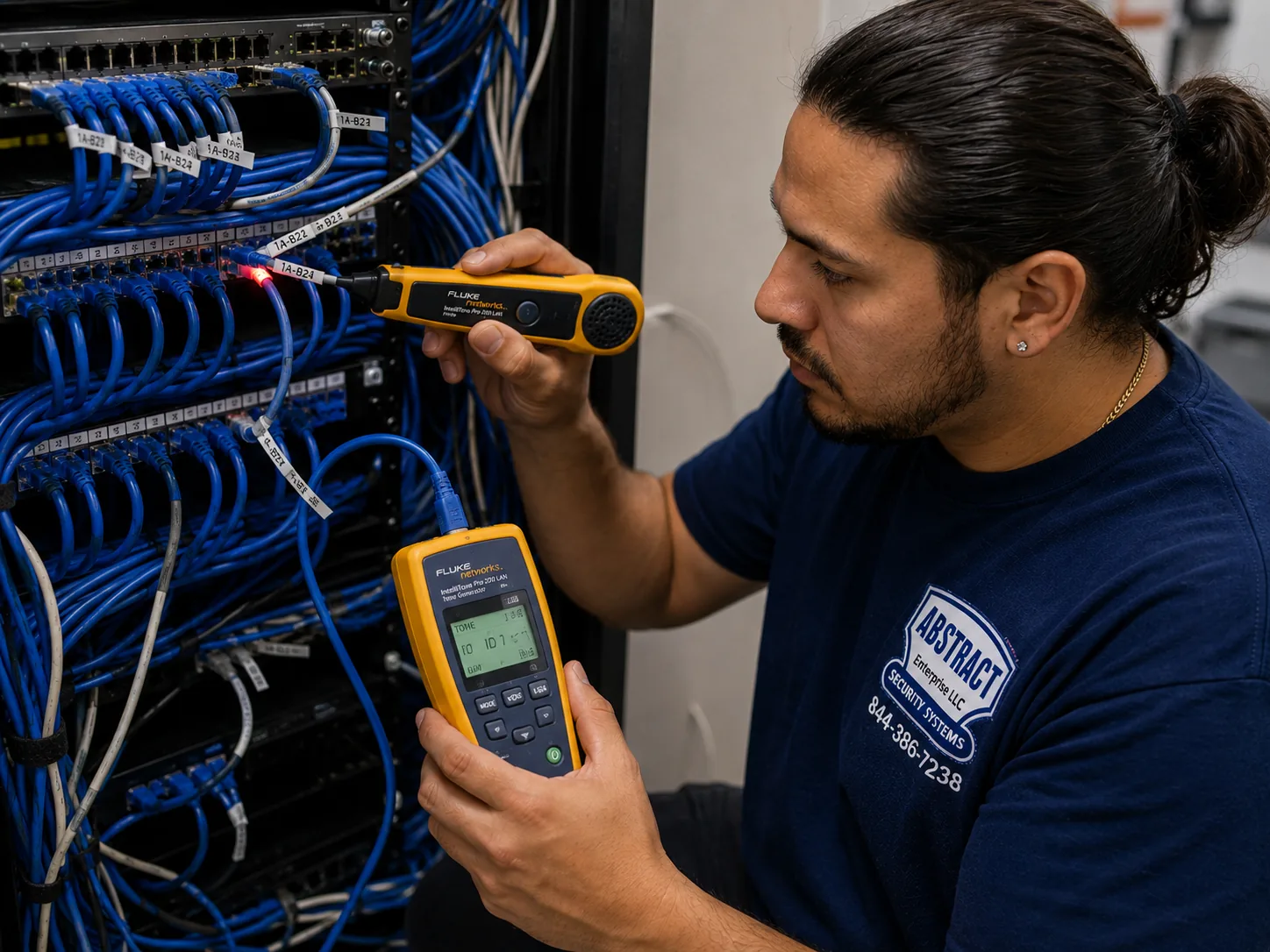
NYC hub, NYC First Alert camera installation job-library photo: technician tracing an unidentified cable run at a patch panel with a tone generator and probe
Photo from the AESS job library, not taken at a First Alert job in New York City: a technician tracing an unidentified cable run at a patch panel with a tone generator and probe. City storefronts and older buildings are full of cables nobody labeled, and finding which one goes to the old camera over the register is often the first step to reusing it for a new First Alert camera instead of pulling new wire.
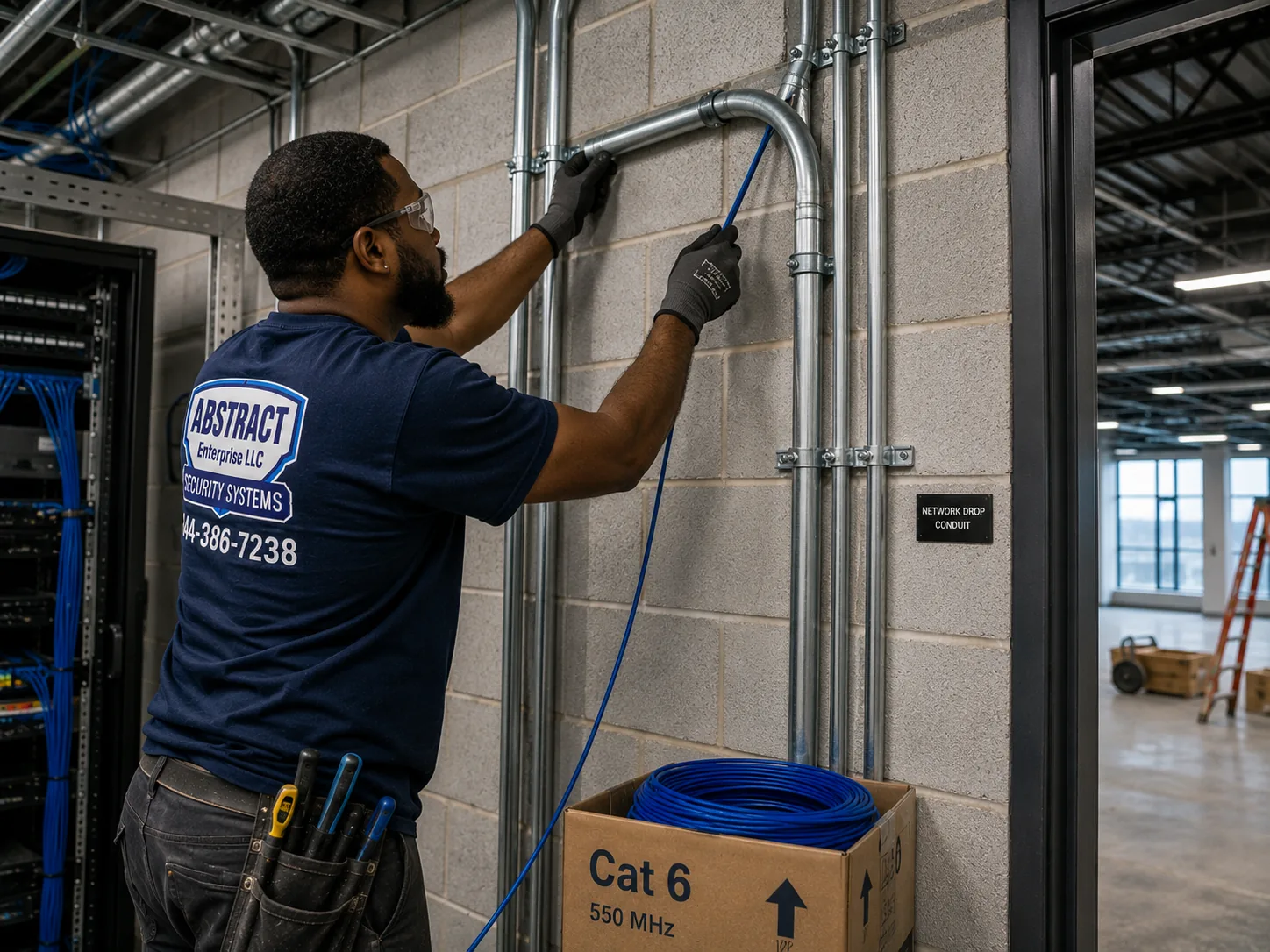
NYC hub, NYC First Alert camera installation job-library photo: technician running cable into EMT conduit beside a telecom room in an industrial building
Photo from the AESS job library, not taken at a First Alert job in New York City: a technician running cable into EMT conduit beside a telecom room in an industrial building. In a warehouse, a garage or a loading dock in the outer boroughs, metal conduit like this protects the cable to a First Alert camera from forklifts, carts and anyone tempted to cut it.
Field Notes

Field Notes: What We Check Before a Camera Goes on a City Door

We do not publish stories about a particular customer's building unless we can document them, so this is not a tale about one address. It is the routine our technicians follow at the kind of door New York is full of: a walk-up vestibule, a brownstone stoop or an apartment door off a long hallway.

We stand where the person ringing the bell would stand and look at the light, because a face lit from behind by the street is a silhouette on any camera. We open the door and watch the closer swing it shut, and we note where the closer arm, the latch and the strike plate sit, so nothing we add touches them. We check what the lens would see past the door: a neighbor's entrance, a window across the hall, the sidewalk. We run a speed test at the exact spot the camera would sit, not in the living room. We look for any old camera, intercom or bell wire that might be reused, and test it before trusting it. We ask who owns the wall in front of us and whether anyone has said yes in writing. Only then do we hold the camera up, show the owner the view on their own phone, and agree the position. In buildings this old, that ten minutes is what separates a camera that helps from one that causes an argument.

Your Questions Answered

First Alert Camera Installation in NYC: Questions Answered

Licensing and permits

Does the person putting up a First Alert camera in New York City need a state license?

Sources disagree, so here is what each says. ButterflyMX writes that a Security or Fire Alarm Installer License from the New York State Department of State is needed to install cameras legally in the city. City Smart Systems argues that alarm work needs the license but camera-only work falls under low-voltage rules. The state rule, 19 NYCRR 195.2(b), as Kirschenbaum Esq. explains it, covers a CCTV system used full-time or part-time to detect or monitor intrusion, break-in, theft, movement, sound or fire, and the Department of State has treated even a video intercom as a small CCTV system. Because First Alert cameras are designed to integrate with ProSeries and VISTA alarm panels, a First Alert job is very often alarm work. We do it under NYS license #12000287431, and we suggest you ask any installer for their number before they start.

Is a camera job in a store or office licensed differently from one in a home?

The state license question is about what the system does, not whether the building is a home or a business; the same detection-and-monitoring test applies. What changes in commercial space is everything around the license. Landlords and managing agents more often ask for a certificate of insurance before work starts. The city's biometric identifier law adds a signage duty if the business uses facial recognition software. Commercial insurers may set camera requirements. And a business is more likely to need new power at a high spot, which is line-voltage electrical work for a licensed electrician, not part of a low-voltage camera license. We sort those pieces out on the quote so the business owner knows who does what.

Does the Buildings Department need to issue a permit before First Alert cameras go in?

We found no Department of Buildings rule specific to low-voltage cameras, and one installer's claim that every install is permitted reads as marketing rather than regulation. What we can point to is Administrative Code §28-105.4.7, added by Local Law 128 of 2024 and in effect from December 21, 2025, which says an electrical permit is not required for wiring designed to run under 50 volts for signaling, communication, alarm and data circuits when the work is done by a licensed master electrician, a special electrician or a qualified person as the electrical code defines it. PoE camera cabling is that kind of wiring. A new outlet or hard-wired line-voltage supply is not, and it needs a licensed electrician who files with DOB. Landmarked exteriors are a separate approval from LPC.

Apartments, hallways and landlords

I rent in Brooklyn. Can I put a camera on my own apartment door that looks out into the public hallway?

This is genuinely unsettled, and the sources split. Connextivity says no New York State or City law stops a resident from putting a camera on their own apartment door or says how it must be aimed. A JustAnswer response to a Brooklyn tenant says cameras in common areas need the landlord's permission and the landlord can remove one installed without consent. In practice, the safest route is the one several sources point to: a camera that replaces or sits on your own door hardware, such as a peephole-style unit, rather than anything fixed to the hallway wall or ceiling, plus a word with the landlord in writing. Keep the view on your doorway rather than the neighbor's, and leave audio off. We will not mount anything on common-area surfaces without the owner's consent.

What about a freestanding camera on a shelf or stand in the hallway outside my door?

An answer on AskALawyerOnCall says a tenant cannot install cameras outside the apartment because the hallway is not under the tenant's control, and suggests a peephole camera mounted on the tenant's door instead. A freestanding unit avoids drilling, but it still occupies common space, can block a corridor that must stay clear for fire safety, and is easy to knock over or take. For those reasons we do not recommend it and will not place one in a common hallway. If what you want is to see who comes to your door and what happens to deliveries, a camera on or just inside your own door does the job without arguing over the corridor.

My landlord put a camera in the hallway pointed straight at my door. Is that allowed?

Owners generally may put cameras in common areas, and Seneca Security notes there is no city law mandating them either way. The limits are about what the camera sees and how the footage is used. Connextivity's guidance is that hallway cameras are on firm ground when they cover corridor traffic without seeing into apartments as doors open. In a building with a smart access system, the Tenant Data Privacy Act limits how the owner may use data the system collects, and the law may not be used to harass tenants. A camera with audio raises New York's eavesdropping law. If you think a camera looks into your home rather than the hall, raise it with the owner in writing first; a JustAnswer thread on exactly this question is a good place to see how lawyers frame it. We are installers, not lawyers, and this is not legal advice.

Can a landlord install a camera inside my rented apartment?

City Smart Systems describes landlord cameras inside a rented apartment's bedrooms or living rooms as generally illegal in the city, and Connextivity notes that a camera installed covertly inside a unit can support a charge under Penal Law 250.45, a felony. The cameras an owner can reasonably install are in common areas, not inside the home you rent. If you find a device inside your unit that you did not put there and that the landlord did not disclose, do not tamper with it; photograph it and get legal advice. We only install cameras inside an apartment for the person who lives there or, in an empty unit between tenancies, at the owner's request for that period.

Audio, privacy and smart entry

Can my First Alert doorbell or camera legally record sound in New York?

New York is a one-party-consent state for recording conversations: according to the Reporters Committee for Freedom of the Press, recording an in-person conversation you are not part of, without the consent of at least one person in it, is a felony. A doorbell that records you talking to a courier is one thing. A camera in a hallway or lobby passively picking up neighbors' conversations is another, and Connextivity notes nobody has cleanly settled whether that counts as eavesdropping. That is why we set audio recording off on common-area and hallway cameras by default, and leave the choice to you on a camera inside your own home or at your own door where you are the one talking. Video and audio are treated separately in the law, so turning off the microphone does not turn off the camera's usefulness.

Our building lets residents in with an app and fobs. Do extra city rules apply to the cameras?

The Tenant Data Privacy Act, Local Law 63 of 2021, covers Class A multiple dwellings that use smart access systems such as fobs, cards, apps or biometrics. It took effect on July 29, 2021, with owners of existing smart access buildings liable from January 1, 2023, according to Thomson Reuters Practical Law. Authentication data must be destroyed within 90 days unless anonymized, and HPD says owners may not use the data for anything other than granting access and monitoring entrances, exits and common areas. The important line for cameras, as CaseGuard explains it, is that authentication data does not include data from a video system that monitors an entrance without granting entry. So a First Alert camera that just watches the lobby door is outside that definition. A camera wired to unlock the door, or to recognize faces for entry, is the kind of system the law was written for, and that is a different project with its own rules.

Landmarks

Our brownstone is in a historic district. Can a First Alert camera go on the front facade at all?

Possibly, but the front is the hardest place. LPC's 2018 rules amendment proposed that cameras and similar equipment would be barred from a primary facade unless there is no workable alternative or an agency requires that location, and that installations avoid damaging significant architectural features and keep the object as small as possible. LPC's Permit Guidebook, in its chapter on health and safety equipment, covers security cameras under its rules, including domes painted to match the facade, and LPC staff can approve installations that meet the criteria without a full hearing. Most exterior changes in historic districts need LPC review, and 311 can confirm a building's status. In practice we look first at the vestibule, the areaway, the door surround and the rear facade, and only plan a primary-facade camera once LPC's route is clear.

How the system works

What exactly is a professionally installed First Alert setup, and how do the parts work together?

FirstAlert.com describes its home security as professionally installed, with cameras, video doorbells and monitoring, and sends shoppers to a local expert. The cameras are the VX Series: a video doorbell, indoor cameras and outdoor cameras, powered over AC, Ethernet, Wi-Fi or PoE. They integrate with ProSeries and VISTA alarm panels, so a home or business with one of those panels can have camera events and alarm events work together. An installer's part is to choose the right camera for each spot, get power and data to it through the building, mount it securely, connect it to your network and panel, and set the alerts. Whether you add professional monitoring is a separate choice; we explain what is involved for your setup before you decide.

Which power option makes sense in a brick rowhouse compared with a high-rise apartment?

In a rowhouse, the owner usually controls the cellar, so a network cable can run from the router down through the cellar ceiling and up to a rear-yard or front camera, which makes Ethernet or PoE the steady choice for outside cameras, with Wi-Fi fine for indoor cameras on the parlor floor. In a high-rise apartment, a tenant usually cannot run cable through walls or common areas, so indoor cameras on Wi-Fi or AC near the router are the realistic option, and anything covering the lobby or hallways is the building's PoE system. A Linked Security cost guide lists distance to the recorder, floors to cross and wall material as the main labor drivers, and those decide the answer as much as the camera does. We test the Wi-Fi at each spot before recommending wireless.

Packages and police

Are apartment dwellers really more likely to lose packages, and what can a camera actually do about it?

Security.org's annual report found apartment residents were more than three times as likely as single-family residents to have had a package stolen in the past three months, 10 percent against 3 percent. A camera does two things about that: it discourages the casual thief who sees it, and it records the face and time when theft happens anyway, which is what the New York Attorney General's tips point to. What a camera cannot do is stop a determined thief in a lobby with no package room. That is why, in apartment buildings, the best results come from a camera aimed at the package shelf at face height combined with the building's own measures, such as a locked package room or a working entry door. A Gowanus Houses participatory budgeting proposal asked for exactly that kind of coverage near elevators and apartment doors.

If I register my First Alert cameras with the NYPD, can police watch them live?

Not through registration alone. NewYorkCityConnect explains that registering cameras does not give the NYPD live access; it tells investigators a camera exists so they can ask you for footage, and registration is free. Separately, 311 describes a program that lets businesses with security cameras share live video with the NYPD during emergencies, which is an opt-in arrangement. A homeowner who registers keeps control of whether to hand over a clip. We can help you find and export a clip quickly when police ask, so the decision is yours rather than a technical scramble.
Equipment

Types of First Alert Camera Installation We Install

These are the components we fit in New York homes, apartment buildings and businesses on First Alert camera jobs. Where we name a feature of a First Alert model, it is one Resideo publishes; we do not add specifications we cannot document. Exact equipment and installed prices for your borough are on the price pages.

🔔

VX Video Doorbell

For houses, brownstones and two-family front doors where the owner controls the entry, powered from tested bell wiring or another supply we plan before mounting.

🏠

VX5 Indoor Camera

Resideo lists a 2-megapixel sensor with wide dynamic range, people-versus-pet detection and an automatic privacy shutter, a useful combination for apartments facing bright windows.

📹

VX Outdoor Cameras

For rear yards, alleys, roof bulkheads, driveways and storefronts, fixed into masonry or wood and sealed where cables pass through the wall.

🔌

PoE Switches and Injectors

The equipment that powers wired cameras over one network cable each, placed in a cellar, closet or rack with room to add cameras later.

🔋

Battery Backup

A UPS for the router and PoE switch so cameras keep recording through short outages, the moment a building is often most exposed.

🚨

Alarm Panel Integration

Connections to an existing ProSeries or VISTA panel, so cameras and the alarm share events and the same people get the alerts.

📶

Wi-Fi Extension

Where a wireless camera is the only option, a properly placed access point or mesh node so the camera is not living on one weak bar through a brick wall.

🧰

Mounts, Raceway and Conduit

Junction boxes, corner and pole mounts, paintable surface raceway for stair halls and EMT conduit where cable needs protecting in garages and docks.

First Alert vs ADT, Ring and SimpliSafe for a city building

QuestionFirst Alert VX (installer-fitted)Typical self-install kit (Ring, SimpliSafe)National alarm company (ADT)
Who installsSold as professionally installed through local expertsMostly the ownerThe company's own technicians or dealers
Wired optionsAC, Ethernet, Wi-Fi or PoE, per ResideoVaries by model; many are battery or Wi-Fi firstDepends on the package sold
Fits an existing Honeywell panelIntegrates with ProSeries and VISTAGenerally their own ecosystemDepends on the system
Best fit in NYCOwners and boards who want wired cameras tied to an alarmRenters wanting a no-drill indoor cameraBuyers who want one company for alarm and monitoring

The difference that matters in New York is not the logo; it is the wall and the permission. A self-install camera on a renter's shelf is fine for watching the living room. A camera covering a lobby door through a brick vestibule, with power that a Wi-Fi jammer cannot knock off, needs someone to pull and test a cable. We install the brand you choose and tell you honestly when a simpler product would serve the spot just as well.

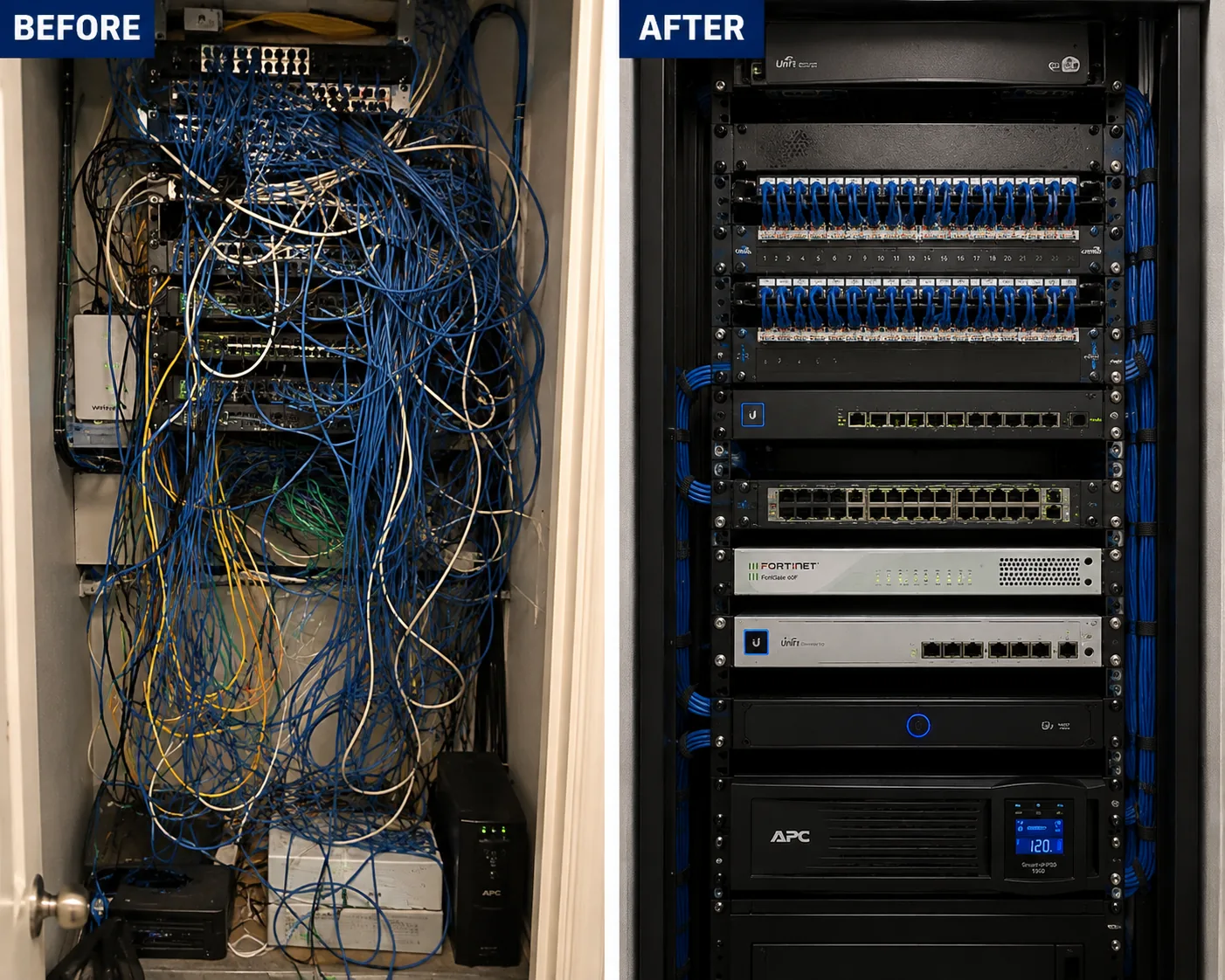
NYC hub, NYC First Alert camera installation job-library photo: before and after views of a network rack, from unlabelled tangled cables to a dressed and identified rack
Photo from the AESS job library, not taken at a First Alert job in New York City: the same network rack before and after, an unlabelled tangle rebuilt into dressed, identified cabling. Many city buildings inherit a closet like the left side from years of camera, intercom and internet work, and untangling it is often the step that lets new First Alert cameras be added without knocking something else offline.
AI Overview Reality Check

What AI Gets Wrong About First Alert Camera Installation in NYC

We could not capture Google's AI Overview, People Also Ask boxes or Bing and DuckDuckGo answers for this topic from our build environment, so we will not pretend to quote them. Below are claims we see repeated in quick online answers about First Alert cameras and about camera installation in this city, set against what the published sources and our field practice say. National cost guides from Angi, HomeAdvisor and Fixr feed many of those answers; they give a rough sense of scale, but they are not a quote for a walk-up vestibule in the Bronx or a co-op lobby on the Upper West Side.

"First Alert is a smoke detector company, so its cameras run on the Onelink app."

Mixing up the two product lines is the most common First Alert confusion we see. Onelink is the app for First Alert's smart smoke and carbon monoxide alarms and the Environment Monitor, according to First Alert support, and its App Store rating sat at 1.5 stars from 306 reviews when we checked our sources.

First Alert cameras today are the VX Series from Resideo, a professionally installed video line with a doorbell, indoor and outdoor cameras, designed to work with Resideo's smart home products and its ProSeries and VISTA panels.

If a quick answer sends you to Onelink troubleshooting for a camera, it is answering the wrong product. Send us a photo of the device and we will tell you which system you actually have.

"First Alert still belongs to the company that sold it in stores for decades."

Ownership changed. Resideo announced on February 7, 2022 that it had agreed to buy First Alert from Newell Brands, according to its SEC filing, and it lists Honeywell Home, First Alert and BRK among its brands.

That is why First Alert cameras and Honeywell alarm panels now integrate. It also explains why the cameras are positioned as an installer product rather than a shelf item.

Resideo also announced in July 2025 a plan to spin off its ADI distribution business. We could not confirm whether that has closed, so we do not repeat claims either way; it does not change how a camera goes on your wall.

"Wireless cameras mean no wiring, which is perfect for city apartments."

Wireless is perfect where the signal is strong and steady. In a pre-war building with brick party walls, plaster on masonry and steel-and-arch floors, the signal at the front door can be a fraction of what it is next to the router, and crowded channels from dozens of neighbors make it worse.

There is also deliberate interference. Spectrum News reported in December 2025 that New York authorities warned some package thieves use Wi-Fi jammers to disrupt doorbell camera footage.

Resideo lists Ethernet and PoE as options for VX cameras for a reason. We test Wi-Fi at each camera spot, use wireless where it holds up, and recommend a cable wherever a camera guards a lobby, a package shelf or a storefront.

"Anyone can install security cameras in New York; no license needed."

Some answers say this flatly. The sources we found disagree with one another: ButterflyMX says a state Security or Fire Alarm Installer License is needed, while City Smart Systems says camera-only work is low-voltage and only alarm work needs the license.

The state rule, 19 NYCRR 195.2(b), covers CCTV used to detect or monitor intrusion, theft, movement, sound or fire, and First Alert cameras are built to tie into alarm panels, which makes most First Alert jobs alarm work.

Separately, the city's low-voltage permit exemption in Administrative Code §28-105.4.7 applies when a licensed electrician or a qualified person does the work. Ask for a license number; ours is NYS license #12000287431.

"Tenants can put a doorbell camera anywhere outside their apartment."

Quick answers often borrow suburban advice, where the front door is yours. In a city building, the hallway is common space. One legal Q&A says a tenant needs the landlord's permission for a common-area camera and the landlord can remove one installed without consent; another source says no law stops a camera on the tenant's own door.

Co-ops add another layer: Connextivity notes some have written camera policies requiring board approval, some decide case by case, and many have never addressed it.

The workable answer in most buildings is a camera on or inside your own door, aimed at your threshold, with audio off, and written permission for anything on a shared wall.

"The Tenant Data Privacy Act bans cameras in apartment lobbies."

It does not. Local Law 63 of 2021 regulates smart access systems in Class A multiple dwellings, the fobs, apps and biometric readers that let people in, and it limits how owners collect, keep and use that data.

As CaseGuard explains, the law's definition of authentication data leaves out data from a video system that monitors an entrance but does not grant entry. HPD's summary says owners may use smart access data only to grant access and monitor entrances, exits and common areas.

So a First Alert camera watching a lobby door is outside that definition. A camera that recognizes faces to unlock the door is exactly what the law, and the Atlantic Plaza Towers tenants, were concerned about.

"Registering your camera with the NYPD lets police watch your home."

This one worries homeowners for no reason. NewYorkCityConnect states that registering cameras does not give the NYPD live access; it lets investigators know a camera exists so they can ask for footage. Registration is free and voluntary.

Live sharing exists only as a separate, opt-in program that 311 describes for businesses during emergencies, and there have been public debates, such as the NYCLU's criticism of the NYPD's partnership with Ring's Neighbors app, about how footage requests work.

Our job is to make sure that if you ever do want to hand over a clip, you can find and export it in minutes, and that the choice stays with you.

Not Sure Which Door to Cover First? Talk It Through With a Technician

Send a photo of the door, hallway or facade, the borough, and whether you own, rent or hold co-op shares. A technician will tell you whether a First Alert camera fits the spot, how it should be powered, and who needs to approve it. Call (800) 486-0943, message us on WhatsApp, or use the quick form.

How It Works

Our Installation Process

Every First Alert camera job in the city follows the same eight steps, whether it is one indoor camera in a Queens rental or a set of PoE cameras across a Manhattan co-op's lobby, mailroom and courtyard. The order matters most in shared buildings, where a camera mounted before permission is settled is the usual cause of a dispute.

1. Describe the building and the goal

The address, the building type, who owns the walls, and photos of what you want covered. Tell us what you want the camera to catch, not just where it goes. We book the visit within two hours of your request.

2. Clear the permissions first

Landlord or board consent in writing, a landmark check through LPC or 311, and any certificate of insurance or contractor hours the managing agent asks for, all before the day.

3. Walk the site and test the signal

Wi-Fi measured at each camera spot, existing coax or network cable found and tested, and the riser, cellar or ceiling path a new cable would follow.

4. Agree positions and privacy

Each view checked on your phone, privacy zones and audio settings agreed, and anything that would see into a neighbor's home moved or masked.

5. Run the cable or set the power

PoE cable pulled, labeled and tested where walls and permissions allow; AC or Wi-Fi where they fit better. New outlets go to a licensed electrician.

6. Mount and seal

Cameras fixed into brick, stone, wood or metal with the right anchors, exterior holes sealed, and door hardware and closers left untouched.

7. Enroll and set alerts

Each camera added to its app and, where you have one, the ProSeries or VISTA panel, named clearly, with person and motion alerts tuned to real events.

8. Test and hand over

Live view, clips and alerts tested with you on your phone, every cable labeled, and a written list of what went where for the super or the next technician.

Coverage Area

First Alert Camera Installation Near NYC's Landmarks

On a citywide page, landmarks are less about directions and more about the kinds of buildings we work in. These six stand for the building types across the five boroughs that shape First Alert camera jobs, each described only from published sources. We do not claim any of them as customers.

The Dakota, Manhattan

Built 1880 to 1884 to Henry J. Hardenbergh's design, a co-op since 1961 and a landmark since 1969, with floors of steel beams and brick or terracotta arches, per Wikipedia. The pre-war co-op at its most demanding.

Brooklyn Heights Historic District

Designated November 23, 1965, the city's first historic district, filled with nineteenth-century brownstones, according to the Historic Districts Council. Where facade rules come first.

Parkchester, the Bronx

Built by Metropolitan Life from 1939 to 1942: 171 brick buildings of eight or thirteen stories, about 12,271 apartments by a 1968 count cited on Wikipedia. Camera plans here run through management.

Forest Hills Gardens, Queens

Planned by Olmsted Jr. and Atterbury, streets laid out by 1910, buildings using Atterbury's precast concrete panels, per the Cultural Landscape Foundation. Concrete panels change how a camera is fixed.

Co-op City, the Bronx

A Mitchell-Lama development of 15,372 units in 35 high-rises and seven townhouse clusters, according to its own history page. Scale that makes cable routing a project in itself.

St. Paul's Avenue–Stapleton Heights, Staten Island

A 2004 historic district of about 92 freestanding houses, the earliest from the mid-1830s, per Six to Celebrate. Detached houses where period facades meet modern doorbells.

Beyond the five boroughs we also install First Alert cameras on Long Island, including Nassau County and Suffolk County, and across the Hudson Valley, including Westchester County. For the city as a whole, start with the NYC First Alert camera price list.

Pricing

First Alert Camera Installation Cost in NYC

We publish First Alert camera installation prices on a separate price page for each borough, because the same job costs a different amount in Manhattan than in the Bronx. We do not print camera figures on this hub page, so that the number you see is always the one for your address. What we can set out here is how the borough rates relate to one another and what moves a city job up or down, so you can read your borough's page with the right expectations.

How the borough rates relate

AreaRate against our Brooklyn baseWhyPrice page
Brooklyn1.00×Our base rate, dispatched from Troy AvenueBrooklyn prices
The Bronx1.00×Parity with BrooklynBronx prices
Queens1.05×Travel and larger service areaQueens prices
Staten Island1.10×The Verrazzano crossingStaten Island prices
Manhattan1.25×Access, parking and building rulesManhattan prices
Nassau County1.15×Long Island travelNassau prices
Suffolk County1.20×Longer Long Island travelSuffolk prices

What moves the price of a city First Alert job

  • Power and data method. A Wi-Fi indoor camera near the router is the quickest job. Each PoE cable pulled through walls, floors or a riser adds labor, and the longer and more obstructed the route, the more it adds.
  • Distance and floors. The Linked Security cost guide names distance to the recorder and floors to cross as main drivers, and in a six-story walk-up the camera in the vestibule and the switch in the cellar can be far apart.
  • Wall material. Brick, brownstone and concrete panels take more time than drywall; every exterior penetration is sealed.
  • Reusable cable. Good existing coax or network cable can cut labor a lot, so we test what is there first.
  • Panel integration. Adding cameras alongside a ProSeries or VISTA panel is its own line of work.
  • Paperwork and access. LPC review on landmarked facades, board requirements and limited contractor hours add time, and we tell you before booking when they apply.
  • Electrical work by others. A new outlet or line-voltage supply is done by a licensed electrician and is not part of our camera price; the quote names it.

If you also want a screen on the wall

Some owners want a TV or monitor mounted at a front desk, in a den or in a store's back office as part of the same visit. That is TV work, priced on our verified TV installation list. Quoted at the Bronx rate as an example, these are the lines that come up most often; other boroughs follow their own TV list.

TV item (Bronx rate)PriceWhen it comes up on a camera job
TV wall mounting, drywall on wood studs, up to 55 inches (bracket separate)$209.99A screen at a desk or in an office
TV placed on its stand, no wall mount$137.99Where the wall should not be drilled
Setup-only visit, first hour, then 30-minute blocks$225A screen already in place that needs connecting
In-wall concealment with code-compliant in-wall power and cable kit$169Hiding the screen's cables inside a frame wall
Paintable cord cover$59Brick walls and rentals that should stay closed
Plaster wall add / brick or stone wall add$45 / $65Pre-war interiors and masonry walls
Above-fireplace mounting add$130A brownstone parlor with a mantel
Soundbar placed / soundbar wall-mounted$79 / $129If the screen needs sound
Take down old TV$85Replacing an older screen on the same wall
Full terms โ€” including 50% deposit, one-year parts-only warranty on AESS-supplied products, and the late-fee schedule โ€” are set out in the service agreement.

Your quote lists every line before work starts. If the technician finds a different wall, a broken existing cable or a permission problem on the day, they show you, explain which line of the price page applies, and do not continue until you agree.

Shop Our Systems

First Alert Camera Installation Packages & Pricing

Three common city setups, described by what goes in. The installed figures for each are on your borough's price page, built from the same lines; there is no package premium and no hidden extra.

Starter: The Renter's Door

One VX indoor camera inside the apartment, aimed at the entry, on Wi-Fi or AC beside the router, with the privacy shutter and people-versus-pet alerts set up. No drilling into common areas, minimal or no drilling inside. Suits rentals in walk-ups and elevator buildings. See the NYC price page for your borough's figure.

Standard: The Rowhouse

A VX video doorbell at the stoop or vestibule, one outdoor camera on the rear yard, and one indoor camera on the parlor floor, with the outdoor camera on a PoE cable run through the cellar and a battery backup on the router. The usual owner-occupied brownstone or two-family job, with a landmark check where it applies.

Premium: The Building or Storefront

Several PoE cameras covering a lobby door, mailboxes and package shelf, a rear door or yard and, for a store, the register, all home-run to a PoE switch with battery backup, labeled and tested, with integration to an existing VISTA or ProSeries panel where there is one.

Bring your own equipment

If you already own First Alert cameras, a doorbell or a PoE switch, we install it at labor-only rates from your borough's price page, as long as the hardware is in working condition. If your cameras were set up by another company, we check before quoting whether they can be moved to your own account or app, so you are not paying for an install of something we cannot enroll. If an item is unsuitable, such as a switch without enough PoE power for the cameras you plan, we say so and show you what would work.

Complete Services

Every First Alert Camera Installation Service in NYC

NYC Price List

The citywide starting point, linking to each borough's figures. First Alert camera installation prices NYC

Brooklyn

Brownstones, rowhouses and large rentals at the base rate. Brooklyn First Alert camera prices

Manhattan

Tenements, pre-war co-ops and towers. Manhattan First Alert camera prices

Queens

Garden apartments, planned communities and new high-rises. Queens First Alert camera prices

The Bronx

Large complexes, walk-ups and houses. Bronx First Alert camera prices

Staten Island

Detached houses and historic districts. Staten Island First Alert camera prices

FAQ

NYC First Alert Camera Installation FAQ

What decides the price of a professionally installed First Alert camera setup in the city?
+

Mostly three things: the borough, how each camera gets power and data, and how far the cable has to travel through brick, plaster and floors. A single Wi-Fi indoor camera beside the router is the shortest job, while PoE cameras pulled up a riser to a lobby and a rear yard take longer. Manhattan carries our highest borough rate and Brooklyn and the Bronx our base rate. Each borough's First Alert price page lists the lines, and your quote names every one before work starts.

Can I have a First Alert camera in a rental without drilling into the landlord's walls?
+

Yes, in most cases. An indoor camera can sit on a shelf or furniture inside your apartment, powered from an outlet and connected over Wi-Fi, aimed at your entry. One city installer's guidance is that drilling inside a rental needs the landlord's written approval, so we keep renter installs to surfaces you control. Anything on a common-area wall or the building's exterior needs the owner's consent first.

The buzzer at my building door hasn't worked for weeks and the landlord ignores it. What can I do?
+

Report it to the landlord in writing, and if nothing happens, file a complaint with 311, which is HPD's route for maintenance issues. Buildings of eight or more apartments built or converted after January 1, 1968 must have an intercom at the main entrance, and older buildings must add one when a majority of tenants request it in writing. A 311 complaint usually leads to an HPD inspection, and a broken intercom can be cited as a violation. A camera does not replace a working buzzer, so it is worth pursuing both.

Could a camera or doorbell on my apartment door get in the way of the building's self-closing door rules?
+

It can if it is installed carelessly. HPD requires self-closing doors in buildings with three or more apartments, and its fiscal 2025 report counted 2,937 self-closing door violations. Anything fixed to a door or frame must leave the closer, the latch and the strike alone so the door still shuts and latches by itself. We watch the door close before and after mounting, and we will not place hardware where it could hold a door open.

Is there a way to physically cover a First Alert indoor camera's lens when we are home?
+

Yes. Resideo lists an automatic privacy shutter on the VX5 indoor camera, which closes over the lens rather than relying only on a software setting. We set it up during the install and show you how it behaves, so you know exactly when the camera can and cannot see the room. For many apartment households, that shutter is the feature that makes an indoor camera acceptable to everyone living there.

Will an indoor camera alert me every time the cat walks across the room?
+

It should not if the person and pet detection is set up properly. Resideo says the VX5 indoor camera can tell people from pets, so alerts can be limited to people. We set the alert types with you during the handover and test them by walking past the camera, so your phone buzzes for the courier or the dog walker and not for every lap the cat makes.

My First Alert Onelink device keeps failing to join our Wi-Fi during setup. What is usually wrong?
+

Onelink devices work on 2.4 GHz Wi-Fi only, and setup usually fails when a dual-band router steers the device toward its 5 GHz band. Separating the two bands, or turning on a temporary 2.4 GHz network for setup, normally fixes it. Remember that Onelink is the app for First Alert's smart smoke and carbon monoxide products, not for VX cameras, so a camera problem needs a different approach.

We already have a Honeywell VISTA or ProSeries alarm panel. Can First Alert cameras work with it?
+

Resideo says the VX Series integrates with ProSeries and VISTA panels, which makes sense because Honeywell Home and First Alert are both Resideo brands. Send us a photo of your keypad and, if you can safely see it, the panel's label, and we will confirm before booking what the integration involves for your panel and whether anything else is needed.

Do we need our co-op or condo board's approval before cameras go up?
+

Often, yes, and always for anything outside your unit. Connextivity notes that some boards have a written camera policy requiring approval, some decide case by case and many have never addressed it, while The Cooperator describes alteration agreements, proof of contractor insurance and set contractor hours as common. Ask the managing agent what they need and send it to us; we provide the insurance paperwork and schedule inside the building's rules.

Is First Alert still owned by the company that made our old smoke detectors?
+

No. Resideo announced on February 7, 2022 that it had agreed to buy First Alert from Newell Brands. Resideo lists Honeywell Home, First Alert and BRK among its brands and sells the First Alert VX cameras as a professionally installed line. Your old First Alert smoke detectors and today's First Alert cameras share a name and an owner but run on different apps.

Can old coax or network cable already in our building be reused for new cameras?
+

Sometimes, and it can save a lot of labor when it works. Good existing network cable can carry PoE to a new camera, and some existing coax can be adapted, but old runs in city buildings are often unlabeled, spliced or damaged. We trace each cable, test it end to end, and only reuse what passes, so a camera does not fail months later because of a hidden break.

Can a thief knock a wireless doorbell camera offline with a jammer?
+

New York authorities warned in December 2025, as Spectrum News reported, that some package thieves use Wi-Fi jammers to disrupt doorbell camera footage. A camera powered and connected over a network cable is not affected by Wi-Fi jamming in the same way, which is one reason we recommend PoE for cameras guarding lobbies, package shelves and storefronts wherever the building allows a cable.

Get In Touch

Request a Free Quote

Tell us the borough, the building type, whether you own or rent, and what you want the First Alert cameras to watch. A photo of the door, hallway or facade makes the quote exact. Prefer to talk? Call (800) 486-0943.

✅
Request Sent!
We'll call about your First Alert cameras within two hours during business hours.

Book Your NYC First Alert Camera Installation

From a brownstone stoop in a Brooklyn historic district to a walk-up vestibule in the Bronx, a pre-war co-op lobby in Manhattan or a storefront on a Queens shopping street, the job starts the same way: who controls the wall, how the camera gets power, and what it needs to see. Call (800) 486-0943, message us on WhatsApp, or send the quote form, and we will tell you exactly what your building needs before anyone drills.

First Alert Camera Installation by neighborhood: NYC hub, NYC first alert camera installation