A First Alert VX camera that keeps dropping off Wi-Fi, a back door or basement window nobody can see, or a new VX doorbell still in its box? Book a Long Island First Alert camera install: (800) 486-0943
Home › First Alert Camera Installation › Long Island
Signal Measured at the Soffit Before We Mount · App and Panel Enrolled Before We Leave · Audio Set With New York Law in Mind
Long Island is a place of houses. The Census Bureau's 2023 survey counts 364,529 detached one-family homes among Nassau's 477,860 housing units and 463,095 among Suffolk's 579,790, and puts the median Nassau home's build year at 1955 and the median Suffolk home's at 1970. That means most First Alert VX cameras here go on the eaves, soffits, garages and porches of Capes, ranches, split-levels and colonials, many of them sitting on slabs with no basement to run cable through, some with masonry walls that do not want a hole in them, and almost all of them on home Wi-Fi that was never planned for a camera at the back fence. We find out which house you have, who holds your First Alert account, and whether a panel is already on the wall before we book, then we measure the signal where each camera will hang and choose the power path that suits the wall.
Reviewed and updated November 5, 2026 by Anwar Timothy, NYS license #12000287431 · Sources: Resideo's First Alert VX Series pages and its VX3 launch release, First Alert's home security and support pages, Alarm Grid's VX3 product page, install guide and back-box article, the Nassau County Police Department Alarm Permit Section, the Suffolk County Police Department Alarm Management Program and SCPD SHIELD initiatives, the Garden City Police private camera registration page, U.S. Census Bureau 2023 ACS 5-year estimates, ny.gov county profiles, the Cradle of Aviation Museum's Mitchel Field history, Wikipedia entries for Uniondale, East Garden City, Mitchel Air Force Base, Nassau Coliseum, Levittown and Roosevelt Field, Kerri Murray Architecture on Levittown, Redfin and Movoto listings for 1121 Front Street, 1140 Front Street and 176 Uniondale Avenue, News 12 Long Island, CBS New York, ABC7, Daily Voice, the LI Herald, LI Life & Politics, Justia (N.Y. General Business Law §69-m), ecode360 (Suffolk County Code Chapter 563 and Town of Hempstead code), the Reporters Committee for Freedom of the Press recording guide, and Fluke Networks on cable temperature · Dispatched from 1282 Troy Ave, Brooklyn
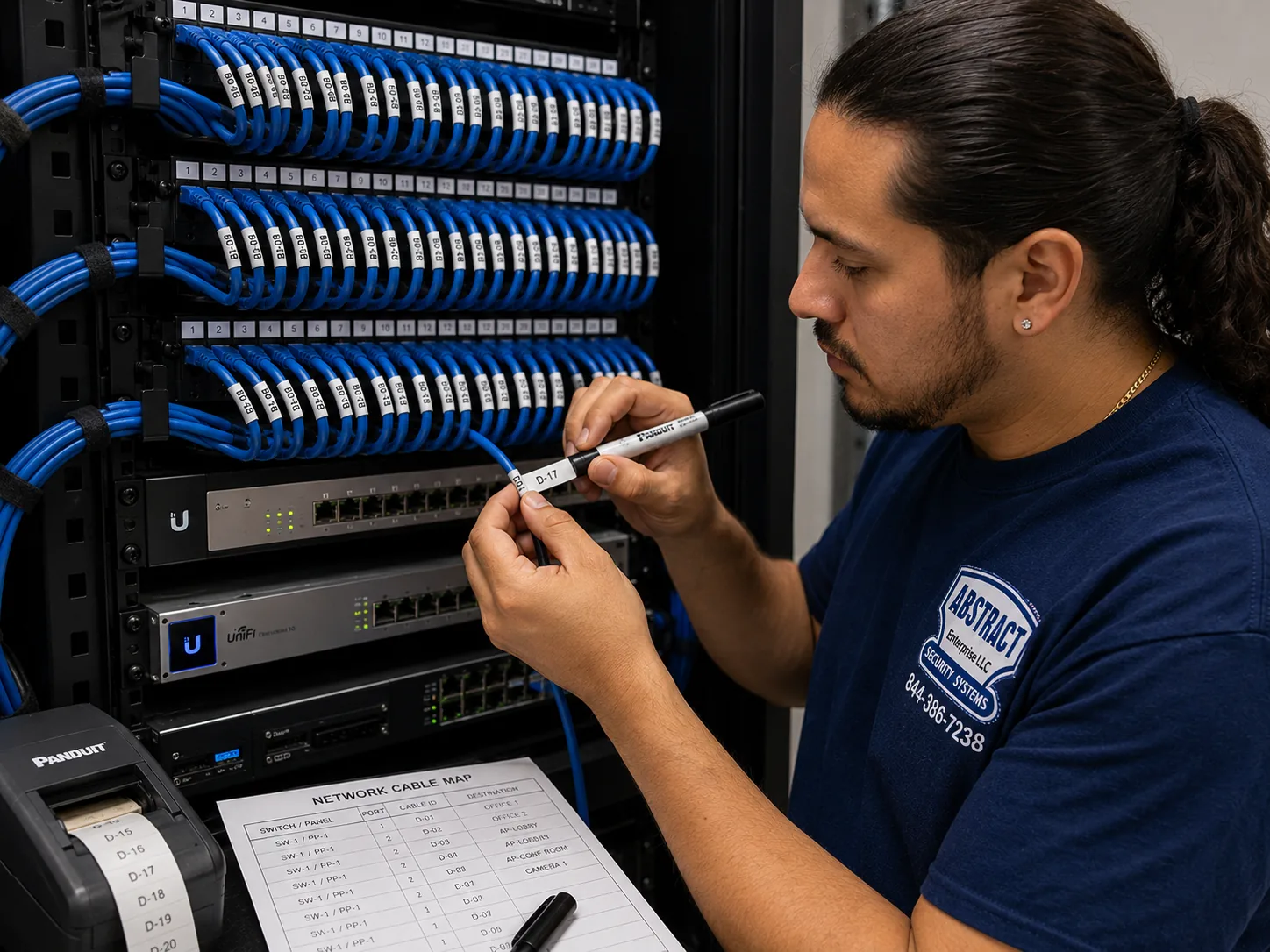
Photo from the AESS job library, not taken on Long Island: a technician printing cable labels at a patch panel, with a printed port map beside the work. When a split-level in Uniondale or a colonial in Suffolk gets four or more wired First Alert cameras, every run is labelled at both ends like this, so the next person to open the closet knows which cable feeds the camera over the back door.
Long Island First Alert Cameras
Tell us the house type, how many cameras, and whether a First Alert or Honeywell panel is already installed
✅
Request Sent!
We'll call about your Long Island First Alert cameras the same business day.
25+
Years Experience
✓
Same-Day Estimates
100%
Licensed & Insured
4.7★
201 Google Reviews
Owner-operated since 2002 · Thousands of jobs completed · Booked within 2 hours
First Alert camera installation on Long Island means mounting, powering and enrolling Resideo's First Alert VX cameras and VX doorbell so they run on your Wi-Fi or a wired PoE line, appear in the Total Connect app and, if you have one, on your ProSeries touchscreen. Our installed prices for Long Island sit on the Long Island First Alert price page, with Nassau County and Suffolk County on their own lists; equipment and labor are shown as separate lines, and the written quote names every line before you book. We confirm the house type, the account holder and the panel on the phone, and requests are booked within 2 hours. Call (800) 486-0943 or use the form.
Every camera position checked for Wi-Fi strength against the -65 dBm minimum and 2 Mbps of steady upload that the VX3 install guide calls for, before a single hole is drilled
Slab houses, masonry Capes and finished split-levels each get the power path their walls allow: PoE through the attic, a plug-in adapter within reach of its 10-foot cord, or a surface back box fed by conduit
Low-voltage work under NYS license #12000287431, with panel-linked cameras set up so they help, rather than hurt, a Nassau or Suffolk alarm permit
Why Long Island Properties Need First Alert Camera Installation
Long Island's camera problem starts with how the island was built: one house at a time, on its own lot, with its own back door. The Census Bureau's 2023 American Community Survey five-year estimates put three in four Nassau housing units and four in five Suffolk units in detached one-family buildings. Nassau's median home was built in 1955, Suffolk's in 1970. In practical terms, a camera job here is rarely about a lobby, a riser or a building manager. It is about one family's front walk, side yard, driveway, garage, back patio and basement windows, all of which face the street or a neighbor rather than a hallway, and all of which need a camera that can be powered, reached by Wi-Fi or cable, and seen in an app. First Alert's VX cameras were designed for exactly that kind of job. Resideo, which owns First Alert, describes the VX Series as AI video built to work with its smart home products, with a video doorbell and indoor and outdoor cameras that installers can power by AC, Ethernet, Wi-Fi or PoE and tie into ProSeries and VISTA alarm panels.
The houses themselves shape every First Alert install we plan here. Levittown is the clearest example. Kerri Murray Architecture records that 17,447 homes were built there between 1947 and 1951, that the ranches were built on concrete slabs with an expandable attic and no garage, and that they were heated by hot-water radiant pipes laid into the slab. A slab house has no basement, so there is no easy way to bring cable up from below to a camera on an outside wall. Cable goes through the attic and down, or along the outside of the house, and nobody should drill into a floor that may still hold heating pipes. Farther west, in the Uniondale section of the Town of Hempstead, a local HVAC contractor describes many homes along Uniondale Avenue and around Front Street as built between the 1940s and 1960s, mostly Cape Cods, ranches and split-levels. Redfin lists 1121 Front Street as a 1948 Cape Cod with masonry exterior walls. A masonry Cape does not take kindly to a cable fished through the wall, which is why Resideo's VX3 outdoor camera has an optional back box that sits on the surface and accepts conduit.
Then there is the reason people call in the first place. In Uniondale, CBS New York reported a burglary in which a suspect entered a home on Atom Court through a basement window around 10 p.m., and another in which suspects got into a Walton Avenue home by breaking through the back door. In June 2026, ABC7 reported that three suspects walked up an East Hills driveway at 3:45 a.m. and rummaged through a car before at least two of them went into the house. An earlier ABC7 report on a joint Nassau and Suffolk burglary task force quoted police saying the burglars are attracted by cars in people's driveways. LI Life & Politics reported that Nassau burglaries rose from 234 to 245 in the January to May period from 2025 to 2026, even as overall property crime fell. None of those cases involved a camera at the front door. They involved basement windows, back doors and driveways, which is where a First Alert layout on a Long Island house has to reach if it is going to show you anything useful.
Package theft and tampering add two more requirements. In November 2025, CBS New York reported that the Suffolk District Attorney charged 14 men in a porch theft ring that worked 31 communities, including Brentwood, Central Islip, Shirley and Deer Park, and allegedly learned when phones and tablets were being delivered. News 12 Long Island has covered porch thefts caught on doorbell cameras on Walters Avenue in Wantagh and Atlantic Avenue in Massapequa Park, and CBS New York reported a thief who waved at a camera on Rider Avenue in Patchogue. ABC7 reported a man in Central Islip caught on video using a knife on a doorbell camera. In May 2026, Daily Voice reported that a burglary crew in North Valley Stream repositioned a homeowner's cameras and covered the lenses with tape while the family was away. So the doorbell has to see the package spot, not just the face at the door, and the outdoor cameras have to be mounted high enough and positioned so that nobody can reach up and turn them toward the sky.
The biggest difference between a First Alert install on Long Island and one in the city is the alarm permit. First Alert sells its systems as professionally installed, with cameras, video doorbells and monitoring, and many VX cameras end up linked to a monitored panel. The Nassau County Police Department's Alarm Permit Section says alarm permits are required for all alarm systems, and that a location can face suspension, revocation or placement in No Police Response Mode if its false alarms exceed two in a calendar year. The same page says Nassau police are asked to respond to more than 125,000 false alarms each year. Suffolk runs its own Alarm Management Program with residential and commercial registration. A camera that sends alerts every time a car's headlights sweep the driveway is an annoyance on a phone. A camera that is part of a monitored system and helps trigger dispatches it should not is a permit problem. That is why the detection settings matter as much as the mounting.
Businesses face the same choices on a larger scale. News 12 Long Island reported in September 2026 that the owner of Morning Delights in Uniondale got a motion alert from his security camera, went to the restaurant, and confronted a burglary suspect; an arrest followed. Wikipedia describes the East Garden City area around the Nassau Hub as home to almost half the county's economic activity. Shops, offices, flex buildings and warehouses along Hempstead Turnpike, Old Country Road, Route 110 and the Hauppauge industrial park all have back doors, loading areas and parking lots after closing time. For those owners, the question is less about one doorbell and more about which doors and lots need a camera, how alerts reach the right person at night, and how the cameras fit with an alarm panel the business may already pay a dealer to monitor.
We also want to be clear about what our research did not find. We searched for Long Island Reddit threads, Yelp reviews and local news about First Alert camera installation specifically and found none. Google's People Also Ask boxes, related searches, AnswerThePublic and Bing results were not available to us when we built this page, so nothing here quotes them. We did find that First Alert Professional lists an office in Melville and works through authorized dealers who own security businesses in their own communities, that Resideo's VX3 launch release quotes Paul Romanelli of Suffolk Security Systems, a First Alert Pro Resideo Premier Partner, praising the camera's "back box that stows cables out of the way," and that PROTECH Surveillance in Manorville installs the First Alert doorbell on eastern Long Island. We mention them because they show how First Alert is sold here: through dealers who hold the accounts. We are not claiming a relationship with any of them. When you call us, the first thing we sort out is who holds your account, so the cameras we mount can actually be enrolled to it.
Long Island facts that shape a First Alert camera install
Mostly detached houses: 364,529 of Nassau's 477,860 housing units and 463,095 of Suffolk's 579,790 are one-unit detached homes, according to the Census Bureau's 2023 five-year estimates.
Two housing eras: the same survey puts Nassau's median build year at 1955 and Suffolk's at 1970, which usually means older Capes and ranches to the west and more colonials and split-levels farther east.
Slabs with no basement: Levittown's 17,447 homes, built from 1947 to 1951, sit on concrete slabs that carried radiant heating pipes, so camera cable cannot come up from below.
Weak points at the back: Uniondale break-ins reported by CBS New York came through a basement window on Atom Court and a back door on Walton Avenue, and police have said burglars are drawn to cars in driveways.
Strict alarm counting: Nassau requires a permit for every alarm system and acts when false alarms exceed two in a calendar year; its police are asked to respond to more than 125,000 false alarms a year.
Two big counties: ny.gov describes Nassau as two cities, three towns, 64 incorporated villages and more than 60 hamlets over 453 square miles, and Suffolk as 10 towns over 2,373 square miles, so rules and travel both vary by address.
What owners often add once the cameras are up. Because so many Long Island break-ins in the news came through basement windows and back doors, the most common follow-on request after a First Alert camera job is a contact sensor or glass-break detector on those same openings, wired into the panel the cameras already report to. If you think you will want that, say so when you book, so the cable paths we plan for the cameras can serve the sensors too.
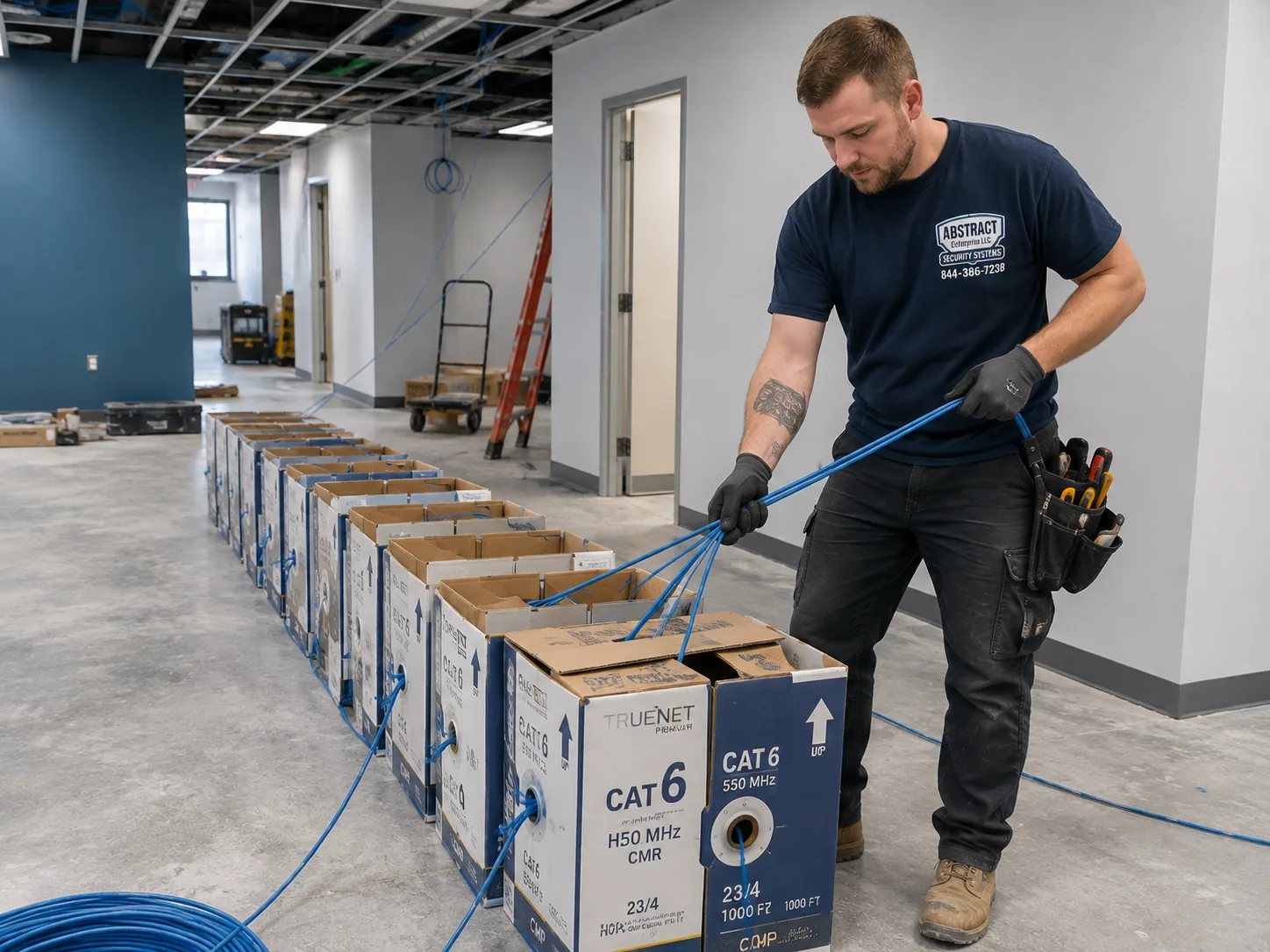
Photo from the AESS job library, not taken on Long Island: boxes of network cable staged for a pull of several runs at once inside a working premises. On a 1970s Suffolk colonial or a Hauppauge flex building where six or more First Alert cameras will be wired for PoE, staging every box at one starting point means each run goes in during one pass through the attic or ceiling.
Camera Offline, Doorbell Dead or a Break-In Last Night? Getting Help on Long Island
If someone came through a back door or basement window last night, call the police first and keep whatever footage you have; do not reset the camera or the app until it is saved. Then call (800) 486-0943. The other urgent calls we hear about First Alert gear are a VX camera that shows offline every evening, a doorbell that stopped ringing the chime, and cameras that went dark after a storm and never came back. Tell us the house type, where the router sits, and whether a panel is installed, and we will tell you on the phone what we think failed. Requests are booked within 2 hours. We will not promise an install the same day, but we will give you the earliest honest slot.
Cape, Slab Ranch, Split-Level, Colonial: How a Long Island House Decides the First Alert Cable Route
Two First Alert VX3 cameras can look identical on a box and need completely different installs on two houses a mile apart. The difference is almost never the camera. It is whether the house has a basement, an attic you can crawl, a wood or masonry exterior, a router in a good spot, and an outlet anywhere near the soffit. The table below sets out the house types the public record and local sources describe on Long Island, with a real example where one exists, and the cable and power route we expect to use. The last column is a working assumption from houses of that kind, not a statement about any particular address; we confirm every one on the walk-through.
House type
Example from public sources
What it is
How a VX camera usually gets power and signal
Levitt-era Cape or ranch on a slab, 1947–1951
Levittown's 17,447 homes
Slab-on-grade, wood frame, small attic, radiant heat in the floor on original houses
Through the attic to the soffit, or along the outside in a raceway; never through the slab
Post-war Cape with masonry walls
1121 Front Street, Uniondale (1948)
Cape Cod with masonry exterior walls
Surface back box with conduit, or a hole drilled through the masonry at the camera and sealed
Legal two-family house
176 Uniondale Avenue (1952)
Two bedrooms and one bath over two bedrooms and one bath
Two households sharing one exterior; cable often from a shared basement, Wi-Fi from whichever unit owns the account
Garden apartments
1140 Front Street, Uniondale (1959)
Classed as an apartment property of more than six families
Indoor VX5 inside the unit; exterior cameras only with the owner or board's approval
Split-level or high ranch, 1950s–1960s
Uniondale Avenue and Front Street area
Three or more short floor levels, often a garage under one end
Cable from the lower level or garage up to the eaves; Wi-Fi often weak at the far end
1970s colonial
Suffolk's median build year of 1970
Two full floors, attached garage, larger lot
Attic runs to second-floor eaves; garage for the PoE switch; more cameras for driveway, pool and yard
Gold Coast estate or large North Shore lot
Wikipedia counts over 500 mansions built from the early 1890s
Large house, outbuildings, long drives, often subdivided later
Wired PoE almost everywhere; Wi-Fi rarely reaches gates and outbuildings
South Shore wood-frame and shingle houses
Described by local installers across the South Shore
Cedar shingle or clapboard, often near water
Mounts on solid blocking under the shingles, every penetration sealed against salt air and wind-driven rain
The slab houses of Levittown and the towns around it
The Levitt houses, and the many copies of them built nearby in the same years, are the single most common reason a First Alert camera job on Long Island takes a different route than the homeowner expected. With no basement, there is no place to stand under the house and drill up into a wall. The original radiant heat pipes were in the slab, and while a heating contractor's account suggests only a small share of those systems are still in use, we never assume a slab is empty of pipes. So for a wired camera, the cable goes up into the attic, across the ceiling joists, and down to the soffit or the top of the wall where the camera mounts. The 1949 ranches in Levittown, as Kerri Murray Architecture notes, came with an expandable attic, which usually means there is room to move. The earlier Capes often had their attics finished into bedrooms decades ago, which leaves only the low knee-wall spaces at the eaves. That is often the place we work from, carefully, with a flashlight and a short drill.
Masonry Capes in Uniondale and other Hempstead hamlets
A Cape like the 1948 house Redfin lists at 1121 Front Street, with masonry exterior walls, changes the question from where to run the cable to whether to run it through the wall at all. Alarm Grid's install guide for the VX3 recommends a cable hole of 7/8 inch or larger. Through a frame wall that is a small hole. Through masonry it is a core of masonry removed with a hammer drill, which then has to be sealed so water does not follow the cable inside. Alarm Grid describes Resideo's optional back box as being for installations where in-wall wiring is not possible, able to accept up to three half-inch conduits, and rated IP66. On a masonry Cape we usually look at both: a sealed hole where the inside of the wall is easy to reach, and the back box fed by conduit along the outside where it is not. Either way, you see the plan before we drill.
Split-levels and high ranches, and the far-end Wi-Fi problem
The split-levels common along Uniondale Avenue and in many Nassau and Suffolk subdivisions of the 1950s and 1960s put short floors at different heights, with the router often in a den on one level and the bedrooms half a flight up at the other end. A camera over the garage or the back patio can end up two floors and several walls from the router. Alarm Grid's VX3 guide says to verify a minimum Wi-Fi signal of -65 dBm at the install location and a continuous upload speed of at least 2 Mbps. In a split-level, those are the numbers that fail first. When they do, we have three honest choices: run Ethernet and use PoE, add a wired access point closer to that end of the house, or move the camera to a spot the Wi-Fi already reaches. We measure before we suggest any of them.
Two-family houses and garden apartments
Movoto describes 176 Uniondale Avenue as a 1952 legal two-family, two bedrooms and a bath over two bedrooms and a bath. In a house like that, two households share one front door, one driveway and one back yard, but usually only one owns the house and pays for the First Alert account. Cameras on the outside of a two-family are the owner's decision, and the footage they capture of the shared yard and entrances needs to be agreed between the two households before the install, not argued about afterward. Redfin classes 1140 Front Street, built in 1959, as an apartment property of more than six families. In buildings like that, an individual tenant or shareholder can usually put a First Alert VX5 indoor camera inside the unit, and its automatic privacy shutter makes it easier to live with; anything outside the unit needs the landlord or board.
Suffolk colonials, North Shore estates and South Shore shingle houses
Farther east, the 1970 median build year shows in the colonials with attached garages and larger lots. Our own residential installer guidance for Long Island suggests one to three cameras for a condo or townhouse, four to eight for a ranch or split-level, and six to twelve for a colonial with a driveway, a pool and a garage. At that count, wired PoE from a switch in the garage or basement is usually more reliable than a dozen cameras on one home router. On the North Shore, where Wikipedia records more than 500 Gold Coast mansions built from the early 1890s and many estates later subdivided, distance and outbuildings rule out Wi-Fi at the edges almost every time. On the South Shore, cedar shingle and clapboard houses near the water need every camera mounted on solid wood behind the shingles and every hole sealed, because wind-driven rain off the bays will find any gap.
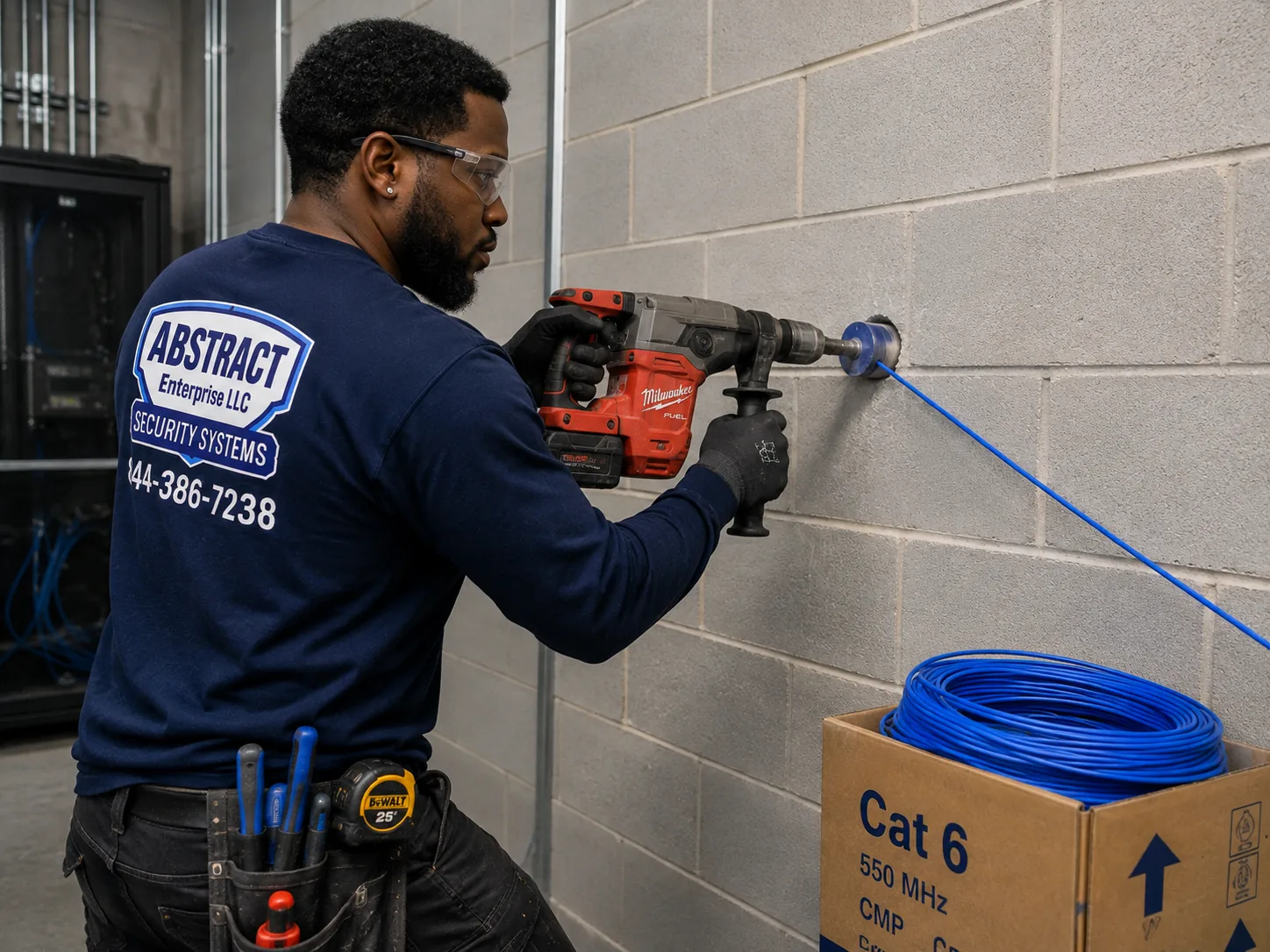
Photo from the AESS job library, not taken on Long Island: a technician core drilling through a block wall to carry cable through to a network room. On a masonry-walled Cape in Uniondale, the hole for a First Alert VX3's cable through the outside wall is drilled the same way, slowly and level, then sealed so rain cannot follow the cable inside.
Before You Book
Router, Panel, Doorbell Button: Five Minutes of Checks Before a Long Island First Alert Visit
Most of the delays on a First Alert job happen before anyone climbs a ladder: an account nobody can log into, a panel too old to show video, a doorbell button with no wires behind it, or Wi-Fi that looks fine in the kitchen and falls apart at the back fence. A short look around the house, a few photos and one speed test on your phone answer most of those questions in advance. Please do not take apart the panel, open the doorbell transformer or cut into walls yourself. Just look and send us what you find.
What to check
Why it matters for First Alert on Long Island
What to send us
Who holds your First Alert or Honeywell account
The VX3 is a Total Connect 2.0 camera and needs a TC2 smart video account to enroll; that account usually sits with a dealer
The dealer's name from a sticker on the panel, or the company that bills your monitoring
The panel on the wall, if any
VX cameras can be viewed on a PROA7PLUS or PROA7PLUSC touchscreen running version 03 or higher
A photo of the panel and its model label
Upload speed at the far end of the house
The VX3 guide asks for a continuous 2 Mbps or faster upload on Wi-Fi
A screenshot of a speed test taken where the farthest camera will go
Where the router and modem sit
Split-levels and colonials often put the router at the opposite end from the driveway or patio
A photo of the router and a note of which room it is in
The front door and doorbell button
A wired doorbell needs a working transformer and chime, or a different power plan
A photo of the button, the chime and the area around the door
Outlets near the camera spots
The VX3's power transformer cord has a 10-foot maximum
Where the nearest indoor or outdoor outlet is to each camera position
Attic and crawl access
On slab houses, cable usually travels through the attic
Where the attic hatch is and whether the attic has been finished
Basement windows and back doors
Local break-in reports point to those openings, not the front
A photo of each from outside
HOA, condo or landlord rules
Shared exteriors need approval before we mount
The rule or the contact for the board or managing agent
Run the speed test where the camera will hang
A speed test taken on the sofa tells you very little about a camera over the garage. Stand as close as you can to where the outdoor camera will mount, outside if the weather allows, and run the test there. Look at the upload figure, not the download. Many home internet plans offer plenty of download and much less upload, and cameras push video up, not down. If the upload at that spot is below what the VX3 guide asks for, or the test stalls, tell us. It does not mean the job cannot happen; it means that camera probably needs a cable, a wired access point, or a different spot. We measure signal strength ourselves on the day, but your screenshot lets us bring the right parts the first time.
Find the panel's model and the dealer's name
If your house already has an alarm keypad or touchscreen, look for a model label on the side or under a flap, and look for a dealer sticker on the panel or on the alarm box in a closet or basement. First Alert Professional works through authorized dealers who hold the accounts, and a review site notes that prices and offers vary among the dealers in an area. You do not need to know anything technical about the account. You only need to know which company it is with, so we can tell you whether new cameras can be enrolled to it, whether the dealer needs to do that part, or whether a separate camera account makes more sense.
Look at the doorbell before you buy the VX doorbell
On many older Long Island houses, the doorbell button has been replaced or painted over several times, and the chime in the hall may be decades old. Take a photo of the button, the chime cover and the area where the doorbell transformer might be, often near the boiler, the electrical panel or in a closet. If there is no chime at all, or the button is wireless, that tells us the doorbell will need a new power plan. We would rather know that before the visit than discover it with the new doorbell in hand.
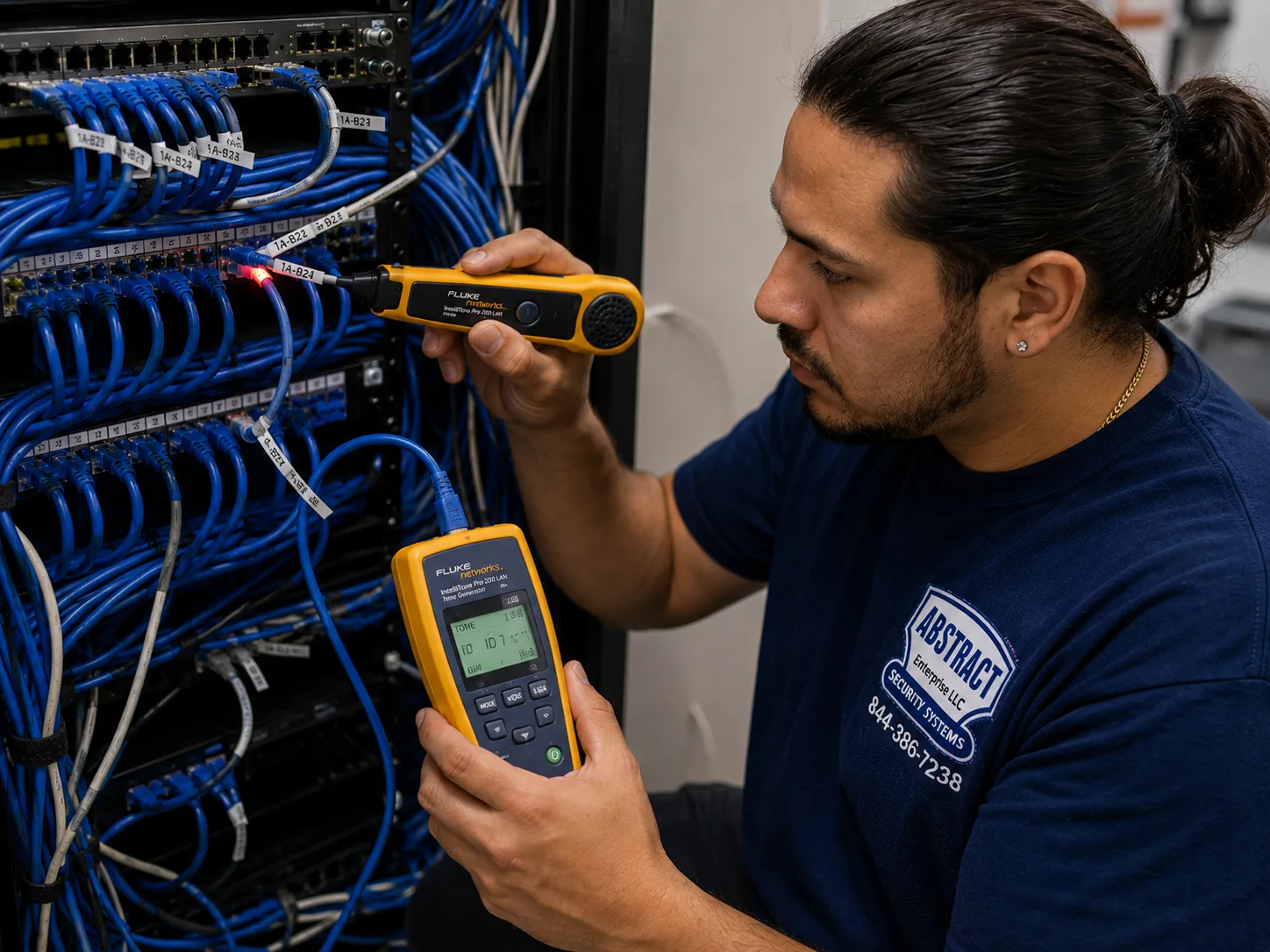
Photo from the AESS job library, not taken on Long Island: a technician tracing an unidentified cable run at a patch panel with a tone generator and probe. Many Long Island houses already have old alarm, phone or coax wiring left by a previous dealer or owner, and tracing it like this tells us whether a run can be reused for a First Alert camera or should be left alone.
What We Install
First Alert Camera Installation Services on Long Island
These are the First Alert jobs Long Island homeowners, landlords, condo owners and business owners ask us about. Each one is priced from our Long Island First Alert price list, with Nassau and Suffolk addresses on their county lists. Where a job needs something extra, such as a back box and conduit on a masonry wall or a wired access point at the far end of a split-level, the written quote names it before you book.
📷
VX3 Outdoor Cameras on Eaves and Soffits
First Alert VX3 outdoor cameras mounted to cover back doors, basement windows, driveways and side yards, with signal and upload checked at each spot and cable hidden in attics where the house allows it.
🔔
VX Video Doorbell at the Front Door
The First Alert VX doorbell placed so it sees the package spot as well as the face at the door, powered from the existing doorbell wiring where it works, and enrolled to the same account as the cameras.
🏠
VX5 Indoor Cameras With a Privacy Shutter
Indoor cameras for front halls, basements and garages. Resideo says the VX5 tells people from pets, uses a 2MP sensor with wide dynamic range, and closes an automatic privacy shutter.
🔌
PoE Runs Through Attics and Garages
Ethernet cable run from a PoE switch or injector to cameras that Wi-Fi cannot reach reliably, using the VX3's 802.3af Class 3 PoE input, tested and labelled at both ends.
🧱
Back-Box Mounts on Masonry and Siding
Resideo's surface back box, which accepts up to three half-inch conduits, used where a cable cannot go inside the wall, such as masonry Capes and finished rooms nobody wants opened.
📟
Panel and Touchscreen Integration
VX cameras made visible on a PROA7PLUS or PROA7PLUSC touchscreen at version 03 or higher, and linked to ProSeries or VISTA systems through the account holder.
📱
Total Connect App Setup and Detection Zones
Every camera in the app, alerts set for the people who need them, detection zones drawn to ignore the road and the neighbor's yard, and audio left off unless you choose otherwise.
🛠
Offline and Failing First Alert Cameras
Cameras that drop off at night, doorbells that stopped ringing, and systems that never came back after an outage, diagnosed from signal, power and account, not guesswork.
🏬
Business Camera Layouts
First Alert cameras for shops, offices, flex units and warehouses, planned door by door and lot by lot with the owner, and scheduled around opening hours.
If a First Alert camera is not the right fit for a particular spot, for instance a long driveway gate that needs a camera far from any power, we will say so and quote a wired non-branded camera for that position instead. The goal is a system that shows you what happened, not one brand on every wall.
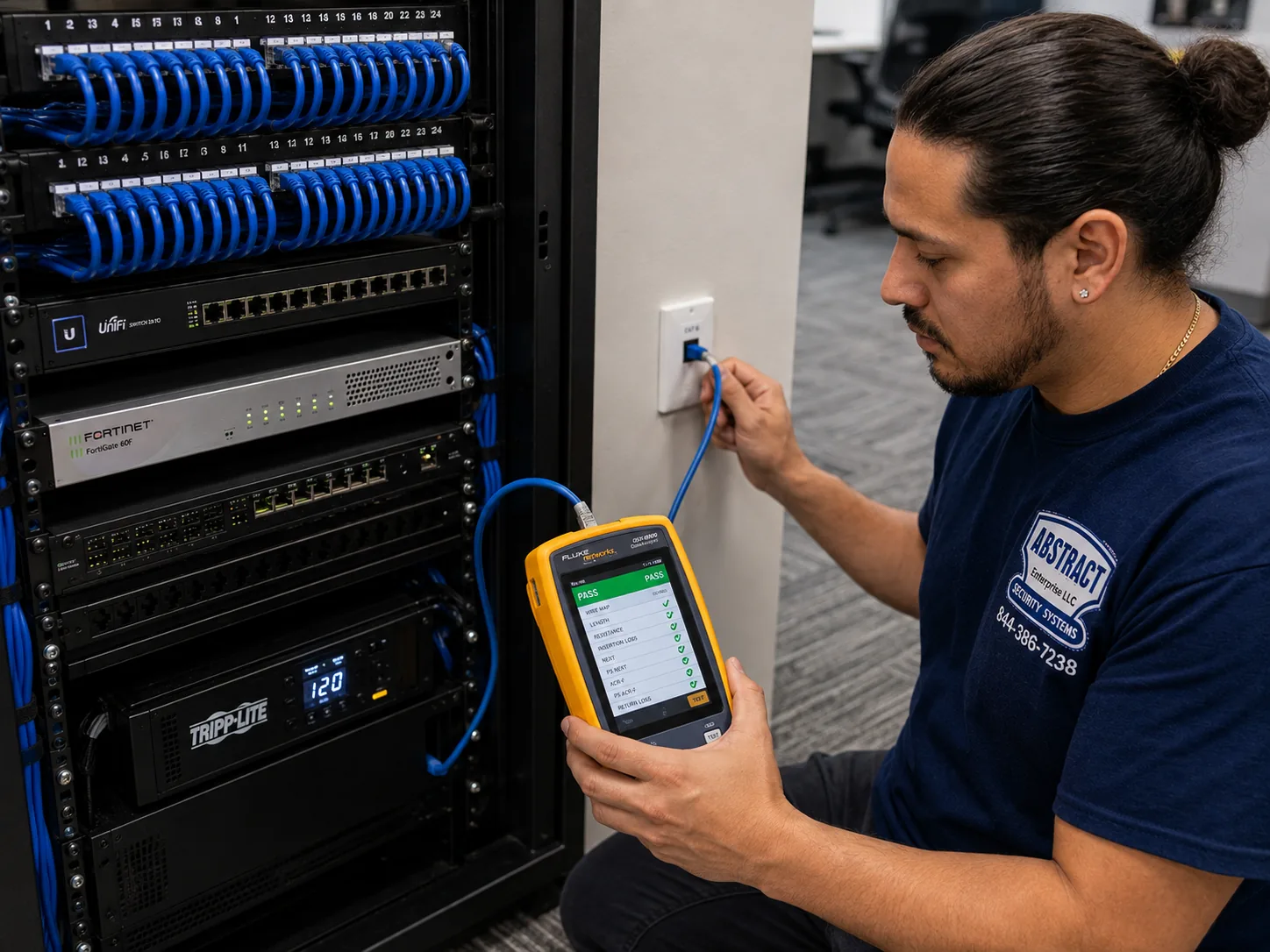
Photo from the AESS job library, not taken on Long Island: a technician certifying a data drop with a cable analyzer that shows a PASS result. Every PoE cable we run to a First Alert VX3 on a Long Island house gets a test like this before the camera goes up, because a cable that fails later in a hot attic is much harder to reach than one fixed on the day.
Building Specialists
First Alert Camera Installation for Long Island's Architecture
The island's houses fall into a handful of families, and each one changes three things about a First Alert job: where the camera can be fixed, how its power and signal reach it, and who has to agree before we mount. These are the types the public record, census figures and local sources describe on Long Island, and how we handle each.
Slab-Built Capes and Ranches
The Levitt houses and their neighbors from the late 1940s and early 1950s. No basement, small or finished attics, and floors that may hold heating pipes. Cable goes up and over, never down.
Masonry-Walled Post-War Capes
Houses like the 1948 Cape on Front Street in Uniondale. Solid walls that take a hammer drill and a sealed hole, or a surface back box with conduit, depending on what is inside.
Split-Levels and High Ranches
Short floors at staggered heights, a garage tucked under one end, and a router often far from the driveway. The far-end Wi-Fi check decides most of the plan.
Legal Two-Family Houses
Two apartments, one exterior, one owner. Cameras on the outside are the owner's call, with the views of shared spaces agreed between the households first.
Garden Apartments, Condos and Co-ops
Complexes like the 1959 apartment property at 1140 Front Street. Indoor VX5 cameras inside the unit; exterior cameras only with the board or landlord's written approval.
Suffolk Colonials With Garages
Two full floors, attached garages and larger lots. More cameras, longer runs, and a PoE switch in the garage or basement rather than everything on Wi-Fi.
North Shore Estates
Large houses, gatehouses, pool houses and long drives. Wired runs to outbuildings, careful aiming at the property line, and a recorder or switch location that stays powered.
South Shore and Waterfront Houses
Cedar shingle and clapboard near the bays, salt in the air and wind-driven rain. Solid blocking behind the mount and every penetration sealed.
Seasonal East End Homes
Houses empty for weeks at a time. Indoor and outdoor coverage that works without anyone home, with alerts going to someone who can actually respond.
How the house type changes the First Alert job
Home
Where the camera is fixed
How power and signal usually get there
Who decides
Slab-built Cape or ranch
Soffit, fascia or the top of a frame wall
Attic run to PoE or an adapter indoors; Wi-Fi where signal tests well
The owner
Masonry-walled Cape
Masonry face or a surface back box
Sealed hole through masonry, or conduit into the back box
The owner
Split-level or high ranch
Eaves above the garage, patio and side doors
Cable from the lower level or garage; access point at the far end if needed
The owner
Legal two-family
Shared exterior, each entrance
Shared basement or garage, one account
The owner, with the other household's agreement on shared views
Garden apartment or condo
Inside the unit
Indoor outlet and the unit's Wi-Fi
The tenant or owner inside; the board or landlord for anything outside
Suffolk colonial
First and second-floor eaves, garage, pool area
PoE switch in the garage or basement, attic runs
The owner, and an HOA where one exists
North Shore estate
Main house, outbuildings, gates
Long wired runs, separate switches in outbuildings
The owner or estate manager
South Shore or waterfront
Solid blocking behind shingle or siding
Sealed penetrations, conduit where the run is exposed
The owner, and the village where rules apply
On hot attics and PoE cable. On a slab ranch or a colonial, the attic is usually the only path from the inside of the house to the camera, and Long Island attics get hot in July. Fluke Networks explains that as temperature rises, a cable link's insertion loss rises too, and quotes the ISO/IEC standard reducing allowable length by 0.4 percent per degree Celsius between 20 and 40 degrees for unscreened cable, and by 0.6 percent per degree above that. A short run to a camera over the patio is nowhere near the limit. A long run along the ridge of a big colonial to a camera at the far corner can get closer to it than people think. So we keep attic runs as short as the house allows, lay them low near the ceiling joists rather than up under the roof deck where it is hottest, and test every run before the camera goes on.
On drilling masonry and sealing it. The VX3 guide's recommended cable hole is 7/8 inch or larger, which is easy in a wood-frame wall and serious work in masonry. We mark the hole where the inside is reachable, drill with the hammer action off until we are through the surface so the face does not spall, then switch it on to finish. The hole is angled slightly down toward the outside so water runs out, not in. Once the cable is through, the gap is sealed with an exterior-grade sealant. Where the inside of the wall is a finished room with no access, we leave the wall whole and use the back box with conduit along the outside instead. On cedar shingle and vinyl siding, we mount on solid wood behind the cladding, never on the shingle or siding alone, because a camera that loosens in the wind loses its view.
On seasonal homes. The East Hampton Star reported police releasing a still from a camera inside one of two houses burglarized on Sammy's Beach Road in East Hampton. That is the case for indoor cameras in houses that sit empty, but only if someone sees the alert and can act. For seasonal houses we set the alerts to go to more than one person, make sure the router and any PoE switch are on a battery backup, and talk with you about whether the cameras should be tied to a monitored panel, which brings the alarm permit rules described below into play.
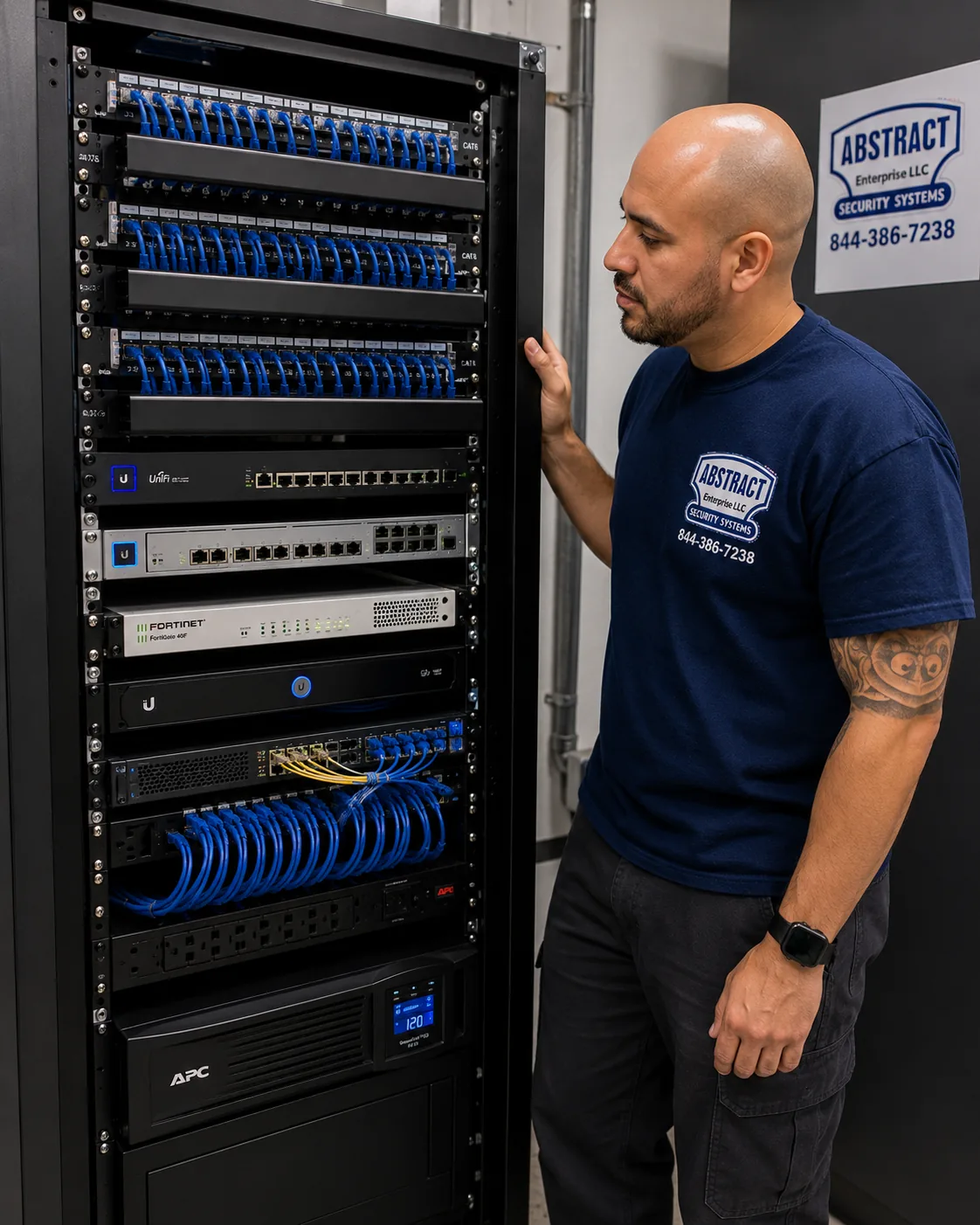
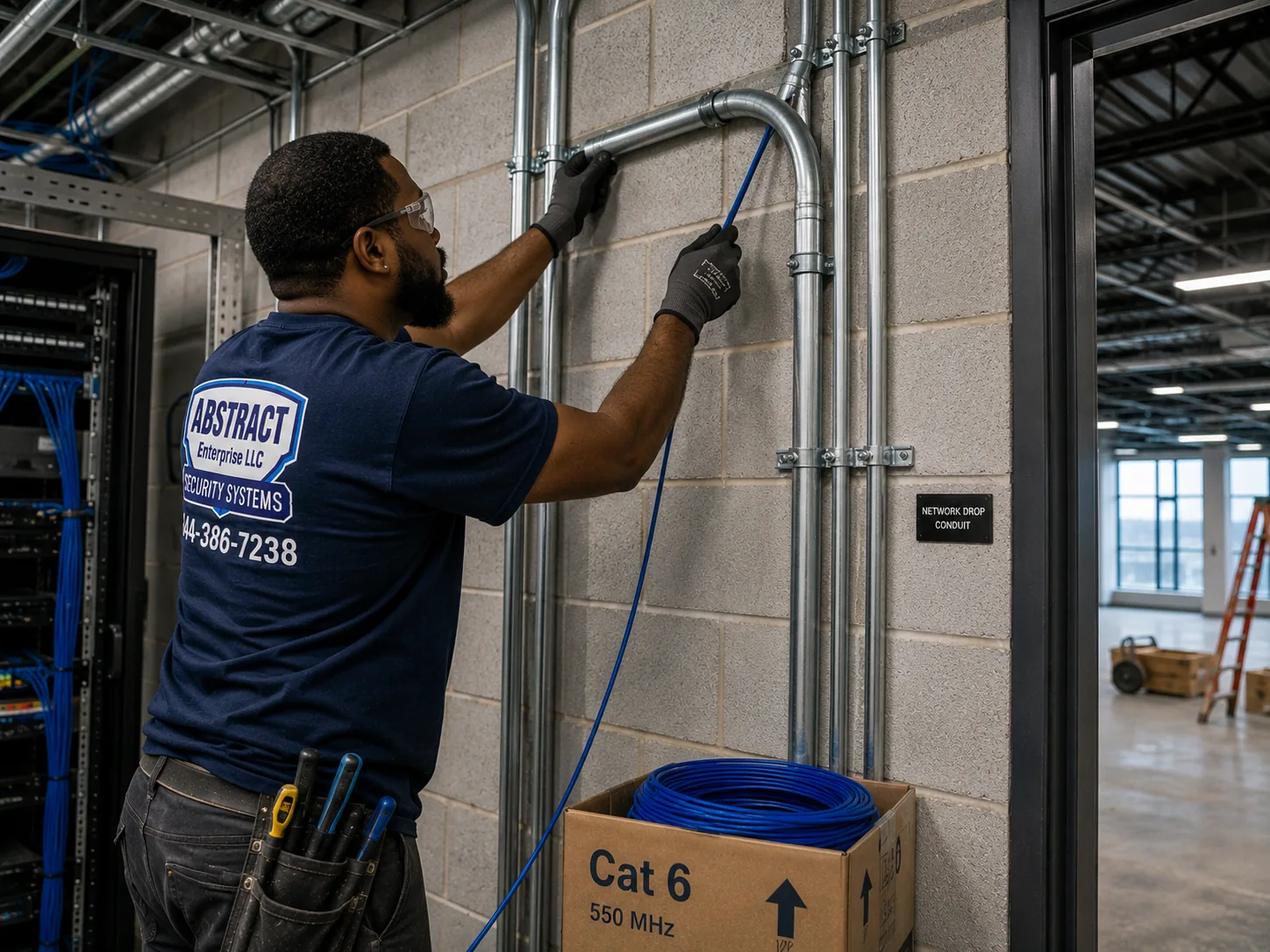
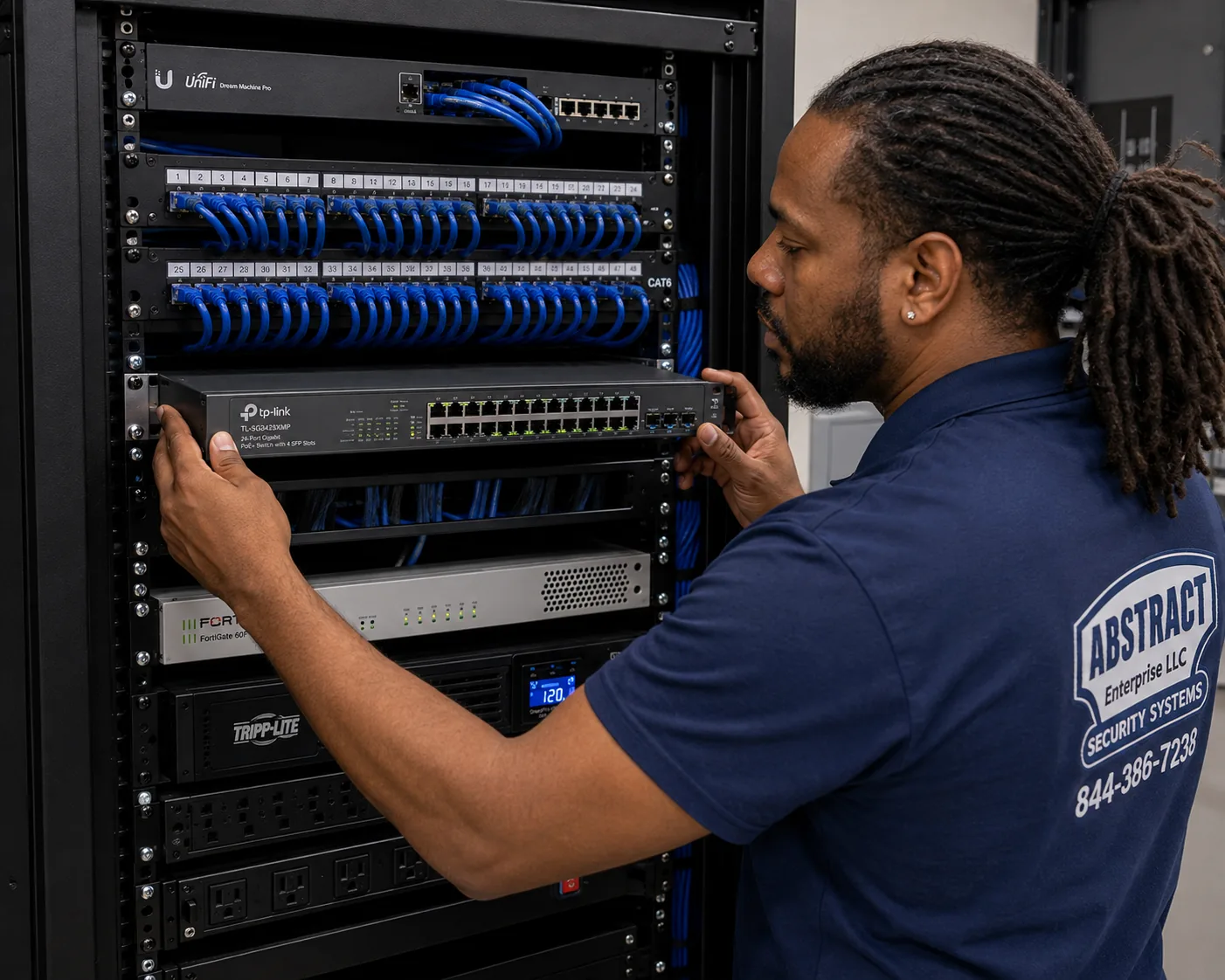
Photo from the AESS job library, not taken on Long Island: a finished network rack with patch panels, switching, a firewall and a battery backup, every cable dressed and identified. A North Shore estate or a large Suffolk colonial with a dozen First Alert cameras needs a home for its switch and router like this, with battery backup, because a storm outage that drops the network also drops every camera on it.Photo from the AESS job library, not taken on Long Island: a technician running cable into EMT conduit beside a telecom room in an industrial building. Where a First Alert VX3 has to mount on a masonry Cape or a block flex building and the cable cannot go inside the wall, it travels in conduit like this into the camera's back box.
Commercial First Alert Camera Installation
Business First Alert Camera Installation on Long Island
Long Island's businesses are spread along a few long roads and gathered in a few large parks. The corridors below are named in Wikipedia, county and commercial real estate sources and local news. We describe what those sources say about each; we have no information about the camera systems inside any particular business there, and we do not claim any of them as customers.
The Nassau Hub and Hempstead Turnpike
Nassau Coliseum stands at 1255 Hempstead Turnpike in Uniondale, on the old Mitchel Field, and Wikipedia describes the area as home to almost half the county's economic activity. The Morning Delights burglary that News 12 reported in September 2026 happened in Uniondale.
Old Country Road and Roosevelt Field
Wikipedia calls Roosevelt Field the largest mall on Long Island, with 243 stores and 2,372,053 square feet of leasable area in the East Garden City section of Uniondale, built on the airfield where Lindbergh began his transatlantic flight.
Route 110 Through Farmingdale, Melville and Huntington Station
A commercial real estate firm describes the corridor as a dense concentration of warehouse, flex, R&D and office uses with access to the Long Island Expressway. First Alert Professional's listed office is in Melville.
Long Island Innovation Park at Hauppauge
Reported at about 1,350 businesses and roughly 55,000 workers across about 11 square miles, two-thirds of it in the Town of Smithtown. Flex and industrial buildings with loading doors and large lots.
Broadway in Hicksville
Wikipedia describes North Broadway as a significant retail center beside the island's busiest LIRR hub. The Mid Island Times reports a streetscape project between Old Country Road and West John Street, with the Macy's building expected to come down by December 2026.
Sunrise Highway and Merrick Road in Freeport
CBS New York describes Freeport as sitting on some of the island's busiest crossroads, including Sunrise Highway and Merrick Road, both lined with storefronts and service businesses.
The Ronkonkoma Hub
Suffolk is seeking a master developer for 48 acres within a 179-acre redevelopment area between Long Island MacArthur Airport and the Ronkonkoma LIRR station, according to GovMarketNews and Long Island Business News.
Jericho Turnpike and Route 25
One of the island's colonial-era routes, now a long commercial road, which Molloy University's history pages trace to the original island roads that became Route 25 and 25A.
What the Nassau Hub's future means for businesses nearby
The land around the Coliseum has been in flux for years. The LI Herald reported that Las Vegas Sands stopped pursuing its casino resort proposal for the Coliseum site, though sources disagree on exactly when that happened. In May 2026 the Herald reported Town of Hempstead residents pressing the town board to rescind the gambling zoning on the Hub, and Casino.org reported that a judge dismissed Garden City's lawsuit over the rezoning while Sands continued to look for someone to take over its lease. A 2026 development plan reported by a construction firm emphasizes office space for life sciences and research. For a business on Hempstead Turnpike or near Charles Lindbergh Boulevard, none of that changes the camera plan today. It does mean a site plan may change, a neighboring lot may become a construction site, and cameras aimed at a parking lot may need to be re-aimed later. We mount business cameras so they can be repositioned without new holes where the building allows.
What a business First Alert layout has to do
A house needs to see its doors, windows and driveway. A business needs to see the same things after closing, plus the register, the stockroom door, the loading area and the parking lot, and it needs alerts to reach someone who will respond at 2 a.m. The Morning Delights case is the pattern: a motion alert, an owner who saw it, a response. For that to work, the outdoor cameras have to be set to alert on people, not every passing car on Hempstead Turnpike, and the alert has to go to the phone of whoever is on call that night. Resideo's VX Series includes smart detection, and the Nassau research we relied on describes VX detection of people, packages, vehicles and animals. We draw detection zones on the doors and the lot, not the road, and we walk the owner through who gets which alert before we leave.
Rules and practical limits for business cameras on Long Island
Alarm licensing in New York State. General Business Law §69-m, as published on Justia, says no person may engage in the business of installing, servicing or maintaining security or fire alarm systems without a license, while the installation of passive, non-detecting security devices does not require one. A First Alert camera on its own is closer to the second. A First Alert camera tied to a ProSeries or VISTA alarm panel is part of an alarm system. We hold NYS license #12000287431 and quote that work accordingly.
Nassau alarm permits. The Nassau County Police Department requires a permit for every alarm system and can suspend or revoke it, or place the location in No Police Response Mode, when false alarms exceed two in a calendar year. A business adding cameras to a monitored panel should check that its permit is current before the install.
Suffolk alarm registration. The Suffolk County Police Department runs an Alarm Management Program with separate residential and commercial registration. The same rule of thumb applies: confirm the registration before cameras join the panel.
Where cameras may not look. Under New York Civil Rights Law §52-a, as summarized in coverage of neighbor camera disputes, it is unlawful to install or use video surveillance where a person has a reasonable expectation of privacy. Restrooms and changing areas are off limits, and we use privacy masking on outdoor cameras so they do not take in a neighbor's private yard.
Audio in the shop. The Reporters Committee for Freedom of the Press notes that New York makes it a felony to record a conversation you are not part of without the consent of at least one party. A camera microphone listening to customers and staff is a legal question, not a feature. We leave audio off by default.
Town and village permits. Sources disagree on whether low-voltage camera work needs a local permit; one installer says standard camera jobs typically do not, while a low-voltage trade site says New York's code has required permits for low-voltage installations since 1984 and that most Nassau towns and villages enforce permit rules. The Town of Hempstead code requires a building permit for work that must meet the Uniform Code or Energy Code. We check the rule for the specific address before quoting.
Insurance papers. Landlords, managing agents and parks often ask for a certificate of insurance before a contractor works on site. Send the request with the booking so it is ready on the day.
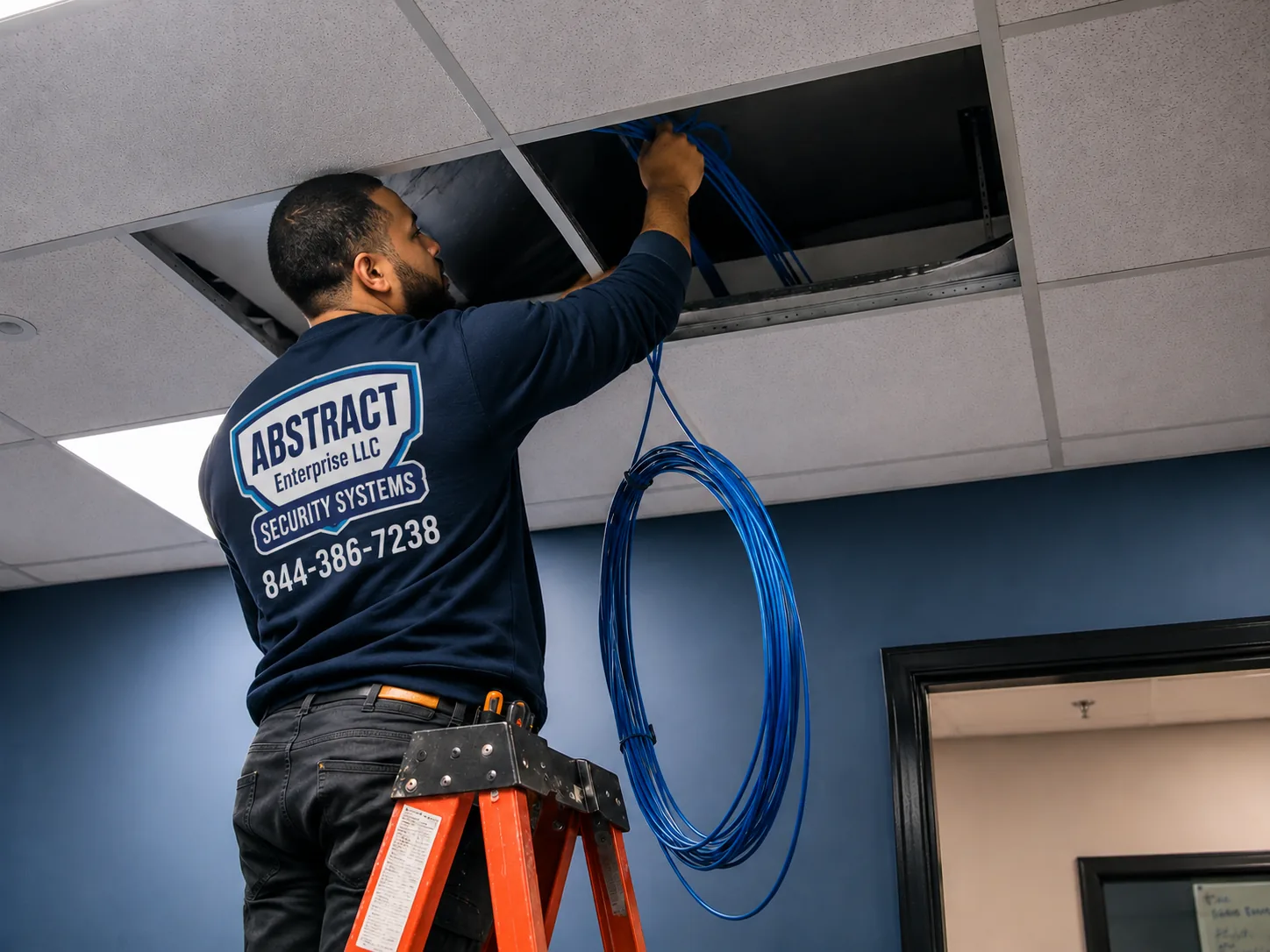
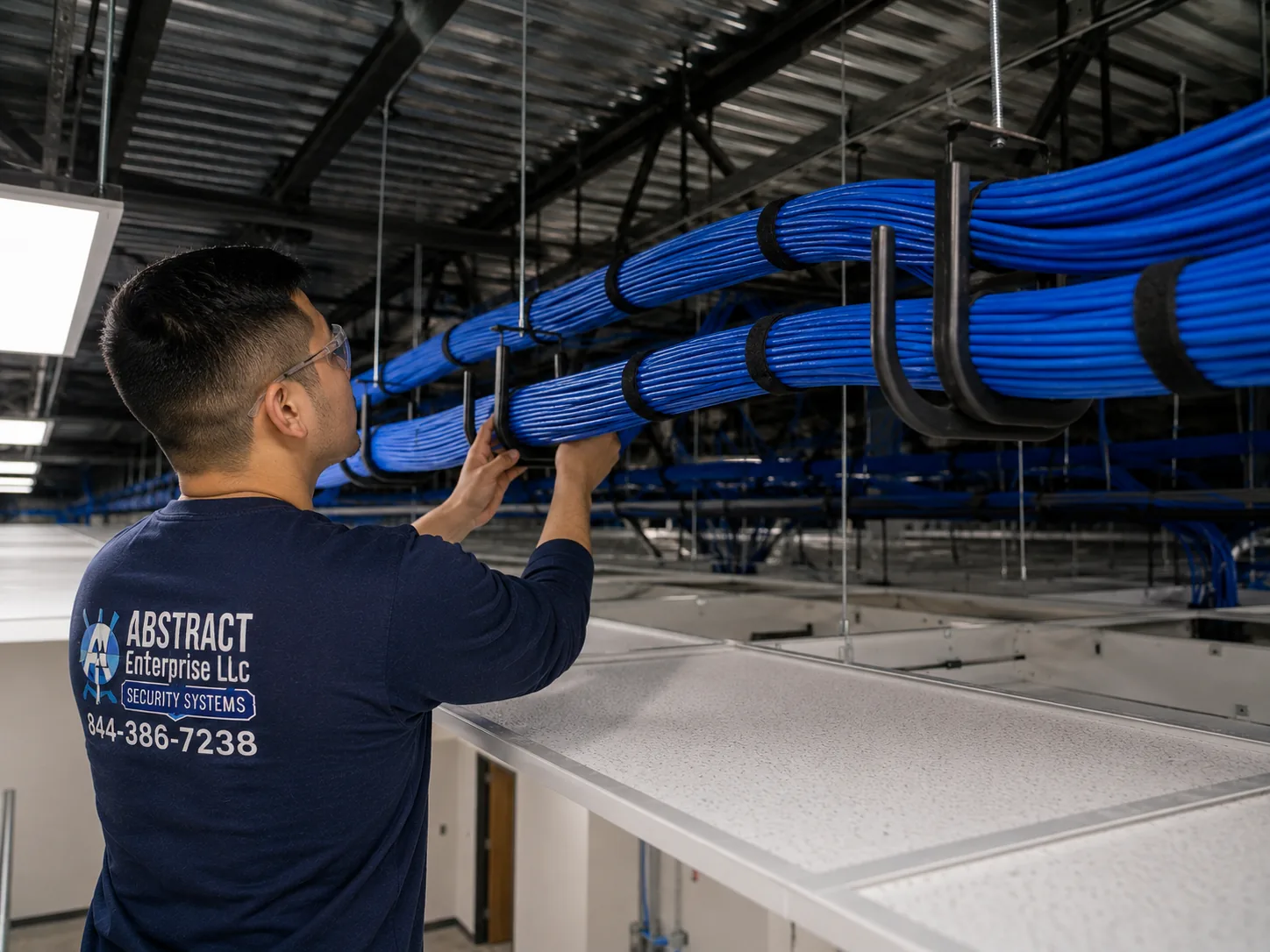
Photo from the AESS job library, not taken on Long Island: a technician feeding cable through a ceiling in a commercial space that is still open. A strip store on Hempstead Turnpike or an office on Route 110 usually stays open while First Alert cameras go in, so the cable work happens in the ceiling, away from customers, in short sections.Photo from the AESS job library, not taken on Long Island: a J-hook pathway carrying dressed cable bundles across a commercial ceiling. In a Hauppauge flex building or a Melville office, the PoE cables for First Alert cameras at the doors and loading area ride in hooks like these, off the ceiling tiles and clear of lights and ducts.
Two Counties
Nassau and Suffolk: Two Rulebooks for the Same First Alert Camera
Long Island is one place to most people and two counties to the law. The same First Alert VX3, on the same kind of house, can fall under different alarm programs, different camera registries and different licensing offices depending on which side of the county line it sits. None of this changes how we mount a camera. It changes what you should know before the cameras join a monitored panel, and what you can do with the footage afterward.
Question
Nassau County
Suffolk County
Local government
Two cities, three towns, 64 incorporated villages and more than 60 hamlets over 453 square miles (ny.gov)
Ten towns over 2,373 square miles (ny.gov)
Population, 2020
1,395,774 (Census QuickFacts)
1,525,920 (reported by Newsday)
Median home build year
1955 (ACS 2023)
1970 (ACS 2023)
Alarm program
NCPD Alarm Permit Section; permit required for all alarm systems; action when false alarms exceed two a year
SCPD Alarm Management Program; residential and commercial registration
Grace period for new alarms
No false-alarm notices for 90 days after installation, up to three, as summarized by a Long Island law firm
Check with SCPD for the current rule
Police camera registry
No countywide registry found in our research; Garden City Police run a voluntary private camera registration
SCPD Camera Registry Program, free, with no police access to the cameras
Contractor licensing
Nassau Office of Consumer Affairs licenses home improvement contractors, who must be fingerprinted
Suffolk County Code Chapter 563 licenses regulated trades through the Office of Consumer Affairs, with restricted licenses for limited areas
Why the false-alarm rule matters for cameras
Cameras do not trigger police dispatch on their own. The alarm panel does. But many First Alert owners link their VX cameras to a monitored ProSeries panel so that the monitoring center, or the owner, can look at video when a sensor trips. Used well, that is a check: a door contact goes off, someone looks at the camera over that door, and sees the dog. Used badly, it adds alerts nobody trusts. The Nassau rule, more than two false alarms in a calendar year before action, leaves very little room for a system that cries wolf, and the 90-day grace period after a new installation, as summarized by a Long Island law firm, is the time to get the settings right. We set detection zones and alert schedules on the day, and we encourage owners to watch the first few weeks of alerts and call us if something keeps firing.
Registering cameras with police
In Suffolk, the SCPD Camera Registry Program lets residents and business owners register the locations of their cameras with the police department, and the department says plainly that it does not have access to those cameras. If detectives are investigating something nearby, they may ask a registered owner to check footage for a specific date and time, retrieved at the owner's convenience. SCPD SHIELD also describes an Emergency Remote Camera Access program that partners can opt into or out of at any time. In Nassau we found no countywide registry, though the Garden City Police Department runs a voluntary private camera registration that, in its words, does not give police access to privately owned systems. Registration is your choice. At handover we can show you where each program's page is and what information it asks for.
Photo from the AESS job library, not taken on Long Island: a technician mounting a managed PoE switch below patch panels in a commercial network rack. For a business or a large house on either side of the county line, a switch like this powers every wired First Alert VX3 from one place, so one battery backup keeps them all running.
Field Notes
Field Notes: The Signal Walk Around a Long Island Ranch
We do not publish stories about a particular customer's house unless we can document them, so this is not a tale about one address. It is the walk our technicians do before mounting a First Alert camera on the kind of house Long Island is full of: a one-story ranch on a slab, the router in the living room, a detached or attached garage, and a back door onto a patio.
We start in the driveway with the homeowner and agree what each camera should see: the back door, the basement or crawl vent if there is one, the side gate, the car. Then we take a phone with a Wi-Fi analyzer and walk the outside of the house slowly, holding it at soffit height on a pole where we can, and write down the signal reading at every proposed spot. On a ranch, the front corners often read well and the back corner over the patio drops off behind the kitchen and a bathroom. We run an upload test at the worst spot. We look up into the attic hatch to see whether there is a path to that corner and how hot it is. We find the nearest outlet and measure to it, because the VX3's power cord stops at ten feet. Only when every spot has a number and a power plan written next to it do we pick up a drill. On most ranches, that walk is what turns a camera that shows offline every evening into one that just works.
Your Questions Answered
First Alert Camera Installation on Long Island: Questions Answered
We could not retrieve Google's People Also Ask boxes, related searches, AnswerThePublic, Bing or DuckDuckGo results for this page, and we found no Long Island Reddit or Yelp threads about First Alert cameras. The questions below come from the FAQ pages of First Alert, installers and review sites that our research did find, reworded for Long Island and answered from the sources listed above.
Permits, licenses and alarm rules
Does putting First Alert cameras on a Nassau or Suffolk house require a town building permit?
For cameras alone, usually not, but the honest answer is that sources disagree and the rule depends on the address. One Long Island installer says standard residential and commercial camera installs typically do not need a local permit, while a low-voltage trade site says New York's building code has required permits for low-voltage installations since 1984 and that most Nassau towns and villages enforce permit rules. The Town of Hempstead code requires a building permit for work that must conform to the Uniform Code or the Energy Code. With 64 incorporated villages in Nassau alone, we check the rule for your specific town or village when we quote, and we tell you if anything needs to be filed.
Our cameras will report to a monitored First Alert panel. Does the Nassau police alarm permit cover them?
The permit is for the alarm system, and if the cameras are part of a monitored system, they are part of what that permit covers. The Nassau County Police Department says permits are required for all alarm systems and that a location can be suspended, revoked or put into No Police Response Mode when false alarms exceed two in a calendar year. Adding cameras does not need a new permit by itself, but it is a good moment to confirm yours is current, and to make sure the cameras' alerts are set up to confirm real events rather than add noise to the system. In Suffolk, the same advice applies to the SCPD alarm registration.
Which New York license should an installer hold for a First Alert job that ties into an alarm panel?
New York General Business Law §69-m says installing, servicing or maintaining security or fire alarm systems requires a license from the State, and that passive, non-detecting security devices do not. A standalone camera is arguably passive. A First Alert VX camera enrolled to a ProSeries or VISTA panel that also runs door contacts and motion sensors is part of an alarm system, so ask for a state security license number, and in Nassau and Suffolk also ask about the county consumer affairs license that applies to the work. Ours is NYS license #12000287431, printed on this page and on every quote.
How many cameras and where they go
How many First Alert cameras does a typical Long Island house actually need?
Our own residential guidance for Long Island suggests one to three cameras for a condo or townhouse, four to eight for a ranch or split-level, and six to twelve for a colonial with a driveway, a pool and a garage. Those are starting points, not targets. The right number comes from counting the doors, the ground-floor and basement windows that face a yard rather than the street, the driveway and any gate. A VX doorbell usually covers the front door, so most layouts add cameras for the back door, the driveway and the sides, then indoor VX5 cameras where an empty house needs eyes inside.
The Uniondale break-ins we read about came through back doors and basement windows. Where should cameras go on a Cape?
Exactly there, before anywhere else. CBS New York reported one Uniondale burglary through a basement window on Atom Court and another through a back door on Walton Avenue. On a Cape, that usually means a camera on the back corner of the house aimed along the rear wall, so it sees the back door and any basement window wells on that side, and a second on the opposite side if there is a side door or gate. The driveway camera goes on the garage or front corner, aimed at the car and the path to the house, since police have said burglars are drawn to cars in driveways. Each camera is mounted high enough that it cannot be reached and turned from the ground.
Will one First Alert doorbell stop the porch thefts we keep seeing in Long Island news?
A doorbell camera helps, but it rarely covers everything a porch thief touches. The Wantagh, Massapequa Park and Patchogue thefts reported by News 12 and CBS New York were all caught on camera, and in Patchogue the thief waved at it, which tells you that being recorded did not stop him. What a doorbell can do is show the package spot clearly, record the face and the vehicle, and alert you fast enough to act. We place the VX doorbell so it sees the step where packages land, and add an outdoor camera on the driveway or the street side if the delivery driver tends to leave boxes out of the doorbell's view. A Long Island Patch reader put it bluntly: a camera alone may only let you watch the theft. A delivery plan helps as much as the camera does.
Wiring, Wi-Fi and power
Our 1950s ranch sits on a slab with no basement. How does cable reach a First Alert camera on the back wall?
Through the attic and down to the soffit, in almost every case. The Levitt-era slab houses, and many built near them, have no space below the floor, and the original ones carried radiant heating pipes in the slab, so we never drill into the floor. From inside, the cable starts at a PoE switch or injector near the router, goes up into the attic through a closet ceiling or a wall plate, runs along the joists, and comes out through the soffit right behind the camera. Where the attic has been finished into rooms, we work from the knee-wall spaces at the eaves, or we run Wi-Fi to that camera if the signal tests well, or we use a neat raceway on the outside wall. You choose once you have seen the options.
Wi-Fi or PoE for a VX3 at the far end of a split-level?
Whichever passes the numbers at that spot. Alarm Grid's VX3 install guide calls for a minimum signal of -65 dBm at the install location and a continuous upload of at least 2 Mbps. In split-levels, the router is often on the middle level and the far end has two floors and several walls in the way, so the far-end camera is the one most likely to fail. The VX3 can run on a 12VDC adapter, on 802.3af Class 3 PoE, or both at once, so if the signal is weak we run a cable and use PoE, which carries data and power on one line and takes Wi-Fi out of the question. If running a cable is impractical, a wired access point near that end of the house is the next choice.
Our Cape has masonry outside walls. Can a First Alert camera go up without opening the wall from inside?
Yes. Resideo makes an optional back box for the VX3 that Alarm Grid describes as being for installations where in-wall wiring is not possible, rated IP66, and able to take up to three half-inch conduits. The back box mounts on the outside of the masonry, the camera mounts on the box, and the cable reaches it in conduit along the wall from wherever it enters the house, often at a basement rim, a garage or an existing hole. Paul Romanelli of Suffolk Security Systems, quoted in Resideo's launch release, praised that back box for stowing cables out of the way. Where the inside of the wall is easy to reach, a sealed 7/8-inch hole straight through is sometimes simpler. We show you both before deciding.
Accounts, apps and equipment you already have
Why do First Alert prices look so different from one Long Island dealer to the next?
Because First Alert Professional is sold through independent authorized dealers who own their own businesses, and a review site notes that you may see varying prices and offers among the dealers in your area. Some bundle cameras with a monitoring contract and spread the equipment cost over the contract; others sell equipment and labor up front. When you compare quotes, compare the same things: which VX models, how many, how each one is powered, whether a panel and monitoring are included, and how long the contract runs. Our Long Island price page lists equipment and installation as separate lines so you can see exactly what you are paying for.
We still have older First Alert Onelink devices. Will they keep working alongside new VX cameras?
They are different products on different apps, so the cameras will not depend on them either way. First Alert's support pages say the Onelink smart alarm line, models 1039102, 1042135 and 1042136, has been discontinued, and that the Onelink Home app covers Onelink smoke and carbon monoxide alarms and the Environment Monitor, not VX cameras. An answer on an Amazon product page says the cloud service behind some Onelink devices is being shut down. Your VX cameras live in Total Connect. Whatever happens to Onelink support, your smoke and CO alarms still need to sound in the house, so check them separately with First Alert; we will tell you which of your devices are cameras and which are alarms.
Can new VX cameras show up on the Honeywell touchscreen already on our kitchen wall?
If the touchscreen is the right model and up to date, yes. Alarm Grid says VX cameras can be viewed on the Honeywell Home PROA7PLUS or the Resideo PROA7PLUSC, provided the panel is on version 03 or higher. Older keypads and panels may only show the cameras in the app, not on the screen. Send us a photo of the panel and its model label, and if you know who installed it, the dealer's name. The panel's software version can usually be checked on the screen or by the dealer, and if it needs an update, the account holder may need to push it before the cameras are enrolled.
Privacy and neighbors
Our driveway camera can see into the neighbor's back yard. Is that allowed?
It is the kind of view that causes disputes, so we avoid it. In one Shirley case reported by CBS New York, police said a back yard visible to the public was fair game, but New York Civil Rights Law §52-a makes it unlawful to use video surveillance where a person has a reasonable expectation of privacy, and a fenced back yard is a different thing from a front lawn on the street. We aim cameras at your property, use the privacy masking in the app to black out parts of the frame that look into a neighbor's windows or private yard, and leave audio off. If a neighbor raises a concern later, we can re-aim and re-mask without moving the camera.
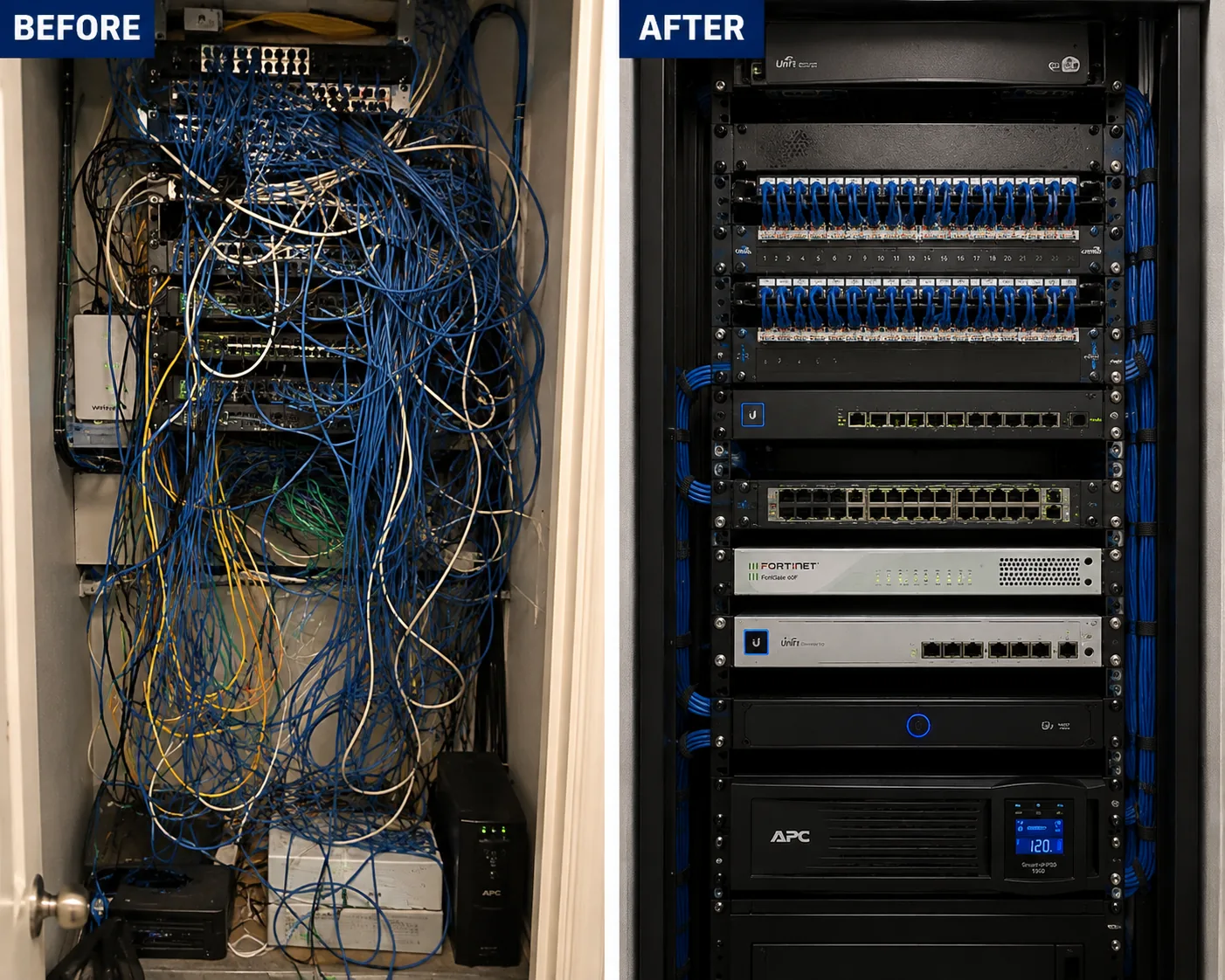
Photo from the AESS job library, not taken on Long Island: a network rack before and after cleanup, the unlabelled tangle on one side rebuilt into dressed, identified cabling on the other. Businesses and large houses on Long Island that have changed alarm dealers more than once often have a closet that looks like the before picture, and sorting it out is the first step before new First Alert cameras are added.
Equipment
Types of First Alert Camera Installation We Install
These are the First Alert components and supporting gear we fit on Long Island homes and businesses. Details below come from Resideo, First Alert and Alarm Grid documentation. Prices for equipment and installation are on the Long Island price page; if you already own the cameras, we install them labor-only once we have confirmed they can be enrolled to your account.
📷
First Alert VX3 Outdoor Camera
A Total Connect 2.0 camera that needs a TC2 smart video account. It runs on a 12VDC 1A adapter, 802.3af Class 3 PoE, or both, and its install guide calls for a 7/8-inch cable hole or larger.
🔔
First Alert VX Video Doorbell
The doorbell in Resideo's VX Series, enrolled to the same account as the cameras, placed for the package step and the face at the door.
🏠
First Alert VX5 Indoor Camera
Tells people from pets, 2MP sensor with wide dynamic range, and an automatic privacy shutter that suits apartments, bedrooms and occupied homes.
📦
VX3 Surface Back Box
For walls where in-wall cable is not possible. IP66 rated and able to take up to three half-inch conduits, per Alarm Grid.
🔌
PoE Switches and Injectors
802.3af PoE from a switch in the garage, basement or network closet, or a single injector for one camera, so the camera needs no outlet nearby.
📟
ProSeries and VISTA Panels
Resideo says VX cameras integrate with ProSeries and VISTA panels; the PROA7PLUS and PROA7PLUSC touchscreens show the cameras at version 03 or higher.
📶
Wired Access Points
Where a split-level or colonial leaves a camera spot below -65 dBm, an access point wired back to the router brings Wi-Fi to that end of the house.
🔋
Battery Backup for the Network
A battery backup on the router and any PoE switch, so cameras keep running through the short power cuts that come with Long Island storms.
First Alert VX vs ADT, Ring and SimpliSafe on a Long Island house
People comparing First Alert with the big national names are usually comparing how the system is sold and supported, not just the camera. The table below sets out the differences our research supports. It is not a ranking, and it does not compare prices.
Question
First Alert VX
ADT
Ring
SimpliSafe
How it is sold
Through authorized dealers and professional installers
Monitored alarm company; Security.org reports it sells installed Nest cameras
Retail devices, with optional pro install from Ring
Sold as self-install security kits
Ties to an alarm panel
ProSeries and VISTA panels, PROA7PLUS touchscreens
ADT's own systems
Ring's own alarm products
SimpliSafe's own base
Wired power options
12VDC adapter or 802.3af PoE on the VX3
Depends on the camera sold
Depends on the model
Depends on the model
Police video requests
Through you, if you choose to share
Through you
Consumer Reports describes Ring's Community Requests, which can be turned off in the Neighbors app
Through you
On a Long Island house, the deciding factor is usually what is already on the wall. If you have a Honeywell or Resideo panel monitored by a dealer, First Alert VX cameras fit into it. If you have no panel and no dealer, you have more choices, and we will tell you plainly whether First Alert, a non-branded wired system, or something you can install yourself makes the most sense for your house.
AI Overview Reality Check
What AI Gets Wrong About First Alert Camera Installation on Long Island
We could not view Google's AI Overview for this topic from our build environment, so we are not quoting it. What follows are claims we see repeated in quick online answers about First Alert cameras and about camera installs on Long Island, set against what manufacturer documents, county rules and local reporting say. Marketplaces like Angi, HomeAdvisor and Fixr publish national cost guides that feed many of these answers; they can give you a rough idea, but they do not know your house, your panel or your county.
"First Alert is a smoke alarm brand, so its cameras run in the Onelink app."
First Alert does make smoke and carbon monoxide alarms, and its Onelink Home app is where many people first met the brand. That is why quick answers often send camera owners to Onelink, and why a 1.5-star app rating from 306 reviews on Apple's store sometimes gets quoted as a camera review.
First Alert's own support pages say the Onelink Home app covers Onelink smoke and CO alarms and the Environment Monitor. The VX cameras are part of Resideo's professional line, and Alarm Grid identifies the VX3 as a Total Connect 2.0 camera that needs a TC2 smart video account.
For a Long Island owner, that means two apps and two support paths. We set up the cameras in Total Connect and leave the alarms where they belong. If a past setup mixed them, we untangle it so the right alert reaches the right app.
"New York is a two-party consent state, so camera audio needs everyone's permission."
We have seen this claim on installer pages, including an older line on our own Long Island camera page, and it is not the clearest statement of the law. The Reporters Committee for Freedom of the Press describes New York as making it a felony to record an in-person conversation you are not part of without the consent of at least one party.
The practical problem is that a doorbell or patio camera with its microphone on records conversations between delivery drivers, neighbors and passers-by, none of whom consented and none of whom included you. That is why legal guides, including a Justia answer from 2025, suggest disabling audio unless a consenting participant will be part of the recording.
So the answer is not "never" or "always". It is: leave audio off by default, use two-way talk when you are actually speaking to someone at the door, and turn on recording only where you have thought it through. We set cameras up that way unless you tell us otherwise.
"Camera installs on Long Island never need a permit or a license."
This is half right, which makes it risky. For a standalone camera on a house, many towns do not ask for a permit, and General Business Law §69-m exempts passive, non-detecting devices from the state alarm installer license.
But a First Alert camera is very often part of an alarm system, tied to a ProSeries or VISTA panel with door contacts and motion sensors. Alarm work needs a state license, Nassau requires a police alarm permit for every alarm system, and Suffolk runs its own alarm registration. Low-voltage permit rules vary across Nassau's villages and Suffolk's towns, and sources disagree on how often they apply to cameras.
The safe answer is to check by address and by job. We quote under NYS license #12000287431, tell you whether your setup counts as alarm work, and check the town or village rule before we start.
"If your phone gets Wi-Fi there, the camera will too."
Phones are forgiving. They mostly download, buffer and retry. Cameras push a steady stream of video up to the cloud, and the VX3 install guide sets clear minimums: a signal of -65 dBm or better at the install location and a continuous upload of 2 Mbps or faster.
On Long Island the places that fail are predictable: the far end of a split-level, the back corner of a slab ranch behind the kitchen, the garage of a colonial, and anything on a North Shore lot more than a short distance from the house. A phone may show two bars there while the camera drops out every evening when the neighbors start streaming.
We measure the actual signal at the mounting point, outside, at height, before we mount. Where it fails, we run a cable or add a wired access point instead of hoping the router copes.
"Any nearby outlet can power an outdoor camera."
Only if it is near enough. Alarm Grid lists the VX3's power transformer cord at a 10-foot maximum, which rules out most outlets on a two-story colonial and many on a ranch with a tall roofline. An extension cord across a soffit is not a safe or tidy answer.
The VX3 also accepts 802.3af Class 3 PoE, and can use the adapter and PoE at the same time. On a Long Island house that usually means one cable from a PoE switch or injector inside to the camera outside, carrying both power and data, with no outlet needed at the eave at all.
On masonry Capes and finished split-levels where a cable cannot go inside the wall, the back box with conduit gives that PoE cable a protected path along the outside. The camera's power plan is decided on the walk-through, not on the ladder.
"Registering your cameras lets the police watch them."
Registration programs are often described as if they hand police a live feed. On Long Island, the programs we found say the opposite. The Suffolk County Police Department's Camera Registry Program records where cameras are, and says the department does not have access to them; detectives may ask an owner to check footage, which the owner retrieves when convenient.
The Garden City Police Department's voluntary registration says the same: it does not provide access to privately owned systems. SCPD SHIELD describes a separate Emergency Remote Camera Access program that partners can opt into or out of at any time. We found no Nassau countywide registry.
Ring's Community Requests, which Consumer Reports covered, are a separate thing again, inside the Ring Neighbors app. First Alert footage is shared only if you share it. We explain the options at handover and leave the decision with you.
"Linking cameras to the alarm can only help, and false alarms cost nothing."
Linking cameras to a monitored panel can help a lot, because someone can look before calling the police. But the help depends on settings. A camera that alerts on every car on the road or every swaying branch trains people to ignore it.
In Nassau, the stakes are written down. The police department's alarm page says a location can face suspension, revocation or No Police Response Mode when false alarms exceed two in a calendar year, and that police are asked to respond to more than 125,000 false alarms a year. A law firm summary of the ordinance describes a 90-day grace period for new systems, up to three false alarm notices.
That grace period is the time to tune the system. We draw detection zones on doors, windows and the driveway, set people detection where it fits, and ask owners to call us during those first weeks if any camera keeps firing for no reason.
Not Sure Which Corner Needs a Camera? Talk to a Technician About Your Long Island House
Send a photo of the front and back of the house, a speed test from the far end, and a photo of your alarm panel if you have one. A technician will tell you how many First Alert cameras your layout needs, which ones should be wired, and whether your account can take them. Call (800) 486-0943, message us on WhatsApp, or use the quick form.
Every First Alert job on Long Island follows the same eight steps, whether it is a single VX doorbell on a Levittown Cape or a dozen cameras on a Suffolk colonial and its outbuildings. The order matters, because the problems that make cameras fail later, a weak signal, a power cord that does not reach, an account nobody can log into, are cheapest to solve before anything is mounted.
1. Send the address, house type and account details
Town and street, the kind of house or business, how many cameras you want, and whether a First Alert or Honeywell panel and a monitoring dealer are already in place. Requests are booked within 2 hours.
2. Confirm the account holder and the panel
We confirm who holds the Total Connect smart video account and, if there is a touchscreen, its model and software version, so enrollment can happen on the day.
3. Walk the property and choose the views
Front, sides and back, including back doors, basement windows, the driveway and the garage. We agree what each camera should see and what it should not.
4. Measure signal and upload at each spot
Wi-Fi strength against the -65 dBm minimum and a 2 Mbps upload test at every mounting point, outside and at height.
5. Choose the power and cable path
PoE over a cable through the attic or garage, an adapter within reach of its 10-foot cord, or a back box with conduit where the wall stays closed.
6. Mount, drill and seal
Holes at 7/8 inch or larger as the guide recommends, mounts on solid wood or masonry, and every penetration sealed against rain and salt air.
7. Enroll and configure
Cameras enrolled to the account and panel, detection zones and privacy masking set, alerts routed to the right phones, audio left off unless you decide otherwise.
8. Test day and night, then hand over
Each camera triggered and checked in daylight and after dark, the app and panel shown to you, cables labelled, and camera registry options explained.
Coverage Area
First Alert Camera Installation Near Long Island's Landmarks
Long Island is too big to give directions by one corner, so we plan visits by the landmarks people already use. These are the ones that come up most when we route a day of First Alert jobs across the two counties.
Cradle of Aviation Museum
A 130,000-square-foot museum on Museum Row at the old Mitchel Field in Uniondale, run by Museums at Mitchel in partnership with Nassau County, with a Firefighters Museum next door.
Nassau Coliseum
At 1255 Hempstead Turnpike. The Islanders played there from 1972 to 2015 and again from 2018 to 2021 before moving to UBS Arena.
Mitchel Field
Established as Field #2 in 1917, renamed Mitchel Field in July 1918 and closed in 1961; its historic district was added to the National Register on May 4, 2018.
Roosevelt Field
The largest mall on Long Island, in the East Garden City section of Uniondale, on the airfield where Lindbergh began his transatlantic flight.
Hofstra University
About 244 acres in the Uniondale section of Hempstead, with part of the campus south of Hempstead Turnpike, per Wikipedia.
Old Westbury Gardens
The 1906 John Shaffer Phipps estate, with about 200 acres of gardens, one of the North Shore's surviving Gold Coast estates.
Levittown
17,447 homes built from 1947 to 1951 on former potato fields; Wikipedia counts 51,758 residents in 2020, Nassau's most populous unincorporated area.
Stony Brook University
A 1,454-acre campus with 213 buildings, near the area where New York State reported Suffolk's first flash flood emergency in August 2024.
First Alert Camera Installation Cost on Long Island
Long Island First Alert jobs are priced from our published Long Island price list, and Nassau and Suffolk addresses each have their own county list with that county's area rate. We do not print figures on this page that are not on those lists, so the numbers live in one place and never disagree. What this section does is show you which lines your job will use, so you can read the price page and add up your own system before you call.
What moves the price
Why it matters on Long Island
Where you will find it
Number of cameras and doorbells
One to three for a condo, four to eight for a ranch or split-level, six to twelve for a colonial, by our own guidance
Per-camera lines on the price page
Which VX models
Outdoor VX3, indoor VX5 and the VX doorbell are priced separately as equipment
Equipment lines
Wi-Fi or wired PoE
Far ends of split-levels and colonials often need a cable
Cable run and PoE lines
Wall material
Masonry Capes take a hammer drill and sealing; shingle and siding need solid blocking
Mounting surface lines
Back box and conduit
Walls where in-wall cable is not possible
Back box line
Attic access
Slab houses route almost everything through the attic
Cable run lines
Panel integration
Enrolling cameras to a ProSeries panel or touchscreen
Integration line
Network support
Wired access points, PoE switches and battery backup
Network lines
Your own equipment
Cameras you already bought, installed labor-only
Labor-only lines
How to read the price list for a Long Island house
Take a slab ranch in Nassau with a VX doorbell and four VX3 outdoor cameras. The doorbell goes on the existing front-door wiring if it tests good. Three cameras at the front and sides pass the signal test and go on Wi-Fi, each powered by an adapter inside within ten feet. The fourth, over the back patio, fails the test behind the kitchen, so it gets a PoE cable through the attic. On the Nassau price page, that is the doorbell line, three Wi-Fi camera lines, one wired camera line with its cable run, and the equipment for each. Move the same layout to a masonry Cape in Uniondale and the back camera probably uses the back box and conduit line instead of the attic run. Nothing else is added on the day unless you ask for it.
Monitoring contracts, if you have one, are between you and your dealer, and are not part of our installation price. If a dealer must enroll the cameras to your account, we tell you before we book so there is no surprise on the day.
Full terms — including 50% deposit, one-year parts-only warranty on AESS-supplied products, and the late-fee schedule — are set out in the service agreement.
Shop Our Systems
First Alert Camera Installation Packages & Pricing
Three common Long Island layouts, each built only from lines on the price list. The figures for each are on the Long Island First Alert price page, and on the Nassau and Suffolk pages for those counties. There is no package premium; a package is just the lines added up.
Starter: Front Door and One Weak Spot
A First Alert VX doorbell on the existing doorbell wiring plus one or two VX3 outdoor cameras, usually the driveway and the back door. Suits condos, townhouses, small Capes and two-family houses where the front and back are the whole story.
Standard: Ranch or Split-Level Perimeter
The VX doorbell and four to six VX3 cameras covering the back door, basement windows, side gate and driveway, with the far-end cameras on PoE through the attic and the rest on tested Wi-Fi. The usual Nassau and western Suffolk house.
Premium: Colonial, Estate or Panel-Linked System
Six to twelve cameras, mostly wired PoE from a switch in the garage or basement with battery backup, VX5 indoor cameras where the house sits empty, and enrollment to a ProSeries panel or PROA7PLUS touchscreen. For larger Suffolk lots, North Shore estates and seasonal homes.
Bring your own First Alert equipment
If you already bought VX cameras or a VX doorbell, we install them at labor-only rates from the same list. Before booking, we check one thing: that the cameras can be enrolled to an account you or your dealer controls, because a VX3 without a TC2 smart video account is a camera on a wall that nobody can watch. We also check the models against your panel and your house, and if a camera you bought will not work where you want it, we tell you before we drill, not after.
Price List Open and Questions Left? A Technician Can Check Your Lines
If you have added up a layout from the price page and want a second look, send it with your house type and a photo of the panel. We will tell you if a line is missing, if a camera can go on Wi-Fi instead of a cable, or if your existing equipment changes the total. Call (800) 486-0943.
Send the house type, panel photo and speed test and we will match your job to the list. Request a free quote
FAQ
Long Island First Alert Camera Installation FAQ
Do you install First Alert cameras out east, far from the city line, or only in western Nassau?
+
We cover both counties, from the Queens line to the East End. Suffolk addresses are priced on the Suffolk County list and Nassau addresses on the Nassau list. Longer trips out east are planned into scheduled windows, so tell us the town when you call and we will give you the earliest honest date for that part of the island.
What does a professionally installed First Alert system end up costing on Long Island?
+
It depends mostly on how many cameras you need, which VX models, how many must be wired, and whether they join a monitored panel. Our installed prices are on the Long Island First Alert price page, with Nassau and Suffolk on their own lists, and every line is shown separately. Monitoring, if you choose it, is a separate contract with your dealer.
How does a professional First Alert camera system actually work day to day?
+
The cameras and doorbell connect to your network by Wi-Fi or a PoE cable and send video to a Total Connect smart video account, which you see in the app and, with a compatible touchscreen, on your panel. If the system is monitored, a sensor tripping on a door or window can be checked against the camera covering it before anyone is dispatched. Alerts go to whichever phones you choose.
If our internet goes down, do the VX cameras keep recording?
+
Remote viewing, app alerts and cloud clips all depend on the internet connection, so while the connection is down you will not see the cameras from your phone. What a particular VX model keeps locally during an outage depends on that model, and we confirm it from the manufacturer's documentation for the cameras on your quote rather than guessing.
Can I mount the First Alert cameras myself and just have you set up the account?
+
You can mount cameras on your own home, and some owners do. The parts that usually go wrong are the signal at the mounting point, the 10-foot limit on the VX3's power cord, sealing holes in masonry or siding, and enrolling to the right account. If you have already mounted them, we can check signal and power and handle the enrollment and settings on a shorter visit.
How can I confirm a camera installer on Long Island is properly licensed?
+
Ask for the New York State security or fire alarm installer license number, which the Department of State issues, and check it before you sign. In Nassau, ask about the county consumer affairs license for home improvement work, which requires fingerprinting; in Suffolk, ask about the county license under Chapter 563. Ours is NYS license #12000287431.
Should the microphone on our First Alert doorbell be switched on?
+
Two-way talk, when you are speaking with someone at the door, is fine because you are part of the conversation. Continuous audio recording is different, because New York makes it a felony to record a conversation you are not part of without at least one party's consent. We leave audio recording off by default and explain the setting so you can decide.
Our alarm and cameras were just installed in Nassau. Do false alarms in the first weeks count against our permit?
+
A Long Island law firm's summary of the Nassau ordinance says a newly installed alarm system is not subject to false alarm notifications for the 90 days after installation, up to a maximum of three. Use that time to fix any sensor or camera that keeps triggering. After it ends, the county counts false alarms toward the two-per-year limit.
What happens to the cameras when a storm knocks out our power?
+
Without power to the router and any PoE switch, the cameras go offline. Tropical Storm Isaias left almost half of PSEG Long Island's 1.1 million customers without power at its peak in August 2020, according to ABC7. A battery backup on the router and switch keeps short outages from taking the cameras down, though no backup lasts through a multi-day outage.
We rent our house in the Town of Hempstead. Can we put up First Alert cameras?
+
Indoor cameras inside your home are usually your choice, and the VX5's privacy shutter makes them easier to live with. Anything drilled into the outside of the house needs the owner's written agreement first. Owners should also know that the Town of Hempstead requires a rental occupancy permit for residential rentals, which is a separate matter from the cameras.
Our First Alert panel came from a dealer we no longer use. Can new cameras still be added?
+
Often, but it depends on who controls the account the panel reports to. If the old dealer still holds it, they may need to release it or enroll the cameras. If you have moved to a new dealer, they hold it now. We find out which before booking, so the cameras can actually be enrolled on the day rather than left waiting.
Will the hole for the camera cable let water into our shingle-sided South Shore house?
+
Not if it is done right. We drill at a slight downward angle toward the outside so water runs out, mount on solid wood behind the shingles rather than the shingles alone, and seal the opening with exterior-grade sealant once the cable is through. Where the run is exposed, it goes in conduit into the camera's back box.
Get In Touch
Request a Free Quote
Tell us the town, the house type, how many cameras you are thinking about, and whether an alarm panel is already installed. A speed test from the far end of the house and a photo of the panel make the quote exact. Prefer to talk? Call (800) 486-0943.
✅
Request Sent!
We'll call about your Long Island First Alert cameras the same business day.
More First Alert Camera Installation near Long Island hub
Book Your Long Island First Alert Camera Installation
From a slab-built Cape in Levittown to a masonry Cape on Front Street in Uniondale, a split-level in Suffolk or a shop on Hempstead Turnpike, the job starts the same way: the house type, the account holder, a signal reading where each camera will hang, and an honest match to the Long Island price list. Call (800) 486-0943, message us on WhatsApp, or send the quote form, and we will tell you exactly what your First Alert system needs before anyone climbs a ladder.