Old Honeywell Total Connect camera dark since the 2025 retirement, or a farmhouse porch that still can't see the end of the driveway? Book a Hudson Valley First Alert camera install: (800) 486-0943
Home › First Alert Camera Installation › Hudson Valley
Dutch Stone Houses in Ulster · Brick Rowhouses in Newburgh's East End · Farms with Long Driveways · Westchester and Rockland Suburbs · Licensed Low-Voltage
First Alert Camera Installation in the Hudson Valley
Account Checked Before the Ladder Goes Up · Signal Measured at Every Mount · Six Counties, One Licensed Crew
First Alert camera installation in the Hudson Valley means fitting Resideo's VX cameras, the line that replaced the old Honeywell Total Connect cameras, onto buildings that were never designed with a camera in mind: colonial stone houses in Ulster County, Italianate brick rowhouses in Newburgh's East End, post-war colonials across Westchester and Rockland, lake houses in Putnam and farms in Dutchess where the driveway runs longer than a city block. Every VX camera lives on a Total Connect 2.0 video account, needs a steady upload connection and a strong Wi-Fi signal or a network cable, and has to be mounted where wind, ice, a historic commission and a neighbor's privacy all leave it in peace. We check the account first, measure the signal at the exact spot the camera will sit, pick the wall second, and price the work from the price list for your county.
Reviewed and updated November 5, 2026 by Anwar Timothy, NYS license #12000287431 · Sources: Resideo's First Alert VX Series page and its Total Connect camera end-of-life notice, Resideo's VX3 launch announcement, Alarm Grid's First Alert product pages, VX3 install guide and VX3 data sheet, Advanced Security's Total Connect video FAQs, Zions Security's VX3 listing, First Alert support and store pages, the SEC filing on Resideo's purchase of First Alert, New York General Business Law Article 6-D (Justia), the NYS Department of State installer license page, 19 NYCRR 195.2 (Cornell LII), Kirschenbaum & Kirschenbaum on CCTV licensing, the Reporters Committee recording guide, Outten & Golden and RecordingLaw on Civil Rights Law §52-c and Labor Law §203-c, the City of Kingston HLPC page and 2025 HLPC minutes, the City of Newburgh East End design guidelines and ecode360 text, Wikipedia entries for the East End Historic District, the Kingston Stockade District and the Hudson Valley, Hudson Valley One, the Hudson River Valley Heritage Area, Times Union, Mid-Hudson News, Daily Freeman, News 12 Hudson Valley and Westchester, Hudson Valley Post, WPDH, Spectrum News, Ulster County's broadband announcement, Stacker's census analysis, the USDA 2022 Census of Agriculture, Earth Networks' 2020 lightning report and Yelp listings for Poughkeepsie · Dispatched from 460 E Fordham Rd
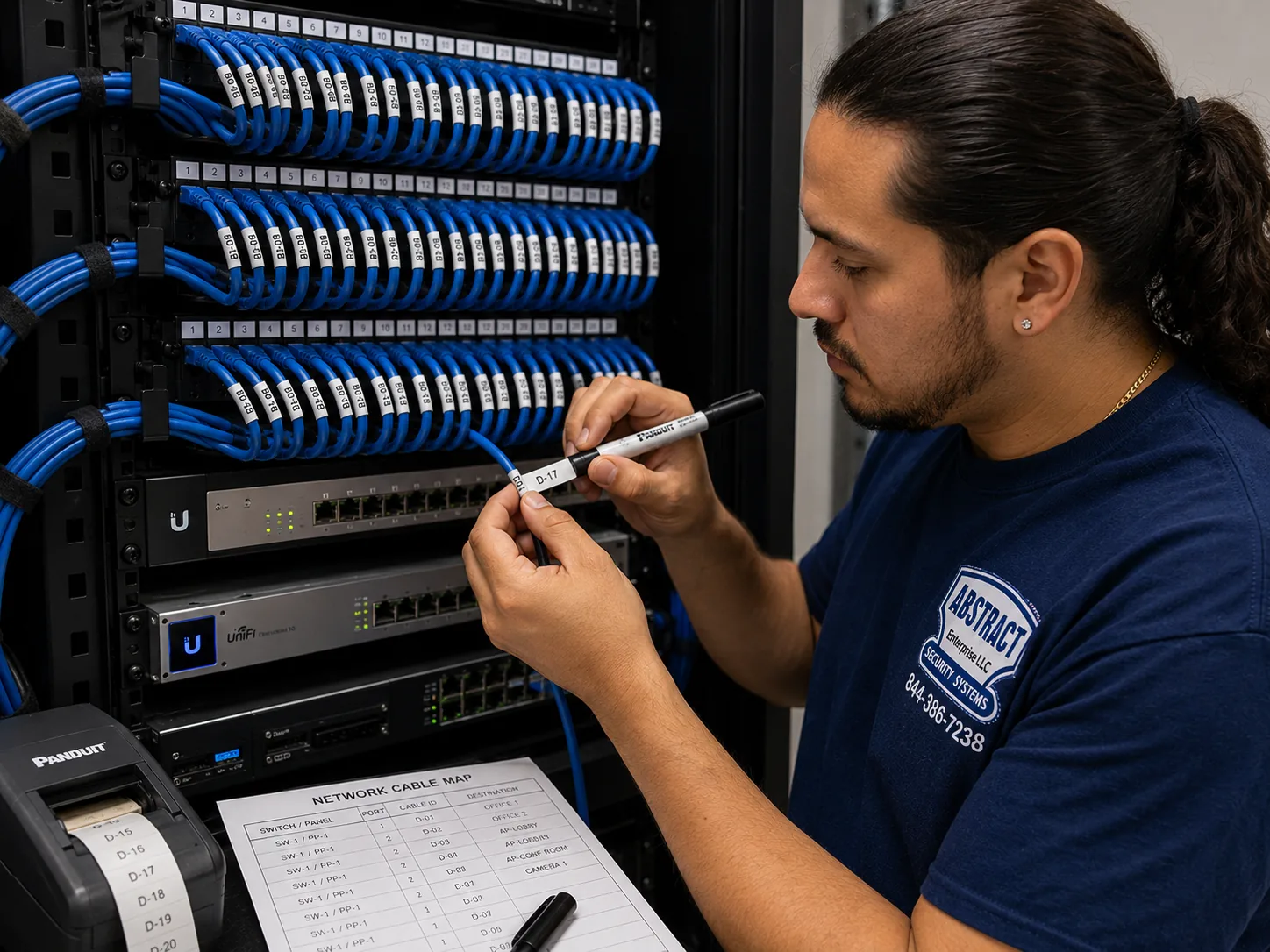
Photo from the AESS job library, not taken in the Hudson Valley: a technician printing cable labels at a patch panel, working from a printed port map. When First Alert CX4 or wired VX3 cameras on a Dutchess farm or a Westchester office land on a patch panel, each port gets a printed label that matches the map, so the barn camera and the driveway camera can never be confused on a winter night.
Hudson Valley First Alert Cameras
Tell us the county, the building, and whether you already have Total Connect
✅
Request Sent!
We'll call about your Hudson Valley First Alert cameras the same business day.
25+
Years Experience
✓
Same-Day Estimates
100%
Licensed & Insured
4.7★
201 Google Reviews
Owner-operated since 2002 · Thousands of jobs completed · Booked within 2 hours
A First Alert camera job in the Hudson Valley is settled by three facts: whether a Total Connect 2.0 account already exists, whether each camera spot has the signal and upload speed Resideo asks for, and what the wall is made of. Many valley homes already have a Honeywell or Resideo alarm panel and a Total Connect login, which makes adding VX cameras straightforward. A farmhouse whose Wi-Fi fades at the porch needs a network cable run instead of a wireless camera. A stone house in Hurley or Kingston takes a different drill bit, a different cable route, and sometimes a historic commission's sign-off. Tell us those three things and we can tell you which lines of your county price list apply before you book. Call (800) 486-0943 or use the form.
Installed pricing comes from the price list for your county, starting at our Hudson Valley First Alert camera price list; the monthly video storage plan Resideo requires for VX cameras is separate and billed through the Total Connect account
Signal and upload checked at each mount against Resideo's published minimums, a continuous 2 Mbps upload and a -65 dBm Wi-Fi signal, before any camera is fixed to the wall
Camera and alarm work done under NYS license #12000287431, the license New York's Article 6-D requires of anyone in the business of installing security systems
Why Hudson Valley Properties Need First Alert Camera Installation
The Hudson Valley was settled house by house over four centuries, and almost none of those houses expected a camera on the gable. The Hudson River Valley Heritage Area describes Dutch colonists arriving after Henry Hudson's 1609 voyage, followed by enormous land patents granted first under the Dutch and later the English, and by 1750 a network of small local communities that still shapes the map today. The six counties we cover from our Bronx office, Westchester, Rockland, Orange, Putnam, Dutchess and Ulster, carry every layer of that history at once. Stacker's analysis of Census Bureau data found that 28.0 percent of Westchester's homes, about 109,608 of them, were built in 1939 or earlier, with a median build year of 1958. In Dutchess the pre-1940 share was 18.0 percent, in Putnam 17.9 percent and in Rockland 11.5 percent. Those are old walls, old wiring and old routers tucked into old basements, and every one of them shapes where a First Alert camera can go and how its signal gets out.
The oldest walls are stone. Hudson Valley One reports that Ulster County has more Dutch-influenced stone houses than anywhere in the world except the Netherlands, and a Fordham University history paper notes that Hurley holds the oldest surviving group of colonial stone houses in the valley. Kingston's Stockade District sits on the site of the stockade Peter Stuyvesant ordered in 1658, and at Crown and John Streets early Dutch stone houses stand on all four corners. For a First Alert VX3 outdoor camera that matters in a very practical way. Resideo's install guide for the VX3 recommends a drill bit of 7/8 inch or larger for the cable hole, and pushing a hole that size through a stone wall two feet thick is slow, dusty work that must be sealed afterwards against water and frost. Where a hole cannot or should not go through, Resideo offers a back box for the VX3 that, according to Alarm Grid, accepts up to three half-inch conduits and carries an IP66 rating, so the cable can run on the surface in a neat, weatherproof way. Deciding between those two routes is the first conversation on almost every stone-house job.
Then come the brick cities. Newburgh's East End Historic District covers 445 acres and, according to Wikipedia, holds 2,217 buildings, mostly two- and three-story Italianate brick townhouses, along with Washington's Headquarters State Historic Site; counted as resources, its 2,239 entries are the most of any federally recognized district in New York. The city designated the district in 1977, enlarged it and saw it listed on the National Register in 1985, and adopted design guidelines in 2005. Those guidelines speak directly to cameras: security features must not damage historic building fabric, and security or motion-detection equipment should sit on side or rear facades. Kingston has five local historic districts, including the Stockade, Rondout-West Strand, Chestnut Street, Fair Street and Ponckhockie, and its Historic Landmarks Preservation Commission reviews exterior work visible from the public right-of-way, including electrical and mechanical equipment. In a January 2025 approval, Kingston's staff recommended that the owner paint all externally mounted lines or line hides to match the facade. A First Alert doorbell or camera on a front facade in either city is exactly the kind of detail that gets noticed, so we plan for it rather than hope.
Out past the cities, the challenge changes from preservation to distance. The USDA's 2022 Census of Agriculture counted 620 farms in Dutchess County averaging 161 acres and 486 farms in Ulster averaging 150 acres. On properties that size the gate, the barn, the equipment shed and the house can sit hundreds of feet apart, and Wi-Fi rarely reaches all of them. That collides with how First Alert cameras work. Resideo's data sheet for the VX3 asks for a continuous upload of 2 Mbps or faster, and its install guide says to verify a signal of at least -65 dBm at the camera location before mounting it on Wi-Fi. Broadband itself is not a given everywhere: Ulster County announced a state ConnectALL award in September 2025 to bring fiber to nearly 1,300 unserved households, businesses and community facilities in remote parts of the county, and Hudson Valley One quoted a county official saying that in most of Ulster the available provider is Spectrum. A camera that is perfect on paper will drop clips all winter if it sits on the edge of the signal, which is why we measure first and choose between Wi-Fi and a PoE cable second.
Weather is the next test. In Earth Networks' 2020 lightning report, Orange County ranked first in New York with 275,059 lightning pulses, with Ulster at 182,760, Westchester at 168,634 and Dutchess at 166,641. The Times Union reported that thunderstorms on June 27, 2024 knocked out power to a combined 60,000 Orange and Rockland and Central Hudson customers, with winds of about 60 mph, and the Daily Freeman reported nearly 50,000 Central Hudson customers without power after storms on July 5, 2026. First Alert cameras are cloud cameras: they save clips to the Total Connect service, and any cloud camera cannot save new footage once the internet connection drops, even if the power stays on. The VX3's data sheet lists an operating range down to -40°C, so January cold is not the weak point. The weak points are the router in the basement, the PoE switch with no battery backup, and the cable that leaves the house and invites a surge back in. A valley install has to think about all three.
The reasons people call are real and recent. In January 2025 the New York State Police issued an alert after a string of targeted residential burglaries in Dutchess, Westchester and Putnam counties. Scarsdale police warned that burglary crews had been placing trail cameras and other hidden surveillance devices outside homes for days before breaking in. In July 2026, News 12 Westchester reported that several Port Chester neighbors shared Ring footage of car break-ins around 4 a.m. on and near Tower Hill Drive. In May 2026, News 12 Hudson Valley reported overnight smash-and-grab burglaries at businesses in Orange County, with Warwick police confirming three incidents and a store owner sharing surveillance video. Porch theft shows up in the record too: Hudson Valley Post published a reader's account of a thief working a house on Fitchett Avenue and then a porch on De Laval Place in Poughkeepsie an hour later, both caught by doorbell cameras; WPDH reported a doorbell camera recording a package theft on Carter Avenue in Newburgh; and Hudson Valley One covered Kingston police warning about porch thefts after a package was taken from a McEntee Street porch. News 12 reported in June 2026 that police data showed package thefts trending down across Westchester, but the same story featured a Yonkers resident who caught a theft on camera on Yonkers Avenue. None of those stories involved First Alert cameras as far as we know, and we do not claim any of those homeowners as customers. They show the job a camera is expected to do here.
The valley also has a strong opinion about who does the watching. The Times Union reported that Dutchess County is moving to shut down and remove all 65 of its county-operated Flock cameras after a packed public meeting in Pleasant Valley. Pine Plains had contracted with Flock Safety for 11 cameras and license plate readers before the plan was scuttled amid backlash. Hudson Valley One reported in September 2026 that Kingston police defended the city's camera network while residents raised privacy concerns, noting 71 conventional surveillance cameras in addition to plate readers. On October 23, 2026, Mid-Hudson News reported that Ulster County Executive Jen Metzger signed an executive order barring county departments from buying or deploying Flock cameras and similar AI-assisted surveillance tools. That tells us something about how private cameras should be set up here: aimed at your own property and driveway rather than the road and the neighbor's yard, with indoor cameras that can close their eyes. The First Alert VX5 indoor camera has an automatic privacy shutter, and every VX camera lets detection zones stop at the property line. We set both deliberately, not as an afterthought.
One more change has filled our phone lines with First Alert questions: the retirement of the older cameras. Alarm Grid reported that first-generation Total Connect 2.0 cameras would stop working after July 31, 2025, be removed from all accounts, and lose their recorded clips. Resideo's own end-of-life notice recommends the new First Alert VX Series cameras as replacements. Plenty of valley homes and businesses had Honeywell alarm systems installed years ago with a camera or two added along the way, and many of those owners discovered the shutdown only when the camera tile in the app went blank. Replacing those cameras is often the simplest First Alert job we do, because the Total Connect account, the panel and much of the wiring are already there.
We want to be clear about what our research did not turn up. We found no Reddit threads in r/hudsonvalley about First Alert cameras or installers, no Yelp reviews mentioning First Alert installs in the region, and no published count of how many valley homes use First Alert or Honeywell panels. Google's People Also Ask boxes, related searches and AI Overview could not be captured from our build environment. Where this page describes walls, signal or weather, it relies on the public sources named above and on what we find in buildings of these types generally, not on a survey of valley homes. The only reliable way to know your property is to look at it, and that is where every job starts.
Hudson Valley facts that shape a First Alert camera install
Old housing stock: Stacker's census analysis found 28.0 percent of Westchester homes built in 1939 or earlier, with Dutchess at 18.0 percent, Putnam at 17.9 percent and Rockland at 11.5 percent.
Stone and brick districts: Ulster holds more Dutch-influenced stone houses than anywhere outside the Netherlands, and Newburgh's East End counts 2,217 buildings over 445 acres with guidelines that send security equipment to side and rear facades.
Big lots, thin signal: Dutchess farms average 161 acres and Ulster farms 150 acres, while the VX3 asks for a continuous 2 Mbps upload and a -65 dBm signal at the mount.
Lightning and outages: Orange County led New York with 275,059 lightning pulses in 2020, and storms in 2024 and 2026 each left tens of thousands of utility customers in the dark.
Retired cameras: first-generation Total Connect 2.0 cameras stopped working after July 31, 2025, and Resideo points owners to the First Alert VX Series instead.
Privacy expectations: Dutchess is removing 65 county Flock cameras, Pine Plains dropped an 11-camera plan, and Ulster barred county use of AI-assisted surveillance tools in October 2026.
What valley customers often add once the cameras are up. A camera on a barn or a detached garage usually exposes a weak home network, and the next request is a proper cable to the outbuilding or a wired access point so phones, smart thermostats and the cameras stop fighting for one tired router. Yelp's own "people also searched for" list for camera installation in Poughkeepsie points the same way, naming home network installation. If your Wi-Fi is already a sore point, say so when booking, because running one cable for the camera and the network together costs less than two separate visits.
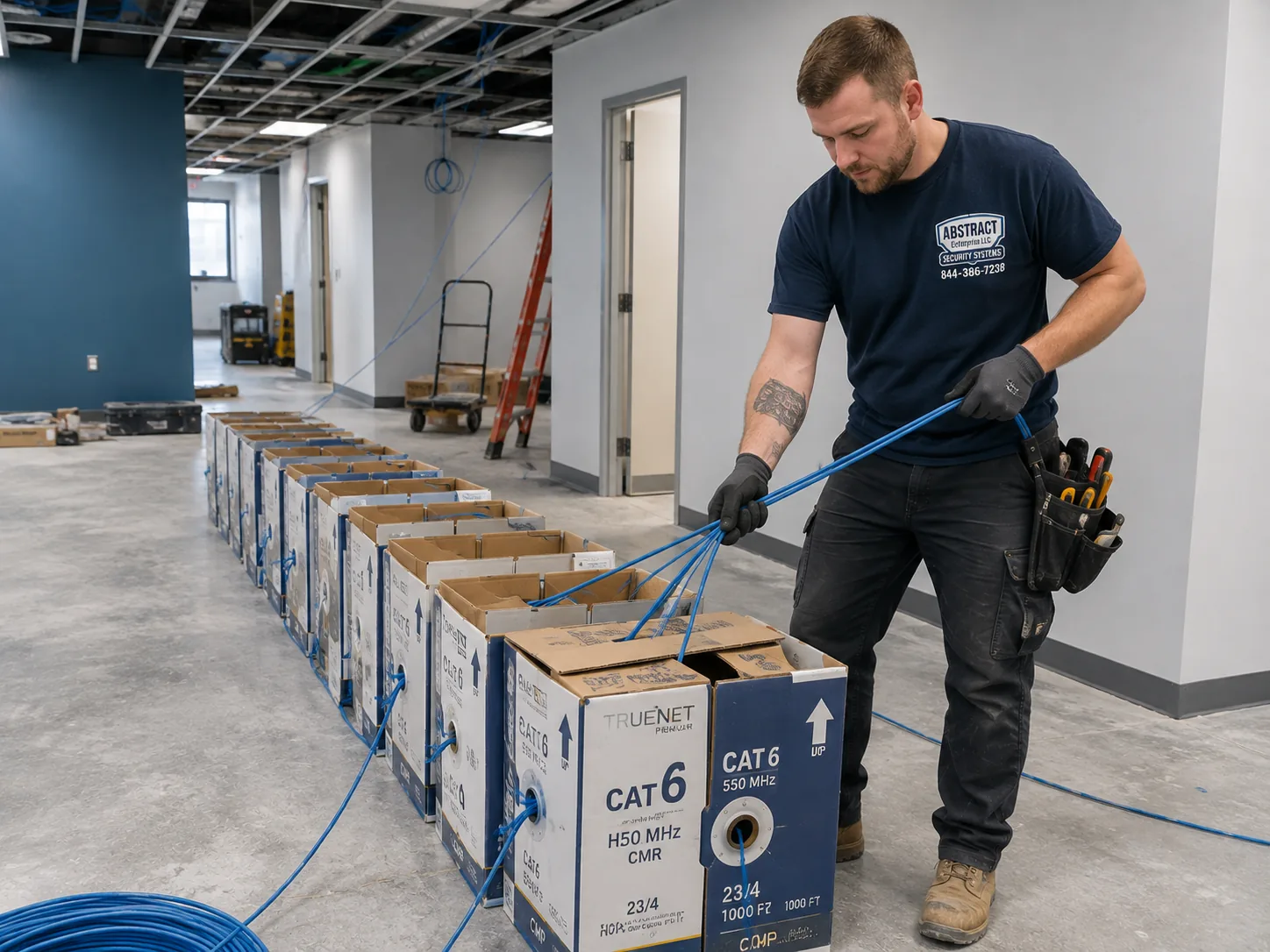
Photo from the AESS job library, not taken in the Hudson Valley: boxes of network cable staged on the floor of a working premises before a pull of several drops at once. On a valley farm or a Route 9 shop where four or five PoE cameras share one route back to the switch, pulling every cable in one pass from staged boxes like these saves a second day on the ladder.
Camera Tile Blank in Total Connect, or a Break-In on the Road? Fast Help Across the Hudson Valley
When a camera goes dark the day after a storm, when a retired Honeywell camera disappears from your account, or when a neighbor down the road has just had a break-in and you realize your driveway is invisible, those are the calls we move to the front of the queue. Before you call, check three things if you safely can: whether the router and any PoE switch still have power, whether the other cameras on the account are still live, and whether the camera's own light is on. Then call (800) 486-0943 and tell us what you saw. Requests are booked within 2 hours, and we will tell you honestly whether the fix is a reset, a replacement camera or a cable that the storm damaged. We do not promise same-day installation, because the right camera, the right bracket and sometimes a historic commission's agreement all have to line up first.
Westchester to Ulster: How Each County Changes a First Alert Camera Job
The Hudson Valley is one region on a map and six very different jobs on a ladder. A First Alert camera on a 1950s colonial in Rockland, a brick townhouse in Newburgh and a stone house outside Kingston uses the same Resideo hardware and the same Total Connect account, but almost everything around it changes: the wall, the route for the cable, the distance to the router, the weather exposure and the rules. The table below sets out what the public record says about each county and what that usually means for the install. The right-hand column is our working expectation, not a fact about any particular property; we confirm every site in person.
County
What the record shows
What it usually means for First Alert cameras
Westchester
28.0% of homes built in 1939 or earlier, median 1958 (Stacker); office corridors on Westchester Avenue and I-287; car break-ins on Port Chester's Tower Hill Drive in July 2026
Older suburban houses with finished basements and attics; good broadband in most towns; doorbell and driveway coverage the most common request
Rockland
11.5% pre-1940, median 1970; commercial strips on Routes 59, 304 and 202 and the Palisades Center in West Nyack; doorbell footage of a Montebello break-in on Coe Farm Road
Newer frame houses with vinyl or wood siding; easier wall penetrations; cul-de-sac and curving-road views that need careful aiming
Orange
Newburgh's East End with 2,217 buildings; Stewart International Airport; large distribution buildings on Route 17K; first in the state for lightning in 2020; Warwick smash-and-grabs in May 2026
Brick rowhouses with side-and-rear camera rules; warehouses with long PoE runs; surge protection on any cable that leaves a building
Putnam
17.9% pre-1940, median 1968; Lake Mahopac at about 587 acres with waterfront homes; included in the 2025 State Police burglary alert
Lake and hillside houses with long driveways and boathouses; seasonal homes checked remotely; Wi-Fi that rarely reaches the water
Dutchess
18.0% pre-1940, median 1971; 620 farms averaging 161 acres; Poughkeepsie porch thefts on Fitchett Avenue and De Laval Place; county removing 65 Flock cameras
Farmhouses, barns and gates hundreds of feet apart; PoE cable or wired access points instead of stretched Wi-Fi; privacy-first aiming
Ulster
Stone houses in Hurley and the Kingston Stockade; five Kingston historic districts; nearly 1,300 unserved locations in a 2025 broadband award; Spectrum the main provider in most areas
Thick masonry and commission review; back box and conduit routes; upload speed tested before Wi-Fi cameras are promised
Westchester: old suburbs, finished basements and doorbells
Westchester's housing is older than most people assume. With more than a quarter of its homes built before 1940 according to Stacker's census analysis, a typical call is a colonial or Tudor-style house with a finished basement, a router hidden in a closet or utility room, and a front door the owner wants to watch. In those houses the First Alert VX1 doorbell and a VX3 on the garage corner are the usual pair. The router's position decides a lot: a router two floors below the front door in a house with plaster walls can leave the doorbell at the edge of the -65 dBm signal Resideo asks for, so we test at the door and suggest moving or adding an access point before blaming the camera. Ida taught Westchester a hard lesson about basements as well. ABC7 reported in September 2021 that some Mamaroneck neighborhoods saw as much as 14 feet of water, with many residents reporting basements filling to the first floor. If your router and any PoE switch live on a basement floor that has flooded before, we will suggest putting the network equipment higher, because a camera with no network is just a lens on a wall.
Rockland: newer frame houses and roads that curve
Rockland's housing is younger, with a median build year of 1970 in Stacker's numbers, so we see more frame houses with vinyl or wood siding, standard drywall and accessible attics. Those are friendly walls for a VX3: a cable can often drop through the soffit or an attic space and come out behind the camera with no surface wiring at all. The harder part in Rockland is often the view. News 12 reported a doorbell camera in Stony Point capturing a crash on a stretch neighbors call very curvy, and another Stony Point doorbell recording a bike being walked off a porch just after midnight. Curving roads, cul-de-sacs and sloped front lawns mean a camera aimed carelessly will spend all night recording headlights. We aim at the walk, the porch and the driveway apron, and set detection zones so a car passing on the road does not wake your phone.
Orange: brick rowhouses, warehouses and lightning
Orange County holds two very different camera jobs. In Newburgh's East End, along streets the city's tourism page names as Grand, Montgomery and Liberty north of Broadway, the work is on brick townhouses where the design guidelines send security equipment to side and rear facades and forbid damage to historic fabric. Out along Route 17K in the Town of Montgomery, where the Hudson Gateway Association of Realtors reported Amazon and Medline distribution buildings of about one million square feet each beginning in 2020, the work is long PoE cable runs and high mounts. Orange also led New York for lightning pulses in Earth Networks' 2020 report. Any First Alert camera cable that runs from a house to a detached garage, or from a warehouse wall to a pole in the lot, is a path for a surge to come back to the switch. We protect those runs and keep outdoor cable away from the building's own lightning and electrical grounds as the codes require.
Putnam: lakes, hills and second homes
Putnam's homes sit on hills and around water. A listing site puts Lake Mahopac at about 587 acres, ringed by waterfront houses, some with boathouses below the main house. Those properties ask a lot of a single router: the dock, the boathouse and the driveway can all be out of reach. Putnam also appeared in the State Police's 2025 burglary alert along with Dutchess and Westchester, which brings a lot of owners to think about remote viewing. Many Putnam houses are second homes or seasonal places, and a First Alert camera that the owner checks from the city has to keep working through a week nobody is home. That means a battery backup for the router and PoE switch, cameras on wired connections where possible, and alerts tuned so the owner hears about a person on the porch and not every gust that moves a tree branch. Work near reservoirs and streams also falls under New York City's watershed regulations in parts of Putnam, so any trench for a buried cable is planned with that in mind.
Dutchess: farms, porch thefts and privacy
Dutchess combines city porches and very large farms. In the City of Poughkeepsie, Mid-Hudson News reported in December 2024 that detectives recovered numerous stolen items after searching a house on South Hamilton Street during a porch-theft investigation, and Hudson Valley Post's reader account placed doorbell cameras at the center of catching a thief on Fitchett Avenue and De Laval Place. Out in the towns, Patch reported State Police in Poughkeepsie asking residents with home cameras to check their footage after car break-ins on roads including Hoofprint Road in Union Vale and Fountain Place and Weatherford Lane in Millbrook. That is the Dutchess pattern in a sentence: a camera is often more useful for what it records on the driveway at 3 a.m. than for live viewing. On a farm averaging 161 acres, getting a clear picture of the gate and the barn door usually means CX4 PoE cameras on network cable rather than VX3s on stretched Wi-Fi. And because Dutchess has just pulled down 65 county Flock cameras after public pushback, we pay extra attention to aiming private cameras at the property, not the road.
Ulster: stone walls and thin broadband
Ulster is where First Alert installs take the most planning. The stone houses in Hurley, Kingston and the river towns have walls that resist a 7/8-inch bit, interiors without cavities to hide cable, and in Kingston a commission that reviews equipment visible from the street. The county's broadband is improving through the ConnectALL fiber program, but on the roads that are still waiting, upload speed rather than download speed is what decides whether a Wi-Fi camera can save its clips. Large buildings are part of the county too: Spectrum News reported in February 2026 that the former IBM Kingston campus, now iPark 87, sits on 200 acres with more than one million square feet of buildings along Enterprise Drive, with the East Campus hosting the Ulster BOCES Career and Technical Center and Archtop Fiber. In Ulster, we test the internet connection before we quote a wireless camera, and we would rather recommend a wired CX4 than leave you with a VX3 that drops clips.
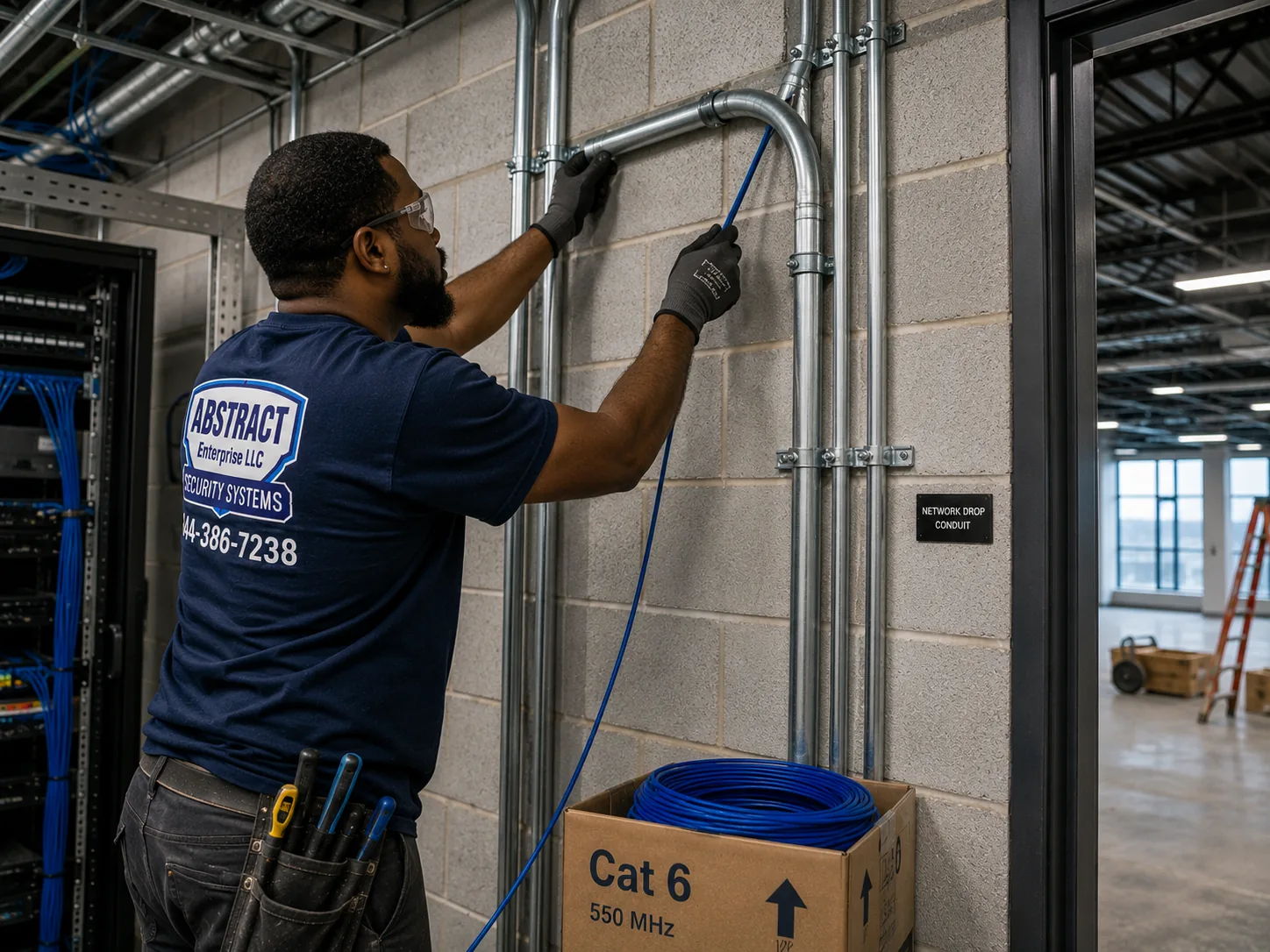
Photo from the AESS job library, not taken in the Hudson Valley: a technician feeding cable into EMT conduit next to a telecom room in an industrial building. In a Route 17K distribution building or an older manufacturing floor in Ulster, PoE runs to high-mounted CX4 cameras travel in conduit like this, so a forklift mast or a falling pallet cannot crush the cable on its way to the switch.
Before You Book
Ten Minutes of Homework That Make a Valley First Alert Install Go Smoothly
Most of the time we lose on a First Alert job is lost before anyone touches a drill: a Total Connect login nobody can find, a panel too old to show cameras, a camera spot the Wi-Fi never reaches, or a historic district nobody mentioned until the camera was on the wall. A phone, a tape measure and a few minutes walking the property prevent almost all of it. You do not need to open any wall, climb anything or touch the alarm panel. Just look, test and send us what you find.
What to check
Why it matters for First Alert cameras
What to send us
Your Total Connect 2.0 login
VX cameras enroll into a Total Connect 2.0 account with a video plan; an existing account saves a step
Whether you can log in, and the name of the company that installed your alarm if there is one
Your alarm touchscreen model
VX3 video can show on a PROA7PLUS or PROA7PLUSC touchscreen running version 03 or higher
A photo of the panel and, if you can find it, the version in its settings
Upload speed at each camera spot
Resideo asks for a continuous 2 Mbps upload or faster for the VX3
A speed-test screenshot taken standing where the camera will go
Wi-Fi bars at each camera spot
The install guide asks for at least -65 dBm signal at the mount
The bars on your phone at the door, the garage and the barn
Power near each outdoor camera
The VX3's power transformer cord has a 10-foot maximum, so an outlet must be close or PoE must be run
Where the nearest outdoor or attic outlet is
What the walls are made of
Stone, brick, block, clapboard and vinyl each take different fixings and a different cable route
A photo of each wall, close enough to see the material
Historic district status
Kingston's HLPC and Newburgh's ARC review some visible exterior equipment
Your address, and any letter from the city about your property
Outbuilding distances
Barns, garages and gates set the cable length and whether Wi-Fi can work at all
Rough paces from the house to each building
Run the speed test where the camera will hang
A speed test at the router tells you what the internet company delivers. A speed test at the porch, on the barn's gable end or at the corner of the garage tells you what the camera will actually get. Stand where the camera will go, with your phone on Wi-Fi rather than cellular data, and run the test twice. Look at the upload number, not the download, because a camera sends video out. If the upload at that spot is under 2 Mbps, or the test stalls, we will plan a cable or a wired access point rather than a wireless camera. In older houses with plaster or stone walls, the drop from the router to the porch is often dramatic, and owners are usually surprised.
Find the account before we arrive
If your house already has a Honeywell, Resideo or First Alert alarm, you probably already have a Total Connect account through the company that installed the panel, and you may already pay for a video plan that covered your old cameras. Find the login and the name of that company before the visit. Resideo's guidance for the VX3 recommends finishing the Total Connect setup before mounting a camera in a hard-to-reach spot, so we want the account sorted on the ground, not discovered on a ladder against a barn wall. If you have no account at all, tell us, and we will explain at the quote how a new one is set up for your cameras.
Ask before you drill into a historic facade
If your house is in the Kingston Stockade or another Kingston district, or in Newburgh's East End, ask yourself one question before you book: can the camera spot be seen from the street? Kingston's HLPC page says exterior work visible from the public right-of-way is reviewed before a building permit, while changes not visible from the street are handled at staff level. Newburgh's guidelines prefer side and rear facades for security equipment. If the answer is yes, send us the address and a photo, and we can suggest positions that avoid review or help you describe the camera to the commission.
What We Install
First Alert Camera Installation Services in the Hudson Valley
These are the First Alert jobs Hudson Valley homeowners, landlords, farm owners and business owners call us for. Each one is priced from the list for your county. Where a job needs something extra, such as a cable to a barn, a back box with conduit on a stone wall or a battery backup for the network, the written quote names it before any work starts.
🏠
VX3 Outdoor Cameras on Old Walls
First Alert VX3 cameras on stone, brick, clapboard and vinyl, wired through the wall where it can be opened and through the IP66 back box with half-inch conduit where it cannot, with every hole sealed for frost.
🛋
VX5 Indoor Cameras With a Shutter
Indoor VX5 cameras that tell people from pets and close an automatic privacy shutter, placed to watch entries and stairs rather than bedrooms and bathrooms.
🔔
VX1 Video Doorbells
First Alert VX1 doorbells replacing old buttons on porches and side doors, with the chime and existing doorbell wiring checked, and on historic facades placed to suit the trim.
🚜
CX4 PoE Cameras for Barns and Gates
First Alert CX4 8MP PoE bullet, dome and turret cameras on network cable for driveways, barn doors, gates and parking lots where Wi-Fi will never be strong enough.
🔄
Replacing Retired Total Connect Cameras
Swapping the first-generation Total Connect 2.0 cameras that stopped working after July 31, 2025 for VX models, reusing good cable and mounts where we can.
📱
Cameras on the Alarm Touchscreen
VX3 video set up to appear on a Honeywell Home PROA7PLUS or Resideo PROA7PLUSC touchscreen running version 03 or higher, so the hallway keypad shows the driveway.
🔌
Network Cable to Outbuildings
Outdoor-rated and direct-burial cable to garages, barns and studios, with surge protection where it enters each building, so PoE cameras and access points get a steady link.
📶
Signal Fixes Before the Camera
Measuring Wi-Fi at each mount and, where it falls short of -65 dBm, adding a wired access point or moving equipment so wireless cameras save every clip.
🔑
Second Homes and Rentals
Remote-friendly setups for weekend houses and rentals: battery backup for the network, alerts tuned for people, and indoor cameras that respect guests' privacy.
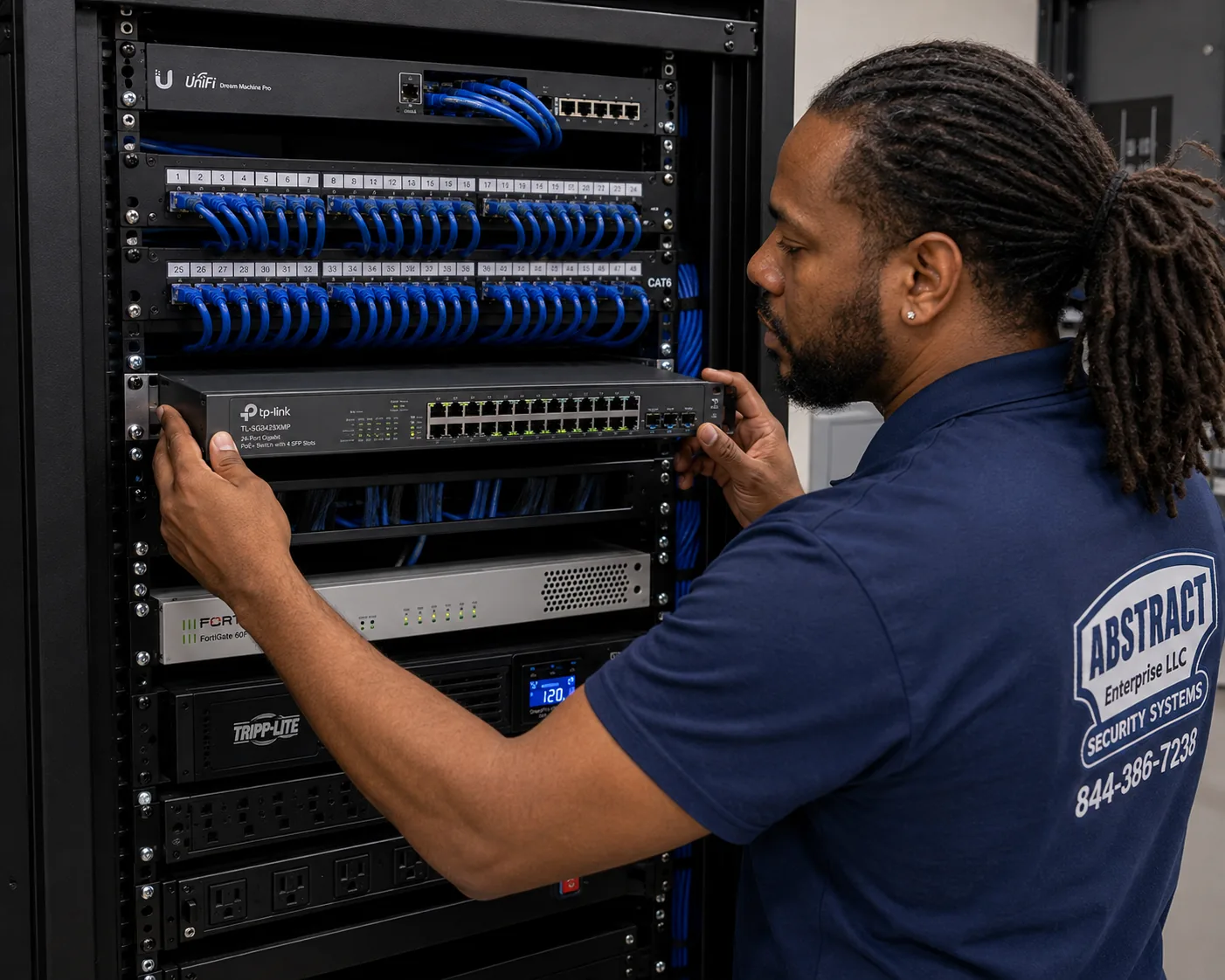
Photo from the AESS job library, not taken in the Hudson Valley: a technician mounting a managed PoE switch beneath the patch panels in a commercial network rack. A switch like this is what powers First Alert CX4 cameras and wired VX3s over the same cable that carries their video, which is how a camera on a far barn wall in Dutchess runs without an outlet anywhere near it.
Building Specialists
First Alert Camera Installation for the Hudson Valley's Architecture
The valley packs four centuries of building into six counties. Each building type changes three things about a First Alert camera job: what the camera is fixed to, how its cable reaches power and network, and who has to agree before it goes up. These are the types the public record and local guides describe, and how we handle each one.
Dutch Colonial Stone Houses
The houses of Hurley, the Kingston Stockade and the river towns, with walls of fieldstone and mortar. Slow masonry drilling, careful sealing, and the VX3 back box with conduit when a hole through the wall is the wrong answer.
Brick Rowhouses and Townhouses
Newburgh's East End and Kingston's brick streets. Side and rear facades first, anchors in the brick face rather than the mortar joint, and line hides painted to match where any wire shows.
Victorian and Village Frame Houses
Wood-frame houses in the river villages and older town centers, with porches, deep trim and plaster walls. Cameras under eaves, cable through attics, doorbells fitted around original moldings.
Post-War Colonials, Ranches and Splits
The suburban stock of Westchester, Rockland and Putnam, median build years in the late 1950s to early 1970s. Accessible attics, siding that takes a clean hole, and the easiest First Alert installs we do.
Farmhouses, Barns and Outbuildings
Dutchess and Ulster farms averaging 150 to 161 acres. PoE CX4 cameras on barn gables, cable buried or carried between buildings, and surge protection at every building entry.
Lake Houses and Second Homes
Houses on Lake Mahopac and the region's hills, often seasonal. Wired cameras where possible, battery backup on the network, and remote alerts the owner can trust from the city.
How the building changes the First Alert job
Building
What holds the camera
How the cable usually travels
Who signs off
Stone house
Masonry anchors in sound stone, set after a test hole
Through a sleeved, sealed hole, or on the surface in the VX3 back box with conduit
The owner; Kingston's HLPC if visible from the street in a district
Brick rowhouse
Sleeve anchors in the brick face, not the joint
Through the rear wall into a basement or back room; painted line hides where needed
The owner; Newburgh's ARC or Kingston's HLPC where applicable
Village frame house
Screws into framing behind siding or trim
Through the soffit into the attic, or down inside a wall to the basement
The owner
Post-war suburban house
Screws into sheathing and framing
Through the wall behind the camera into the attic or garage
The owner; a homeowners association where one exists
Farm and barns
Framing on barn gables, poles at gates
Outdoor-rated or direct-burial cable between buildings, surge-protected at each entry
The owner; a tenant farmer's agreement if the barn is leased
Lake or second home
Framing under eaves, deck posts for dock views
Wired back to a PoE switch on battery backup
The owner; the rental platform's camera rules if the house is rented
On stone walls. A stone house wall is not a uniform material. It is a mix of stones of different hardness held together with mortar that may be centuries old in places and modern repointing in others. A 7/8-inch hole of the size Resideo recommends for the VX3 cable, drilled straight through, can wander when the bit meets a hard stone, crack a soft one, or open a void inside the wall where water will later collect and freeze. We drill test holes first, prefer to pass the cable through a mortar joint that has been repointed and can be repaired, sleeve the hole so the cable is not chafed by stone, and seal both faces. Very often, though, the better answer on a stone house is not to go through the wall at all. The VX3 back box lets the camera sit on the surface with its cable in conduit running along a corner, under an eave or down to a basement window frame where entry is easy. Painted to match, as Kingston's staff asked of one owner in 2025, that conduit disappears into the shadows of the wall.
On barns and outbuildings. A camera on a barn is really a cable problem. The camera itself bolts easily to a gable board or a post. The work is getting power and network to it in a way that survives winter, rodents and lightning. Overhead runs between buildings sag and ice up; buried runs need outdoor or direct-burial cable, a trench below where the frost and the mower can reach, and slack so freeze and thaw do not pull the connectors apart. Inside the barn, cable stays in conduit or high on the framing, away from animals and machinery. At each building entry we add surge protection, because in a county with Orange's or Ulster's lightning counts a cable between two buildings is an invitation for a strike to reach the switch in the house. Doing this once, properly, is cheaper than replacing a scorched switch and three cameras after the next storm.
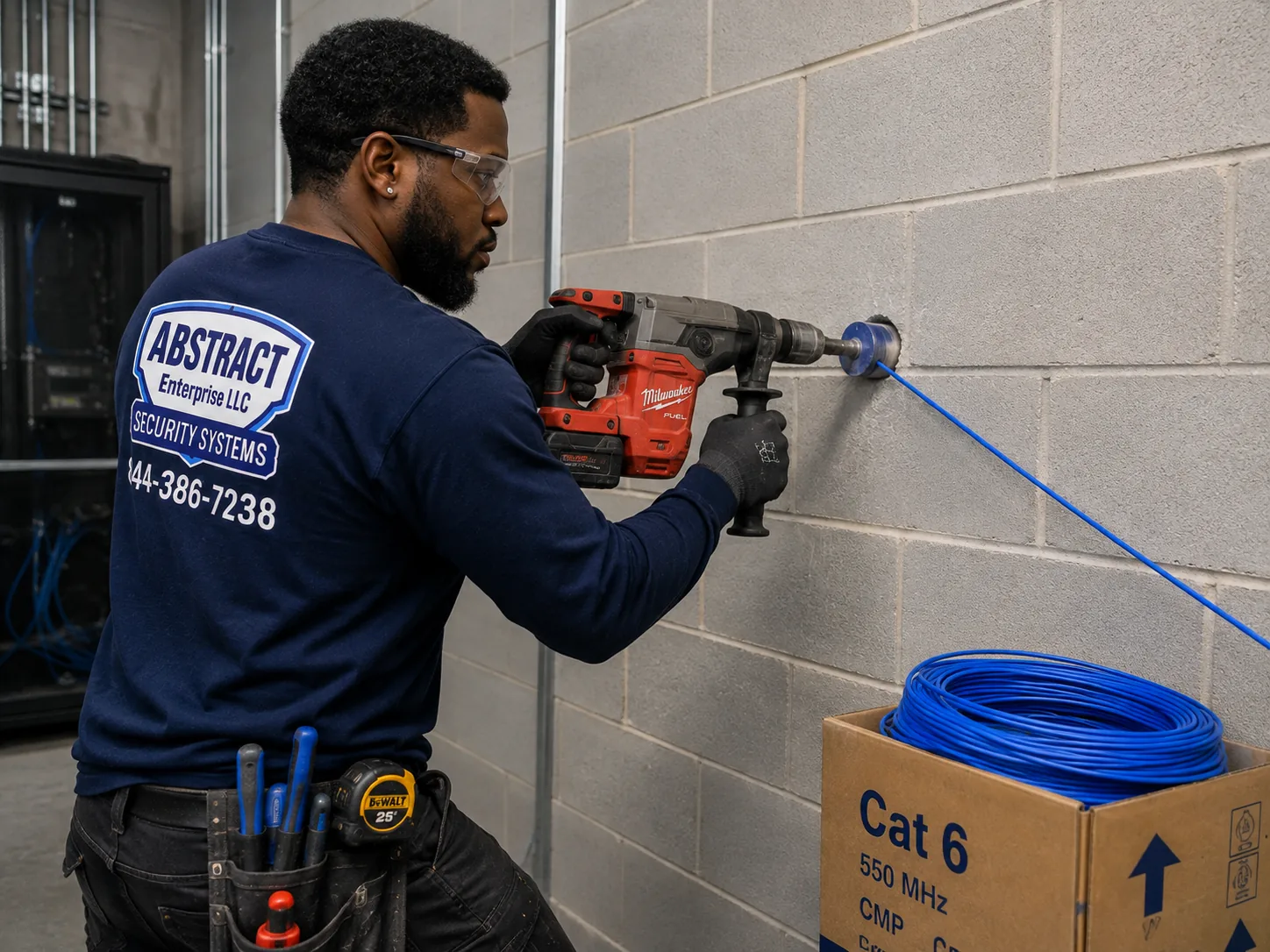
Photo from the AESS job library, not taken in the Hudson Valley: a technician core drilling through a block wall to carry cable into a network room. Passing a First Alert camera cable through the stone or brick of an old valley house takes the same patience: a steady drill, a sleeve in the hole, and a seal on both faces so winter water never follows the cable in.
Commercial First Alert Camera Installation
Business First Alert Camera Installation in the Hudson Valley
Valley businesses run from corporate office parks to farm stands, and their cameras do different jobs: watching a loading dock through the night, covering a register and a door on a village Main Street, or keeping an eye on a parking lot after hours. The corridors below are the ones named in news reports and regional sources. We describe what those sources say about each one; we have no information about the cameras inside any particular business and do not claim any of them as customers.
Westchester Avenue and I-287
Westfair reported about 335,000 square feet at 1111 and 1129 Westchester Avenue on the Platinum Mile, and Howard Properties reported the 1970s "700 series" office buildings on Route 287 in White Plains bought for mixed use, with county office vacancy at 19.9 percent.
Route 59 and the Palisades Center
Rockland's main retail corridors run along Routes 59, 304 and 202, anchored by the Palisades Center in West Nyack, which Hoodline reported at about 2.36 million square feet when it went to a foreclosure auction in February 2026.
Route 17K and Stewart
The Hudson Gateway Association of Realtors reported Amazon at about 1,015,740 square feet and Medline at about 1.2 million square feet in the Town of Montgomery, near Stewart International Airport.
Route 9 Through Poughkeepsie
Route 9 in Wappingers Falls runs past the Poughkeepsie Galleria, and WRRV reported a 2026 tip-jar theft caught on camera at Alimentari Rossi & Sons at Eastdale Village in Poughkeepsie.
Main Street, Beacon
A local guide describes Beacon's historic Main Street as almost a mile long, and Beacon's code requires a certificate of appropriateness for permits that alter historic features in its district.
Enterprise Drive and Uptown Kingston
iPark 87, the former IBM Kingston campus, spans 200 acres along Enterprise Drive, while Hudson Valley One noted that private business cameras in Kingston are mostly bullet-style cylinder cameras.
Village Shops in Warwick
News 12 reported overnight smash-and-grab burglaries at several Orange County businesses in May 2026, with Warwick police confirming three incidents and a store owner sharing surveillance video.
Broadway and the East End, Newburgh
Shops and offices in brick buildings around Broadway and the East End, where the city's guidelines put security equipment on side and rear facades and the Architectural Review Commission issues certificates of appropriateness.
What a business camera has to get right
A home camera mostly has to see a door. A business camera has to identify a face at the register, read a plate at the lot entrance in the dark, and keep doing it through a winter of salt spray from the road. For a shop on a village Main Street that usually means a VX5 or CX4 dome inside covering the counter and the door, and a CX4 bullet or turret outside, mounted high enough that it cannot be knocked aside by a passer-by. For a warehouse off Route 17K or an older industrial building in Ulster it means cameras mounted high on long PoE runs, cable in conduit away from forklifts, and a plan for how many cameras the Total Connect video plans will carry, because each plan package covers up to four VX cameras. We plan business jobs camera by camera, with the owner on site, and the written quote lists each camera, each cable run and each plan before anything is ordered.
Rules every valley business camera has to follow
Licensed installers only. New York's General Business Law Article 6-D says no one may be in the business of installing, servicing or maintaining security or fire alarm systems unless licensed, and a Kirschenbaum & Kirschenbaum explainer notes that closed-circuit cameras used to detect or monitor intrusion, theft or movement fall under it. We work under NYS license #12000287431. State rules at 19 NYCRR 195.2 exempt an owner installing a system bought for their own property with their own employees.
Tell employees about monitoring. Under Civil Rights Law §52-c, as Outten & Golden explains it, employers that monitor electronically must give notice and post it in a conspicuous place visible to employees. We point it out when we hand over a business system.
No cameras in restrooms or locker rooms. Labor Law §203-c, as RecordingLaw summarizes it, prohibits video recording in restrooms, locker rooms and similar areas regardless of any posted policy. We will not install a camera there and will move one that is aimed through a door into one.
Audio is a separate decision. The Reporters Committee's guide notes that New York makes it a felony to record a conversation without the consent of at least one party. In a shop, a camera that hears customers talking at the counter is risky; we leave audio off unless the owner has a lawful reason and posted notice.
Historic storefronts. In Kingston's districts and Newburgh's East End, a camera visible on a storefront may need commission review. Side and rear facades and inside-the-glass placements avoid most of it.
Exits and door hardware. Cameras and their cable never block an exit sign, a path of travel or a door's closer and panic hardware. We check sight lines and door swing before fixing a bracket.
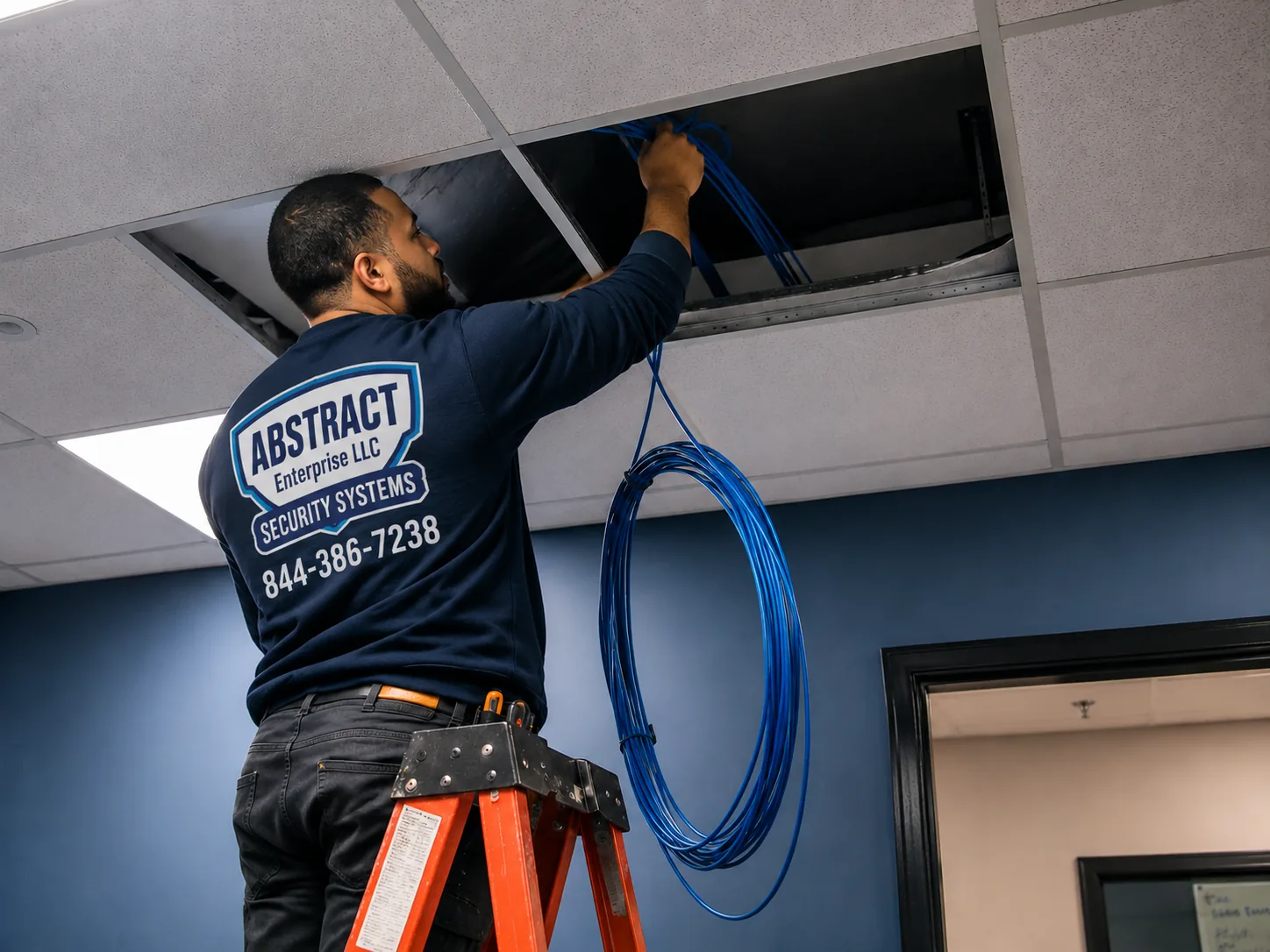
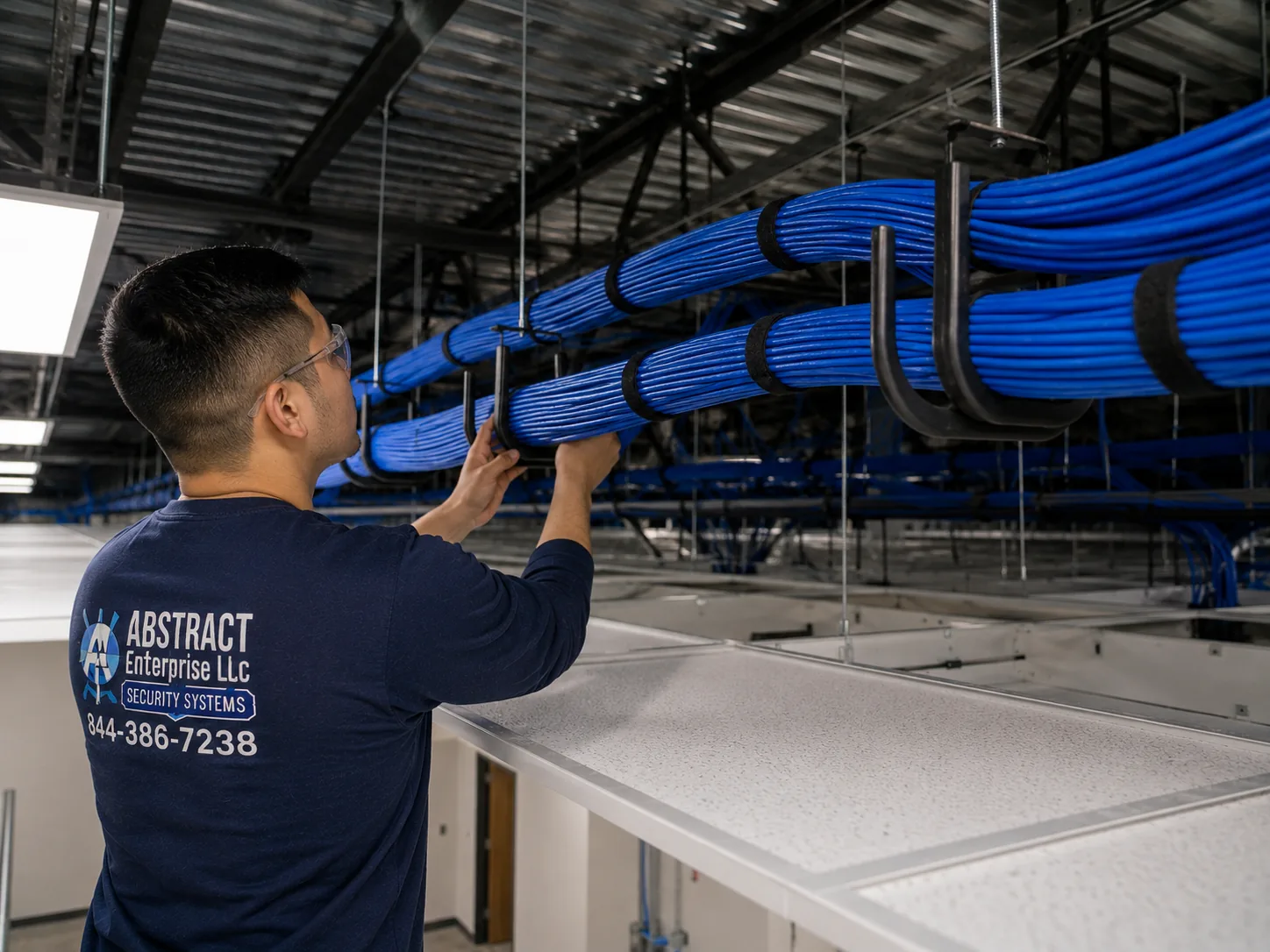
Photo from the AESS job library, not taken in the Hudson Valley: a technician feeding cable through the ceiling of a commercial space while it stays in use. A shop on Beacon's Main Street or an office suite on Westchester Avenue rarely closes for a camera install, so cable for indoor First Alert domes goes in above the ceiling with the business still open below.Photo from the AESS job library, not taken in the Hudson Valley: a J-hook pathway carrying neatly dressed bundles of cable across a commercial ceiling. In a valley office park or a converted mill, camera cables to First Alert CX4 domes ride on supports like these rather than lying on ceiling tiles, so the next tenant's contractor does not cut them by mistake.
Field Notes
Field Notes: Walking a Farmhouse Before the First Camera Goes Up
We do not publish stories about a particular customer's property unless we can document them, so this is not a tale about one address. It is the routine our technicians follow on the kind of property the valley is full of: a farmhouse with a detached garage, a barn across the yard, a gravel driveway that bends out of sight, and an owner who wants to know who comes and goes.
We start indoors, at the router and the alarm panel, and ask for the Total Connect login. We note the panel model and its version. Then we walk the property with a phone running a signal meter and a speed test, stopping at every spot where a camera might go: the front porch, the kitchen door, the garage corner, the barn gable, the bend in the drive. We write the signal and the upload number down at each stop. We look at what each wall is made of and where the nearest outlet is, remembering the VX3's transformer cord stops at ten feet. We pace the distance from the house to the barn. We look up for overhead lines and down for where a trench could go. Then we sit with the owner and draw the plan: which cameras run on Wi-Fi because the numbers are good, which need a cable because they are not, and where the PoE switch and its battery backup will live. Only after the owner agrees to that drawing does anything get enrolled, mounted or drilled.
Your Questions Answered
First Alert Camera Installation in the Hudson Valley: Questions Answered
Accounts, plans and the old cameras
Where do First Alert camera recordings go, and how long does the account hold them?
First Alert VX cameras save clips to the Total Connect service rather than to a recorder in your house, and Resideo requires a monthly storage plan and Total Connect service for them to work. According to Advanced Security's Total Connect video FAQs, the 7-day plan stores up to 350 clips and the 30-day plan stores up to 1,500 clips. For a valley driveway that sees a few cars a day, the 7-day plan can be enough; for a business lot or a farm gate that sees trucks all day, or a second home you only check on weekends, the longer plan makes more sense. We help you pick the plan based on how busy each camera view really is, and we tune detection so the clip count is spent on people and vehicles, not on trees moving in the wind.
Our Honeywell cameras from years ago disappeared from the Total Connect app. Do we have to start over?
Not usually. Alarm Grid reported that first-generation Total Connect 2.0 cameras stopped working after July 31, 2025, were removed from accounts, and lost their recorded clips, and Resideo's end-of-life notice points owners to the First Alert VX Series as the replacement. In most valley homes the account, the alarm panel and often the cable and mounting spots are still good. We remove the old cameras, test any existing cable, install VX models in the same or better positions, and enroll them on your existing account. The old clips cannot be recovered, so if you need footage of an old incident, there is nothing we can retrieve now.
We want six cameras around the property. Does one video plan cover all of them?
Alarm Grid's product page says each video plan allows up to four VX-Series cameras per package, so a property with six cameras needs more than one package. That is worth knowing before you decide how many cameras to buy, because the plan cost is ongoing and the camera cost is not. Often a valley property with a long list starts with four well-placed cameras covering the doors, the driveway and the garage, then adds a second group later for the barn and the gate. We map the positions first and show you which four cover the most ground, so the decision about a second plan is yours and not a surprise.
Signal, distance and power
Our farmhouse Wi-Fi barely reaches the front porch. Can a VX3 still work out there?
It depends on the numbers at that exact spot. Resideo's install guide asks for a Wi-Fi signal of at least -65 dBm where the camera is mounted, and the data sheet asks for a continuous upload of 2 Mbps or better. If your phone shows one bar at the porch and the speed test stalls, the VX3 will drop clips or go offline. The VX3 also supports a wired Ethernet connection and PoE power, which removes the Wi-Fi problem entirely. In thick-walled farmhouses we often run one network cable from the router to the porch camera, or add a wired access point that improves the signal for the whole front of the house. We test first and tell you which answer your porch needs.
The gate is at the end of a long gravel driveway. How far can a camera cable reach?
A standard Ethernet run, which carries both the video and the PoE power for a CX4 or wired VX3, is good for about 100 meters, roughly 328 feet, from the switch to the camera. Many valley driveways are longer than that. For a distant gate we usually put a small weatherproof enclosure with a switch partway along, powered from an outbuilding or a post with power, or bring the cable from the nearest building rather than the house. On farms the barn is often closer to the gate than the house is. We pace the route with you, plan the cable path and any trench, and include surge protection where the cable enters each building.
If the power stays on but the internet drops, do the cameras keep recording?
No. First Alert VX cameras are cloud cameras, and as a general rule a cloud camera cannot save new footage without an internet connection, even when it has power. That matters on valley roads where the internet line is a single cable on poles that come down in a storm. The practical steps are to put the router, the modem and any PoE switch on a battery backup so a brief power blip does not take the internet down with it, and to ask your provider about a backup connection if footage during outages matters to you. We will not tell you a cloud camera records through an internet outage, because it does not.
Stone, brick and historic districts
Our house is in the Kingston Stockade. What has to happen before a camera goes on the front?
Kingston's HLPC page says exterior work on historic properties visible from the public right-of-way is reviewed by the commission before a building permit is issued, and that review covers electrical and mechanical equipment visible from the street that does not comply with city code. Exterior changes not visible from the street are handled at the desk level. In practice that means a camera on a rear or side wall that cannot be seen from the street is usually the easier route, while a doorbell or camera on the front facade may need the commission's look first. We help you choose positions, describe the hardware for an application if one is needed, and paint any surface line hides to match the facade, as Kingston staff recommended in a 2025 approval.
Our Newburgh rowhouse is in the East End. Where can the cameras go without breaking the guidelines?
Newburgh's East End design guidelines say security features must not damage historic building fabric and that security or motion-detection equipment should be located on side or rear facades, with the Architectural Review Commission issuing certificates of appropriateness for exterior changes. For a rowhouse with no side wall, that usually means cameras at the rear, covering the yard, the back door and any alley, with the front door handled by a doorbell or an indoor VX5 watching through the glass. Fixings go into the brick face rather than the mortar joints, and holes are made where they can be repaired cleanly. If a front camera is truly needed, we suggest the smallest, best-hidden position and the paperwork to ask the commission.
How big a hole does a VX3 need, and what if our wall is two feet of stone?
Resideo's VX3 install guide recommends a drill bit of 7/8 inch or larger for the cable entry. In wood siding that is quick. In a thick stone or brick wall it is a slow masonry job, and a hole that size through old stone can crack a soft stone or open a void that later collects water. For those walls we often skip the hole entirely and use the VX3's optional back box, which Alarm Grid describes as IP66 rated and able to take up to three half-inch conduits, running the cable on the surface to a point where entry is easy, such as a basement window frame or a wooden eave. Where a through-hole is the right answer, we sleeve it and seal both faces.
Privacy, audio and the law
Can an indoor First Alert camera stop watching when we are home?
Yes. Resideo's VX Series page lists an automatic privacy shutter on the VX5 indoor camera, which physically covers the lens, and the VX5 can tell people from pets, so a dog walking past does not trigger the same alert as a stranger. We set the shutter to close when the alarm is disarmed or on a schedule you choose, and we place indoor cameras to watch entry doors, stairs and hallways rather than bedrooms or bathrooms. For a valley rental or a home with caregivers or guests, that combination keeps the camera useful when the house is empty and out of the way when it is not.
Is it legal for our doorbell camera to record what visitors say on the porch?
Video and audio follow different rules in New York. The Reporters Committee's recording guide explains that New York makes it a felony to record a conversation you are not part of without the consent of at least one party. A doorbell recording a visitor speaking to you is one thing; a camera that silently picks up two neighbors talking on the sidewalk is another, and nobody has clearly settled where passive audio pickup falls. That uncertainty is why we usually leave audio recording off on outdoor cameras aimed beyond your door, keep two-way talk on the doorbell, and explain the settings at handover so you decide with the facts. This is general information, not legal advice.
Does whoever installs our First Alert cameras need a state license?
Yes, if they do it as a business. New York's General Business Law Article 6-D says no one may engage in the business of installing, servicing or maintaining security or fire alarm systems without a license, and the Department of State's licensing page sets education and exam requirements, with a two-year renewal cycle according to a licensing guide. A legal explainer from Kirschenbaum & Kirschenbaum notes that camera systems used to detect or monitor intrusion, theft or movement fall under that rule, and First Alert cameras tied to a Honeywell or Resideo alarm panel are clearly security systems. We work under NYS license #12000287431. A property owner installing their own system with their own employees on their own property is exempt under state rules.
Panels and the rest of the system
Can the driveway camera show up on the alarm keypad in our hallway?
It can if the keypad is the right model. Alarm Grid reports that the VX3 can be viewed on a Honeywell Home PROA7PLUS or a Resideo PROA7PLUSC touchscreen, as long as the panel is running version 03 or higher. Older keypads and panels without a touchscreen will not show video, though the cameras still work in the Total Connect app on your phone. Send us a photo of your keypad and, if you can find it, the version number in its settings menu. If the panel needs an update or the keypad is too old, we tell you before booking, so you are not surprised on the day.
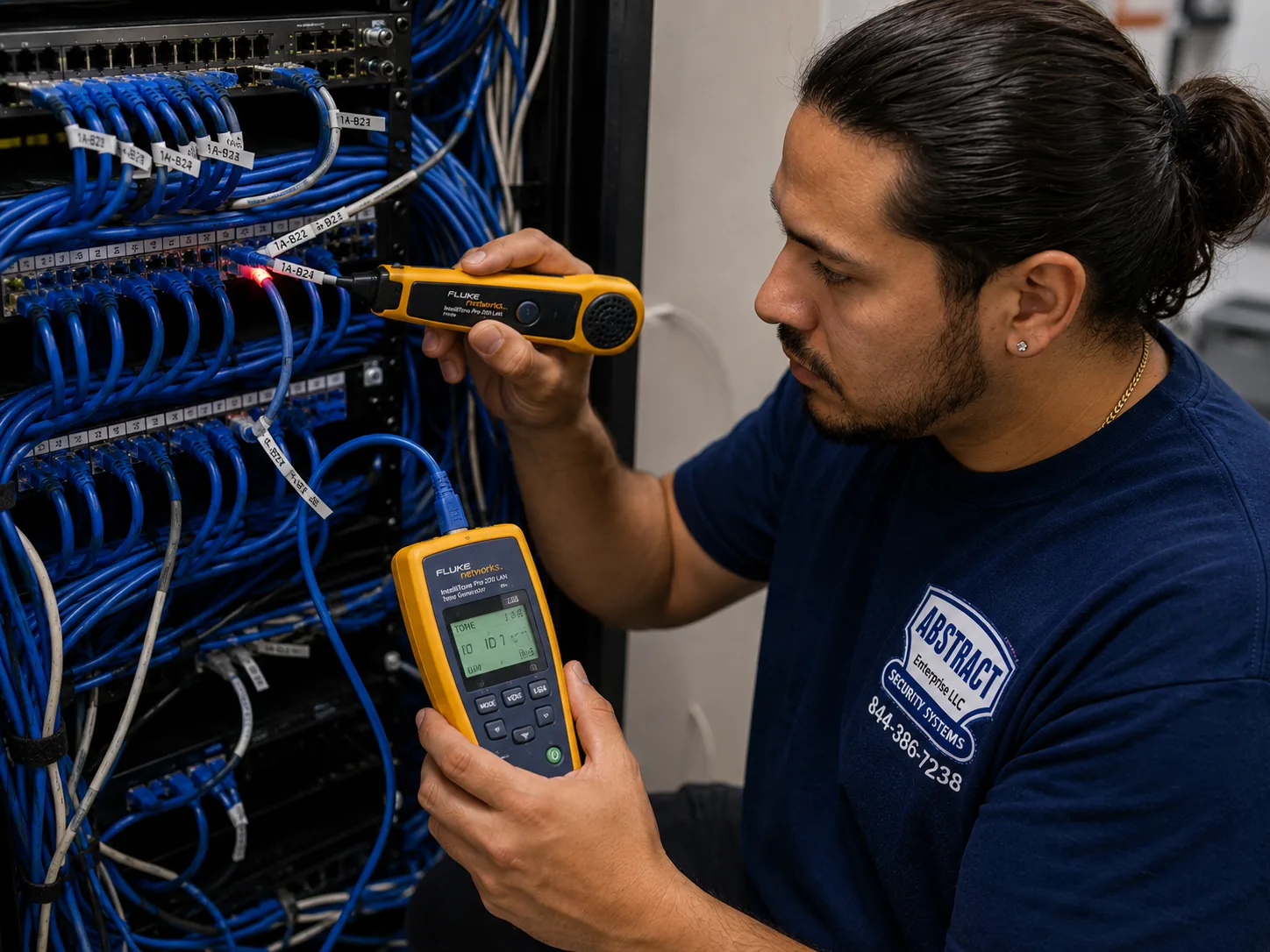
Photo from the AESS job library, not taken in the Hudson Valley: a technician tracing an unidentified cable run at a patch panel with a tone generator and probe. When we replace retired Total Connect cameras in a valley house, we trace the old cables like this first, so a run that is still sound can carry the new VX camera instead of drilling a fresh hole through an old wall.
Equipment
Types of First Alert Camera Installation We Install
These are the First Alert cameras and supporting parts we fit across the six counties. The model you need depends far more on your signal, your walls and your distances than on the brochure. Installed prices for each come from the price list for your county; the equipment notes below come from Resideo and its distributors' published specifications.
📷
VX3 Outdoor Camera
Wi-Fi or Ethernet, powered by a 12VDC adapter or 802.3af PoE (both at once if wanted), rated to -40°C, with a 10-foot maximum transformer cord. The everyday camera for porches, garages and house corners.
🏡
VX5 Indoor Camera
A 2MP sensor with wide dynamic range for rooms with bright windows, person-versus-pet detection, and an automatic privacy shutter. For entry halls, mudrooms and stairways.
🔔
VX1 Video Doorbell
First Alert's VX doorbell, on the same Total Connect account as the cameras. For porches in Poughkeepsie, Newburgh and Kingston where packages and visitors arrive.
🔭
CX4 PoE Bullet
An 8MP PoE bullet camera for long views: driveways, gates, parking lots and the length of a barn aisle, on network cable rather than Wi-Fi.
⚪
CX4 PoE Dome and Turret
8MP PoE dome and turret versions for shop ceilings, under porch roofs and on walls where a compact, tamper-resistant shape suits the building.
📦
VX3 Back Box and Conduit
The optional IP66 back box that keeps VX3 cables out of sight and accepts up to three half-inch conduits, for stone, brick and any wall that should not be opened.
📱
PROA7PLUS and PROA7PLUSC Touchscreens
Honeywell Home and Resideo alarm touchscreens that can show VX3 video on version 03 or higher, so the keypad doubles as a monitor.
🔋
PoE Switches, Surge Protection and Backup
Switches to power wired cameras, protectors where cables leave a building, and battery backup to keep the router and cameras up through short outages.
The back box, in an installer's words
When Resideo launched the VX3, its announcement quoted Paul Romanelli of Suffolk Security Systems, a First Alert Pro Resideo Premier Partner, saying, "Our installers also really like the compact and modern design and back box that stows cables out of the way." That matches what the back box does on old valley walls: it gives the camera a clean, weatherproof base and a place for the cable to go when drilling through the wall is the wrong idea.
National brands vs a local licensed installer
People comparing options often ask how First Alert installed by a local company stacks up against ADT, Ring or SimpliSafe. ADT is best known for its own monitored systems. Ring and SimpliSafe sell cameras and kits mostly designed for owners to install themselves, with optional installation through networks of contractors. First Alert's VX line, by contrast, is a dealer-installed product built to work with Resideo's ProSeries and VISTA alarm panels and the Total Connect app, which is why so many valley homes with older Honeywell alarms end up with it. The brand matters less than the install, though. A camera of any brand on the edge of a weak Wi-Fi signal, on a stone wall drilled carelessly, or on a historic facade without a thought for the commission is a bad install. A local technician who walks the property, measures the signal and reads the wall is what turns any of these into a working system.
First Alert cameras vs the First Alert decoy
One source of confusion is worth clearing up. The First Alert store also sells a consumer decoy camera, the DC-1, which looks like a camera but records nothing. It shares the First Alert name with Resideo's working VX and CX4 cameras but has nothing to do with them. If someone tells you they have "a First Alert camera" on the garage, the first question is whether it is a decoy or a real VX camera on a Total Connect account. We have seen both on the same wall.
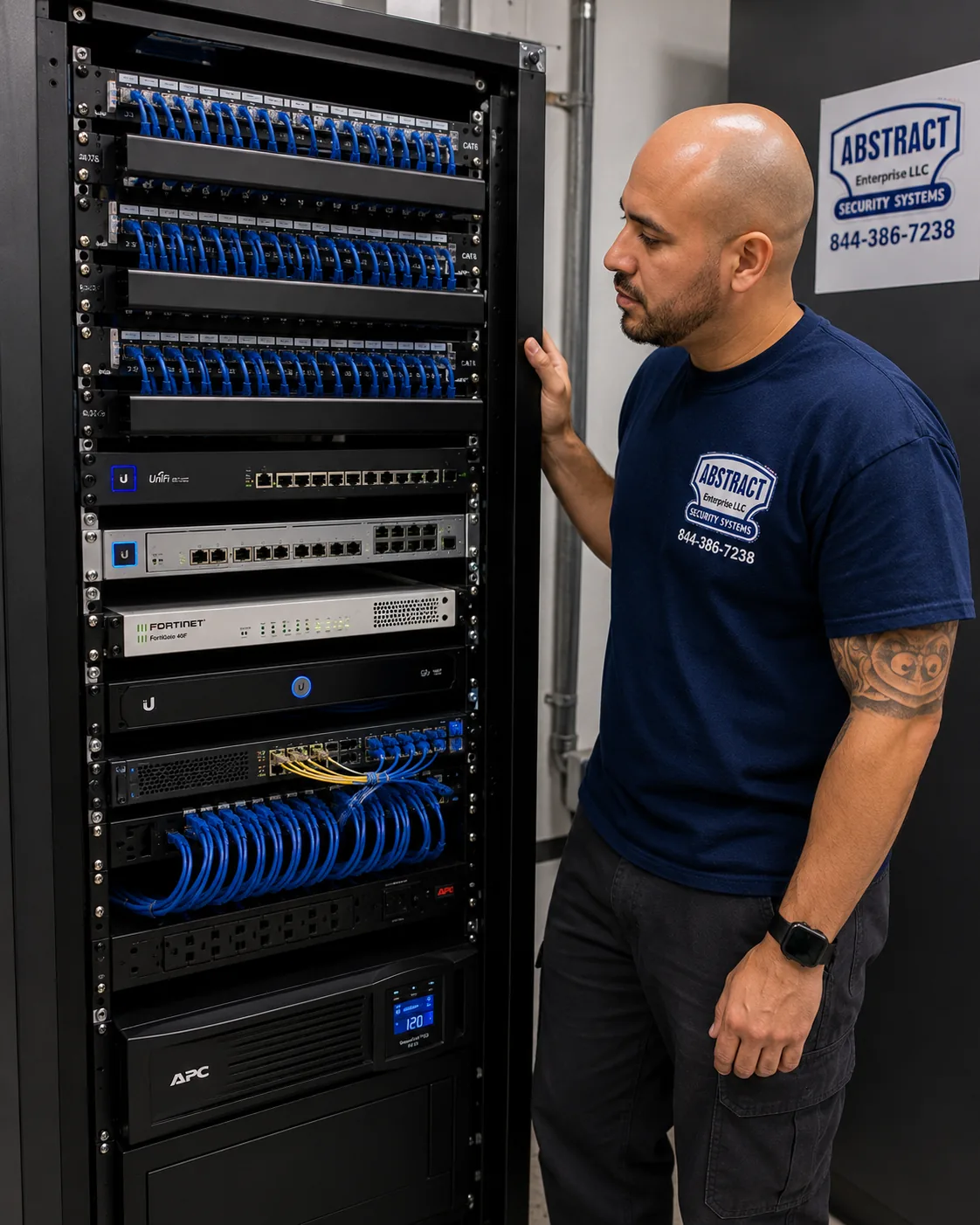
Photo from the AESS job library, not taken in the Hudson Valley: a finished network rack with patch panels, switching, a firewall and a battery backup, all dressed and labelled. A valley business or a large estate with First Alert PoE cameras ends up with a smaller version of this, where the battery at the bottom keeps the switch and the internet running through the short outages that follow every summer storm.
AI Overview Reality Check
What AI Gets Wrong About First Alert Camera Installation in the Hudson Valley
We could not capture Google's AI Overview or People Also Ask boxes for this topic from our build environment, so we will not pretend to quote them. What follows are claims we commonly see in quick online answers about First Alert cameras and about camera installs in the valley, set against what Resideo's documentation, the public record and our own field practice say. Marketplaces such as Angi, HomeAdvisor and Fixr publish national cost guides for camera installation that feed many of those answers; they are useful for a rough sense of the market, but they do not know your walls, your signal or your county.
"First Alert cameras are cheap plug-in cameras from the hardware store."
This mixes up two products that share a name. The First Alert store sells a decoy camera, the DC-1, that looks like a camera and records nothing. The working First Alert cameras are Resideo's VX Series and CX4 line, which Alarm Grid explains carry the First Alert name because Resideo, formerly selling under Honeywell and Honeywell Home, chose it for the new cameras.
Resideo agreed to buy First Alert from Newell Brands in an announcement on February 7, 2022, and describes a network of about 100,000 professional installers. First Alert's own home security page sends shoppers to a local expert rather than a checkout button.
In other words, the real cameras are designed to be installed and enrolled by a professional on a Total Connect account. A decoy on a barn in Ulster may deter a casual thief; it will not show you the 3 a.m. car in your driveway.
"Download the First Alert app and add your cameras."
Searches for "the First Alert app" often land on Onelink Home, which First Alert support describes as the app for its Onelink smoke and carbon monoxide alarms and its Environment Monitor. It is not the app for VX cameras, and its App Store rating of 1.5 from 306 reviews has nothing to do with them.
VX cameras run on Total Connect 2.0. Alarm Grid's VX3 page is explicit that you need a Total Connect 2.0 smart video account to enroll and use the camera, and installers such as PROTECH describe the First Alert doorbell as working through the Total Connect app.
Getting this right saves an afternoon of frustration. If you have been trying to add a VX camera to Onelink, stop; we will set it up in Total Connect, and if you also own Onelink alarms, they stay in their own app.
"Professional cameras record without a subscription."
Some quick answers lump all professionally installed cameras together with systems that record to a box in the closet. First Alert's VX line does not work that way. Advanced Security's listing for the VX1 doorbell states that a monthly storage plan and Total Connect service are required for the VX Series doorbell and cameras.
Those plans have limits worth knowing: the 7-day plan stores up to 350 clips and the 30-day plan up to 1,500, and each plan package covers up to four VX cameras, according to Advanced Security and Alarm Grid.
We say this plainly at the quote, because it changes the decision. If a recurring plan is a deal-breaker, a First Alert camera is the wrong product, and we will tell you so rather than sell it.
"Any home Wi-Fi is fine for a wireless camera."
This is the claim that causes the most dropped clips in the valley. Resideo's VX3 data sheet asks for a continuous upload of 2 Mbps or faster, and its install guide says to verify at least -65 dBm of signal at the installation location. Those are measured at the camera, not at the router.
In a stone house in Hurley or a farmhouse with a barn 300 feet away, the signal at the mount can be a fraction of the signal in the kitchen. Ulster County's 2025 broadband award for nearly 1,300 unserved locations is a reminder that, on some roads, even the connection to the house is thin.
The VX3 accepts Ethernet and PoE, and the CX4 line is PoE only. Where the numbers fall short, a cable is the reliable answer. We measure at every mount before promising Wi-Fi.
"Older Honeywell Total Connect cameras keep working forever."
Plenty of answers still describe the first-generation Total Connect cameras as current. Alarm Grid reported that those cameras would no longer work in Total Connect 2.0 after July 31, 2025, would be removed from all accounts, and would have their recorded clips deleted.
Resideo's end-of-life notice for Total Connect cameras recommends the First Alert VX Series as replacements. That makes many valley homes with older Honeywell alarms candidates for an upgrade they did not plan.
The good news is that the account and panel usually stay. We test existing cable, reuse sound runs and mounting points where we can, and put VX cameras where the old ones were, or better.
"Outdoor cameras quit in upstate winters."
Cold is a real problem for battery-powered cameras, and answers often generalize from that. The VX3 is not a battery camera. Its data sheet lists an operating range down to -40°C, and it runs on a plug-in adapter or PoE.
In our experience the winter failures in the valley are rarely the camera. They are water that followed a cable into an unsealed hole and froze, an outdoor cable buried without slack that pulled its connector apart, or a router on a basement floor that lost power in an ice storm.
That is why we seal every penetration, use outdoor or direct-burial cable between buildings, leave slack for frost, and put the network on battery backup. The camera can take the cold; the install has to as well.
"A security camera doesn't need any approval on a historic house."
Answers that treat cameras as too small to matter miss how the valley's historic cities write their rules. Newburgh's East End design guidelines address security features directly, saying they must not damage historic fabric and that security or motion-detection equipment should go on side or rear facades.
Kingston's HLPC reviews exterior work visible from the public right-of-way before a building permit, including electrical and mechanical equipment visible from the street, and its staff recommended in 2025 that one owner paint all externally mounted lines to match the facade.
Whether a single surface-mounted camera alone triggers review in a given case is something we could not find written down, so we do not guess. We plan positions that avoid the question where possible, and help you ask the commission where it is not.
Not Sure Which Camera Fits Your Wall or Your Signal? Talk to a Technician
Send a speed-test screenshot from each camera spot, a photo of each wall and a photo of your alarm keypad, and a technician will tell you which First Alert cameras fit, whether Wi-Fi will hold or a cable is needed, and which lines of your county's price list apply. Call (800) 486-0943, message us on WhatsApp, or use the quick form.
Every Hudson Valley First Alert job follows the same eight steps, whether it is a single doorbell on a Rockland split-level or a dozen PoE cameras across a Dutchess farm. The order matters most on old walls and big lots, where a camera mounted before the signal and the account are checked is the usual cause of a second visit.
1. Send the property details
County and town, building type, how many cameras, and whether you have a Total Connect account or a Honeywell or Resideo alarm. Photos of each spot help us match the job to your county price list.
2. Confirm the account and plan
Who holds the Total Connect 2.0 account, which video plan the cameras will use, and how many cameras it carries, since each plan package covers up to four VX cameras.
3. Survey signal and power
At every proposed mount we measure Wi-Fi against the -65 dBm minimum, check for a continuous 2 Mbps upload, and find power within the VX3's 10-foot cord or plan PoE.
4. Agree positions and approvals
We mark each camera spot with you, check the view on a phone, and for Kingston or Newburgh historic districts confirm whether commission review is needed first.
5. Enroll before mounting
Following Resideo's advice for hard-to-reach spots, each camera is added to Total Connect and tested on the ground before it goes up a ladder or onto a barn.
6. Mount, cable and seal
Cameras fixed into sound material, cable inside the wall or in back box conduit, outdoor runs surge-protected, and every hole through stone, brick or siding sealed for frost.
7. Tune detection and privacy
Zones set to the property line, the VX5 shutter scheduled, audio set to suit New York's consent law, and alerts trimmed so deer and road traffic stay quiet.
8. Test and hand over
Every camera checked live in the app and on a PROA7PLUS or PROA7PLUSC where installed, clips confirmed saving, and a labelled map of cameras, cables and ports left with you.
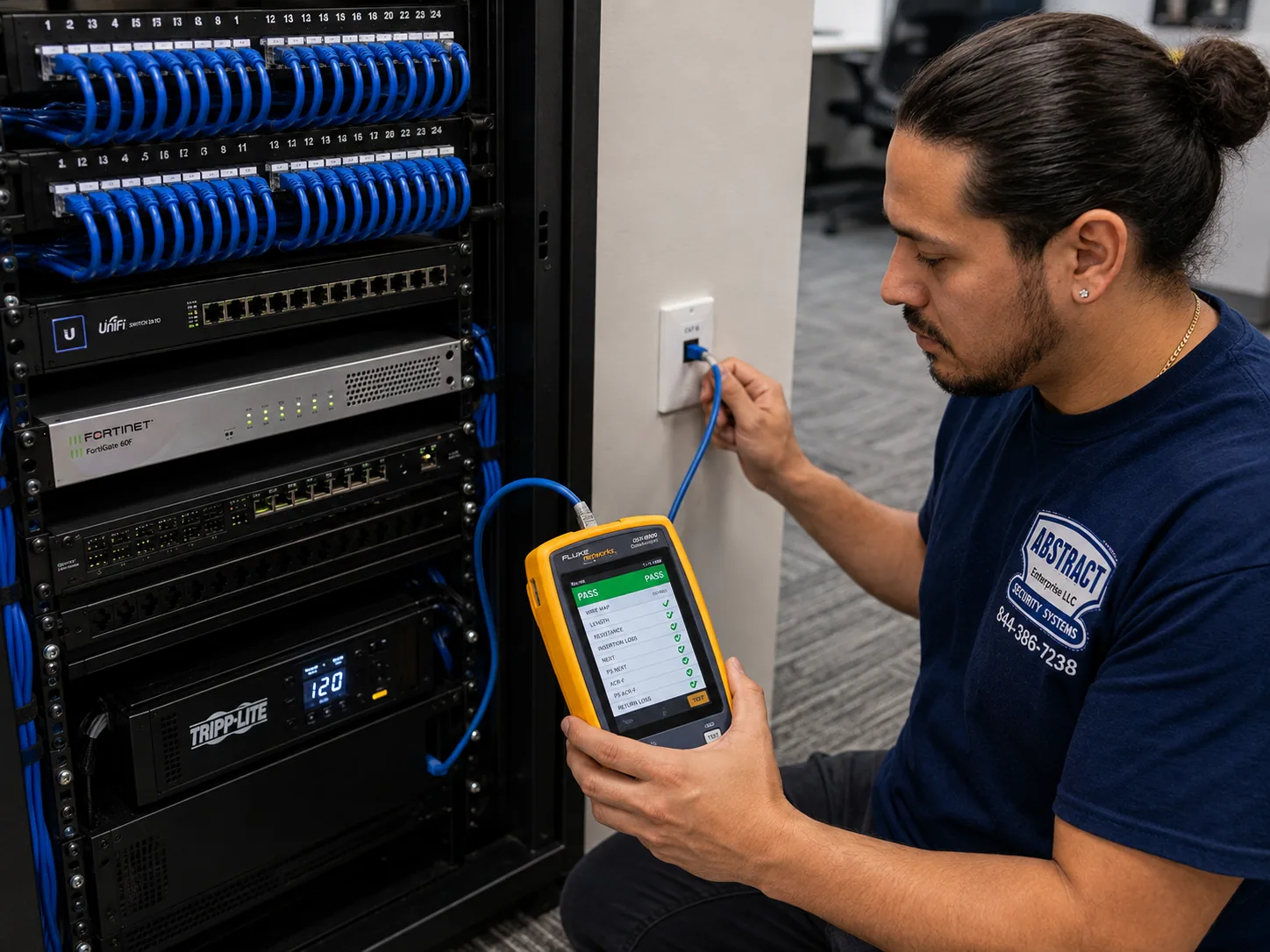
Photo from the AESS job library, not taken in the Hudson Valley: a technician certifying a data drop with a cable analyzer that shows a PASS result. Before a First Alert CX4 goes up on a barn gable or a warehouse wall in the valley, the cable that feeds it is tested like this, so a bad connector is found on the ground and not after the ladder is packed away.
Coverage Area
First Alert Camera Installation Near the Hudson Valley's Landmarks
The valley is big, and most people give directions by its landmarks and river crossings. These are the ones we use when we plan a route from the Bronx up the I-87, Taconic and I-84 corridors.
Kingston Stockade District
The site of the 1658 stockade, eight blocks and about 32 acres according to Wikipedia, with Dutch stone houses at all four corners of Crown and John Streets and the Senate House nearby.
Washington's Headquarters, Newburgh
The stone house where George Washington lived in 1782 and 1783, inside the East End Historic District, called the nation's first publicly operated historic site.
Walkway Over the Hudson
Opened in 1888 as a rail bridge, now a pedestrian bridge 212 feet tall and 1.28 miles long between Poughkeepsie and Highland, according to the Hudson River Valley Heritage Area.
Dia Beacon
A 1929 Nabisco box-printing factory of nearly 300,000 square feet in brick, steel, concrete and glass, a short walk from Beacon's Main Street, per Dia.
Storm King Art Center
A 500-acre outdoor museum at 1 Museum Road in New Windsor, Orange County, near the Route 32 and Route 9W corridors.
Lake Mahopac
About 587 acres of water in Putnam County according to a listing site, ringed by waterfront homes, some with boathouses below the main house.
First Alert Camera Installation Cost in the Hudson Valley
Each Hudson Valley county has its own First Alert price list, because travel and access differ from Yonkers to the far side of Ulster. We do not print a single valley-wide number here, because a number that is right for a Rockland split-level is wrong for a stone house in Hurley. The full lists live on our Hudson Valley First Alert camera price page and the county pages linked above, and every quote is built only from the lines on those lists. Two costs sit outside our quote: the cameras themselves if you supply them, and the monthly Total Connect video plan, which Resideo requires for VX cameras and which is billed through whoever holds your account.
What moves the quote
Why it matters in the valley
How we handle it
Number of cameras
Each video plan package covers up to four VX cameras
We map positions so four cameras cover the most ground first
Wi-Fi or cable
The VX3 needs -65 dBm and a continuous 2 Mbps upload at the mount
Measured on site; a cable run is quoted only where the numbers fall short
Wall material
Stone, brick and block take far longer than vinyl or wood siding
Named on the quote per camera, with the back box option for masonry
Distance to outbuildings
Barns and gates can sit beyond a standard 100-meter cable run
Route and any midway switch planned and listed before work starts
Trenching and burial
Frost, mowers and, in parts of Putnam, watershed rules affect buried cable
Quoted per run; utility mark-outs requested before digging
Surge protection and backup
Lightning and storm outages hit cameras that leave the building
Protectors at building entries and battery backup listed as separate lines
Replacing retired cameras
Old Total Connect cameras stopped working after July 31, 2025
Existing cable tested and reused where sound, which shortens the job
Historic-district work
Kingston and Newburgh may review visible exterior equipment
Positions planned to suit the guidelines; painted line hides where needed
Panel viewing
Video on the keypad needs a PROA7PLUS or PROA7PLUSC on version 03+
Checked from your keypad photo before booking
How to read a valley quote
Picture a farmhouse in Dutchess with a VX1 doorbell at the kitchen door, a VX3 on the front porch where the Wi-Fi tests well, and a CX4 bullet on the barn watching the driveway. The quote lists the doorbell, the porch camera on Wi-Fi, the barn camera with its cable run, the surge protector where that cable enters each building, and a battery backup for the router and switch if you want one, each from the Dutchess list. Move the same three cameras to a brick rowhouse in Newburgh and the barn cable disappears, but the rear-wall masonry work and painted line hides appear instead. Nothing is added on the day unless you ask for it, and if the technician finds a different wall or a weaker signal than your photos showed, they stop, show you, and agree the change before going on.
Warranty terms for this work:
Full terms — including 50% deposit, one-year parts-only warranty on AESS-supplied products, and the late-fee schedule — are set out in the service agreement.
Separately, any return visit for adjustments after a job is complete is quoted in advance, and we will tell you before booking whether a problem is covered or not.
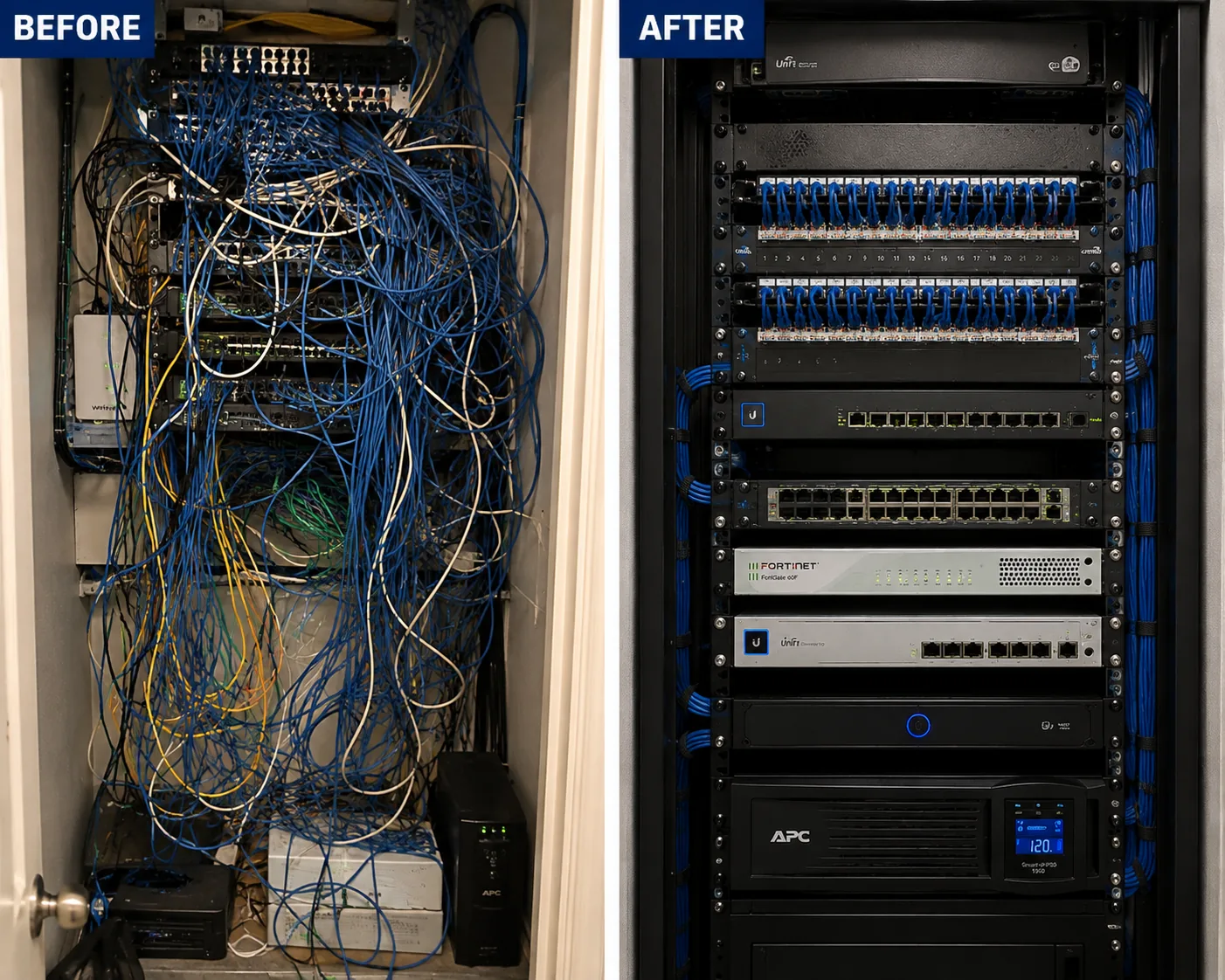
Photo from the AESS job library, not taken in the Hudson Valley: before and after views of a network rack, from an unlabelled tangle to a dressed, identified rack. Valley businesses that inherited years of added cameras and network gear often start a First Alert upgrade with a cleanup like this, which is why tidying old cabling is listed as its own line rather than hidden inside the camera price.
Shop Our Systems
First Alert Camera Installation Packages & Pricing
Three common valley setups, each built only from lines on your county's price list. The figures for each line are on the county price pages; there is no package premium and no hidden extra.
Starter: Door and Driveway
A VX1 doorbell at the main door and one VX3 covering the driveway, both on Wi-Fi where the signal tests at -65 dBm or better, enrolled on your Total Connect account. Suits post-war houses in Westchester, Rockland and Putnam with good broadband.
Standard: Four Sides of the House
Four cameras, the most one video plan package carries: the doorbell, two VX3s on the house corners and a VX5 indoors with its privacy shutter, plus battery backup for the router. The usual job for a village frame house or a replaced Honeywell system.
Premium: House, Barn and Gate
VX cameras on the house plus CX4 PoE cameras on the barn and at the gate, with outdoor-rated or buried cable, surge protection at each building, a PoE switch on backup and video on a PROA7PLUS touchscreen. For Dutchess and Ulster farms and estates.
Bring your own equipment
If you have already bought First Alert VX or CX4 cameras, we install them at labor-only prices from the same county list, as long as they are genuine Resideo products in working condition and can be enrolled on your Total Connect account. We check each camera on the ground and enroll it before anything is mounted. If a camera you supply turns out to be a decoy, a retired first-generation Total Connect model or a damaged unit, we tell you before drilling and show you what would replace it. Cameras you supply are covered by their maker's terms, not ours, which the quote states plainly.
Complete Services
Every First Alert Camera Installation Service in the Hudson Valley
Going by local reviews, what should we look for in a Hudson Valley camera installer?
+
The praise in Poughkeepsie-area Yelp listings comes back to the same thing: one reviewer wrote that the installation was clean, the wiring neatly concealed and the system worked flawlessly. The complaints point the other way, including a reviewer who said an installer failed to connect a sensor and simply tucked it into the wall. Ask any installer how they will hide the cable on your walls, how they will test each camera before leaving, and what they leave you in writing about what was installed and where.
Can you fix our home network at the same visit as the cameras?
+
Yes. In many valley houses the camera install shows that the Wi-Fi never reached the porch, the garage or the barn in the first place. We can run network cable to an outbuilding, add a wired access point or move equipment to a better spot during the same visit, which costs less than two separate trips. Tell us about any Wi-Fi trouble when you book so we bring the right cable and parts.
Why pay an installer for First Alert cameras rather than putting them up ourselves?
+
First Alert's VX line is sold as a professionally installed product. The cameras have to be enrolled on a Total Connect 2.0 account with a video plan, tested against signal and upload minimums at the mount, and fixed to walls that in the valley are often stone or brick. If they tie into an alarm panel, the work is security-system work that New York licenses. You can still do parts yourself; many owners just want the wall, the cable and the account done once and done right.
Is the First Alert decoy camera sold online the same as the ones you install?
+
No. The First Alert store sells a DC-1 decoy that looks like a camera but records nothing. The cameras we install are Resideo's working VX and CX4 models, which record clips to a Total Connect account. A decoy can sit alongside real cameras as a deterrent, but it will never show you who came up the driveway.
We already use the Onelink app for our First Alert smoke alarms. Will the cameras show up there?
+
No. First Alert support describes Onelink Home as the app for Onelink smoke and carbon monoxide alarms and the Environment Monitor. VX cameras run in Total Connect, so you will use two apps: Onelink for those alarms and Total Connect for the cameras and any Honeywell or Resideo alarm panel.
Should our cameras and router have battery backup for storm outages?
+
In most of the valley, yes. Storms in June 2024 and July 2026 each left tens of thousands of Central Hudson and Orange and Rockland customers without power. A battery backup on the modem, router and any PoE switch keeps cameras online through short outages and brief flickers. It will not carry them through a multi-day outage, which needs a generator, and the internet line itself has to stay up for clips to save.
Do you really come out to every Hudson Valley county from the Bronx?
+
Yes. We cover Westchester, Rockland, Orange, Putnam, Dutchess and Ulster from our office at 460 E Fordham Rd, heading up the I-87, Taconic and I-84 corridors. Each county has its own First Alert price list, and the quote uses the list for your address. Distant jobs are planned so the first visit can finish the work, which is why we ask for photos and measurements first.
Is a First Alert setup worth it on a weekend house or rental we rarely visit?
+
It is one of the better uses for it, because you see the property through the Total Connect app from wherever you are. The setup has to suit an empty house: wired cameras where the signal is weak, battery backup on the network, a longer clip plan if you check in only on weekends, and alerts tuned to people rather than wind. For rentals, indoor cameras should be limited and disclosed to guests.
Can First Alert cameras be installed in the middle of a valley winter?
+
Yes. The VX3's data sheet lists operation down to minus 40 Celsius, and most of the work is indoors or on a ladder for short spells. Winter does change two things: sealants need the right conditions to cure, and buried cable runs wait for ground that can be dug. We plan around both and tell you if a trench is better left until the thaw.
What should we have ready on the day the technician arrives?
+
Your Total Connect login or the name of your alarm company, your Wi-Fi network name and password, access to the router and any alarm panel, and clear paths to each camera spot, including garage and barn doors unlocked. If the property is in a Kingston or Newburgh historic district, have any approval letter handy. Pets kept away from ladders help everyone.
Will deer and wildlife set off camera alerts all night on our wooded lot?
+
They can if the cameras are set up carelessly. We aim outdoor cameras at the drive, the doors and the paths rather than the tree line, draw detection zones that stop short of the woods, and use the cameras' smart detection to favor people and vehicles. Indoors, the VX5 tells people from pets. You will still see the occasional deer, but not a phone full of them every night.
Can our old wired cameras' cable be reused for new First Alert cameras?
+
Often, if it is network cable in good condition. Existing Cat5e or Cat6 that tests cleanly can carry a PoE CX4 or a wired VX3 and saves drilling new holes through old walls. Old coaxial cable from analog systems is a different matter and is usually replaced. We test every existing run before deciding and list reused and new runs separately on the quote.
How quickly will someone get back to us after we send a request?
+
Requests are booked within 2 hours during business hours, and estimates can be same-day. The install date then depends on the cameras, the account and, in historic districts, any approval needed. We do not promise same-day installation, because rushing a stone wall or a barn cable run is how jobs go wrong.
Get In Touch
Request a Free Quote
Tell us the county and town, the building type, how many cameras you want and whether you already have Total Connect. A speed test from each camera spot makes the quote exact. Prefer to talk? Call (800) 486-0943.
✅
Request Sent!
We'll call about your Hudson Valley First Alert cameras the same business day.
More First Alert Camera Installation near Hudson Valley hub
Book Your Hudson Valley First Alert Camera Installation
From a stone house in the Kingston Stockade to a brick rowhouse on Grand Street, a split-level in Rockland or a farm in Dutchess with a barn across the yard, the job starts the same way: the Total Connect account confirmed, the signal measured where each camera will sit, the wall read before anyone drills, and an honest match to your county's price list. Call (800) 486-0943, message us on WhatsApp, or send the quote form, and we will tell you exactly what your property needs before a single camera goes up.