Cars coming and going from your Long Island driveway, gate or loading dock and nobody can read a single plate on the footage? Book a capture camera survey in Nassau or Suffolk: (800) 486-0943
License Plate Capture · Face Capture at Doors · Levittown Slab Ranches · Gated Drives and HOA Entrances · Route 110 and Hauppauge Lots · Licensed Low-Voltage
Capture Camera Installation in Long Island
Every Capture Point Measured · Tuned After Dark With Real Headlights · Nassau and Suffolk Price Lists
A normal security camera tells you that a car pulled into your driveway. A capture camera tells you which car. On Long Island, where almost every property is reached by car and the Census counts more than 827,000 one-unit detached homes across Nassau and Suffolk, that difference decides whether footage helps the police or just shows a blur. We install dedicated license plate capture cameras on gate lanes, driveways, dock aprons and parking entrances, and face capture cameras at the doors people actually use, from slab-built Levittown ranches with no basement to office parks off Route 110 and warehouses in the Hauppauge industrial park. Each capture point is measured, aimed at a shallow angle, and tuned at night with real headlights before we call the job done.
Reviewed and updated November 5, 2026 by Anwar Timothy, NYS license #12000287431 · Sources: U.S. Census Bureau American Community Survey 2023 five-year estimates for Nassau and Suffolk counties, Census QuickFacts, ny.gov county profiles, CBS New York (Freeport license plate readers; Suffolk porch theft ring), News 12 Long Island (Village of Lawrence camera system, April 29, 2026), NBC New York, Gothamist and PBS on the Nassau border camera plan, the Long Island criminal law blog summary of DeFlock and procurement records (August 2026), Roslyn Landmarks on East Hills, ABC7 New York (2024 burglary task force; Tropical Storm Isaias outages), the NYS Department of Financial Services on the August 2024 Suffolk flash flood, CrimeOnline on the 2022 Wi-Fi jammer burglaries, the Suffolk County Police Department alarm program and SCPD SHIELD camera registry, the Suffolk County Code, Greater Long Island, the Nassau County alarm permit form, the Garden City Police private camera registration page, the NYS Department of State installer license page, Justia Answers and Vertex Security on New York camera law, The Suffolk Times (April 2026), Variety (2026), Wikipedia entries for Levittown, Roosevelt Field, Hicksville, East Garden City and Mitchel Field, EBSCO and History.com on Levittown, Long Island Wave and Greater Long Island on Station Yards, ecode360 and Preservation Long Island on town landmark review · Dispatched from 1282 Troy Ave, Brooklyn
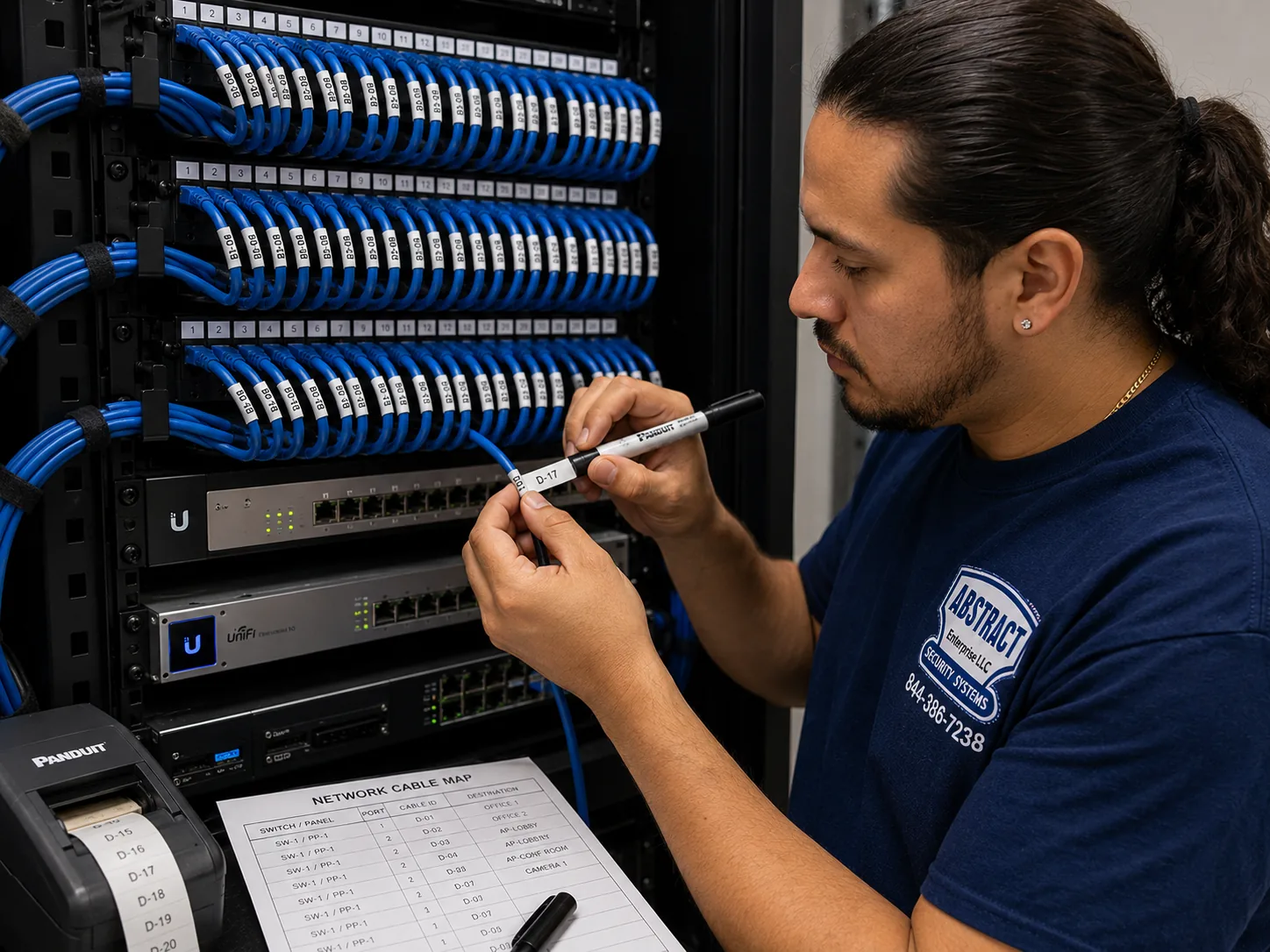
Photo from the AESS job library, not taken on Long Island: a technician printing cable labels at a patch panel with a printed port map beside it. On a Long Island property with a plate camera at the gate, another at the garage and a face camera at the side door, every run gets a label like this at both ends, so a cable that fails after a winter storm can be found in minutes instead of traced through an attic.
Long Island Capture Cameras
Tell us the town, the property and where vehicles or people come in
✅
Request Sent!
We'll call about your Long Island capture cameras the same business day.
25+
Years Experience
✓
Same-Day Estimates
100%
Licensed & Insured
4.7★
201 Google Reviews
Owner-operated since 2002 · Thousands of jobs completed · Booked within 2 hours
Capture camera installation on Long Island means putting a dedicated plate or face camera exactly where every vehicle or visitor is funneled into a narrow, predictable path, then tuning it until it reads plates at night through headlight glare. It is priced per capture point at the Long Island rate, which is our Brooklyn base multiplied by 1.15 for Nassau addresses and 1.20 for Suffolk addresses; the full itemized list and calculator are on our Long Island capture camera price page. The installed price covers the site survey, the camera and overview camera at each point, outdoor-rated cable, mounting, recorder setup, night tuning and a labelled cable map. Requests are booked within 2 hours. Call (800) 486-0943 or use the form.
One plate camera per lane or driveway, paired with an overview camera that records the whole vehicle, because a single wide camera cannot do both jobs well
Cable runs planned around Long Island's building stock, including attic and exterior routes for slab-built homes where the floor must never be drilled
Low-voltage work under NYS license #12000287431, with privacy masks set so cameras do not record into a neighbor's yard or windows
Why Long Island Properties Need Capture Camera Installation
Long Island is a place built around the driveway, and that makes it a place where license plates matter more than almost anywhere in the state. The U.S. Census Bureau's 2023 American Community Survey counts 477,860 housing units in Nassau County, 364,529 of them one-unit detached houses, and 579,790 housing units in Suffolk County, 463,095 of them one-unit detached. Put plainly, the large majority of homes on the Island stand on their own lot with their own curb cut, and nearly everyone who arrives at one of them, invited or not, comes by car. The ny.gov county profiles describe Nassau as two cities, three towns, 64 incorporated villages and more than 60 unincorporated hamlets across 453 square miles, and Suffolk as ten towns across 2,373 square miles. That is a lot of driveways, a lot of parking lots and a lot of roads with no doorman, no lobby and no super watching the street.
The police have been telling Long Islanders the same thing for years: the car in the driveway is part of the target. When ABC7 New York reported in January 2024 on a multi-jurisdictional task force against residential burglaries and stolen cars, bringing together the Nassau and Suffolk police departments and district attorneys, the NYPD, the State Police and the FBI, the article quoted police saying they believe burglars are attracted by cars in people's driveways, and noted that break-ins while people were at home had gone up. A separate Daily Voice report described a theft crew that allegedly entered Long Island homes looking for key fobs before driving off with high-end vehicles. In those cases, the camera that matters is the one that can show the plate of the car that pulled up before the theft, not only the one that shows a hooded figure walking to the door. A wide camera on the corner of a garage will usually catch the shape of a vehicle. It will rarely catch characters on a plate moving through the frame at night.
Package and porch theft add a second pattern. CBS New York reported in November 2025 that the Suffolk County District Attorney charged 14 men in a ring that allegedly stole more than 200 phones and tablets from doorsteps in 31 communities, including Brentwood, Central Islip, Shirley and Deer Park, between October 2023 and February 2025. News 12 Long Island has run doorbell footage of porch thefts in Wantagh, where four new iPhones were taken within minutes of delivery, and in Massapequa Park, where a thief took a package from a home on Atlantic Avenue mid-delivery. In Central Islip, ABC7 reported a man caught on video using a knife to destroy a doorbell camera. A doorbell camera shows the person on the step. What it almost never shows is the car waiting at the curb, and that car's plate is often the detail investigators need. That gap is where a capture camera aimed at the street side of the driveway earns its place.
Then there is the way Long Island's local governments have already embraced plate capture on public roads. CBS New York described Freeport's "ring of steel": 27 license plate readers around the 4.3-square-mile village at nearly every entrance, including crossroads on Sunrise Highway and Merrick Road. Roslyn Landmarks reported in 2020 that East Hills was installing 81 cameras to scan plates at its 43 entrances and exits. News 12 reported on April 29, 2026 that the Village of Lawrence board unanimously approved more than 100 cameras, including advanced plate readers, linked to the Nassau County Police Department's command center and also watched at village hall. NBC New York covered a Long Island village seeking 160 cameras, half of them plate readers, inside five square miles. A Long Island criminal defense firm, summarizing DeFlock and procurement records, counted roughly 4,660 plate cameras across 234 New York municipalities as of late August 2026, with Hempstead at 47, Old Westbury at 46 and Glen Cove at 21, and wrote that "Long Island has quietly built one of the denser surveillance networks in the state, with essentially no statutory framework governing it." In late November 2025, Nassau County Executive Bruce Blakeman announced a line of surveillance cameras along the county's border with New York City, a border PBS described as about fifteen and a half miles long on the Queens side.
We mention all of that for two reasons, and neither of them is to sell fear. First, it shows that plate capture is an established tool on Long Island, and owners of gated drives, HOA entrances, retail lots and warehouses are reasonably asking for the same capability on their own property. Second, it explains why people ask us harder questions about privacy and law than they used to. In Southold, The Suffolk Times reported in April 2026 that residents pressed a public safety task force to drop Flock plate cameras, with one asking whether there was "any place you can go that somebody doesn't have a camera on their porch." Variety reported that Ring ended its partnership with Flock Safety in 2026 after a privacy backlash. A private capture camera is a different thing from a public plate-reader network: it records your own entrances to your own recorder, and nobody else sees it unless you choose to share. We design capture systems that way, with privacy masks, no audio by default and footage that stays under the owner's control, and we explain the rules plainly further down this page.
The building stock is the last reason the job needs a specialist rather than a box from a warehouse club. The Census puts the median year a home was built at 1955 in Nassau and 1970 in Suffolk. That means much of Nassau is postwar housing, including Levittown, which Levitt and Sons announced as Island Trees on May 7, 1947 on old potato farms and which had 17,447 homes when it was finished in 1951, according to EBSCO's account. Original Levitt houses sat on a concrete slab with no basement and radiant heating pipes cast into the floor. A capture camera at the end of a Levittown driveway cannot be wired the way an installer would wire a colonial with a full basement. Suffolk's later housing brings longer setbacks, bigger lots and detached garages, which make the distance between the recorder and the street camera the main design problem. Out east and along both shores, salt air and storms add their own demands. Each of these is covered in detail below.
We also want to be honest about what our research could not find. We could not retrieve Google's People Also Ask boxes, related searches, Bing or DuckDuckGo results, or Answer the Public data for capture cameras on Long Island, and we found no Reddit threads or Patch articles about private plate capture on the Island. We found no source that says whether a village landmark commission requires approval for an exterior camera specifically. Where this page gives an opinion about how a type of house is likely to be built, it is our field experience with houses of that age and type, not a survey. Everything else is drawn from the sources named in the stamp above.
Long Island facts that shape a capture camera install
Two counties, two very different housing ages: the 2023 ACS puts the median year built at 1955 in Nassau and 1970 in Suffolk, with 364,529 and 463,095 one-unit detached homes respectively.
Roughly 2.9 million people: Census QuickFacts lists Nassau at 1,395,774 on April 1, 2020, and Newsday reported Suffolk at 1,525,920 in the same census.
Slab foundations in the postwar tracts: original Levittown houses were roughly 750 square feet on a slab with no basement and radiant heat in the floor; Levitt switched from the Cape Cod model to ranches in 1949.
Public plate readers already everywhere: 27 in Freeport, 81 cameras at 43 entrances in East Hills, more than 100 cameras approved in Lawrence in 2026, and roughly 4,660 plate cameras counted statewide in August 2026.
Driveway-focused crime: police on the 2024 burglary task force said burglars are attracted by cars in driveways; a Suffolk ring allegedly took more than 200 devices from doorsteps in 31 communities.
Weather that tests outdoor cable: ABC7 reported that Tropical Storm Isaias in August 2020 left almost half of PSEG's 1.1 million Long Island customers without power at the peak, and the state declared Suffolk's first-ever flash flood emergency in August 2024.
What Long Island owners often pair with plate capture. Once the gate or driveway has a capture camera, the next request is usually a face capture camera at the door people really use, which on many Long Island houses is the side door off the driveway or the door from the garage, not the front door. The two work as a pair: the plate camera shows which car arrived, and the face camera shows who got out of it. If you want both, tell us when booking so the cable for the door camera rides the same route as the driveway cable and we only open the attic or wall once.
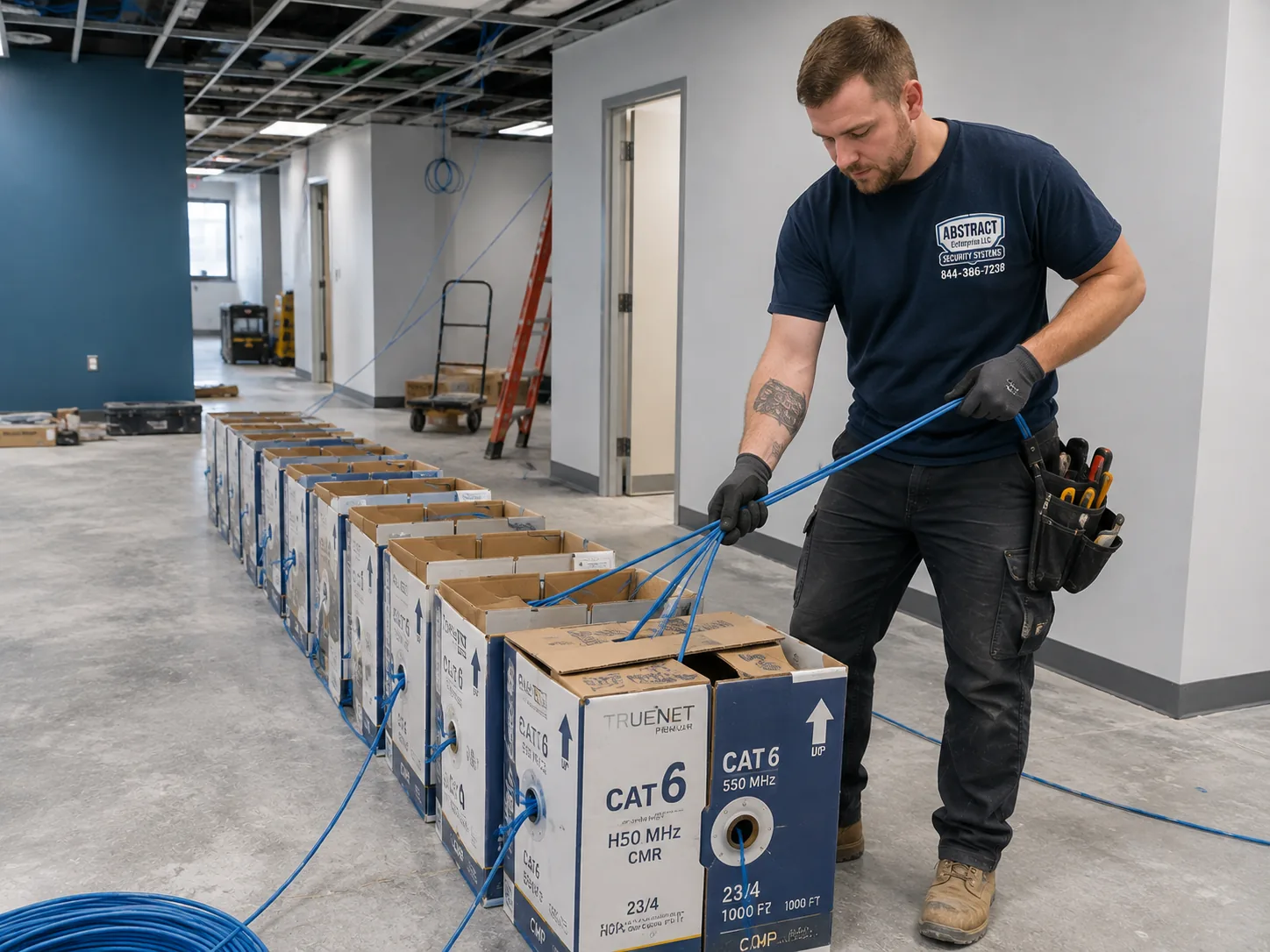
Photo from the AESS job library, not taken on Long Island: boxes of cable staged on a working commercial premises before a multi-drop pull. A Long Island warehouse with plate cameras on every dock apron and gate lane is wired the same way, with all the runs pulled together in one pass so the building keeps operating while the cable goes in.
Camera Missed the Plate, Recorder Went Dark or a Theft Just Happened? Fast Help on Long Island
If your driveway or lot camera recorded a theft but the plate is unreadable, the recording you already have is the first thing to protect. Do not reset or reformat the recorder, and export the clip to a phone or USB drive if you know how. Then call (800) 486-0943 and tell us what the camera is, where it is mounted and roughly how far it is from where the car stopped. We will tell you honestly whether retuning the existing camera could help for the future or whether the point needs a dedicated capture camera. The other urgent call is a recorder or camera that went offline after a storm or a power cut. Tell us which cameras are dark and whether the recorder has power, and we will book the next slot.
Plate Capture, Face Capture and Overview: Three Jobs No Single Camera Does Well
"Capture camera" is not a formal trade term, and people use it loosely. On Long Island, installers mostly use it the way one Long Island installer's page puts it, describing "features like license plate capture and facial recognition." In our work it means a camera chosen and aimed for one narrow task: reading a plate or recording a usable face at a specific spot. That is the opposite of how most home and business cameras are set up, which is to see as much as possible. A wide lens that covers a whole driveway spreads its pixels across the lawn, the street and the sky, so a plate twenty feet away may occupy only a few pixels. A capture camera gives up width to put enough pixels on the one thing that matters.
Our own Long Island warehouse page says it directly: "Plates need a dedicated license plate recognition camera on each gate lane or dock apron, tuned for headlights and motion." A local integrator that has installed CCTV since 2001 describes what plate recognition can do on private property: cameras at entrances and exits capture and log every vehicle, and the data can drive user profiles, approved schedules and automatic alerts. Not every Long Island property needs the logging and alert side. Many homeowners simply want a readable plate on the recording. Businesses, HOAs and warehouses often want the log as well. We size the system to what you actually need.
Camera role
What it is for
Where it goes on a typical Long Island property
What it gives up
Plate capture camera
Readable characters on a moving plate, day and night
At a gate lane, the street end of a driveway, a parking entrance or a dock apron, close to where plates pass
Almost all width; it sees a slice of the lane and little else
Overview camera
The whole vehicle: color, make, damage, direction of travel
Wider position covering the same lane from further back
Plate detail; it shows the car, not the characters
Face capture camera
A usable, front-on image of each person at a door
At head height near the door people use, often the side or garage door off the driveway
Coverage of the yard; it watches one approach
General coverage camera
Movement around the property
Corners of the house, backyard, pool, side yards
Identification detail at distance
The geometry that decides whether a plate is readable
Plate capture is mostly geometry. One New York installer describes plate capture as a two-camera setup: an overview camera that records the vehicle and a dedicated plate camera positioned within about ten feet of where plates pass. Manufacturer placement guides, as one New York integrator summarizes them, put the plate camera at least about a meter, roughly three feet, above headlight level and keep the angle between the camera and the plate within about 25 to 30 degrees. Each of those numbers solves a real problem. Distance sets how many pixels land on the plate. Height above the headlights keeps the camera out of the direct beam that floods the sensor at night. A shallow angle keeps the characters from being stretched sideways until they cannot be read. On a Long Island driveway that means the plate camera often belongs on a post, a gate pillar or the front corner of a detached garage near the street, not on the house sixty feet back.
Why night is the real test
Almost any camera can read a parked plate at noon. The hard case is a car arriving after dark with its headlights on, moving at driveway speed, with a reflective plate bouncing the camera's own infrared light back into the lens. That combination is when car theft, key fob burglaries and late porch thefts happen. A capture camera handles it with a fast shutter that freezes motion, controlled infrared, and settings that stop the sensor from washing out the plate. Those settings are not right out of the box. They depend on the distance, the angle, the speed of cars at your entrance and how bright the street lighting is. We tune each capture camera with real vehicles after dark, and if we cannot read a plate on the recording, the job is not finished.
Face capture at Long Island doors
Face capture has its own rules. A camera mounted high under a soffit, which is where most installers put house cameras because it is easy to reach from the attic, looks down on the top of people's heads and the brims of their hats. For a usable face, the camera has to be lower and closer, looking at the approach, not straight down on it. On many Long Island houses the best face position is beside the side door off the driveway or inside a vestibule. On retail and office properties it is usually inside the entrance, facing people as they come through the door, where lighting is steady. We will also be clear about one thing: a face capture camera records a clear image of a face. Whether any software later matches that face to anything is a separate question, and on private systems we install, it is the owner's decision and not something we turn on by default.
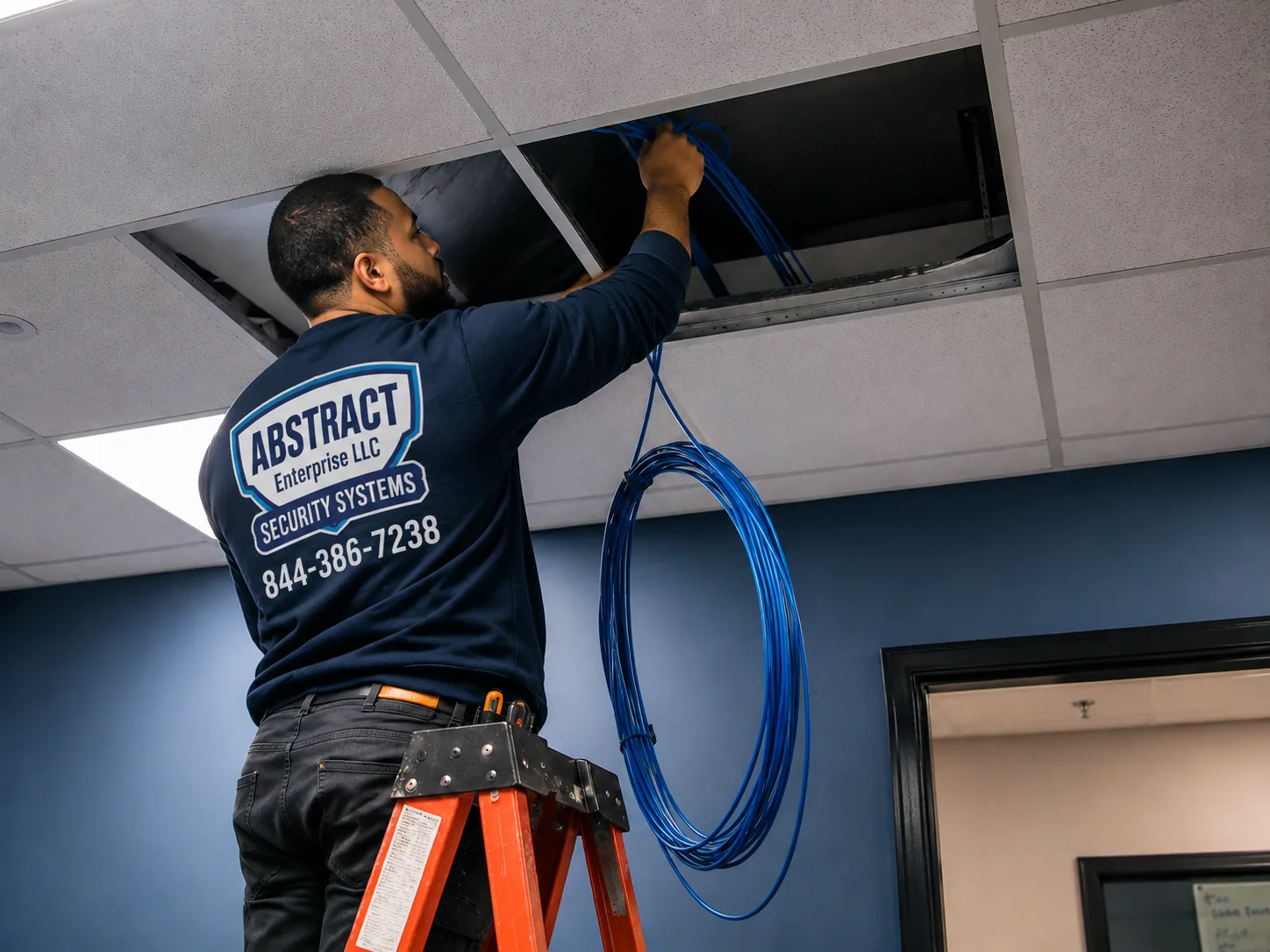
Photo from the AESS job library, not taken on Long Island: a technician feeding cable through the ceiling of an occupied commercial space. A face capture camera inside the entrance of a Long Island store or medical office is wired the same way, through the ceiling above the door, so the camera can sit at the height and angle that sees faces rather than hat brims.
Two Counties
Nassau Versus Suffolk: How the County Changes a Capture Camera Job
People talk about Long Island as one place, and for many things it is. For a capture camera install, though, the line between Nassau and Suffolk changes the housing, the distances, the alarm rules, the police programs and the price. The table below sets out the differences that come from public sources. The right-hand column is our working expectation in the field, which we confirm on every survey.
Factor
Nassau County
Suffolk County
What it means for capture cameras
Median year homes were built (ACS 2023)
1955
1970
Nassau jobs often meet postwar slab and block construction; Suffolk jobs more often meet basements, crawlspaces and larger houses
One-unit detached homes
364,529 of 477,860 units
463,095 of 579,790 units
Most capture jobs on both sides are driveways and gates, not apartment lobbies
Land area (ny.gov)
453 square miles
2,373 square miles
Suffolk lots and setbacks tend to be longer, so the cable run to a street-side plate camera is the main design issue
Local government (ny.gov)
2 cities, 3 towns, 64 villages, 60+ hamlets
10 towns
Rules vary by village in Nassau; we check the specific address
Alarm permits
Police alarm registration for systems with police dispatch
Permit required for alarm systems in the Suffolk County Police District
Applies if capture cameras are tied into a monitored alarm, not to cameras on their own
Police camera programs
Village-level registries such as Garden City's
SCPD Camera Registry Program and Emergency Remote Camera Access
Registration is voluntary; we explain the options at handover
Our price multiplier
1.15× the Brooklyn base
1.20× the Brooklyn base
Same design, same equipment, priced by the address
Nassau: dense villages, short drives, public readers nearby
Nassau's postwar suburbs put houses close together on modest lots. Levittown's original Capes stood on lots of about 60 by 100 feet, and many neighboring tracts follow the same pattern. Short driveways sound easy for plate capture, and in one way they are: the street is close. The difficulty is that the capture camera then sees the street, the sidewalk and often the neighbor's driveway across the way, and New York law and plain courtesy both say it should not be recording into a neighbor's private space. So Nassau capture jobs lean heavily on careful aiming and privacy masks. Nassau is also where most of the public plate readers are concentrated, in villages like Freeport, East Hills, Lawrence, Old Westbury and Glen Cove. That does not replace a private camera at your gate, because public readers sit on public roads and their records are not yours to review, but it does mean your plate camera is one of many in the area and should be set up to respect people passing by.
Suffolk: long setbacks, detached garages and distance
In Suffolk, the median house is younger and the land is far more spread out. Many properties have longer driveways, detached garages, gates set well back from the house, or a mailbox and curb a long walk from the front door. The capture camera has to be near the plate, which means near the street, which means a long way from the recorder. That distance decides the cable type, whether we need an intermediate switch in the garage, and whether a buried conduit or an overhead route makes sense. Suffolk also has a formal alarm permit system, which grew out of a 2015 count of 97,000 false alarms that Greater Long Island reported had cost some 32,000 patrol hours. If your capture cameras are part of a monitored alarm system with police dispatch, that permit matters. Cameras on their own are a different question, covered in the Questions section.
The East End and the shores
Further east and along both shores, the property types change again. Waterfront homes, seasonal houses and estates bring long private roads, boathouses and outbuildings. One Long Island installer describes a Sands Point system of 20 cameras with a fiber link to a boathouse recorder and marine-grade housings on the sea-facing cameras. The East Hampton Star once published a still from a Nest camera inside a burglarized house on Sammy's Beach Road in East Hampton, which is the kind of empty-season case where a plate on the driveway is the evidence that matters most. A capture camera at the start of a long private drive on an East End property has to survive salt air, wind and months of nobody checking on it, and it has to keep recording when the power or internet goes down.
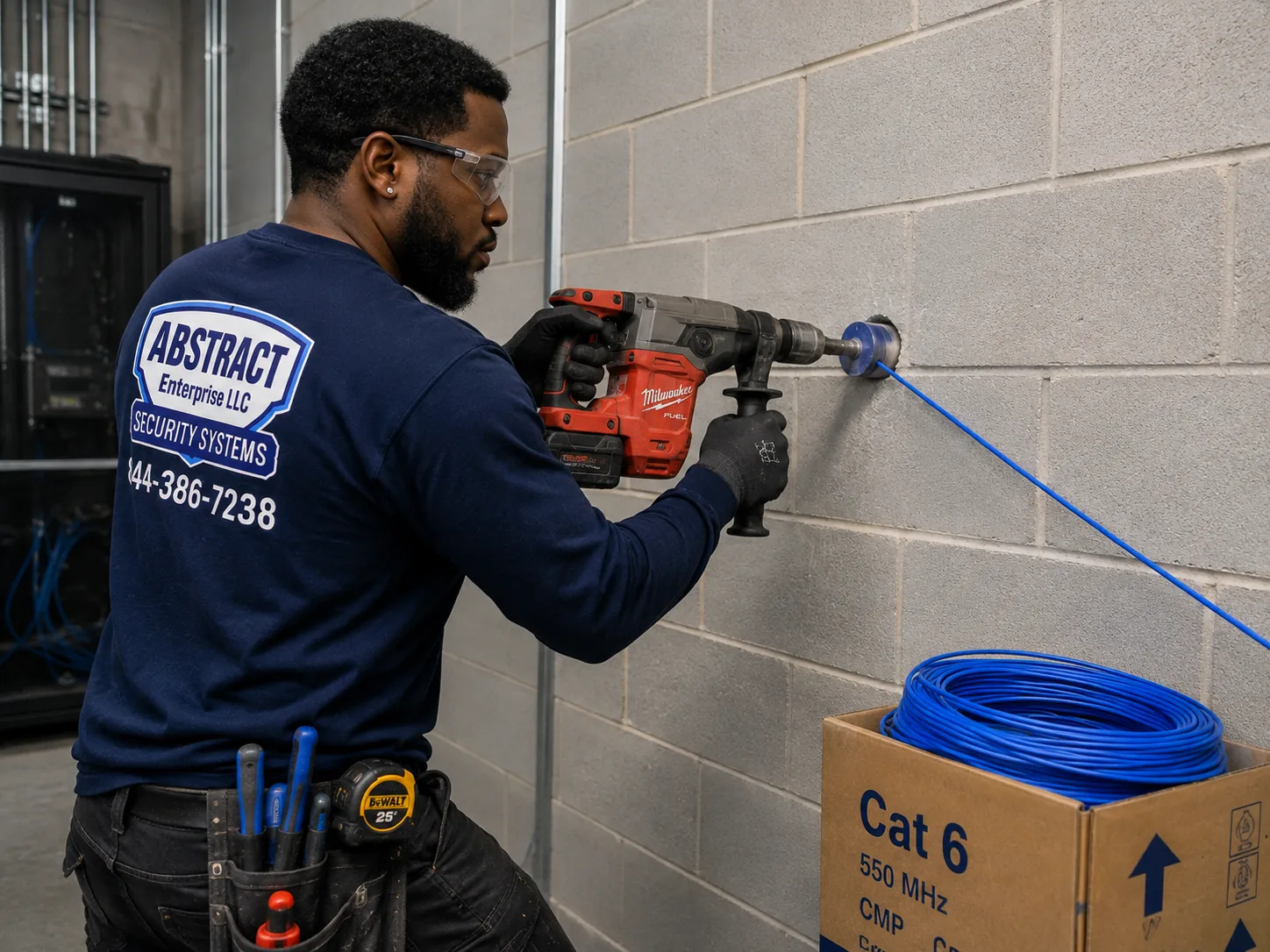
Photo from the AESS job library, not taken on Long Island: a technician core drilling a block wall to carry cable through to a network room. Many Nassau ranches and Capes stand on block foundations, and a detached garage that houses the switch for a street-side plate camera often needs one neat cored entry like this rather than a cable squeezed under a door.
What We Install
Capture Camera Installation Services in Long Island
These are the capture camera jobs Long Island homeowners, HOA boards, store owners, property managers and warehouse operators book us for across Nassau and Suffolk. Each one is priced from the Long Island price list for your county. Where a site needs something extra, such as a pole for a plate camera at a gate or a trench for buried conduit, the written quote names it before any work starts.
🚗
Driveway Plate Capture
A dedicated plate camera at the street end of the driveway, paired with an overview camera, aimed low and close enough to read plates on cars pulling in or idling at the curb, with privacy masks over neighbors' property.
🚧
Gate and Entrance Lanes
Plate capture at gated drives, estate gates and HOA or condo entrances, one camera per lane, with an option to log every vehicle and alert on vehicles you choose.
🚚
Dock Aprons and Truck Yards
Plate and trailer capture at warehouse docks and yard gates in the industrial parks, tuned for headlights, truck height and the slow rolling speeds of trailers backing in.
🅿
Parking Lot Entrances
Capture points at the entrances and exits of retail lots, strip centers, medical buildings and office parks, so every vehicle in the lot passes a readable camera on the way in and out.
👤
Face Capture at Doors
Cameras set at head height near the doors people really use: side doors off the driveway, garage entries, store entrances, lobby vestibules and loading doors.
🔌
Long Cable Runs and PoE
Outdoor-rated cable, conduit and intermediate PoE switches for the long distances between a street-side camera and a recorder in the house, office or warehouse.
💾
Recorders and Remote Viewing
Network video recorders sized for capture cameras, set up for phone viewing, clip export and search by time, with battery backup so recording continues through short outages.
🔧
Adding Capture to an Existing System
Dedicated capture cameras added to the system you already own where the recorder is compatible, so you keep your coverage cameras and gain readable plates and faces.
🌙
Retuning Cameras That Miss Plates
Re-aiming, re-zooming and adjusting shutter and infrared on cameras that record cars but never plates, and an honest call when a point needs a different camera.
Photo from the AESS job library, not taken on Long Island: a technician mounting a managed PoE switch below patch panels in a commercial network rack. On a Long Island office park or warehouse job, a switch like this powers every plate and face camera over its data cable, so the capture cameras at the gate need no separate outlet out in the weather.
Building Specialists
Capture Camera Installation for Long Island's Architecture
The property type changes three things about a capture camera job: where the camera can be mounted close enough to the plate or face, how the cable gets from that camera to the recorder, and who has to agree before we drill or dig. These are the property types the public record and local sources describe on Long Island, and how we approach each one.
Slab Ranches and Capes
The Levittown model and its neighbors: no basement, radiant pipes once cast into the slab, an attic as the main cable route. Many have been expanded since, so every house is surveyed fresh.
Colonials, Split-Levels and Hi-Ranches
Common across both counties. Multiple levels and finished basements mean cable has to travel between floors, but a basement or garage usually gives a good recorder location.
Waterfront and Estate Properties
North Shore estates, South Shore waterfront and East End homes with long drives, gates and outbuildings. Salt-rated housings, long runs or fiber, and recording that survives outages.
HOAs, Condos and Gated Communities
Shared entrances where one capture point serves every resident. Board approval, shared power and clear rules about who can view the footage.
Managed Rental Complexes
New transit-oriented buildings such as Station Yards in Ronkonkoma, where management controls the exterior. Renters need written permission for anything that drills.
Warehouses, Flex and Office Parks
Block and steel buildings along Route 110 and in the Hauppauge industrial park, with docks, yards and large lots. Conduit, core drilling and capture at every vehicle entrance.
How the property type changes the install
Property
Where the capture camera usually mounts
How the cable usually travels
Who signs off
Slab ranch or Cape
Front corner of the house or garage, or a post near the curb
Through the attic and down an exterior wall in conduit; never through the slab
The owner
Colonial, split-level, hi-ranch
Garage front, a post or a pillar near the street
Basement or garage to the exterior, then along the drive or overhead
The owner
Waterfront or estate
Gate pillars, posts at the drive entrance, outbuildings
Buried conduit, outdoor-rated cable or fiber for very long runs
The owner; a village landmark commission where a historic district applies
HOA or gated community
Gatehouse, entrance island or a dedicated pole per lane
Gatehouse power and network, or a run from a nearby clubhouse
The board or managing agent
Managed rental complex
Usually inside the unit only; exterior only with permission
Wireless or surface methods unless management agrees to wiring
Building management in writing
Warehouse, flex, office
Dock aprons, yard gates, lot entrances, building corners
Conduit on the building, J-hooks inside, core drilled entries
The owner or landlord; tenants need landlord approval
On slab houses. A Levittown-style slab house is the single most common reason a Long Island capture camera job goes differently from one in the city. Original Levitt houses had no basement, and copper coils embedded in the slab carried heated water from the furnace. One history of the system says only about five percent of the houses still have their original radiant systems, but we never assume a slab is safe to drill, because we cannot see what is cast into it. So we never route camera cable through or under the slab. The usual route for a capture camera at the street end of the drive starts in the attic, where a recorder or switch can live, drops down an exterior wall in a neat conduit or inside a soffit and downspout line, and then either runs along the house to the garage corner or continues to a post near the curb. Original Levitt houses also had unfinished attics and many have since been expanded, sometimes, as one remodeler notes, without permits or proper structural support, so we look at the attic before promising a route. If the attic is closed off by a dormer or a later addition, we find another path rather than cutting into ceilings.
On split-levels and hi-ranches. Split-levels and hi-ranches, common in the 1950s and 1960s neighborhoods across both counties, have a different problem: cable has to cross between half-levels where walls do not line up. The good news is that these houses almost always have a garage on the lower level facing the street, which is often the best place for both the recorder and the plate camera. A camera on the front corner of a lower-level garage is close to the driveway, low enough to see plates at a shallow angle, and a short cable away from a switch inside. We use that layout wherever it works, because short runs are cheaper and more reliable than long ones.
On long drives and detached garages. Where the plate camera must sit at a gate or curb far from the house, distance is the design. Standard network cable carries power and video to a camera up to a limited distance; beyond that we place a weatherproof switch in a detached garage, outbuilding or enclosure partway, or use fiber for very long runs, as the Sands Point example shows is done on large estates. Buried runs go in conduit so the cable can be replaced without digging again. Above ground, cable runs in UV-rated conduit or inside the structure, never stapled loose along a fence where a mower or a frost heave will find it.
On villages with historic districts. Some Long Island communities review exterior work. The Town of Oyster Bay's landmarks commission reviews exterior construction, alteration or repair inside historic districts, Huntington requires a certificate of approval for exterior structural changes in its historic districts, Sea Cliff has a Landmarks Preservation Commission, and real estate guides describe Cold Spring Harbor's and Stony Brook Village's reviews as rigorous. We found no source saying whether a small exterior camera needs approval in any of them. If your house is in one of these districts, we ask you to check with the commission before we drill, and we design the mount to be as discreet and reversible as the camera allows.
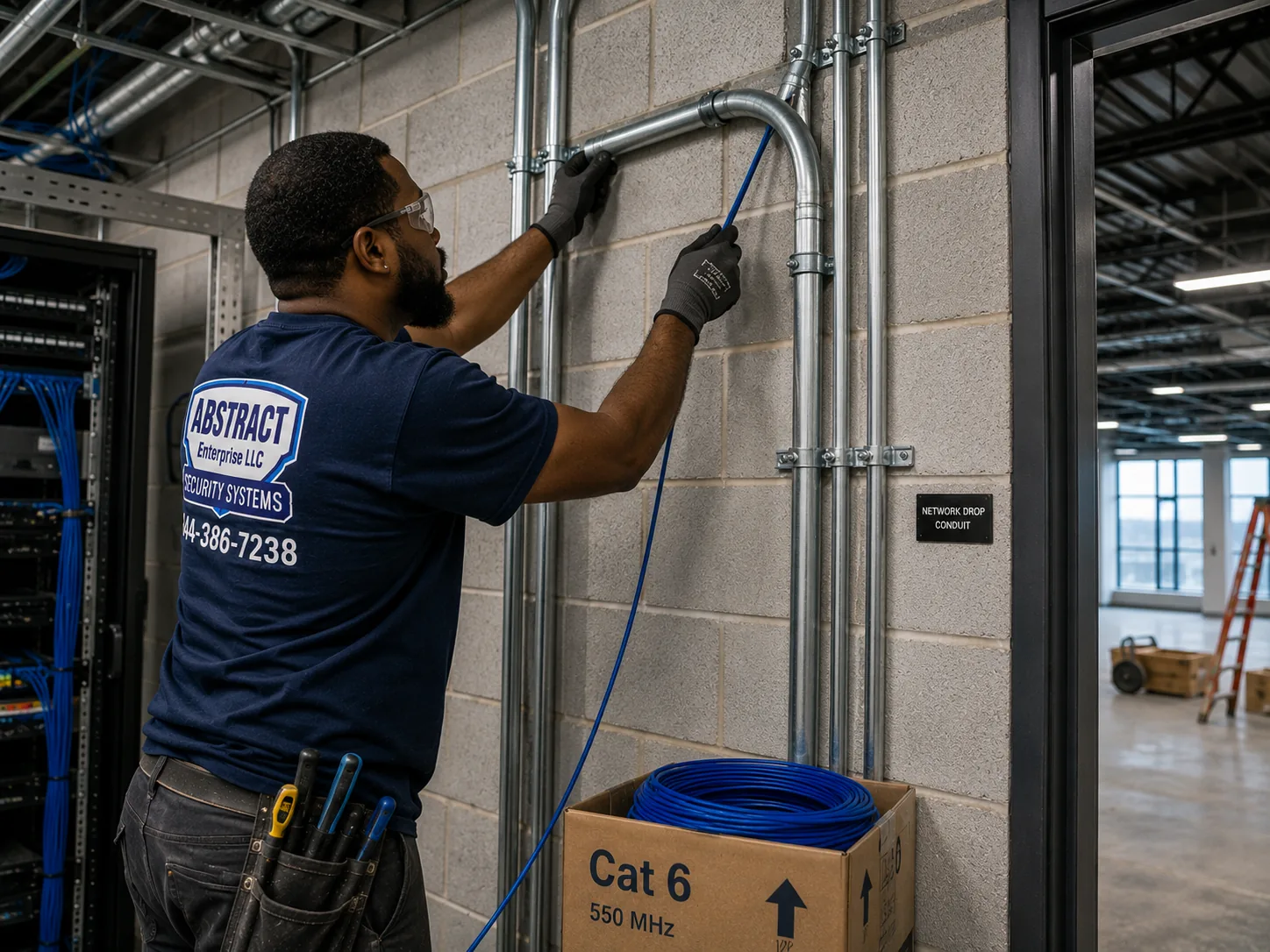
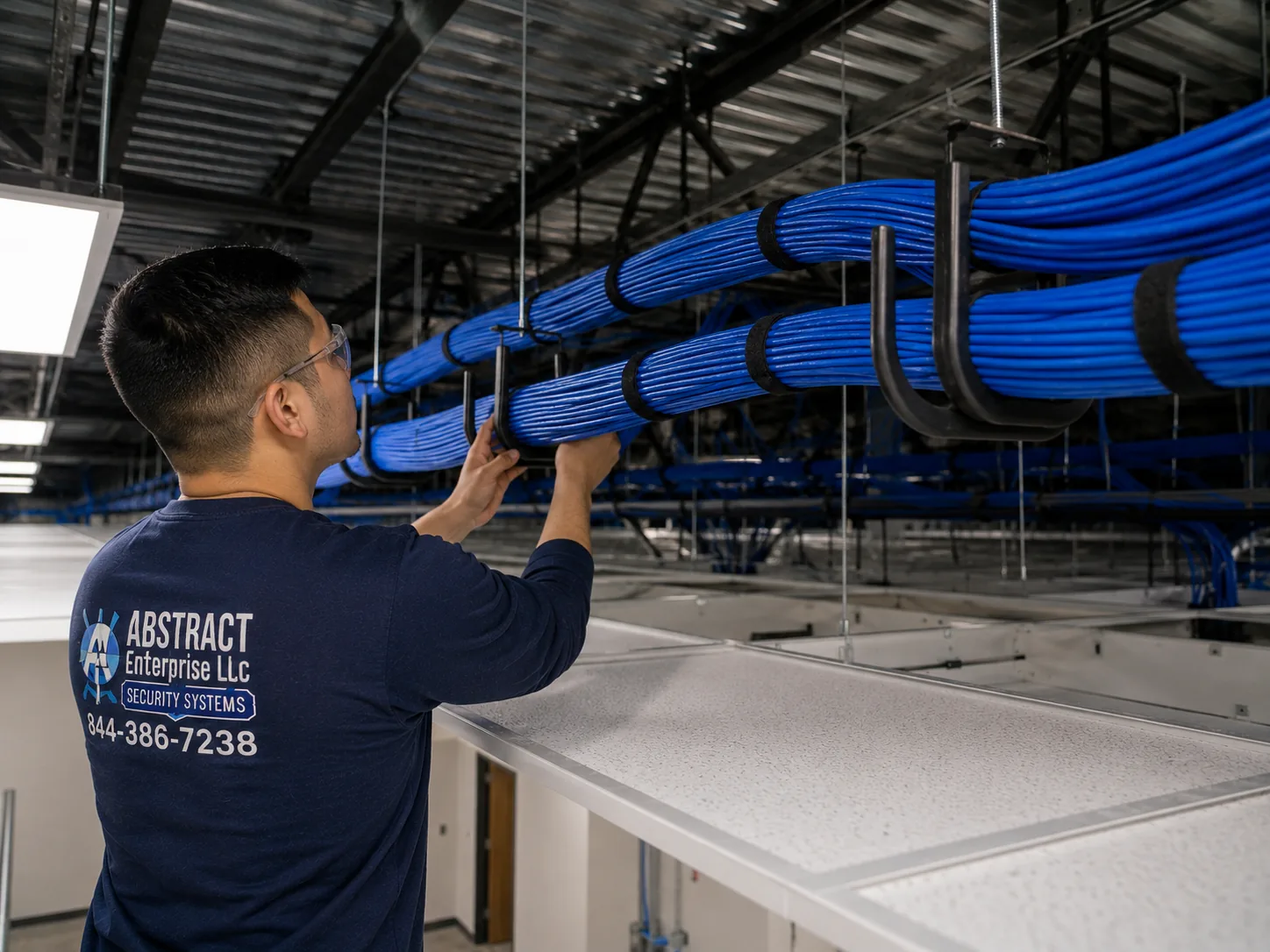
Photo from the AESS job library, not taken on Long Island: a technician running cable into EMT conduit beside a telecom room in an industrial building. On a flex or warehouse building in the Hauppauge industrial park, the runs to plate cameras on the dock aprons leave the telecom room in conduit like this, protected from forklifts and weather the whole way out.Photo from the AESS job library, not taken on Long Island: a J-hook pathway carrying dressed cable bundles across a commercial ceiling. In a Long Island office park or medical building, face capture cameras at the entrances are fed along a pathway like this above the ceiling, which keeps the cables supported, separated and easy to trace years later.
Commercial Capture Camera Installation
Business Capture Camera Installation in Long Island
Long Island's commerce happens along a handful of corridors and in a few large business districts, and nearly all of it is reached by car. That makes the vehicle entrance the most valuable capture point a business can have. The corridors below are named in Wikipedia's transportation summary of Long Island and in the commercial sources listed. We describe what those sources say about them; we do not claim any business there as a customer.
Route 110 Corridor
Running through Farmingdale, Melville and Huntington Station, described by a commercial real estate firm as a mix of warehouse, flex, R&D and office space. Large lots, truck access and multiple entrances per site.
Long Island Innovation Park at Hauppauge
Described in published reports as home to about 1,350 businesses across roughly 11 square miles. Docks, yards and gated lots where plate capture at the gate logs every truck.
Roosevelt Field and Old Country Road
Wikipedia calls Roosevelt Field, at 630 Old Country Road in East Garden City, the largest mall on Long Island. Daily Voice reported two new GMC vehicles stolen from its west parking lot.
Hempstead Turnpike and the Nassau Hub
The roughly 72-acre Coliseum site and the office towers around it, including RXR Plaza, which listings describe as Long Island's largest office building, with raised floors that ease cable routing.
Sunrise Highway and Merrick Road
The South Shore's main commercial roads, where Freeport placed plate readers at crossroads. Strip centers, car lots and service businesses with street-facing lots.
Hicksville's North Broadway
Wikipedia describes North Broadway as a significant retail center beside the Island's busiest LIRR hub; the Shops on Broadway plan and new apartments are reshaping the area.
What a commercial capture point has to do
A homeowner usually wants one thing from a plate camera: a readable plate when something goes wrong. A business usually wants more. A warehouse manager may want a record of every truck that entered the yard and when, so a disputed delivery can be checked against the dock log. A medical office may want to know which vehicles parked overnight in a lot reserved for patients. A store on a busy corridor may want a readable plate on the car that waited while someone shoplifted. Each of those is a different requirement. Some need only good recording and easy search by time. Others need software that reads plates as text, keeps a log and sends an alert on a vehicle of interest, which a local integrator describes as user profiles, approved schedules and automatic alerts. We ask what decisions the footage needs to support before we choose cameras, because a logging system priced for a use you will never have is money wasted.
Lots, lanes and speed
The single biggest mistake we see on commercial lots is trying to read plates in the middle of a wide parking field, where cars move in every direction and no camera can be close to all of them. Capture works where traffic is funneled: the entrance and exit lanes, the gate, the dock apron, the drive-through. A strip center with two curb cuts on Sunrise Highway needs two or four capture points at those curb cuts, not a dozen cameras pointed at the lot. A warehouse with a single gated truck entrance and a separate car lot needs capture at each. If traffic moves fast through an entrance, a speed bump or gate slows it enough to help the camera; we will say so if your entrance needs one, though we do not install them.
Rules and practical limits for business capture cameras
Licensed installers. The New York State Department of State licenses security and fire alarm installers, and a state regulation, 19 NYCRR 195.2, as one New York law firm explains it, covers closed-circuit television used for detecting or monitoring intrusion, theft or movement. AESS installs under NYS license #12000287431.
Audio stays off. A Justia attorney answer advises disabling audio on security cameras unless a consenting participant will be part of any recorded conversation. On a business entrance where customers and staff talk, we leave audio off unless you have taken legal advice to the contrary.
Private spaces stay private. New York Civil Rights Law section 52-a, as a news explainer summarizes it, makes it unlawful to use video surveillance where a person has a reasonable expectation of privacy. No capture camera points into restrooms, changing areas or a neighbor's windows.
Signage where it applies. We recommend posting clear notice at vehicle entrances that video recording is in use. It sets expectations for drivers and staff, and many landlords require it.
County licensing for home improvement work. Nassau County licenses home improvement contractors through its Office of Consumer Affairs, and its FAQ says those who work only on commercial buildings do not need that license; Suffolk County has its own licensing chapter for regulated trades. We tell you plainly which applies to your job.
Power and outlets. Our work is low-voltage. Capture cameras are powered over their data cable. If a gate pillar or pole needs a new electrical circuit, that is a job for a licensed electrician and our quote says so.
Field Notes
Field Notes: The Night Visit That Finishes a Capture Camera Job
We do not publish stories about a named customer's property unless we can document them, so this is not a tale about one address. It is the routine our technicians follow at the end of a capture job on the kind of property Long Island is full of: a ranch or colonial with a driveway, a garage and a street with parked cars and passing headlights.
The daytime install is only half the work. Cameras are mounted, cable is in, the recorder is running, and in daylight every plate on the recording looks sharp. Then we come back to the screen after dark, or wait until dusk, because that is when plates disappear. We have the owner, or one of us, drive in slowly with headlights on, then again at the speed people really pull in. We watch the recording frame by frame. If the plate blooms white, we shorten the shutter and lower the infrared. If the characters smear, we tighten the shutter further and check the angle. If the plate is too small, we zoom in and give up a little width. We check that the privacy mask still covers the neighbor's driveway after the zoom changed. We repeat it until the plate reads at night as clearly as it did at noon. Only then do we export a test clip, show the owner how to do the same, and call the job done.
Your Questions Answered
Capture Camera Installation in Long Island: Questions Answered
Reading plates and faces
Will a capture camera at our gate actually read plates after dark, with headlights pointed straight at it?
Yes, if it is a dedicated plate camera set up for that position, and that is the whole reason to buy one. Headlights and the camera's own infrared bouncing off a reflective plate are what wash out ordinary cameras at night. A capture camera solves it with a fast shutter, controlled infrared and placement above headlight level at a shallow angle to the lane, which manufacturer guides put at roughly three feet above the lights and within about 25 to 30 degrees. We tune each gate camera with real vehicles after dark before we leave. If the gate faces directly into oncoming high beams with no way to offset the camera, we tell you during the survey and look for a position beside the lane instead.
Can one camera on the garage record both the driver's face and the car's plate?
Rarely well, and we will not promise it. A plate sits low on the car and needs a camera close to the lane at a shallow angle; a face is at head height and needs a camera looking at the approach, usually at a door. A single camera set between the two ends up with a plate too small to read and a face seen from above. The reliable answer is two cameras: a plate camera at the driveway or gate, and a face camera at the door the driver walks to, which on many Long Island houses is the side door off the drive. Both feed the same recorder, so one search by time shows the car arriving and the person getting out.
Rules and permits on Long Island
Does my town or village need to issue a permit before you mount capture cameras?
For standard camera installations, usually not. One Nassau and Suffolk installer states that standard security camera installations in the two counties typically do not require local municipality permits, and that matches what we see. There are three exceptions to check. If the cameras are part of a monitored alarm with police dispatch, Suffolk requires an alarm permit in the Suffolk County Police District and Nassau requires police alarm registration; unregistered Nassau systems can get no police response to an alarm. If the property is in a historic district reviewed by a village or town commission, ask the commission before exterior work. And if a camera needs a new pole, a trench across a right of way or a new electrical circuit, other approvals may apply. We check the address before we quote.
Is it legal on Long Island for my camera to record the plates of cars passing on the public street?
Recording what happens in public view from your own property is generally treated differently from recording into private spaces, but we are not lawyers and this is not legal advice. What New York law does clearly limit is recording where people have a reasonable expectation of privacy, under Civil Rights Law section 52-a, and recording conversations without a consenting participant. In practice we aim capture cameras at your own driveway, gate or lane, mask out neighbors' windows, yards and driveways using the camera's privacy masking, and leave audio off. A plate camera tuned for a narrow driveway slice will catch passing traffic only at the edge of its view, if at all. If you specifically want to record a public road, take legal advice first.
Do the capture cameras you install use facial recognition?
Not by default. The cameras we install for face capture record a clear, front-on image of whoever comes to the door, which is what makes the footage useful to you or to police if you choose to share it. Matching faces against a list is software, not the camera, and it raises questions that Long Island residents are rightly asking about, including in coverage of the Nassau border camera plan. On a private system we leave any face matching off unless the owner asks for it and understands what it does. Plate reading to text is more common on business systems, where a log of vehicles has a clear purpose, and we set it up only when you want it.
If police readers are already logging plates in my village, why would I put one on my own property?
Because those readers belong to the village or the police, sit on public roads, and keep records you cannot search. Freeport's readers sit at village entrances and Lawrence's system feeds the Nassau County Police Department's command center, but none of them watches your driveway, your gate or the curb in front of your store, and none of them gives you a clip to hand over. A private capture camera covers your own entrance, records to your own recorder, and gives you the evidence when something happens on your property. If you later want to help police, both Suffolk's SCPD Camera Registry and village registries such as Garden City's let you register a camera's location without giving police access to it.
Wiring Long Island houses
Our Levittown house sits on a slab with no basement. How does cable reach a plate camera at the curb?
Over, not under. We never drill or trench through a slab that may still carry radiant heating pipes. The usual route starts in the attic, where the recorder or a small switch can live, comes down an exterior wall inside a neat conduit painted to match the siding, runs along the house or the garage to the front corner, and from there either feeds a camera on the garage corner or continues in buried conduit to a post near the curb. If the attic was closed off by a dormer or an addition, we look for a soffit or garage route instead. We show you the route on the walk-through before anything is cut.
Could a burglar knock out wireless capture cameras with a jammer?
It has happened on Long Island. CrimeOnline reported in 2022 that a serial burglar working in Queens and Long Island was seen carrying a device investigators believed jams Wi-Fi to keep cameras offline, and that the camera that caught him did not depend on Wi-Fi to record. News 12 Long Island has also relayed police advice, from a New Jersey case, to hardwire security systems rather than rely on Wi-Fi. That is one reason we wire capture cameras whenever the property allows: a cable from the camera to the recorder cannot be jammed. Wireless still has a place where wiring is not permitted, such as some rentals, but we tell you plainly what you give up.
Our driveway is long and the garage is detached. How far can you run cable to the gate camera?
Further than most people expect, as long as the run is designed properly. A single network cable carries power and video to a camera over a limited distance; past that point we put a weatherproof switch in the detached garage or an outdoor enclosure partway, which restarts the distance, or we use fiber on very long estate runs. Underground runs go in conduit, so a damaged cable can be pulled out and replaced without digging the lawn again. We measure the whole route on the survey and the quote lists each segment.
Weather, power and the shoreline
Will plate cameras near the water on the South Shore hold up to salt and storms?
They can, with the right housings and mounting. One Long Island installer notes that salt air, humidity and storms call for marine-grade hardware and sealed housings, and the Sands Point example in our research used marine-grade housings on sea-facing cameras. Hurricane Sandy did an estimated $150 million in damage in Long Beach alone, according to Wikipedia's summary, so on waterfront and flood-prone properties we keep recorders and switches above likely water levels, use sealed connectors, and mount cameras on structures that will not move in wind. A camera on a loose fence post will drift out of aim after the first storm, and a drifted plate camera reads nothing.
After a storm takes the power out, do the capture cameras keep recording?
Only if the system was built to. ABC7 reported that at the peak of Tropical Storm Isaias in August 2020, almost half of PSEG's 1.1 million Long Island customers were without power. A battery backup on the recorder and PoE switch keeps cameras recording through short outages, and we size it to the number of cameras. It will not run a system for days; for long outages, a home generator that covers the recorder circuit is the answer. We also set the recorder to restart and resume recording on its own when power returns, so nobody has to remember to turn it back on.
Costs and existing systems
Why is the installation labor often more than the capture camera itself?
Because the camera is the easy part. Most of the work on a Long Island capture job is the survey, getting cable from the recorder to a point near the street on a house with no basement or a long drive, mounting at the exact height and angle, and coming back after dark to tune the camera with real headlights. A capture camera bought online and screwed to the wrong spot will record cars and never plates, which means the money spent on it buys nothing. The labor is what turns a camera into readable evidence. Every part of it is itemized on the price list for your county, so you can see where the money goes.
What drives the cost of running capture camera cable through a Long Island warehouse?
Distance, height and the building. A run from a telecom room to a dock apron camera may cross a large open floor at ceiling height, which means a lift, J-hooks or conduit, and sometimes a core drilled through a block wall. Runs outside to a yard gate need outdoor-rated cable in conduit, often buried. Our own Long Island warehouse page puts most Nassau and Suffolk warehouse projects in a wide range because these factors vary so much. We walk every route, count each capture point and list every cable segment on the written quote, using the Long Island price list for your county.
The previous owner left a camera system that never reads plates. Can you trace and reuse the old cable?
Often, yes. We trace each run with a tone generator, test it, and label it, so you know which cable goes where and whether it is fit to carry a modern camera's power and video. Old coaxial cable from analog systems can sometimes carry newer camera signals with adapters, and network cable in good condition can be reused directly. What we rarely reuse is the old camera position, because cameras installed for general coverage are almost always too high and too far from the plate. If the old cable reaches near the right spot, we extend it; if not, we run new.
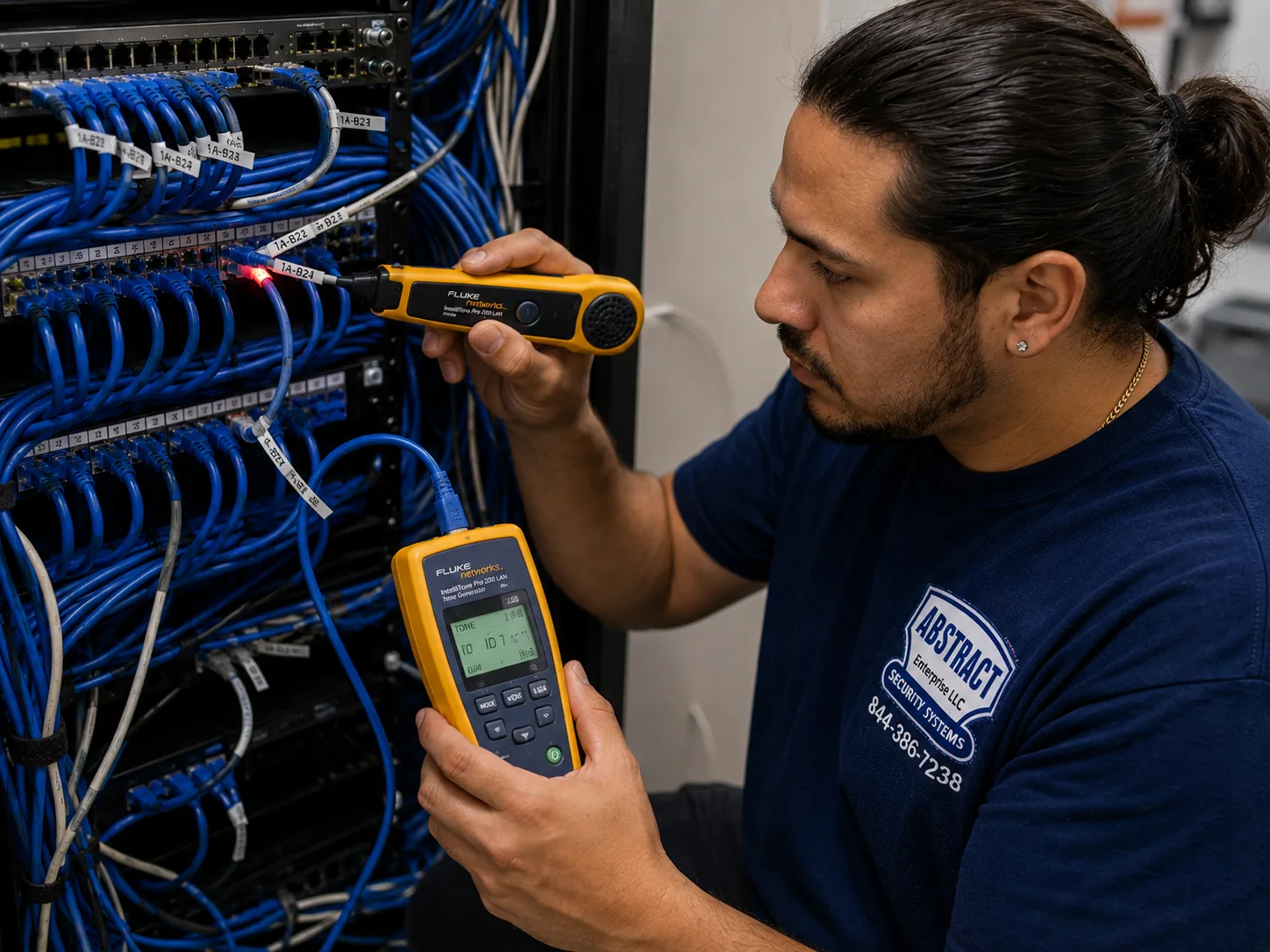
Photo from the AESS job library, not taken on Long Island: a technician tracing an unidentified cable run at a patch panel with a tone generator and probe. When a Long Island buyer inherits a camera system with no records, this is how we find which old cable runs to the driveway before deciding whether it can feed a new plate camera.
Equipment
Types of Capture Camera Installation We Install
These are the components we fit on Long Island capture jobs. We work with the major brands our team installs, including Lorex, Dahua, Hikvision and Uniview, and we choose by the job, not by the box. Equipment and installed prices for your county are on the Long Island capture camera price list.
🎯
Dedicated Plate Capture Cameras
Varifocal cameras built for plates: fast shutter, controlled infrared and settings that resist headlight glare. One per lane, gate or driveway, aimed at a narrow slice where plates pass.
📷
Overview Cameras
Wider cameras that record the whole vehicle, its color, make and direction, paired with each plate camera so the plate and the car are on the same recording.
🧑
Face Capture Cameras
Cameras mounted at head height near doors, entrances and vestibules, set for a front-on view under steady lighting rather than a downward view from the eaves.
🖥
Network Video Recorders
Recorders with enough storage and channels for capture cameras, search by time and, where wanted, plate reading to text with a vehicle log and alerts.
🔌
PoE Switches and Outdoor Enclosures
Switches that power cameras over their data cable, including weatherproof enclosures in detached garages or partway down long drives.
📏
Poles, Pillar Mounts and Brackets
Mounts that put a plate camera at the right height beside a lane: gate pillars, posts, poles and wall arms that hold aim through wind and frost.
🔋
Battery Backup
UPS units sized to keep the recorder and switch running through short outages and to restart cleanly when power returns.
🧵
Outdoor Cable, Conduit and Fiber
Outdoor-rated network cable, UV-rated and buried conduit, and fiber for very long estate or campus runs.
National brands versus a local licensed installer
People ask whether a national security company can do the same job. ADT is best known for monitored alarm systems, while Ring and SimpliSafe sell doorbells, cameras and kits designed largely for self-installation. Those products are good at what they are designed for: general coverage, motion alerts and doorbell video. A license plate capture point is a different kind of job. It depends on a camera placed close to a specific lane, at a specific height and angle, wired to a recorder that keeps working without Wi-Fi, and tuned at night on site. That takes a technician on the property with a ladder, a cable plan and time after dark. If you already have a doorbell or kit camera, we can usually add capture points beside it rather than replace it.
Question
Typical self-install kit or doorbell
Dedicated capture camera installed by AESS
Readable plates at night
Rarely; wide lenses and glare
The design goal, tuned on site after dark
Depends on Wi-Fi
Often
No; wired to the recorder wherever possible
Placement
Wherever the owner can reach
Measured to the lane, above headlight level, shallow angle
Recording location
Often cloud, often subscription
Local recorder you own; remote viewing optional
Privacy masking
Varies by product
Set and checked at handover
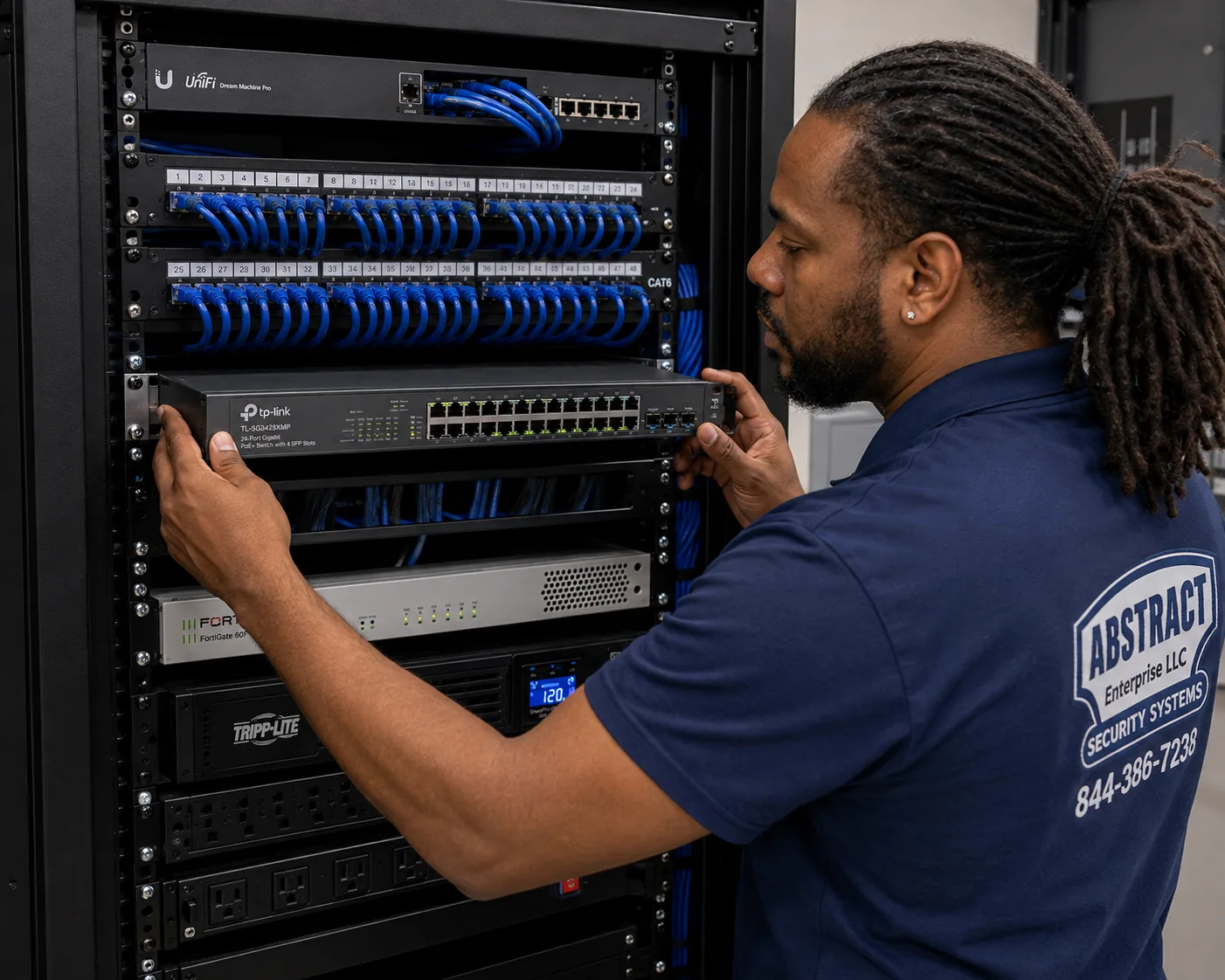
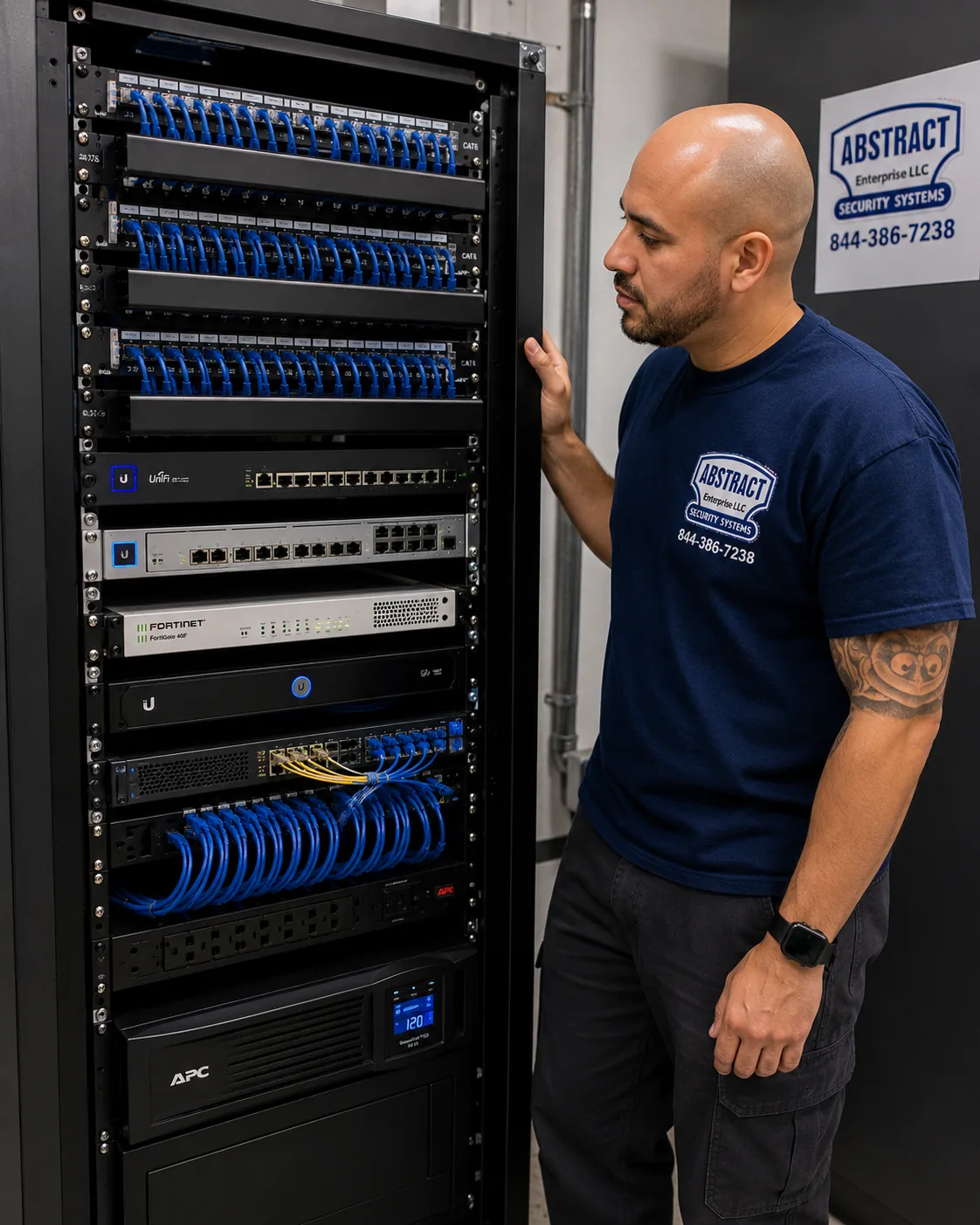
Photo from the AESS job library, not taken on Long Island: a finished network rack with patch panels, switching, a firewall and battery backup, all dressed and identified. For a Long Island office park or warehouse running plate capture at several entrances, the recorder, switches and backup live in an organized rack like this, so the system keeps recording through short outages and anyone can see what each cable feeds.
AI Overview Reality Check
What AI Gets Wrong About Capture Camera Installation in Long Island
We could not capture Google's AI Overview, People Also Ask boxes or Bing and DuckDuckGo results for capture cameras on Long Island from our build environment, so we will not pretend to quote them. What follows are claims we see repeated in quick online answers and national cost guides about plate cameras and camera installation in general, set against the Long Island public record and our own field practice. Marketplaces such as Angi, HomeAdvisor and Fixr publish national cost and how-to guides that feed many of these answers. They are useful for a rough idea, but none of them has walked your driveway.
"Any 4K camera will read license plates."
This is the claim that sells the most disappointing cameras. Resolution is the number of pixels across the whole picture. A 4K camera with a wide lens covering an entire driveway spreads those pixels across the lawn, the street and the sky, and a plate twenty or thirty feet away still ends up as a small smudge, especially when the car is moving.
What reads a plate is enough pixels on the plate itself, a shutter fast enough to freeze motion and a position that avoids headlight glare. One New York installer puts the plate camera within about ten feet of where plates pass, and manufacturer guides call for a shallow angle to the plate.
On a Long Island driveway that usually means a dedicated plate camera near the curb or gate, not a higher-resolution camera on the house. We would rather install one well-placed capture camera than three expensive wide ones that never read a plate.
"License plate readers are only for police and governments."
It is true that the plate readers people hear about on Long Island are public: Freeport's 27 readers, East Hills' 81 cameras at 43 entrances, Lawrence's system tied to the county police command center, and the thousands statewide in the DeFlock count. That coverage has led many answers to treat plate capture as a government tool.
Private plate capture is common and legal on private property. A local integrator describes plate cameras at the entrances and exits of private sites logging every vehicle, with schedules and alerts, and a Nassau installer lists license plate recognition among its commercial specialties for retail, warehouses, office parks and industrial facilities.
The real difference is control. A public reader's records belong to the agency. A private capture camera records to your recorder, and the footage is yours to review, keep or share. That is the setup we install.
"You need a town permit to put up cameras on Long Island."
Answers that blend New York City rules with suburban ones often suggest a building permit for cameras. New York City's agencies do not reach Nassau or Suffolk, and one installer working both counties states that standard camera installations there typically need no municipal permit.
What does exist is alarm regulation. Suffolk requires a permit for alarm systems in its police district, a rule that followed 97,000 false alarms in 2015, and Nassau's police alarm registration governs systems with police dispatch. Those rules apply when cameras are part of a monitored alarm, not to cameras on their own.
Separately, the state licenses the installer, not the camera: the Department of State's security and fire alarm installer license covers this work. Ask any installer for their license number. Ours is NYS license #12000287431.
"Wireless cameras are just as reliable as wired ones."
Quick answers often treat Wi-Fi cameras as a simple upgrade because they skip the cable. For general coverage in a small house, they can be fine. For capture, which matters most at the moment something is being stolen, they carry a specific risk.
CrimeOnline reported a 2022 burglar in Queens and Long Island who carried what investigators believed was a Wi-Fi jammer, and noted that the camera that caught him did not depend on Wi-Fi. News 12 Long Island has relayed police advice to hardwire systems. A capture camera at the far end of a long Suffolk driveway is also often at the edge of Wi-Fi range on an ordinary night.
We wire capture cameras wherever the property allows, and on slab houses we plan attic and exterior routes to make that possible. Where wiring is not permitted, we say what you give up.
"Mount the camera as high as possible so it sees more."
Height is good advice for general coverage cameras, because it protects them from tampering and widens the view. For capture, it is usually wrong. A plate camera mounted high on the house looks steeply down at the plate, stretching the characters, and a face camera mounted high records the tops of heads.
Plate capture works best with the camera only modestly above headlight level, roughly three feet according to the manufacturer guidance we follow, and at a shallow angle to the lane. Face capture works best at about head height near the door, looking at the approach.
We balance that with tamper resistance. ABC7's report of a man in Central Islip destroying a doorbell camera with a knife is a reminder that low cameras get attacked, so we use vandal-resistant housings and positions that are hard to reach without being useless.
"On your own property you can record anything you like."
Owning the wall does not settle what the camera may record. New York Civil Rights Law section 52-a, as summarized in news coverage, makes it unlawful to use video surveillance where a person has a reasonable expectation of privacy, and audio recording raises separate consent issues that lead a Justia attorney to advise turning audio off unless a consenting participant is present.
On Long Island's closely spaced Nassau lots, a driveway camera can easily see into a neighbor's yard, driveway or windows. An installer's advice we agree with is to use privacy masking on exterior cameras so they do not capture a neighbor's private space.
We set masks and leave audio off at installation, and we show you where the masks are so you can keep them in place if you adjust anything later.
"Camera installation costs about the same everywhere in the New York area."
National guides give one cost range for a metro area, and AI answers repeat it. Long Island prices differ from the city's for real reasons: longer cable runs, larger lots, detached garages, gates far from the house, and travel across two large counties.
Our price list reflects that by area. Nassau addresses are priced at 1.15 times our Brooklyn base and Suffolk addresses at 1.20 times, with the same design approach and equipment in both. Within a job, the number of capture points, the length of each run and whether a pole or trench is needed move the total far more than the county does.
That is why our Long Island price page itemizes each part of the work, and why we never quote a number that is not on it.
Want a Plate You Can Actually Read? Talk to a Technician About Your Entrance
Send a photo of your driveway, gate or lot entrance taken from where cars come in, plus the town and whether it is in Nassau or Suffolk, and a technician will tell you where a capture camera would need to sit, how the cable could get there and which lines of the price list apply. Call (800) 486-0943, message us on WhatsApp, or use the quick form.
Every Long Island capture job follows the same eight steps, whether it is a single plate camera at the end of a Massapequa driveway or capture at every gate and dock of a Hauppauge warehouse. The order matters most at the end: a capture camera is not finished until it has read plates at night.
1. Send the property details
The address, town or village, Nassau or Suffolk, the property type, and photos of each gate, driveway, dock or door where vehicles or people need to be captured. We book a survey within 2 hours of your request.
2. Walk the capture points
A technician measures from each proposed mount to where plates and faces pass, notes speed, headlight direction and street lighting, and checks power and cable routes, including the attic on slab houses.
3. Agree the written design
Each capture camera, overview camera, cable route, recorder location and privacy mask goes on a written plan, matched line by line to the Long Island price list for your county.
4. Check the rules
HOA, landlord, building management and any historic district review are confirmed before drilling, and we explain whether alarm permit rules apply if cameras tie into an alarm.
5. Run and terminate the cable
Outdoor-rated cable through the attic, walls, conduit or core-drilled block, buried in conduit where needed, labelled at both ends and terminated at the switch or recorder.
6. Mount and aim
Plate cameras close to the lane at a shallow angle above headlight level, overview cameras on the same lane, face cameras at head height near the doors.
7. Tune for night and headlights
Shutter, zoom, focus and infrared adjusted with real vehicles after dark until plates read through glare and motion, with privacy masks rechecked after every change.
8. Certify, document and hand over
Every cable tested, recorder and phone app set up, a test clip exported with you, and a labelled map of every camera and cable left for the future.
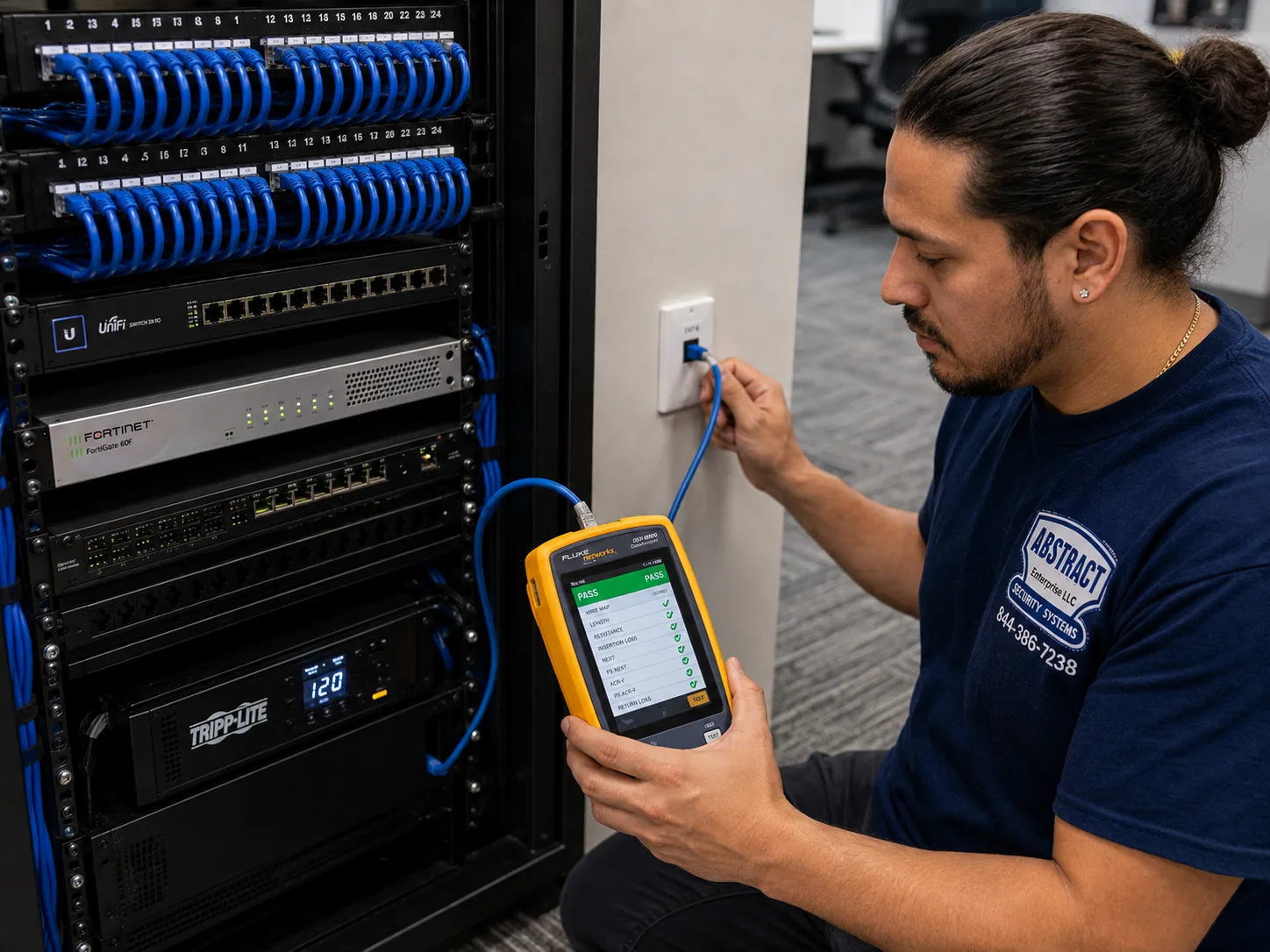
Photo from the AESS job library, not taken on Long Island: a technician certifying a data drop with a cable analyzer that shows a PASS result. Before a plate camera at the end of a long Suffolk driveway goes live, its run is tested like this, because a cable that barely works in October can drop the camera on the coldest night of January.
Coverage Area
Capture Camera Installation Near Long Island's Landmarks
Long Island is too big to describe by neighborhood, so most people give directions by its roads and anchors. These are landmarks named in our research that sit near the kinds of properties where capture cameras are most often requested.
Roosevelt Field
At 630 Old Country Road in East Garden City, described by Wikipedia as Long Island's largest mall, on the former airfield where Lindbergh's 1927 flight took off.
Nassau Coliseum and the Nassau Hub
The roughly 72-acre site on the former Mitchel Field in Uniondale, with RXR Plaza, Hofstra University and the Cradle of Aviation Museum nearby; its redevelopment has stalled since Sands withdrew in April 2025.
Levittown
Announced as Island Trees on May 7, 1947 and finished in 1951 with 17,447 homes, the template for Nassau's slab-built postwar suburbs.
Long Island Innovation Park at Hauppauge
About 1,350 businesses across roughly 11 square miles, the Island's largest concentration of warehouses, docks and gated yards.
Station Yards, Ronkonkoma
The 53-acre transit-oriented development at the Ronkonkoma LIRR station, planned for up to 1,450 apartments with retail, office space and a Northwell medical hub.
Hicksville LIRR Station and North Broadway
The Island's busiest railroad hub, beside a retail strip that the Shops on Broadway plan and hundreds of new apartments are reshaping.
Capture cameras on Long Island are priced per capture point, from a verified price list, at the rate for the county the property is in. Nassau addresses use 1.15 times our Brooklyn base rate and Suffolk addresses use 1.20 times, which reflects the longer runs, larger lots and travel that Long Island jobs involve. We do not print a single "Long Island price" on this page because capture jobs differ too much: a single driveway point on a short Nassau lot and six gate and dock points on a Hauppauge warehouse are different jobs. Instead, the complete itemized list, with a calculator to build your own system, lives on our Long Island capture camera price page, and every written quote uses those lines and nothing else.
What moves the price
Why it matters on Long Island
How we handle it on the quote
Number of capture points
One per lane, gate, driveway or dock apron; plus face points at doors
Each point listed separately with its overview camera
Cable distance to the recorder
Long Suffolk drives, detached garages and gates far from the house
Each segment measured on the survey and listed
Route difficulty
Slab houses with attic-only routes; block walls needing a core drill
Route described in writing before work starts
Buried or exterior conduit
Runs across lawns, driveways or yards to a gate or post
Listed by length; trench approvals noted where needed
Mounting hardware
Poles, pillar mounts or arms to put cameras at the right height by a lane
Named by type and location
Recorder and storage
Number of cameras and how long you want footage kept
Recorder and drive size listed; your own recorder used if compatible
Plate reading to text and alerts
Useful for HOAs, warehouses and lots; often unnecessary at a single home
Only included if you ask for it
Battery backup
Storms and outages, as Isaias showed in 2020
Sized to the number of cameras
County
Nassau 1.15× and Suffolk 1.20× the Brooklyn base
Set by the property address
How to read a Long Island capture quote
Take a ranch on a slab in Nassau with one plate camera at the street end of a short driveway and one face camera at the side door. The quote lists two capture points, an overview camera for the driveway, the attic-to-exterior cable route with its conduit, the recorder and battery backup, and the night tuning, all at the Nassau rate. Move the same design to a Suffolk colonial with a 150-foot driveway and a detached garage, and the lines change: the cable segment to the garage, a weatherproof switch there, a buried conduit run to a post at the curb, and the Suffolk rate. Nothing else is added on the day unless you ask for it, and if the technician finds something the survey missed, they show you, name the price list line and wait for your agreement before going on.
Terms
The written quote sets out exactly what is included at each capture point. Here are the warranty terms that apply to AESS-supplied equipment on Long Island installs:
Full terms — including 50% deposit, one-year parts-only warranty on AESS-supplied products, and the late-fee schedule — are set out in the service agreement.
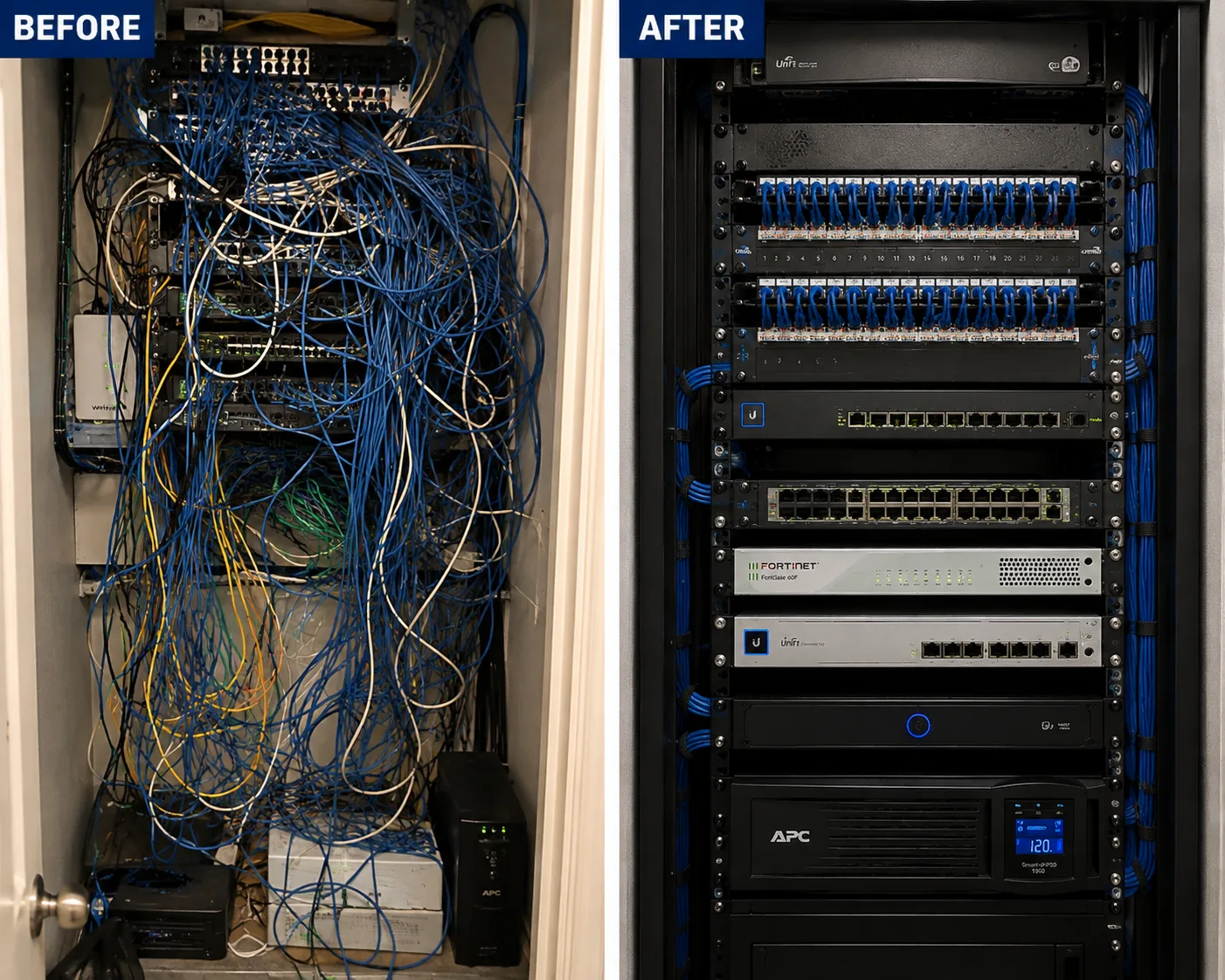
Photo from the AESS job library, not taken on Long Island: before and after views of an unlabelled, tangled network rack rebuilt into a dressed, identified one. When a Long Island business adds plate capture to an older camera system, cleaning up the recorder and switch area like this often comes first, so the new capture cameras are not lost in a nest of unmarked cables.
Shop Our Systems
Capture Camera Installation Packages & Pricing
Three common Long Island capture jobs, each built only from lines on the price list. The current figures for each, at the Nassau and Suffolk rates, are on the Long Island capture camera price page; there is no package premium and no hidden extra.
Starter: One Driveway Capture Point
A dedicated plate camera and an overview camera on a single driveway, cabled through the attic or garage, recorded to a compact recorder with battery backup, tuned at night and privacy-masked. Suits slab ranches, Capes and split-levels on short Nassau lots.
Standard: Driveway Plus Door
The starter driveway point plus a face capture camera at the door people use, usually the side or garage door, and up to a few general coverage cameras for the yard, all on one recorder with phone viewing. The usual whole-house capture job on both sides of the county line.
Premium: Gate, Lanes and Docks
Plate capture at every vehicle entrance of an estate, HOA, lot or warehouse, overview cameras on each lane, face capture at entrances, long runs with switches or fiber, optional plate reading to text with a vehicle log and alerts, and a rack-mounted recorder with battery backup.
Bring your own equipment
If you already bought cameras or a recorder, from a warehouse club or online, we can install them at labor-only rates from the same list, as long as the equipment is suitable for the job. We check each camera's lens, shutter and infrared against the capture point it is meant for, and the recorder's compatibility and channels, before anything goes on a wall. A general-purpose camera can often serve as an overview camera or yard camera even if it cannot read plates; we will tell you honestly which of your cameras can capture and which cannot, and show you the list price of a capture camera that will.
Complete Services
Every Capture Camera Installation Service in Long Island
Send a photo of your entrance and the town, and we will match it to the list. Request a free quote
FAQ
Long Island Capture Camera Installation FAQ
How much does capture camera installation cost on Long Island?
+
It is priced per capture point from our verified list, at 1.15 times our Brooklyn base for Nassau addresses and 1.20 times for Suffolk addresses. The total depends on how many entrances need capture, how far each camera is from the recorder, the cable route and any poles or conduit. The full itemized list and a calculator are on our Long Island capture camera price page, and every written quote uses only those lines.
Do you cover the whole Island, Nassau and Suffolk, all the way out east?
+
Yes. We install capture cameras in every town in Nassau and Suffolk, from the Queens line to the East End. The design approach and equipment are the same in both counties; only the rate changes with the address, and long-distance East End jobs are scheduled so the night tuning visit can happen on the same trip where possible.
Is AESS a city company, or do you really work in the suburbs?
+
We work in both. AESS has been owner-operated since 2002 and our technicians install across the five boroughs, Long Island and the Hudson Valley. Suburban capture jobs are a large part of the work because driveways, gates and parking lots are exactly where plate capture matters most.
Should the capture cameras at my door record sound as well as video?
+
We leave audio off by default. A Justia attorney answer advises disabling audio on home security cameras unless a consenting participant will be part of any recorded conversation, and a camera at a door or entrance often picks up other people talking. If you want audio for a specific reason, take legal advice first and we will set it up accordingly.
Can I tell the police where my cameras are without giving them access to my footage?
+
Yes. Suffolk County Police run a free Camera Registry Program where you register the location of your system; the department says it does not get access to the cameras and may ask you to check video for a date and time at your convenience. SCPD SHIELD also offers Emergency Remote Camera Access, which partners can opt into or out of. In Nassau, some village police such as Garden City's run their own voluntary registries.
I rent at a managed complex like Station Yards in Ronkonkoma. Can I still have capture cameras?
+
Inside your own unit, often yes, using cameras that need no drilling. Exterior capture points, such as at a parking entrance, belong to building management, and complexes like Alston at Station Yards already have gated parking and concierge services. We need written permission from management before drilling or wiring anything, and we are happy to talk with them about a capture system for the property itself.
How long will my recorder keep the plate footage?
+
That depends on the number of cameras, their resolution, how much motion they record and the size of the drive in the recorder. We ask how far back you want to be able to search, which for many owners is long enough to cover a vacation or a delayed police request, and size the storage to match. You can always export an important clip to keep it permanently.
Can you add plate capture to a camera system I already own?
+
Usually, if the recorder is compatible and has a free channel. We add dedicated capture cameras at the right spots and keep your existing cameras for general coverage. If the recorder cannot accept the new cameras, we tell you during the survey and price a replacement recorder from the list, reusing as much of your existing cable as tests sound.
Our HOA entrance has one lane in and one lane out. How many capture cameras does that take?
+
Typically one plate camera per lane plus an overview camera covering both, so two plate cameras and one overview at a simple in-and-out entrance. Separate service or construction entrances each need their own capture point. The board should also decide in advance who can view and export footage, and we set user accounts on the recorder to match.
Can the system send me an alert when a particular vehicle pulls in?
+
Yes, with plate reading software on the recorder or cameras, which turns each captured plate into text and compares it against lists you set. A local integrator describes these systems driving user profiles, approved schedules and automatic alerts. Many homeowners do not need it; warehouses, HOAs and businesses often do. We include it only if you ask.
How quickly can a technician come and look at my property?
+
Requests are booked within 2 hours, and we offer same-day estimates. The survey date depends on the schedule and where you are on the Island. Sending photos of your entrances with the request lets us prepare the survey and often give you a rough plan before the visit.
Will I get a record of where every camera and cable was installed?
+
Yes. Every cable is labelled at both ends and we leave a map showing each camera, what it is for, the route its cable takes and where the recorder, switches and battery backup are. On a slab house with attic and exterior routes, or a warehouse with long conduit runs, that map saves hours the next time anything needs attention.
Get In Touch
Request a Free Quote
Tell us the town, whether you are in Nassau or Suffolk, the property type and where vehicles or people come in. A photo taken from the street looking at the entrance makes the plan much faster. Prefer to talk? Call (800) 486-0943.
✅
Request Sent!
We'll call about your Long Island capture cameras the same business day.
More Capture Camera Installation near Long Island hub
From a slab-built Levittown ranch to a long Suffolk driveway, an HOA gate or the docks of a Hauppauge warehouse, the job starts the same way: a look at where vehicles and people come in, an honest plan for getting a camera close enough to read them, and a price from the Long Island list for your county. Call (800) 486-0943, message us on WhatsApp, or send the quote form, and we will tell you exactly what your entrance needs before anyone drills.