Plates unreadable at the bottom of a long driveway, or a gate camera that never came back after the last storm outage? Book a Hudson Valley capture camera visit: (800) 486-0943
Home › Capture Camera Installation › Hudson Valley
Long Wooded Driveways · Dutch Stone Houses and Historic Districts · Farms, Wineries and Business Lots · Six Counties from Westchester to Ulster · NYS Licensed
Capture Camera Installation in the Hudson Valley
Aimed at the One Spot Every Car Must Pass · Tuned for Headlights and Dark Country Roads · Your Footage, Your Rules
A capture camera is a security camera set up for one job: recording a license plate, or a face at a gate, clearly enough to read later. In the Hudson Valley that job is harder than it sounds. Homes sit far back from the road at the end of curving gravel drives. Farms and wineries have wide, open entrances. Stone houses in Kingston and Hurley, and row houses in Newburgh's East End, sit inside historic districts where anything bolted to a front wall may be reviewed. And 2026 has been the year the region argued in public about plate readers, with Dutchess County voting to cover its Flock cameras. We plan private capture cameras for homes, communities and businesses across Westchester, Rockland, Orange, Putnam, Dutchess and Ulster, aimed at your own ground, recorded on your own equipment, and installed under our New York State license.
Reviewed and updated November 5, 2026 by Anwar Timothy, NYS license #12000287431 · Sources: The Highlands Current (October 16, 2026, Dutchess Flock vote), the Times Union (Dutchess decommissioning, Pine Plains and Ulster broadband reports), Hudson Valley Post, the Daily Gazette HV360 (Columbia County and City of Hudson plate readers, Columbia broadband), Hudson Valley One (Kingston surveillance map, Ulster broadband), Mid Hudson News (Ulster plate-reader policy and ConnectALL grants), Spectrum News (Assembly Bill A563A), the New York State Senate (Sen. Michelle Hinchey, S.9890/A.10808), the NYS Department of State and 19 NYCRR 195.2 as summarized by Kirschenbaum & Kirschenbaum, CCTV Camera Pros plate capture guidance, the City of Kingston HLPC page and 2025 minutes, City of Hudson code, City of Beacon Chapter 134, Newburgh East End design guidelines, Hudson River Valley National Heritage Area, NYS Parks, Stacker (U.S. Census housing age), Central Hudson and Orange & Rockland, the Daily Freeman, News 12 Hudson Valley, Patch, and public Yelp listings for Poughkeepsie · Dispatched from 460 E Fordham Rd
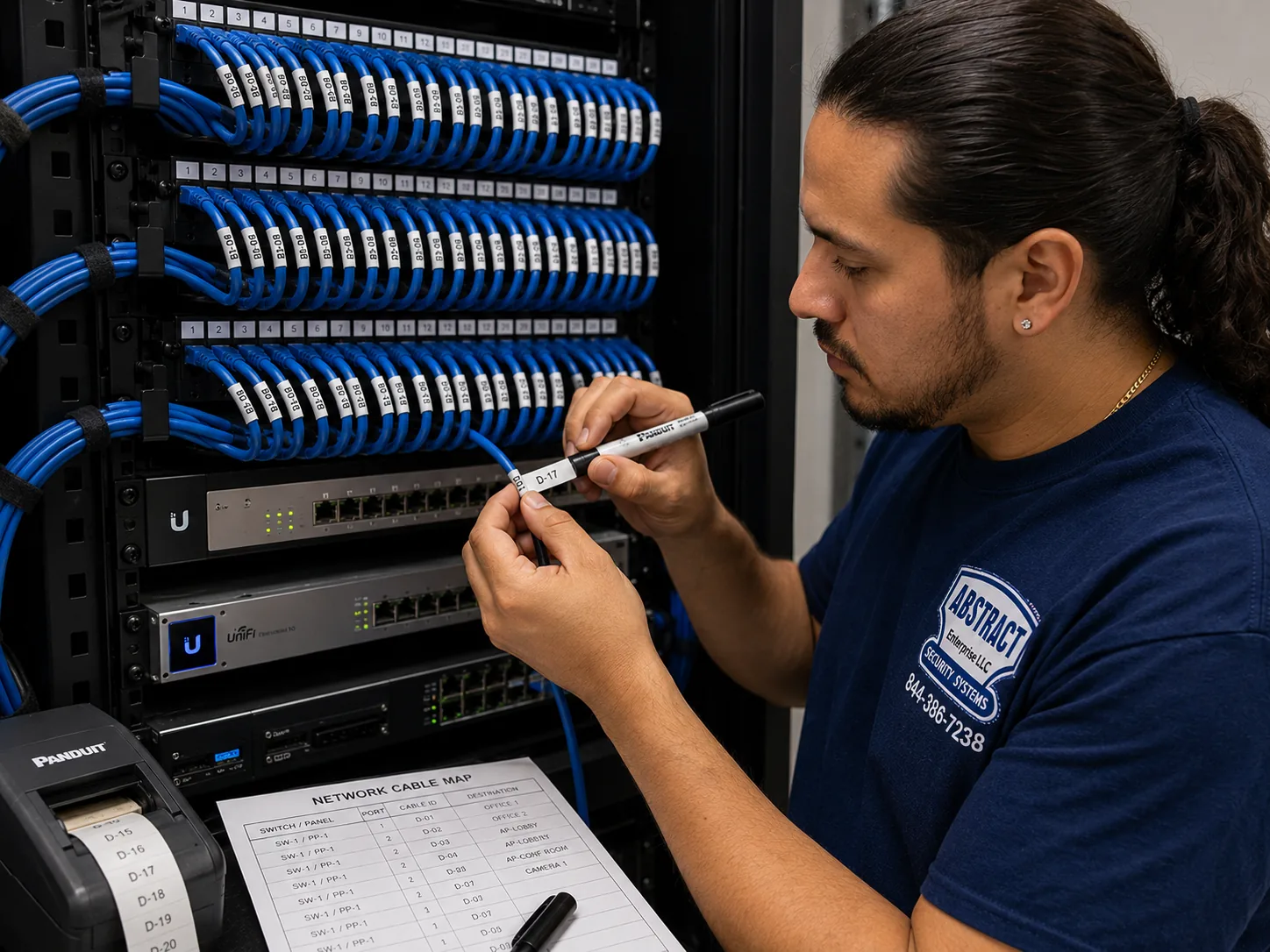
Photo from the AESS job library, not taken in the Hudson Valley: a technician printing labels for a patch panel with the printed port map beside it. On a Hudson Valley farm or estate where the plate camera sits at a gate several hundred feet from the house, every run is labelled like this at the recorder end, so the gate camera is never confused with the barn or the back porch years later.
Hudson Valley Capture Cameras
Tell us the town, the property and how far the gate or road is from the house
✅
Request Sent!
We'll call about your Hudson Valley capture camera the same business day.
25+
Years Experience
✓
Same-Day Estimates
100%
Licensed & Insured
4.7★
201 Google Reviews
Owner-operated since 2002 · Thousands of jobs completed · Booked within 2 hours
Capture camera installation in the Hudson Valley is the work of choosing one narrow, slow point on your driveway, gate or lot entrance, mounting a zoomed camera low and close to it, and tuning that camera so a plate stays readable under headlights and in the dark, with a second wider camera recording the whole vehicle. The installed price follows the county: our area rates run from 1.25 times our base in Westchester to 1.53 times in Dutchess and Ulster, and the exact lines for each county are on our Hudson Valley capture camera price page. A quote includes the walk of the approach, the cameras, cable or wireless link, recorder, setup and app. We book within two hours of your request. Call (800) 486-0943 or use the form.
Plate cameras aimed at your own property and entrance, not at the public road or a neighbor's yard, with recording kept on a recorder you own
Mounting angles held inside the limits manufacturers publish for plate capture, about 15 degrees off to the side and about 30 degrees down, because outside those limits plates smear
Camera and recorder work done under NYS license #12000287431, the state security installer license that covers cameras used to monitor intrusion, theft or movement
Why Hudson Valley Properties Need Capture Camera Installation
The Hudson Valley is not a neighborhood, and that is exactly why a plate camera here needs more planning than one on a city block. The Hudson River Valley National Heritage Area, created by Congress in 1996, groups Westchester and Rockland as the Lower Hudson Valley and Putnam, Orange, Dutchess and Ulster as the Middle Hudson Valley. Those six counties are the ones we cover. Between Yonkers and the Catskills you pass suburban streets where houses sit close together, river cities built in brick and stone, horse farms and orchards with entrances wide enough for a tractor, lake houses that stand empty from October to May, and commercial lots along state routes. The one thing all of those properties share is that cars and trucks arrive at them, and when something goes wrong, the question the police, the insurer or the owner asks first is usually the same: whose vehicle was it?
An ordinary security camera rarely answers that. A wide camera on a porch sees the whole yard, which is what most people want, but a license plate across that yard is a handful of pixels, and at night it is a white smear under headlights. In the security trade, a camera built and set up to read plates is called a license plate capture camera, and the camera industry treats it as its own type. CCTV Camera Pros, a supplier that sells them, separates license plate capture, where a camera records a readable image of the plate, from license plate recognition, where software reads the characters and turns them into text. Their guidance also lists what decides success at a house: setback from the road, mounting height, how tightly the detection area can be angled, lighting and obstructions. Every one of those is a Hudson Valley problem. Long setbacks, wooded drives, unlit country roads and entrances on curves are the normal condition north of the Westchester line, not the exception.
Then there is the year the region has had. On September 25, 2026, according to Hudson Valley Post, the Dutchess County District Attorney and Sheriff announced the county would stop using Flock plate readers. The Highlands Current reported that on October 13 the Dutchess Legislature voted unanimously that any camera still installed on November 1 be covered "with opaque, non-damaging material." That resolution covered only the 65 cameras the county owns; the same report counted 372 others on private land or on roads controlled by the state and municipalities, including seven in Beacon. The Times Union reported residents at a public forum citing privacy, constitutional rights, data security, inaccurate plate readings and possible misuse such as stalking, and noted that New Lebanon and Milan had banned Flock cameras on town property while Newburgh was moving to end its contract. In Pine Plains, Flock marked out 11 camera and plate-reader locations and never installed them. We mention this not to take a side in a public policy debate, but because it changes how private owners in this region should think about their own capture cameras. The concerns people raised about government networks, who keeps the data, who can see it and for how long, are the same questions a careful homeowner, HOA board or business should answer for a private camera before it goes up.
The burglary picture also keeps coming back. In January 2025 State Police issued a public alert about targeted residential burglaries in Dutchess, Westchester and Putnam counties, and their advice to residents included installing or activating security systems and cameras, as reported by Patch and WPDH. In Scarsdale in 2024, police told WRRV that an organized group of burglars had placed trail cameras or other hidden devices outside homes for days before breaking in, which means someone was studying who came and went. In Port Chester, News 12 reported neighbors' cameras recording a person trying car doors around 4 a.m. on and near Tower Hill Drive. And in May 2026 News 12 covered a string of overnight smash-and-grab burglaries at businesses in Warwick, Florida and Goshen in Orange County, where one owner admitted he had never looked at his own camera and did not even know the password. That last detail is the one we think about most. A camera that records but has never been checked, tuned or explained to its owner is a camera that fails on the one night it matters.
Rural life adds its own complications. Plate capture cameras record a lot of detail, and if you want to see that detail from the city on a phone, the property needs an internet connection that can carry it. Hudson Valley One reported in 2023 that 1,070 properties in Ulster County still had no broadband, and that in Shandaken even cell service struggled. The Times Union has since reported Verizon fiber planned for about 1,300 households and businesses in remote parts of Ulster through a state grant, and Mid Hudson News reported ConnectALL awards to Archtop Fiber for parts of Columbia, Dutchess, Orange and Sullivan, with fixed wireless for some eligible locations. Those projects are welcome, but they are not finished. Power is the other weak point. The Daily Freeman reported nearly 50,000 Central Hudson customers without power after storms in July 2026, and Central Hudson reported crews restoring power to more than 19,000 homes and businesses after a nor'easter in late September. A capture camera at the end of a driveway that loses power, or whose recorder reboots into a fault, is not capturing anything. That is why we treat battery backup, recovery after an outage and local recording as part of the job, not an upgrade.
The housing stock shapes where a camera can physically go. Stacker's analysis of U.S. Census data puts the median home in Westchester County at 1958, with 28 percent of homes built in 1939 or earlier; Dutchess at 1971 with 18 percent built by 1939; Putnam at 1968 with 17.9 percent; and Rockland at 1970 with 11.5 percent. NYS Parks counts ten Dutch stone houses along Main Street in Hurley, built between 1715 and 1790. The National Park Service's heritage study calls Kingston's Uptown Stockade District the largest identified area of early Dutch settlement in the state. Newburgh's East End Historic District, according to its Wikipedia entry, holds 2,239 resources, the most of any federally recognized district in New York. A bracket that goes into vinyl siding on a 1990s colonial in ten minutes needs masonry anchors on a stone house, and may need a historic commission's sign-off on a Newburgh row house. We find out which of those you have before we price anything.
Finally, many Hudson Valley properties are watched from somewhere else. A 2019 Federal Reserve Bank of New York report on Newburgh and Kingston quoted housing advocates describing downstate residents buying second homes upstate and the rise of short-term vacation rentals. For an owner who spends weekdays in Manhattan, a plate camera at the entrance of a lake house or farm is the simplest record of who arrived while the house was empty: the propane truck, the caretaker, the rental guests, or someone who had no reason to be there. That use only works if the camera records reliably on its own, alerts sensibly, and can be reached over whatever connection the property has.
We also want to be honest about what our research did not turn up. We looked for Reddit threads, community posts and local reviews about private plate capture cameras in the Hudson Valley and found none. We did not find any ruling from the Kingston, Hudson, Beacon or Newburgh commissions on a camera specifically. Google's People Also Ask panels, related searches, Bing and DuckDuckGo results and AnswerThePublic were not accessible from our build environment, so the questions on this page come from FAQ sections of real web pages and public Yelp listings for the Poughkeepsie area. Where this page describes our methods, it is describing our practice, not a survey of Hudson Valley properties.
Hudson Valley facts that shape a capture camera install
Six counties, two halves: the National Heritage Area groups Westchester and Rockland as the Lower Hudson Valley and Putnam, Orange, Dutchess and Ulster as the Middle Hudson Valley.
A public plate-reader reversal: Dutchess voted on October 13, 2026 to cover its 65 county-owned Flock cameras still in place on November 1; 372 others sat on private or other public land, per The Highlands Current.
Putnam runs its own readers: the same report says Putnam County owns 48 license plate readers, three of them in Philipstown, not tied to the Flock network.
Old housing: 28 percent of Westchester homes and 18 percent of Dutchess homes were built in 1939 or earlier, per Stacker's reading of Census data.
Gaps in broadband: 1,070 Ulster properties lacked broadband in 2023, per Hudson Valley One; Columbia County's count of unconnected addresses had dropped to roughly 700, per the Daily Gazette.
Storm outages: nearly 50,000 Central Hudson customers lost power after July 2026 storms, per the Daily Freeman.
What owners often pair with a plate camera. Once a Hudson Valley entrance is covered, the next request is usually a camera at the house itself: the front door, the garage or the barn, so the plate recorded at the gate can be matched to the person who walked up to the house a minute later. Both cameras can share one recorder and one app. If you think you will want that, say so at booking so the cable plan and the recorder size allow for it from the start.
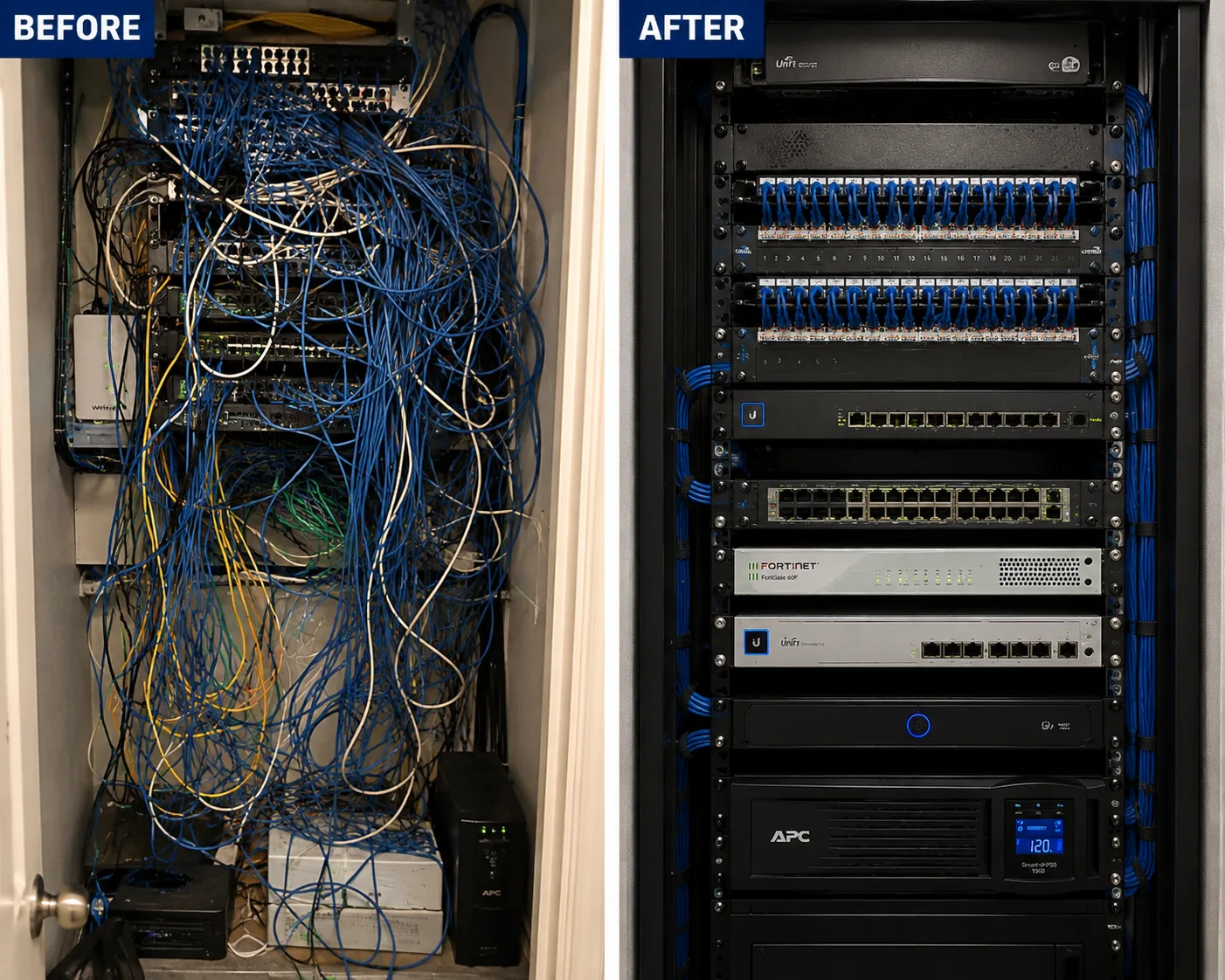
Photo from the AESS job library, not taken in the Hudson Valley: a network rack shown before and after, from an unlabelled tangle of cables to a dressed and identified rack. Many second homes and small businesses in the region inherit a closet like the "before" side from a past owner; when a plate camera is added, we sort out the recorder and network gear it depends on so it keeps working when nobody is there.
Camera Down After an Outage, or Plates Unreadable on the Night You Needed Them? Fast Help in the Hudson Valley
The calls we move on first are the ones where something has already happened: a car came up the drive overnight and the footage shows only headlights, a gate camera went dark after a storm and never came back, or a business owner needs a plate from last night's break-in and cannot get into the recorder. Do not unplug or reset the recorder, because a factory reset can erase the very footage you need. Write down the date and the time window, then call (800) 486-0943 and tell us the make of the recorder if you can see it. We book within two hours of your request. We will help you get at what was recorded first, and only then talk about what should change so the next clip is readable.
Three Cameras People Confuse: What a Hudson Valley Entrance Actually Needs
When a farm owner in Orange County or a homeowner in Putnam asks for "a camera that gets the plate," they are usually describing one of three things, and the difference decides the price, the mounting point and what the footage will show. Mixing them up is the most common reason people pay for a camera and still cannot read a plate. The table sets out the three, in plain terms, with the trade meanings that suppliers like CCTV Camera Pros use.
Camera
What it records
What it is good for
What it will not do
Overview camera
A wide view of the drive, gate or lot: the vehicle's color, shape, direction and the people who get out
Showing what happened and when, matching events across cameras
Read a plate at any real distance, especially at night
License plate capture (LPC)
A tight, zoomed image of the plate at one chosen point, tuned for headlights and motion
Giving a person a readable plate to look up or hand to police
Turn the plate into searchable text by itself
License plate recognition (LPR)
A capture image plus software that reads the characters and logs them as text
Searching by plate, alerts for listed vehicles, gate automation
Work well without a good capture image underneath it
For most homes, the right answer is the first two together: an overview camera that shows the whole scene, and a capture camera that reads the plate at the narrowest, slowest point. One New York installer describes plate capture as exactly that two-camera arrangement, an overview camera recording the vehicle and a dedicated plate camera placed within about 10 feet of where plates pass. LPR software makes sense for some HOA gates, business lots and loading docks where someone actually needs to search plates or trigger a gate, and much less sense on a private driveway, where you are typically looking back at one event. We will tell you which you need and why, and we do not sell recognition software to people who only need a readable picture.
The angle rule that decides everything
A plate is a flat, reflective rectangle, and a camera can only read it when it looks at it nearly straight on. CCTV Camera Pros' guidance for its plate capture cameras says they should not be mounted off to the side of the viewing area at more than 15 degrees, and should not be mounted so high that the downward angle exceeds 30 degrees. Other manufacturer guidance quoted by New York installers puts the camera about 3 feet above headlight level and keeps the angle to the plate within roughly 25 to 30 degrees. In practice that means a plate camera is usually low, close to the drive, and pointed almost along it, which is the opposite of where people instinctively put a camera: high on the corner of the house, looking down at everything. On a Hudson Valley property, that low, close point is often a post near the gate, a fence line, a stone pillar or the side of a barn, not the house at all.
Why the slow, narrow point matters on a country drive
Cars on a long gravel drive do not move in a straight line. They slow for a curve, drift to the side to pass a mailbox or a tree, and speed up on the straight stretch. A plate camera aimed at the wide part of the drive sees plates at every angle and every speed, and blurs most of them. So the first thing we do on site is walk the route a vehicle takes and look for the one place where every car must pass slowly and nearly straight: just inside a gate, at the throat of the drive where it meets the road, beside a speed bump, or at the point where a curve straightens toward the garage. That spot, not the house, decides where the camera goes. On a property where no such spot exists, we sometimes recommend creating one with a gate, a planter or a narrowing, and we say so plainly rather than promising readable plates we cannot deliver.
Headlights, darkness and the reflective plate
New York plates are reflective so that headlights light them up. That helps a human driver and hurts a camera, because at night the plate glows far brighter than the car around it and the camera, set to see the dark drive, washes it out to white. A capture camera has to be set the other way: a fast shutter so the moving plate does not blur, exposure held down so the reflective surface stays readable, and infrared illumination aimed at the capture point. The result is footage where the plate is crisp and the rest of the scene looks dark and odd, which is why the overview camera matters. On unlit Hudson Valley roads, where the only light at 2 a.m. may be the car's own headlights, this tuning is the difference between a readable plate and a white rectangle, and it is done on site with real cars, not from a spec sheet.
When the word "capture" means something else
Searches for "capture camera" also turn up product listings that use the word as part of a name, as well as webcams and photo clips. If a box or an app on your property already says "Capture," send us the model number before the visit. We will check it against what we install and what is listed on our Hudson Valley price page, tell you honestly whether it can be set up to read plates at your entrance, and install it if it can.
After the Flock Vote
Private Plate Cameras in a Region That Is Rethinking Public Ones
No part of New York argued about license plate readers more publicly in 2026 than the Hudson Valley. The arguments were about government and police networks, mostly Flock, not about a camera at the end of a private driveway. But the reporting gives private owners a useful checklist, because almost every concern residents raised applies, on a smaller scale, to any camera that records plates. The timeline below uses only what local outlets reported.
Where
What was reported
Source
Dutchess County
DA and Sheriff announced on September 25 the county would stop using Flock cameras; on October 13 the Legislature voted unanimously to cover any still installed on November 1
Hudson Valley Post; The Highlands Current
Beacon
Seven of the 372 cameras outside the county-owned group
The Highlands Current
Putnam County
Owns 48 plate readers, three in Philipstown, not tied to Flock
The Highlands Current
New Lebanon and Milan
Banned Flock cameras on town property
Times Union
Newburgh
Moving to end its Flock contract; with Poughkeepsie, considering dropping the technology
Times Union; Mid Hudson News
Pine Plains
Flock marked 11 locations but never installed them
Times Union
Columbia County
Sheriff's Office bought 10 Flock readers though the Board of Supervisors had tabled the purchase in 2023
Daily Gazette HV360
City of Hudson
Police plate readers by Axon at S. 3rd Street and Power Avenue, on Harry Howard Avenue in front of M.C. Smith Elementary, and at 154 Green Street
Daily Gazette HV360
Kingston
Police map of cameras concentrated in Midtown and Uptown; Motorola Solutions plate readers and Ubiquiti cameras, which the chief called consumer-level
Hudson Valley One
Ulster County
To look at a policy on use, access, retention, disclosure and sharing of plate-reader data
Mid Hudson News
What Albany has been doing about private plate readers
Two pieces of state legislation matter for anyone who puts up a capture camera. Spectrum News reported on October 25, 2026 that Assembly Bill A563A, which would have the state Division of Consumer Protection set minimum standards for plate-reader use by organizations that are not government or police, passed the Assembly 144-0 and the Senate 60-0. Under the bill, covered organizations would have to post their policy publicly. We have not seen a record of it being signed, and we do not know yet exactly which private users the final standards will reach, so we treat it as a sign of where the rules are heading rather than a rule in force. Separately, the State Senate's site describes a bill from Kingston-based Senator Michelle Hinchey, S.9890/A.10808, that would ban selling plate-reader data to private entities and let people harmed by unlawful use sue. That bill is also pending.
For a homeowner with one camera at the driveway, the practical takeaway is modest. For an HOA board, an apartment owner, a business with a lot, or a farm that hosts the public, it is more serious. If plate data is being collected from many people who visit, it is sensible to have a short written policy now: what is recorded, how long it is kept, who can see it, and when it is shared. We help clients set retention periods and access in the recorder to match whatever policy they write, and we do not route plate data to any third-party network unless the owner chooses that and understands it.
How we keep a private capture camera on the right side of the line
Aim at your own entrance. The capture point is on your drive, gate or lot, not the public road or the neighbor's property. A plate camera tuned to your entrance has a narrow field of view, which helps here.
No audio by default. Our installers' standard summary of New York law is that recording conversations without consent raises legal problems video does not, so we leave microphones off unless the owner has a lawful reason and has checked with counsel.
Local recording. Footage stays on a recorder at the property, with app access you control, rather than in a shared network.
Set retention on purpose. We set how long plate clips are kept instead of leaving whatever default the recorder shipped with.
Know Civil Rights Law 52-a. As RecordingLaw summarizes it, this section lets an owner or tenant sue someone who places a camera on adjoining property to film backyard recreation without consent and with intent to harass. A plate camera at a gate has no reason to look into a neighbor's yard, and we do not aim one there.
Sharing is your decision. When police ask for footage, you can export a clip and hand it over. We show you how, and we do not enroll your camera in any registry on your behalf.
One more point is worth making. Some commentary online repeats that there is no reasonable expectation of privacy in a license plate. The clearest version of that claim we found came from a Florida law firm writing about homeowners' associations, not a New York court. It may be broadly true, but it is not a license to point a camera anywhere, and it does not settle the separate questions about data retention and sale that New York lawmakers are now taking up.
Before You Book
Gate to Recorder: What to Check on a Hudson Valley Property Before We Arrive
Most of what makes a capture camera succeed or fail is decided before we bring a ladder: how far the entrance is from power and internet, how cars actually move up the drive, what the front of the house is built of, and who has to agree. A walk around your property with a phone camera and a tape measure, or simply pacing it out, tells us most of what we need. Please do not dig trenches, cut into stone or run cable to the gate yourself before we talk; it is easy to put a pathway in the wrong place.
What to check
Why it matters here
What to send us
Distance from the entrance to the house
Long setbacks decide whether a cable can reach or we need fiber or a wireless link; Ethernet is limited to 100 meters, about 328 feet, per run
A rough measurement or a pacing count, and a map screenshot with the drive traced
Power near the gate or entrance
A gate opener, lantern post or barn may already have power; many do not
Photos of any outlet, gate operator or lamp post near the entrance
How cars move
The camera goes where every car slows and straightens
A short video walking or driving the route at normal speed
Trees and seasons
Leaves fill in from spring to fall and can block a view or a wireless link
Photos of the entrance, and whether they were taken in winter or summer
Lighting at night
Many entrances are completely dark; some have a bright lamp that glares into a camera
A photo taken at night from where the camera might go
Wall and post materials
Stone, brick, timber posts and vinyl siding each take different fixings
Close photos of the surface you would like us to mount on
Internet service
Cable, fiber, DSL, fixed wireless, satellite or cellular each change what remote viewing can do
The provider's name and, if you can, a speed-test result taken at the house
Rules and permissions
Historic districts, HOAs, co-op boards and landlords can each need to sign off
The district or HOA name and the contact who approves exterior changes
Watch three cars come in
The most useful thing you can do is stand where the camera might go and watch the next three vehicles come up the drive: your own car, a delivery truck and a visitor if you can. Notice where each one slows, where it swings wide, where its headlights point and where the plate faces the camera squarely. Delivery vans often stop short of the house and turn around; visitors often pull in further than you expect. If you can film each arrival on your phone from the spot you have in mind, those clips tell us more than any measurement. We will still check on site, but you will already know whether the spot you chose works.
Look at the front plate question
New York issues two plates to most passenger vehicles, front and rear, but trucks from other states and some vehicles carry only a rear plate. A camera at the throat of the drive sees the front of arriving cars and the back of leaving ones. If you want every plate, it often makes sense to read arrivals and departures, which may mean one camera aimed each way at the same narrow point, or a single camera placed so it sees rear plates of departing vehicles. We will talk this through with you, because it changes the count and the price.
Find the recorder's home
The recorder needs a dry, ventilated spot with power and a network connection, ideally where a battery backup can sit beside it. In older farmhouses that is often a basement, a utility room or a closet near where the internet comes in; in a barn, a heated office or tack room. A cold, damp outbuilding is a poor choice for a hard drive. Tell us where your internet router lives and we will plan around it.
What We Install
Capture Camera Installation Services in the Hudson Valley
These are the capture camera jobs Hudson Valley homeowners, boards, landlords, farmers and business owners book us for. Each one starts with a walk of the approach and ends with you being able to find and export a plate clip yourself. Exact prices for each county are on the price pages linked in the pricing section below.
🚗
Driveway Plate Capture
A capture camera at the narrow, slow point of a long or wooded drive, paired with an overview camera, tuned for headlights and the dark stretch of a country road at night.
🚪
Gate and Call-Box Capture
Plates and faces recorded where vehicles stop at a gate, keypad or call box on estates, horse farms and private roads, with the camera at a height that sees both the driver and the plate.
🏘
Community and HOA Entrances
Entrance and exit lanes at condo developments and private communities, with retention and access set to match a written board policy, and optional plate recognition where the board wants searching.
🏭
Business Lots, Docks and Yards
Lot entrances, loading docks and equipment yards along state routes, with one capture camera per lane, overview coverage of the yard, and recorders secured indoors.
🍇
Farms, Wineries and Breweries
Entrances to properties that host the public on weekends and sit empty at night, where farm vehicles, delivery trucks and visitors share one drive.
📡
Long Links to the Gate
Runs past the 328-foot Ethernet limit by fiber, PoE extenders or a point-to-point wireless bridge, planned around trees, slopes and leaf season.
🌙
Fixing Blurry Night Plates
Existing cameras re-aimed, re-zoomed and re-tuned, or replaced with a proper capture camera, when your footage shows headlights and white rectangles instead of plates.
🔋
Outage-Proofing
Battery backup for the recorder, switch and router, settings that bring cameras back on their own after a power cut, and a test with the power actually off.
📱
Remote Viewing for Second Homes
App access set up for the connection the property really has, with alerts tuned so a city-based owner hears about a vehicle at the gate without a flood of deer and wind.
Building Specialists
Capture Camera Installation for the Hudson Valley's Architecture
A plate camera is often mounted on a post or fence, not the house, but the house still matters: it is where the cable starts, where the recorder lives, and in historic districts, what a commission may be looking at. These are the property types the region's sources describe and how each changes the job.
Dutch Stone Houses
The colonial stone houses of Hurley's Main Street, Kingston's Stockade and New Paltz's Historic Huguenot Street, where NYS Parks and Wikipedia describe some of the best Dutch stone architecture in the country. Thick masonry walls, very few clean cable paths, and historic review in most locations.
River-City Row Houses
The Federal, Italianate and Greek Revival row houses of Newburgh's East End and the narrow brick and clapboard row houses Fresh Air NY describes in Hudson. Shallow fronts on the sidewalk, rear access from alleys, and design guidelines on what attaches to a facade.
Suburban Colonials and Ranches
The post-war and later houses that make up much of Westchester and Rockland, with modest setbacks and attached garages. Usually the simplest case: the capture point is close, power and internet are nearby.
Farms, Horse Properties and Estates
Long drives, gates, barns and outbuildings across Orange, Dutchess and Ulster. The entrance may be far from both power and the house, and the camera may live on a post or a barn wall.
Lake Houses and Second Homes
Seasonal houses such as those around Lake Mahopac in Putnam, which a listing site gives as 587 acres. Often empty for months, sometimes on private lake roads, often with weaker internet than a primary home.
Industrial and Commercial Buildings
Brick, block and steel buildings in river towns and along state routes, like the 1929 Nabisco box-printing plant that Dia Beacon now occupies. Conduit, block walls and roll-up doors at loading areas.
How the property type changes the job
Property
Where the capture camera usually goes
How the cable usually travels
Who has to agree
Dutch stone house
A post or fence at the drive, rarely the stone wall itself
Underground or along a fence to an outbuilding or a rear wall, with a single sealed entry through a mortar joint
Owner; historic commission where the house sits in a district
River-city row house
Rear alley or parking pad, or a side wall out of view from the street
Through the rear wall or a basement window frame
Owner; Newburgh, Hudson, Kingston or Beacon review for street-facing work
Suburban colonial or ranch
Garage corner or a low post beside the drive
Through the attic or garage, in short runs
Owner; HOA if the community has exterior rules
Farm or estate
A gate post, pillar or barn wall at the entrance
Trenched conduit, aerial run, fiber or wireless bridge
Owner; an electrician for any new power at the gate
Lake house or second home
The private road or drive where it reaches the property
Short wired run if possible; wireless link if the road is long
Owner; lake or road association if the entrance is shared
Industrial or commercial building
Each lane of the lot entrance and the dock apron
EMT conduit on block walls, J-hooks above ceilings
Owner or landlord; tenants if the lot is shared
On stone and masonry. Stone houses rarely want a camera on them, and we usually agree. A plate camera belongs low and close to the drive, and a two-hundred-year-old stone wall at the front of a house is usually neither. When the cable has to enter the house, we choose a single entry point, preferably at the back or the side, drill through a mortar joint rather than the stone face wherever possible, and seal the hole with a material that can be removed later without damage. In Kingston, staff guidance recorded in the 2025 Historic Landmarks Preservation Commission minutes asked that externally mounted lines or line hides be painted to match a facade's existing color. We plan exposed runs with that in mind even where it has not been asked, because it is simply the respectful way to work on an old building.
On row houses in river cities. Newburgh's East End design guidelines speak directly to security features: integrate them with the architecture, do not obscure architectural features, and do not damage historic building fabric when attaching them. For a row house, that usually points the capture camera to the back, where cars actually park, off an alley or rear lot, and keeps the street face clean. Where the only parking is on the street, a private plate camera has very little legitimate job to do, and we will say so. A small camera at the door, covered by a later service, may be the better choice.
On farms and estates. The entrance on a working farm is often hundreds of feet from the house, with no power and no network. There are four ways to get a camera there: a buried conduit carrying cable or fiber, an aerial run along existing poles or fences, a wireless bridge from the house to the gate, or a camera with local power and its own connection. We look at distance, line of sight in summer, existing power at the gate and how much digging the owner will accept, and we price the option that will still work in five years, not just the cheapest one. Any new line-voltage power at the gate is work for a licensed electrician in the counties that require one; our quote says who does what.
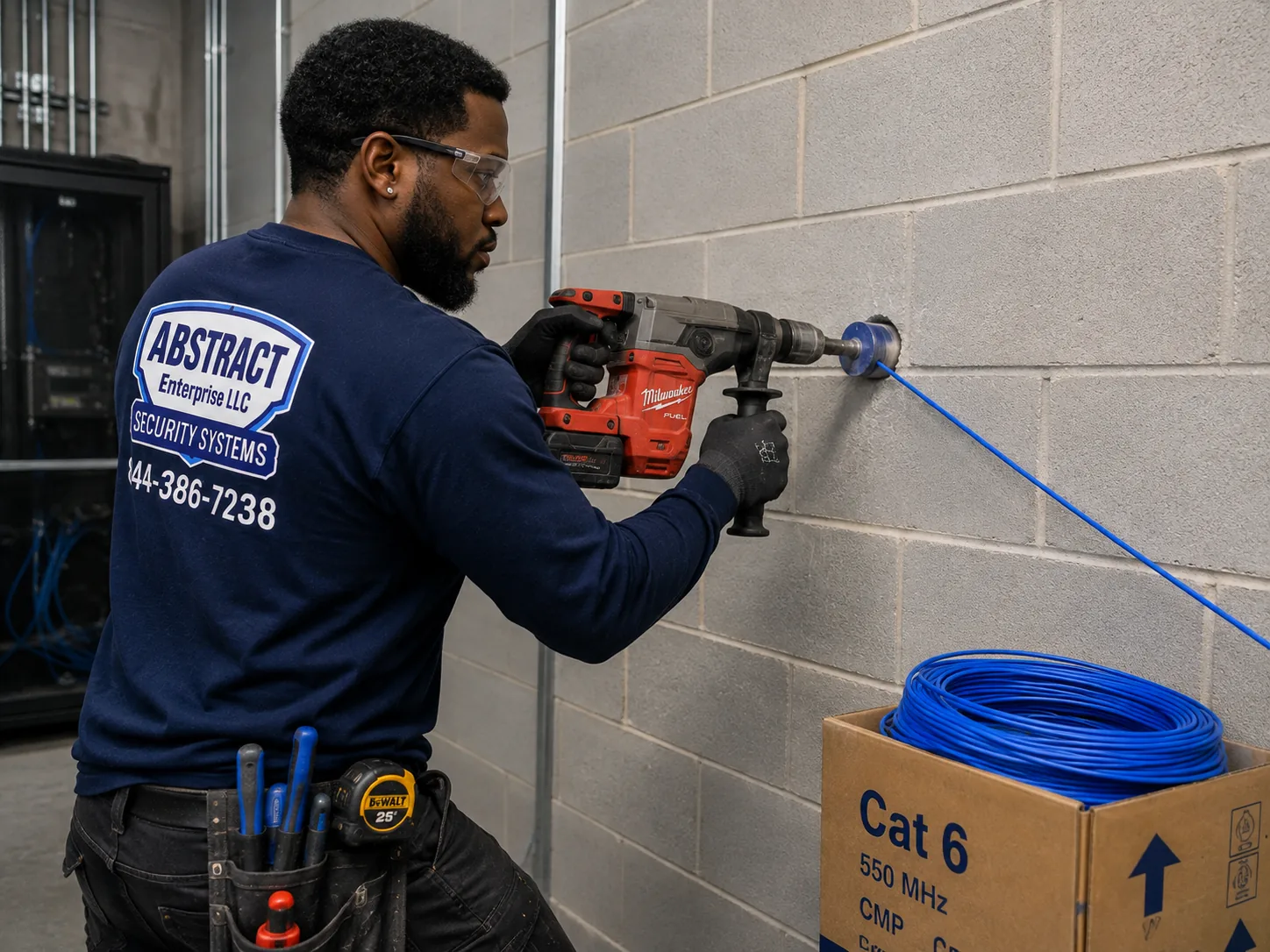
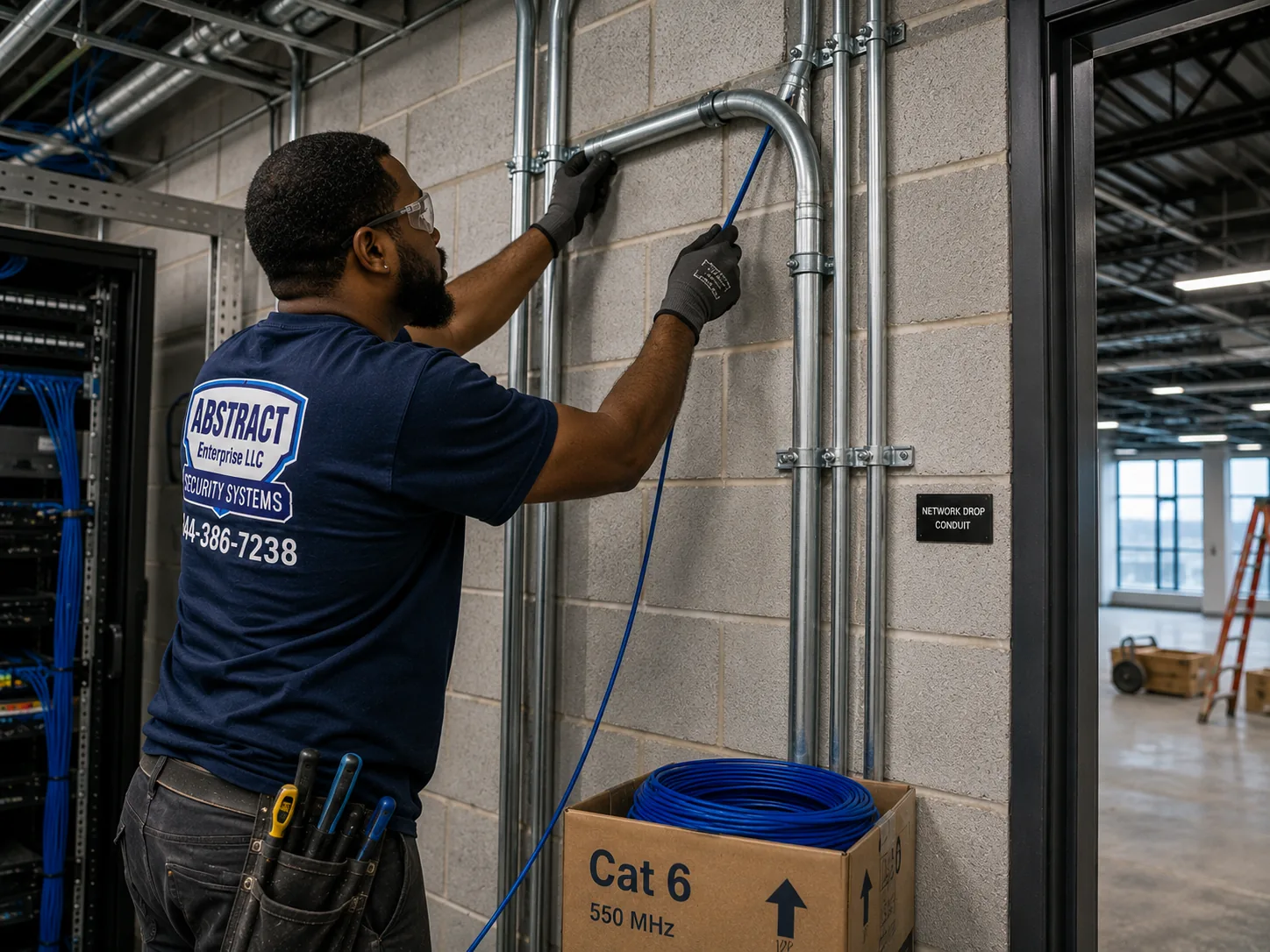
Photo from the AESS job library, not taken in the Hudson Valley: a technician core drilling through a block wall so cable can pass into a network room. Getting cable from a gate or post into a Hudson Valley stone house or a block-walled barn office takes the same kind of single, deliberate entry point, placed where it can be sealed and is not visible from the street.Photo from the AESS job library, not taken in the Hudson Valley: a technician feeding cable into EMT conduit beside a telecom room in an industrial building. Old brick and block factory buildings in the region's river towns, now warehouses, studios and offices, get the same treatment when plate cameras go on their lot entrances: cable in conduit along the wall, back to a room where the recorder can be locked up.
Commercial Capture Camera Installation
Business Capture Camera Installation in the Hudson Valley
Hudson Valley businesses rarely sit on a dense commercial strip. They sit on historic main streets, along state routes, in converted factories and at the end of farm drives. The places below are ones local and tourism sources name. We describe what those sources say; we have no information about the cameras at any business named and do not claim any of them as clients.
Warren Street, Hudson
Wikipedia calls Warren Street New York's most intact 19th-century main commercial street, inside a 139-acre historic district. The city's Historic Preservation Commission issues certificates of appropriateness before building permits, so exterior work on a shop front is planned around review.
Main Street, Beacon
A local guide describes a historic Main Street almost a mile long. Beacon's Planning Board handles certificates of appropriateness, and its code text mentions security-related changes that do not substantially detract from a historic property.
Uptown and Midtown Kingston
Where Hudson Valley One reported the police camera map was heavily concentrated, and where the Stockade and other historic districts put exterior work visible from the street before the HLPC.
Orange County Main Streets
News 12 reported overnight smash-and-grab burglaries at businesses in Warwick, Florida and Goshen in May 2026, including an owner who had never checked his own camera and did not know its password.
Wineries, Breweries and Farm Stands
Travel Hudson Valley counts more than 100 wineries, breweries and distilleries in the region. Their lots fill on weekends and empty at night, often with one shared drive for visitors and deliveries.
Malls, Routes and Warehouses
The Palisades Center in West Nyack, Rockland, proposed at 875,000 square feet according to Wikipedia, and the lots, distributors and contractors' yards along the region's state routes and the Thruway corridor.
What a business capture camera has to do differently
A home plate camera mostly watches one car at a time. A business camera at a lot entrance watches traffic in two directions, in two or more lanes, at different speeds, often with trucks that carry plates at different heights. The rule of thumb we follow is one capture camera per lane at the slowest point, which is usually the curb cut or the gate, plus overview cameras that show how vehicles move through the lot and where they park. Loading docks are a separate case: trucks back in slowly, which is good for reading a rear plate but means the camera has to be placed where the trailer will not block it. For a business that has already been hit, we start with the recorder: can the owner get into it, find last night's footage and export a clip? If the answer is no, that gets fixed before anything new is mounted.
Hosting the public changes your duty of care
A winery tasting room or a brewery lot records plates of hundreds of visitors who did not ask to be recorded. That is lawful in a visible, non-private area in general terms, but it is also exactly the situation Assembly Bill A563A, if it becomes law, is aimed at: non-government organizations collecting plate data. Our advice to any business is to post visible notice that the lot is under video surveillance, keep plate footage only as long as there is a reason to, limit who can log into the recorder, and write the policy down. We will set the recorder to match it, and we do not connect business cameras to outside plate networks unless the owner asks for that specifically and understands what it means.
Rules and practical limits for business capture cameras
A licensed installer. Under 19 NYCRR 195.2, as Kirschenbaum & Kirschenbaum explain it, closed-circuit TV used to detect or monitor intrusion, break-in, theft or movement is security work that requires a state security and fire alarm installer license. AESS holds NYS license #12000287431. The firm notes unlicensed installers can face fines of up to ten thousand dollars.
County electrical licensing. Westchester requires a county trade license for electricians; Rockland's Chapter 250 covers electrical contractors working on 50 volts or more; Orange's Local Law 8 of 2007, revised by Local Law 1 of 2024, requires a county license, and the City of Middletown has its own board; Ulster's Chapter 185 defines electrical work to include signaling and data. We found no county contractor license in Dutchess. Any new outlet or circuit for a gate camera goes to a licensed electrician where required.
Putnam's low-voltage license. Putnam's Chapter 145 covers low-voltage and limited communications technicians, including video surveillance cabling at 90 volts or less fed from an outlet a licensed electrician installed.
Third-party inspection. Many towns, Fishkill among them, require electrical work to be inspected by an approved independent agency. Where electrical work is part of the job, inspection is part of the schedule.
Historic districts. Kingston reviews exterior work on historic properties visible from the public right-of-way before a building permit issues, and Hudson issues no permit until its commission grants a certificate of appropriateness. Whether a camera alone triggers review we could not confirm, so we ask the commission when a camera faces the street.
Accessibility and egress. Posts, poles and junction boxes we add near walkways must not narrow an accessible route or block a path to an exit. We place them at the edge of drives and lots, not in pedestrian paths.
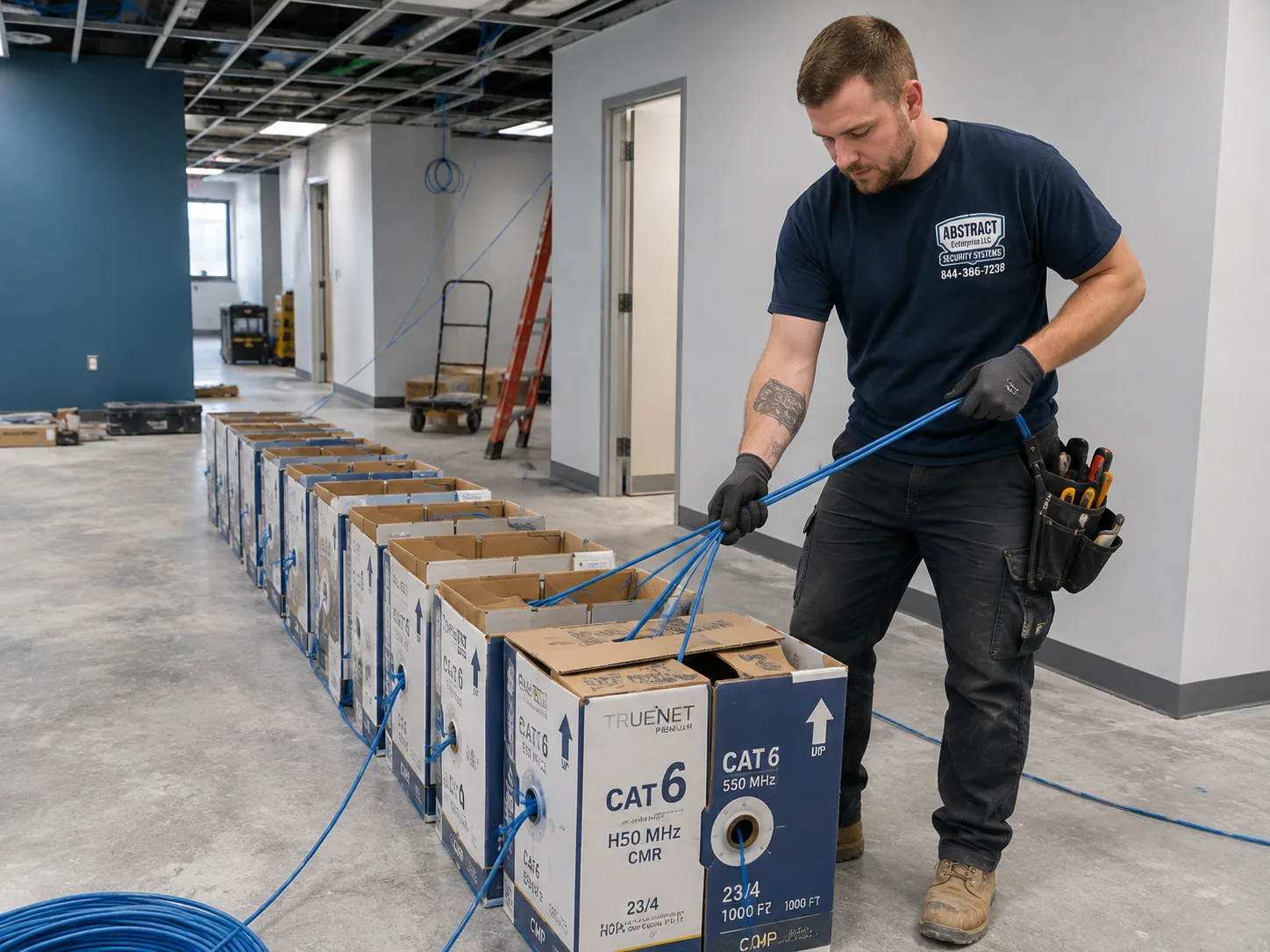
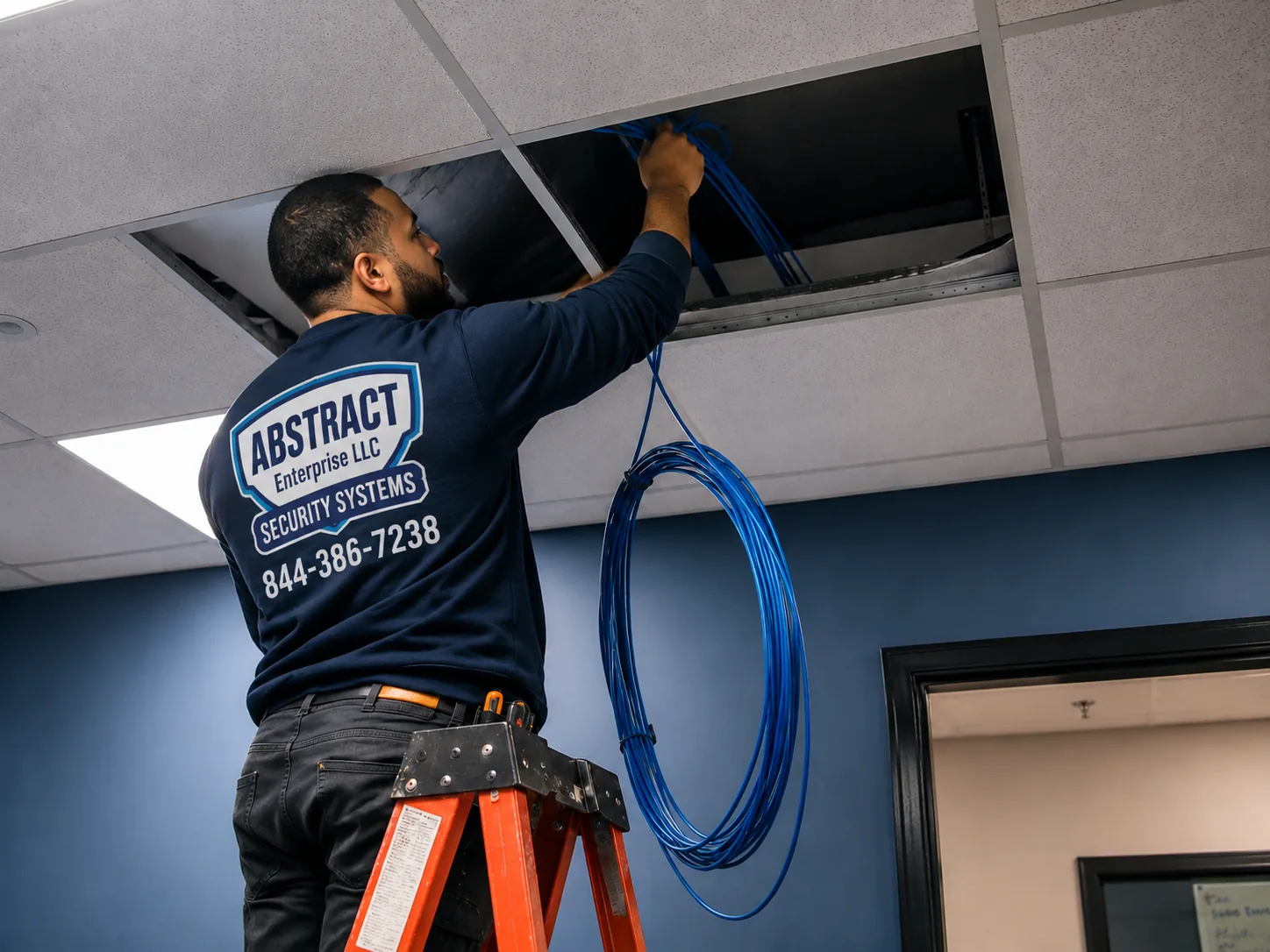
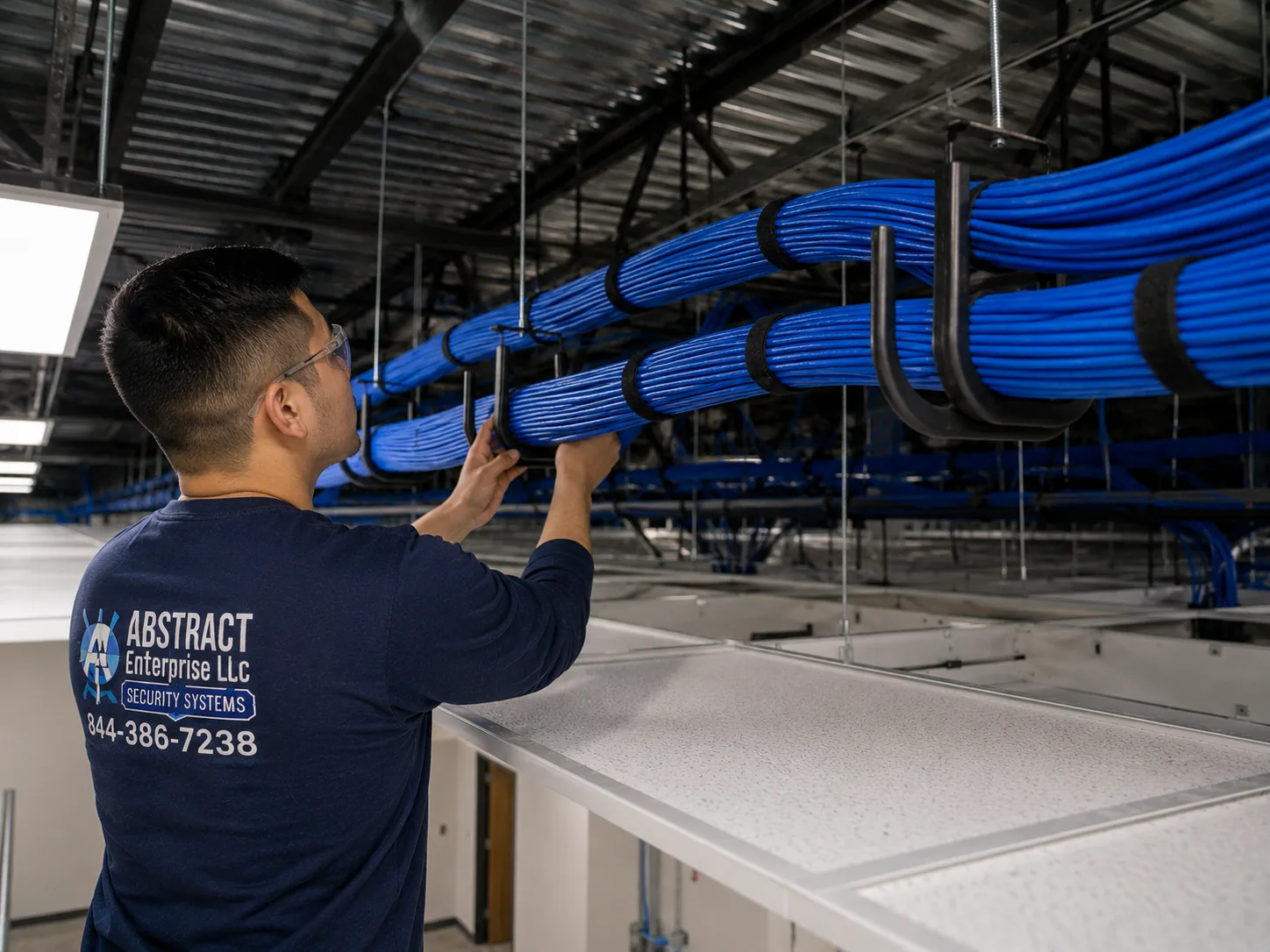
Photo from the AESS job library, not taken in the Hudson Valley: boxes of cable staged for a multi-drop pull on a commercial premises that stayed open during the work. At a Hudson Valley winery or shop with weekend crowds, we stage like this on a weekday and keep the pull out of the way of customers, so the lot cameras go in without closing the business.Photo from the AESS job library, not taken in the Hudson Valley: a technician feeding cable through the ceiling of a commercial space while it is in use. In a Warren Street or Main Street storefront, the cable from a rear lot camera usually travels the same way, above the ceiling from the back wall to a locked closet near the front.Photo from the AESS job library, not taken in the Hudson Valley: J-hooks carrying neat bundles of cable across a commercial ceiling. In the warehouses and distribution buildings along the region's state routes, cables from dock and gate cameras are supported this way rather than laid loose on ceiling tiles, so they survive the next tenant's renovation.
Field Notes
Field Notes: Walking a Country Drive Before Choosing the Spot
We do not publish stories about a particular client's property unless we can document them, so this is not a story about one address. It is the routine our technicians follow when the job is a plate camera at the end of a long Hudson Valley driveway.
We park at the road, not the house, and walk in the way a stranger would. We note where the drive leaves the road, where it narrows, where a car would slow for the first curve, and where a delivery truck could stop and turn. We look at the trees and ask what the view looks like in July. We find the nearest power and estimate the distance back to the router. Then we stand at the candidate spot with a laptop and a camera on a pole and watch a real car come in, ideally the owner's, at normal speed, in daylight. If the plate is readable from that point, we come back after dark, or ask the owner to send a clip, and check it under headlights. Only when both work do we mark the post or wall. On some drives the first spot we liked turns out wrong, because cars swing wide there or the sun sets straight into the lens. Finding that out before drilling is the whole point of the walk.
Your Questions Answered
Capture Camera Installation in the Hudson Valley: Questions Answered
Cost and planning
What does it cost to install a plate capture camera at a Hudson Valley home, and why does the county change it?
There is no single honest number for the whole region, because the biggest cost drivers are distance and site conditions, not the camera. A capture camera thirty feet from an attached garage in Westchester is a short job; the same camera at a farm gate six hundred feet from the house in Ulster needs a fiber run or a wireless bridge, a weatherproof enclosure and often new power. On top of that, our area rates run at 1.25 times our base in Westchester, 1.30 in Rockland, 1.40 in Orange, 1.45 in Putnam and 1.53 in Dutchess and Ulster, reflecting travel and access. The exact lines for each county are on our county price pages, and we give you a written quote after the walk of your approach, with every item named.
For a warehouse or contractor's yard in Ulster County, what goes into a plate camera quote?
We count lanes first: each entrance or exit lane that vehicles use needs its own capture camera at the slowest point, usually the gate or curb cut. Then we count dock aprons where trucks back in, decide how much overview coverage the yard needs, and look at where the recorder can be locked up indoors. Cable routes on block walls and through steel buildings, any conduit needed outside, and whether the business wants plate recognition software for searching all go on the quote. Ulster County jobs are priced at the 1.53 county rate on our Ulster County capture camera price page.
Placement and coverage
On a long, wooded driveway, where should the plate camera actually be mounted?
At the narrowest point where every vehicle slows and travels nearly straight, mounted low and close. Manufacturer guidance for plate capture cameras keeps the side angle within about 15 degrees and the downward angle within about 30 degrees, which on a driveway means a post or pillar a few feet beside the drive, a little above headlight height, looking along it. On most wooded Hudson Valley drives that point is near the road entrance or just inside a gate, not near the house, where cars are moving in different directions and plates are at odd angles. We confirm the spot with a real car before mounting, and we account for leaves, which can fill a view that looked clear in March.
Can one good camera on the corner of the house both show the whole driveway and read plates?
Not reliably, and we would rather tell you that now than after a night you needed it. A camera wide enough to show a long driveway spreads its pixels across the whole scene, so a plate at a distance is a few pixels wide; a camera zoomed enough to read the plate sees only a small patch of the drive. The two jobs also need opposite night settings, because a plate camera holds its exposure down so the reflective plate stays readable, which makes the rest of the scene dark. That is why the standard approach is two cameras: a wide overview for the story and a tight capture camera for the plate, both recording to the same recorder.
Rural reach, power and internet
Our house is out past the end of cable service in the northern part of Ulster. Will you come out, and will the camera still work?
We cover all six counties we serve, including rural towns, and a capture camera does not need the internet to record. It records to a recorder at the property, and that recording is what police or an insurer will ask for. The internet only matters for watching remotely and getting alerts. Hudson Valley One reported in 2023 that 1,070 Ulster properties had no broadband and that cell service struggled in places like Shandaken, so for those properties we set the system up to record locally first, and we size remote viewing to the connection you have, whether that is fixed wireless, satellite or cellular, with lower-resolution streams for the app and full resolution kept on the recorder.
When a Central Hudson or Orange & Rockland outage knocks out power, does the gate camera keep recording?
Only if it was planned to. A camera powered over its network cable from a switch at the house stops when the switch stops, so we put a battery backup on the recorder, the switch and, where useful, the router. A battery buys time, not unlimited hours, and the Daily Freeman's July 2026 report of nearly 50,000 Central Hudson customers without power, with many still out days later, shows outages here can run long. So we also set every device to restart on its own and resume recording when power returns, and we test that by switching the power off at the panel before we leave. If you have a generator, we check which circuits it carries and whether the recorder is on one.
Law, licensing and permission
Does a plate camera at the gate need an electrician, or can your team do it all?
It depends on whether new line-voltage power is needed. Cameras, network cable, power over Ethernet, recorders and app setup are low-voltage security work, which we do under our NYS security installer license. If the gate has no power and the camera or a gate-side enclosure needs a new outlet or circuit, that is electrical work, and Westchester, Rockland, Orange and Ulster all have county electrical licensing rules, as do some cities such as Middletown. Many towns also require third-party electrical inspection. In those cases a licensed electrician installs the power, and our quote says so. Often power over Ethernet or a fiber-and-power arrangement avoids new line-voltage work at the gate entirely.
Is it legal for our capture camera to record the road in front of the house as well as our driveway?
Recording what is plainly visible from your property is generally lawful in New York, but a capture camera has no good reason to be aimed at the public road, and we do not aim one there. Its job is to read plates on your own entrance, and a tight field of view on your drive will catch the road only incidentally. Keeping the camera off the road, off neighbors' yards and free of audio avoids the problems people actually get into, including claims under Civil Rights Law 52-a when a camera looks into an adjoining backyard. With A563A having passed both houses, owners who collect plates from many visitors, such as HOAs and businesses, should expect clearer rules soon.
Our house is in the Kingston Stockade District. What do we need before a camera goes on the front?
The City of Kingston says exterior work on historic properties visible from the public right-of-way is reviewed by the Historic Landmarks Preservation Commission before a building permit issues, and if a project is approved, the commission emails a certificate of appropriateness to the applicant, owner and the Building and Safety Division. A contractor's guide to Kingston says applications go in about 30 days ahead of the monthly meeting; check that timing with the city. We did not find a ruling on cameras specifically, so the cleanest path is usually a capture camera at the side or rear where the car parks, out of view from the street. If it must face the street, we ask the city first and paint exposed lines to match the facade, as Kingston staff have asked of other exterior wiring.
Communities and shared entrances
We are on the board of a condo community in Rockland. Who has to approve plate cameras at our entrance, and what should we decide first?
The board, under whatever authority your declaration and bylaws give it over common elements, and usually after notice to owners. Before any camera is chosen, we suggest the board settle four things in writing: what will be recorded, how long plate footage will be kept, which named people can log in and export clips, and when footage will be shared with police or residents. Those are the same issues residents raised in the Dutchess debate, and the same ones A563A would ask organizations to address publicly. Once the policy is set, we design the entrance and exit lanes and configure the recorder to match it. Rockland work is priced on our Rockland County capture camera price page.
Existing systems and DIY
Should we buy a wireless camera and put it up ourselves, or have plate capture installed by a licensed pro?
For a general view of a porch or yard, a wireless camera you mount yourself can be fine. For plates, it usually disappoints, for three reasons: most consumer cameras are wide-angle and cannot zoom optically to a plate; they rely on Wi-Fi, which rarely reaches the end of a long drive; and many run on batteries, which work poorly in deep cold. A 2022 case on Long Island and in Queens involved a burglar investigators believe used a device to jam Wi-Fi, and the camera that caught him did not depend on Wi-Fi to record. A wired capture camera tuned on site avoids all three problems, and in New York, a person paid to install cameras that monitor intrusion or theft needs a state security installer license.
Our existing camera records the car but the plate is a white blur at night. Can it be fixed without starting over?
Sometimes. If the camera has an optical zoom and adjustable shutter and exposure, we can often re-aim it to a better capture point, zoom in, raise the shutter speed so the plate does not smear, and hold exposure down so headlight glare on the reflective plate does not wash it out. If it is a fixed wide-angle camera, no setting will make a distant plate readable, and the honest fix is to keep it as your overview camera and add a proper capture camera at the narrow point. We test with your own car at night before telling you which case you are in, and if the recorder is old, we check that it can record the capture camera at full quality.
Sharing with police
Now that Dutchess has covered its Flock cameras, should our private camera be linked to a police network?
That is your choice, and our default is not to link it. Your camera records to your recorder, and when police ask, you can review the footage and export the relevant clip. The Patch report on State Police asking residents along Hoofprint Road in Union Vale and several Millbrook and Washington roads to check home cameras after car break-ins shows how that usually works: police ask, owners look. Dutchess County has also promoted a free camera registry that, according to its page, ran on Flock's Community Connect; we have not confirmed its status since the county stepped away from Flock. If you want to register, we will show you how, but we do not enroll anyone's camera without being asked.
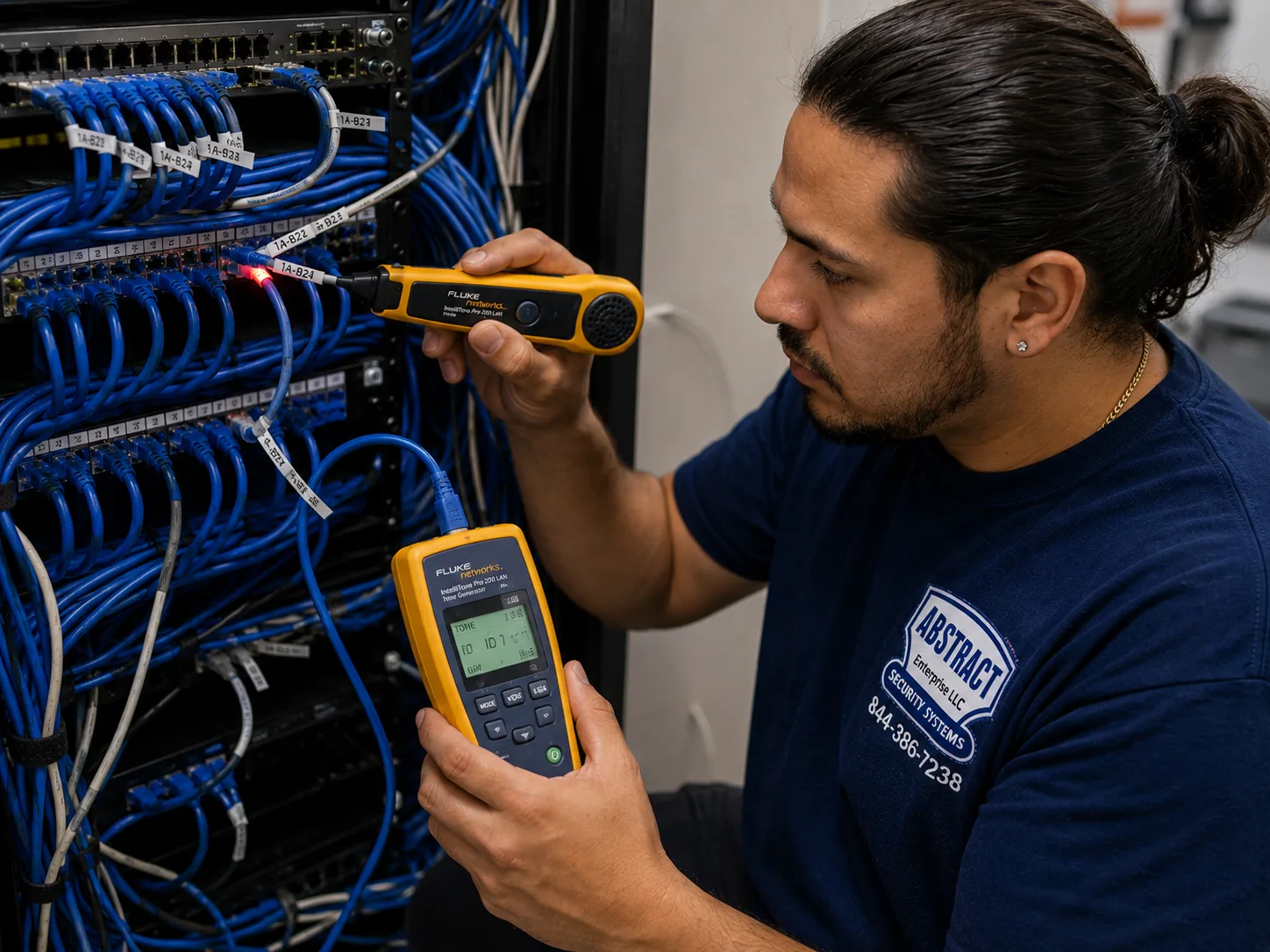
Photo from the AESS job library, not taken in the Hudson Valley: a technician tracing an unidentified cable at a patch panel with a tone generator and probe. When a Hudson Valley property already has an old camera at the drive and nobody knows which cable feeds it, this is how we find it before deciding whether to re-tune that camera or replace it.
Equipment
Types of Capture Camera Installation We Install
These are the components a Hudson Valley capture camera system is built from. We choose them for the site after the walk, not before. Brands we install include Lorex, Dahua, Hikvision and Uniview, and we will work with equipment you already own if it can do the job. Installed prices by county are on our price pages.
🎯
Varifocal Plate Capture Cameras
Cameras with optical zoom that can be narrowed to the plate at one chosen point, with adjustable shutter and exposure so moving, reflective plates stay readable under headlights.
🖼
Overview Cameras
Wide cameras that record the vehicle, its color and direction, and the people who get out, so the plate can be tied to what happened.
🔦
Infrared Illumination
Built-in or separate infrared aimed at the capture point for unlit country entrances, set so it does not flare off the plate.
💾
Network Video Recorders
Recorders sized for full-quality capture streams and a retention period you choose, kept indoors and dry, with export to a USB drive or the app.
🔌
PoE Switches and Extenders
Power and data over one cable to each camera, with extenders where a run approaches the 328-foot Ethernet limit.
📶
Fiber and Wireless Bridges
Fiber for long farm and estate runs, and point-to-point wireless links where trenching is not wanted, planned for line of sight in leaf season.
📦
Enclosures, Posts and Conduit
Weatherproof junction boxes, mounting posts at the drive, and outdoor-rated conduit for runs along fences, walls and trenches.
🔋
Battery Backup
UPS units for the recorder, switch and router, chosen for how long the property needs to keep recording through an outage.
💻
Plate Recognition Software
Optional software that turns capture images into searchable text and alerts, for HOA gates, business lots and docks that need it.
National security brands vs a local licensed installer
People sometimes ask whether a national company would be simpler. ADT is best known for monitored alarm systems, and Ring and SimpliSafe for doorbells, cameras and kits that owners can install themselves. Those products can be a good fit for a porch or a front door. A plate capture camera is a different job: it depends on finding the right point on a specific driveway, mounting low and close, tuning the camera with real cars at night, and getting power and network to an entrance that may be hundreds of feet from the house. That takes someone standing on your drive with a laptop, not a kit in a box. If you already have a doorbell camera from one of those brands, it can stay; a capture camera at the entrance complements it.
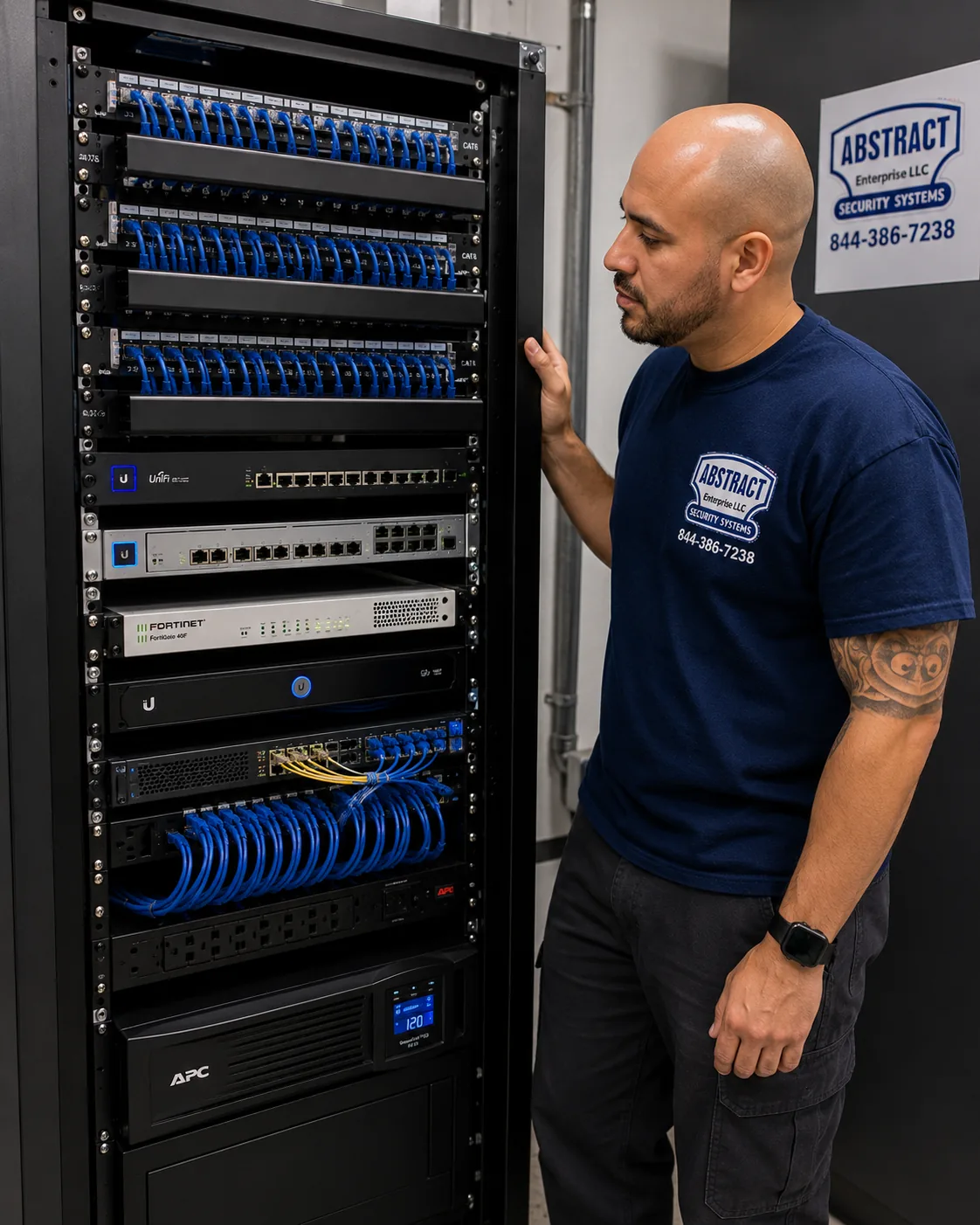
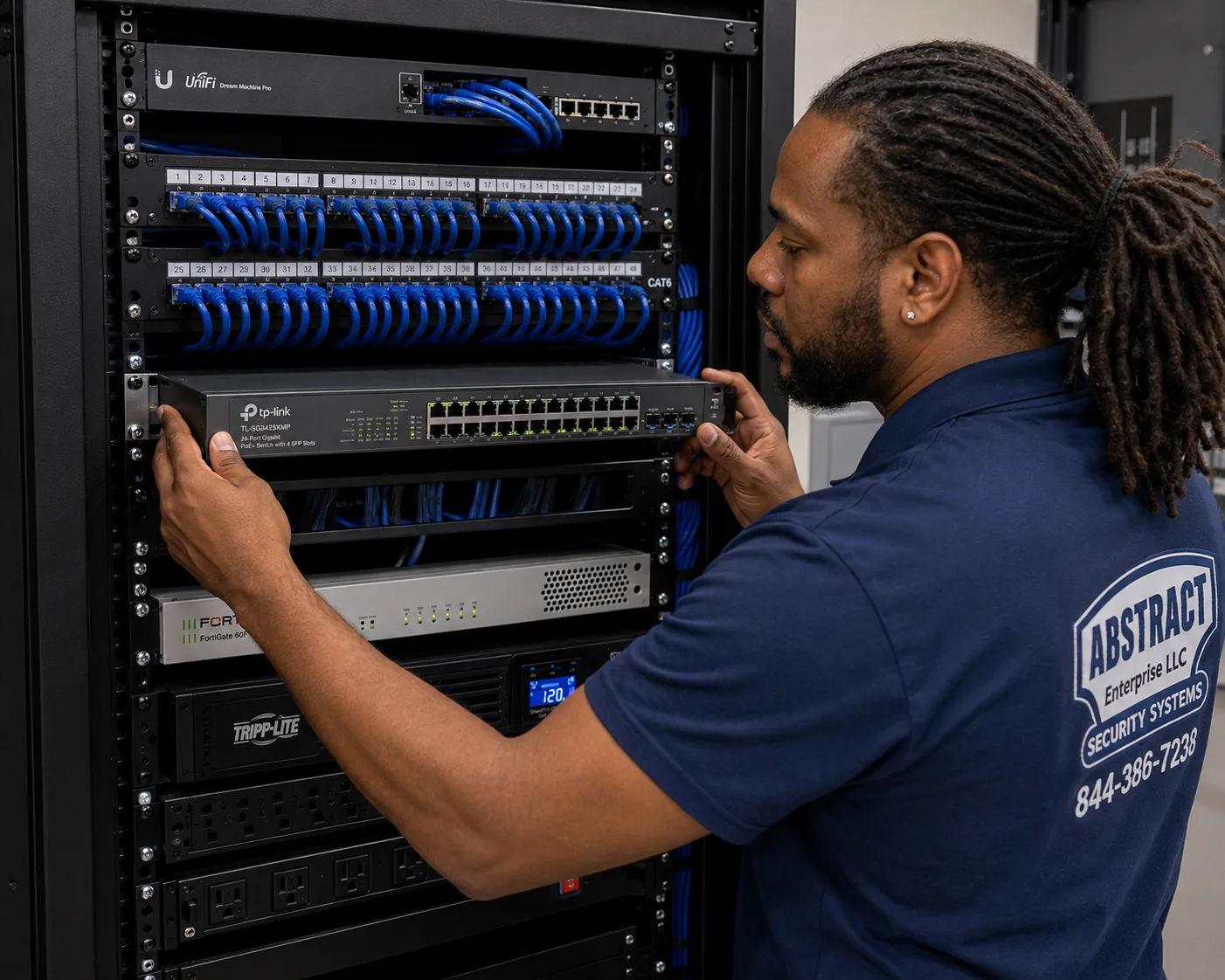
Photo from the AESS job library, not taken in the Hudson Valley: a finished rack with patch panels, switching, a firewall and battery backup, dressed and labelled. A larger Hudson Valley site, such as a business lot or an estate with several gate and dock cameras, ends up with a smaller version of this, with the battery backup in the bottom of the rack to carry the system through a storm outage.Photo from the AESS job library, not taken in the Hudson Valley: a technician mounting a managed PoE switch beneath patch panels in a commercial rack. This is the box that sends power and data down a single cable to each plate camera, which is often how we avoid new line-voltage power at a Hudson Valley gate.
AI Overview Reality Check
What AI Gets Wrong About Capture Camera Installation in the Hudson Valley
We could not capture Google's AI Overview for this topic from our build environment, so we will not pretend to quote it. What follows are claims we see repeated in quick online answers and cost guides about plate cameras and home security in general, set against the public record for this region and our own field practice. Marketplaces such as Angi, HomeAdvisor and Fixr publish national cost guides that feed many of those answers. They are useful for a rough idea; they are not a plan for a gravel drive in Dutchess.
"Any 4K camera can read license plates."
Resolution is the claim that sells cameras, and it is the one that most often disappoints at a Hudson Valley entrance. A 4K camera with a wide lens spreads its pixels across a whole yard, and a plate fifty feet away still ends up a small, soft rectangle.
What reads plates is a narrow field of view at a chosen point, a fast shutter so the plate does not smear, and exposure held down so the reflective surface does not glow. Those are the features capture cameras are built around, and CCTV Camera Pros treats capture as its own camera type for that reason.
We have seen footage from high-resolution cameras where the car is sharp and the plate is unreadable. A modest-resolution camera aimed and tuned properly at a slow point usually beats it.
"Mount it high so nobody can reach it."
Height protects a camera from tampering, which is why most security cameras go under eaves. For plates, height is the enemy. The guidance we cited earlier keeps the downward angle within about 30 degrees and puts the camera only a few feet above headlight level.
A camera on the second-floor corner of a farmhouse looking down a drive meets plates at a steep angle, where the raised characters and reflective film blur together.
The practical answer on a country property is a sturdy post or pillar close to the drive, with the camera in a vandal-resistant housing and the cable in conduit, so it is low enough to read plates and solid enough to survive a bump.
"Wi-Fi cameras are fine anywhere now."
Wi-Fi cameras are fine near the router. A gate several hundred feet down a wooded drive is usually beyond reliable Wi-Fi, and summer leaves make it worse. Many rural Hudson Valley homes also have limited internet upload, which caps how much video can leave the property.
The Long Island and Queens case reported in 2022, where a burglar was believed to use a Wi-Fi jamming device, is a reminder that a camera relying on Wi-Fi has a single weak link that a wired camera does not.
For capture cameras we prefer a wired connection or fiber, and where that is impractical, a dedicated point-to-point wireless bridge aimed between two fixed points, not the household Wi-Fi.
"A battery or solar camera removes the need for wiring."
Battery and solar cameras work for occasional clips of a porch. Plate capture usually needs continuous recording or fast triggering at a moment when the car is in exactly the right place, which drains batteries quickly.
Cold matters too. Google's own support pages for Nest cameras say that between minus 4 and 32 degrees Fahrenheit the battery can still power the device but will not charge, and that a solar accessory only charges the battery. Hudson Valley winters spend long stretches in that range, often with short, cloudy days in the woods.
Where wired power truly cannot reach, we look at it case by case and tell you plainly what the camera will and will not catch in January.
"Plate cameras are basically unregulated."
One Long Island lawyer described that island's public plate-reader network as having essentially no statutory framework, and that may be how it felt. But private camera installation in New York is regulated: under 19 NYCRR 195.2, paid installation of cameras that monitor intrusion, theft or movement requires a state security installer license, and county and town rules govern any electrical work.
The rules on plate data are also moving. A563A passed both houses in 2026 to set standards for non-government users, and Senator Hinchey's bill would ban selling plate data to private entities. Ulster County announced it would look at a policy on plate-reader data.
For a private owner, the sensible response is to act as if those standards are coming: aim narrowly, keep data only as long as needed, and know who has access.
"Professional installation costs the same everywhere in New York."
National cost guides tend to give one range, and quick answers repeat it. Our own area rates are not the same across the region: 1.25 times our base in Westchester rising to 1.53 in Dutchess and Ulster, because travel and access change the work.
Within a county, the site moves the price more than anything else. A camera thirty feet from a garage and a camera at a gate reached only by fiber are not the same job.
That is why our county price pages list each line separately and why we quote after walking the approach, instead of giving a single figure over the phone.
"Once it's installed, it takes care of itself."
This is the claim behind the Orange County business owner News 12 quoted, who had never looked at his camera and did not know the password. A camera that has not been checked since installation may be recording the wrong thing, may have a full drive, or may have stopped after a power cut.
Hudson Valley conditions add to that: storms, outages like the nor'easter Central Hudson reported in September 2026, branches that grow into a view, and snow on a lens.
At handover we show the owner how to find and export a clip, leave the passwords in the owner's hands, and recommend checking the entrance camera after every major storm and when the leaves come in each spring.
Ready to Find the Right Spot? Talk to a Technician About Your Entrance
Send a short video of a car coming up your drive, a photo of the entrance at night and the town you are in, and a technician will tell you where a capture camera would go, how the cable would reach it, and which county price page applies. Call (800) 486-0943, message us on WhatsApp, or use the quick form.
Every Hudson Valley capture camera job follows the same eight steps, from a single camera at a suburban garage to several lanes at a business entrance. The order matters most on long, rural approaches, where a camera placed before the walk is the usual reason plates come out unreadable.
1. Send photos, the address and the goal
Photos of the drive, gate or lot entrance, the town and county, and whether you need plates, faces at a gate, or both. We match the job to the right county price page and book within two hours of your request.
2. Walk the approach
On site we walk in from the road, measure setback, and note slopes, curves, trees and lighting, to find the narrow spot where every vehicle slows and travels straight.
3. Check rules before drilling
Historic-district review in Kingston, Hudson, Beacon or Newburgh, HOA or board approval for shared gates, landlord consent for rentals, and who handles any line-voltage work.
4. Set the mounting point and angles
Plate camera low and close, within about 15 degrees off to the side and 30 degrees down, with an overview camera placed to record the whole vehicle and scene.
5. Run and protect the cable
Outdoor-rated cable in conduit, along fences or trenched, or over fiber or a wireless bridge past 328 feet, with every wall entry sealed.
6. Tune for day and night
Zoom and focus on the capture point, then shutter, exposure and infrared adjusted with real cars at normal speed, in daylight and after dark.
7. Set recording, retention and remote viewing
Recorder, motion zones, retention period and app access configured, battery backup added, and recovery tested with the power switched off.
8. Hand over and document
We show you how to find and export a plate clip, leave a written record of cameras, settings and passwords with you, and go over your data and sharing choices.
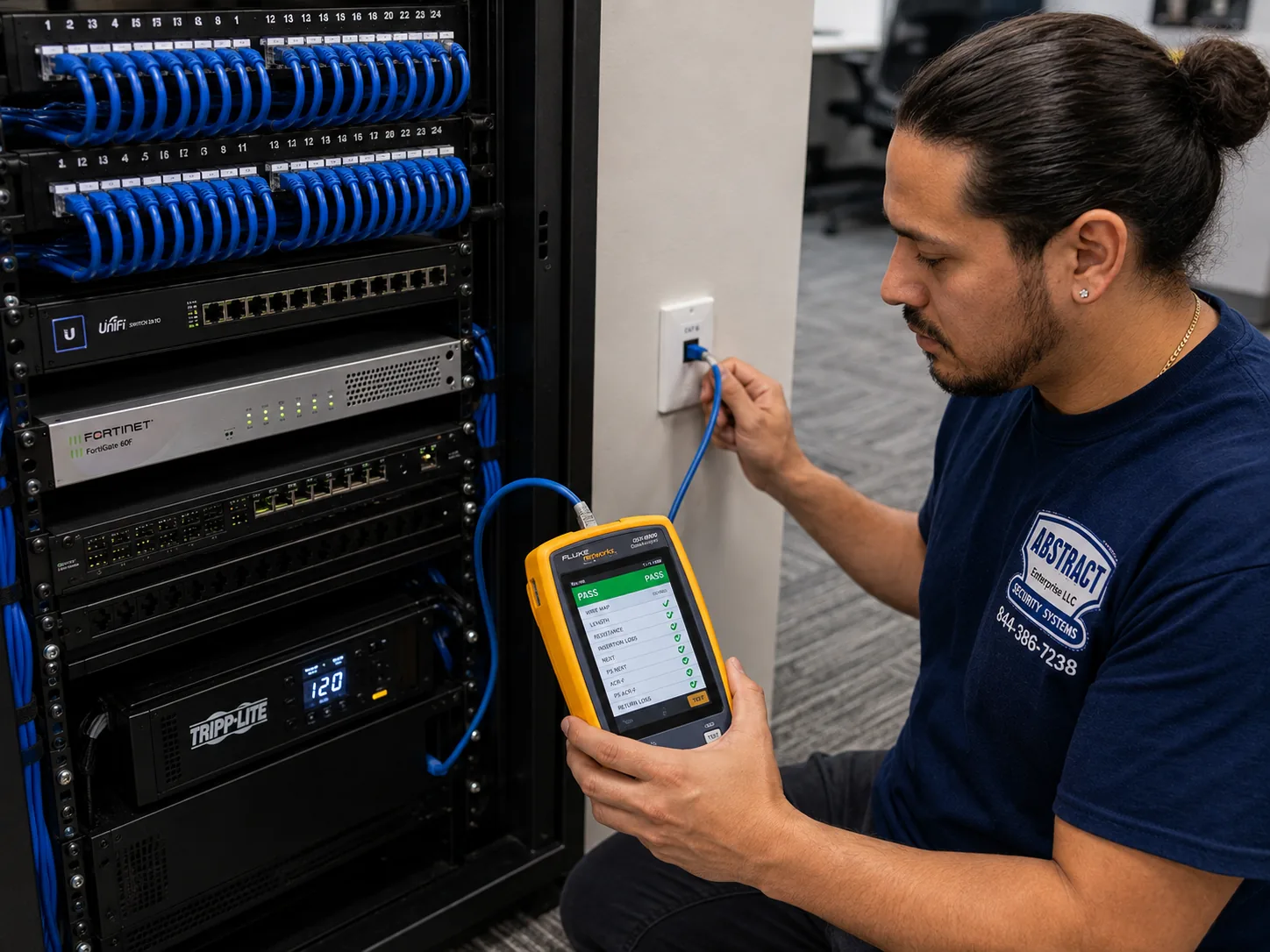
Photo from the AESS job library, not taken in the Hudson Valley: a technician certifying a data drop with a cable analyzer that shows a PASS result. On a long run out to a Hudson Valley gate, close to the Ethernet distance limit, a test like this before the camera goes up tells us the cable will carry full-quality video and power, not just a picture on the first day.
Coverage Area
Capture Camera Installation Near the Hudson Valley's Landmarks
Across a six-county region, people give directions by landmarks more than streets. These are the ones we use when we plan a route, along with what local sources say about them.
Walkway Over the Hudson
Opened in 1888 as a rail bridge, 212 feet tall and 1.28 miles long between Poughkeepsie and Highland, and described as the longest elevated pedestrian bridge.
Dia Beacon
The 1929 Nabisco box-printing factory in Beacon, nearly 300,000 square feet of brick, steel, concrete and glass, now an art museum.
Kingston Stockade District
The mid-17th-century Dutch settlement of Wiltwyck, a National Historic Landmark with colonial Dutch stone houses on all four corners at Crown and John Streets.
Storm King Art Center
A 500-acre outdoor museum at 1 Museum Road in New Windsor, Orange County.
Newburgh East End Historic District
About 445 acres of Federal, Italianate and Greek Revival row houses, with the stone house that served as Washington's Headquarters in 1782 and 1783.
Palisades Center
The West Nyack mall in Rockland County, proposed at 875,000 square feet, among the region's largest parking fields.
Capture Camera Installation Cost in the Hudson Valley
Every Hudson Valley address is priced at the rate for its county, and the county is the one on your tax bill, not necessarily the one your mailing town suggests. The table shows how our area rates compare with our base. The item-by-item installed prices for each county are on the price pages linked in the right-hand column; we do not quote numbers that are not on those lists.
County
Area rate vs our base
Typical capture camera sites
Price page
Westchester
1.25×
Suburban drives, community entrances, older estates
Past about 328 feet, Ethernet alone will not reach
PoE extender, fiber or a wireless bridge, priced as separate lines
Power at the entrance
No power means PoE from the house or new electrical work
PoE where possible; licensed electrician where required
Number of lanes and directions
Each lane, and arrivals versus departures, may need its own capture camera
We count lanes with you and price each camera
Mounting surface
Posts, stone pillars, brick, block and siding take different fixings
Masonry anchors, new posts or enclosures as the site needs
Pathway outdoors
Trenching, conduit along a fence or an aerial run take different time
We agree the route on the walk before quoting
Historic or board review
Applications and meetings add time before work can start
We prepare product details and photos for the application
Recognition software
Only needed where plates must be searched or trigger a gate
Quoted separately, never bundled by default
Battery backup
Sized to how long the property must record through an outage
Chosen on the walk from what the owner needs
How a quote is put together
After the walk you receive a written quote that names each camera and its mounting point, the cable or link to it, the recorder and storage, any battery backup, any work by a licensed electrician, and the setup and handover. Nothing is added on the day without your agreement. If something unexpected turns up, such as a buried line where we planned to trench or a stone pillar too crumbly to hold a bracket, we stop, show you, and agree the change before we carry on.
Full terms — including 50% deposit, one-year parts-only warranty on AESS-supplied products, and the late-fee schedule — are set out in the service agreement.
Shop Our Systems
Capture Camera Installation Packages & Pricing
Three common Hudson Valley setups, described by what they include. Installed prices for each county are on that county's price page; the Hudson Valley overview is on our Hudson Valley capture camera price page.
Starter: Suburban Driveway
One plate capture camera at the throat of a short drive and one overview camera at the garage, both wired back to a recorder in the house, with app access and a battery backup for the recorder. Suits the colonials and ranches of Westchester and Rockland where the drive is close to the house.
Standard: Long Drive or Farm Gate
A capture camera and an overview camera at an entrance well away from the house, reached by fiber, a PoE extender or a point-to-point wireless bridge, with a weatherproof enclosure at the gate, battery backup on the recorder, switch and router, and remote viewing sized for the property's internet.
Premium: Community or Business Entrance
A capture camera per lane in and out, overview coverage of the entrance and lot, a recorder sized for the retention period in your written policy, optional plate recognition software for search and alerts, and access set up for named board members or managers.
Bring your own equipment
If you already own a camera with optical zoom and adjustable shutter, or a recorder in good condition, we can install and tune it at labor rates from the county price page, provided it can actually do the job at your capture point. We check the model, its settings and its firmware before it goes up. If it cannot read plates at your entrance, we say so, show you on a test, and suggest keeping it as an overview camera instead.
Complete Services
Every Capture Camera Installation Service in the Hudson Valley
Send a video of a car coming up your drive and we will match it to the right county list. Request a free quote
FAQ
Hudson Valley Capture Camera Installation FAQ
Does the person installing my plate camera in New York need a state license?
+
Yes, if they are paid to install cameras used to detect or monitor intrusion, theft or movement. Under 19 NYCRR 195.2 that is security installer work requiring a license from the NYS Department of State, and the state says even master electricians must file to do it. AESS holds NYS license #12000287431. Ask any installer for their license number before work starts.
Will my town make me get a building permit for a capture camera?
+
A low-voltage camera on its own usually does not need a building permit, but three things can change that: new line-voltage electrical work at the gate, which many towns require to be permitted and inspected; a location inside a historic district such as Kingston, Hudson or Beacon, where exterior work may need a certificate of appropriateness first; and a new post or structure near a road that a town may regulate. We check the specific town before we start.
Can a landlord put plate cameras on the parking lot of an apartment building in the Hudson Valley?
+
Generally yes, in shared outdoor areas such as a lot entrance, as long as the cameras do not look into apartments and do not record audio. Tenants should be told the lot is under video surveillance. Because the landlord collects plates from many tenants and visitors, a short written policy on retention and access is wise, especially with state plate-reader standards under way.
Is a video call box at our gate covered by the same state license as the cameras?
+
It can be. A law firm that advises the alarm trade, Kirschenbaum and Kirschenbaum, has written that whether a video access or intercom system needs the NYS security installer license depends on whether it is used to detect or monitor intrusion or movement. A gate unit that records visitors and plates usually falls on the security side. We install both under the same license, so the question does not hold up your job.
What can I do if a neighbor's camera looks straight into my backyard?
+
Start by talking to them, since many cameras are aimed carelessly rather than deliberately. New York Civil Rights Law 52-a lets an owner or tenant sue someone who puts a camera on adjoining property to record backyard recreation without consent and with intent to harass. For your own camera, we aim at your drive and entrance only, so it never puts you on the other side of that law.
Will our home network need work before a capture camera goes in?
+
Often a little. Yelp's related searches for camera installation in Poughkeepsie include home network installation for a reason: cameras depend on the router, switch and cabling behind them. We check that the recorder has a stable wired connection, that the router will survive an outage on battery backup, and that remote viewing will not swamp a limited rural upload. Any network changes appear on the quote.
How can we tell whether an installer will finish the job properly?
+
Read what local customers praise and complain about. One Poughkeepsie-area Yelp review praised an install where the wiring was neatly concealed and the system worked flawlessly, while a one-star review of a Wappingers Falls company complained a sensor was never connected and was simply tucked into the wall. Ask for a walkthrough at the end, a test with a real car, and the passwords in your hands before the installer leaves.
Will a camera at the gate survive a hard Hudson Valley winter?
+
A wired outdoor camera rated for the cold generally does; many outdoor models are rated down to about minus 4 degrees Fahrenheit. What fails in winter is usually power and access: batteries that will not charge below freezing, snow drifting over a low lens, and ice on the enclosure. We use wired power, choose housings with hoods, and place the camera where a plow will not bury it.
Can I see who pulled into my second home from my apartment in the city?
+
Yes, if the property has a working internet connection. We set the app to show a lighter stream for viewing and keep full-quality recording on the recorder at the house, which matters on fixed wireless, satellite or cellular service. Alerts can be limited to the entrance zone so you hear about vehicles at the gate without being woken by wind or wildlife.
How long should a homeowner keep plate recordings?
+
Long enough to notice a problem and report it, and no longer than you need. For most homes that is a few weeks, which also suits recorder storage. HOAs and businesses should write their retention period into a policy. We set the recorder to overwrite automatically at the period you choose, rather than leaving the default.
Will deer and bears set off alerts at our wooded entrance all night?
+
They can if alerts are set to any motion. The DEC describes black bear range running through the Catskills, Orange and Rockland and into Putnam, and deer are everywhere. We tie alerts to vehicle or person detection and draw zones along the drive itself, so the camera still records animals but only notifies you about cars and people.
The box from a camera I already bought says Capture. Can you put it up for me?
+
Send us the model number first. We check whether it has the optical zoom and shutter control needed to read plates at your entrance, and whether it will work with a recorder. If it can do the job, we install and tune it at labor rates from your county's price page. If it cannot, we tell you before the visit and suggest where it would be useful instead.
If the State Police ask for our footage, how do we get them a clip?
+
At handover we show you how to search the recorder by date and time, play back the capture and overview cameras together, and export the clip to a USB drive or share it from the app. Note the time on the recorder against real time, since a clock that has drifted causes confusion later. You decide what to share; we do not hand footage to anyone on your behalf.
Get In Touch
Request a Free Quote
Tell us the town and county, the kind of property, and how far the entrance is from the house. A short video of a car coming up the drive makes the quote exact. Prefer to talk? Call (800) 486-0943.
✅
Request Sent!
We'll call about your Hudson Valley capture camera the same business day.
More Capture Camera Installation near Hudson Valley hub
Book Your Hudson Valley Capture Camera Installation
From a stone house in Hurley to a horse farm gate in Dutchess, a lake road in Putnam or a business lot in Rockland, the job starts the same way: a walk of the approach, the one spot where every car slows down, and an honest match to your county's price page. Call (800) 486-0943, message us on WhatsApp, or send the quote form, and we will tell you where the camera belongs before anyone drills.