See every Blink camera price in Long Island and build your own system →
Signal Tested Before Anything Is Mounted · Doorbell Power Measured, Not Guessed · Nassau and Suffolk Price Lists
Blink is sold as a do-it-yourself camera, and Blink itself offers no professional installation. That works until a Long Island property gets in the way: a detached garage eighty feet behind a Cape Cod, a concrete-block foundation between the router and the yard, a 1950s doorbell transformer that cannot feed a wired doorbell, or a January morning that drains the batteries in the side-yard camera. Census figures put more than 364,000 one-unit detached homes in Nassau and more than 463,000 in Suffolk, with median build years of 1955 and 1970. We plan a Blink system around the house you actually have, test the Wi-Fi at every spot before a screw goes in, and price the work from the Nassau or Suffolk Blink list.
Reviewed and updated November 5, 2026 by Anwar Timothy, NYS license #12000287431 · Sources: U.S. Census Bureau American Community Survey 2023 five-year estimates and 2020 census QuickFacts for Nassau and Suffolk, ny.gov county profiles, NeighborhoodScout and Homes.com profiles of Uniondale and East Garden City, Wikipedia entries for East Garden City, Roosevelt Field, Mitchel Air Force Base, Hofstra University, Stony Brook University and Brookhaven National Laboratory, Keri Murray Architecture on Levittown, Blink support articles on Sync Module range and doorbell power, Blink's renter installation guide, NerdWallet and SafeHome reviews of Blink, Trustpilot reviews of Blink, Patch Garden City (week ending September 15, 2026), News 12 Long Island, CBS New York (November 25, 2025), ABC7 New York (August 2020 and January 2024), Long Island Life & Politics, the NYS Department of Financial Services (August 2024 flooding), the Suffolk County Police SHIELD camera registry, the Garden City Police private camera registration page, the Digital Media Law Project and RecordingLaw guides to New York recording law, the Nassau County Office of Consumer Affairs, 19 NYCRR 195.2, the Town of Hempstead code, LI Herald and Long Island Press coverage of the Nassau Hub · Dispatched from 1282 Troy Ave, Brooklyn

Owner-operated since 2002 · Thousands of jobs completed · Booked within 2 hours
Blink camera installation on Long Island, done by AESS, means a technician tests the Wi-Fi at every camera spot, places the Sync Module where it can reach all of them, checks the doorbell's power, mounts each device into solid material and sets up the app, motion zones and storage before leaving. Nassau addresses are priced from our Nassau County Blink price list and Suffolk addresses from the Suffolk County Blink price list; the full island-wide list is on our Long Island Blink price page. Requests are booked within 2 hours. Call (800) 486-0943 or use the form.
Long Island is not one neighborhood but two counties stitched together by parkways, and a Blink camera behaves differently in almost every corner of it. The state's own county profiles describe Nassau as two cities, three towns, 64 incorporated villages and more than 60 unincorporated hamlets packed into 453 square miles, and Suffolk as ten towns spread across 2,373 square miles. The 2020 census counted 1,395,774 people in Nassau and 1,525,920 in Suffolk. This page is the hub for both. When we use one place as a close-up example, it is usually the Nassau Hub, the stretch of Uniondale and East Garden City around the Nassau Coliseum on Hempstead Turnpike, because its mix of postwar houses, apartment complexes, office towers and one of the busiest retail strips on the island captures most of what a Blink job on Long Island can involve. But the same questions come up in a Levittown ranch, a Smithtown colonial, a Long Beach condo and a seasonal house on the East End, and we have written this page so each of them gets a straight answer.
Start with the houses, because they decide almost everything about a wireless camera. The U.S. Census Bureau's 2023 American Community Survey five-year estimates count 477,860 housing units in Nassau, of which 364,529 are one-unit detached houses, and 579,790 units in Suffolk, of which 463,095 are detached. The median home in Nassau was built in 1955; the median home in Suffolk in 1970. Levittown is the textbook case of the older stock: Keri Murray Architecture records 17,447 homes built there between 1947 and 1951, ranch houses on concrete slabs with expandable attics, hot-water radiant heating pipes in the floor and no garage. A Newsday analysis of nearly 12,000 home sales in 2026, quoted in a Newsday post, found that more than 5,000 of the houses sold had been built in the 1950s and 1960s. Those are the homes people buy Blink for. They are finished, lived in and often already renovated, and nobody wants to open their walls to run camera cable. A battery camera on a bracket, a plug-in camera on a shelf and a doorbell that uses the old doorbell wires look like the obvious answer, and very often they are.
The catch is that those same houses put real obstacles between a Blink camera and the box that talks to it. Most Blink outdoor cameras and the Blink battery doorbell do not connect straight to your Wi-Fi; Blink's own support pages say the Outdoor 2K+ and the Battery Doorbell 2K+ need a Sync Module, a small hub that plugs in indoors and relays the cameras to the router. Blink states that its Sync Modules can communicate with cameras up to 100 feet away, and it tells owners to keep the module away from thick walls and from concrete, brick, stone and metal. In real use the distance is shorter. SafeHome's review of Blink reported a strong connection only within about 70 to 80 feet once walls and obstacles were in the way. A Long Island lot puts all of those obstacles in a row: a router in a finished basement behind a concrete-block foundation, a kitchen full of appliances, an exterior wall, a driveway, and a detached garage at the far end.
The Nassau Hub shows how common that layout is. NeighborhoodScout reports that single-family detached homes make up 69.74 percent of Uniondale's housing units and that 55.45 percent of its housing was built between the 1940s and the 1960s. Homes.com describes the area as divided by the Hempstead-Bethpage Turnpike, with East Garden City to the north busy with commerce and condos, townhouses and apartments, and the southern part mostly single-family homes, Cape Cods and minimal traditionals, often with detached garages and private driveways. NeighborhoodScout also counts 19.83 percent of Uniondale's homes in large apartment complexes or high-rises and puts ownership at 62.02 percent, with 37.98 percent renting. In plain terms: a lot of Long Island households want a camera on a garage that sits well beyond the Sync Module's comfortable range, and a lot of renters want cameras they can put up without upsetting a landlord or losing a deposit. Both situations are where a technician earns his keep on a product that is sold as do-it-yourself.
Then there is the reason people buy the cameras in the first place. In its police report for the week ending September 15, 2026, Patch Garden City listed a resident who reported packages taken from the front porch of the home, with detectives investigating, and in the same report noted that detectives were looking into damage to a Flock license-plate camera on Clinton Road. News 12 Long Island ran doorbell-camera video of a thief taking a package off a porch in Massapequa Park mid-delivery. CBS New York reported on November 25, 2025 that the Suffolk District Attorney had charged 14 men in a porch-theft ring that worked 31 communities, including Brentwood, Central Islip, Shirley and Deer Park, between October 2023 and February 2025, allegedly hacking into systems to learn when Verizon and AT&T devices were being delivered and taking more than 200 phones and tablets. ABC7 New York reported a Central Islip man caught on video using a knife to destroy a doorbell camera at a home. And Long Island Life & Politics reported that Nassau burglaries rose 5 percent, from 234 to 245, in January through May of 2026 compared with the same months of 2025, even while overall property crime fell. Back in January 2024, ABC7 quoted police in a multi-agency burglary task force saying the burglars were attracted by cars in people's driveways.
Weather is the other Long Island factor, and it hits a battery-and-Wi-Fi system in particular ways. When Tropical Storm Isaias came through in August 2020, ABC7 reported almost half of PSEG Long Island's 1.1 million customers in the dark at the peak. A battery camera keeps its charge in an outage, but the router and the Sync Module plugged into the wall do not, so the cameras have nothing to report to. In August 2024 the state Department of Financial Services described the first-ever flash flood emergency for Suffolk County, the failure of the Stony Brook Mill Pond dam and flood damage to more than 2,000 residents and business owners. Winters are the quieter problem. A battery seller's guide notes that cold weather, weak Wi-Fi signal and frequent alerts all reduce battery performance, and that lithium batteries hold their output across a far wider temperature range than alkaline cells. A camera on the north side of a house, aimed at a busy street, on the edge of the Sync Module's range, in February, is the camera whose batteries die first.
Finally, the rules, which are not the city's rules. Long Island has no HPD, no 311, no Department of Buildings and no Landmarks Preservation Commission; those are New York City agencies, and none of their data applies to a house in Hicksville or a shop in Patchogue. Permits come from the town, village or city where the property sits. New York's recording law is the same island-wide: the Digital Media Law Project describes it as a one-party consent law, and New York Penal Law section 250.45 makes recording video inside a bathroom, bedroom, changing room or hotel room without the occupant's consent a class E felony. Police camera registries are local: the Suffolk County Police SHIELD program lets residents and businesses register the location of their cameras, and the Garden City Police run their own voluntary registry. We explain all of this below, plainly, because it affects where we point your cameras and how we set their audio.
We also want to be honest about what our research could not find. We searched for Reddit threads, Yelp reviews and local news about Blink installations specifically on Long Island and found none. We could not view Google's People Also Ask boxes, its related searches, AnswerThePublic, Bing or DuckDuckGo from our build environment, so the questions on this page come from installer and manufacturer FAQ pages, legal guides and forum threads, labelled for what they are. We found no Long Island study of how often Blink cameras fail or drop offline. Where this page says what we expect to find on a property, it is drawing on the building types in the public record and on how wireless cameras behave in houses of that age generally, not on a survey of Long Island homes. The only way to know your signal is to stand at each spot and measure it, which is the first thing we do.
What owners often add once the cameras are up. After a Long Island house has a Blink doorbell and a couple of outdoor cameras working, the next request is usually reach: a camera on the garage or the back gate that the Wi-Fi could not cover the first time. Sometimes that means moving the Sync Module or adding a second one; sometimes it means improving the Wi-Fi itself. Say so when booking, so we bring what that part of the property is likely to need rather than coming back a second day.

The Blink calls we move on first are the ones where something has already gone wrong: a doorbell that went dark after a storm, a garage camera that has been offline for a week, clips that stopped saving, or a theft or break-in where you need to know whether the cameras caught it. If you think a crime was recorded, do not delete or reset anything; save what the app shows and call the police in your area, which is Nassau County Police, Suffolk County Police or your village's own department. Then call (800) 486-0943 and tell us which devices are offline, when they last worked and whether the power or internet went out. Requests are booked within 2 hours, and we will tell you honestly whether the fix is a setting, a battery, the Sync Module's position or the Wi-Fi itself.
Almost every Blink problem we expect on Long Island comes back to one measurement: how far, and through what, each camera has to reach to get to the Sync Module, and how far the Sync Module has to reach to get to the router. Blink publishes the outer limit; SafeHome's testing gives a more realistic one. Everything between the camera and the module cuts into that distance, and Long Island houses are full of things that cut into it. The table pairs common property types from the public record with what usually stands in the signal's way and the approach we start from. The last column is our working plan, not a fact about any particular house; we confirm every spot with a live reading on site.
| Property | From the public record | What gets in the signal's way | Where we usually start |
|---|---|---|---|
| Slab ranch, late 1940s | Levittown: 17,447 homes built 1947–1951 on concrete slabs, no garage | Few walls, but the router is often in a back bedroom or by the TV at one end | Sync Module near the middle of the house, cameras on the eaves at the front and back |
| Cape Cod with detached garage | Uniondale's southern streets: Cape Cods and minimal traditionals with detached garages and private driveways | Exterior walls of both buildings, the driveway distance, car bodies parked between | Signal reading at the garage first; module on the side of the house facing the garage |
| Split-level or hi-ranch | Common on postwar streets across Nassau and western Suffolk | Half-floors, a block-walled lower level and the router often downstairs | Module on the main level, not beside a lower-level router |
| 1970s two-story colonial | Suffolk's median home was built in 1970 | Longer runs to the back yard, attached garages with metal doors | Doorbell checked for power; garage camera tested through the metal door |
| Condo or townhouse | East Garden City's condos and townhouses; complexes across the island | Neighbors' Wi-Fi on the same channels, shared walls, association rules | Indoor Mini cameras on your own Wi-Fi; exterior devices only where the association allows |
| Waterfront or seasonal home | South Shore and East End houses that sit empty for weeks | Internet service paused or unreliable off-season, salt air, storms | A plan for what happens when the house is closed, decided before mounting |
The single most common reason we expect a Long Island Blink owner to call is a camera on a detached garage that works for a day and then keeps going offline. It is a distance problem dressed up as a camera problem. A Cape Cod on a typical lot might put the garage sixty or eighty feet behind the house, which is already at or past the strong-connection range SafeHome measured, and the signal has to pass through the house's back wall, the garage wall and whatever is parked between. A battery camera on the edge of range also works harder: it retries, it wakes up more, and its batteries drain faster. Blink's own support guidance is that a second Sync Module can help cameras with weak signal. Sometimes that is the answer. Sometimes the better answer is moving the existing module to the back of the house, into a window that looks at the garage. And sometimes the Wi-Fi itself does not reach the back of the house well enough to feed a module there, in which case the real fix is better Wi-Fi. We take a reading at the garage before we mount anything there, so you know which of those three you need before you pay for it.
A lot of Long Island routers live in the basement, where the cable line comes in. A restoration contractor working in Uniondale describes the local Cape Cods and ranches as sitting on concrete-block foundations, with basements finished in the 1960s and 1970s. Blink tells owners to keep the Sync Module away from concrete, brick and stone, and a block foundation is all three of those in one wall. A Sync Module sitting next to a basement router may have a perfectly good connection to the router and a poor one to every outdoor camera. We almost always move the module upstairs, to a spot with a clear path to the outside walls the cameras are on, and confirm the module still connects well to the router from there. The same contractor's warning that postwar Capes and ranches frequently contain asbestos materials is one reason we avoid drilling into old basement walls and ceilings unless there is no other choice, and why a Blink system, which rarely needs any interior drilling at all, suits these houses so well.
Blink's guidance names metal as a signal blocker, and a blog on Blink doorbells notes that obstructions such as walls, brick and metal doors both shorten the Sync Module's range and increase battery drain. On a 1970s colonial with an attached garage and a steel overhead door, a camera inside the garage aimed at the door may struggle more than one outside on the eave. On a house with a steel front entry door, a battery doorbell mounted on the frame can be fighting the door itself. We test those spots specifically, and where the reading is poor we look at mounting a few inches away on wood trim, moving the Sync Module or switching a doorbell to wired power if the house allows it.
In the condos, townhouses and apartment complexes of East Garden City and across the island, distance is rarely the issue; the issue is how many other networks share the air. A Blink Mini 2K+, which Blink says connects directly to Wi-Fi without a Sync Module, has to compete with every router through the walls. We look at how crowded the neighborhood's Wi-Fi is, where your router sits relative to the camera and whether your router's settings are helping or hurting, and we tell you plainly if the problem is the router rather than the camera. Exterior cameras on a condo or townhouse are also an association question before they are a technical one, which we cover in the building section below.

The time lost on a Blink job is usually lost before the first camera goes up: a kit bought without a Sync Module, a doorbell transformer nobody has looked at in decades, a router in a basement corner, or a Blink account set up under an email nobody remembers. A few minutes with your phone prevents most of it. Please do not take apart the doorbell chime or open the electrical panel yourself; just look, photograph and send us what you find.
| What to check | Why it matters on Long Island | What to send us |
|---|---|---|
| Which Blink devices you have | Mini cameras use your Wi-Fi directly; outdoor cameras and the battery doorbell need a Sync Module | A photo of the boxes or the model names in the app |
| Where the router is | Basement routers behind block foundations are the most common cause of weak outdoor signal | Which floor and which side of the house |
| Distance to the farthest camera spot | Detached garages and back fences often sit beyond the strong-connection range | A rough pace count from the back door to the garage or fence |
| Your doorbell chime | Postwar houses may still have their original transformer and chime | A photo of the chime box on the wall with its cover on |
| What the walls are made of outside | Vinyl, wood shingle, brick and stucco each take different fixings | A photo of the wall under each planned camera |
| Who owns the property | Renters, condo owners and association members may need written permission | Whether you own, rent or belong to an association |
| Your Blink account | We set up the system on your account, not ours | Confirmation you can log in, or that you need a new account |
The simplest test is free. Walk out to the garage, the back gate or the side yard with your phone and see how many bars of your home Wi-Fi it shows. A phone is more sensitive than a battery camera, so if your phone struggles out there, a camera will struggle more. If your phone shows a strong signal at the garage, the job is probably a matter of Sync Module placement. If it barely holds on, the job may need better Wi-Fi at the back of the house. Either way, telling us what you saw saves a good part of the visit.
Before you think about cameras, think about events. Do you want a face at the front door, the car in the driveway overnight, a delivery on the side porch, the gate to the pool, or the back of the garage where the bikes are kept? Each answer suggests a different spot and a different camera. On a corner lot or a street with heavy foot traffic, a camera that sees the whole sidewalk will alert you every time someone walks past and drain its batteries; one aimed at the walkway and the porch gives you the deliveries and the visitors without the noise. Send us a list of what matters to you, in order, and we will match cameras to it rather than the other way around.
Blink sends clips over your internet connection, so the upload side of your plan matters. Most home plans have plenty for a handful of cameras, but a house that already streams, works from home and runs other cameras can feel it. Note the name on your router and whether it is the provider's box or one you bought. If it is more than a few years old, or it sits inside a metal cabinet or behind a TV, those details help us judge whether the router is part of the problem before we start moving cameras around.

These are the Blink jobs Long Island homeowners, renters, condo owners and small businesses book us for. Each is priced from the Blink list for your county. Where a job needs something more, such as a second Sync Module for a far garage or Wi-Fi work so the cameras can reach the router, the quote names it before you pay.
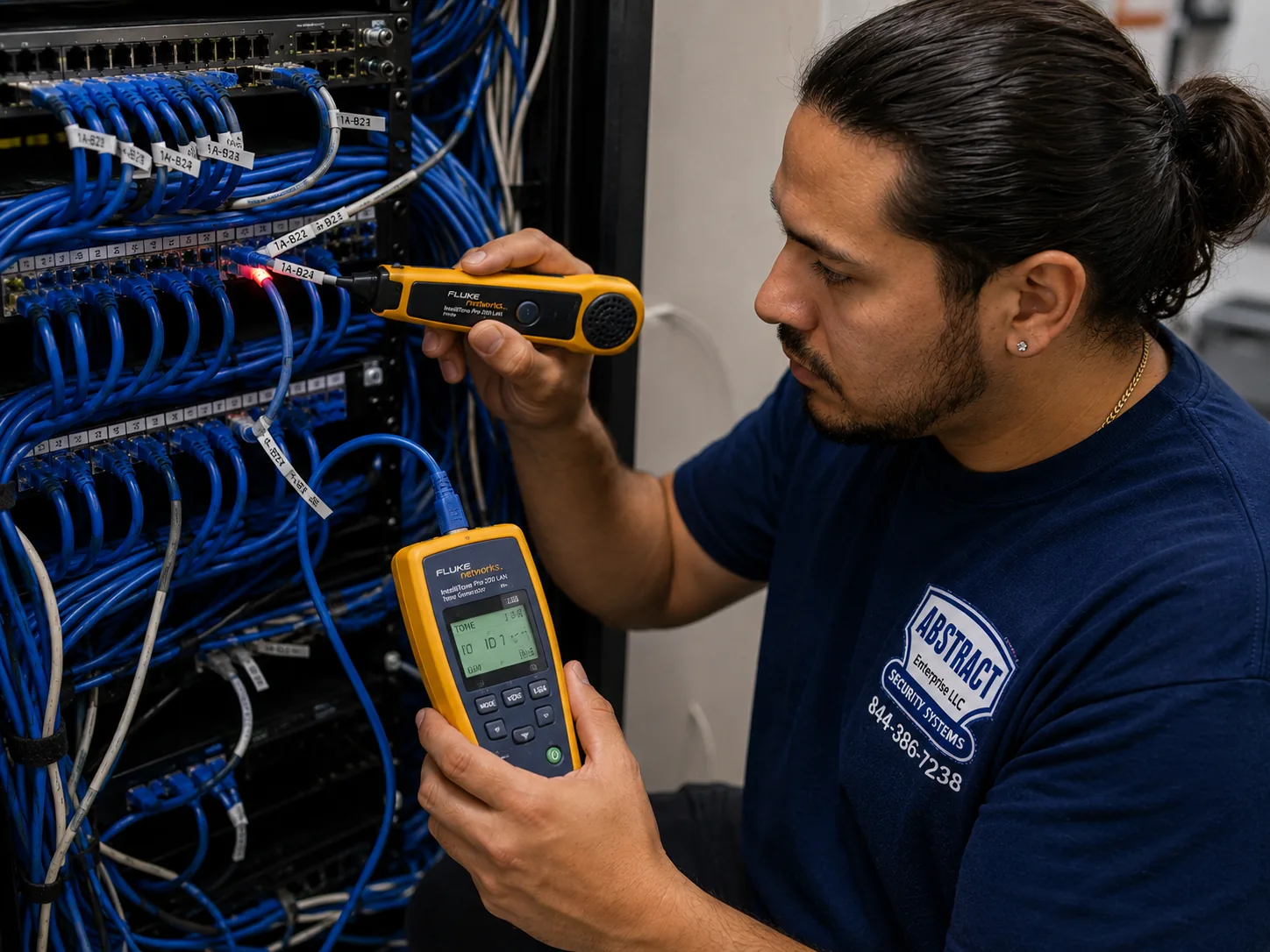
A live signal reading at every planned camera spot, then the Sync Module placed where it reaches the farthest camera with the fewest block walls, brick and metal doors in between.
Transformer and chime measured against Blink's published requirement before a wired doorbell goes up, or a battery doorbell chosen and mounted where the old wiring cannot help.
Battery outdoor cameras on eaves, porches, garages and fences, fixed into solid material with exterior-rated hardware and sheltered from direct rain wherever the angle allows.
Plug-in Blink Mini cameras for entryways, basements, back doors and offices, set on shelves or small mounts with the cords kept tidy and the privacy settings explained.
Cameras on shelves, in windows and on removable mounts for tenants who cannot make holes, matched to the door and frame you have so they actually stay put.
Existing Blink systems that drop cameras, miss events or drain batteries, diagnosed spot by spot: signal, Sync Module position, motion settings, batteries and the router.
Cloud or local storage set up the way you choose, every household phone added, alerts and schedules set so the cameras work for your routine.
Indoor and outdoor Blink cameras for small storefronts and offices, with an honest word when the space or the traffic calls for a wired camera system instead.
Cameras moved to better spots, a garage or gate camera added later, a system moved to a new house, or a second Sync Module brought in when the property outgrows one.

Long Island's houses look alike from the road and behave very differently once you try to put a wireless camera on them. Each type changes three things about a Blink job: how far the signal has to travel, what the camera is fixed to, and who has to agree before it goes up. These are the types the census, neighborhood guides and housing histories describe here, and how we handle each.
Levittown's 1947–1951 ranches on concrete slabs, with radiant heating pipes in the floor and expandable attics. One level makes signal easy; the floor is the one place we never drill.
The type Homes.com describes on Uniondale's southern streets. The house is easy; the garage at the end of the driveway is where the Sync Module's range is tested.
Half-floors and lower levels set partly into block foundations, with the router often downstairs and the cameras on the upper eaves. Module placement matters more than camera choice.
Two-story houses typical of Suffolk's newer stock, often with attached garages, steel overhead doors and longer back yards. Doorbell power is more likely to be adequate; range to the yard less so.
East Garden City's condos and townhouses and the large complexes NeighborhoodScout counts in Uniondale. Association rules come first; crowded Wi-Fi comes second.
With nearly 38 percent of Uniondale households renting, many cameras go up in homes the occupant does not own. No-drill mounts and the landlord's written agreement decide the plan.
South Shore and East End houses exposed to salt air and storms and sometimes empty for weeks. The plan covers what the cameras do when nobody is there and the internet is paused.
| Property | What holds the camera | Main signal concern | Who signs off |
|---|---|---|---|
| Slab ranch | Eave fascia and soffit framing, wood trim by the door | Router at one end of a long house | The owner |
| Cape with detached garage | House eaves and garage fascia or corner boards | Distance and two exterior walls to the garage | The owner |
| Split-level or hi-ranch | Upper eaves, porch posts, door trim | Basement router behind a block wall | The owner |
| 1970s colonial | Eaves, garage trim, porch ceiling | Long back yards and metal garage doors | The owner |
| Condo or townhouse | Indoor shelves and windows; exterior only if allowed | Crowded Wi-Fi channels | The owner and the association or board |
| Rental or two-family | No-drill mounts, shelves, window placement | Shared router or a separate one per unit | The tenant, with the landlord's written agreement for anything fixed |
| Seasonal or waterfront home | Sheltered eaves and porch ceilings, stainless hardware | Internet left on or paused off-season | The owner |
A Blink camera weighs very little, so the question is not whether a wall can hold it; it is whether the screws will stay tight through wind, frost and a thief's tug. On vinyl siding we avoid screwing through the siding panel alone, because vinyl is meant to move with the temperature; we look for the trim, the soffit or a siding mounting block that ties into the sheathing behind. On wood shingle and clapboard we fix into the sheathing and framing, not the shingle face, and we seal the screw holes. On brick, which is common on older Long Island fronts and chimneys, we drill into the brick face rather than the mortar joint and use anchors made for masonry. Stucco takes a masonry bit and slow drilling so the surface does not spall around the hole. On all of them we prefer a spot under an eave or porch roof, because Blink's own setup advice and Asurion's guide both point to sheltering outdoor cameras from direct rain and extreme temperatures where possible.
The wired Blink doorbell does not run on whatever happens to be connected to the button. Blink's support pages say the Video Doorbell needs a chime system that provides 16 to 24 volts AC at 50 to 60 hertz and 40 VA maximum. If the app shows a "Wired power not supported" message during wiring and the doorbell is not connected to a Sync Module, Blink says the existing chime wiring is not compatible, and the doorbell falls back to Event Response mode. In a house built in 1955, the transformer and chime may well be the originals, or replacements from decades ago. One homeowner selling a doorbell on eBay described having to upgrade a 35-year-old transformer to get enough power for a different brand's video doorbell. We measure first. If the transformer is within range, the doorbell goes on the old wires. If it is not, the choices are a battery doorbell, Blink's plug-in adapter for the Wired Doorbell 2K+, which Blink says provides 24 volts AC from an indoor outlet but has no battery backup, or transformer work, which may be a job for an electrician depending on where the transformer sits. We tell you which one makes sense before we start.
A house that sits empty from October to May is where people most want cameras and where Blink is most likely to let them down if nobody plans for the off-season. The East Hampton Star reported police releasing a still from a Nest camera inside one of two houses burglarized on Sammy's Beach Road in East Hampton, which is the kind of footage owners of closed-up houses hope to have. A Blink system in a closed house needs three things to stay useful: internet service that stays on all winter, a router and Sync Module on power that will come back on by itself after an outage, and batteries that can handle the cold, which a battery supplier's guide says favors lithium cells over alkaline. We ask how the house is closed down each year, whether the heat stays on, and who would check on it, and we plan the cameras around those answers. Coastal houses also face what one Long Island installer describes as salt air, humidity and storms; we use stainless hardware there and keep cameras under cover rather than on exposed corners.


Blink is a consumer camera, and we say so to every business that asks. A forum poster on Slickdeals put it fairly: Blink cameras and doorbells work best in low-traffic areas where normal wired cameras would be difficult to install. That describes a small office, a back storeroom, a quiet side door or a seasonal shop much better than it describes a busy retail floor. The corridors below are the ones named in the public record; we describe what the sources say about them, we have no information about the cameras in any particular business there, and we do not claim any of them as clients.
Wikipedia describes Roosevelt Field, at 630 Old Country Road in East Garden City, as the largest mall on Long Island, with 243 stores, built on the airfield Charles Lindbergh took off from in 1927. The strips around it are full of small tenants.
The Turnpike divides Uniondale, with East Garden City's commercial blocks to the north. The Coliseum sits at 1255 Hempstead Turnpike, on land rezoned for redevelopment in 2025, according to the Long Island Press.
The Omni at 333 Earle Ovington Boulevard, built in 1990, offers tenants key-card access across 10 floors, and RXR Plaza nearby is described as Long Island's largest office building, with two 15-story towers and a backup generator.
Spanning Farmingdale, Melville and Huntington Station, the corridor holds a dense mix of warehouse, flex, research and office buildings with Long Island Expressway access, per a regional real-estate firm.
Formerly the Hauppauge Industrial Park, described in 2017 as about 1,350 businesses in roughly eleven square miles, and renamed in 2019. Metal buildings and long floors here test any wireless camera.
Suffolk is seeking a master developer for 48 acres within a 179-acre redevelopment area between Long Island MacArthur Airport and the Ronkonkoma LIRR station, according to Government Market News.
A Blink camera wakes up when it senses motion, records a clip and goes back to sleep to save its batteries. That is exactly right for a back door that opens a few times a day, a storeroom, an office after hours or the front of a seasonal shop in winter. It is wrong for a sales floor where people walk past the camera all day, because a motion-triggered battery camera in constant traffic either drains its batteries quickly or misses the moments between clips. Blink's plug-in Mini cameras avoid the battery problem but still depend on the shop's Wi-Fi, which in a mall tenant space or a flex building on Route 110 may be crowded or weak. Trustpilot reviewers also report Blink devices going offline or failing in daily use, which a homeowner can live with and a business holding cash or stock may not. We look at the space, the traffic and what the owner needs to prove after an incident, and if a wired recorder-based system is the better tool, we say so before quoting Blink at all.
The case for good video in a small business is real. In September 2026 News 12 Long Island reported that the owner of Morning Delights in Uniondale received a motion alert from his security camera, went to the restaurant and found a burglary suspect there. We do not know what camera that owner uses and we are not claiming the job. We mention it because a motion alert to a phone is exactly what a Blink system does well, and it shows why the alert settings, the camera angle and the Wi-Fi at the back of the shop all matter as much as the camera itself.


We do not publish stories about a particular customer's house unless we can document them, so this is not a tale about one address. It is the routine our technicians follow on the kind of property Long Island is full of: a postwar Cape or ranch, a router somewhere in the basement, a doorbell that has been there for decades and a garage at the end of the driveway.
The cameras stay in their boxes. We ask you to walk the property with us and point at what you want to see, starting with the front door and ending at the farthest corner. At the front door we take the chime cover off and measure the transformer before anyone talks about doorbell models. Downstairs we find the router and note what is between it and the outside walls: block, a boiler, a metal cabinet. Then we take the Sync Module and a phone with the Blink app to each spot and read the signal, starting with the farthest, because if the garage will not connect, the plan for the whole house changes. We hold each camera where it would mount and look at its view on the phone from the ground, so you can see what it will see before a hole is drilled. Only after you have looked at every view and agreed does the first screw go in. It takes a little longer at the start, and it is the reason cameras stay online afterward.
Signal, distance and the Sync Module
It might, and the only honest way to know is to measure at the garage before mounting. Blink lists its Sync Module range at up to 100 feet, but SafeHome's testing found a strong connection only within about 70 to 80 feet once walls and obstacles were involved, and a garage at 75 feet sits right on that edge with two exterior walls in the way. We take a live reading there first. If it is strong, the camera goes up with the module where it is. If it is marginal, moving the module to a window facing the garage often solves it; Blink also says a second Sync Module can help weak cameras. If the house's Wi-Fi itself does not reach the back of the house, that has to be fixed first, and we will show you the reading so you can see why.
It depends on the model. Blink's own guidance is that the Mini 2K+ connects straight to Wi-Fi without a Sync Module, while the Outdoor 2K+ and the Battery Doorbell 2K+ need one. Many Long Island households end up with a mix: Minis indoors on the Wi-Fi and battery cameras outdoors through the module. One Sync Module serves many cameras, so you rarely need more than one unless the property is large or spread across buildings. Tell us the exact models you own or plan to buy, and we will tell you whether your kit is complete before the visit, which saves a second trip.
Very possibly. Blink tells owners to keep the Sync Module away from concrete, brick, stone and metal, and a concrete-block foundation wall puts the module, the router or both behind exactly that material. Many Cape Cods and ranches on Long Island sit on block foundations with finished basements, which is where the cable line and router usually end up. A module beside a basement router may connect well to the router and poorly to every outdoor camera. We usually move the module to the main floor, on the side of the house where the cameras are, then confirm it still talks reliably to the router. If the router itself cannot reach upstairs well, the Wi-Fi needs attention before the cameras will behave.
Power, batteries and doorbells
There is no fixed answer, because battery life depends on how often the camera wakes, how strong its signal is and how cold it gets. A battery supplier's guide notes that cold weather, weak Wi-Fi and frequent alerts all reduce battery performance, and that lithium batteries hold their output across a very wide temperature range while alkaline cells lose significant capacity in the cold. A camera on a quiet back corner with a strong signal can last a long time; one aimed at a busy sidewalk on the edge of range, in February, will need batteries far sooner. We set motion zones and sensitivity so the camera wakes for what matters, place the module so the signal is strong, and recommend lithium cells for outdoor cameras.
Only if the transformer delivers what Blink asks for. Blink's support pages say its Video Doorbell needs a chime system providing 16 to 24 volts AC at 50 to 60 hertz and 40 VA maximum, and that a "Wired power not supported" message means the existing wiring is not compatible, in which case the doorbell defaults to Event Response mode if it is not connected to a Sync Module. We measure the transformer and look at the chime before you buy or mount anything. If it is in range, the doorbell goes on the existing wires. If not, you can use a battery doorbell, Blink's plug-in adapter for the Wired Doorbell 2K+, or have the transformer replaced, which may be an electrician's job depending on where it sits.
The battery cameras keep their charge, but they need a powered Sync Module and a working internet connection to save clips to the cloud and send alerts. When Isaias hit in August 2020, ABC7 reported almost half of PSEG Long Island's 1.1 million customers without power at the peak, and in an outage like that the router and module go dark with everything else on the wall. A battery backup under the router, the module and the provider's modem can keep the system reporting through a short outage, provided the provider's service outside is still up. For long outages, local storage on the Sync Module does not help if the module itself has no power. We explain what your setup will and will not do in an outage before you rely on it.
Permits, police and the law
For a typical residential Blink install, usually not, but Long Island has dozens of towns, villages and cities, each with its own building department, so we check by address rather than promise. The Town of Hempstead's code, for example, requires a building permit for work that must conform to the state's Uniform Code or Energy Code, which a battery camera screwed to an eave normally does not trigger. Separately, the installer matters: New York requires a security installer's license for camera systems used to detect intrusion or theft, and Nassau requires home improvement contractors working on houses to hold a county license. Ask any installer for both before you book.
New York's eavesdropping law is a one-party consent law, as the Digital Media Law Project explains, which means a recording is lawful when at least one person in the conversation consents. When you are talking to someone at the door through the doorbell, you are a party. The risk is a doorbell or camera picking up conversations between passers-by or neighbors when nobody in the household is involved; a legal Q&A on Justia advises disabling audio unless a consenting participant, including you, will be part of any recorded conversation. Video has its own limits: Penal Law section 250.45 makes recording inside bathrooms, bedrooms and similar rooms without consent a felony. We set audio to your choice after explaining this, and we never aim a camera into a neighbor's windows.
It is your choice, and it does not hand anyone access to your cameras. The Suffolk County Police SHIELD Camera Registry Program lets residents and businesses register the location of their video systems; the department says it does not have access to those cameras, registration is free, and detectives may ask a participant to check footage for a particular date and time, with retrieval at the owner's convenience. SHIELD also runs a separate Emergency Remote Camera Access program that partners can opt into or out of. The Garden City Police run their own voluntary registry and state that it does not give them access to privately owned systems. We found no county-wide Nassau police registry in our research.
We could not confirm that it does. Nassau County requires residents served by the Nassau County Police Department to register their alarm systems, and Suffolk runs its own Alarm Management Program with a registration fee and, at the time of our research, a mail-in application because its online portal was down. Those programs are aimed at alarms that call for a police response. A Blink camera system is self-monitored: it sends alerts to your phone and does not dispatch anyone. If you add a monitored alarm to the house, registration almost certainly applies; for cameras alone, check with the department that serves your address.
Renters and shared homes
For anything fixed to the building, yes, get it in writing. Blink's own renter guide advises asking the landlord before installing cameras and favors plug-in indoor cameras and no-drill placements for renters. Inside your own unit, a Blink Mini on a shelf aimed at your own door is usually a non-issue, though it should never cover a shared space the other unit uses privately. Outside, the porch, the driveway and the yard in a two-family are often shared, and a camera there affects the other household and the owner. The Town of Hempstead also requires rental properties to hold a rental occupancy permit, so landlords there tend to be careful about changes. We can set up a no-drill system now and fixed mounts later if the landlord agrees.
Businesses and offices
For a quiet office, a storeroom, a back door or a seasonal shop, Blink can be a sensible, low-cost choice. For a busy sales floor, a cash register or anywhere the owner may need to prove exactly what happened, a wired system recording continuously to a recorder is usually the better tool. Blink's battery cameras record clips when motion wakes them, so constant traffic drains them and the moments between clips are not saved; Trustpilot reviewers also report Blink devices going offline in daily use. We look at the space and the traffic with you and tell you honestly which one fits. If wired is the answer, we will say so before quoting Blink.
Usually, inside your own suite, as long as the lease and the building allow it. Office buildings like The Omni on Earle Ovington Boulevard, which advertises key-card access for tenants, generally control the corridors, lobbies and exteriors, so cameras in those areas are the building's business, not the tenant's. Inside the suite, plug-in Minis on your own Wi-Fi can cover a reception door or a records room. Shared office Wi-Fi is the usual obstacle: guest networks and corporate networks often block or isolate smart devices. We coordinate with your IT person or provider on which network the cameras should join, and we keep cameras away from restrooms and any private space.
Existing systems and setup
Both, and the app work is half the job. A camera that is mounted well but has the wrong motion zones, no storage set up and alerts going only to one phone is not finished. We set the system up on your Blink account, not ours, so you own it outright. We add each camera, name it so the household can tell them apart, draw motion and privacy zones, set schedules if you want the cameras armed only at certain times, and add every phone that should receive alerts. Before we leave, we trigger each camera and confirm the clip saves and the alert arrives on each phone.
Usually, because offline cameras are far more often a placement or signal issue than a broken camera. We check each problem camera's signal at its spot, the Sync Module's position and its connection to the router, the batteries and their type, and whether anything changed recently, such as a new router or a provider's equipment swap. In many houses the fix is moving the module or the camera a short distance, switching to lithium batteries, or improving the Wi-Fi at one end of the house. If a camera is genuinely failing, which Trustpilot reviewers report does happen with Blink, we will tell you plainly rather than keep adjusting settings.
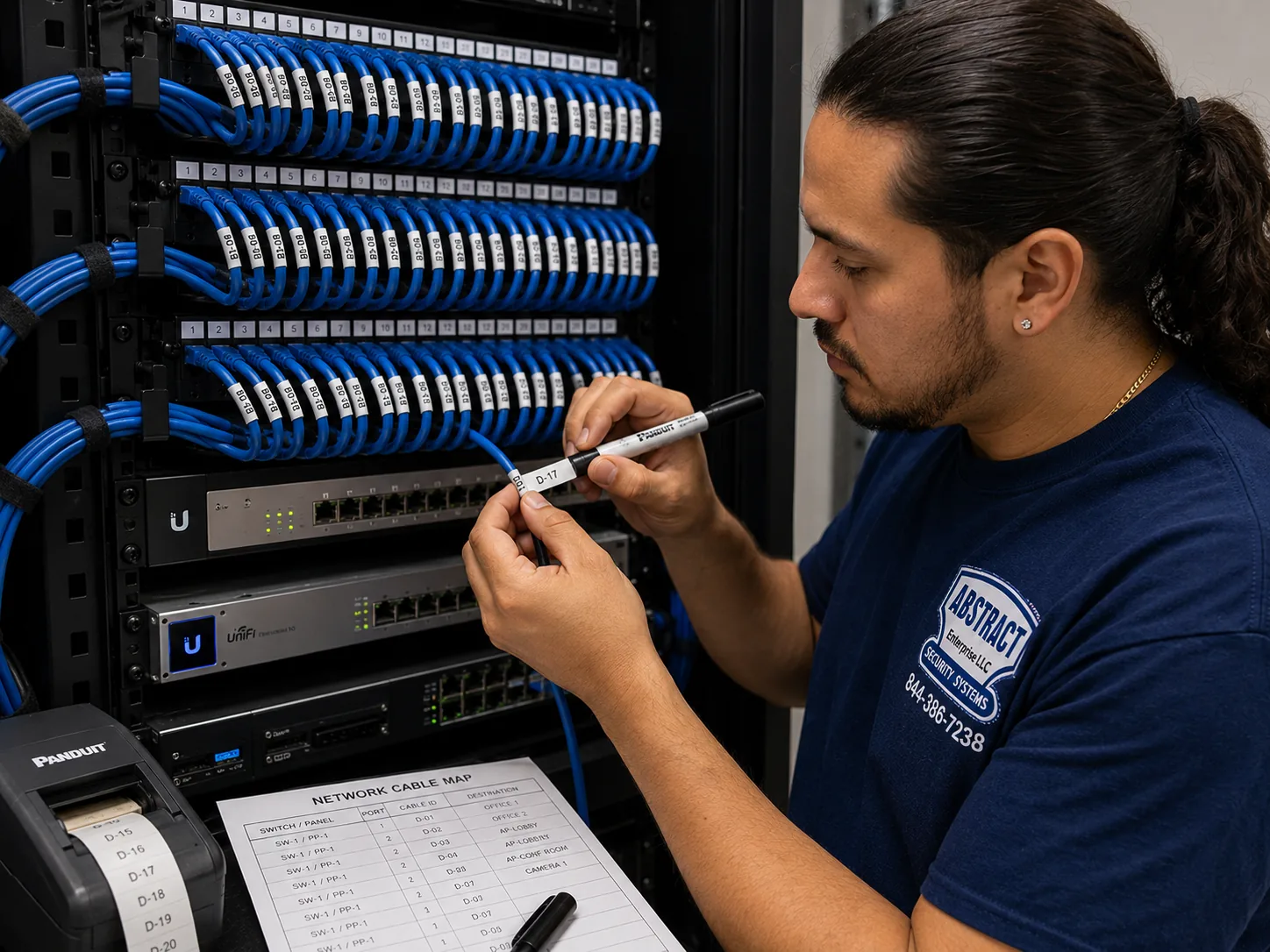
These are the Blink devices and supporting pieces we fit on Long Island homes and businesses. You can buy the equipment yourself and have us install it, or ask us to supply it. Installed prices for each are on the Long Island Blink price page, by county.
Weather-resistant battery cameras, including the Outdoor 2K+ and earlier Outdoor models, for eaves, porches, garages and fences. They need a Sync Module and do best sheltered from direct rain.
Plug-in indoor cameras such as the Mini 2K+, which Blink says connect straight to Wi-Fi without a Sync Module. Good for entryways, basements and small offices.
Battery doorbells such as the Battery Doorbell 2K+ for houses where the old doorbell wiring will not help; Blink says this model needs a Sync Module.
Wired doorbells on an existing chime circuit that meets Blink's 16 to 24 VAC requirement, or on Blink's plug-in adapter, which supplies 24 VAC from an indoor outlet but has no battery backup.
The hub that links battery cameras to the router. Blink lists its Sync Module 1st Gen, Sync Module 2 and Sync Module Core at up to 100 feet of range; we place it for the farthest camera and add a second where needed.
Lithium batteries for outdoor cameras through Long Island winters, and Blink-compatible covers and sheltered mounting spots for exposed corners and coastal houses.
Removable and door-clamp mounts for renters. One listed no-drill Blink doorbell mount fits only inward-opening doors between 0.82 and 2.08 inches thick with a gap over 0.063 inches, so we measure your door first.
Help with the network the cameras depend on: router placement, an access point for a far end of the house or a garage, and a battery backup under the router and module.
People often ask how Blink compares with the big national names. ADT is best known for professionally monitored alarms. Ring and SimpliSafe both sell doorbells, cameras and self-install alarm kits, and Ring has its own neighborhood app and a history of police video-sharing programs that Consumer Reports and Variety have covered. Blink sits at the simpler end: battery and plug-in cameras, self-monitored through its app, no professional installation of its own. None of those companies sends someone to read the signal from your basement router to your detached garage or to measure your 1950s doorbell transformer. If you have already chosen Blink, our job is to make it work on your property. If you have not chosen yet, we will tell you honestly whether a Blink system, a different brand or a wired system fits what you want to see.
| Question | Blink battery and plug-in | Wired recorder-based system |
|---|---|---|
| Drilling and cabling | Little or none; ideal for finished postwar houses and rentals | Cable to every camera, through walls, attics or soffits |
| Recording | Clips when motion wakes the camera | Continuous recording to a local recorder |
| Power | Batteries outdoors; outlets indoors | Powered over the cable |
| Best place | Quiet doors, garages, small offices, renters | Busy shops, driveways that need full-time recording, large properties |
| Weak point on Long Island | Distance, block walls, cold-weather batteries | Cost and disruption of running cable in finished houses |

We could not capture Google's AI Overview or its People Also Ask boxes for this topic from our build environment, so we are not going to pretend to quote them. What follows are claims we see repeated in quick online answers about Blink cameras and about security work on Long Island, set against what the sources and our field practice say. Marketplaces such as Angi, HomeAdvisor and Fixr publish national cost guides that feed many of those answers; they are useful for a rough idea, but they are not a plan for a Cape Cod with a garage at the end of the driveway.
It is true that Blink is built to be self-installed. NerdWallet's review notes plainly that no professional installation is available from Blink itself, and for a single Mini on a bookshelf, you do not need anyone.
The difficulty on Long Island is not screwing a camera to a wall. It is the parts the box does not cover: whether the garage is within reach of the Sync Module, whether the module should be upstairs instead of beside a basement router behind a block foundation, and whether a 1950s doorbell transformer can power a wired doorbell.
Those are measurement questions, and getting them wrong is why so many systems end up with one camera that is always offline. That part of the work is what we are paid for; the screws are the easy bit.
That figure comes from Blink, which says its Sync Modules can communicate with cameras up to 100 feet away. It is a best case. Blink's own guidance warns against thick walls and materials such as concrete, brick, stone and metal between the module and the cameras.
SafeHome's testing found a strong connection only within about 70 to 80 feet once walls and obstacles were involved. A Long Island lot often puts the far camera on a detached garage at roughly that distance, behind two exterior walls and sometimes a parked car.
So we treat 100 feet as the limit you will never reach in practice, take a reading at every spot, and plan for a second module or better Wi-Fi when the far camera needs it.
This one appears on installer pages, and we have to admit an older page of our own repeated it. It is wrong. The Digital Media Law Project describes New York's wiretapping law as a one-party consent law: a recording is lawful when one participant in the conversation consents.
That does not make every doorbell recording fine. A device that picks up conversations between strangers on the sidewalk, with nobody in the household taking part, is where the risk lies, and a legal Q&A on Justia suggests disabling audio unless a consenting participant will be part of the conversation. Video in private rooms is governed separately; Penal Law section 250.45 makes recording in bathrooms and bedrooms without consent a felony.
On every install we explain the difference and set audio to your informed choice, rather than leaving it on by default or switching it off because of a rule that does not exist.
Plenty of quick answers say to remove the old button and connect the two wires. Blink's support pages are more specific: the Video Doorbell needs a chime system providing 16 to 24 volts AC at 50 to 60 hertz and 40 VA maximum, and a "Wired power not supported" alert means the wiring is not compatible.
Nassau's median home was built in 1955. Many of those houses still have old transformers and chimes, and one homeowner online described having to replace a 35-year-old transformer to power a different brand's video doorbell.
We measure before the doorbell goes up. If the power is wrong, the choices are a battery doorbell, Blink's plug-in adapter for the Wired Doorbell 2K+, which Blink notes has no battery backup, or transformer work.
Battery-life claims on any camera box assume reasonable conditions. A battery supplier's guide points out that cold weather, weak Wi-Fi and frequent alerts all reduce battery performance, and that alkaline cells lose significant capacity in the cold while lithium cells hold up across a very wide range.
On Long Island, the camera on the north side of a house, aimed at a busy street, on the edge of the module's range, is hit by all three at once in midwinter. Its batteries will run down far faster than the one under the back porch.
We cut down needless wake-ups with motion zones that skip the street, place the module for a strong signal, and recommend lithium batteries outdoors.
Online answers often blend the island into the city and mention HPD rules, 311 complaints, Department of Buildings permits or Landmarks Preservation Commission approval. Those are New York City agencies. Even one older vendor page for Nassau mentioned the LPC and NYPD precincts, and the NYPD does not police Nassau County.
On Long Island, permits come from the town, village or city. Policing comes from the Nassau County or Suffolk County Police, or a village department such as Garden City's. Contractor licensing runs through each county's Office of Consumer Affairs, with Suffolk's rules not applying in towns and villages that license on their own.
We check the rules for your address, not a citywide summary that does not apply to it.
Some answers treat camera registries as a back door into private systems. The Suffolk County Police describe their SHIELD Camera Registry as a list of camera locations; the department says it does not have access to registered cameras, and any footage is retrieved at the owner's convenience when detectives ask.
Live access is a separate, opt-in program, SHIELD's Emergency Remote Camera Access, which partners can join or leave at any time. The Garden City Police also say their voluntary registry does not give them access to privately owned systems.
Whether to register is your decision. We can explain both programs, but we never sign a customer up for anything; that choice stays with you.
Send us the town, the house type, which Blink devices you have and a rough distance from the router to the farthest camera spot, and a technician will tell you whether one Sync Module is likely to do it, whether your doorbell wiring is worth measuring, and which lines of the county price list apply. Call (800) 486-0943, message us on WhatsApp, or use the quick form.
Every Long Island Blink job follows the same eight steps, whether it is a single doorbell in a Levittown ranch or a dozen cameras across a house, a garage and a pool fence in Suffolk. The order matters most on properties with distance and masonry in the way, where a camera mounted before the signal was read is the usual cause of a system that never quite works.
Town or hamlet, house or building type, which Blink devices you own or want, and where the router sits. We match the job to the Nassau or Suffolk Blink price list before you book.
We stand at every planned spot, farthest first, including garages and back fences, and read the signal before anything is mounted.
Where it reaches every battery camera with the fewest block walls, brick and metal in the way, still connecting well to the router. A second module only if the distances need it.
The transformer and chime measured against Blink's 16 to 24 VAC requirement, or a battery doorbell or plug-in adapter planned instead.
Into solid trim, framing or masonry with exterior-rated hardware, sheltered from direct rain where possible, at an angle you approve from the live view.
Motion zones that skip the street, privacy zones over neighbors' windows and yards, and audio set to your choice after we explain New York's rules.
The system set up on your account, cloud or local storage configured, cameras named and every household phone added for alerts.
Every camera triggered, every clip checked, every alert confirmed, and written notes left on where the module sits and how each device is powered.

Long Island is too large to describe by its edges, so most people give directions by its anchors. These are the ones we use when planning visits across both counties.
The largest mall on Long Island, at 630 Old Country Road in East Garden City, built on the airfield where Lindbergh began his 1927 transatlantic flight; the airfield closed in 1951.
At 1255 Hempstead Turnpike on former Mitchel Field land; the surrounding Hub was rezoned for new development in 2025 after Las Vegas Sands dropped its casino plan.
The Mitchel Air Base and Flight Line historic district, about 108 acres, joined the National Register on May 4, 2018; the museum sits on former base land.
About 244 acres in the Uniondale section of Hempstead, with part of the campus south of Hempstead Turnpike, according to Wikipedia.
213 buildings across 1,454 acres in the Town of Brookhaven; the nearby Mill Pond dam failed in the August 2024 flash flood emergency.
Established in 1947 at the former Camp Upton, covering about 5,265 acres in Upton in the Town of Brookhaven.
We cover all of Nassau, from Levittown, Hicksville, Massapequa, Garden City, Uniondale and Hempstead to the North Shore and Long Beach, and all of Suffolk, from Huntington, Melville and Hauppauge to Brentwood, Central Islip, Ronkonkoma, Stony Brook and out to the North Fork and South Fork. County pricing is on our Nassau County Blink price list and Suffolk County Blink price list. Just over the city line, Queens addresses use our Queens Blink price list.
Long Island Blink work is priced by county. Nassau addresses use the Nassau County Blink price list, and Suffolk addresses use the Suffolk County Blink price list; the Long Island Blink price page shows both side by side and lets you build your own system line by line. We do not print a different set of numbers here, because the price page is the one place we keep current, and a quote that disagrees with it is a quote you should not accept. What this section explains is what moves the total, so you can read that list with your own property in mind.
| What moves the price | Why | Where it shows up on Long Island |
|---|---|---|
| Number of devices | Each camera and doorbell is mounted, connected, zoned and tested | Most houses start with a doorbell and two or three outdoor cameras |
| Who supplies the equipment | Install-only when you own the cameras; supplied and installed when we bring them | Many Long Islanders already bought a Blink kit and need it made to work |
| Doorbell power | A doorbell on good existing wiring is quicker than one needing an adapter or a different plan | Original transformers in 1950s Nassau houses |
| Distance and extra Sync Modules | Far cameras may need a second module or Wi-Fi work before they stay online | Detached garages, deep lots, pool fences |
| Mounting surface and height | Brick and stucco take masonry drilling; second-story eaves take a tall ladder | Brick fronts, colonial eaves, split-level upper floors |
| Fixing an existing system | Diagnosis comes first, then whatever the diagnosis calls for | Cameras that keep going offline, dead batteries, missed events |
| Travel and scheduling | Suffolk covers 2,373 square miles; far East End visits are planned around a route | North Fork, South Fork and seasonal houses |
Take a Cape Cod in Uniondale with a doorbell, a camera over the front porch, one on the driveway side and one on a detached garage. On the Nassau list, that is the doorbell line, three outdoor camera lines and, if the garage reading is weak, either a Sync Module repositioning or a second module. If the doorbell transformer measures out of range, the doorbell line changes to the battery or adapter version. Move the same layout to a 1970s colonial in Suffolk with an attached garage and good doorbell power, and the Suffolk list applies, the garage line is often simpler, and the back-yard camera may be the one that needs the extra module. Nothing is added on the day unless something we find changes the job, and if it does, we show you and agree it before going on.
Booking, payment and rescheduling terms for Blink work are set out on the price page and confirmed in writing with your quote. Warranty terms on equipment we supply and on our work are below.
Full terms โ including 50% deposit, one-year parts-only warranty on AESS-supplied products, and the late-fee schedule โ are set out in the service agreement.Three common Long Island Blink setups, built only from lines on the county price lists. The current price of each line is on the Long Island Blink price page; add the lines that match your property. There is no package premium and no hidden extra.
A Blink doorbell, wired on measured existing power or battery-powered where the old wiring will not help, plus one outdoor camera over the porch or driveway and a Sync Module placed on the main floor. Suits a slab ranch or Cape where the main worry is deliveries and visitors.
Doorbell, three outdoor cameras covering the front, the driveway side and the back door, one indoor Mini by the back entry, signal survey at every spot, motion and privacy zones and storage set up on every phone. The usual job on a postwar Nassau or 1970s Suffolk house.
Everything in Standard plus cameras on the detached garage and the back fence or pool gate, a second Sync Module or Wi-Fi improvement where the readings call for it, lithium batteries outdoors and a backup-power plan for the router and module. For deep lots and seasonal homes.
Many Long Island households have already bought a Blink kit, sometimes on sale, and just need it to work. If you own the cameras, doorbell or Sync Module, we install them at the install-only lines on the same county list. We check that the kit includes everything it needs before the visit; a common question on deal forums is whether an outdoor camera bundle actually includes the Sync Module, and the answer varies by bundle. If a camera you own is a poor fit for a particular spot, for example a battery camera you hoped to aim at a busy sidewalk, we tell you and suggest a better spot or a better device rather than mounting it where it will disappoint you.
The island-wide list and calculator, with Nassau and Suffolk side by side. Long Island Blink camera installation prices
Levittown to Long Beach, Garden City to the North Shore, at the Nassau rate. Blink camera installation prices in Nassau County
Huntington and Hauppauge to the North and South Forks, at the Suffolk rate. Blink camera installation prices in Suffolk County
For family homes and rentals in the five boroughs. NYC Blink camera installation prices
Addresses just west of the Nassau line are priced on the Queens list. Queens Blink camera installation prices
Send the town, the house type and your Blink models, and we will match them to the list. Request a free quote
A doorbell and one or two cameras on a house where the signal is good and the doorbell power is right is a short visit. A full house with a detached garage, a doorbell that needs its transformer checked and a second Sync Module takes longer, mostly because of the signal readings at each spot before anything is mounted. Tell us the number of devices and the layout when you book and we will give you a realistic window for your property.
We cover both counties, from the Queens line to the East End. Visits far out in Suffolk are planned around a route so the drive is used well, which is why we ask for the town or hamlet up front. Seasonal houses there are often easiest to schedule before the house closes for the winter or when you are opening it in spring.
For many households, yes, especially in finished postwar houses where nobody wants walls opened for cable. Porch theft is a real Long Island problem, from the Garden City porch report in September 2026 to the Suffolk ring that worked 31 communities, and a doorbell plus a couple of outdoor cameras gives you alerts and clips without wiring. Where you need continuous recording of a busy driveway or a large property, a wired system may be the better buy, and we will tell you honestly which fits.
Yes. Blink devices stay on your account, so they can be taken down, moved to your new home and re-added there. If the cameras were set up on no-drill mounts, removal leaves nothing behind. If any were screwed into the building with the landlord's permission, we can take them down and leave the holes neat, and set them up again at your new address on the same visit or another one.
Not always, which is why it comes up on deal forums. Blink says its battery outdoor cameras and battery doorbell need a Sync Module, while the plug-in Mini does not. Some bundles include a module and some single cameras do not. Send us a photo of the box or the model names before the visit and we will confirm your kit is complete, so we do not arrive to find a camera with nothing to connect to.
Make sure you know your Wi-Fi network name and password, can log in to your Blink account or are ready to create one, and know where the router and the provider's modem sit. If you have a separate guest network, tell us which network you want the cameras on. If you recently changed routers or providers, mention it, because cameras set up on the old network will not reconnect by themselves.
Blink's own renter guide points to a plug-in indoor camera such as the Mini 2K+ for living areas, which connects straight to Wi-Fi without a Sync Module, and a battery doorbell for the front door where the building allows it. In a condo or townhouse complex, anything on the exterior usually needs the association's approval first, so most owners start indoors and add exterior devices once the board agrees.
Usually, yes. Indoor Minis sit on shelves or windowsills, outdoor battery cameras can sit on removable mounts in some spots, and there are door-clamp doorbell mounts. Those mounts have limits; one listed Blink no-drill doorbell mount fits only inward-opening doors between 0.82 and 2.08 inches thick with a small gap at the edge, so we measure your door first. Photograph the walls before and after installation for your own records.
No camera is impossible to damage, as the Central Islip case ABC7 reported, where a man destroyed a doorbell camera with a knife, showed. We make it harder: outdoor cameras go high enough under eaves to be out of easy reach, doorbells are fixed into solid framing with the screws Blink supplies or stronger ones, and a second camera covers the doorbell so that if someone attacks it, the attack itself is recorded and saved to the account.
Yes, with care. We avoid fixing through a loose vinyl panel alone and look for trim, soffit or a mounting block tied into the sheathing behind it. On cedar shingle or clapboard we fix into the sheathing and framing and seal the holes. Wherever possible we choose a spot under an eave or porch roof, which keeps rain off both the camera and the screw holes.
That depends on how you want clips stored. Blink sells cloud plans, which security.org notes include 60 days of cloud storage, and some Sync Modules can also save clips locally to a USB drive. Each approach has trade-offs: cloud storage keeps clips if a module is stolen or damaged, while local storage avoids a subscription. We explain both and set up whichever you choose on your account.
Yes. If you need continuous recording of a busy driveway, a camera aimed at constant sidewalk traffic, coverage across a large commercial floor, or a system you cannot afford to have go offline, a wired camera system is usually the better tool, and we will say so before you buy anything. Blink is good at what it does, and part of doing the job well is being honest about where it is not the right fit.
A short written note: where the Sync Module sits and why, which camera is on which battery type and when it was installed, how the doorbell is powered and what the transformer measured, and which phones receive alerts. On a Long Island house where the router sits in a basement corner and the garage camera is the one most likely to cause trouble, that note saves a lot of guessing later.
Tell us the town or hamlet, the house type, which Blink devices you have or want, and how far the farthest camera spot is from the router. A photo of the doorbell chime makes the doorbell part of the quote exact. Prefer to talk? Call (800) 486-0943.
ยท Blink Camera Installation NYC Hub: All Five Boroughs ยท Blink Camera Installation Hudson Valley Hub | 6 NY Counties
From a Levittown slab ranch to a Cape Cod with a garage at the end of the driveway, a 1970s Suffolk colonial or a quiet office on Earle Ovington Boulevard, the job starts the same way: the signal read at every spot, the doorbell power measured, and an honest match to the Nassau or Suffolk Blink price list. Call (800) 486-0943, message us on WhatsApp, or send the quote form, and we will tell you what your property needs before a single camera goes up.
Blink Camera Installation by neighborhood: Long Island hub, Long Island blink camera installation