What are you looking for?
About Us Contact Us Careers Get a Free Quote (800) 486-0943
Pick a service
✅ Got Your Own System?
🎬 Home TheatreQuote 🎶 AV SoundQuote 🔑 Access ControlQuote
Now pick your area
Pick your area
Long Island
Hudson Valley
Services available
Pricing & Tools
Pick a service for pricing
🚪 Intercom Pricing 🔔 Buzzer Repair Pricing
Calculators
📹 Camera System Calculator 🚨 Alarm Calculator ⚡ Cabling Quote Builder ✅ Got Your Own System?
Select your area
Blink camera gone offline after the last Central Hudson outage, or batteries quitting on the barn camera in a Dutchess cold snap? Book a Hudson Valley Blink visit: (800) 486-0943
Home › Blink Camera Installation › Hudson Valley
Stone Houses in the River Towns · Estates and Farmhouses · Suburban Lots in Westchester and Rockland · Long Rural Driveways and Barns · Licensed Low-Voltage

Blink Camera
Installation in
the Hudson Valley

See every Blink camera price in the Hudson Valley and build your own system →

Signal Mapped Before Anything Is Mounted · County Price Pages, No Guesswork · Power Matched to Valley Winters

Blink camera installation in the Hudson Valley is a different job from the same camera in a city apartment. Across Westchester, Rockland, Orange, Putnam, Dutchess and Ulster, the camera has to talk to a Sync Module through stone walls that have stood since colonial times, reach a barn or a detached garage well down a gravel drive, keep its batteries alive through January, and come back on its own after the power fails in a storm. Blink sells these cameras as do-it-yourself kits and offers no installation of its own, so the planning is left to the owner. We do that planning for you: we measure the Wi-Fi where each camera will hang, decide where the Sync Module goes, choose batteries or wired power for each spot, mount the cameras into whatever the house is built of, and set the app so it records people, not every deer that crosses the lawn.

Reviewed and updated November 5, 2026 by Anwar Timothy, NYS license #12000287431 · Sources: Blink support and blog pages on Sync Module range, offline troubleshooting, doorbell wiring and renter installs; Amazon, Amazon Forum and Best Buy customer Q&A on Blink in cold weather; Tom's Guide's Outdoor 4 range-extender test; SafeHome's Blink review; NerdWallet's Blink review; HomeGuide on Blink plans; Central Hudson news releases; Mid-Hudson News; Times Hudson Valley; Hudson Valley One; Hudson Valley 360; the Daily Gazette; Patch Mid-Hudson Valley; Hudson Valley Post; Hudson Valley Country; News 12 Hudson Valley and Westchester; the Village of Croton-on-Hudson police camera registration page; the City of Kingston Historic Landmarks Preservation Commission; Justia Ask a Lawyer and RecordingLaw on New York recording rules; NYS DEC on black bears; Teatown; USDA 2022 Census of Agriculture county profiles; Hudson River Heritage; the Historical Marker Database; Wikipedia entries for the Hudson Valley, the Kingston Stockade District and the Hudson River Historic District · Dispatched from 460 E Fordham Rd

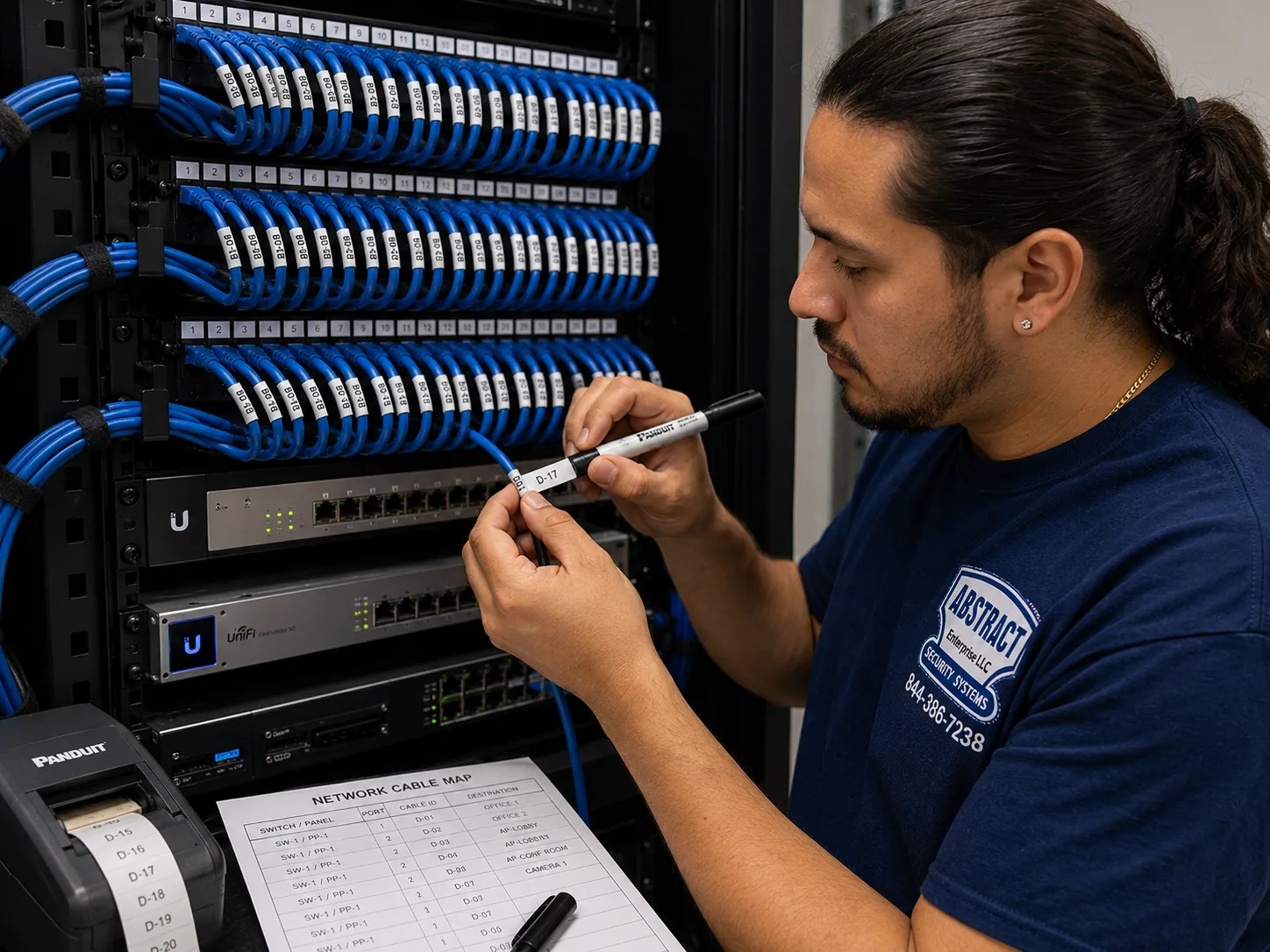
Blink camera installation reference for the Hudson Valley hub, Hudson Valley: technician printing cable labels at a patch panel beside a printed port map
Photo from the AESS job library, not taken in the Hudson Valley: a technician printing labels at a patch panel beside a printed map of every port. Blink cameras are wireless, but the router and Sync Module they depend on still live in a closet, a basement or a utility room, and in a Dutchess farmhouse or a Westchester split-level the first thing we do is find that equipment and write down what plugs in where.
Hudson Valley Blink Camera Setup
Tell us the county, the property type and which Blink cameras you have or want

✅
Request Sent!
We'll call about your Hudson Valley Blink cameras the same business day.
25+
Years Experience
✓
Same-Day Estimates
100%
Licensed & Insured
4.7★
201 Google Reviews

Owner-operated since 2002 · Thousands of jobs completed · Booked within 2 hours

Blink camera installation in the Hudson Valley is priced by county, because the six counties sit at different points on our area scale: Westchester at 1.25 times our Brooklyn base, Rockland at 1.30, Orange at 1.40, Putnam at 1.45, and Dutchess and Ulster at 1.53. The visit covers a Wi-Fi and Sync Module signal survey at every planned camera spot, mounting into wood, siding, stone or brick, the right batteries or wired power for each camera, motion zones and schedules in the Blink app, and a walkthrough for everyone who will use it. Each county's exact figures, and the calculator for building your own system, are on its Blink price page; requests are booked within 2 hours. Call (800) 486-0943 or use the form.

  • Exact numbers live on the Hudson Valley Blink camera price page and the six county pages linked further down; nothing is added on the day that is not on your county's list
  • Signal is measured where the camera will actually hang, with doors closed, before a single anchor goes in, because thick masonry and long distances are what break Blink systems in the valley
  • Low-voltage work under NYS license #12000287431; any new outlet or transformer circuit is left to an electrician licensed for your county, and the written quote says who does what
The Neighborhood

Why Hudson Valley Properties Need Blink Camera Installation

The Hudson Valley was settled as a scatter of farms, manors and river landings, and most properties still spread out the way they did. The Historical Marker Database records that the Dutch set up a trading post near the future site of Albany in 1614, made a permanent settlement at Fort Orange in 1624, and settled Esopus, today's Kingston, in 1653. The same marker notes that the Van Rensselaer patroonship and the Livingston, Philipse and Van Cortlandt manors gave the valley an aristocratic shape in the seventeenth century, and the Hudson River Valley Heritage Area writes that by 1750 most of the region had been settled as a network of small local communities that still survives. What that history leaves behind, for a camera installer, is distance. A house here is rarely one box on a small lot. It is a main house, a garage that may stand on its own, a shed or a barn, a gate or a mailbox at the end of a drive, and walls of fieldstone, brick or old timber between them. Every one of those details decides whether a battery camera that talks over Wi-Fi will work.

Blink is built around a simple chain, and that chain is what makes the valley tricky. According to Blink's own support pages and independent troubleshooting guides, Blink's battery cameras do not connect to your router directly. They talk to a small hub called a Sync Module, and the Sync Module talks to your Wi-Fi. Blink states that its Sync Modules can communicate with cameras up to 100 feet away, and it tells owners to keep the module away from thick walls and from materials such as concrete, brick, stone or metal. In SafeHome's testing, the claimed 100 feet shrank to a strong connection at only about 70 to 80 feet once walls and obstacles were in the way. Now picture a Kingston Stockade house, where Wikipedia notes colonial Dutch stone houses still stand on all four corners of Crown and John Streets, or a farmhouse in Dutchess with a barn across the yard. A camera that worked perfectly on the kitchen table during setup can drop offline the day it is screwed to the barn, because two feet of stone or eighty feet of open yard now sit between it and the module. That is the most common reason a self-installed Blink system disappoints, and it is the first thing we measure.

Then there is the weather. Blink rates its Outdoor cameras to operate from minus 4 to 113 degrees Fahrenheit, according to an answer on Blink's Amazon product page, and its Indoor and Mini cameras only from 32 to 95 degrees, for indoor use only. Valley winters test those numbers. On Amazon's own forum, one owner reported a Blink Outdoor that would not record at 15 degrees outside. On a Best Buy question page, another owner said their version 4 cameras gave up at minus 11 Celsius, would not stream on demand and eventually disconnected. Battery guides that cite Blink say the cameras are meant to run on AA 1.5 volt lithium non-rechargeable cells and list extreme heat and cold among the things that shorten battery life. Put those facts together and you have the classic January call: the driveway camera that went silent the week the temperature dropped, or the barn camera whose batteries were the wrong type from the start. Choosing the right cells, keeping a camera out of the wind where we can, and deciding when wired power is worth it are part of every valley install we do.

Power and internet are the last two links, and both fail more often here than in the city. Central Hudson reported 669 active outages affecting 41,323 customers across the region at noon on the Sunday after the July 4, 2026 storms, according to Times Hudson Valley, and later said the most heavily affected areas were in Dutchess and Ulster. Mid-Hudson News reported that the utility restored power to more than 24,000 customers after a nor'easter in September 2026. A Blink battery camera keeps its own charge through an outage, but without a working router and Sync Module it has nowhere to send a clip. Some properties have no fast internet to begin with. Hudson Valley One reported in 2023 that 1,070 Ulster County properties still had no broadband, and that in Shandaken, with 2,866 residents across 120 mountainous square miles, even cell service struggles. Mid-Hudson News reported in September 2025 that eleven providers had won nearly 400 million dollars in state funding to reach every documented unserved location, including parts of Putnam, Dutchess, Orange, Ulster and Westchester. Until that work reaches your road, a Wi-Fi camera is only as good as the connection the house already has, and we check that connection before we sell you on any plan.

Why do people in the valley buy cameras at all? The local news answers that directly. In a January 2025 alert reported by Hudson Valley Post, the New York State Police said troopers were investigating residential burglaries in Dutchess, Westchester and Putnam counties, and one of their tips was to install or activate security systems and cameras. Patch Mid-Hudson Valley reported that State Police in Poughkeepsie asked anyone with home cameras to check their footage from midnight to 5 a.m. after car break-ins, naming residents of Hoofprint Road in Union Vale, Fountain Place and Weatherford Lane in Millbrook, and Horseshoe, Verbank and Maple Hill Roads and Rodrigo Court in the town of Washington. News 12 reported that neighbors on and near Tower Hill Drive in Port Chester showed doorbell-camera footage of incidents around 4 a.m., and that the Ulster County Sheriff's Office warned of burglaries and car break-ins on Union Center Road in Esopus. In Scarsdale, Hudson Valley Post reported, a resident doing yard work on Bradford Road found a surveillance camera hidden in the bushes and aimed at the home, and Scarsdale police described organized burglars placing such devices for days before a break-in. A camera only helps in those moments if it was recording, at night, in the right direction, and if the clip is still there when the police ask. That is an installation question as much as a product question.

We want to be honest about the gaps in what we could find. We searched Reddit, local news, Yelp and hyperlocal outlets for posts about Blink installations specifically in the valley and found none. We found no Yelp complaints about Blink installs here, and no public source that says whether a small battery camera on a historic house triggers a landmark review in any particular town. Where this page talks about stone walls, barns, long drives and cold mornings, it draws on Blink's published specifications, owners' reports, and the public record of what the valley's buildings and weather are like, not on a survey of valley Blink owners.

Hudson Valley facts that shape a Blink install

  • Six counties, six price points: AESS covers Westchester, Rockland, Orange, Putnam, Dutchess and Ulster, priced at 1.25, 1.30, 1.40, 1.45, 1.53 and 1.53 times our Brooklyn base respectively, because lots are larger, runs are longer and travel is further than in the city.
  • Room to spread out: the USDA's 2022 Census of Agriculture counted 620 farms on 99,652 acres in Dutchess, averaging 161 acres, and 486 farms on 73,026 acres in Ulster, averaging 150 acres. Barns and outbuildings are normal here, and so are cameras that need to reach them.
  • Historic fabric everywhere: the Hudson River National Historic Landmark District, designated in 1990, is described by Hudson River Heritage as the largest such district on the mainland of the contiguous United States, and Wikipedia notes only 2 percent of its property by acreage is not considered historic.
  • Storms that take the router down: Central Hudson reported 41,323 customers affected after the July 4, 2026 storms, and more than 24,000 restored after the September 2026 nor'easter.
  • Internet dead zones: 1,070 Ulster properties without broadband in 2023, and an older WPDH map found that most unserved spots were apartment complexes, townhomes and rural neighborhoods.
  • Police who ask for footage: the Village of Croton-on-Hudson invites residents and businesses to register private cameras voluntarily, and contacts registrants only if a crime happens nearby.

What valley owners often add after the cameras. Once a Blink system is reliable, the next request is usually about the network behind it: a stronger Wi-Fi signal out to the garage or barn, or a battery backup for the router so the cameras keep sending clips during a short outage. Those are planned in the same visit if you mention them when booking, so we bring the right equipment rather than coming back on a second trip up the Taconic.

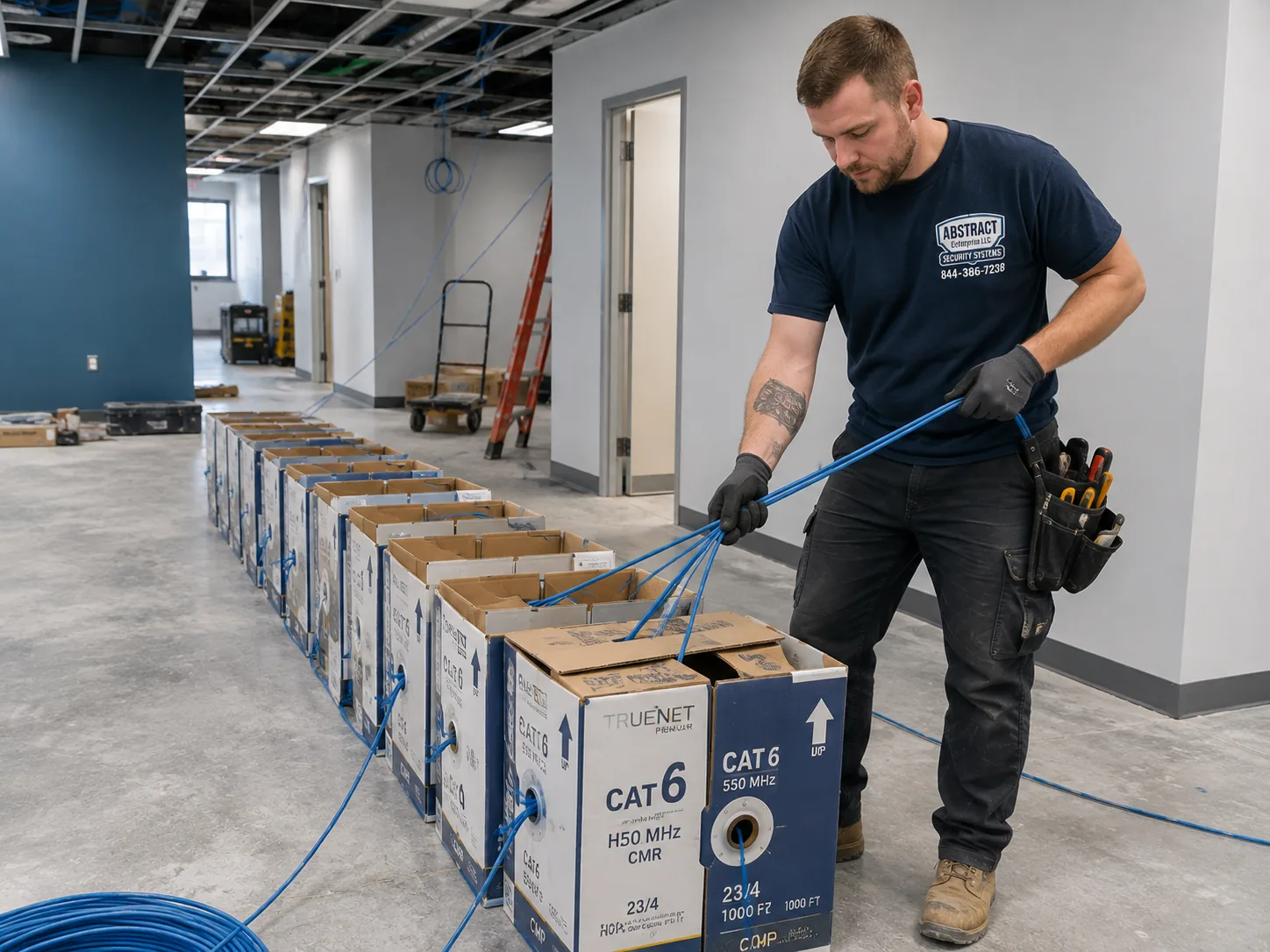
Blink camera installation reference for the Hudson Valley hub, Hudson Valley: boxes of cable staged on the floor of a working commercial premises ready for a multi-drop pull
Photo from the AESS job library, not taken in the Hudson Valley: boxes of cable staged on the floor of a working premises before a multi-drop pull. Most Blink jobs need no cable at all, but when a camera at the end of a long drive in Putnam or a barn in Ulster needs wired power or a network extension to stay online, the material is staged and checked like this before work starts, so the property is not left half-done.

Blink Offline After a Storm, a Cold Snap or a New Router? Fast Help Across the Valley

The calls we move on first are the ones where a camera has stopped doing its job right when it matters: a driveway camera that went dark the week of a break-in on your road, a barn camera that died in the first deep freeze, or a whole system that never came back after the power returned. Before you call, open the Blink app and note which cameras show offline, what the battery and signal readings say, and whether the Sync Module's light looks normal. If your internet provider changed the router, or the Wi-Fi password changed, say so; that single fact explains many sudden outages. Then call (800) 486-0943. If the police have asked residents on your road for footage, tell us the date and hours, and we will help you find and save what the cameras captured before cloud storage rolls it off.

Six Counties

From the Sound Shore to the Catskills: How the Same Blink Job Changes County by County

The Hudson Valley as AESS serves it runs from Westchester's border with the Bronx up to Ulster County and the edge of the Catskills. Wikipedia describes the wider region as stretching from the Capital District south to Yonkers, and the Hudson River Valley Heritage Area groups Westchester and Rockland as the Lower Hudson, and Putnam, Orange, Dutchess and Ulster as the Middle Hudson. A Blink camera is the same box in every one of those counties, but the property it lands on changes as you go north. In the south, lots are tighter, neighbors are close and the question is mostly where a camera may point. Further up, the questions become how far, how cold and how reliable the internet is. The table sums up what we expect in each county; the paragraphs after it explain why. Each county has its own Blink price page, linked in the table.

CountyArea scale (Brooklyn = 1.00)What the property usually asks of a Blink systemPrice page
Westchester1.25×Suburban lots, close neighbors, doorbells and driveway cameras; careful aim away from the house next doorWestchester Blink prices
Rockland1.30×Suburban neighborhoods, village downtowns and rural properties; front doors, garages and side yardsRockland Blink prices
Orange1.40×A mix of river cities, suburbs and farms; longer drives and outbuildings start to matterOrange County Blink prices
Putnam1.45×Wooded lots, hills between house and road, and storm outages that hit most of the county at oncePutnam Blink prices
Dutchess1.53×Farms, estates and long country roads; barns, gates and the river estates of the landmark districtDutchess Blink prices
Ulster1.53×Stone houses in Kingston, farms, mountain towns with patchy internet and the coldest morningsUlster Blink prices

Westchester: close neighbors and a camera that has to stay on your side

Much of southern Westchester is built on village and town lots where the next house is a few yards away. The Blink jobs there look most like city work: a video doorbell, a camera over the driveway, one on the back door, maybe one in the garage. The challenge is aim. A camera that sees your front walk often also sees a neighbor's front window or a public sidewalk, and Blink's activity zones and privacy settings exist for that reason. The local news here is also the most camera-heavy in the region. News 12 reported doorbell footage from neighbors on Tower Hill Drive in Port Chester, and Rye police have reported 99 vehicle thefts since 2020, all involving vehicles left unlocked with the key fob inside, according to News 12. A driveway camera does not stop that, but it records what happened, and placing it so it sees the car doors rather than only the street is the difference between a useful clip and a blur of headlights. Westchester also brings the Scarsdale reminder: burglars placing their own hidden cameras in bushes. When we set up a Westchester system, we look at your hedges and side yards with that in mind.

Rockland: suburban streets, village centers and room at the back

Rockland mixes suburban neighborhoods, village downtowns, growing commercial centers along roads such as Route 59, Route 304 and Route 202, and rural properties further from the river. For a Blink system, that usually means a house with a modest front yard and a deeper back lot, often with a shed, a pool fence or a detached garage at the far end. The front of the house is easy. The back is where the 100-foot Sync Module range gets tested, especially if the module sits in a front room or a basement on the far side of the house. Rockland is also bear country. The New York State Department of Environmental Conservation describes the Southern Black Bear Range as extending to southern Orange and Rockland counties at the New Jersey border, and lists bird seed and feeders as the most common attractant. A camera pointed at a trash enclosure or a bird feeder will record a lot of animals; we set the zones so that a bear at the bins does not drain the batteries on the camera watching your back door.

Orange: river cities, warehouses and farm country on the same map

Orange County holds the widest range of property in the region, from Newburgh's East End Historic District, which the city describes as the second largest designated historic site in New York State and which is lined with Italianate row houses, to farms and newer subdivisions further west. In a Newburgh row house, a Blink job is closer to a city job, with brick party walls that block the Sync Module's signal from one end of the house to the other. On a farm, it is a distance problem. Orange is also, by one measure, the stormiest county in the state: an Earth Networks report on 2020 lightning ranked Orange first in New York, with 275,059 lightning pulses and 41 thunder days. Lightning does not usually hit a battery camera, but surges and outages knock out routers, and a Blink system with no router has nowhere to send clips. Orange is served mostly by Orange and Rockland Utilities, which says it serves about 300,000 electric customers across New York and northern New Jersey, and by Central Hudson in villages such as Montgomery, Maybrook, Cornwall and Highland Falls.

Putnam: wooded hills and the outage that takes the whole county down

Putnam's houses tend to sit back from the road on wooded lots, often uphill or downhill from the driveway, with trees in every line of sight. Trees matter to a wireless camera: wet leaves in summer absorb signal that passes freely in winter, so a camera that tests well in March can struggle in July. Putnam is also where a single storm can switch off most of the county at once. The Daily Voice reported that at 10:15 a.m. on August 5, 2020, during Tropical Storm Isaias, NYSEG had 34,150 of its 38,693 Putnam customers out, and Central Hudson 3,621 of its 5,160. When the power comes back, the cameras have to find the Sync Module and the module has to find the router again, all without anyone home to press a button. We test exactly that recovery before we leave a Putnam job, and we talk through whether a small battery backup on the router is worth it for your house.

Dutchess: estates, farms and the roads the State Police named

Dutchess carries much of the Hudson River National Historic Landmark District, the estates of the old Great Estates region, and more than 600 farms. It is also where State Police asked residents of named rural roads in Union Vale, Millbrook and the town of Washington to check their cameras for footage between midnight and 5 a.m. after car break-ins. Those requests show what a Dutchess camera needs to do: see a car in a long, dark driveway at three in the morning and keep the clip long enough for someone to ask for it. That rules out a lot of careless placements. A camera mounted high on a barn gable, aimed across a wide yard, captures motion but not a face or a vehicle. A camera on a fence post by the gate, closer to where a car must slow down, often captures far more. Distance from the house is the limiting factor, which is where Blink's Extended Range Sync Module, covered below, comes in. Dutchess is Central Hudson territory, and the utility named Dutchess and Ulster as the hardest-hit areas after the July 2026 storms.

Ulster: stone walls, cold mornings and the internet question

Ulster gives us the hardest walls and the coldest air. Kingston's Stockade District, per Wikipedia an eight-block, 32-acre area of Uptown Kingston, mixes homes and businesses among colonial stone houses, and the city's Historic Landmarks Preservation Commission reviews exterior work on historic properties that can be seen from the street before a building permit is issued. Out in the towns, the issue is connectivity. Hudson Valley One reported 1,070 Ulster properties with no broadband in 2023, and in September 2025 the county announced a state ConnectALL award, with Verizon's match, to reach nearly 1,300 unserved homes, businesses and community facilities in remote areas. Blink cameras need working Wi-Fi to send clips and alerts. On a road that is still waiting for service, the honest answer may be that a Blink system cannot do what you want yet, and we will say that before you spend money on cameras.

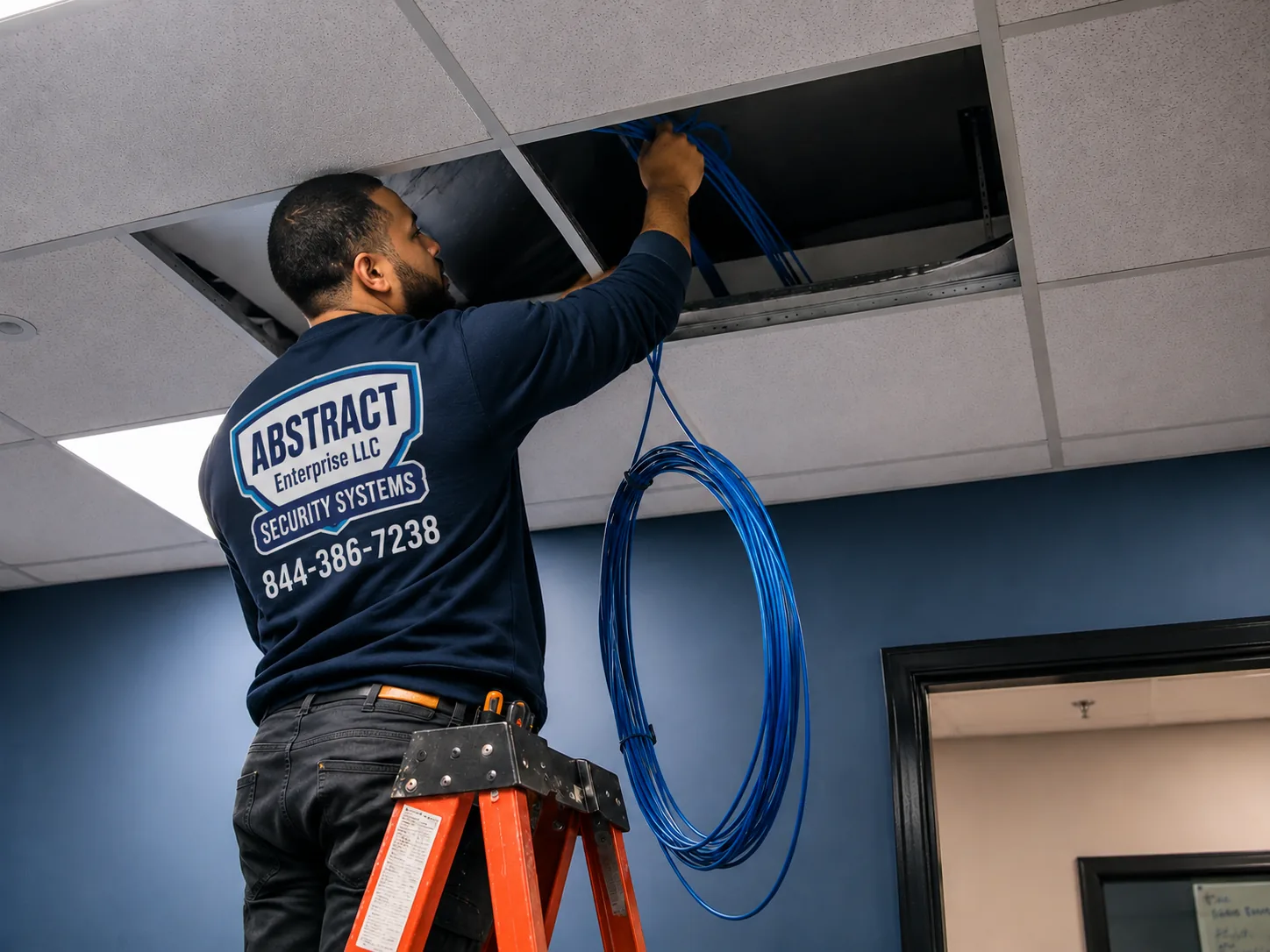
Blink camera installation reference for the Hudson Valley hub, Hudson Valley: technician feeding cable up through an open ceiling in an occupied commercial space
Photo from the AESS job library, not taken in the Hudson Valley: a technician feeding cable through the ceiling of a commercial space that stayed open while we worked. In a small shop in Uptown Kingston or along Route 59, a wired power feed for an indoor Blink camera is run the same way, above the ceiling and out of sight, so customers never see a dangling cord.
Before You Book

Ten Minutes With the Blink App Before We Drive Up: What to Check at a Valley Property

The time lost on a Blink job in the valley is almost always lost to surprises: a Sync Module that turns out to be an older model, a router in a basement on the far side of the house, a doorbell chime that cannot power a wired doorbell, or an internet connection that slows to a crawl in the evenings. A few checks with your phone and a walk around the property prevent most of them. Please do not climb ladders or open electrical boxes to look; just observe, take photos and send us what you find.

What to checkWhy it matters in the valleyWhat to send us
Where the router and Sync Module sitThe module's range is about 100 feet by Blink's own figure, less through stone, brick or metalA photo of each, and which room and floor they are on
Phone Wi-Fi bars at each camera spotBlink cameras and modules use 2.4 GHz Wi-Fi; weak spots near the barn or drive show up here firstA screenshot of your phone's Wi-Fi strength standing where each camera would go
Distance to outbuildings and the gatePast about 100 feet, a second module or the Extended Range module may be neededA rough pace count or a map screenshot with the spots marked
What the walls are made ofFieldstone, brick and concrete need masonry anchors and block signal; wood and siding do notA photo of each wall where a camera will mount
Which Blink models you ownOutdoor 4, Outdoor 3rd Gen, Mini and doorbells have different power and module needsA photo of the boxes or the device list in the app
Your existing doorbellA wired Blink doorbell needs a chime system that supplies 16 to 24 volts ACA photo of the chime box inside the house, with its cover on
Your internet connectionClips upload over your connection; slow rural links can delay alertsYour provider's name and a speed-test screenshot from the evening
Historic or homeowner association rulesSome districts and associations review exterior fixturesAny letter or rule you have, and whether the house is in a historic district

Walk the route a stranger would take

Before deciding where cameras go, walk your property the way a visitor or a stranger would: from the road, up the drive, to the front door, around to the back door, to the garage and the barn. Note where a person has to slow down, turn or stop, such as a gate, a step, a door or a parked car. Those are the points where a camera gets a usable face or plate. In the valley, owners often want to cover everything at once, the whole lawn, the whole field, the whole tree line, and end up with cameras that trigger on every branch and still miss the person at the door. A short list of choke points gives better clips and longer battery life.

Think about winter before you think about angles

A spot that is perfect in October can be useless in February. Notice where snow drifts against the house, where ice drips from the gutter line, which side of the house takes the prevailing wind, and where the plow piles snow at the end of the drive. A camera under an eave on the sheltered side of the house stays clearer and warmer than one on an exposed corner. If a camera has to face the weather, say so, and we will plan its power and mounting around that.

Blink camera installation reference for the Hudson Valley hub, Hudson Valley: technician core drilling through a block wall to carry cable into a network room
Photo from the AESS job library, not taken in the Hudson Valley: a technician core drilling through a block wall so cable can pass into a network room. Masonry is where many do-it-yourself Blink plans stop; when a weather-resistant power cable has to pass through the foundation of a Dutchess farmhouse or the brick of a Newburgh row house, it is drilled and sealed properly like this rather than squeezed through a window frame.
What We Install

Blink Camera Installation Services in the Hudson Valley

These are the Blink jobs valley homeowners, weekend owners, farmers and small-business owners book us for. Every one is priced on your county's Blink price page. Where a job needs something beyond the usual, such as a second Sync Module to reach a barn or wired power on an exposed corner, the written quote names it before any work starts.

📶

Signal Survey and Sync Module Placement

Wi-Fi strength measured at every planned camera spot, the Sync Module placed where it sees the most cameras through the fewest walls, and a second module added only when the survey shows it is needed.

🏠

Whole-House Outdoor Coverage

Blink Outdoor cameras at front and back doors, garage and side yards, aimed at the points where people stop, with activity zones that keep the road and the neighbor's yard out of the alerts.

🔔

Video Doorbells, Battery or Wired

Battery doorbells for houses with no usable chime, and wired doorbells on chime systems that supply 16 to 24 volts AC, checked before mounting so the doorbell does not fall back to battery-only mode.

🌾

Barns, Garages and Long Drives

Cameras on outbuildings, gates and fence posts, reached with a second Sync Module or Blink's Extended Range Sync Module, with the trade-offs in picture quality explained before you choose.

🔌

Wired and Solar Power

Weather-resistant power cables and adapters for cameras that should never need a battery change, and solar panel mounts on the models that support them, placed for winter sun rather than summer sun.

🧱

Mounting on Stone, Brick and Old Timber

Masonry anchors set in the stone or brick face rather than crumbling mortar, and fixings into old timber that hold through freeze and thaw, on river-town houses and farm buildings alike.

📱

App Setup, Sharing and Schedules

Arm and disarm schedules, shared access for family or a caretaker, alert settings tuned so the phone is not buzzing all day, and storage settings explained in plain language.

🛠

Offline and Cold-Weather Repairs

Cameras that keep dropping off, batteries that die in weeks, systems that never recovered after an outage or a router change, diagnosed from signal and battery readings rather than guesswork.

🏪

Blink for Small Shops and Offices

Indoor and doorway cameras for small storefronts and offices where a full wired system is more than the business needs, set up with sensible privacy limits for staff and customers.

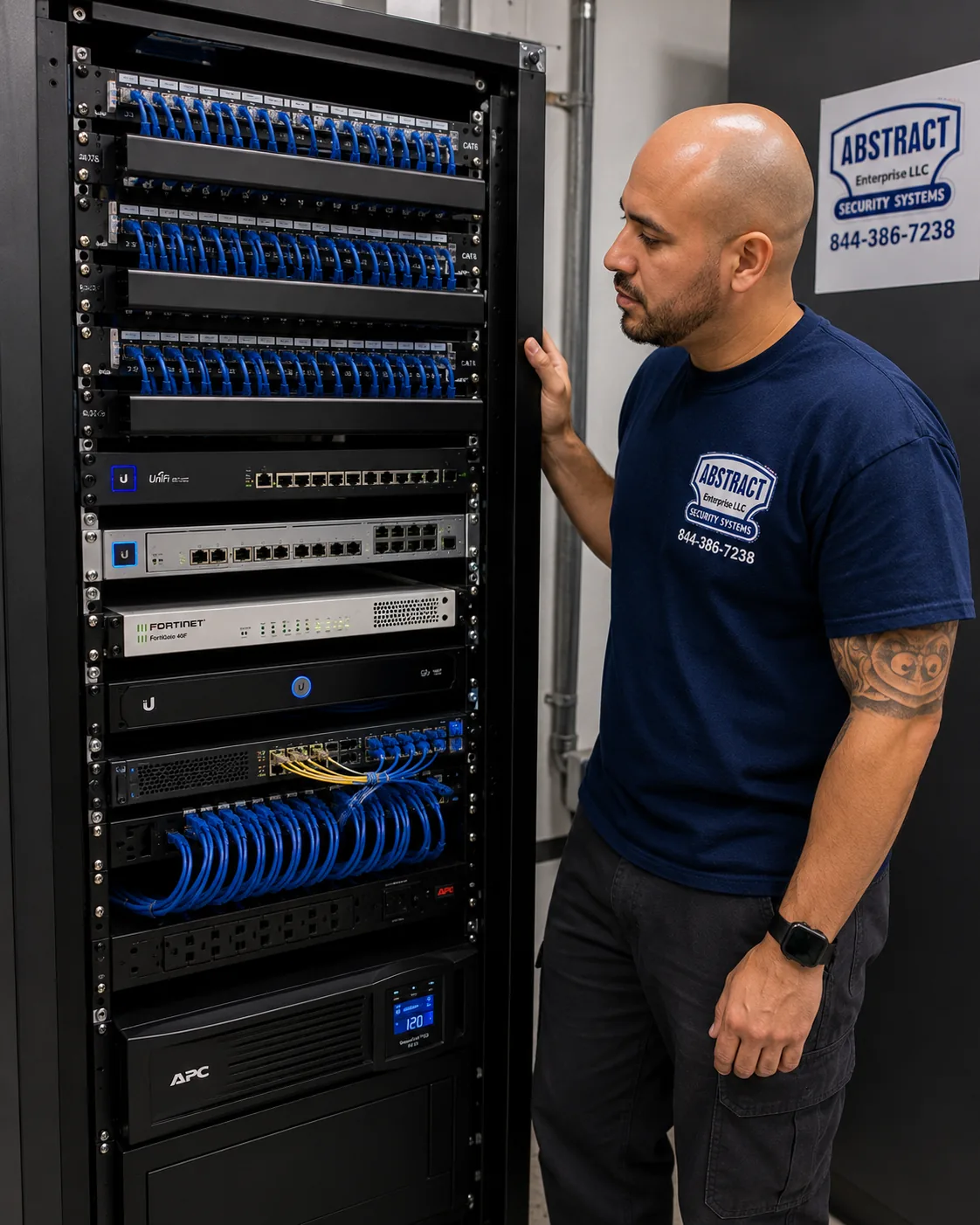
Blink camera installation reference for the Hudson Valley hub, Hudson Valley: finished network rack with patch panels, switching, a firewall and a battery backup unit, all dressed and labelled
Photo from the AESS job library, not taken in the Hudson Valley: a finished rack with patch panels, switching, a firewall and a battery backup at the bottom, every cable dressed and labelled. A home Blink system needs only a fraction of this, but the battery backup idea carries straight over: in a Putnam or Ulster house that loses power in storms, a small backup on the router keeps the cameras uploading through a short outage.
Building Specialists

Blink Camera Installation for the Hudson Valley's Architecture

A wireless camera cares about two things a homeowner rarely thinks about: what the walls are made of, and how far apart the buildings are. The valley's building stock pushes both to extremes. These are the property types we expect to meet across the six counties, drawn from the public record and regional histories, and how each one changes a Blink job.

Colonial Stone Houses

Dutch stone houses like those Wikipedia describes at the corners of Crown and John Streets in Kingston's Stockade. Walls thick enough to stop a Sync Module's signal cold, and exteriors that historic commissions care about.

Brick Row Houses in the River Cities

Italianate row houses like those in Newburgh's East End Historic District. Brick party walls, long narrow plans, and a back yard that may be out of range from a module in the front room.

River Estates and Great Houses

Mansions and estates along the river, including the forty-plus riverfront estates of the Hudson River National Historic Landmark District. Large footprints, carriage houses and long approach drives.

Farmhouses, Barns and Outbuildings

The hundreds of working farms in Dutchess and Ulster, and the many former farms now owned as homes. Several buildings across open ground, often with metal roofs or siding that blocks signal.

Suburban Houses on Village and Town Lots

The Westchester and Rockland streets where most Blink jobs look like a doorbell, a driveway camera and a back door. Close neighbors make aim and privacy the main design question.

Townhouses, Condos and Apartment Complexes

Attached homes where an association or landlord controls the exterior, and where, according to an older WPDH broadband map, many of the region's unserved internet spots were found.

How the building type changes the job

PropertyWhere the Sync Module usually goesHow cameras usually mountWho has a say
Stone houseNear a window or doorway facing the cameras, never behind the thickest wallMasonry anchors in the stone face, or into wood trim and porch framing where possibleThe owner, and the local historic commission if the house is in a district
Brick row houseMid-house, sometimes with a second module at the backMasonry anchors into brick, kept out of mortar jointsThe owner; neighbors if a camera would view a shared yard
EstateMain house plus a module in the carriage house or garageUnder eaves and on outbuildings, with wired power on the busiest camerasThe owner, the estate manager or caretaker
FarmHouse, plus a module in the barn or an Extended Range module for the far spotsOn posts, gables and doors at the points where vehicles slowThe owner; tenants if land or buildings are leased
Suburban houseCentral room on the main floorSiding or trim, with doorbell on the existing chime where it qualifiesThe owner; a homeowners' association where one exists
Townhouse or condoInside the unit, near the frontNo-drill or minimal-drill mounts where the exterior is common propertyThe board, association or landlord

Stone houses: getting signal through walls built to last

The valley's colonial stone houses are the hardest buildings we put a Blink system into, for one simple reason. Blink's own guidance is to keep the Sync Module away from stone, brick and concrete, and in a stone house almost every wall is one or the other. The fix is not more power, because the cameras cannot shout louder. It is geometry. We place the module where the signal can leave the house through a window, a door or a wood-framed addition rather than through solid masonry, and we measure at each camera spot with the doors shut. Often the answer is a module in a back porch, a frame wing or an attached garage rather than the living room where the router sits. Mounting is the second question. Fieldstone is uneven, and mortar in old walls can be soft. We look for a flat face of stone, or better, a wooden lintel, a porch beam or a piece of trim that will take a screw without anyone ever noticing it, because a Kingston historic district house is reviewed on how it looks from the street. Kingston's Historic Landmarks Preservation Commission reviews exterior work on historic properties visible from the public right of way before a building permit is issued. We found no source that says whether a small battery camera alone triggers that review, so on a district house we ask you to check with the city before we mount anything on the street side.

River estates: big footprints and the drive that goes on and on

The Hudson River National Historic Landmark District, the Historical Marker Database notes, takes in four towns, four hamlets, two villages and more than forty riverfront estates, including names such as Montgomery Place, Wilderstein and Wildercliff listed by Wikipedia. An estate-scale property breaks a Blink system's assumptions in several ways at once. The house may be more than 100 feet across, so one Sync Module cannot reach both ends. The carriage house, the garage and the gate lodge sit apart from the main house. The approach drive may run for hundreds of feet through trees. We plan these jobs as a set of zones: the main house, each outbuilding, and the drive. Each zone gets a module where the signal survey says it should go, and the farthest spots are where Blink's Extended Range option is weighed against its lower picture quality. On a property where cameras matter that much, we will also tell you plainly if a wired system would serve you better than Blink, and we write that into the quote.

Farms: metal, open ground and animals that never stop moving

Farm buildings bring metal siding, metal roofs and steel doors, and Blink-focused guides note that metal doors and walls both cut range and increase battery drain, because a camera struggling for signal works harder on every clip. They also bring livestock, wildlife and machinery moving through every frame. A camera on a barn door that faces the paddock will trigger hundreds of times a day. We place farm cameras on the approaches, not the fields: the lane, the gate, the barn door from the side where people walk up, and the spot where a truck would back in. Activity zones are drawn tight, and sensitivity is set for a person, not a cow. Where the barn has power, a wired camera saves the owner from changing batteries every few weeks during calving season or harvest.

Suburban lots: the neighbor is closer than the barn ever was

On the suburban streets of Westchester and Rockland, distance is easy and privacy is not. A doorbell on a front door that faces the street records the street. A driveway camera may look straight into the house across the way. Blink lets us draw activity zones and, on many models, privacy zones that black out part of the picture. We use both, and we check the view from the app with you before we leave. Suburban houses are also where the wired doorbell question comes up most, because many have an existing chime. Blink states that its wired doorbell needs a chime system supplying 16 to 24 volts AC at 50 to 60 hertz and no more than 40 VA; if the wiring does not qualify, the app shows a "wired power not supported" message and the doorbell falls back to battery behavior. We check the chime before we promise a wired doorbell.

Townhouses, condos and apartments: the board owns the wall

In attached homes, the outside wall and the common hallway usually belong to the association or the landlord, not the owner or tenant. Blink itself suggests plug-in cameras such as the Mini for living areas and battery doorbells and outdoor cameras for doors and patios in rentals, and no-drill mounts exist for some doorbells, with limits on door thickness and gaps. We work inside those rules: indoor cameras placed to look out, doorbells on approved mounts, and written confirmation from the board or landlord before anything is fixed to a common wall.

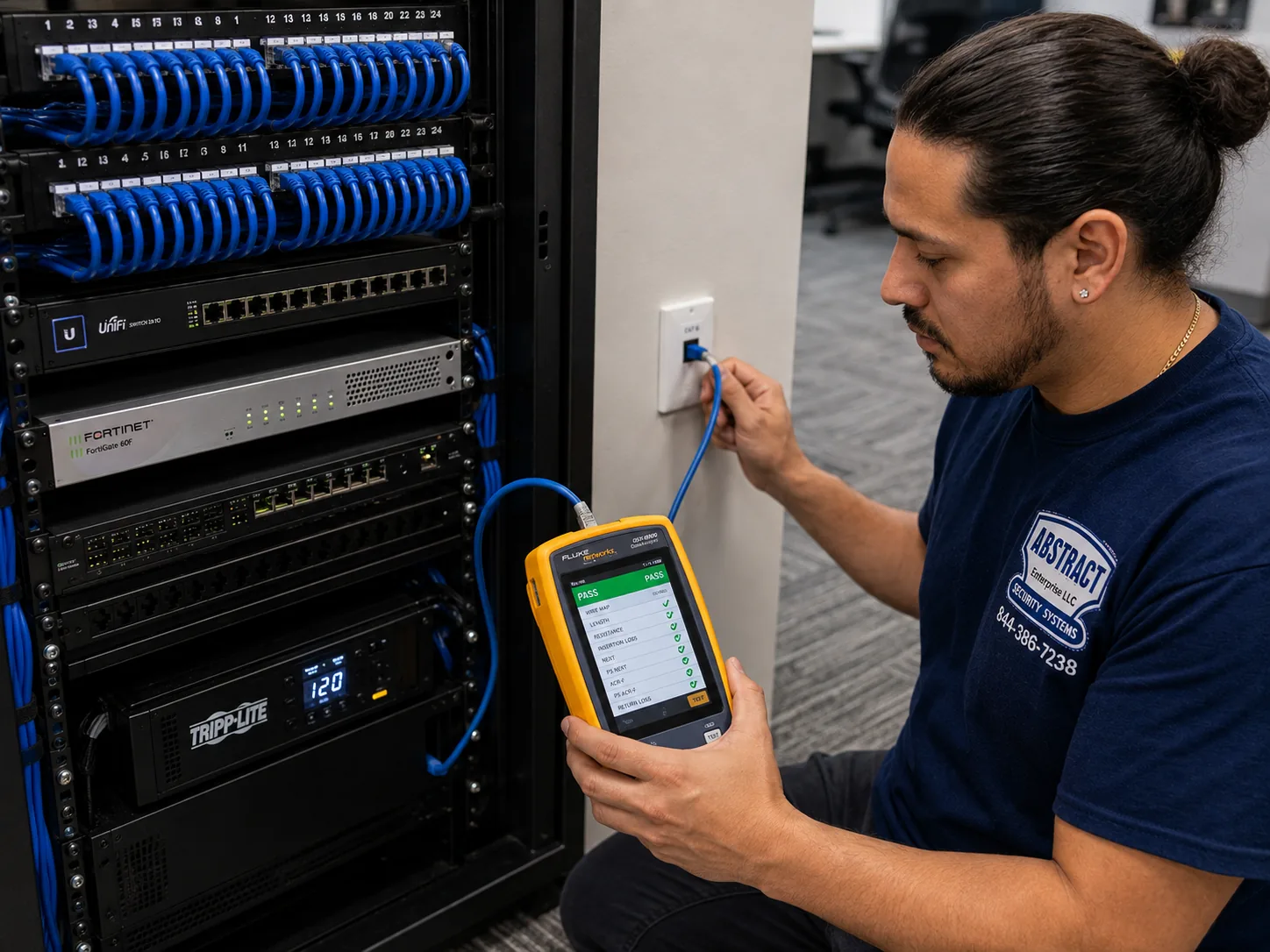
Blink camera installation reference for the Hudson Valley hub, Hudson Valley: technician holding a cable analyzer showing a PASS result while certifying a data drop
Photo from the AESS job library, not taken in the Hudson Valley: a technician certifying a data drop with a cable analyzer that reads PASS. A Blink job is tested differently, with signal and battery readings in the app instead of a cable tester, but the rule is the same: on a stone house in the Stockade or a farmhouse in Dutchess, a camera is not finished until a test at its final position says it works.
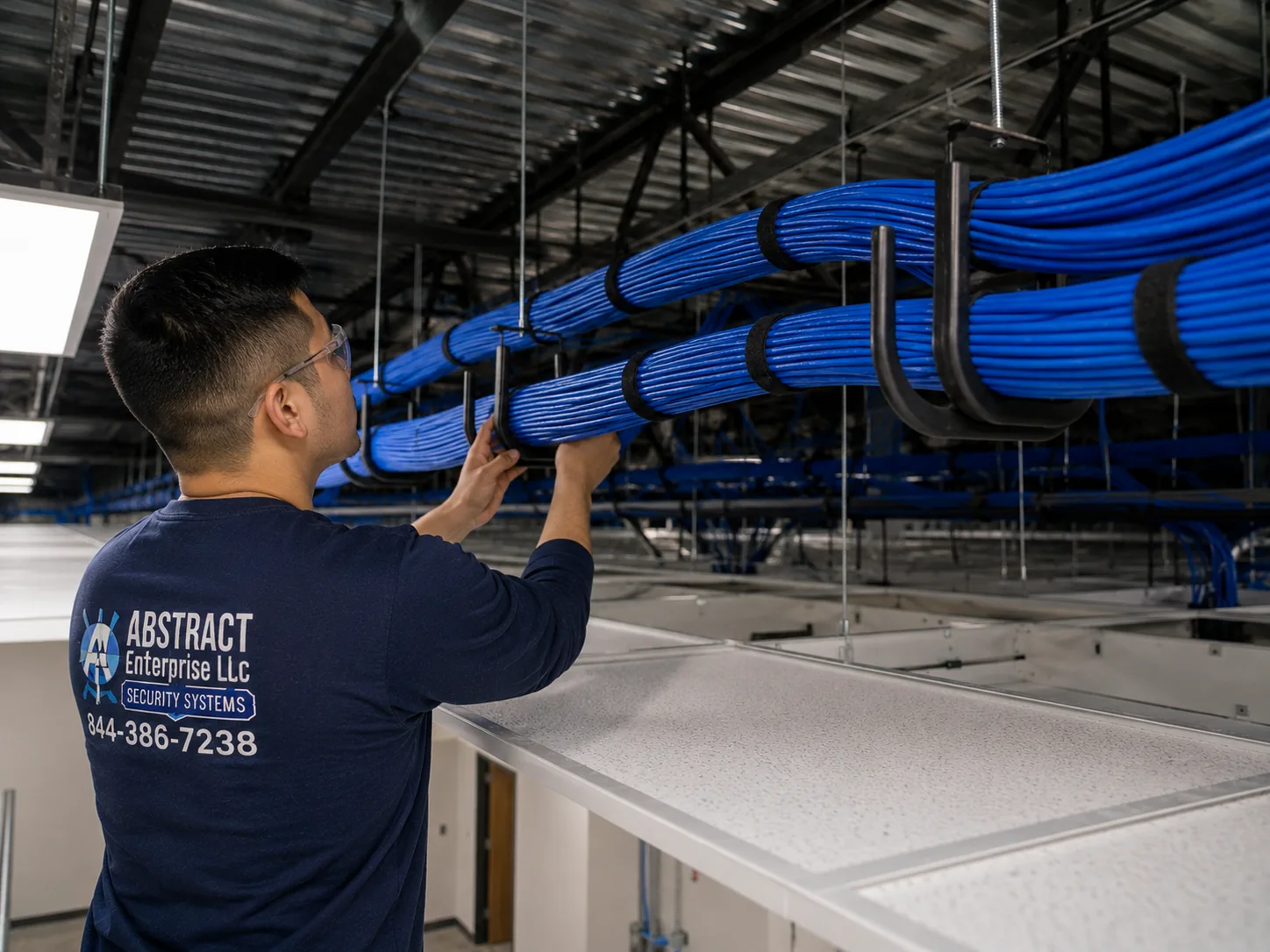
Blink camera installation reference for the Hudson Valley hub, Hudson Valley: J-hook pathway carrying dressed cable bundles across a commercial ceiling
Photo from the AESS job library, not taken in the Hudson Valley: a run of J-hooks carrying neat bundles of cable across a commercial ceiling. In the attic of a river estate or the loft of a barn, the power cable for a wired Blink camera is supported along the framing in the same way rather than left draped across insulation, where it can be crushed or chewed.
Commercial Blink Camera Installation

Business Blink Camera Installation in the Hudson Valley

Blink is a consumer camera line, and we say so to business owners up front. For a small shop, an office suite, a farm stand or a studio, it can be exactly enough: a camera over the register, one on the back door, one on the storage room. For a warehouse yard or a large lot, it is not the right tool, and we will tell you that. The corridors below are named in regional sources; we describe what those sources say about them and do not claim any business there as a client.

Uptown Kingston and the Stockade

Wikipedia describes the Stockade District as a mix of homes and businesses in an eight-block area. Small shops and offices in historic buildings, where cameras go inside looking out to protect the facade.

Route 59, Route 304 and Route 202 in Rockland

Commercial roads named on Rockland security pages, around the Palisades Center area. Strip shops and small offices where a doorway camera and a back-door camera cover most needs.

Westchester Avenue's Platinum Mile

Office buildings in White Plains along I-287, including 1111 and 1129 Westchester Avenue, about 335,000 square feet, per Westfair. Building-wide security is the landlord's system; a tenant suite may want its own inside camera.

Route 17K in Montgomery

HGAR reported a distribution center of more than a million square feet at Route 17K and Route 747. Sites at that scale need wired, recorded systems; Blink fits only a small satellite office or guard room.

South Road in Poughkeepsie

The IBM campus at 2455 South Road, where Dutchess County documents describe a new facility planned. Campus security is a major-system job; nearby small businesses are where Blink fits.

Village Main Streets and Farm Stands

The valley's village centers and seasonal farm businesses, where a shop may be open only part of the year and a battery camera that needs no wiring has real appeal.

Where Blink fits a business and where it does not

A battery Blink camera records clips when it senses motion; it is not a continuous recorder in the way a wired system with a network video recorder is. For a shop owner who wants an alert when the back door opens after hours and a clip of who came in, that is enough. For a business that needs every minute of the register on record, or cameras on poles across a parking lot, it is not. Blink plans also include no professional monitoring or response service, HomeGuide notes, so the owner is the one who decides whether to call the police. We talk through those limits before we quote, and if the honest answer is a wired system, the quote says so.

Rules and practical limits for business cameras in New York

  • Who may install. New York licenses security system installers. A New York alarm association's licensing course page warns that unlicensed installers of security systems, which it says include security cameras, can be fined, while a homeowner installing a system on their own home needs no state license. AESS works under NYS license #12000287431.
  • Audio is the risk most owners miss. New York follows a one-party consent rule for recording conversations. A Justia Ask a Lawyer answer warns that a camera recording voices with no consenting participant present can amount to eavesdropping, a class E felony. In a shop, we leave microphones off unless the owner has taken legal advice.
  • No cameras in private spaces. Penal Law 250.45 makes it unlawful surveillance to record a person in a bedroom, bathroom, changing room or fitting room without consent. Restrooms and changing areas are never in view.
  • Electrical work is an electrician's job. Westchester requires plumbers and electricians to hold a county trade license, and Rockland, Orange, Putnam and Ulster have their own county electrical licensing laws. If a camera needs a new outlet, that is electrical work and is done by a licensed electrician; our quote says so.
  • Landlords and facades. In a rented storefront, the exterior belongs to the landlord, and in a historic district the facade may be under review. We ask for written permission before fixing anything outside.
  • Police camera registries. Croton-on-Hudson police run a voluntary camera registration program for residents and businesses. Registering costs nothing and does not give police live access; it means they know whom to ask after a nearby crime.
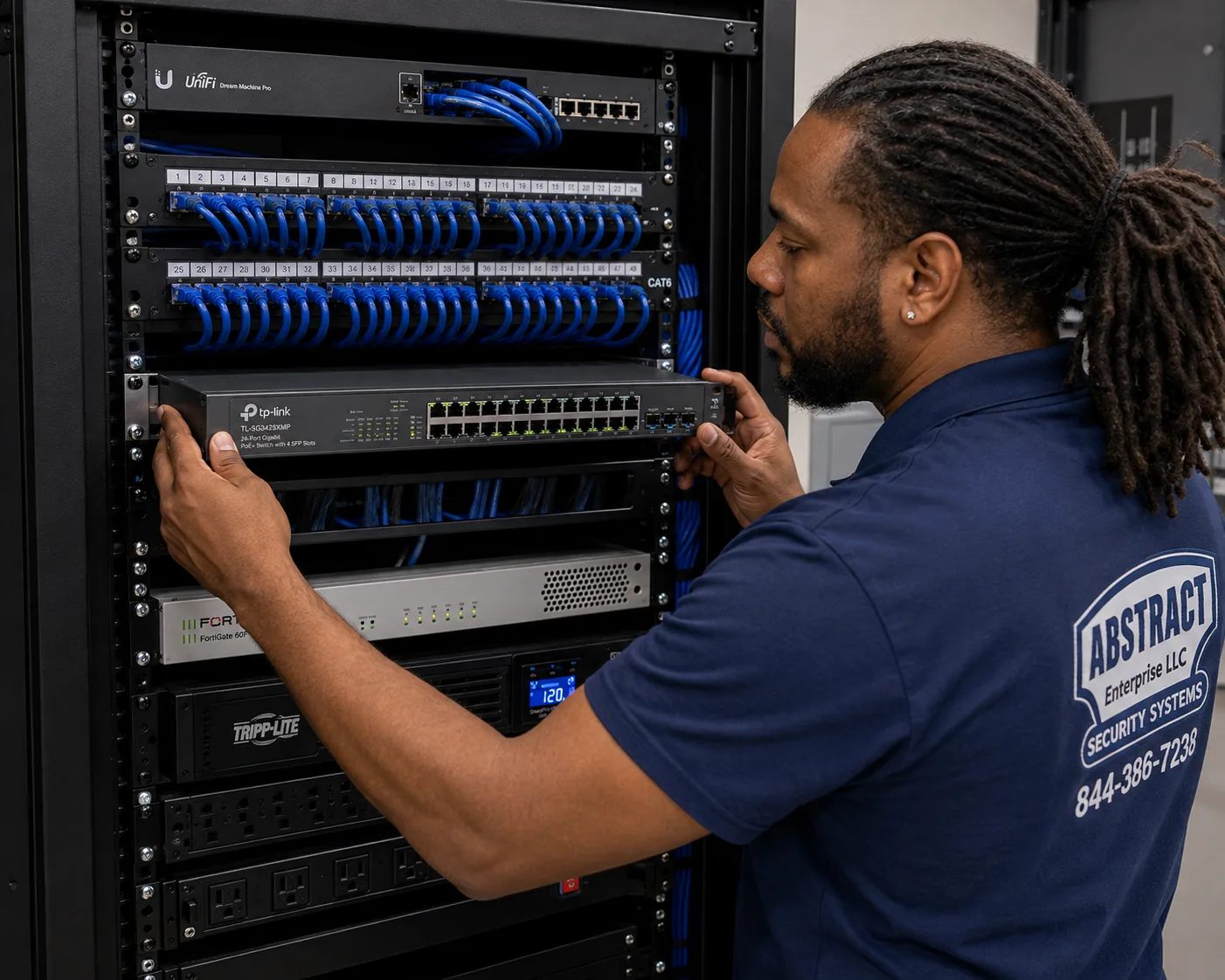
Blink camera installation reference for the Hudson Valley hub, Hudson Valley: technician mounting a managed PoE switch below patch panels in a commercial network rack
Photo from the AESS job library, not taken in the Hudson Valley: a technician mounting a managed PoE switch under the patch panels of a commercial rack. When a business along Route 59 or in a Platinum Mile office has outgrown battery cameras, this is the kind of wired backbone that takes over, and we tell owners honestly when they have reached that point.
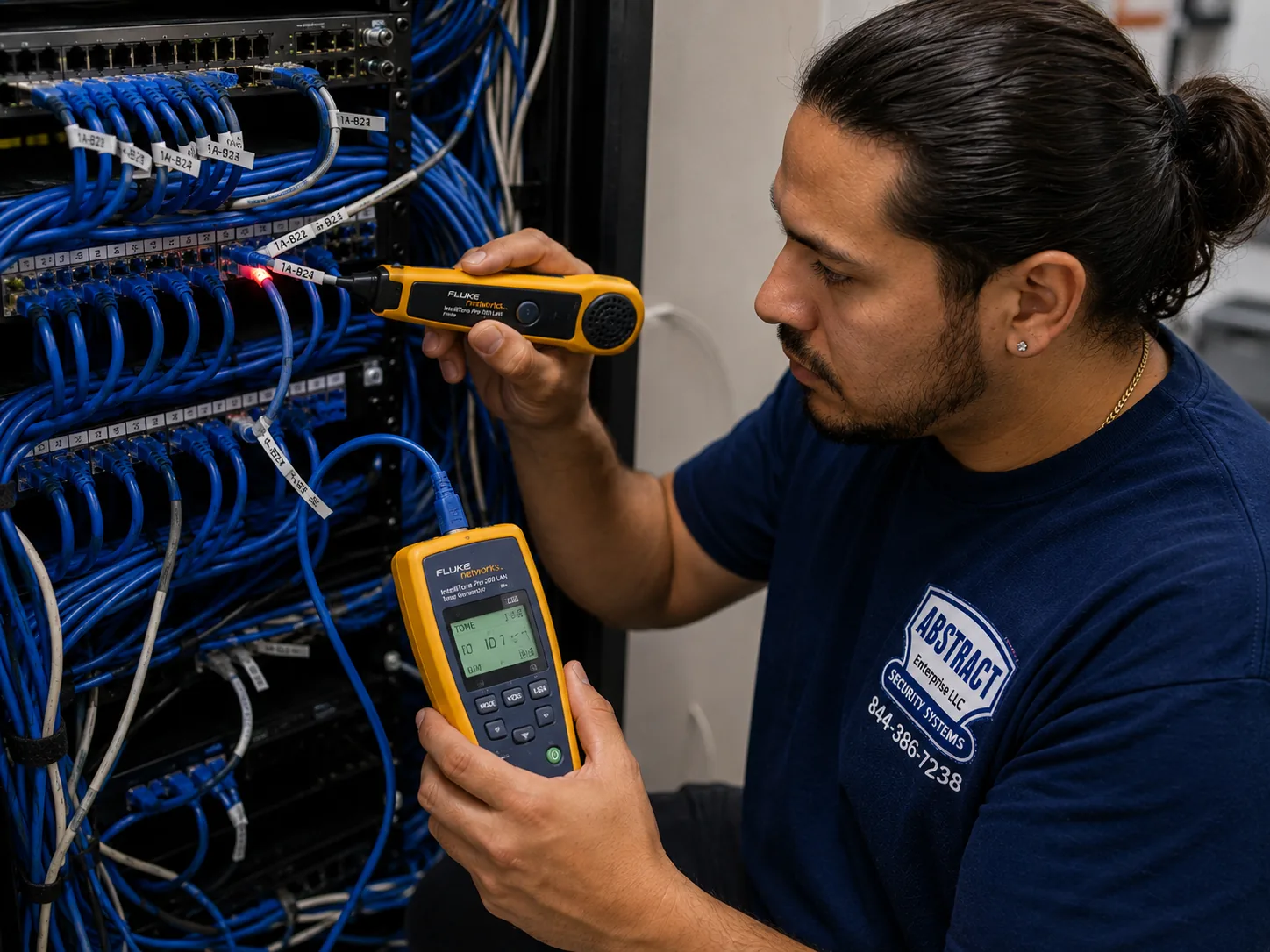
Blink camera installation reference for the Hudson Valley hub, Hudson Valley: technician tracing an unidentified cable run at a patch panel using a tone generator and probe
Photo from the AESS job library, not taken in the Hudson Valley: a technician tracing an unlabelled cable at a patch panel with a tone generator and probe. In an older shop building in Uptown Kingston, the cable that feeds the router a Blink system depends on is often just as mysterious, and finding it is the first step when cameras keep dropping offline.
Field Notes

Field Notes: Why We Carry the Cameras Around Before We Mount Them

We only tell stories about a specific property when we can document them, so this is not about one address. It is the routine our technicians follow on a typical valley job, where the router is in the house and the cameras need to be out by the garage, the barn or the gate.

Before anything is fixed to a wall, we pair the cameras to the Sync Module and then walk them, by hand, to each spot where they will live. We hold each one where it will hang, close the doors behind us, and watch the signal reading in the app settle. We take a test clip from that spot and play it back on the phone. Then we walk the next one. A camera that reads well in the driveway at noon with the front door open can read poorly once the door is shut and the van is gone, so we test with the house the way it will be on an ordinary night. On a stone house, that walk often moves the Sync Module from the room the owner expected into a porch or a frame addition. On a farm, it tells us within minutes whether the barn needs its own module. The drill comes out only after every camera has passed that walk, which is why the cameras we mount stay online after we leave.

Your Questions Answered

Blink Camera Installation in the Hudson Valley: Questions Answered

Winter, cold and batteries

Will a Blink Outdoor camera keep recording through a January night in Ulster or Dutchess when it drops far below freezing?

Usually, but not always, and the published rating is not the whole story. Blink rates its Outdoor cameras to operate from minus 4 to 113 degrees Fahrenheit, according to an answer on its Amazon product page. Owners report trouble before that limit: one on Amazon's forum said a Blink Outdoor would not record at 15 degrees, and another on Best Buy's question page said version 4 cameras gave up at minus 11 Celsius, stopped streaming on demand and eventually disconnected. Cold slows battery chemistry, and a camera that is also struggling for Wi-Fi spends more power on each clip. We reduce the risk in three ways: the right lithium cells, a mounting spot sheltered from wind under an eave where the view allows it, and a strong signal path so the camera is not straining. For a camera that must never miss a cold night, wired power removes the battery from the equation.

Do Blink batteries really die faster in the cold, and which ones should go in?

Yes, and the type matters. Battery guides that cite Blink say its cameras are designed for AA 1.5 volt lithium non-rechargeable batteries and list extreme heat and cold among the factors that shorten battery life. A battery vendor's guide adds that lithium cells hold steady across a very wide temperature range, while alkaline cells lose significant capacity in the cold. In practice that means the alkaline batteries in the kitchen drawer are a poor choice for a barn or driveway camera in the valley, and rechargeable AAs are not what Blink specifies either. We install fresh lithium cells and note the date in the handover sheet, so you know when the camera was last changed. If a camera is draining far faster than its neighbors, that usually points to weak signal or a busy activity zone rather than the battery itself, and we look at both.

Can a Blink Mini watch our unheated mudroom, enclosed porch or barn through the winter?

Not reliably. Blink states that its Indoor and Mini cameras operate from 32 to 95 degrees Fahrenheit and are intended for indoor use only. An unheated porch, a garage or a barn in the valley spends much of the winter below freezing, so a Mini there is outside its rating for months at a time. For those spaces we use an Outdoor model instead, even though it sits indoors, because its rating is wider and it is built for damp air. The Mini stays in heated rooms, where it does a good job looking out a window at a driveway or watching an entry hall. If you already bought Minis for the barn, we will tell you which spots they can safely move to.

Signal, distance and staying online

Why does our Blink Outdoor 2K+ keep dropping offline when it worked fine the day we set it up?

Blink's own guide to offline cameras points to three usual causes: weak signal, low batteries and unstable Wi-Fi, and tells owners to check battery and signal in the app and confirm a stable 2.4 GHz connection. In valley houses the most common version is the first one. The camera was paired on the kitchen table, then mounted outside a stone or brick wall, or past the point where the Sync Module's roughly 100-foot range holds up. Signal that is barely enough on a dry day fails on a wet one, or once the trees leaf out. Batteries then drain faster as the camera keeps reconnecting, which makes the problem worse. We read the signal from the mounted position, move the Sync Module or add a second one where the readings call for it, and check the router's 2.4 GHz band, which some newer routers combine with 5 GHz in a way that confuses smart devices.

Our barn and front gate are several hundred feet from the house. Can Blink reach that far?

Sometimes, with the right module and a compromise on picture quality. In Tom's Guide's test of Blink's Extended Range feature, Extended Range let a camera work up to 250 feet from the house at up to 720p, and Extended Range Plus reached 400 feet but dropped the picture to 360p. Deal-forum listings note that one Sync Module XR handles up to ten devices but only two of them can use the extended range, an account can have up to two XR modules, and the feature works only with the Blink Outdoor 4 and Outdoor 4 Floodlight. At 360p, a camera at the gate will show that a car arrived, but probably not its plate. Where the barn has power and Wi-Fi of its own, a standard Sync Module placed in the barn is often the better answer, with full picture quality. We measure both options on site before you buy.

We bought new Blink cameras, but our older Sync Module has the USB stick for local storage. Will they work together?

That is a question owners ask on deal forums, and the honest answer is that it depends on the exact combination, so we check before you buy rather than after. What the published listings do show is that local storage depends on the module, not the camera: an Outdoor 4 bundled with the Sync Module Core can only save clips to paid cloud storage, while the Sync Module XR adds extended range and a slot for local recording. If keeping clips at home without a subscription matters to you, tell us which module you own and which cameras you want, and we will confirm in the Blink app and Blink's own documentation that the pairing and the storage you expect will actually work.

Our road still has no broadband. Is there any way to run Blink cameras out here?

Not without some internet connection at the house, because Blink cameras send their clips and alerts through the Sync Module and your Wi-Fi. Hudson Valley One reported 1,070 Ulster properties without broadband in 2023, Hudson Valley 360 later counted roughly 700 Columbia County addresses without internet, and state funding is now paying providers to reach the remaining unserved locations in parts of Putnam, Dutchess, Orange, Ulster and Westchester. If your house has a satellite or cellular internet connection, Blink can work over it, but clips use data and upload speed matters, so we look at your plan's limits first. If the house has no connection at all, we will tell you plainly that Blink is the wrong camera for now, rather than selling you a system that can only record motion nobody ever sees.

Power and outages

Can our Blink cameras be wired or solar-powered so nobody climbs a ladder every few months?

Many of them can, but the options differ by model. Battery guides that cite Blink say the Outdoor 3rd Gen works with Blink's weather-resistant 13-foot power cable and adapter pack, the Outdoor 4 with its Weather Resistant Power Adapter, and the Blink Solar Panel Mount powers the Outdoor 3rd Gen only. For doorbells, the wired option runs from a qualifying chime transformer, and the Wired Doorbell 2K+ can use Blink's plug-in adapter from an indoor outlet, which Blink notes has no battery backup. Wired power needs an outlet within reach; where there is none, a new outlet is work for a licensed electrician, which we arrange or leave to yours. Solar on a valley lot depends on winter sun, not summer sun, so we look at where the panel would sit in December before recommending it.

After a long Central Hudson or O&R outage, will our Blink cameras come back by themselves?

Battery cameras keep their own charge, so they usually come back as soon as the Sync Module and the router do. The weak link is the router. Some come back cleanly after a power cut; others need to be restarted, or come back before the internet provider's line does and leave the Sync Module unable to connect. Outages here can be large: Central Hudson reported 41,323 customers affected after the July 4, 2026 storms, and the Daily Voice reported NYSEG with 34,150 of 38,693 Putnam customers out during Isaias in 2020. Before we leave a job, we switch the router off and on and watch every camera reconnect without anyone touching it. If yours does not recover cleanly, we tell you, and a small battery backup on the router and Sync Module keeps the system uploading through short outages.

Privacy, rules and the law

Is it legal to leave the microphone on our Blink cameras in New York?

New York follows a one-party consent rule for recording conversations, and that is where outdoor microphones get risky. A Justia Ask a Lawyer answer from October 2025 warns that a camera that records voices when you are not there, with no participant consenting, can count as eavesdropping, a class E felony, and that leaving the microphone on while away risks recording delivery drivers, neighbors or visitors. Video inside private rooms is a separate issue: Penal Law 250.45 makes it unlawful surveillance to record a person in a bedroom, bathroom or changing room without consent. We are not lawyers, so we set cameras up conservatively: outdoor microphones off unless you decide otherwise after advice, and no camera pointed into a private room, including rooms in a guest suite or rental unit.

Do we need a permit or a historic-district sign-off to put Blink cameras on our house?

For most valley homes, a battery camera screwed to the house is not something a building department regulates, but historic districts are the exception to check. Kingston's Historic Landmarks Preservation Commission reviews exterior work on historic properties visible from the public right of way before a building permit is issued, and its ordinance bars material changes to a property's appearance in a landmark district without approval. We found no source that says whether a small camera alone counts, so we do not guess. On a district house, we suggest asking the city or village first, keeping street-side cameras small and discreet, and mounting on trim rather than stone where we can. Any wired power that needs a new outlet is electrical work, which may need a permit and an inspection from the town.

Our village police keep a list of private cameras. Should we register our Blink system?

It is up to you, and it costs nothing in the places that offer it. The Village of Croton-on-Hudson asks residents and businesses to register private camera systems voluntarily, and says registrants are contacted only if a crime happens near their camera. Registration does not give police access to your cameras; it simply tells them whom to ask. If you register, it helps to know how long your Blink plan keeps clips, how to download and share one, and which camera covers what, and we leave you a written sheet with exactly that. Other departments may run similar programs; if yours does not, the same preparation still makes you ready when State Police ask a whole road to check its footage, as they did in Dutchess.

What Blink can and cannot do

State Police asked our road to check cameras between midnight and 5 a.m. How should a Blink be set so it would have caught something?

The requests Patch reported in Dutchess, for Hoofprint Road, Weatherford Lane, Verbank Road and others, tell you what a valley camera needs to do: wake up for a person or a car in the dark, record clearly enough to be useful, and keep the clip until someone asks. That means a camera close to where vehicles must slow down, such as the turn into the drive or the spot beside the parked cars, rather than high on a gable looking at the whole yard. It means night vision tested from the real position, because a porch light can wash out a picture, and an activity zone that covers the driveway, not the road. It means the system armed overnight on a schedule, and storage set so clips survive long enough to be requested. We set and test each of those before handover.

After the Scarsdale reports of hidden cameras in bushes, can our Blink cameras help spot someone watching the house?

They can help, if they cover the right ground. Hudson Valley Post reported that a Scarsdale resident found a surveillance camera in the bushes aimed at their home on Bradford Road, and Scarsdale police described organized burglars placing trail cameras or similar devices for days before a burglary. A Blink camera will not detect another camera, but it will record whoever walks into your hedge line or side yard to place one. We make sure at least one camera's zone covers the side and back approaches, not only the front door, and that motion alerts from those zones reach your phone while you are away. During setup, we also look along hedges and fence lines with you; it costs nothing and is worth doing on any property in the region.

Is Blink actually a good security system for a valley property, or should we be looking at something wired?

Blink is good at what it was designed for: affordable, battery-powered cameras that send motion clips and alerts to your phone, with no wiring and, as HomeGuide notes, no professional monitoring or police dispatch. A deal-forum commenter summed up a common view, that Blink works best in low-traffic areas where wired cameras would be hard to install. For a suburban house, a weekend home or a small barn, that fits well. For an estate drive, a busy farmyard or a business that needs every minute on record, a wired system with continuous recording usually serves better. We install both kinds of system, so we have no reason to push one. We look at what you need to see, how often things move in front of the cameras, and how reliable your power and internet are, and then give you a straight recommendation.
Equipment

Types of Blink Camera Installation We Install

These are the Blink devices and accessories we fit on valley properties. We install cameras you already own, or we can supply them; current pricing for your county is on its Blink price page. Model names below are Blink's own; where a feature applies only to some models, we say so.

📷

Blink Outdoor 4 and Outdoor 2K+

Weather-resistant battery cameras for doors, driveways and outbuildings. They need a Sync Module, per Blink. The Outdoor 4 is the model that works with Extended Range for far-off spots.

📸

Blink Outdoor 3rd Gen

The earlier outdoor model, still common on valley houses, and the one Blink's Solar Panel Mount supports. We fit, re-site and power these as readily as new cameras.

💡

Outdoor 4 Floodlight

A camera with a light for a dark driveway or barn door, and the other model named as Extended Range compatible. Aimed and timed so it lights the path without lighting the neighbor's window.

🔔

Battery and Wired Doorbells

The Battery Doorbell, which needs a Sync Module, and wired doorbells on chime systems of 16 to 24 volts AC, or on Blink's plug-in adapter where there is no chime wiring.

🏠

Blink Mini and Indoor Cameras

Plug-in cameras for heated rooms only, rated 32 to 95 degrees. The Mini 2K+ connects straight to Wi-Fi without a Sync Module, per Blink, which makes it useful in attached homes.

📶

Sync Module Core, 2 and XR

The hubs that link cameras to your Wi-Fi. The XR adds Extended Range for up to two cameras and a slot for local recording; the Core bundled with an Outdoor 4 relies on cloud storage.

🔌

Power Cables, Adapters and Solar

Blink's weather-resistant power cable and adapter pack, the Outdoor 4 power adapter and the Solar Panel Mount, each matched to the model it actually supports.

🔋

Lithium Batteries and Mounts

AA 1.5 volt lithium non-rechargeable cells as Blink specifies, plus wall, gutter, post and no-drill mounts chosen for the surface and the weather on each side of the house.

National security brands vs a local Blink installer

People sometimes ask whether they should simply call ADT, or buy a Ring or SimpliSafe kit instead. They are different things. ADT is best known for monitored alarm systems with a contract and a response service. Ring and SimpliSafe sell their own cameras and do-it-yourself kits, as Blink does, and Blink, per NerdWallet, offers no professional installation at all. None of them sends someone to measure the signal through a fieldstone wall, find the best home for a Sync Module in a farmhouse, or test how a camera at the end of a Putnam drive behaves after the power has gone out. That is the work a local installer does, whichever brand ends up on the wall. If you want monitored alarms as well, that is a separate system with its own quote; Blink itself, as HomeGuide notes, has no professional monitoring.

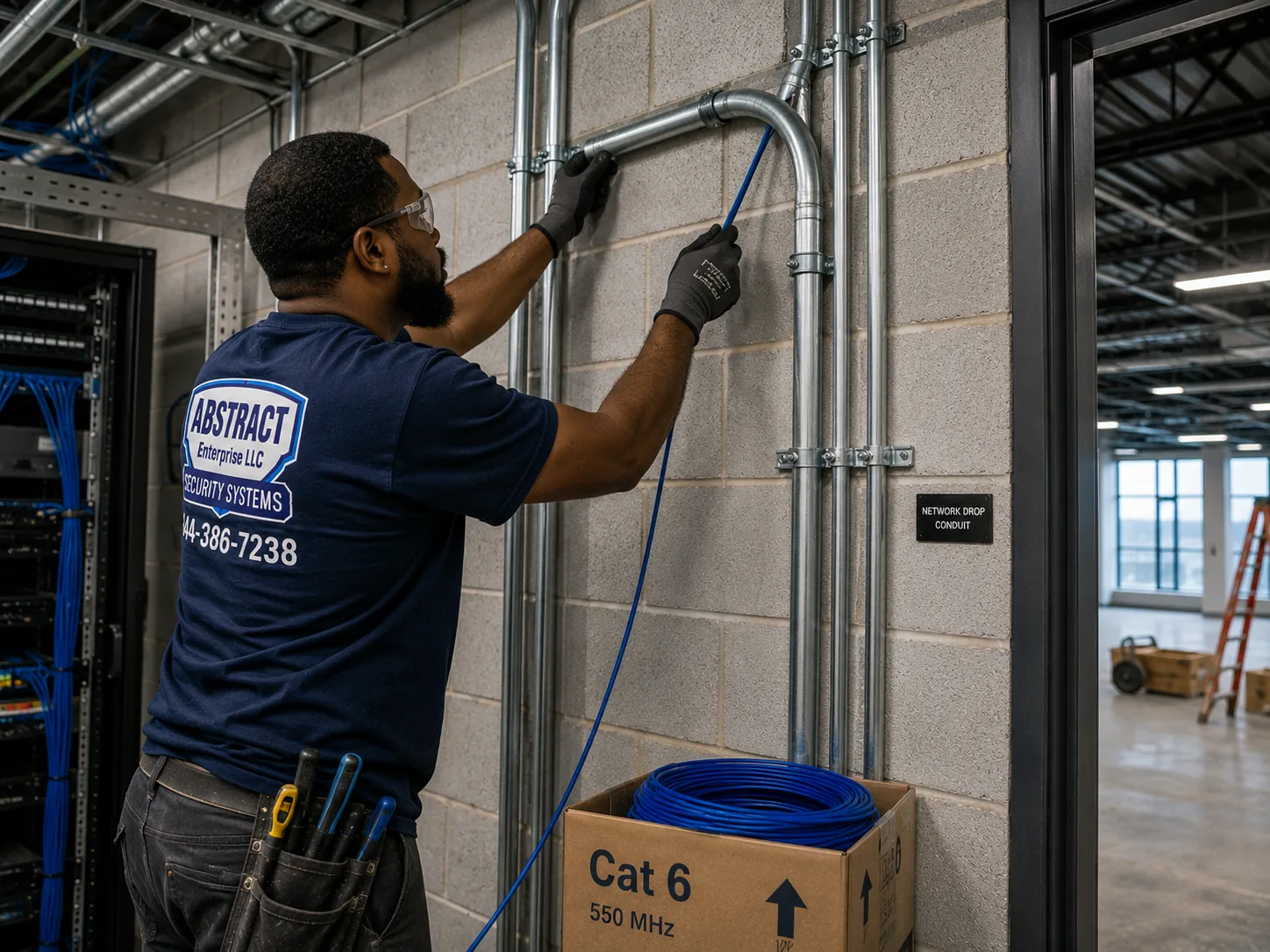
Blink camera installation reference for the Hudson Valley hub, Hudson Valley: technician running cable into EMT conduit beside a telecom room in an industrial building
Photo from the AESS job library, not taken in the Hudson Valley: a technician running cable into metal conduit beside a telecom room in an industrial building. On the outside wall of a barn in Orange County or a garage in Rockland, the power cable for a wired Blink camera gets the same protection where it is exposed, so weather, rodents and string trimmers cannot reach it.
AI Overview Reality Check

What AI Gets Wrong About Blink Camera Installation in the Hudson Valley

We could not capture Google's AI Overview or its People Also Ask boxes for this topic from our build environment, so we will not pretend to quote them. Instead, these are claims that appear again and again in quick online answers, cost guides from marketplaces such as Angi, HomeAdvisor and Fixr, and product summaries about Blink, set against Blink's own documentation and what valley properties actually do to a wireless camera.

"Blink is a ten-minute DIY job, so nobody needs an installer."

For one camera on a suburban front porch with the router in the next room, that is often true. Blink designed its cameras to be self-installed, and NerdWallet's review notes Blink offers no professional installation at all.

The valley breaks that assumption. A stone wall, a detached garage eighty feet away, a router in a basement and a camera that has to survive January are four separate reasons a ten-minute job becomes a system that keeps dropping offline.

What an installer adds is not the screwdriver. It is the signal survey from the final mounting spot, the choice of where the Sync Module goes, and the power plan for each camera, done before anything is fixed to the house.

"Blink Outdoor cameras work in any weather."

Blink rates its Outdoor cameras from minus 4 to 113 degrees Fahrenheit, which covers most valley days. The rating says nothing about how long batteries last at the cold end, or how a camera behaves when it is cold and on weak signal at the same time.

Owners have reported trouble well inside the rating: an Outdoor that would not record at 15 degrees, and version 4 cameras that stopped streaming and disconnected at minus 11 Celsius.

Weather-resistant is not weather-proof. Sheltered mounting, lithium cells and strong signal keep a valley camera working through winter, and wired power is the answer where a missed night is not acceptable.

"Any AA battery will do."

Many quick answers treat a Blink camera like a remote control. Guides citing Blink say the cameras are meant for AA 1.5 volt lithium non-rechargeable batteries.

Alkaline cells, a battery vendor's guide notes, lose significant capacity in cold weather, and in a valley winter that difference shows up as a camera that goes quiet weeks earlier than its neighbors.

We install lithium cells, record the date, and if a camera still drains quickly, treat it as a signal or motion-zone problem rather than simply swapping batteries again.

"The Sync Module reaches 100 feet, so the barn is covered."

Blink does say its Sync Modules can communicate with cameras up to 100 feet away. It also says to keep the module away from thick walls, concrete, brick, stone and metal.

In SafeHome's testing, real-world strong connection held to about 70 to 80 feet once walls and obstacles were involved. A valley barn with metal siding, behind a stone house, may be well past that.

Range is measured, not assumed. A second module in the barn, or the Extended Range module with its lower picture quality, is chosen from readings taken where the camera will actually hang.

"New York requires everyone's consent to record audio."

This one shows up even on installer websites, including an older page of our own, which said New York had a two-party consent law. That is wrong. New York's rule is one-party consent.

The correction does not make outdoor microphones safe. A Justia attorney answer warns that a camera recording voices with no consenting participant present can amount to eavesdropping, a class E felony, which is exactly the situation when you are away and a delivery driver talks at the door.

Our default is microphones off on outdoor cameras unless you decide otherwise with proper advice, and no camera ever pointed into a bedroom, bathroom or changing area.

"A Blink system will alert the police if someone breaks in."

Blink is self-monitored. HomeGuide notes that Blink plans include no professional monitoring or response service, so in an emergency you call the police yourself.

That matters most on a weekend home or a farm where nobody is watching the phone at three in the morning. The camera records, the alert goes out, and if no one sees it, nothing else happens.

We set alerts so they are useful rather than constant, share access with a neighbor or caretaker if you want, and tell you plainly when a monitored alarm system would be a better fit than cameras alone.

"Add a solar panel and you will never change a Blink battery again."

Solar sounds like the obvious fix for a camera that eats batteries. But battery guides citing Blink say the Blink Solar Panel Mount powers the Outdoor 3rd Gen only; the Outdoor 4 uses Blink's weather-resistant power adapter instead.

Even on the right model, a panel needs sun when the camera needs power most. On a wooded Putnam lot or a north-facing wall in Ulster, December light can be far too weak to keep up.

We check the model first, then look at where the panel would sit in winter, and recommend a power cable to an existing outlet wherever the sun simply is not there.

Not Sure Your Barn or Gate Is in Range? Talk to a Technician About Your Property

Send a rough map of the house and outbuildings, photos of the walls where cameras would go, your internet provider and the Blink models you own. A technician will tell you whether one Sync Module will do, whether the far spots need Extended Range or wired power, and which lines of your county's price page apply. Call (800) 486-0943, message us on WhatsApp, or use the quick form.

How It Works

Our Installation Process

Every valley Blink job follows the same eight steps, whether it is a single doorbell in Westchester or a house, barn and gate in Dutchess. The order matters because the two things that sink wireless camera systems here, weak signal and the wrong power, can only be fixed cheaply before anything is mounted.

1. Send photos, the county and the camera list

Photos of each door, drive and outbuilding, your town and county, your internet provider and the Blink models you own or want. We match the job to your county's price page before you book.

2. Agree coverage and privacy limits

What each camera must see, what it must not see, such as a neighbor's windows, the road or a guest room, and whether microphones stay off.

3. Map the Wi-Fi and Sync Module signal

We walk the property with the app, read 2.4 GHz signal at each spot with the doors closed, and decide where the module goes, away from stone, brick, concrete and metal.

4. Choose power for each camera

Lithium AA cells, a weather-resistant cable or adapter, a solar panel on the model that supports it, or a chime transformer checked for 16 to 24 volts AC for a wired doorbell.

5. Mount the cameras

Into wood, siding, stone or brick with fixings suited to the material, at heights that catch faces and plates and stay out of easy reach.

6. Set zones, sensitivity and schedules

Activity zones drawn to the paths people use, sensitivity tuned against deer, branches and passing cars, and an arming schedule that fits the household.

7. Test recording, night vision and recovery

Every camera triggered, day and night clips checked, the router restarted to confirm everything reconnects alone, and signal read again from each mounted position.

8. Hand over the app and the paperwork

A walkthrough of the app, shared access and storage, and a written sheet listing each camera, its location, its power source and its battery date.

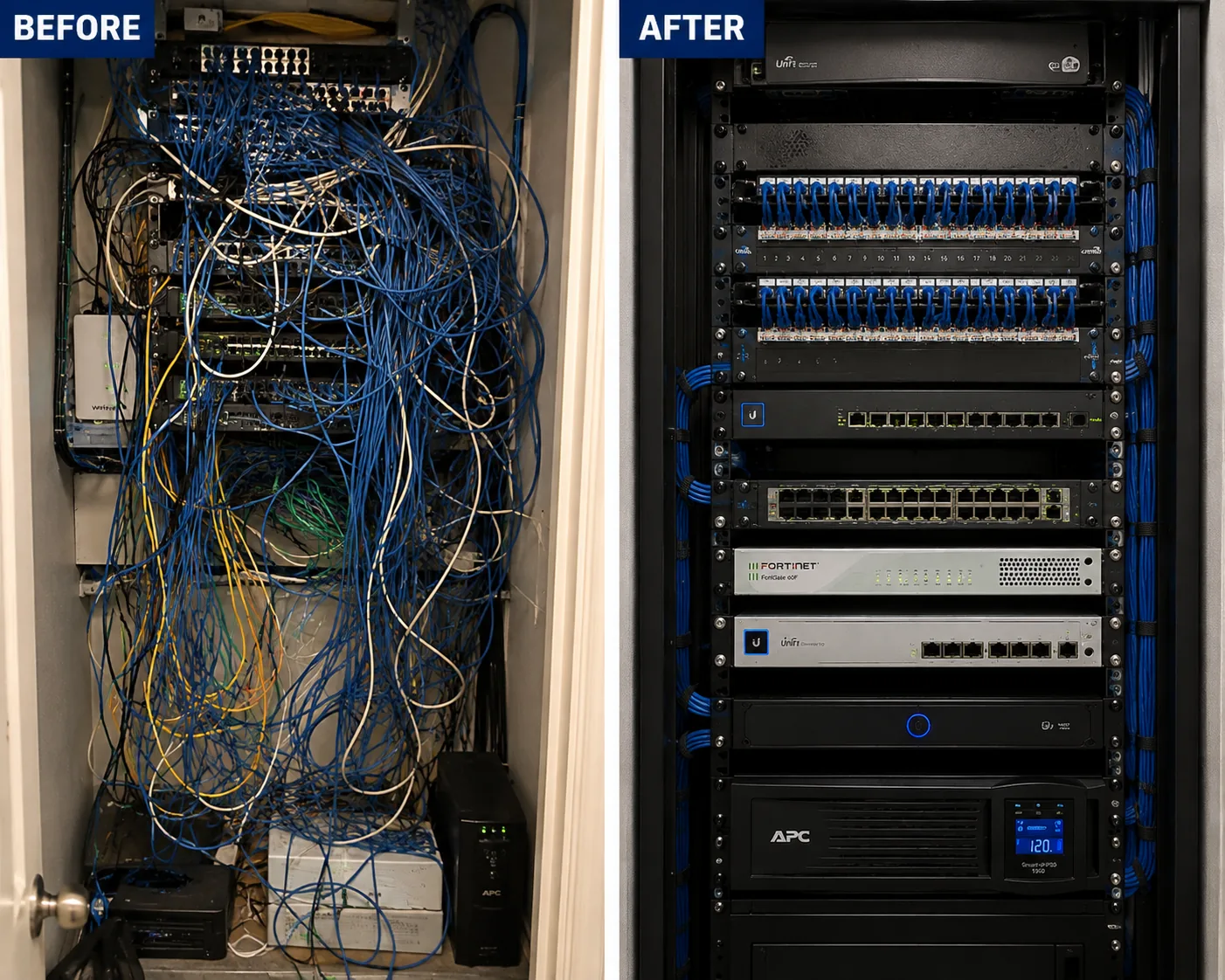
Blink camera installation reference for the Hudson Valley hub, Hudson Valley: before and after views of a network rack, tangled and unlabelled on one side, rebuilt dressed and identified on the other
Photo from the AESS job library, not taken in the Hudson Valley: a rack shown before, as an unlabelled tangle, and after, rebuilt with every cable dressed and identified. The Blink version of that cleanup is the written handover sheet: on a valley property with cameras on the house, the garage and the barn, it tells the next person exactly which camera is where, what powers it and when its batteries were last changed.
Coverage Area

Blink Camera Installation Near the Hudson Valley's Landmarks

The valley is too large to describe by street, so most people give directions by its towns, districts and great houses. These are landmarks across our six counties that help place a job, each with what the public record says about it.

Kingston Stockade District

Eight blocks and 32 acres of Uptown Kingston, listed on the National Register in 1975, with colonial Dutch stone houses and the Senate House from 1676, per Wikipedia. The hardest walls in the region for a Sync Module.

Hudson River National Historic Landmark District

Designated in 1990 and described as the largest such district on the mainland of the contiguous United States, spanning towns, hamlets, villages and more than forty riverfront estates.

Mills Mansion, Staatsburgh

A neoclassical Beaux-Arts mansion in Hyde Park by McKim, Mead & White, as the Baltimore Sun described it, one of the great houses that give the Great Estates region its name.

Vanderbilt Mansion, Hyde Park

Built between 1896 and 1899, with a carriage house and its own hydroelectric plant on Crum Elbow stream on 211 remaining acres, per Wikipedia: the scale of property where one Sync Module is never enough.

East End Historic District, Newburgh

Which Newburgh describes as the second largest designated historic site in New York State, with Italianate row houses and Washington's Headquarters among its buildings.

Village of Croton-on-Hudson

Whose police invite residents and businesses to register private camera systems voluntarily, contacting them only when a crime happens near a camera.

Across the six counties we serve towns from Port Chester, Rye and Scarsdale in Westchester to West Nyack in Rockland, Newburgh and Montgomery in Orange, Cold Spring and the wooded towns of Putnam, Millbrook, Union Vale and Rhinebeck in Dutchess, and Kingston, Esopus and New Paltz in Ulster. Each county's numbers are on its own page: Westchester, Rockland, Orange, Putnam, Dutchess and Ulster. South of the valley we also install Blink cameras throughout New York City, with NYC Blink pricing, and on Long Island, with Long Island Blink pricing. For everything else AESS does, start at our home page.

Pricing

Blink Camera Installation Cost in the Hudson Valley

We do not print a single Blink figure for the whole valley on this page, because there is no single figure. Each county sits at a different point on our area scale, set against our Brooklyn base, and the published price for your property is the one on your county's Blink price page, where the calculator lets you build your own system camera by camera. The scale exists for practical reasons: valley lots are larger, cameras sit further apart, masonry is more common, and the drive to a job in Ulster is longer than the drive to one in Westchester.

CountyArea scale vs Brooklyn baseWhy it lands thereWhere to see the numbers
Westchester1.25×Closest to the city, mostly suburban lots, shorter travelWestchester price page
Rockland1.30×Suburban and village properties with deeper back lotsRockland price page
Orange1.40×River cities, suburbs and farms; longer drives and outbuildingsOrange County price page
Putnam1.45×Wooded, hilly lots with houses set back from the roadPutnam price page
Dutchess1.53×Farms, estates and long rural roads; furthest travelDutchess price page
Ulster1.53×Stone houses, mountain towns and the hardest signal conditionsUlster price page

What moves the total within a county

Within any one county, the price of a Blink job is driven by a handful of things you can see for yourself. The number of cameras is the first. Whether each one runs on batteries or needs wired power is the second, because a power cable routed and protected along a wall takes more time than a battery camera on a bracket. The third is the wall: siding and wood trim are quick, while fieldstone and brick need masonry drilling and anchors. The fourth is distance, which decides whether one Sync Module is enough or whether the barn needs its own, or the gate needs the Extended Range module. A doorbell adds a check of the chime transformer. The Hudson Valley Blink price page sets these out line by line, and your county's page applies its scale to each line, so you can total a job before you call.

What is not part of our price

Blink's own cloud storage plans are billed by Blink, not by us, and we explain what each plan keeps before you choose. New electrical outlets are work for a licensed electrician; if one is needed, the quote names it and who will do it. If a historic commission or association requires drawings or an application, that is between you and them, though we will give you the device photos and mounting details they ask for.

Full terms — including 50% deposit, one-year parts-only warranty on AESS-supplied products, and the late-fee schedule — are set out in the service agreement.

Shop Our Systems

Blink Camera Installation Packages & Pricing

Three common valley setups, described by what they include. Each one is priced on your county's Blink price page from the same line items, so there is no package premium and nothing hidden; the packages simply show what a typical property usually needs.

Starter: Front Door and Driveway

A battery or wired Blink doorbell, one Outdoor camera over the driveway, one Sync Module placed after a signal check, lithium batteries, zones and schedules set, and the app walkthrough. Suits a Westchester or Rockland house on a village lot. See the Westchester or Rockland page for the figures.

Standard: Whole-House Perimeter

Doorbell plus Outdoor cameras at the front, back and garage, a Mini in a heated room watching the main entrance from inside, one or two Sync Modules as the survey requires, and wired power on the busiest camera. The usual job on an Orange or Putnam house. Figures on the Orange and Putnam pages.

Premium: House, Barn and Long Drive

Perimeter coverage of the house, a separate module and cameras for the barn or carriage house, Outdoor 4 cameras on the drive or gate using the Extended Range module where the survey supports it, and wired or solar power on the hardest-to-reach spots. Built for Dutchess and Ulster farms and estates. Figures on the Dutchess and Ulster pages.

Bring your own Blink cameras

Many valley owners already have a box of Blink cameras, bought on sale or as a gift, sitting in a closet because the first try at setup did not go well. We install your own equipment at labor-only rates from your county's price page. We check every device first: which model it is, which Sync Module it pairs with, whether it is rated for the spot you have in mind, and whether it is a Mini that someone hoped to put in the barn. If a camera you own is not suitable for a spot, we say so and suggest where it can go instead, so nothing you bought goes to waste. We also install new Sync Modules, power accessories and mounts that you supply, as long as they are genuine parts made for the model.

Complete Services

Every Blink Camera Installation Service in the Hudson Valley

Hudson Valley Blink Price Page

Every line item for the region, with the calculator to build your own system. Hudson Valley Blink camera installation prices

Lower Hudson Counties

Suburban lots, doorbells and driveway cameras closest to the city. Westchester Blink prices · Rockland Blink prices

Orange and Putnam

River cities, farms, wooded hills and outage-prone roads. Orange County Blink prices · Putnam Blink prices

Dutchess and Ulster

Estates, farms, stone houses and the longest drives. Dutchess Blink prices · Ulster Blink prices

New York City and Long Island

The same careful installs in the five boroughs and on the Island. NYC Blink prices · Long Island Blink prices

Get a Quote

Send photos, distances and your camera list and we will match them to your county's page. Request a free quote

FAQ

Hudson Valley Blink Camera Installation FAQ

Does Blink send its own technician to install cameras at a Hudson Valley house?
+

No. Blink sells its cameras as do-it-yourself products, and NerdWallet's review lists no professional installation available. If you want someone to plan the Sync Module placement, power and mounting, that is done by an independent installer such as AESS, working with the cameras Blink sells.

What should we look for when hiring someone to put up Blink cameras in the valley?
+

Ask for a New York State license number, a written scope that lists every camera, its power source and the Sync Module plan, and a clear statement of who does any electrical work. Ask whether they will test signal from the final mounting spots and test recovery after a router restart. AESS works under NYS license #12000287431 and leaves a written handover sheet on every job.

Can you put our Blink cameras on a fieldstone or brick wall without wrecking it?
+

Yes. We drill into the face of sound stone or brick rather than soft mortar, use anchors made for masonry, and keep holes small enough to fill neatly if the camera is ever moved. Where the house has wooden trim, a porch beam or a lintel near the spot, we often mount there instead, which is gentler on an old wall and less visible from the street.

Can our new Blink doorbell run off the old doorbell wiring in our farmhouse?
+

Only if the chime system supplies what Blink asks for: 16 to 24 volts AC at 50 to 60 hertz and no more than 40 VA. Old farmhouse chimes often fall outside that. If the wiring does not qualify, Blink's app reports that wired power is not supported, so we test the chime first and fall back to a battery doorbell or Blink's plug-in adapter where needed.

Do we have to pay Blink every month to keep clips from the cameras?
+

It depends on your Sync Module and what you want to keep. Security.org notes Blink's plans include 60 days of cloud storage, and listings show that an Outdoor 4 paired with the Sync Module Core saves clips only to paid cloud storage, while the Sync Module XR adds a slot for local recording. We explain the options before you choose; any plan is billed by Blink, not by us.

How many Blink cameras can one Sync Module handle on a big property?
+

The real limit on a valley property is usually distance and walls, not numbers. For the Extended Range model, listings state one Sync Module XR takes up to ten devices but only two can use extended range, and an account can hold up to two XR modules. We plan modules by zone, house, barn and drive, from the signal readings rather than the camera count.

Where should the Sync Module sit in a stone house when the router is in the basement?
+

Somewhere it can reach both the router's Wi-Fi and the cameras without passing through the thickest masonry. Blink advises keeping the module away from stone, brick, concrete and metal. In practice that is often a ground-floor room with windows facing the cameras, a frame addition or a porch, chosen after we measure signal at each camera spot with the doors closed.

Will a solar panel keep a Blink Outdoor going on our shaded lot in Putnam?
+

Possibly, but check two things first. Battery guides citing Blink say the Solar Panel Mount powers the Outdoor 3rd Gen only, so an Outdoor 4 needs a power adapter instead. And a panel must get real winter sun, which wooded lots and north-facing walls often lack. We look at where the panel would sit in December before recommending it over a power cable.

Can we take our Blink cameras with us when we sell the house?
+

Usually, since battery cameras come off their mounts easily, but agree it with the buyer in writing, because some contracts treat anything fixed to the house as staying with it. We can remove the cameras and mounts, fill the holes, and reinstall the system at your new property. Remove the devices from your Blink account before handing over the house.

Our camera by the trash and bird feeder records animals all night. Can that be fixed?
+

Mostly, by moving the zone rather than the camera. The DEC lists bird seed and feeders as the most common bear attractant, and the Southern Black Bear Range reaches southern Orange and Rockland, so busy feeders and bins draw constant visitors. We tighten activity zones to the paths people use, lower sensitivity and adjust the angle so animals at the bins no longer drain the batteries on your door camera.

Which of your price pages applies to a house right on a county line?
+

The county the property actually sits in, which is the one named on your tax bill, not necessarily the one your mailing address suggests. Postal town names cross county lines in places. Tell us the street address when you book and we will apply the right county's page, so the quote and the paperwork match.

Do you cover the whole Hudson Valley, including places north of Ulster and Dutchess?
+

AESS's Hudson Valley service covers six counties: Westchester, Rockland, Orange, Putnam, Dutchess and Ulster. The wider region reaches up to the Capital District, but those counties are not on our Hudson Valley price pages. If your property is outside the six, call and ask; we will tell you honestly whether we can help.

Get In Touch

Request a Free Quote

Tell us the town and county, the property type, how far the furthest camera spot is from the house, what the walls are made of and which Blink models you have. Photos of each spot make the quote exact. Prefer to talk? Call (800) 486-0943.

✅
Request Sent!
We'll call about your Hudson Valley Blink cameras the same business day.

More Blink Camera Installation near Hudson Valley hub

Book Your Hudson Valley Blink Camera Installation

From a stone house in Kingston's Stockade to a suburban lot in Westchester, a Newburgh row house or a Dutchess farm with a barn down the lane, a Blink system that stays online starts the same way: a signal reading from every camera spot, the right power for every camera, and an honest match to your county's price page. Call (800) 486-0943, message us on WhatsApp, or send the quote form, and we will tell you what your property needs before anything goes on the wall.