Wired PoE, Not Wi-Fi Guesswork · App Set Up Before We Leave · NYC Privacy Rules Checked First
AVYCON is a California camera maker whose recorders power cameras over a single network cable, and in New York City almost all of the hard work in that kind of system is the building, not the camera. More than half of the city's homes sit in buildings put up before 1947, with brick party walls, cellars, shafts and plaster ceilings between the recorder and the door you want to watch. Add co-op boards, landlords, the Landmarks Preservation Commission, sidewalk sheds, the city's biometric signage rule and the Tenant Data Privacy Law, and an AVYCON install here is mostly planning. We plan it with you, run and certify every cable, set up the AVYCON ONE app on every phone that needs it, and leave you a written record of where everything goes.
Reviewed and updated November 5, 2026 by Anwar Timothy, NYS license #12000287431 · Sources: AVYCON's contact page, support FAQ and NDAA statement, the AVYCON ONE listing and reviews on the Apple App Store, iSpy's AVYCON connection notes, NYC Business (security and fire alarm installer license), NYC rules on biometric identifier signage and analyses by Kennedys Law and Hinshaw & Culbertson, the Landmarks Preservation Commission rules (Section 2-20) and a published LPC camera approval, HPD's Tenant Data Privacy Law page, NYC 311 (NYPD camera registration), amNY (May 16, 2024), The Intercept (October 28, 2025), NYCHA testimony and reports, NYC Buildings and Mayor's Office releases on facade inspections and sidewalk sheds, intro.nyc (Local Law 128 of 2024), the Citizens Housing and Planning Council, the Rent Guidelines Board, the NYC Independent Budget Office, HPD's housing and vacancy survey findings, CBS New York, News 12, Spectrum News and the NY Senate bill record · Dispatched from 1282 Troy Ave, Brooklyn

Owner-operated since 2002 · Thousands of jobs completed · Booked within 2 hours
AVYCON camera installation in NYC is priced by borough, because the same system costs more to put into a Manhattan co-op than a Bronx rowhouse, and each borough has its own published AVYCON price page. A typical job includes the AVYCON network video recorder, the cameras, a separate network cable to each camera that also carries its power, mounting on whatever your building is made of, recording and motion settings, and AVYCON ONE app setup on the phones of the people who need it. We book a visit within 2 hours of your request. Call (800) 486-0943, use the form, or open the AVYCON camera installation prices for NYC to see the list before you call.
New York is a city of old buildings asked to do new things, and a wired camera system is one of the most demanding of those things. The Citizens Housing and Planning Council reports that more than 80 percent of the city's housing was built more than 50 years ago, and that over half of all units, about 2 million homes, went up before 1947. The Rent Guidelines Board's 2026 housing supply report puts the pre-1947 share at 54 percent of units, out of a total stock of 3,705,000. CHPC describes the range as running from mansions in Riverdale to small homes in Midland Beach, from garden apartments in Sunnyside to high-rises near Central Park, from brownstones to tenements. Every one of those building types hides a different path between a camera and the recorder that powers it. An AVYCON system, like most modern camera systems, runs on Power over Ethernet: one network cable from the recorder to each camera carries the picture one way and the power the other. That is a clean, reliable design. It also means a physical cable has to travel from the cellar or a back office to the stoop, the lobby, the hallways, the rear yard and the roof, through brick, stone, plaster, terra cotta and concrete laid down a century ago.
The city's history explains why those paths are so varied. Manhattan, Brooklyn, the Bronx, Queens and Staten Island became one city on January 1, 1898, after a consolidation vote that New York City's archaeology office records as 64,744 in favor and 64,467 against. The subway opened in 1904 and tied the new metropolis together, and building followed the lines outward. The Architectural League's history of New York housing describes most tenements going up quickly and in huge numbers between 1860 and 1910 in Manhattan, Brooklyn and later the Bronx, on lots that were usually 25 feet wide, while rowhouses spread into Brooklyn, the Bronx and Queens as they were linked to Manhattan. A walk-up tenement from that period has a cellar, a narrow stair hall, a roof bulkhead and a rear yard, and every one of those is a place an owner wants to see. A 1920s elevator building adds a lobby, a mail area, a laundry room, a service entrance and sometimes a courtyard. A postwar tower adds parking, a package room and a dozen floors of identical corridors. The camera count changes, but the problem is always the same: getting a certified cable to each spot without damaging the building or annoying the people who live in it.
The second reason New York properties need careful installation is that a camera here sits inside a web of people and rules. Most residents rent. The Independent Budget Office counts about 3.7 million housing units in the city, two-thirds of them rentals, and about one million rent-stabilized apartments. HPD's housing and vacancy survey findings put 829,200 units, 22 percent of the stock, in buildings with 100 or more apartments. In prewar buildings, HPD found that only 12 percent of units were condos or co-ops, and about 70 percent of those were co-ops. So in most buildings someone other than the person asking for cameras has to agree: a landlord, a managing agent, a co-op board, a condo board, or all of them. There is no general city law that requires cameras in apartment buildings, as compliance writers at Seneca Security point out, but many commercial property insurers set camera coverage as a condition of theft and vandalism coverage, and owners respond to break-ins, package thefts and lobby incidents. Tenants, meanwhile, have pushed back when cameras turn into something more. At Atlantic Plaza Towers in Brownsville, two brick high-rises that already had cameras on the grounds, doorways, elevators and halls, tenants fought the landlord's plan to add facial-recognition entry. The city's Tenant Data Privacy Law, adopted in 2021, now limits what owners can do with data collected by smart entry systems.
The third reason is specific to AVYCON. The AVYCON ONE app offers AI filtering for motion, people and vehicle detection, license plate reading and facial recognition. Those features are useful, but in New York a few of them carry legal weight. Lawyers at Kennedys explain that ordinary CCTV appears to be exempt from the city's biometric identifier signage requirement, as long as a commercial establishment does not use software to analyze the footage. Turn on facial recognition in a store, a restaurant or a theater lobby and the rule may apply: a sign at every customer entrance, at least 8.5 by 11 inches, and individuals can sue for five hundred dollars per violation for a missing sign, according to Hinshaw & Culbertson. The same app also draws real complaints. On the App Store, AVYCON ONE carries a 2.9 out of 5 rating, and one reviewer wrote that the app seemed to hang about half the time when viewing cameras and that their installer also had trouble getting the app to save the device. In other words, an AVYCON system in New York is only finished when the building is wired, the AI settings are lawful for the property, and the app works on the phones of the people who need it. That is the job we do.
There is also the city's own camera network to think about. The NYPD's Domain Awareness System, as The Intercept reported in October 2025, draws on footage from tens of thousands of privately owned cameras outside shops, businesses and banks. Through a program described on NYC 311, any business with a security camera can choose to share live video with the NYPD during emergencies and register camera locations at NewYorkCityConnect.org. amNY reported in May 2024 that the "Connect New York" pilot, built on technology called Fusus developed by Axon, had expanded to nine precincts across the five boroughs after a demonstration that began in Flushing and College Point, Queens, and that businesses can choose how and when their footage is accessible. Whether to join is your decision, not ours, but if you plan to, the cameras should be aimed and recorded with that in mind, and the network should be set up so outside access is limited to what you approve.
Finally, the city keeps changing the outside of buildings. The Department of Buildings' facade inspection program covers buildings taller than six stories, with inspections on a multi-year cycle, and an "Unsafe" facade means the owner must immediately install protection such as a sidewalk shed. In April 2025 the Mayor's Office announced laws to shorten shed permits and raise under-shed lighting from 45 to 90 lumens, and a March 2026 release reported sheds down 17 percent citywide. NYCHA told the City Council in 2023 that cameras blocked by sidewalk sheds or other obstructions are relocated. Private owners face the same problem every time a shed goes up over an entrance: the camera that watched the door now watches plywood. A wired system that was installed with labeled cable and spare length can be moved in a visit. A system that was stapled up in a hurry often has to be rebuilt.
We want to be straight about what our research did not find. We looked for HPD violations, 311 complaints and DOB permits tied specifically to security cameras, for Reddit threads about AVYCON systems in New York, and for local news about AVYCON installs, and found nothing we could cite. We also could not capture Google's People Also Ask boxes, related searches or AI Overview from our build environment. Where this page answers a question, the question comes from pages that rank for these searches or from manufacturer and government sources, and we say so.
What owners usually add after the cameras. Once the cameras are in, the next request in most New York buildings is the front door: a video intercom so the person in the lobby can be seen and answered from a phone, or a change to the buzzer panel. Tell us about the entrance when you book. If we are already pulling cable from the cellar to the vestibule for a camera, it costs far less disruption to pull the intercom cable on the same day than to open the same path twice.

The calls we move on first are the ones where nothing is recording: an AVYCON NVR that will not boot, every camera dropping off at once after a power cut or a new internet router, or the AVYCON ONE app showing a blank grid when there has just been an incident and you need footage. If something has happened, do not unplug or reset the recorder, because a factory reset or a failing drive can take the footage with it. Leave it powered and call (800) 486-0943. Tell us the borough, the recorder model if you can see it, how many cameras are dark, and whether anything changed recently, such as a new modem, a contractor in the cellar, or a sidewalk shed over the entrance. We will tell you what can likely be done over the phone and what needs a visit.
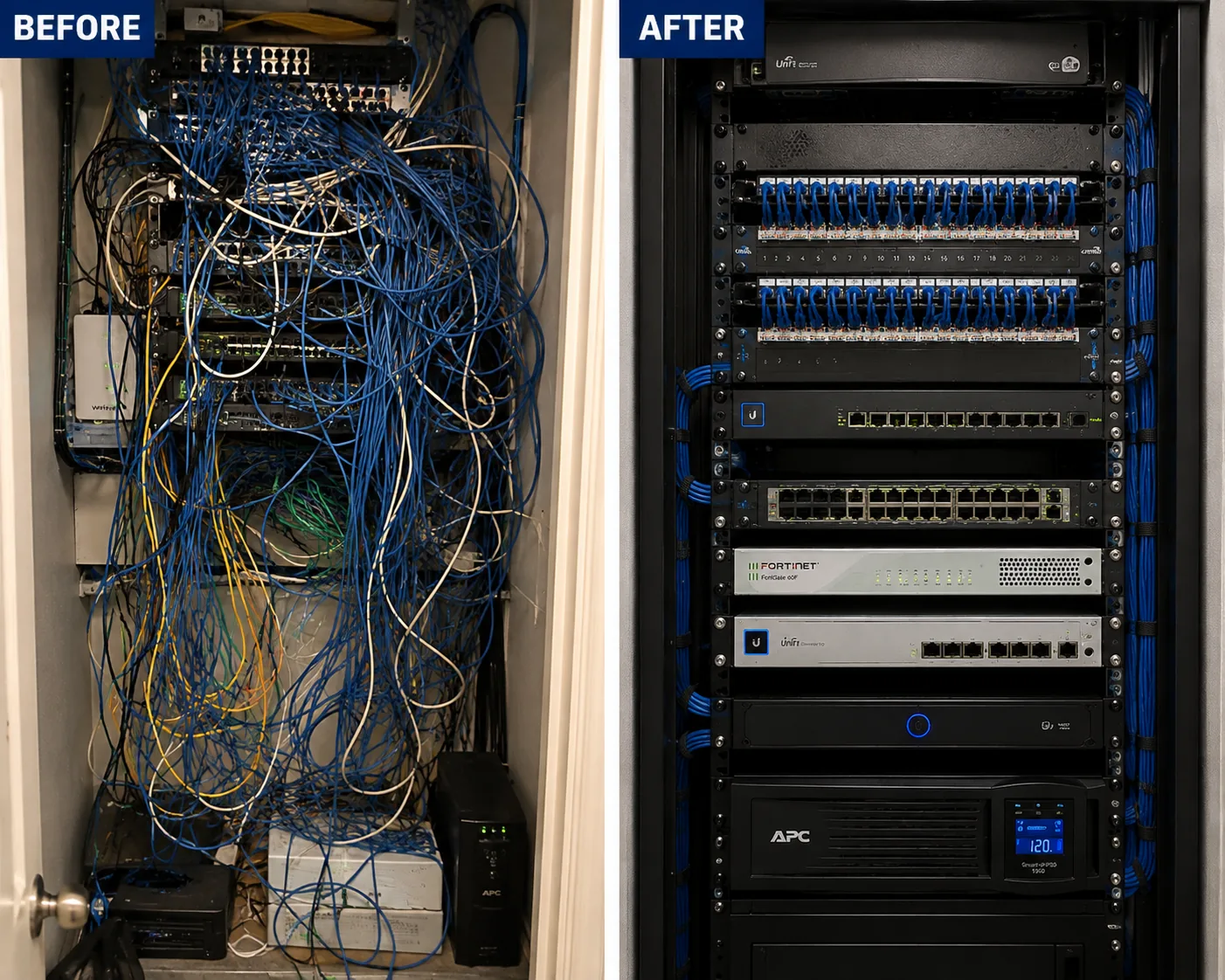
A camera's picture is only as good as the cable behind it, and in a PoE system the cable also keeps the camera alive. A loose termination, a crushed run or a cable that is too long for the standard can produce a camera that drops out every few hours or goes dark when the heat comes on. So before we talk about camera models, we talk about the building. The table below groups New York's common building types by the period they come from, using the categories described by CHPC, Sky NYC and the Architectural League, and sets out where an AVYCON recorder usually ends up and how the cable usually travels. The last column is our working assumption from buildings of that kind generally; we confirm every path on the walk-through.
| Building type | Period | Usual recorder spot | How camera cable usually travels |
|---|---|---|---|
| Walk-up tenement, 4 to 6 stories | Mostly before 1929 | Cellar near the electric meters, or a locked closet off the ground-floor hall | Up the stair hall in a surface raceway, through the roof bulkhead, or along the cellar ceiling to the front and rear walls |
| Elevator apartment house, 8 to 12 stories | 1910s and 1920s | Super's office, cellar or a telecom closet | Through existing shafts or sleeves where they exist, or new core-drilled openings in masonry with board approval |
| Prewar doorman building | 1920s and 1930s | Package room, back office or behind the lobby desk | Above lobby ceilings, through service corridors, conduit up service stairs |
| Brownstone, rowhouse or two-family | Late 1800s into the 1900s | Basement, garden floor or a closet | Through the basement to the front areaway and rear yard; around the stoop; up the rear wall to the roof |
| Postwar and newer towers | After the war onward | Telecom room, garage office or management office | Ceiling grid, J-hooks, conduit and existing risers |
| Storefront under apartments | Any period | Back office, stockroom or under the register counter | Above a drop ceiling, through the stockroom, to the front window line and rear exit |
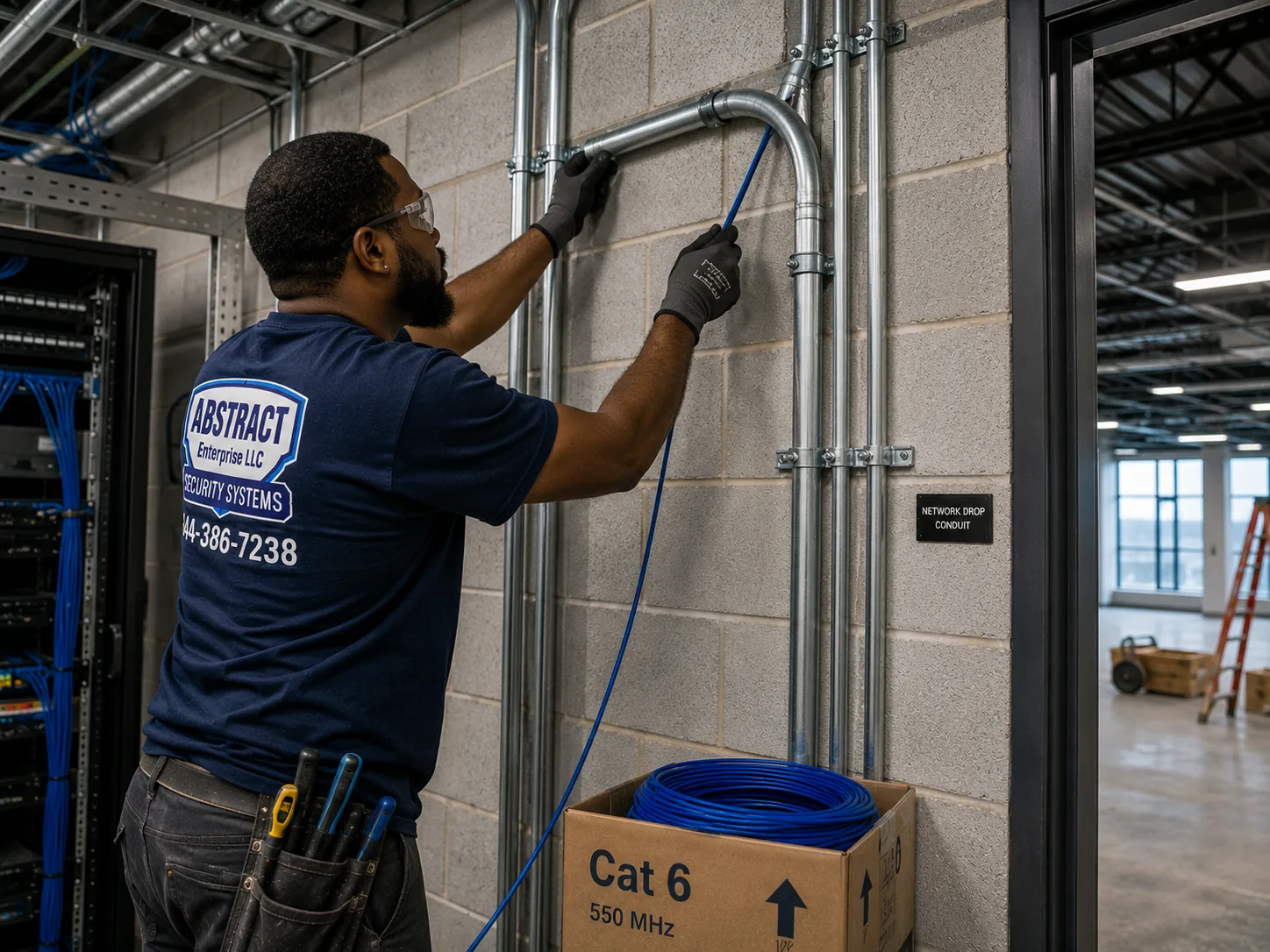
The four-to-six-story walk-up is the most common call in large parts of Manhattan, Brooklyn and the Bronx, and it is the one where planning saves the most money. Old Law and New Law tenements were built for gas light and coal heat, not for data. There is rarely a shaft we can use. What there usually is: a cellar with a ceiling of timber joists or steel and arches, a stair hall that runs from vestibule to roof, a roof bulkhead, and a rear yard reached through the cellar or a ground-floor door. The owner's list is predictable: the vestibule and front door, the mailboxes, the cellar door, the rear yard, sometimes the roof door and one camera per landing. The recorder goes where it can be locked and where it has a power outlet and the internet modem nearby, which is usually the cellar. From there, cameras at the front and rear are reached along the cellar ceiling and up through the floor or wall at each end. Hallway cameras are reached by a surface raceway that climbs the stair hall beside the existing wiring, painted to match if the owner wants. The roof door camera is the longest run in the building, and on a six-story walk-up it can approach the distance limit for a single network cable, which we measure, not guess.
An eight-to-twelve-story elevator building from the decades after the subway arrived brings more cameras and more rules. The lobby, the elevator landings, the laundry room, the service entrance and the courtyard all come into play, and the building often already has an old camera system, usually analog cameras on coaxial cable feeding a DVR in the super's office. In buildings like these, we look first at what can be reused. AVYCON's own support guidance shows its recorders talking to third-party cameras over ONVIF, but old analog cameras need either replacement or a different kind of recorder, so the honest conversation is about which runs are worth keeping as pathways and which cameras are worth replacing. Many of these buildings are co-ops. A board may require the alteration agreement, proof of insurance and limited working hours, and any new opening through a fire-rated wall or floor has to be sealed properly. We plan the risers before we quote so the board sees exactly where every new hole goes.
The one- to four-family houses of Brooklyn, Harlem, the Bronx, Queens and Staten Island are simpler buildings but fussier surfaces. Brownstone is soft, and a front facade on a stoop house is the one everyone sees, so we avoid drilling the stone face where a mortar joint, a cornice return or a window reveal will do. A camera over the parlor-floor door often works best mounted under the door hood or on the side of the stoop, with its cable dropping straight into the basement. The rear of these houses is usually brick and much more forgiving, and the rear yard is often where the real security problem lies. In a two-family, the owner may want each unit to see the front door and only the owner to see the yard and the basement, which an AVYCON NVR can do by giving each user access to particular cameras. If any part of the street front is in a historic district, the Landmarks Preservation Commission's rules apply, and we cover that further down.
Newer towers are the easiest to wire and the hardest to coordinate. Most have a telecom room or riser closet, ceiling grid in the corridors, and garages and loading areas where cables can run on J-hooks or in conduit. The work is fast, but it is usually done for a managing agent under a written scope, with a certificate of insurance, elevator reservations and set hours. These buildings also tend to have other systems already in the risers, including the intercom, the fire alarm and the internet provider's equipment, and we keep camera cable separate from all of them and labeled so the next contractor knows what is ours.
The ground-floor store is New York's most common business setting: a bodega, a laundromat, a pharmacy, a restaurant or a phone repair shop with apartments above. The owner usually controls only the store, not the building, which limits what can be drilled outside. Inside, the recorder goes in the back office or under the counter, cameras watch the register, the door, the aisles and the rear exit, and an exterior camera, if the landlord allows it, watches the sidewalk in front of the door. The cable runs above the drop ceiling where there is one and through the stockroom where there is not. The legal questions in a store are different from those in an apartment building: facial recognition and the biometric sign rule, audio recording, and whether to share with the NYPD. Those are covered in the business section below.


An AVYCON quote in New York is only as accurate as what we know about the building, who controls it and what the cameras need to prove. Twenty minutes of looking around before we come saves a second visit, a revised quote and, sometimes, a board meeting. Please do not open walls or ceilings, move other systems or reset any existing recorder yourself. Look, photograph and send.
| What to check | Why it matters in NYC | What to send us |
|---|---|---|
| Who has to approve the work | Landlords, managing agents, co-op and condo boards often must sign off before drilling or adding cameras to common areas | The managing agent's or board's contact and any alteration rules they have sent you |
| Whether the building is landmarked or in a historic district | LPC rules cover security cameras on regulated buildings, especially on primary facades | The address; you can also ask 311 for the Landmarks Preservation Commission |
| Where the internet comes in | The recorder needs a network connection for the AVYCON ONE app; in walk-ups the modem is often in the cellar or one apartment | A photo of the modem or router and where it sits |
| Any existing camera system | Old coaxial cable and DVRs may be reusable as pathways, and some cameras may be ONVIF-compatible with an AVYCON NVR | Photos of the recorder's front and back and of two or three cameras |
| Sidewalk sheds and scaffolding | A shed over the entrance changes where a camera can see and may come down within months | A photo of the shed and the date work is expected to finish, if known |
| Lighting at each spot | The Multiple Dwelling Law requires adequate lighting in common areas; a camera in a dark corridor records very little | Night-time photos of the vestibule, hallways and yard if you can |
| What each camera must show | A face at the door, a plate at the garage and a wide view of a yard need different cameras and heights | A short list: "faces at the front door," "who takes packages," "the rear gate" |
| Who will use the app | Each person gets their own login and only the cameras they should see | Names and roles: owner, super, managing agent, store manager |
The most useful question we ask in New York is not "how many cameras" but "what happened last time, and what would the footage have needed to show." A package thief in a lobby is a face and a time. A car hitting a gate is a plate and a direction. A dispute about who left the cellar door open is a wide view of a door and a clock that is correct. Write down two or three incidents, real or likely, and we design the system backwards from them. That usually means fewer cameras placed better, with a high-detail camera at the one spot where faces matter, rather than a ring of wide cameras that show a lot and identify no one.
Before the first camera goes up, decide who gets access. In a rental building that usually means the owner and the managing agent, sometimes the super, and in a co-op the board's designee. Tenants do not get access to common-area recordings by default, and the person who manages access should be named, not assumed. If your building also uses a key fob or app-based entry system, the Tenant Data Privacy Law limits how data from that system can be used and requires authentication data to be destroyed within 90 days, so keep the camera system's logins separate and documented. We set up one AVYCON ONE login per person, with only the cameras they need, and give you the list.
An AVYCON NVR powers its cameras through its PoE ports, so the recorder itself needs a reliable outlet, ideally on a circuit that is not shared with a boiler, a freezer or a washing machine. If power in the building is unreliable, a small battery backup keeps the recorder and cameras running through short outages. The recorder also needs a network cable to the internet router for remote viewing. In walk-ups where the only internet is in one tenant's apartment, the owner usually needs a separate building line; ask your provider about it before the install date, because we cannot connect the recorder to a tenant's private network.

These are the AVYCON jobs New York homeowners, landlords, boards, managing agents and business owners call us for. Each one is quoted from the published AVYCON price page for your borough, and where a job needs something unusual, such as a core-drilled sleeve, conduit on an exterior wall or after-hours work for a co-op, the written quote names it before anything is ordered.
A complete system: AVYCON recorder with PoE ports, cameras placed for what each view must prove, certified cable to every camera, and recording set to the retention your building needs.
Vestibules, mailboxes, stair halls, elevator landings, laundry rooms, cellar doors and roof doors, with hallway cameras aimed at corridor traffic and not into apartments.
Old analog cameras and DVRs in super's offices replaced with AVYCON, with existing pathways reused where they are sound and the old equipment removed.
ONVIF cameras from other makers added to an AVYCON NVR where they are compatible, so a building does not have to throw away cameras that still work.
The system added to every authorized phone, each user limited to their cameras, live view and playback tested on cellular data, and clip export shown before we leave.
Register, door, aisle, stockroom and rear-exit cameras, with AI features set to match the city's biometric signage rule and the owner's privacy choices.
Small, finished cameras placed where LPC rules allow, with cable routed to avoid significant features, and the plan prepared for review where review is needed.
Cameras relocated when a sidewalk shed goes up over the entrance, then moved back when it comes down, using labeled cable with spare length left at each end.
Extra cameras on spare PoE ports, a PoE switch where the recorder runs out of ports, and tracing and retesting runs that drop out.

Each building type changes three things about an AVYCON job: what the cameras are mounted on, how the cable gets to them, and who has to agree before work starts. These are the types the city's housing data and housing historians describe, and how we approach each one.
Masonry walls, narrow stair halls, cellars and roof bulkheads. The recorder usually lives in the cellar; cameras at the vestibule, mailboxes, cellar door, yard and roof door; raceways up the stair hall.
Lobbies, landings, laundry and service entrances, often an old analog system to replace, and boards that want an alteration agreement, insurance and set working hours.
Soft stone fronts, stoops and areaways, brick rears and rear yards. Cameras tucked under door hoods and along stoops, with cable dropping straight into the basement.
The small houses CHPC points to in places like Midland Beach, and larger houses like those in Riverdale. Driveways, side yards and garages, with the recorder in a basement or closet.
Courtyards, multiple entrances and long distances between buildings, often needing a PoE switch in each building linked back to a central recorder.
Telecom rooms, ceiling grid and conduit, managing agents, certificates of insurance and elevator bookings, with existing intercom and fire alarm systems in the same risers.
| Building | Mounting surface | Cable method | Who signs off |
|---|---|---|---|
| Walk-up tenement | Brick, plaster on masonry, pressed-tin or plaster ceilings | Cellar ceiling runs, painted surface raceway in the stair hall | The owner; tenants are told where common-area cameras go |
| Prewar co-op | Plaster, masonry, ornamental lobby ceilings | Existing sleeves and shafts, or new openings approved by the board | The board and managing agent |
| Brownstone or rowhouse | Brownstone, brick, wood door hoods | Through the basement to the areaway and yard | The owner; LPC where the front is regulated |
| Detached house | Siding, brick, soffits | Attic and basement runs, exterior conduit where needed | The owner |
| Garden complex | Brick and block | A switch per building, linked back to the recorder | The owner, condo board or management |
| Tower | Concrete, drywall, ceiling grid | J-hooks, conduit, risers | Managing agent and building engineer |
On masonry fronts. Most New York facades are brick or stone, and both take a camera well if the fixings go in the right place. In brick, anchors go into the face of a sound brick, not the mortar joint, wherever the camera's base allows. In brownstone, which is a sandstone and much softer, we drill slowly with a sharp masonry bit, avoid carved features entirely and prefer a mounting point on an adjacent wood door hood or a joint in a plain wall. Every exterior penetration gets sealed so water does not follow the cable into the building. Where the camera is on a landmarked building, the LPC Permit Guidebook asks for a camera on a primary facade to be as small as possible and painted to match, so we choose the smallest housing that will do the job and finish it accordingly.
On plaster ceilings and stair halls. Inside prewar buildings, hallway cameras often go on plaster ceilings or high on plaster walls. Plaster over wood lath or metal lath is brittle, and a camera bracket screwed into lath alone will loosen over time. We find the framing or the masonry behind it, use fixings rated for the material, and run cable in a slim raceway along the line where the wall meets the ceiling so it disappears into the trim. In a building with pressed-tin ceilings, we avoid the tin and mount on the wall instead.
On fire separations. In many buildings the camera cable has to pass through a floor, a stair enclosure or a wall between the cellar and the boiler room. Where it does, the opening is sealed with a firestop product rated for that kind of assembly, not left open or stuffed with insulation. Altering fire-rated door assemblies, changing a means of egress or tying into the building's fire alarm is a different kind of work that can require filing, and we stay out of all three on a camera job.

New York businesses buy cameras for three reasons: to deter theft, to settle disputes with footage, and because an insurer or landlord asks. The places below are ones local news and city programs have named in connection with business and building cameras. We describe what those sources report; we have no information about the camera systems at any particular business named here and do not claim any of them as clients.
amNY reported that the NYPD's Connect New York demonstration, letting businesses link cameras to their local precinct, began in Flushing and College Point before expanding to nine precincts across the five boroughs.
Police1 reported new NYPD cameras going into East Harlem, Harlem, Washington Heights and Inwood, several aimed at bodegas, which shows how much attention corner stores receive uptown.
CBS New York reported four men entering the Robeson, a key-code building on Lenox Avenue, around 2:30 a.m. and taking lobby furniture, with police finding no forced entry. Lobby footage was the story.
CBS New York covered a package theft near 36th Avenue and 31st Street in which the suspect used a screwdriver to disable a door lock, the kind of entry a door camera documents.
CBS New York reported a man caught on video taking packages from an apartment lobby on Lawton Street, a reminder that mixed-use and residential lobbies are where package losses happen.
News 12 reported in December 2025 on a Morris Park resident who caught a porch thief on camera seconds after a delivery, alongside a proposed state bill to make package theft a felony.
A store camera in New York works harder than a home camera. It watches a door that opens hundreds of times a day, a register where cash and cards change hands, and aisles where shoplifting happens in seconds, and it records around the clock because a dispute may surface a week later. It also has to work in poor conditions: a bright window behind a dark interior, a sidewalk in full sun at noon and in shadow by three, a steel gate that comes down at night and blocks the exterior view. We place a camera inside the door looking in, so faces are lit by the window rather than silhouetted against it, and a second over the register at an angle that catches hands and the counter without catching a customer's PIN. Recording retention is set to how quickly the owner realistically finds out about a problem, and the recorder is locked away from the sales floor so a thief cannot walk off with the evidence. Where an exterior camera is allowed by the landlord, it goes under the sign band or inside the gate box, not where a ladder or a pole can reach it.
For restaurants and bars, the kitchen door, the cash area and the rear delivery entrance usually matter more than the dining room. For laundromats and pharmacies, the counter and the door. For garages and warehouses, the gate, the loading area and the plate of every vehicle that enters. That last one is where AVYCON's license plate reading in the app can help, and it is also where camera height and angle matter most: a plate camera has to see the plate straight on at a low enough angle, with lighting that works at night, or the software has nothing to read.

We do not publish stories about a particular customer's building unless we can document them, so this is a method, not a tale about one address. It is the routine our technicians follow in the kind of building New York is full of: a prewar walk-up with a cellar, a stair hall, a roof door and a rear yard, and an owner who wants to know who keeps propping the front door open.
We start at the front door with the owner and ask what the last incident was. We stand where each camera would go and hold a phone camera there to see roughly what the view will be, because a door that looks easy to watch from the floor can be all ceiling from up high. We check the light at each spot and note where night footage will suffer. In the hallways we stand outside apartment doors and look at what a camera at the planned spot would see when a door opens, and we move it until it shows the corridor and not the inside of anyone's home. Then we go to the cellar and find the modem, the outlets and the best place to lock a recorder. We trace a path from there to each camera on paper, measure the longest run, and look for existing sleeves before suggesting a new hole. We ask who has to approve the work and whether a sidewalk shed or a facade job is coming. Only then do we price the system.
AVYCON hardware and compatibility
Often yes, as long as those cameras speak ONVIF, the common standard that lets cameras and recorders from different makers talk. AVYCON's own support FAQ says a third-party camera that supports ONVIF can be added to its recorder using that protocol. In practice, basic video almost always works over ONVIF, while some extras, such as the other brand's own smart detection or two-way audio, may not carry over. On the walk-through we check each existing camera's model, test it against the recorder where we can, and tell you which ones are worth keeping. The ones that are not, usually older analog cameras on coaxial cable, are replaced, and their cable path is reused for new network cable where it is sound.
Most third-party video software connects to cameras through RTSP, a streaming protocol, and connection guides such as iSpy's list AVYCON cameras as typically using port 554 for it. That is the technical answer; the practical one in a New York building is about who should be allowed in. Opening a camera stream to outside software means opening a path into the building's network, so we set it up only for the specific program and user the owner approves, with a separate login, and never by forwarding ports wholesale on the building's router. If the agent only needs to watch, a viewer login in the AVYCON ONE app is often simpler and safer than connecting another system.
We can tell you what AVYCON says and help you check the specific models. AVYCON's NDAA statement says its compliant products use approved chipsets and were manufactured and substantially transformed in the United States, South Korea and/or Vietnam. That is a statement about its compliant product line, not a blanket statement about every model ever sold, so the right step is to list the exact recorder and camera models on the quote and confirm each one against AVYCON's current documentation before ordering. If your program needs a written confirmation, we include the model list and the manufacturer's statement with the proposal so the program or insurer can review it directly.
It can. The AVYCON ONE listing notes that standalone cameras require a microSD card for storage and playback. That suits a single door in a small house or a store's back exit where a full recorder would be overkill. The trade-off is that the card sits in the camera, so if someone pulls the camera down, the footage goes with it, and cards wear out over time. For anything more than one or two cameras, or for any spot where a thief can reach the camera, we recommend a recorder in a locked location instead, and we will say so on the quote.
The AVYCON ONE app
Yes, and we do not leave until it is. The app carries a 2.9 out of 5 rating on the App Store, and a reviewer there described it hanging about half the time and an installer struggling to save the device in the app. Many app problems trace back to how the recorder was connected: a weak network link, a recorder on a tenant's Wi-Fi, a stream setting too heavy for a phone on cellular data, or one login shared across several people. We give the recorder a wired connection and a fixed address on the network, set a lighter sub-stream for phone viewing, create a separate login for each user, and test live view and playback on cellular data with Wi-Fi turned off on your phone. Then we show each person how to find a clip and export it.
This is the question one App Store reviewer asked AVYCON directly: how to get cameras back into the app after installing a new base unit. In most cases the cameras did not disappear; the app was tied to the old recorder's identity, and the new recorder has to be added to the app as a new device, then each camera assigned to it. On a PoE recorder, AVYCON's FAQ notes a camera plugged into a PoE port appears on the screen after about a minute, so the cameras themselves usually come up on the recorder quickly. The work is in removing the old device from each user's app, adding the new one, rebuilding user permissions and checking the recording schedule and retention, which reset to defaults on a new unit. We do all of that and give you the updated login list.
AI features and New York privacy rules
Read the city's biometric identifier rule first, because facial recognition is exactly what it covers. As Kennedys Law explains, ordinary CCTV appears to be exempt from the signage requirement as long as the business does not use software to analyze the footage; facial recognition is that software. Covered commercial establishments, which include food and drink businesses, must post a clear sign at every customer entrance, and the city's rule sets a minimum sign size of 8.5 by 11 inches. Hinshaw & Culbertson notes individuals can recover five hundred dollars per violation for a missing sign, and the law also restricts selling or profiting from the data. We install with facial recognition off by default. If you decide to use it after talking to your lawyer, we turn it on, and the signs have to be up at every entrance first.
Wiring New York buildings
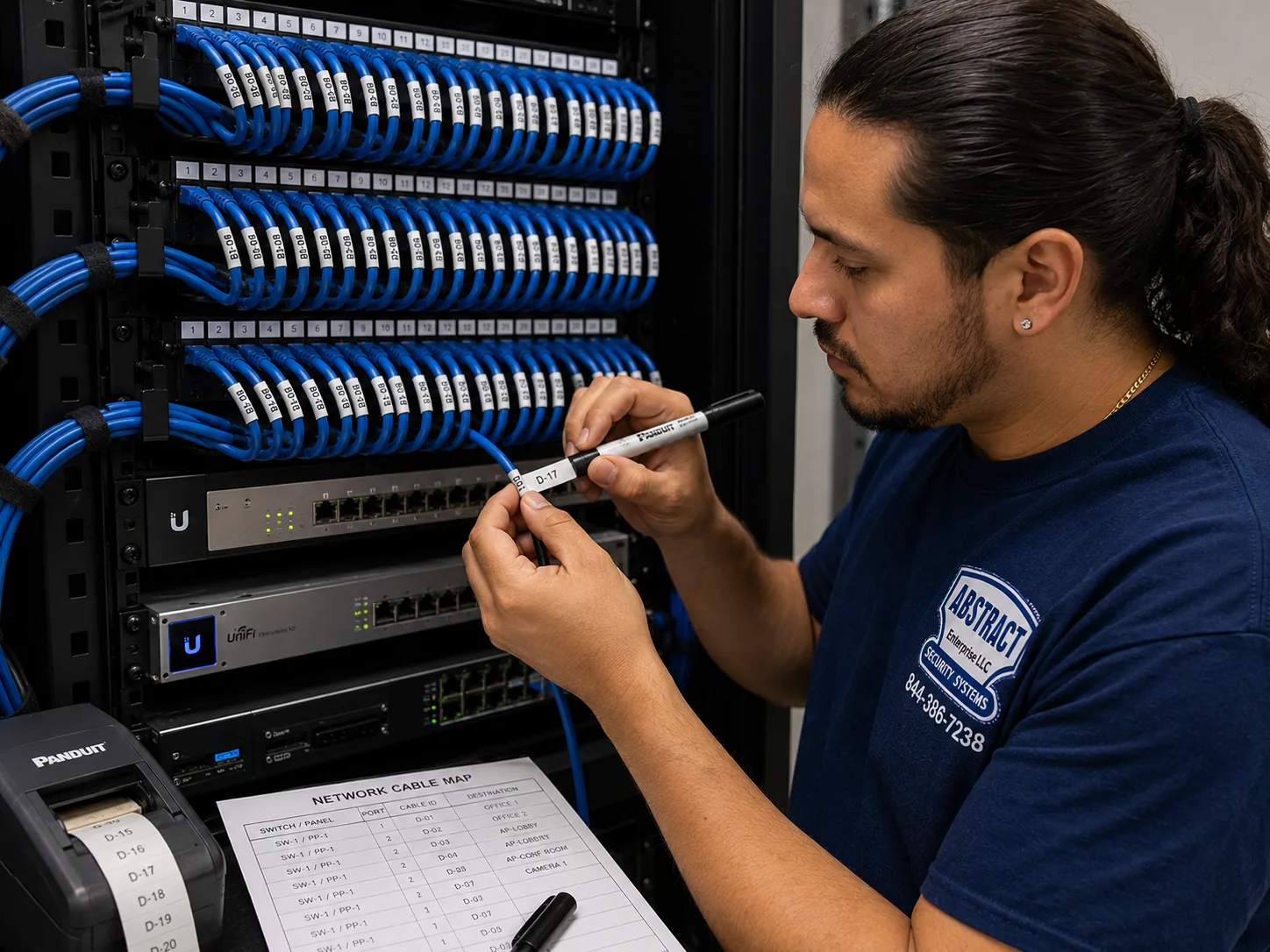
In a building without shafts there are three honest options. The first is a slim, paintable raceway that climbs the stair hall in the corner where the wall meets the stair stringer or the ceiling, which nearly disappears once painted. The second is to use paths that already exist: an old dumbwaiter shaft, a chase beside the plumbing stack, or the sleeve the old intercom or cable TV used, if they connect the floors. The third is to drill through each floor inside a closet or behind a door that lines up from floor to floor. We look at all three on the walk-through and price the one that fits. Whichever is chosen, openings between floors are firestopped, and each cable is labeled at the camera and at the recorder.
Usually four things, though every board writes its own rules. A scope of work that lists each camera position and every new opening in walls or floors. A certificate of insurance naming the parties the managing agent specifies. Working hours that fit the house rules, which in many buildings means weekdays during business hours with the service elevator booked in advance. And a plan for the old equipment, which we remove. Seneca Security notes that building-wide camera replacements may need board approval and compliance with building-specific standards, so we prepare the scope as a document the board can approve rather than a verbal estimate. If the building uses fob or app entry, the board should also have its Tenant Data Privacy Law policy in place, and we keep the camera logins separate from that system.
We place each one by standing in the hallway with the camera's actual field of view on a phone or the recorder screen, then having someone open each nearby apartment door. If the view reaches past the threshold, we move or re-aim the camera, or use the recorder's privacy masking to black out that part of the image. Connextivity's guide to NYC apartment camera rules says hallway cameras are permitted when positioned to cover corridor traffic without seeing into apartments as doors open, and notes that a covert camera inside a unit can support a felony charge under Penal Law 250.45. Common-area cameras should also be plainly visible; we do not install hidden cameras in residential buildings.
No, but they shape where the cameras go and what they look like. Section 2-20 of the LPC rules covers health, safety and utility equipment, including security cameras, and the LPC can approve cameras that meet its criteria at staff level. One published LPC approval reviewed nine security cameras at a building's ground floor, five on the west facade and three on the east, under Section 2-20(c)(4). The rules prefer secondary facades and inconspicuous spots; on a primary facade, the guidebook asks for the smallest possible camera, painted to match. We plan the camera positions with that in mind, avoid significant architectural features, and prepare the drawings and photos you or your architect need to file. Cameras inside the vestibule, looking out, sometimes avoid the question altogether.
Business cameras and outside access
Not unless you choose that. NYC 311 describes the program as letting businesses share live feeds with the NYPD during emergencies, with registration at NewYorkCityConnect.org, and amNY reported in May 2024 that participating businesses can choose how and when their footage is accessible. Registering your camera locations and connecting a live feed are also different steps. Our role is technical: if you decide to participate, we make sure the cameras that face the street are aimed and recording well, and that any outside connection to the recorder is limited to the cameras and hours you approve. If you decide not to, nothing on the system connects to anyone but you.
Usually, if the original install left the cable labeled with some spare length coiled at the old position or at the recorder, as we do. Moving a camera onto a shed post or under the shed deck during facade work, and then back when the shed comes down, is a common New York job. The city's April 2025 laws shortened shed permits and doubled the lighting required under sheds to 90 lumens, which also changes what a camera under a shed can see at night. When the shed comes down, we remount the camera at its original spot, re-seal the old penetrations, re-aim it, and check that motion zones and privacy masks still match the new view.
These are the parts of an AVYCON system we fit in New York buildings. We choose the exact recorder and camera models when we quote, from AVYCON's current line and against what each spot must show, and list every model on the written proposal. Prices for each borough are on its AVYCON price page; this hub does not print model prices.
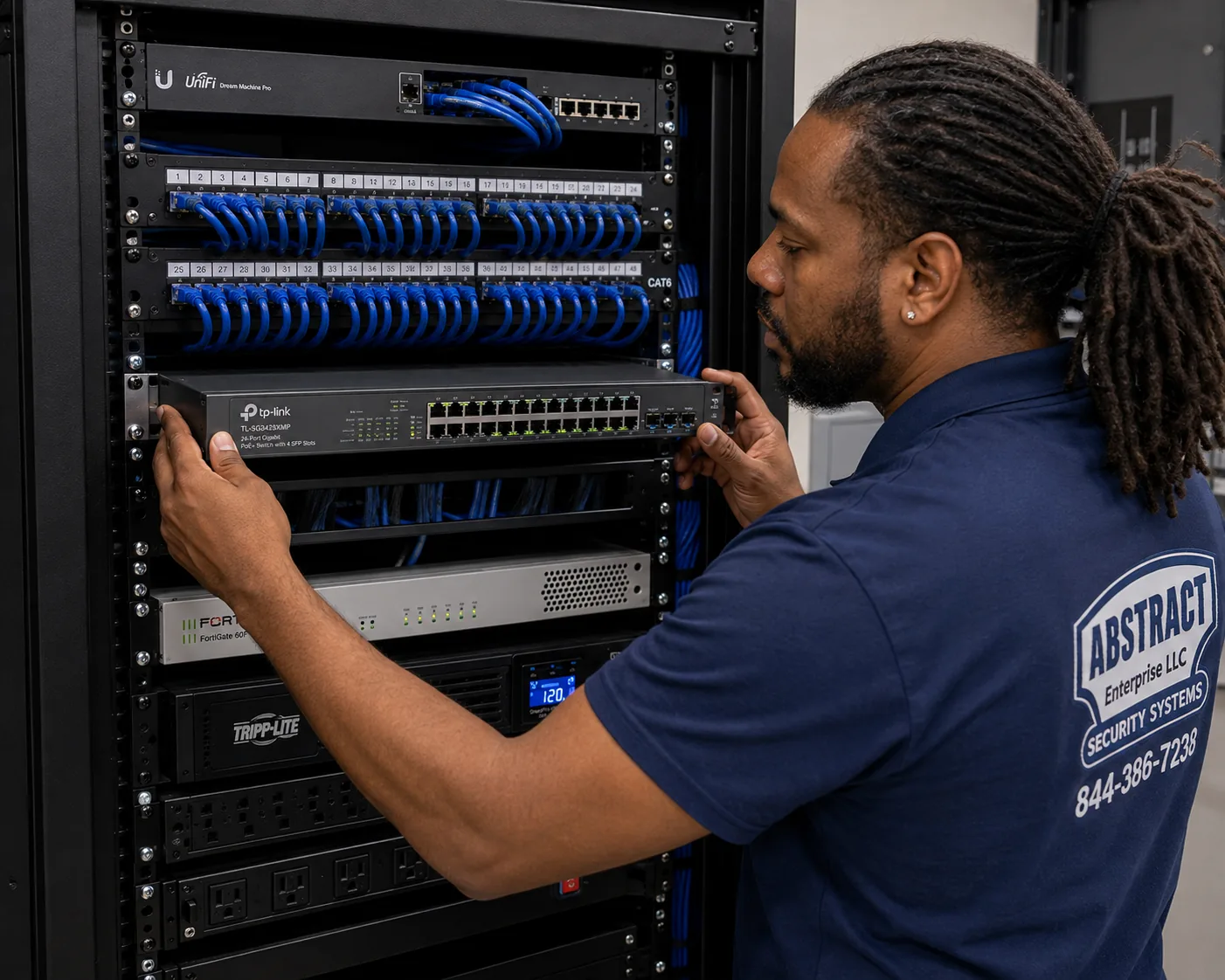
The heart of the system: an AVYCON NVR that powers cameras through its PoE ports and records them to internal drives, sized for camera count and retention, locked in a cellar, office or closet.
For long views down a rear yard, a driveway, an alley or a loading dock, where a longer, visible camera also tells people the area is watched.
For vestibules, lobbies, hallways and store ceilings, where a compact, low-profile housing suits plaster ceilings and landmarked fronts, and domes resist tampering.
Cameras positioned and set for garage gates and driveways, so the AVYCON ONE app's people, vehicle and plate features have a usable image to work from.
Extra PoE ports for larger buildings and long runs, a switch in each building of a complex, and a battery unit so short outages do not end recording.
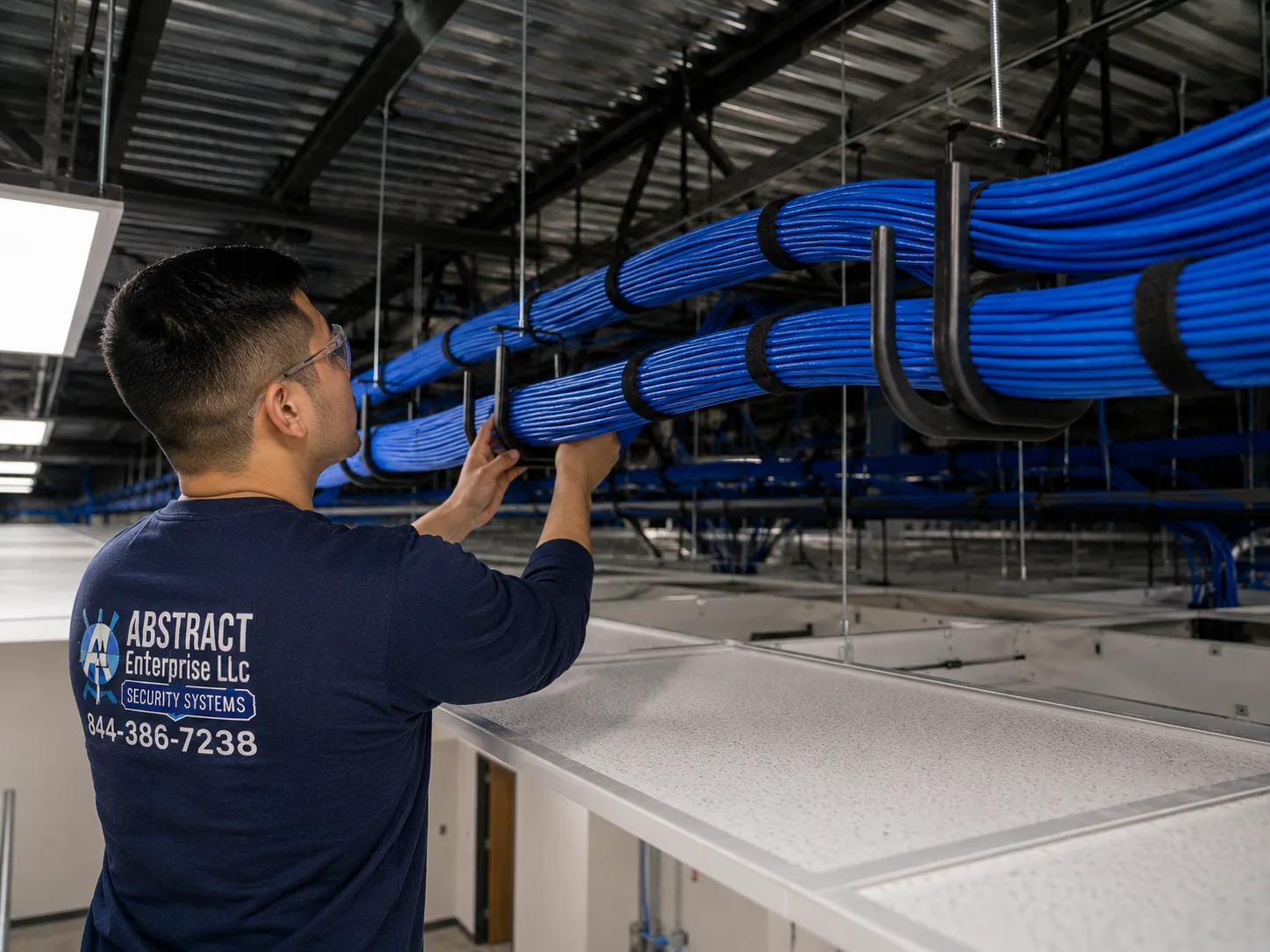
Network cable tested end to end, raceway for stair halls, J-hooks and conduit for cellars and garages, firestop at every floor or rated wall it crosses.
The app set up on each authorized phone, one login per person, cameras limited by role, and AI filters set to the property's legal and privacy choices.
A screen in a lobby desk, super's office or behind a counter showing the camera grid, mounted on the wall with the cable hidden or covered.
People sometimes ask whether they should simply sign up with a national brand instead. ADT is best known for monitored alarm systems sold with a monitoring plan, and Ring and SimpliSafe for doorbells, cameras and kits that owners set up themselves, mostly over Wi-Fi with cloud plans. Those suit a lot of homes. They are a different thing from a wired AVYCON system, where the footage records to a recorder you own in your building and nothing depends on a monthly plan to keep recording. In New York the deciding factor is usually the building: a Wi-Fi camera in a masonry stair hall or a cellar may struggle to hold a signal, and Spectrum News reported in December 2025 that New York authorities warned some package thieves use Wi-Fi jammers to disrupt doorbell cameras. A wired PoE camera does not depend on Wi-Fi at all. For a renter who cannot drill, a no-drill Wi-Fi camera inside the apartment may be the better answer, and we will say so.

We could not capture Google's AI Overview, People Also Ask boxes or related searches for this topic from our build environment, so we are not going to pretend to quote them. What follows are claims we see repeated in quick online answers and installer blogs about camera systems in New York, set against manufacturer, government and legal sources and our own field practice. National marketplaces such as Angi, HomeAdvisor and Fixr publish cost guides that many of those answers draw on; they give a rough sense of the market, but they are not a quote for your building.
The plug-and-play part is true. AVYCON's own FAQ says a camera plugged directly into the recorder's PoE port appears on the screen after about a minute. In a showroom, that is the whole job.
In a New York building, that one minute comes after the cable has been pulled from a cellar through a brick foundation wall, up a stair hall and out to a vestibule ceiling, terminated, tested and labeled. On a six-story walk-up, the roof-door run alone can take longer than mounting every camera in the building.
So when an answer says installation is simple, it means the connection is simple. The labor, the approvals and nearly all the risk are in the path, which is why we price by building and borough rather than by camera alone.
Several quick answers say or imply this. Compliance writers at Seneca Security state plainly that there is no general NYC law mandating cameras in apartment buildings. What the law requires are things like adequate common-area lighting under the Multiple Dwelling Law and, in many buildings, intercoms and self-locking doors.
What actually drives most building camera systems is insurance and experience. Seneca notes that many commercial property insurers set camera coverage as a condition of theft and vandalism coverage, and owners add cameras after lobby thefts and package losses.
The difference matters, because an owner who believes cameras are mandatory may install them in a hurry and in the wrong places. Cameras chosen to match an insurer's written requirement and the building's real incidents work better and cost less.
The AVYCON ONE app does list facial recognition among its AI filters, alongside motion, people and vehicle detection and plate reading. Technically, it is a setting.
Legally, in New York City, it is a decision. The city's biometric identifier law applies to covered commercial establishments that use software to analyze customers' faces, requiring a clear sign at every customer entrance of at least 8.5 by 11 inches, and allowing individuals to sue over a missing sign. In residential buildings, tenants at Atlantic Plaza Towers in Brownsville fought a landlord's facial-recognition entry plan, and a Council Member's site recounts another rent-stabilized tenant's fight in 2018.
We install with facial recognition off and explain the rule to the owner before anyone decides otherwise. It is the one AVYCON feature where reading the law first is part of the installation.
This claim appears on at least one installer blog, and it conflicts with the official route. NYC Business states that a license from the New York State Department of State is required to install or maintain security systems, and the rule behind it covers CCTV used to detect or monitor intrusion, theft or movement.
On the electrical side, Local Law 128 of 2024 updated the city's electrical code so that low-voltage work under 50 volts for signaling, communication, alarm and data generally needs no electrical permit when done by a licensed master or special electrician or a qualified person. Sources still disagree on the details, which is a good reason to ask any installer exactly which license they hold.
Our answer: the camera system work is done under NYS license #12000287431. If a job needs a new outlet or circuit for the recorder, that line-voltage work is for a licensed electrician, and the quote says so.
Some vendor pages state that a "Local Law 50" requires residential buildings with common-area cameras to notify residents. We could not confirm that in any official source, so we do not repeat it as law.
What we can point to is Penal Law 250.65, which, as a legal analysis by Ambient.ai summarizes, protects systems where a written notice is conspicuously posted that video surveillance is installed, or where cameras are installed so their presence is clearly and immediately obvious. Visible cameras and a posted notice are sensible either way.
So we install residential common-area cameras in plain view and recommend a posted notice at the entrance. If a lawyer confirms a specific notice requirement for your building, we will build the system to match it.
One security site says that in most New York City buildings a Wi-Fi camera that needs no drilling or wiring is allowed inside the apartment. That is a reasonable general statement, but it covers exactly the kind of camera an AVYCON PoE system is not.
A wired AVYCON system means drilling, cable and a recorder, and in a rental that needs the landlord's written agreement, and in a co-op or condo often the board's. Cameras in common hallways are a separate question, where sources conflict about a tenant's rights and audio raises eavesdropping concerns.
For tenants, we usually recommend talking to the owner about a building system first. Where that is not possible, we are honest that a no-drill camera may suit better than AVYCON.
Many quick answers treat the app as the easy finish. The AVYCON ONE app's 2.9 out of 5 App Store rating, and a review describing frequent hangs and an installer who could not get the app to save the device, suggest otherwise.
App trouble in New York buildings often begins with the network: a recorder on a weak link in a cellar, a tenant's router, an internet provider change that alters the network, or one shared login used by six people. After a recorder replacement, users have to be re-added, which one reviewer asked AVYCON about directly.
That is why our installation is not finished until each authorized user can open live view and playback on cellular data, and we leave a written list of logins and the network settings that the next technician will need.
Send the address, a few photos of the entrance, the hallways and the cellar, and a line about what the cameras need to prove. A technician will tell you where the recorder can live, how the cable is likely to travel, whether a board, landlord or LPC review is likely, and which borough price page applies. Call (800) 486-0943, message us on WhatsApp, or use the quick form.
Every AVYCON job we do in New York follows the same eight steps, whether it is two cameras on a Staten Island house or thirty across a Bronx elevator building. In this city the early steps matter most, because a system planned around the wrong approvals or the wrong cable path costs twice.
Borough and address, house, walk-up, elevator building, co-op, landmarked property or business, the views you need covered, and who has to approve the work.
Board or landlord sign-off, LPC review where the facade is regulated, sidewalk sheds, insurance certificates, the super's contact and the hours we are allowed to work.
Each camera spot checked for view, lighting and privacy, with hallway cameras aimed at corridor traffic and not into apartments.
Where the AVYCON NVR or PoE switch lives, and the route for every cable through cellars, shafts, ceilings, conduit or masonry, measured before quoting.
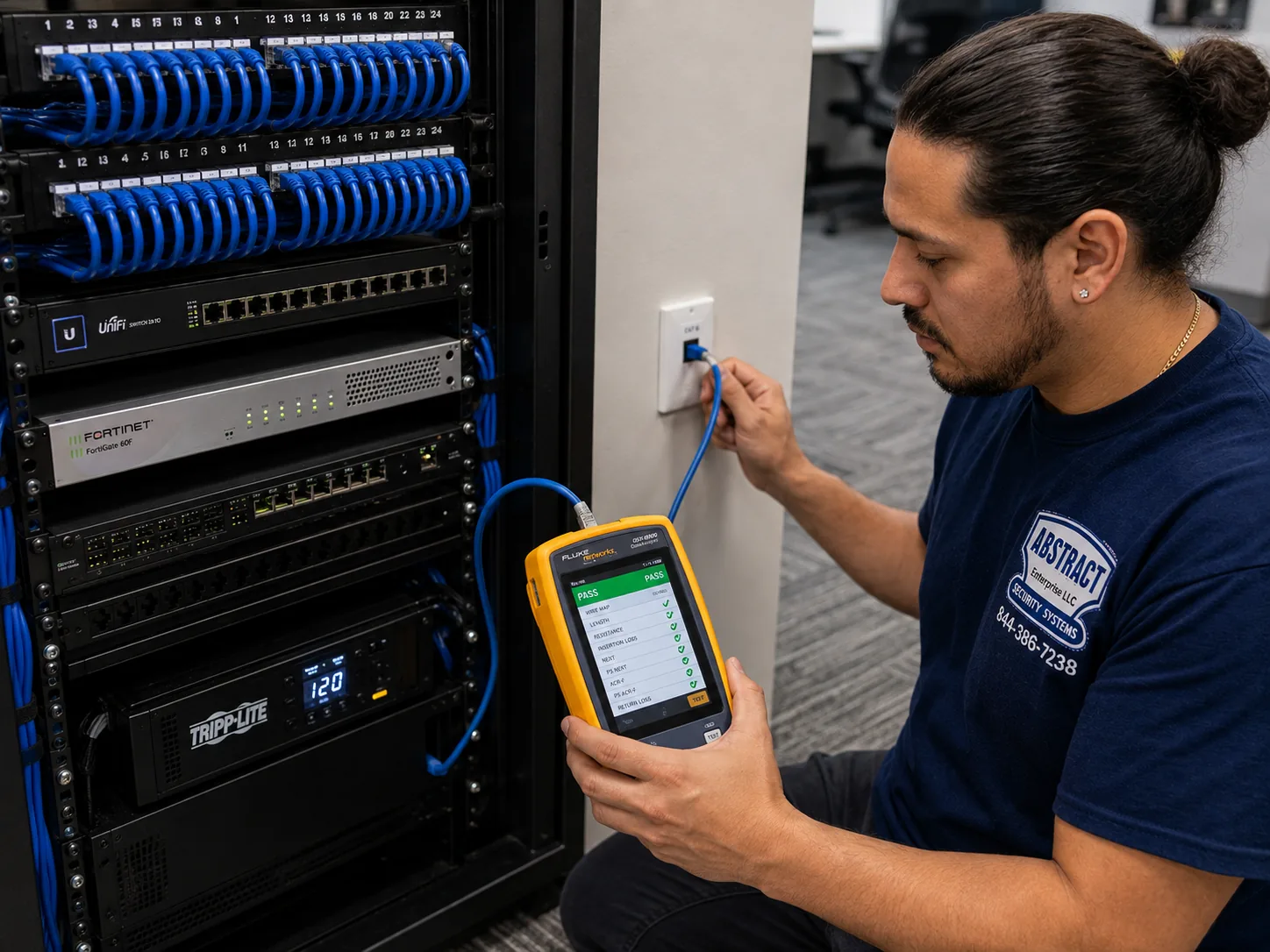
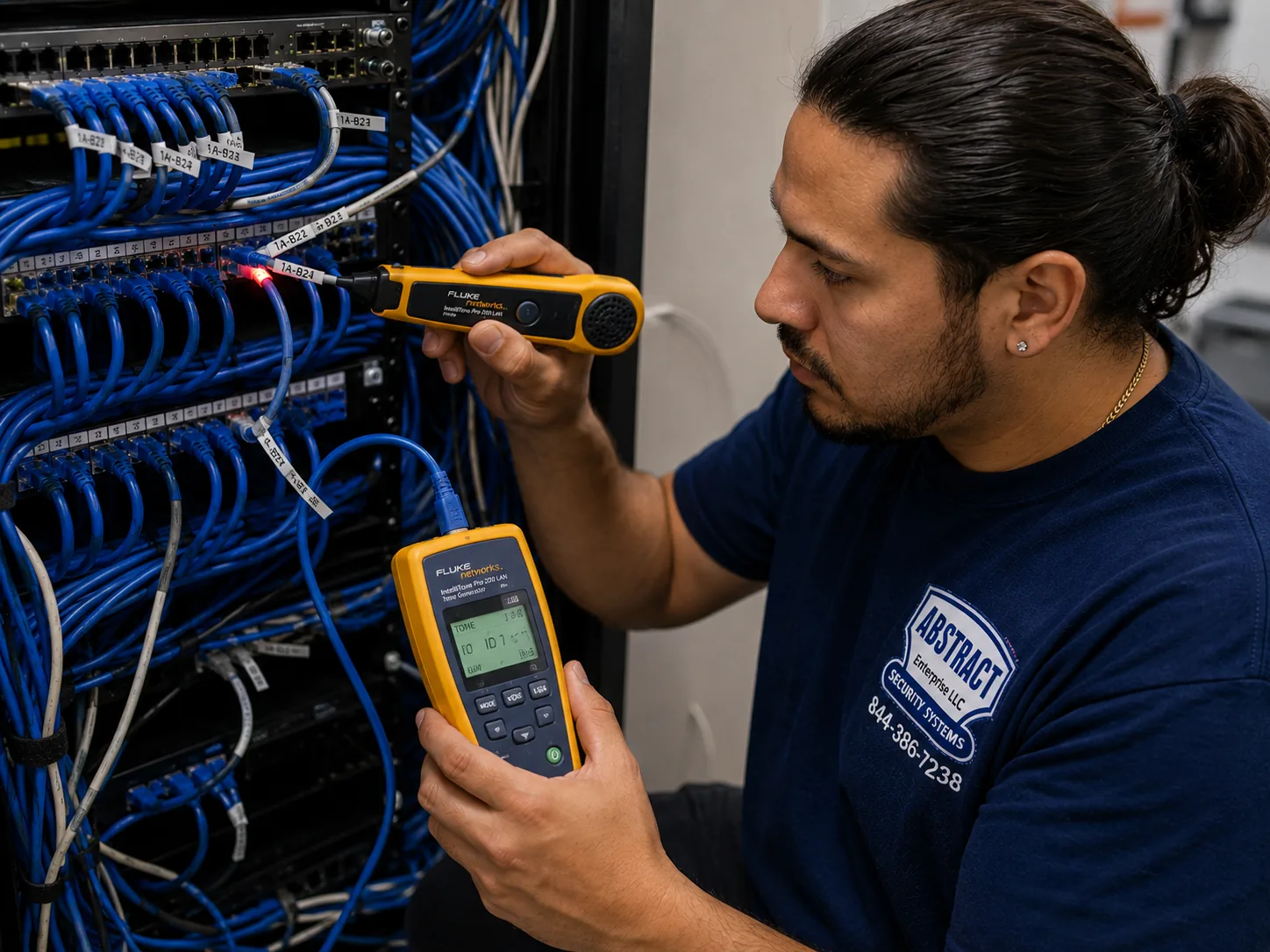
Each run pulled on proper support, firestopped where it crosses a floor or rated wall, labeled at both ends and tested with a cable analyzer.
Cameras fixed on brackets suited to brick, stone, block or plaster, plugged into PoE, and added to the recorder, including compatible ONVIF cameras.
Schedules, retention, motion and people or vehicle zones and privacy masks, with facial recognition left off unless the owner decides after reviewing the city rule.
AVYCON ONE on each user's phone, tested on cellular data, clip export shown, and a written port map and login list left with the owner.

This page covers the whole city, so instead of one neighborhood's corners, here are six buildings and districts across the five boroughs whose history says something about camera work in that kind of place. We have no information about camera systems at any of them and do not claim them as customers.
Built 1880 to 1884 to Henry J. Hardenbergh's design, a co-op since 1961 and a city landmark since 1969, per Wikipedia. The kind of building where board rules and landmark review both shape a camera plan.
Designated November 23, 1965, the first New York City historic district, according to the Historic Districts Council, with blocks of nineteenth-century brownstones where front cameras follow LPC rules.
Built by Metropolitan Life between 1939 and 1942 as 171 brick buildings of 8 or 13 stories, later converted to condominiums, per Wikipedia. Campus-scale coverage means a switch per building.
A planned community by Olmsted Jr. and Grosvenor Atterbury, streets laid out by 1910, with over 800 homes, townhouses and garden apartments, per the Cultural Landscape Foundation.
A historic district designated in 2004 with about 92 freestanding houses, the earliest from the 1830s, according to Six to Celebrate. Detached houses with landmark review on the street side.
Two brick high-rises that already had cameras on grounds, doorways, elevators and halls when tenants fought the landlord's facial-recognition entry plan, as The Guardian reported in 2019.
Each borough has its own AVYCON price page: Brooklyn, Manhattan, Queens, the Bronx and Staten Island. Outside the city we also cover Long Island and the Hudson Valley, and the city-wide list is on AVYCON camera installation prices for NYC.
AVYCON systems are priced per borough because access, parking and building conditions change the labor so much from one part of the city to another. Our area factors start with Brooklyn and the Bronx at the base, Queens a little above, Staten Island above that, and Manhattan highest. Rather than print one city-wide figure that would be wrong for most addresses, we keep each borough's full AVYCON list on its own price page, where you can build a system camera by camera. Use the table to find yours.
| Where the property is | Price page | What usually drives the labor there |
|---|---|---|
| Brooklyn | AVYCON prices, Brooklyn | Brownstones, rowhouses and walk-ups with cellar-to-roof runs |
| The Bronx | AVYCON prices, Bronx | Elevator buildings, large complexes and two-family houses |
| Queens | AVYCON prices, Queens | Attached houses, garden apartments, storefront strips and new towers |
| Staten Island | AVYCON prices, Staten Island | Detached houses with driveways and yards, plus travel |
| Manhattan | AVYCON prices, Manhattan | Co-op rules, doorman buildings, parking and limited working hours |
| Nassau or Suffolk County | Nassau · Suffolk | Larger houses, longer exterior runs |
| Westchester, Rockland or Orange | Westchester · Rockland · Orange | Distance, driveways, outbuildings |
| Putnam, Dutchess or Ulster | Putnam · Dutchess · Ulster | Long drives, estates and rural properties |
Four things matter more than the camera count. The first is the longest cable path: a camera at a roof door six floors above a cellar recorder takes more labor than four cameras around a ground-floor store. The second is the surface: core drilling a foundation wall or mounting on brownstone is slower than fixing into a ceiling grid. The third is the building's rules: a co-op that allows work only on weekday business hours with the service elevator booked, or a facade under LPC review, adds coordination. The fourth is what you already have: an existing cable path that tests well, or ONVIF cameras that can stay, takes labor off the job. We put each of these on the written quote, so you can see which part of the price comes from which part of your building.
Many buildings want a screen at the lobby desk or in the super's office showing the camera grid. Mounting that screen is priced from our TV installation list. At the Bronx rate on that list, a wall mount for a screen up to 55 inches on drywall over wood studs starts at $209.99, with the bracket sold separately; a plaster wall adds $45 and a brick or stone wall adds $65. Hiding the cable with a code-compliant in-wall power and cable kit is $169, a paintable cord cover is $59, and taking down an old monitor is $85. Other boroughs follow their own lists.
Full terms — including 50% deposit, one-year parts-only warranty on AESS-supplied products, and the late-fee schedule — are set out in the service agreement.Three common New York AVYCON systems, described by scope. The installed price for each is on your borough's price page, because the same scope costs differently in Manhattan and Staten Island. Add or remove cameras as your building needs; there is no package premium.
An AVYCON NVR with PoE, cameras at the front door, the rear yard or rear exit and one or two other spots, certified cable from a basement or back office, and AVYCON ONE on the owner's phone. Suits one- and two-family houses, brownstones and single storefronts. See the NYC AVYCON price list.
A recorder in the cellar with cameras at the vestibule, mailboxes, cellar door, rear yard and roof door, plus stair-hall cameras placed to avoid apartment doors, a painted raceway up the stairs, battery backup and logins for owner and super.
A recorder plus PoE switches where runs are long or buildings are separate, lobby, landing, laundry, service entrance and garage coverage, a live-view monitor at the desk, a board-ready scope and role-based app access for management.
If you already bought an AVYCON recorder and cameras, or have compatible ONVIF cameras you want to keep, we install them at labor-only pricing from the same borough page. We check the models against the job first: the recorder's PoE ports and power budget, the drive capacity for the retention you want, and whether each camera suits the spot it is meant for. If a piece is not suitable, such as an indoor camera meant for an exposed rear yard, we say so before it goes up and show you the listed alternative.
The city-wide list and how the borough factors apply. AVYCON camera installation prices NYC
Brownstones, rowhouses and walk-ups across the borough. Brooklyn AVYCON prices
Co-ops, doorman buildings, tenements and storefronts. Manhattan AVYCON prices
Attached houses, garden apartments, towers and business strips. Queens AVYCON prices
Elevator buildings, complexes and two-family houses. Bronx AVYCON prices
Detached houses, driveways and yards. Staten Island AVYCON prices
Nassau and Suffolk homes and businesses. Long Island AVYCON prices
Westchester north through Ulster. Hudson Valley AVYCON prices
Send the address and a few photos, and we will map the building. Request a free quote
Yes. NYC Business states that a license from the New York State Department of State is required to install or maintain security or fire alarm systems, and the underlying rule covers closed-circuit television used full-time or part-time to detect or monitor intrusion, theft, movement, sound or fire. That describes almost every AVYCON system. Ask any installer for their license number before work starts; ours is NYS license #12000287431.
A Kirschenbaum law firm analysis of this exact question points to the state rule that brings CCTV used for detecting or monitoring intrusion or theft into the security system license, which is why video entry and access systems with cameras are generally treated as security work. In buildings that also use fobs or app entry, the city's Tenant Data Privacy Law adds limits on how entry data is used and requires authentication data to be destroyed within 90 days, so we keep camera and entry logins separate and documented.
Generally no. Compliance guides note there is no general city law that requires cameras in apartment buildings. The legal requirements that touch building security are things like adequate common-area lighting and, in many buildings, self-locking doors and intercoms. In practice, owners add cameras because insurers ask for them, after thefts or lobby incidents, or because tenants want them.
Whoever the owner or board authorizes, which usually means the owner, the managing agent and sometimes the super, not every tenant. We set up a separate AVYCON ONE login for each authorized person with only the cameras their role needs, and leave the owner a written list so access can be removed when someone leaves. A clear access policy also helps when police or an insurer later asks for footage.
Only with the landlord's written agreement, and in a co-op or condo often the board's too, because a wired system means drilling and running cable. Some guides note that a Wi-Fi camera that needs no drilling is usually allowed inside an apartment. If the owner will not agree to wiring, a no-drill camera may be the better fit, and we will tell you so rather than sell you a system you cannot install.
We recommend it, even though we could not confirm a specific city notice law that some vendor sites cite. New York Penal Law 250.65 favors systems with a conspicuous posted notice or cameras whose presence is clearly obvious, and one installer guide advises owners of rent-stabilized buildings to document the security reason in writing and notify tenants in advance. We install common-area cameras in plain view and suggest a posted notice at the entrance.
Sources disagree. One legal Q&A says a tenant needs the landlord's permission for a camera in a common area and the landlord can remove it, while another source says no state or city law clearly forbids a camera on a resident's own door. Audio in a shared hallway raises eavesdropping questions, which is why audio is usually left off. Ask the owner or board first, and speak to a lawyer if there is a dispute.
Yes, on your own property, aimed at your own entrances, driveway and yard. Avoid aiming into neighbors' windows or private spaces, and leave audio off on cameras that face the street. If your house is a landmark or in a historic district, the Landmarks Preservation Commission's rules apply to cameras on the facade, which usually means small, finished cameras in discreet spots, sometimes with an LPC staff approval.
Start with your borough's AVYCON price page, which lists the recorder, cameras and installation for that area. Then the building adjusts it: how far each camera is from the recorder, whether cable runs through masonry or an easy basement, how high the cameras go, and whether a board or landmark review is involved. We give a written quote with each of those named, after seeing photos or walking the house.
Usually per camera it is similar, but business systems tend to need more: more cameras, longer recording retention, conduit where cable could be cut, a locked recorder location, after-hours work so the business stays open, and sometimes a PoE switch for extra cameras. Insurers may also set specific coverage requirements. We price each of those as separate lines on the borough list so the owner can see what is driving the total.
We do, across all five boroughs, Nassau and Suffolk, and the Hudson Valley counties from Westchester up to Ulster. City and Long Island jobs are dispatched from our Brooklyn office on Troy Avenue. Each area has its own AVYCON price page, and we book a visit within 2 hours of your request. Owner-operated since 2002, the same licensed team handles the walk-through, the install and the app handover.
Start by asking management in writing what the camera records and why it faces your door. New York's eavesdropping law is about recording conversations without the consent of a party, and installers commonly leave hallway audio off for that reason. A camera that sees into your apartment when the door opens is a further concern. If writing to the owner does not resolve it, a tenant lawyer or your local tenant organization is the next step.
Generally not for the low-voltage cabling itself. Local Law 128 of 2024 updated the city's electrical code so that work under 50 volts for signaling, communication, alarm and data circuits generally does not need an electrical permit when done by a licensed master or special electrician or a qualified person. A new outlet or circuit for the recorder is line-voltage work for a licensed electrician, and work that alters fire-rated doors, exits or the fire alarm can require filing.
Tell us the borough and address, the building type, how many places you want covered and who has to approve the work. Photos of the entrance, the hallways and the cellar make the quote exact. Prefer to talk? Call (800) 486-0943.

From a Brooklyn brownstone's stoop to a Bronx elevator building's lobby, a Queens storefront, a Manhattan co-op or a Staten Island driveway, the job starts the same way: the address, a few photos, what the cameras need to prove, and who has to approve the work. Call (800) 486-0943, message us on WhatsApp, or send the quote form, and we will map your building before anyone drills.
AVYCON Camera Installation by neighborhood: NYC hub, NYC avycon camera installation
AVYCON Camera Installation by neighborhood: Hudson Valley hub, Hudson Valley avycon camera installation
AVYCON Camera Installation by neighborhood: Long Island hub, Long Island avycon camera installation