NDAA-Compliant NVRs · One Labeled Cable per Camera · AVYCON ONE App Set Up Before We Leave
AVYCON camera installation on Long Island means fitting a wired, NDAA-compliant recorder and PoE cameras to a housing stock that runs from 1950s slab ranches in Nassau to 1970s colonials across Suffolk, North Shore estates on long drives, and office towers and warehouses along Hempstead Turnpike and Route 110. The U.S. Census puts the median Nassau home at 1955 and the median Suffolk home at 1970, and those twenty years change how cable reaches a camera. We plan the runs around the house you actually have, set up the AVYCON ONE app so it works on your phone, and quote from our verified Long Island price list.
Reviewed and updated November 5, 2026 by Anwar Timothy, NYS license #12000287431 · Sources: AVYCON's support FAQ, NDAA statement, NDAA compliant product list and contact page; the AVYCON ONE listing on the Apple App Store; ADI Global Distribution's AVYCON catalog; U.S. Census Bureau ACS 2023 five-year estimates and QuickFacts; NY.gov county profiles for Nassau and Suffolk; Encyclopedia.com, EBSCO and Wikipedia entries on Levittown, the North Shore, Hicksville, Roosevelt Field and NY Routes 24 and 110; Newsday; ABC7 New York; CBS New York; NBC New York; News 12 Long Island; Daily Voice; the LI Herald; The Suffolk Times; Long Island Wave; longisland-ny.com; the Department of Financial Services 2024 flood release; the Suffolk County Police SHIELD and Alarm Management pages; Garden City Police; eCode360 (Suffolk County Code); Nassau County Office of Consumer Affairs; the NYS Department of State and Department of Labor installer license pages; and Kirschenbaum & Kirschenbaum on 19 NYCRR 195.2 · Dispatched from 1282 Troy Ave

Owner-operated since 2002 · Thousands of jobs completed · Booked within 2 hours
AVYCON camera installation on Long Island is priced per site from our verified area list, with Nassau addresses at 1.15 times our Brooklyn base and Suffolk addresses at 1.20 times, and the full itemized list on our Long Island AVYCON price page. A quote covers the AVYCON NVR, the PoE cameras, one cable run per camera, mounting, weather sealing, recording and AI detection setup, and the AVYCON ONE app on your phones. Send the town, the property type and a few photos and we book you within 2 hours of the request. Call (800) 486-0943 or use the form.
Long Island is two counties of mostly detached houses, and a camera system here has to cover a driveway, a back door and a yard rather than a lobby and a hallway. The Census Bureau's 2023 American Community Survey counts 477,860 housing units in Nassau County, of which 364,529 are one-unit detached homes, and 579,790 units in Suffolk County, of which 463,095 are detached. That is roughly three homes in four in Nassau and four in five in Suffolk standing on their own lot. In the city, a building camera system usually watches shared doors. Out here, most systems watch a single family's property line, a driveway with cars parked in it, a side gate, a detached garage, and often a pool, a shed or a dock. That shapes everything about the install: how many cameras, which lenses, how far the cables run, and where the recorder lives.
The age of those homes shapes the wiring. The same Census tables give a median year built of 1955 for Nassau housing and 1970 for Suffolk. Newsday, in an analysis of nearly 12,000 home sales in 2026, found that more than 5,000 of the houses sold were built in the 1950s and 1960s. The best-known of them are in Levittown, which Encyclopedia.com says began in 1947 on 1,300 acres of potato fields and by 1951 had about 17,500 single-family homes. EBSCO's history puts the final number at 17,447. The first houses were Cape Cods, offered as rentals; in 1949 Levitt and Sons switched to ranches, all sold. Many of those houses were built on a concrete slab with no basement, and one Levittown history notes that copper coils carrying hot water from the furnace were set into the slab to heat the house. For a camera installer, that single fact rules out the trick that works in a colonial with a basement: dropping cables down through the floor and running them across the ceiling below. In a slab house, cable goes through the attic, along the garage, or outside under the eaves.
Then there is the reason people call. Long Island's recent police news is full of cameras doing their job and cameras being defeated. In May 2026, Daily Voice reported that a burglary crew in North Valley Stream repositioned a family's cameras and covered the lenses with tape while the family was away. The same month, a Roslyn Heights homeowner watched two men on his camera system trying to break into a storage unit, and police tracked their car and arrested them. In June 2026 the LI Herald reported four men sentenced for a key-fob burglary spree through Woodmere, Lawrence, Hewlett Harbor and Franklin Square, with the district attorney urging residents to consider cameras and alarms. ABC7 reported an East Hills case that month in which three people walked up a driveway at 3:45 a.m. and searched a car before at least two of them went into the house. In 2024, ABC7 described a burglary task force of Nassau and Suffolk police, district attorneys, the NYPD, State Police and the FBI, with police saying the burglars "are attracted by cars in people's driveways." Those stories describe exactly what a Long Island camera system has to see: the end of the driveway, the car door, the side of the house, and its own lenses.
Package theft is the other daily concern. CBS New York reported in November 2025 that the Suffolk district attorney charged 14 men in a porch-theft ring that worked 31 communities, including Brentwood, Central Islip, Shirley and Deer Park, from October 2023 to February 2025, taking more than 200 phones and tablets. News 12 Long Island has shown porch thefts on Walters Avenue in Wantagh and on Atlantic Avenue in Massapequa Park. Most of those clips come from doorbell cameras. A doorbell sees the person on the step. It usually does not see the car at the curb, the plate on that car, or the direction it drove off. That gap between a doorbell clip and usable evidence is one of the main reasons owners move up to a wired recorder with cameras placed for faces and plates.
Why AVYCON in particular? Three things come up on Long Island. First, AVYCON's NDAA statement says its compliant cameras, encoders, NVRs and DVRs avoid critical components and systems-on-chip from vendors the NDAA prohibits, naming Huawei, ZTE, Hytera, Hikvision and Dahua, and that they are made and substantially transformed in the United States, South Korea and/or Vietnam. Schools, government contractors and businesses with insurance or contract requirements ask for that by name. Second, AVYCON's support FAQ says its NVRs accept third-party cameras that speak ONVIF, so a property with a few decent cameras from another brand does not have to throw them away. Third, the AVYCON ONE app adds people and vehicle detection, facial recognition and license plate reading on the same phone screen where you watch the live view. The app is also where the trouble is: it was rated 2.9 out of 5 from 52 ratings on the App Store listing we checked, and one reviewer wrote that it "seems to hang about 50% of the time." That is why the last step of our install is always the app on your phone, tested before we leave.
We are plain about what our research did not find. AVYCON is based at 16682 Millikan Avenue in Irvine, California, with a second office in Korea, and we found no AVYCON office or certified dealer on Long Island. We found no Reddit threads, Patch stories or Yelp reviews about AVYCON installation in Nassau or Suffolk. We also did not find any official rule that settles whether a camera install needs a local permit everywhere on the island; sources disagree, and towns and villages set their own requirements. Where this page talks about what we expect inside a Levittown ranch or a North Shore carriage house, it draws on the building history in the public record and on what houses of that type usually hide, not on a survey of Long Island homes. We confirm every route on site.
What owners often add once the cameras are in. A Long Island owner who has just watched a stranger try the side door on the NVR usually asks next about an alarm that sounds and calls someone. That is a separate system, with its own county alarm permit rules described further down, and we quote it separately. If you think you will want it, say so at the start: we can pull an extra cable to the back door or the garage while the attic is already open, rather than going back into it on another day.

The calls we move on first are the ones where the system has stopped protecting the property: a recorder that went dark after a power outage and never came back, cameras that someone turned to face the sky, lenses covered over the way the North Valley Stream crew did it, or an AVYCON ONE app that suddenly shows every camera offline. If you can, do not reset the NVR to factory settings, because that can wipe recordings and passwords at once. Check whether the recorder has power and whether its lights are on, take a photo of the screen and the back panel, and call (800) 486-0943. Tell us the town, what changed and when. If there was a break-in, call the police first and keep the recorder powered so the footage is still there when detectives ask for it.
People talk about Long Island as one place, and in many ways it is. For a camera installer, though, the line between Nassau and Suffolk tends to mark two different kinds of house, two different sets of paperwork and two different distances. The table sets out what the public record says and what we expect to find as a result. The last column is our working assumption, not a fact about any particular address; we confirm on site.
| Question | Nassau County | Suffolk County | What it means for the install |
|---|---|---|---|
| Median year built (Census ACS 2023) | 1955 | 1970 | Nassau leans to postwar ranches, Capes and early split-levels; Suffolk leans to later split-levels, hi-ranches and colonials |
| Housing units / one-unit detached | 477,860 / 364,529 | 579,790 / 463,095 | Most systems cover a single house and its lot in both counties |
| Land area (NY.gov) | 453 square miles | 2,373 square miles | Suffolk lots and drives tend to be longer, which pushes cable runs toward their limits and favors zoom lenses |
| Local government | 2 cities, 3 towns, 64 villages, 60+ hamlets | 10 towns plus their villages | Paperwork depends on the exact village or town, not the county name |
| Contractor licensing | County home improvement license for residential work; commercial-only work exempt, per the county FAQ | County licensing through the Office of Consumer Affairs for regulated trades, except where towns or villages license their own | We check which applies to your address before booking |
| Price list multiplier | 1.15 times our Brooklyn base | 1.20 times our Brooklyn base | Same equipment and method, different area rate |
Nassau's median house is from 1955, the decade of Levittown and the many tract developments that followed it. Wikipedia records that before Levittown, William Levitt built 1,080 homes in Westbury and 2,250 in Roslyn, and History.com describes the same sequence. Those houses tend to be modest in size. Wikipedia gives the original Levittown house at about 750 square feet with no basement or porch, on a lot of about a quarter acre. The cameras on a house like that are rarely far from the recorder, so distance is not the problem. Getting the cable from the attic to a camera position without a basement below, without drilling the slab, and without leaving a visible tangle on the siding is the problem. Nassau houses have also been remodeled heavily over seventy years. One Levittown history notes that very few original Capes survive unchanged, which means two houses on the same block can have completely different attics, dormers and wall cavities. We plan each one from its own photos.
Nassau is also where the paperwork is most varied. A homeowner in an unincorporated hamlet like Levittown or Uniondale deals with the Town of Hempstead or the Town of Oyster Bay, while a homeowner a mile away in an incorporated village deals with that village's building department. Some sources say a standard camera install needs no local permit. Low Voltage Nation, by contrast, says the state building code has required permits for low-voltage electrical installations since January 1, 1984, and that virtually all Nassau towns and villages enforce permit rules. We do not settle that argument for you; we check the rule for your address before we book.
Suffolk's median house is from 1970, and its land area is more than five times Nassau's. Out there the typical camera job has more distance in it: a house set back from the road, a long drive, a detached garage, a barn or pool house, and in the North and South Fork towns, seasonal homes that sit empty for months. Distance changes the equipment. A camera meant to read a plate at the end of a long drive needs a longer lens or a PTZ, and AVYCON's NDAA product list includes long-zoom PTZ cameras such as 5MP 40X and 8MP 25X models. A garage or outbuilding beyond the practical reach of one copper cable needs either a small PoE switch in that building fed from the house, or another kind of link we plan on site. Empty seasonal homes need the system to keep recording and stay reachable when nobody is there to reset it after a storm.
Suffolk also has a free police camera registry, described below, and a county alarm permit system that covers alarms but not standalone camera recorders. Those two programs come up on almost every Suffolk call, so we explain them in plain terms before you decide what to install.
Some of the busiest parts of the island are not houses at all. In Nassau, the area around the Coliseum in Uniondale and East Garden City is known as the Nassau Hub; Wikipedia describes it as home to almost half the county's economic activity. In Suffolk, the Ronkonkoma Hub, now called Station Yards, is a 53-acre development around the LIRR station that by March 2020 had converted four vacant industrial buildings into 489 apartments and is planned for up to 1,450 apartments, 195,000 square feet of retail and 360,000 square feet of office space. Hicksville, described by Wikipedia as having the busiest LIRR hub on the island, is adding hundreds of apartments near the station. Those buildings bring the camera questions of the city to the suburbs: landlords, building rules, shared entrances and tenants who cannot drill. We cover them in the building section below.

Most homeowners who ask us about AVYCON have seen the name on a quote, a school spec sheet or a distributor's catalog rather than in a store. It helps to know what the brand is before deciding it is the right fit for your property, so here is what the public record says, without the marketing.
A reseller's profile says AVYCON was founded in 2012. Its contact page gives a headquarters at 16682 Millikan Avenue in Irvine, California, and an office in Korea. AVYCON's equipment is sold through security distributors; ADI Global Distribution, for example, carries the brand, including NDAA 32-channel NVRs. In practice that means AVYCON is mostly installed by security contractors rather than bought off a shelf by homeowners, which is different from the consumer kits sold in warehouse clubs. The same reseller profile calls AVYCON a global market leader; that is the company's own marketing, and we do not repeat it as fact.
A typical AVYCON system on a Long Island house is an NVR, a network video recorder with hard drives inside, and a set of IP cameras connected by network cable. AVYCON's support FAQ describes the simplest setup: connect the camera directly to a PoE port on the back of the NVR, and the camera appears on the screen after about a minute. PoE, Power over Ethernet, carries power and video on the same cable, so there is no separate power supply at each camera. Where there are more cameras than NVR ports, or cameras far from the recorder, a PoE switch sits in between. AVYCON cameras typically stream over RTSP on port 554, according to iSpy's camera database, which matters when the system has to feed other software. AVYCON also makes cameras that can run standalone; the App Store listing for AVYCON ONE notes that standalone cameras need a microSD card for storage and playback.
Section 889 of the National Defense Authorization Act is why many institutions now ask for "NDAA-compliant" cameras. AVYCON's NDAA statement says specified AVYCON cameras, encoders, NVRs and DVRs do not use critical components or systems-on-chip from prohibited vendors, which it names as Huawei, ZTE, Hytera, Hikvision and Dahua, and that its compliant products are manufactured and substantially transformed in the United States, South Korea and/or Vietnam. Two cautions apply. Not every AVYCON product is on the compliant list, so a job that needs compliance needs each model checked against AVYCON's current list. And compliance is about the equipment, not the install; a compliant camera on a badly planned network is still a weak system. We check the list for every model on a compliance job and put the model numbers on the written quote.
The AVYCON ONE app sorts alerts into Event, AI and Abnormal categories and supports facial recognition, people and vehicle detection and license plate reading, according to its App Store listing. Those features are useful on Long Island, where the questions after an incident are usually "was it a person or a raccoon" and "what car was it." They are also where most frustration comes from. The listing showed 2.9 stars from 52 ratings when we checked. One reviewer said the app hangs about half the time when viewing cameras and that their installer also struggled to get the app to save the device. Another asked for a way to add cameras back to the app after installing a new base unit. Our reading is that the app rewards careful setup and punishes a rushed one. We treat app setup as part of the install, not a favor at the end, and we test it on your phone on cellular data, away from your home Wi-Fi, before we leave.
AVYCON's FAQ says third-party cameras can be added to its NVRs using the ONVIF protocol, if the camera supports it. That matters on Long Island because many houses already have a few cameras from an earlier system. ONVIF support is not a promise that every feature carries over; AI detection, for instance, may only work on AVYCON's own cameras. We test each existing camera on the new recorder and tell you which features you will and will not get before you decide to keep it.

Most of the time lost on a camera job is lost before the first cable: an attic nobody can reach, a recorder location with no outlet and no internet, a village that wants paperwork, or a camera position that turns out to look straight into a neighbor's bedroom window. A walk around the house with your phone camera prevents most of it. Please do not climb onto the roof, open the slab or move insulation that looks old; just look, photograph and send us what you find.
| What to check | Why it matters on Long Island | What to send us |
|---|---|---|
| The attic hatch and what is above it | In slab ranches and Capes, the attic is usually the only inside route to the eaves | A photo looking into the attic from the hatch, and whether it is pull-down stairs or a panel |
| Basement, crawlspace or slab | A basement lets cable run below the floors; a slab means attic or exterior routes only | Which one the house has, and a photo of any basement ceiling |
| Where the router and internet come in | The NVR needs a network connection for the AVYCON ONE app; a recorder far from the router needs one more cable | A photo of the router and the modem, with the room it sits in |
| A spot for the recorder | The NVR needs power, ventilation and a place a burglar will not find in seconds | Two or three candidate closets or shelves |
| Outbuildings | Detached garages, sheds, pool houses and boathouses add distance and sometimes a second switch | The distance from the house, paced or measured |
| What you want to see | Faces at the doors, plates at the curb or the end of the drive, people in the yard | A list, in order of importance |
| Neighbors' windows and yards | Cameras must not look into places where people expect privacy | Photos from each corner of the house looking outward |
| Village, HOA, landlord or board rules | Paperwork varies by village and town; condos and rentals often need written sign-off | The name of your village or town, and any building manager's email |
"I want to see the driveway" and "I want to read the plate of a car stopped at the end of the driveway at 3:45 in the morning" are two very different camera jobs. The first is a wide lens on the corner of the garage. The second is a narrower lens, a carefully chosen angle, and a camera placed so the headlights do not wash out the picture. A face at the front door needs a camera near head height looking slightly down, close enough that the face fills a good part of the frame. Write down what you would want to hand to a detective after a break-in, and we will plan the cameras around that list rather than around how many cameras a kit happens to contain.
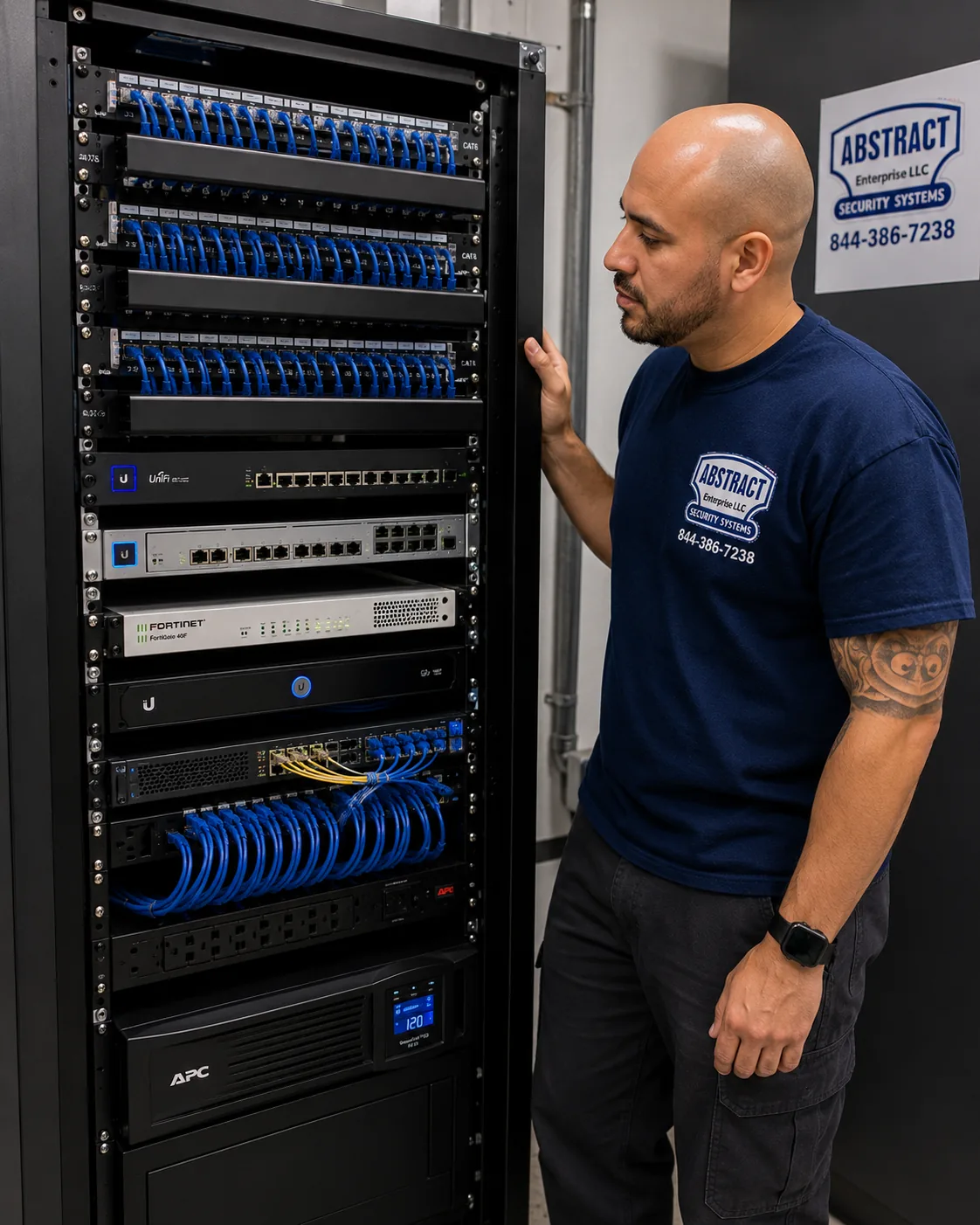
The North Valley Stream case showed that some burglars go after the cameras. Others go after the recorder, because taking it takes the footage too. We usually suggest a closet, a basement corner or a utility area away from the front door, with the NVR on a shelf, a battery backup beside it, and its network cable running back to the router. If you have a spot in mind, photograph it. If you do not, we will suggest two or three during the survey and explain the trade-offs: a hidden spot may be warmer, further from the router or harder to reach for future drives.
Stand on the sidewalk and look at your house the way a stranger would. Where would you walk up unseen? Which windows are hidden by a hedge? Is there a side gate or a back fence that opens onto a path or a park? Long Island's lots often have a side yard that nobody looks at, and that is usually where we find the gap in an existing system. Photos from the street and from each corner of the yard let us mark camera positions on paper before the visit, so the survey is about confirming, not guessing.

These are the AVYCON jobs Long Island homeowners, landlords, businesses and schools book us for. Each is quoted from our verified Long Island price list at the Nassau or Suffolk rate. Where a job needs something extra, such as a PoE switch in a detached garage or a bracket for a corner with no eave, the quote names it before you agree.
An AVYCON NVR with PoE cameras covering the front door, driveway, side yards, back door and garage, with each cable routed through the attic, garage or exterior to suit a slab ranch, a split-level or a colonial.
Hikvision or Dahua recorders and cameras swapped for AVYCON models on its NDAA compliant list, reusing good existing cable where it tests clean, for owners and institutions that need compliance.
A new AVYCON recorder added to existing ONVIF cameras from another brand, with each one tested so you know which features carry over before you decide to keep it.
Pan-tilt-zoom cameras for long North Shore drives, big Suffolk lots and South Shore docks, set with preset positions so they return to the gate or the bulkhead after each move.
Cameras aimed and tuned for license plates at a driveway mouth, a parking lot entrance or a gate, with headlight glare and vehicle speed accounted for in the placement.
The app installed and tested on every phone that needs it, with alert categories, AI zones and quiet hours set so a passing car on the street does not wake you every night.
NDAA systems for private, parochial, yeshiva and daycare buildings across Nassau and Suffolk, planned around entrances, pickup lines and parking, with the administration's access rules set up in the recorder.
Multi-camera AVYCON systems for retail strips, office suites and industrial buildings along Hempstead Turnpike, Route 110 and in the Hauppauge industrial park, with the recorder in a locked IT closet.
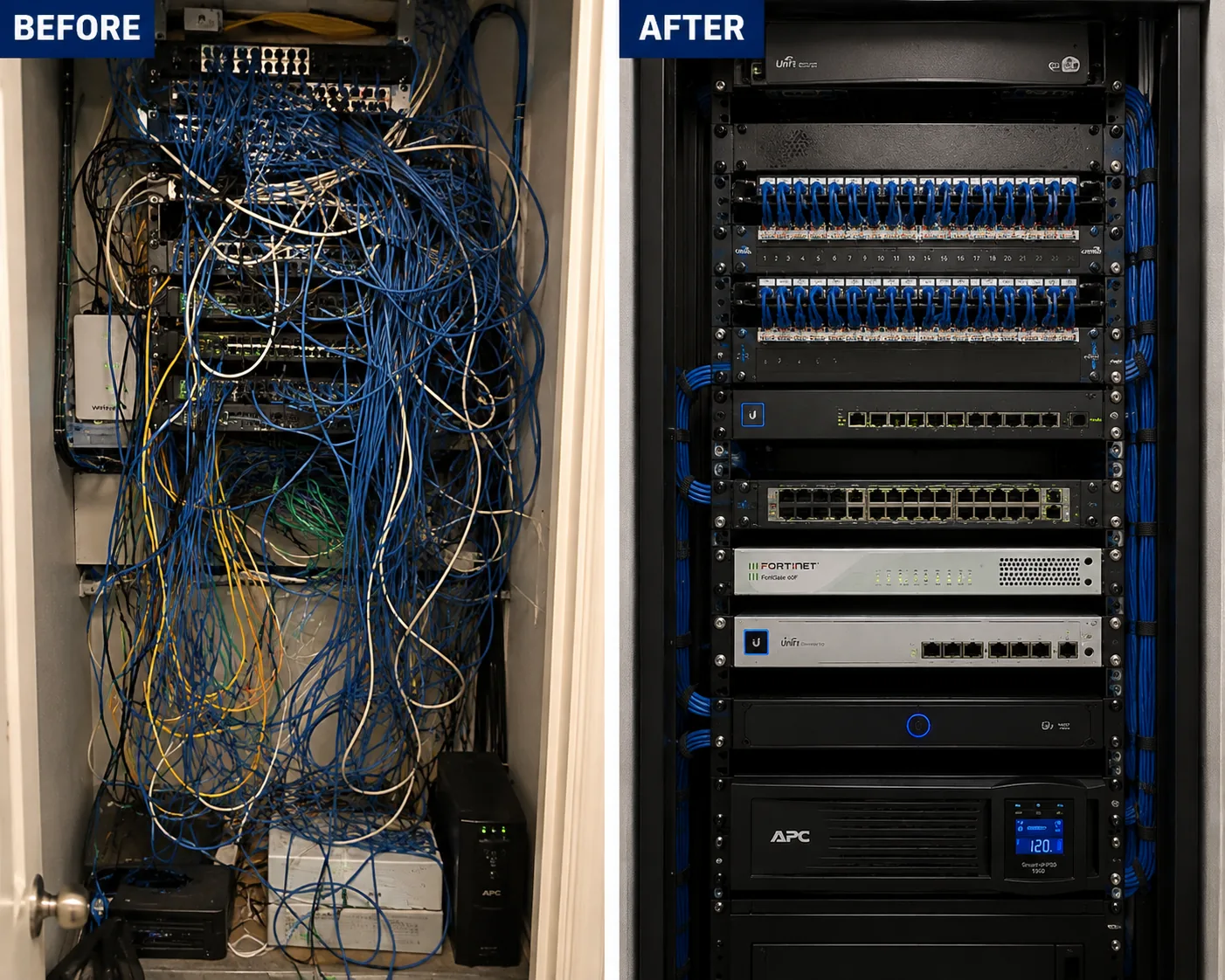
Dead recorders, cameras that dropped off the app, lost passwords and unlabeled systems left by a previous installer, traced, documented and brought back under your control.

Installers who work on Long Island tend to describe the same set of homes: the colonials, split-levels, ranches and Capes of places like Levittown, Hicksville and Massapequa; the Gold Coast estates of the North Shore; the wood-frame and cedar-shingle houses of the South Shore; and waterfront and seasonal homes out to the East End. Each changes three things about an AVYCON job: how cable reaches each camera, where the recorder can live, and who has to agree before we drill.
Levittown-style houses on concrete slabs with no basement, some with heating coils in the slab. Cable goes through the attic to the eaves or along the garage; the floor is never drilled.
Multi-level 1950s through 1970s houses, common in both counties. Cable has to climb between half-levels, often through closets stacked above one another or along the garage wall.
More common in Suffolk's later housing. A basement or crawlspace lets cable run below the floors and up the outside walls, which keeps the attic quieter and the eaves cleaner.
Large houses on long drives, often with gatehouses, garages and outbuildings. Distance, zoom lenses and switches in secondary buildings drive the design.
Wood-frame and shingle houses near the bays and canals, with docks and bulkheads to watch. Weather, salt air and flood levels decide where the recorder and switches sit.
New rental buildings at Station Yards in Ronkonkoma and near the Hicksville LIRR station. Landlord and building rules come first; most hard-wired work needs written permission.
| Property | Usual cable route | Usual recorder spot | Who signs off |
|---|---|---|---|
| Slab ranch or Cape | Attic to the eaves; garage wall; sealed exterior runs where there is no attic access | A hall or bedroom closet, or the garage if it stays dry | The owner, plus village or town paperwork where required |
| Split-level or hi-ranch | Through stacked closets, the garage and the attic over the upper level | Lower-level utility area near the router | The owner |
| Colonial with basement | Basement ceiling and up the outside walls or through the rim joist | Basement, near the panel and the internet line | The owner |
| North Shore estate | Long runs to outbuildings via PoE switches, conduit or other links planned on site | An equipment room in the main house, with switches in secondary buildings | The owner, the estate manager, sometimes a village |
| Waterfront home | Exterior runs kept high and sealed; nothing low in flood-prone spaces | An upper floor, above where water could reach | The owner; sometimes an HOA |
| Rental apartment or condo | Often none; a standalone camera with microSD inside the unit | No NVR, or one approved by management | The landlord, board or management company |
A Levittown-style ranch gives cable three possible paths: up into the attic, along the garage, or outside. The attic is usually best. From the hatch we crawl to the eaves above each camera position and drop the cable down through the soffit or the top of the wall, so the camera mounts on a short, clean run. Older attics bring their own care. Insulation may be thin or packed in, and in houses of this age it is not always the modern kind. A restoration contractor working in Uniondale warns that postwar Capes and ranches there frequently contain asbestos materials. We do not disturb material we cannot identify, and if anything in the attic or a wall looks like it could be asbestos, we stop and route around it or recommend testing before we continue.
The slab itself is never drilled. Even if a heating history is right that only about five percent of Levittown houses still run their original radiant coils, nobody can tell from the surface which houses those are, and a drill bit through a live hot-water line under the floor is a disaster. Where a camera has to go on a wall with no attic above it, such as a garage that was converted to a room, we run cable along the outside in a paintable raceway or under a soffit return, and seal every hole through the siding.
Split-levels and hi-ranches, which a Hempstead real-estate source describes around Hofstra and the Coliseum, put three or four floor levels in a small footprint. The upper bedrooms sit over the garage, the living room sits a half-flight up from the entry, and the family room sits a half-flight down. Cable from a recorder on the lower level to a camera on the upper eaves has to cross those offsets. We look for stacked closets, a chase beside the chimney or the space beside the garage stair. The garage ceiling is often the easiest horizontal route, because it is usually unfinished or easy to open and patch. We plan these houses carefully because a split-level wall that looks simple from the outside can hide a floor change halfway across.
The North Shore's Gold Coast was built from the early 1890s; Wikipedia counts more than 500 mansions in about 70 square miles, and a Thirteen guide gives a higher count of more than 1,200 built from the 1890s to the 1930s with fewer than a third surviving. After the Second World War many estates were demolished and subdivided, so today's North Shore mixes surviving great houses with large postwar homes on what were once estate grounds. For an AVYCON system, those lots mean a gate far from the house, a drive that curves out of sight, and buildings such as garages, staff quarters and pool houses that may each need cameras. Copper network cable has a practical distance limit, so outbuildings usually get their own PoE switch fed from the main house. Another Long Island installer has described a Sands Point job using a 32-channel recorder with a fiber link to a boathouse; we mention it because it shows the scale these properties reach, not because we did that job. We design each estate system from a site walk.
Hurricane Sandy, Wikipedia records, caused heavy damage in Long Beach and led to evacuations in Nassau south of Sunrise Highway. In August 2024 the state Department of Financial Services described the first-ever flash flood emergency for Suffolk County, the failure of the Stony Brook Mill Pond dam and more than 2,000 residents and businesses with flood damage. On waterfront and low-lying lots, we keep recorders, switches and battery backups on upper floors, mount cameras high under eaves, and seal every penetration. Some installers say salt air calls for marine-grade housings and sealed connectors, and we choose outdoor-rated cameras and stainless fixings near the water. A camera that faces the bay also faces glare at sunrise or sunset, so we check the sun's path before we fix the bracket.
The newer buildings near the LIRR stations are rentals with shared entrances and building rules. RentCafe lists the Alston at Station Yards, 1000 Mill Road, with package lockers and a concierge. A tenant in a building like that usually cannot run cable through walls or put a camera on the outside. What a tenant can usually do is place a camera inside the unit, aimed at the unit's own door from inside, recording to a microSD card or to an approved small recorder. We will not mount anything on common areas or exterior walls without the landlord's written approval, and if the building already has a system, the management company is the right place to ask about footage.


Long Island's businesses cluster along a few long roads and in a few dense hubs. The corridors below are the ones named by Wikipedia, local news and real-estate sources. We describe what those sources say about them; we have no information about the camera systems inside any particular business and do not claim any of them as clients.
Wikipedia describes long commercial strips along the turnpike in Elmont and Hempstead. North of it in Uniondale, East Garden City is the commercial side; the Coliseum stands at 1255 Hempstead Turnpike.
Runs through commercial strips in Melville and Huntington Station and crosses Jericho Turnpike in South Huntington, with warehouse, flex, research and office buildings from Farmingdale north.
Wikipedia calls Roosevelt Field, at 630 Old Country Road, the largest mall on Long Island. News 12 and Daily Voice have reported shoplifting arrests and vehicles stolen from its west parking lot.
An industrial and office park of about 1,350 businesses across about 11 square miles, according to sources compiled for an earlier Long Island page.
Wikipedia describes North Broadway as a significant retail center; a $200 million Broadway Commons plan, Bass Pro Shops on the former Sears site and new apartments near the LIRR station are reshaping it.
RXR Plaza, described as Long Island's largest office building, with two 15-story towers and raised access floors, and the Omni at 333 Earle Ovington Boulevard, a 10-floor building from 1990.
A homeowner looks at a camera clip when something happens. A store owner on Hempstead Turnpike or a warehouse manager in Hauppauge often has to answer a question from an insurer, a lawyer or the police: what happened at the loading door at 2:14 last Tuesday, and who was there. That makes recording time, image quality at the right points and the ability to export a clean clip more important than live viewing. On a business AVYCON system we plan cameras for the points that matter in a claim: every customer entrance, the register area, the stock room door, the loading dock, the parking lot entrance for plates, and the corners where people hide. We size the recorder's drives for the number of days the business wants to keep, and we show the manager how to find and export footage without calling us.
Office buildings like the Nassau Hub towers bring a different set of facts. A listing describes RXR Plaza's towers as built on column-free concrete slabs with four-inch raised access floors and a backup generator. Raised floors make horizontal cable runs easier inside a suite. Building management controls the risers, the roof and the common areas, so a tenant's AVYCON system usually covers the suite's own entrances and interior, with the building's system watching the lobby. We work under the building's contractor rules, which almost always include a certificate of insurance and scheduled hours.
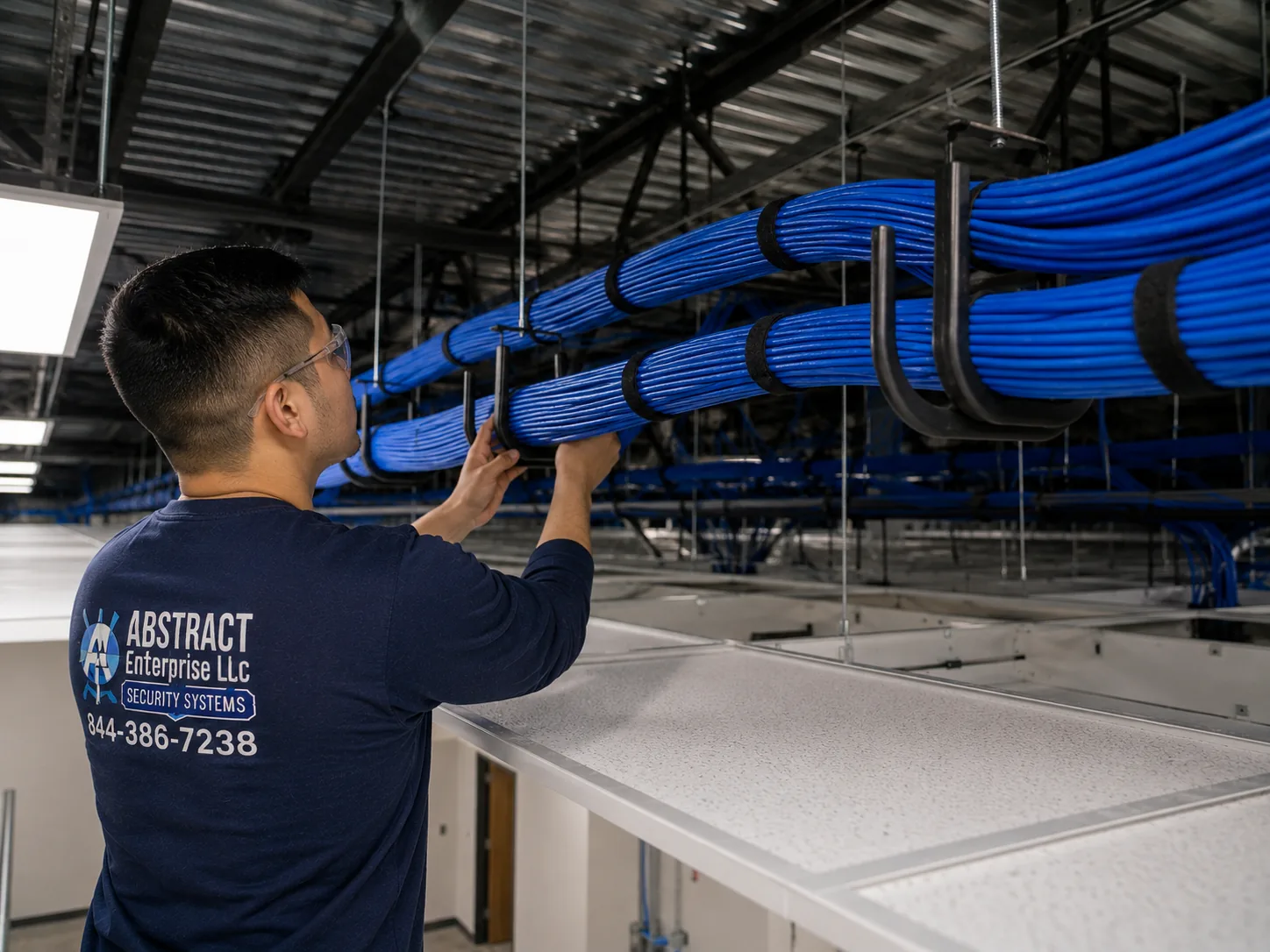
Warehouses and flex buildings along Route 110 and in Hauppauge usually need the longest runs and the hardest mounts: block walls, steel beams, high ceilings and yards with trucks moving at night. That is where conduit, J-hooks and lift work come in, and where long-zoom PTZ cameras earn their place on a corner of the building facing the yard gate.


We do not publish stories about a particular customer's house unless we can document them, so this is not a tale about one Long Island address. It is the routine our technicians follow on the first visit to a slab ranch or a Cape, which is the kind of house Nassau is full of.
We start outside, not inside. We walk the lot with the owner and stand at each corner of the house, asking the same question every time: what do you need to see from here? We look at the eaves above each position and note whether there is a soffit we can feed through or a solid fascia. Then we go up the attic hatch with a light and look before we touch anything: the depth and type of insulation, where the bath fans and the old wiring run, whether the eaves are reachable or pinched down to nothing at the edges. We look at the garage ceiling and the wall shared with the house. We find the router and the electrical panel. We pick a recorder spot with the owner, away from the front door, with an outlet and a short path to the router. We hold a phone at each camera position and look at the screen, so the owner sees roughly what the camera will see. Only then do we write down the cable routes. In houses of this kind, that walk is what keeps the cable out of the slab, the insulation undisturbed and every camera aimed at something that matters.
Fitting AVYCON to what you already have
Often they can stay. AVYCON's support FAQ says its NVRs can add third-party cameras that support the ONVIF protocol. Most network cameras from established brands support it, but not all, and older analog cameras on coaxial cable do not work with an NVR at all without an encoder. We connect each existing camera to the AVYCON recorder during the survey or at the start of the install and check three things: that it streams, that it records reliably, and which features work. Basic motion recording usually carries over. AVYCON's AI detection for people and vehicles, facial recognition and plate reading are generally tied to AVYCON's own cameras, so a kept camera may record but not sort its alerts as cleverly. We tell you that plainly, camera by camera, and you decide which to keep and which to replace.
Yes. iSpy's camera database notes that AVYCON cameras typically stream over RTSP on port 554, which is the standard way to hand a live stream to video management software, a monitoring service or a display system. We confirm the stream path on your specific model, create a separate user with view-only rights for that connection so the main admin password is never shared, and document it for whoever manages the other software. On a business network we also check that the port is only reachable inside the network or through a secure connection, not opened to the whole internet.
NDAA and institutions
By model number, on paper. AVYCON's NDAA statement says its specified compliant products avoid critical components and systems-on-chip from prohibited vendors, naming Huawei, ZTE, Hytera, Hikvision and Dahua, and AVYCON publishes a list of compliant products. Not every AVYCON product is on that list. For a school, daycare, campus or any client with a compliance requirement, we choose each camera, recorder and encoder from AVYCON's current compliant list, put the exact model numbers on the written quote, and give the administration the list we checked against. If the board's requirement goes beyond NDAA, for example a specific country of manufacture, we raise it before ordering, because AVYCON says its compliant products are made and substantially transformed in the United States, South Korea and/or Vietnam, not in one place.
Licenses and paperwork
There are two layers. At the state level, the Department of State licenses security and fire alarm installers, and 19 NYCRR 195.2 covers closed-circuit television used to detect or monitor intrusion, theft and movement, which is what most Long Island camera systems do. The Department of Labor's licensing summary lists the requirements for the license: at least 18 years old, at least 81 hours of qualifying education, an installer exam and fingerprints. AESS works under NYS license #12000287431. At the county level, Nassau requires a home improvement license for residential contractors through its Office of Consumer Affairs, while Suffolk licenses regulated trades through its own Office of Consumer Affairs except where a town or village licenses them itself. Ask any installer for both and check them before signing.
Yes, and we check before we book. Nassau's 64 incorporated villages each run their own paperwork, and villages, landlords and parks can add insurance certificates and site rules. One Long Island installer says standard camera installs typically do not need local permits; Low Voltage Nation says the state code has required permits for low-voltage electrical installations since January 1, 1984, and that virtually all Nassau towns and villages enforce permit rules. Because sources disagree, we do not guess. We look up what your village or town asks for, tell you before you book, and handle the filing or the certificate of insurance where one is needed. If the village has nothing to file for a job like yours, we tell you that too.
Slab houses, split-levels and long runs
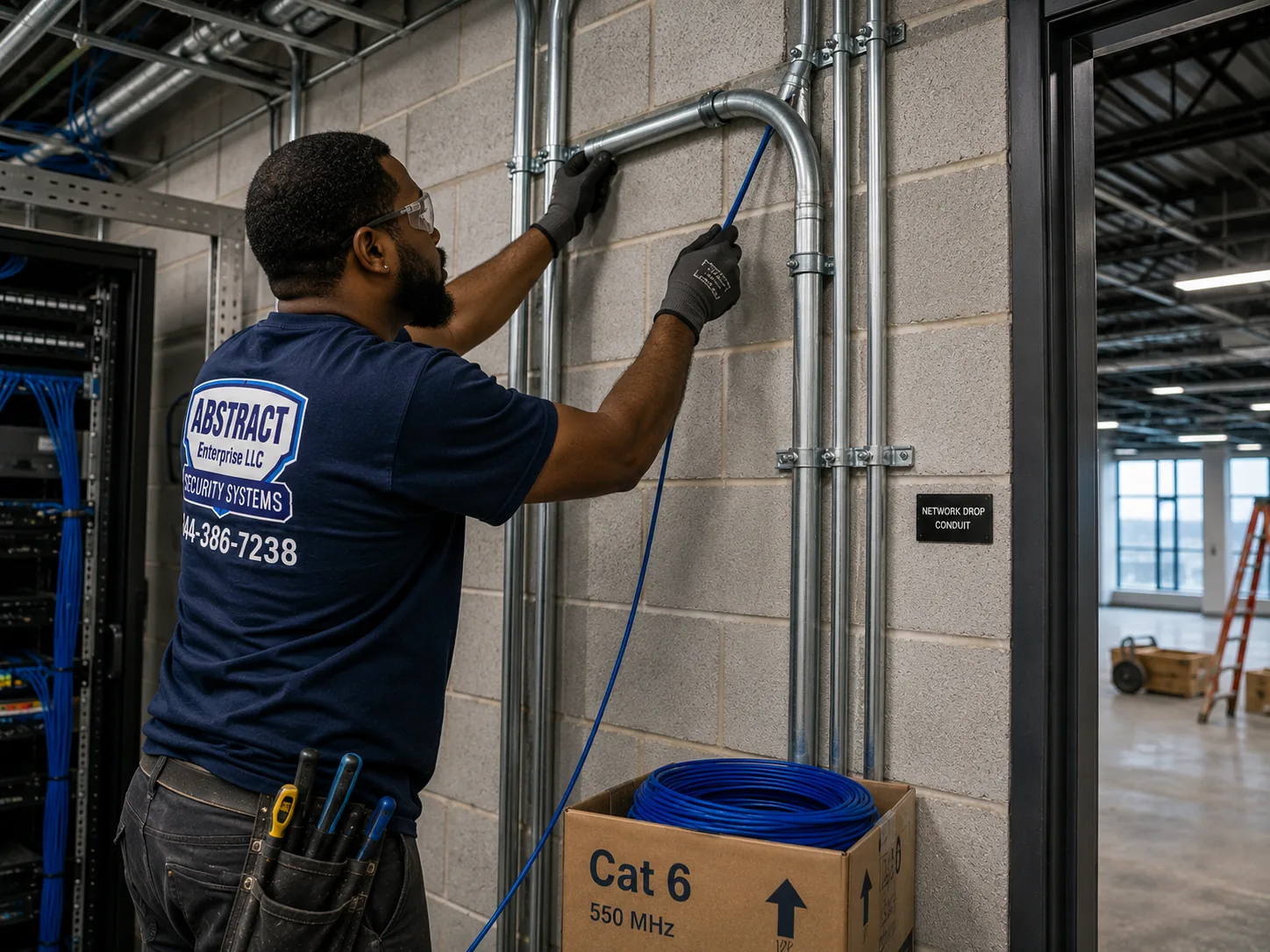
Through the attic, the garage or the outside walls, never the floor. In most slab ranches and Capes, the attic runs over the whole house and reaches the eaves, so we drop each camera's cable down through the soffit or the top of the wall right above the camera. The recorder usually sits in a closet whose ceiling opens into the attic, so the cables come down a single path into that closet. Where a camera sits under a room with no attic above it, such as a converted garage or a dormer, we run the cable along the outside in a paintable raceway or tucked under the eave, sealed where it passes through the siding. The slab stays untouched because some Levittown houses still carry heating coils in the concrete and there is no way to know from above which ones.
Yes, but the garage usually needs its own small network point. A single copper network cable has a practical length limit, and a detached garage at the back of a big lot can be near or past it once the cable goes up the house, across the attic and down again. The common answer is a cable from the house to a PoE switch inside the garage, which powers the garage cameras and sends their video back on one line. How that line crosses the yard depends on the ground, the driveway and what is already buried; we plan it on site and put the method on the quote. If the garage already has power and a network line, the job is simpler and we test what is there first.
The AVYCON ONE app
We set it up as part of the install and prove it works before we leave. The App Store listing we checked showed 2.9 stars from 52 ratings, with one reviewer saying the app hangs about half the time and that their installer struggled to save the device. Most of those problems come from three places: the recorder's network settings, the phone's app permissions and an account that was set up in a hurry. We give the recorder a fixed address on your network, update its firmware, create the owner account with you, add each family member's phone with the access they need, turn on the alert types you actually want, and then test live view and playback on cellular data with Wi-Fi off. If a phone still struggles, we find out why while we are there.
Privacy and neighbors
With angles first and privacy masks second. New York's Civil Rights Law section 52-a makes it unlawful to install or use a video surveillance device where a person has a reasonable expectation of privacy, and installer guidance recommends digital privacy masking on exterior cameras to avoid capturing a neighbor's yard or windows. On a tight Long Island side yard, we aim cameras along your own wall and down toward your own path, rather than across at the house next door. Where some of the neighbor's property still falls in the frame, we draw a privacy mask over it in the AVYCON recorder, which blacks out that part of the picture permanently. In Shirley, CBS New York reported police saying a backyard visible to the public is fair game, but a window is a different matter, and we keep cameras away from them.
Usually not on outdoor cameras. New York requires consent for audio recording, and legal guidance on home cameras advises disabling audio unless you know a consenting participant, such as you, will be part of any recorded conversation. A camera on your front door picking up two strangers talking on the sidewalk is the kind of recording that causes trouble. We leave audio off by default and turn it on only where you have a clear reason and understand the rule, for example on a doorbell where you are the one talking to a visitor.
Theft, tampering and the morning after
Height, overlap and alerts. We mount cameras out of easy reach, usually under the eaves rather than at head height, so nobody can turn or cover them without a ladder. We place cameras so that each important camera is seen by another one; a person reaching up to tape a lens is then recorded by the camera across the yard. And we turn on the recorder's abnormal-event alerts, which in AVYCON ONE are a separate alert category, so that a camera that goes offline or loses its picture sends a notification to your phone. On a house that sits empty for long stretches, those alerts are what tell you something is wrong before you get home.
Two kinds: a wide view of the whole driveway from the house, and a narrower view of the driveway mouth for faces and plates. ABC7 reported police saying Long Island burglars are attracted by cars in driveways, and the East Hills case in June 2026 began with three people searching a car at 3:45 a.m. A wide camera on the garage corner shows what people do around the cars. A second camera aimed at the point where the driveway meets the street, mounted where headlights do not blind it, is what gives you a usable picture of a face or a plate as people arrive and leave. We set the recorder to treat people and vehicles in the driveway as alerts while ignoring cars driving past on the street.
Power and storms
Without a battery backup, it stops, along with the router that sends alerts to your phone. ABC7 reported that at the peak of Tropical Storm Isaias in August 2020, almost half of PSEG's 1.1 million Long Island customers were in the dark. We recommend a battery backup for the recorder, the PoE switch and the router together, sized to ride through a short outage and shut the recorder down cleanly in a long one, so the drives are not damaged. A battery will not keep a system running for days. If you have a whole-house generator, we connect the recorder to a circuit it covers, and we set the recorder to restart and resume recording on its own when power returns.
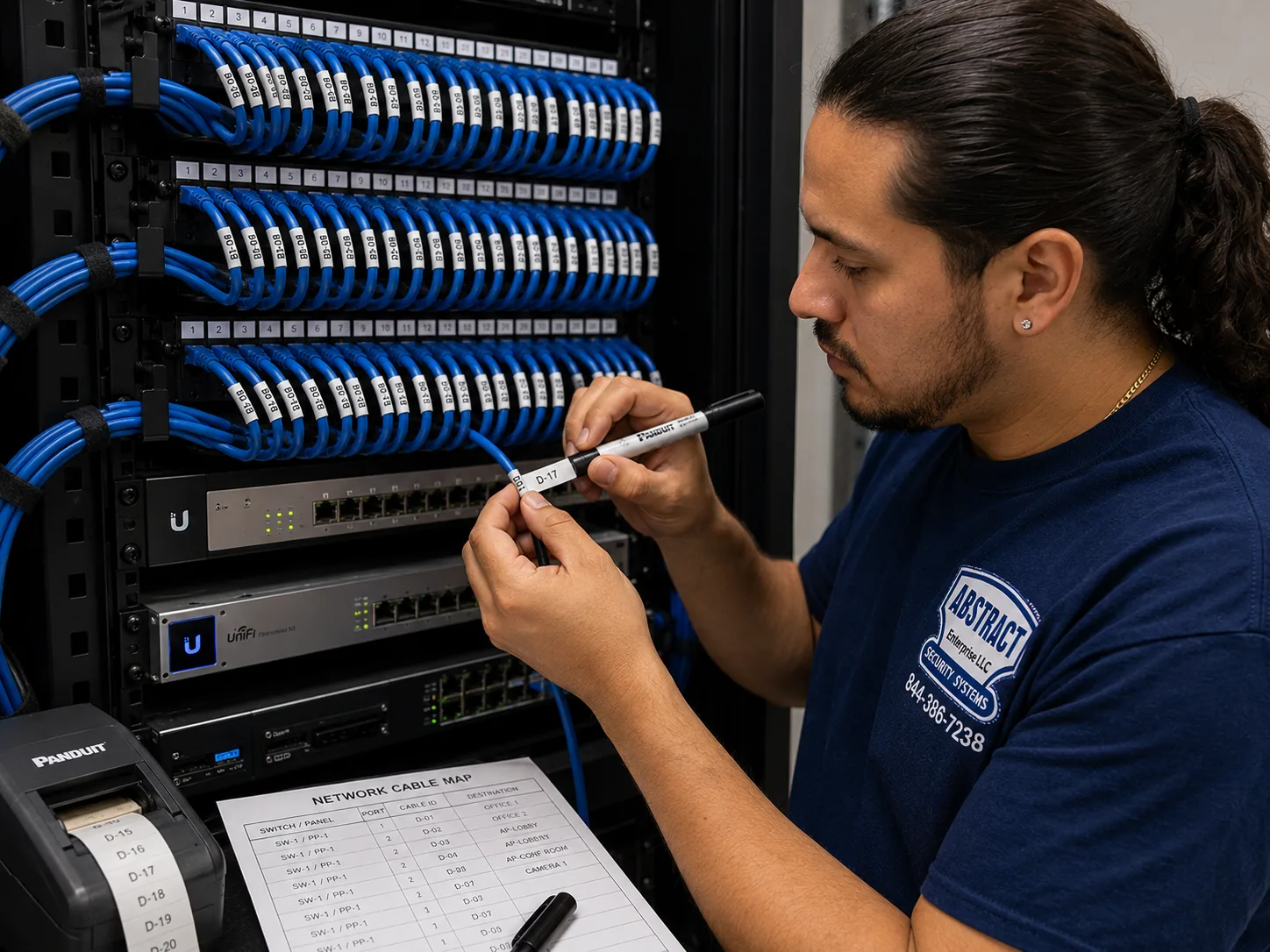
These are the AVYCON components and supporting equipment we fit on Long Island properties. Exact models are chosen per site and named on the written quote; for compliance jobs every model is checked against AVYCON's current NDAA list. Equipment and installed prices for the Long Island area are on our Long Island AVYCON price page.
Network video recorders with built-in PoE ports for small systems and larger channel counts for bigger ones; ADI lists NDAA 32-channel AVYCON NVRs for estates, schools and commercial buildings.
Fixed PoE cameras for doors, driveways, side yards and parking lots, chosen by lens angle and mounting surface: turrets under eaves, domes where vandalism is likely, bullets where a long view matters.
AVYCON's NDAA list includes long-zoom PTZ models such as 5MP 40X and 8MP 25X units, for long drives, open lots, docks and campus grounds.
Cameras whose alerts sort people and vehicles from shadows and animals, feeding AVYCON ONE's AI alert category so owners get fewer false notifications.
Cameras aimed and tuned for license plates at driveway mouths and lot entrances, with shutter and lens settings set for moving cars at night.
Single cameras recording to a microSD card, as the AVYCON ONE listing describes, for renters, small outbuildings or spots where a recorder is not practical.
PoE switches for extra cameras and outbuildings, outdoor-rated network cable for exterior runs, and conduit where cable needs protection.
UPS units for the recorder, switch and router, so a short outage does not stop recording and a long one shuts the system down cleanly.
Good existing cameras from other brands added to the AVYCON recorder where they support ONVIF, each one tested before we agree to keep it.
Many Long Island owners compare an AVYCON system with a national brand before calling us. The comparison is less about which is "better" and more about which kind of system fits the property.
| Question | AVYCON NVR system, installed by a local licensed installer | Ring or SimpliSafe cameras | ADT |
|---|---|---|---|
| How cameras connect | Network cable with PoE: power and video on one wire per camera | Mostly Wi-Fi, battery or plug-in power | Depends on the package sold |
| Where video is stored | On the NVR's drives in your house or business | Mostly cloud plans, with some local options | Depends on the package sold |
| Who installs | A licensed installer who plans each run | Mostly self-install; Ring and others sell paid pro install | ADT technicians |
| Police sharing | Your footage stays on your recorder; you choose what to hand over and whether to join a voluntary registry | Ring runs Community Requests in its Neighbors app, which Consumer Reports says can be turned off | Depends on the program |
| NDAA question | Compliant models available from AVYCON's list | Not usually the selling point | Depends on the equipment |
| Best fit | Houses and businesses that want many wired cameras, local recording and no dependence on Wi-Fi | A doorbell or a few cameras, renters, quick setup | Owners who want a monitored alarm package from one company |
Ring's police-sharing programs have changed more than once. Consumer Reports describes Community Requests as a way for police to ask users for video, with an option to turn it off in the Neighbors settings, and Variety reported in 2026 that Ring ended a partnership with Flock Safety after a backlash. A local recorder does not join any of those programs by itself; you decide what to share and when. If what you really want is a single doorbell and a camera over the garage, a Wi-Fi system may suit you better, and we will say so.

We could not capture Google's AI Overview or People Also Ask boxes for this search from our build environment, so we will not pretend to quote them. What follows are claims we see repeated in quick online answers about AVYCON, NDAA cameras and camera installation on Long Island, set against the public record and our field practice. National marketplaces such as Angi, HomeAdvisor and Fixr publish cost guides that feed many of those answers; they help with a rough sense of scale, but they are not a quote for a slab ranch in Levittown or an estate in Old Westbury.
Some consumer kits are locked to their own recorders, and quick answers often assume every brand works that way. A Slickdeals thread about one warehouse-club kit, for example, has a buyer saying those cameras would only work on that brand's recorder.
AVYCON's own support FAQ says the opposite for its NVRs: third-party cameras can be added if they support ONVIF. That is useful on Long Island, where many houses already have a few cameras from an earlier system.
The fair version is that ONVIF gets the video onto the recorder, but not always the smart features. We test each existing camera on the new recorder and tell you what you will and will not get from it before you decide to keep it.
The phrase gets shortened that way, and it is not what AVYCON says. Its NDAA statement describes compliant products as manufactured and substantially transformed in the United States, South Korea and/or Vietnam, without critical components or chips from the named prohibited vendors.
For most Long Island homeowners, the difference does not matter. For a school, a government contractor or a business with a written supply-chain requirement, it can matter a great deal, and the requirement should be read exactly as written.
We check every model on a compliance job against AVYCON's current list and give the client that list with the quote. If the requirement is country-specific, we raise it before anything is ordered.
This one is half true, which makes it dangerous. A permit guide says no state license is required for a homeowner installing a system on their own home. That is about the homeowner, not about someone paid to do it.
For paid work, the NYS Department of State licenses security and fire alarm installers, and 19 NYCRR 195.2 covers CCTV used to detect or monitor intrusion, theft or movement. A trade association warns that unlicensed installers of security systems, which it says include cameras, can face fines of up to ten thousand dollars; that figure is the association's, not one we checked in the statute.
On Long Island the county layer sits on top: Nassau's home improvement license for residential work, and Suffolk's Office of Consumer Affairs licensing where towns and villages do not run their own. Ask for both, and check them.
An installer's page says standard camera installations in Nassau and Suffolk typically do not require local permits, and AI answers repeat that as a flat rule. Another source says the state code has required permits for low-voltage electrical installations since January 1, 1984, and that virtually all Nassau towns and villages enforce permit rules.
With 64 incorporated villages in Nassau alone, plus towns, a blanket answer cannot be right for every address. What applies in one village may not apply in the hamlet next to it.
Our approach is boring and reliable: we look up the rule for your address before booking and tell you what, if anything, has to be filed.
Generic install guides assume a basement. Nassau's median house was built in 1955, and the most famous houses of that era, in Levittown, were built on slabs with no basement at all, some with heating coils cast into the concrete.
Following a basement-first guide in a slab house leads people to drill the floor or to staple cable along the baseboards. Neither is a good result, and drilling the slab can hit a live heating line.
In slab ranches and Capes, the attic is the route, with the garage and sealed exterior runs as backups. In split-levels, it is stacked closets and the garage ceiling. In Suffolk's later colonials, the basement guide often does apply.
AVYCON ONE does offer facial recognition, people and vehicle detection and plate reading, and answers about those features tend to stop at "how to enable." They skip the parts of New York law that still apply: consent for audio, and Civil Rights Law section 52-a against video where people expect privacy.
Plate reading has its own debate on the island. A Long Island criminal-law blog counted 47 plate readers in the Village of Hempstead and 46 in Old Westbury and noted New York has no law on how long plate data is kept. In Greenport, longisland-ny.com reported Flock plate cameras vandalized again, with three more tampering reports in one week in October 2026.
For a private house, a camera that reads plates on your own driveway is a sensible tool. For a business, decide who can see that data and how long you keep it before you switch it on.
AVYCON's FAQ is right that a PoE camera plugged into the NVR appears on the screen in about a minute. That minute is the end of the job, not the job. The hours are in getting a tested cable from that port to a camera under the eave of a 1950s attic without disturbing anything that should not be disturbed.
The other hidden hour is the app. The AVYCON ONE listing's 2.9-star rating and reviews about hanging and devices that will not save suggest that phone setup goes wrong when it is rushed.
An install is finished when every cable has tested clean, every camera is aimed and masked, the recorder is set and backed up on battery, and the app works on your phone away from home. That is the standard we hold ourselves to.
Send photos of the outside of the house or building, the attic hatch and the spot where your router lives, and a technician will tell you how the cable can reach each camera, which AVYCON models fit the job, whether your existing cameras are worth keeping, and which lines of our Long Island price list apply. Call (800) 486-0943, message us on WhatsApp, or use the quick form.
Every Long Island AVYCON job follows the same eight steps, whether it is four cameras on a Levittown ranch or thirty on a campus. The order matters most on older houses and busy commercial sites, where a rushed route is the usual cause of a camera that drops off the app or a hole that lets water in.
Town or village, property type, what you want to see, and whether existing cameras or an NVR are on site. Photos of the outside walls, attic hatch and equipment spot let us plan before booking.
Village or town paperwork, landlord, HOA, board or school sign-off, and certificates of insurance, confirmed before the visit.
We stand at each position, check sight lines for faces, plates and approach paths, and mark what must be masked to keep neighbors' private spaces out of view.
Recorder, switch and battery backup placed away from the front door; each run mapped through attic, garage, basement or exterior, avoiding the slab and any material that should not be disturbed.
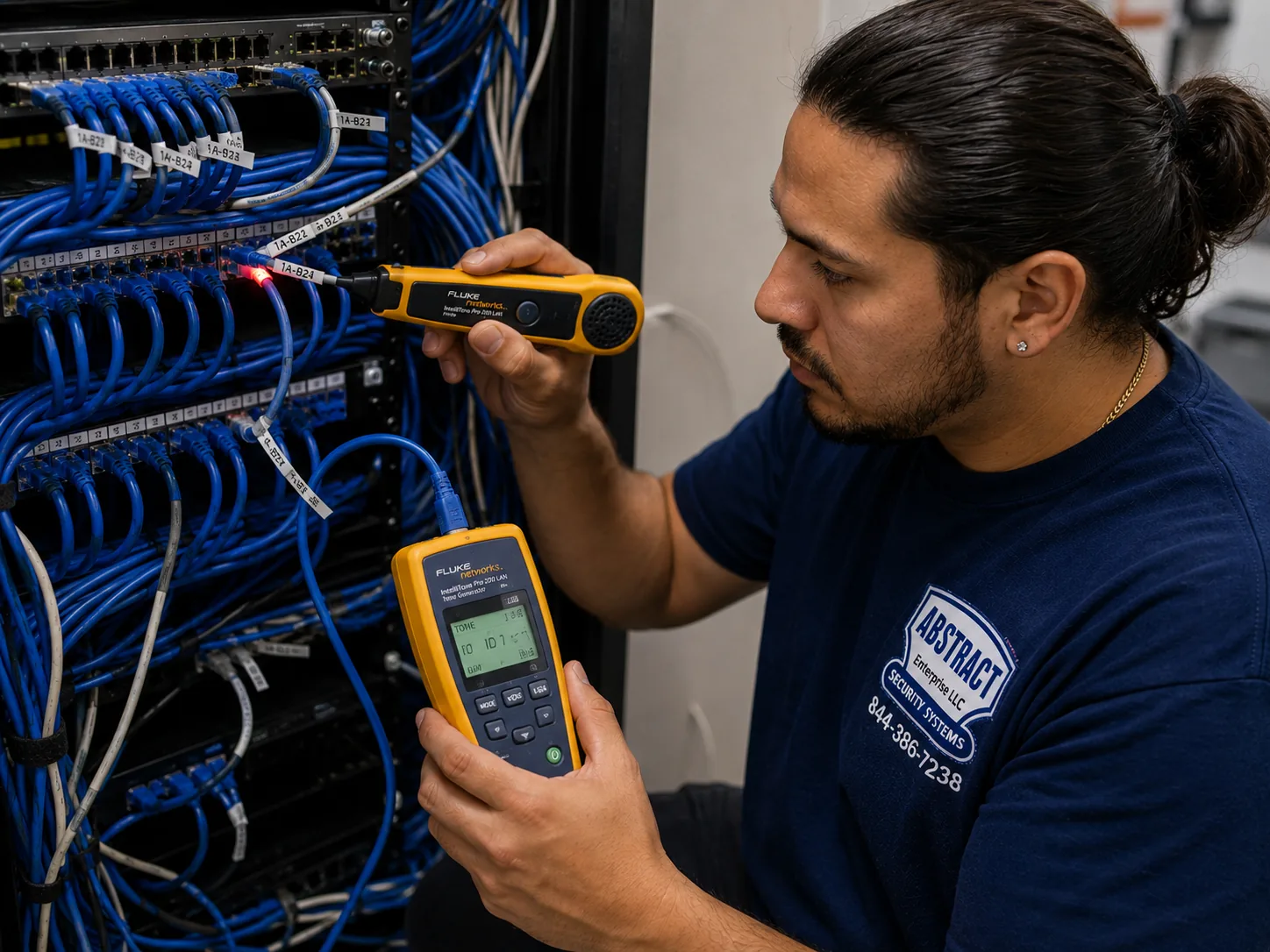
One run per camera, tested and labeled at both ends so the camera number on screen matches the cable in the closet.
Cameras up out of easy reach, on junction boxes where the surface needs them, with penetrations through siding, brick or block sealed against weather.
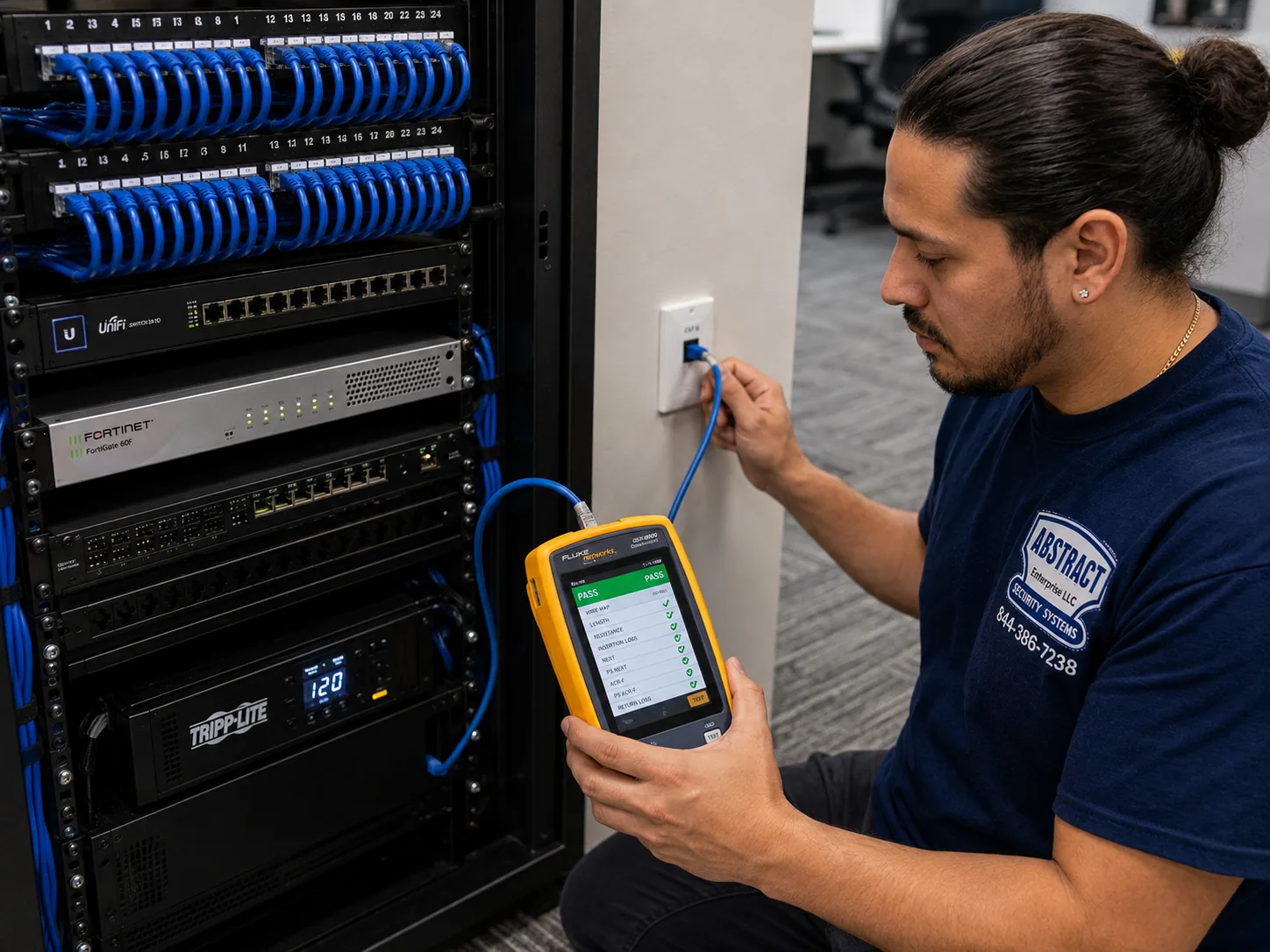
Every camera recording, schedules and drive retention set, AI zones and privacy masks drawn, alerts tuned, battery backup tested.
AVYCON ONE on your phones, tested on cellular data; playback, clip export and alert settings shown; passwords, camera map and cable labels left with you.
The survey and the install are often separate visits on larger jobs, because estates, schools and commercial buildings need equipment ordered and paperwork filed in between. On a smaller house we can often confirm the plan from photos and do the survey at the start of the install day.
Long Island is too large to describe by one set of streets, so we plan visits by the landmarks people use to give directions. These are the ones that come up most, from the city line to the East End.
Begun in 1947 on potato fields; 17,447 homes by 1951 and 51,758 residents in 2020, making it Nassau's most populous unincorporated area, per Wikipedia.
The largest mall on Long Island, at 630 Old Country Road in East Garden City, on the airfield where Lindbergh's 1927 transatlantic flight took off.
The arena at 1255 Hempstead Turnpike on the former Mitchel Field, beside the Cradle of Aviation Museum, Nassau Community College and Hofstra.
The 1906 John Shaffer Phipps estate, with about 200 acres of gardens, in the heart of the North Shore's estate country.
A 53-acre development around the LIRR station; in October 2026 work began on three five-story buildings with 285 apartments and a Northwell medical hub.
A campus of 213 buildings on 1,454 acres, near the Mill Pond whose dam failed in the August 2024 flash flood.
The island's other anchors include the Vanderbilt museum in Centerport, Oheka Castle, Planting Fields, Sands Point Preserve with Castle Gould and Hempstead House, and Hicksville's LIRR hub. We cover Nassau and Suffolk from the Queens line to the East End; Nassau and Suffolk addresses are priced at their own county rates, on the Nassau County AVYCON price page and the Suffolk County AVYCON price page. If your property is just over the line in Queens, see AVYCON camera pricing in Queens, and for the five boroughs as a whole, AVYCON camera pricing in NYC.
Every Long Island AVYCON quote is built from our verified area price list and nothing else. Nassau addresses are priced at 1.15 times our Brooklyn base and Suffolk addresses at 1.20 times, which reflects the longer drives, bigger lots and travel involved. The full itemized list, with equipment, labor and add-ons, is on our Long Island AVYCON price page, with county versions for Nassau and Suffolk. We do not quote numbers on this page that are not on those lists, and we do not compare our installed prices with store or manufacturer prices.
| Factor | Why it changes the quote | Where it shows up on Long Island |
|---|---|---|
| Number of cameras | Each camera is equipment, a cable run, a mount and setup time | A Cape may need four to six; an estate or campus far more |
| Recorder size and storage | Channel count and drive size set how many cameras and how many days of video | Businesses that keep footage longer for insurers or claims |
| Camera type | Fixed cameras, AI cameras and long-zoom PTZ units are priced differently | PTZ on long North Shore drives and waterfront lots |
| Cable route difficulty | Open attics are quicker than tight eaves, finished ceilings or exterior raceway | Slab ranches, split-levels and remodeled Capes |
| Mounting surface and height | Brick, block, stucco and high mounts take more time and different fixings | Block foundations, masonry commercial walls, warehouse heights |
| Outbuildings | Detached garages, pool houses and boathouses may need a switch and a link back | Suffolk lots, estates, waterfront homes |
| Existing equipment | Reusing tested cable or ONVIF cameras can reduce new equipment | Houses with earlier systems; NDAA replacements |
| Battery backup | Sized to the recorder, switch and router | Recommended everywhere after the outages the island has seen |
| Paperwork and access | Village filings, certificates of insurance, school or landlord rules | Incorporated villages, office buildings, campuses |
Our written quote lists each camera with its model and position, the recorder and drive, any switches, the battery backup, the cable runs, the mounts and any paperwork. It names the county rate it uses. If we plan to reuse your existing cable or cameras, the quote says so and notes that they were tested. If a camera position needs something unusual, such as a junction box on stucco, a long bracket on a corner without an eave or conduit across a yard, that line is on the quote before you agree. Nothing is added on the day unless you ask for it.
Repairs and takeovers of existing systems are quoted after we have seen the system, because the cause of a dead camera or a recorder that will not connect can be a bad cable, a failed drive, a firmware problem or a forgotten password, and each takes a different amount of work.
Full terms โ including 50% deposit, one-year parts-only warranty on AESS-supplied products, and the late-fee schedule โ are set out in the service agreement.Three common Long Island AVYCON systems, described by what they cover. Each one is priced from the itemized lines on our Long Island AVYCON price page at the Nassau or Suffolk rate, so you can see exactly what you are paying for and add or remove cameras line by line.
An AVYCON NVR with built-in PoE and fixed cameras at the front door, driveway, back door and one side yard, cabled through the attic, with a battery backup and the AVYCON ONE app on your phones. Suits Levittown-style slab ranches and Capes on a quarter-acre lot. See the line items
A larger NVR with AI cameras around the whole house, a dedicated plate position at the driveway mouth, cameras on a detached garage through a PoE switch, privacy masks toward neighbors and tamper alerts. The usual system for split-levels, hi-ranches and Suffolk colonials. See the line items
A high-channel NDAA NVR, long-zoom PTZ coverage of a gate, drive, dock or yard, switches in outbuildings, extended storage, and a documented NDAA model list where required. For North Shore estates, waterfront homes, schools and commercial sites. See the line items
If you already own AVYCON cameras or an NVR, bought through another installer or inherited with a house, we can install or re-install them at labor-only rates from the same list, as long as the equipment is in sound condition and on current firmware. We check each item before it goes on your wall and tell you plainly if a camera or recorder is not worth installing. The same goes for third-party ONVIF cameras you want to keep on an AVYCON recorder: we test them, and if one does not work reliably, we show you the list price of a replacement instead of fitting something we expect to fail.
The full itemized list for Nassau and Suffolk, with equipment, labor and add-ons. AVYCON camera installation prices on Long Island
Pricing at the Nassau rate for towns, villages and hamlets from Elmont to Oyster Bay. Nassau County AVYCON pricing
Pricing at the Suffolk rate from Huntington and Babylon to the East End. Suffolk County AVYCON pricing
For properties on the Queens side of the Nassau border. Queens AVYCON pricing
The same AVYCON method and verified list structure across the five boroughs. NYC AVYCON pricing
Send the town, property type and photos and we will match the job to the list. Request a free quote or start from our home page.
It depends on the number of cameras, the recorder, the cable routes and any outbuildings, and every line comes from our verified Long Island price list, with Nassau addresses at 1.15 times our Brooklyn base and Suffolk addresses at 1.20 times. The itemized list is on our Long Island AVYCON price page, and a written quote names every camera, cable run and add-on before you agree.
All of Nassau and Suffolk, from the Queens line through the Nassau Hub, Hicksville and the Route 110 corridor out to Ronkonkoma, Stony Brook and the East End. Larger jobs further east may need the survey and install on separate days, which we plan with you at booking.
Yes. We install AVYCON systems in houses, rental buildings with the owner's approval, stores, offices, warehouses, schools and campuses. Commercial jobs are planned around entrances, registers, stock rooms, loading docks and parking entrances, with storage sized to how long the business needs to keep footage.
A permit guide says a homeowner installing on their own home does not need a state installer license, but a shop is a different situation, and paid installers need the NYS security installer license. If you do it yourself, check your village or town rules, keep audio off, keep cameras out of private spaces such as restrooms, and make sure exits and fire equipment stay clear. We are happy to review a self-installed system afterwards.
Ask for the NYS security installer license number and the county license that applies to your address, a certificate of insurance, the exact camera and recorder models, who keeps the admin password, how each cable will reach each camera, and what is excluded. A good quote names all of it in writing. Ours carries NYS license #12000287431.
Usually only inside your own unit and with the landlord's written permission for anything that drills or wires. A standalone AVYCON camera recording to a microSD card, aimed at your own door from inside, is often the practical option. We do not mount on hallways, entrances or exterior walls of a managed building without management's approval.
Yes, with limits. Civil Rights Law section 52-a prohibits video surveillance where people have a reasonable expectation of privacy, and New York requires consent for audio recording. Aim cameras at your own property, use privacy masks where a neighbor's yard or window falls into the frame, and leave outdoor audio off unless you have a clear reason and understand the rule.
Enough to cover every way onto the property and the places you would want evidence from: front door, driveway and driveway mouth, back door, side yards, and any detached garage. A compact slab ranch on a quarter-acre lot needs fewer cameras than a split-level with a detached garage or an estate with outbuildings. We count them from a site walk, not from a kit size.
It is free and voluntary. The Suffolk County Police SHIELD camera registry records where cameras are so detectives can ask you to check footage for a date and time, and the department says it does not have access to the cameras. Garden City's police run a similar private camera registry. Suffolk SHIELD also has an emergency remote access program you can opt into or out of at any time.
A camera recorder on its own is not an alarm. Suffolk requires a permit for alarm systems in its police district, and Nassau registers alarms that send signals for police response, with false-alarm fees in both counties. If you add a monitored alarm to the cameras, the permit rules for that alarm apply, and we explain them at booking.
Yes, with a few extra steps. We add a battery backup, set the recorder to restart and resume recording on its own after a power cut, turn on abnormal-event alerts so a camera that goes offline notifies you, and make sure the app works from wherever you spend the winter. The East Hampton Star has reported police using video from a camera inside a burglarized Sammy's Beach Road house.
Yelp's Long Island CCTV installation search lists Abstract Enterprises alongside other local companies, and its security camera installation category for Long Island shows a 4.6 average across 387 reviews. Our own Google profile shows 4.7 stars from 201 reviews. Read recent reviews for how each company handled wiring, cleanup and app setup.
Tell us the town or village, the property type, roughly how many cameras you want, and whether there is an existing system. Photos of the outside, the attic hatch and the router spot make the quote exact. Prefer to talk? Call (800) 486-0943.
ยท AVYCON Camera Installation NYC | NYC Hub, All 5 Boroughs ยท AVYCON Camera Installation Hudson Valley hub | 6 Counties
From a 1950s slab ranch in Levittown to a split-level near Hofstra, a colonial on a long Suffolk lot, an estate on the North Shore or an office near the Nassau Hub, the job starts the same way: the address, a few photos, a clear list of what you need to see, and an honest match to our Long Island price list. Call (800) 486-0943, message us on WhatsApp, or send the quote form, and we will tell you how every cable will reach every camera before anyone climbs into the attic.
AVYCON Camera Installation by neighborhood: Long Island hub, Long Island avycon camera installation