What are you looking for?
About Us Contact Us Careers Get a Free Quote (800) 486-0943
Pick a service
โœ… Got Your Own System?
๐ŸŽฌ Home TheatreQuote ๐ŸŽถ AV SoundQuote ๐Ÿ”‘ Access ControlQuote
Now pick your area
Pick your area
Long Island
Hudson Valley
Services available
Pricing & Tools
Pick a service for pricing
๐Ÿšช Intercom Pricing ๐Ÿ”” Buzzer Repair Pricing
Calculators
๐Ÿ“น Camera System Calculator ๐Ÿšจ Alarm Calculator โšก Cabling Quote Builder โœ… Got Your Own System?
Select your area
Amcrest NVR kit still in the box in a Levittown ranch, or a camera that went dark at a Hauppauge warehouse? Book a licensed Long Island Amcrest install: (800) 486-0943
Home › Amcrest Camera Installation › Long Island
Postwar Slab Ranches · Cape Cods with Detached Garages · Suffolk Colonials · Route 110 and Hauppauge Offices · Licensed Low-Voltage

Amcrest Camera
Installation in
Long Island

See every Amcrest camera price in Long Island and build your own system →

Every Model Checked Before We Mount It · Recording Kept on Your Own Recorder · Nassau and Suffolk, One Hub

Amcrest camera installation on Long Island means wiring a budget-friendly, subscription-optional camera brand into houses and buildings that were never planned for it. Nassau County's median home was built in 1955 and Suffolk's in 1970, according to the Census Bureau's 2023 American Community Survey, and more than three quarters of the housing units in each county are single-family detached homes. That gives us slab ranches with no basement, Cape Cods with detached garages at the end of a long driveway, split-levels with three floors of cable routes, and colonials with full basements, plus office towers in Uniondale, flex buildings on Route 110 and industrial suites in Hauppauge. We read the house and the Amcrest model numbers before we book, wire PoE cameras to a recorder you own, and work under NYS license #12000287431 across both counties.

Reviewed and updated November 5, 2026 by Anwar Timothy, NYS license #12000287431 · Sources: U.S. Census Bureau 2023 ACS five-year estimates for Nassau and Suffolk Counties, ny.gov county profiles, the NYS Department of State security and fire alarm installer license pages, Kirschenbaum & Kirschenbaum on CCTV licensing, Nassau County Office of Consumer Affairs, Suffolk County Police SHIELD initiatives, Garden City Police private camera registration, the FCC Covered List, iCTally and Blinkless on the 2026 FCC import rules, Amcrest.com and Amcrest support installation guides, Amcrest forum posts, The Intercept (July 2021), SafeHome.org, Daily Voice (May 2026), Nassau County Police Department alerts, ABC7 (January 2024 and August 2020), CBS New York (November 2025), the NYS Department of Financial Services (August 2024), Kerimurray Architecture on Levittown, NeighborhoodScout and Homes.com on Uniondale, LoopNet and VTS listings for RXR Plaza and The Omni, Wikipedia entries for East Garden City, Mitchel Air Force Base, Roosevelt Field, Hofstra, Stony Brook University and the Cradle of Aviation Museum, CMM LLP on the Hauppauge park, the Long Island Press (June 2025), and RecordingLaw.com and the Digital Media Law Project on New York recording law · Dispatched from 1282 Troy Ave, Brooklyn

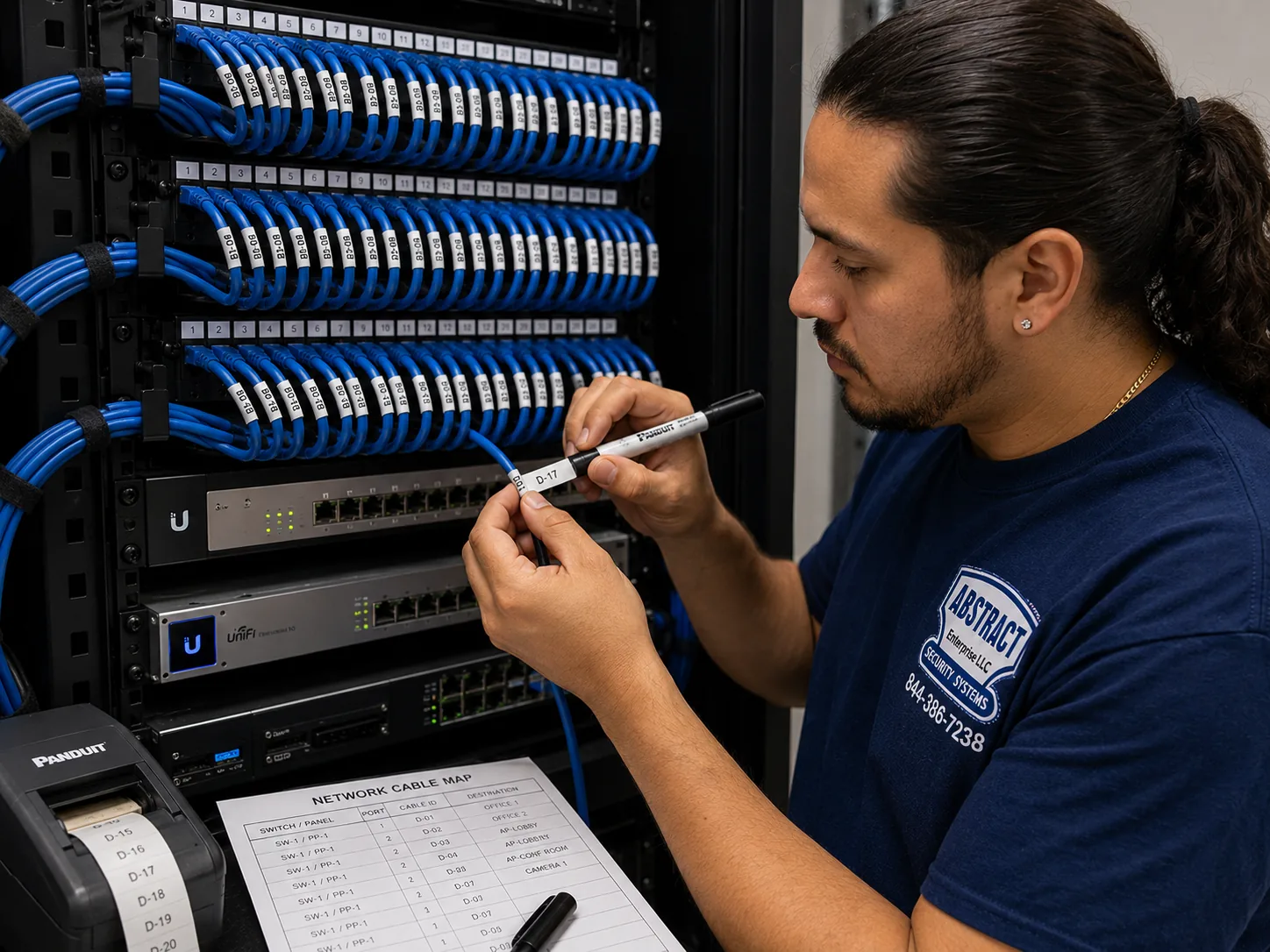
Amcrest camera installation reference for the Long Island hub, Long Island: technician printing cable labels at a patch panel beside a printed port map
Photo from the AESS job library, not taken on Long Island: a technician printing cable labels at a patch panel beside a printed port map. On an Amcrest job in a Nassau ranch or a Suffolk colonial, every camera run gets the same treatment, labelled at the recorder end with the place it serves, such as "garage east" or "back slider," so the next person who opens the closet knows which cable feeds which camera.
Long Island Amcrest Installation
Tell us the town, the property type and the Amcrest models if you already have them

✅
Request Sent!
We'll call about your Long Island Amcrest system the same business day.
25+
Years Experience
✓
Same-Day Estimates
100%
Licensed & Insured
4.7โ˜…
201 Google Reviews

Owner-operated since 2002 · Thousands of jobs completed · Booked within 2 hours

Quick answer: a Long Island Amcrest installation is priced per job from our Long Island, Nassau or Suffolk Amcrest price page, and it depends on three things: how many cameras, how the cable can reach each one in your type of house, and whether the Amcrest models you want are still a sound buy under the 2026 FCC rules. A licensed installer includes the camera mounting, the cable runs, the recorder and PoE switch setup, fixed network addresses, recording settings and app access, and we book the visit within two hours of your request. Send the town, the property type and the model numbers to (800) 486-0943 or the form, and we will tell you which lines apply before you commit.

  • Prices for installed Amcrest systems are published on our Amcrest camera installation prices for Long Island page; Nassau and Suffolk addresses follow their own county pages, because blueprint pricing runs Nassau at 1.15 times and Suffolk at 1.20 times our Brooklyn base
  • Every Amcrest model number is checked before it goes on your wall, because Amcrest has historically built on Dahua hardware and the FCC's July 2026 rules changed what can still be imported and marketed for certain security uses
  • Camera and recorder work is done under NYS Department of State license #12000287431, the security and fire alarm installer license that New York requires for CCTV used to watch for intrusion, theft or movement
The Neighborhood

Why Long Island Properties Need Amcrest Camera Installation

Long Island is a place of detached houses with driveways, and that single fact shapes almost every Amcrest job we plan here. The Census Bureau's 2023 five-year American Community Survey counts 477,860 housing units in Nassau County, of which 364,529 are one-unit detached homes, and 579,790 units in Suffolk County, of which 463,095 are detached. The median year built is 1955 in Nassau and 1970 in Suffolk. In plain terms, most of the people who call us about an Amcrest system live in a house with its own yard, its own front door and back door, a driveway that holds one or more cars, and often a garage that may or may not be attached. Each of those is a place a camera is supposed to watch, and each is a separate cable route from wherever the recorder ends up. A one-bedroom apartment in the city might need two cameras; a Long Island ranch on a corner lot can easily need six or eight, simply because there is more outside to see.

The age of those houses matters as much as their number. Kerimurray Architecture's history of Levittown records that 17,447 homes were built there between 1947 and 1951, that they were ranches built on concrete slabs with no basement, and that they were heated with hot-water radiant heating pipes in the slab. That is the extreme version of the postwar Long Island house, but the pattern repeats well beyond Levittown. NeighborhoodScout reports that single-family detached homes make up 69.74 percent of Uniondale's housing units and that 55.45 percent of the housing there was built between the 1940s and the 1960s. Homes.com describes the residential streets south of Hempstead Turnpike as mostly Cape Cods and minimal traditionals, often with detached garages and private driveways, and a Hempstead real-estate guide describes 1950s and 1960s split-levels and hi-ranches near Hofstra and the Coliseum. For an Amcrest PoE system, a slab means the cable cannot drop into a basement and travel underneath the house; it has to go up into the attic instead. A detached garage means a cable that crosses open ground. A split-level means three short floors and a route that has to step between them. We plan for that before we book, not on the day.

The reason people want cameras here is not abstract. In January 2024, ABC7 reported on a multi-jurisdictional task force of Nassau and Suffolk police and district attorneys, the NYPD, State Police and the FBI working on residential burglaries and stolen cars, and quoted police saying the burglars "are attracted by cars in people's driveways." In November 2025, CBS New York reported that the Suffolk District Attorney had charged 14 men in a package-theft ring that worked 31 communities, including Brentwood, Central Islip, Shirley and Deer Park, and allegedly targeted deliveries of phones and tablets. And in May 2026, Daily Voice reported that a Roslyn Heights homeowner saw would-be burglars on his own surveillance system, called police, and arrests followed. None of those stories is about Amcrest in particular, and we do not claim any of those homeowners as customers. They show the two jobs a Long Island camera system is asked to do: watch the driveway, and watch the front step.

Amcrest is a common answer to that job because of how it records. SafeHome.org's review notes that most Amcrest cameras need no subscription and can record to a microSD card, a network video recorder or a NAS drive, and retailer listings for Amcrest PoE cameras describe recording to an FTP server, a local computer, any Amcrest NVR, or Blue Iris software. For a homeowner who does not want a monthly bill for every camera, that is attractive. The trade-off is that the system is only as good as the network it sits on. Amcrest's own support forum explains that the common remote-viewing setup relies on peer-to-peer connection through the internet, so when the internet drops, remote access goes with it. That puts more weight on the installation: a recorder in a cool, dry place, a PoE switch with battery backup, cameras with fixed addresses, and recording that keeps running locally even when you cannot see it from your phone.

There is also a question that did not exist a few years ago. Amcrest says on its own website that it built its brand with Dahua and is moving its line toward NDAA-compliant products, naming its AMLINK and HELIX lines. In 2021, The Intercept reported that an Amcrest representative confirmed its products were not NDAA compliant, while the company described them as designed by Amcrest in Houston, Texas. Amcrest itself is not named on the FCC's Covered List, but Dahua is, for certain security purposes, and iCTally reports that since July 16, 2026, the FCC has barred the continued import and marketing of previously authorized Dahua equipment for those uses. One source, Blinkless, says the rules do not revoke equipment already installed or ban private use. For a Long Island homeowner, that usually means the cameras on the wall today keep working. For a business, a school, or anyone buying replacement parts later, it means the exact model number matters. That is why we ask for the SKU before we quote.

Finally, Long Island is not one jurisdiction. The state's county profile describes Nassau as two cities, three towns, 64 incorporated villages and more than 60 unincorporated hamlets, and Suffolk as 10 towns. The NYC agencies that govern camera work in the five boroughs, such as Housing Preservation and Development, the Department of Buildings and the Landmarks Preservation Commission, do not reach Nassau or Suffolk at all. Here the rules come from the state license law, the county consumer affairs offices, and whichever town or village the house sits in, plus any homeowners' association. We ask for the full address so we know which of those applies.

We also want to be honest about the gaps in what we could find. We looked for Reddit threads, Yelp reviews and hyperlocal news about Amcrest installations on Long Island and found none specific to the brand or the area. We did not find a source describing the walls, attics or siding of Long Island houses as a group, so where this page talks about attic routes on slab ranches or block foundations on Cape Cods, it is drawing on the housing types named in the public record and on what we expect in houses of that age, not on a survey. One restoration contractor in Uniondale warns that postwar Cape Cods and ranches there often contain asbestos materials; we treat that as a reason for care when drilling old siding and ceilings, not as a fact about your house.

Long Island facts that shape an Amcrest installation

  • Mostly detached houses: 364,529 of Nassau's 477,860 housing units and 463,095 of Suffolk's 579,790 are one-unit detached homes, per the 2023 ACS five-year estimates.
  • Different ages by county: the median home was built in 1955 in Nassau and 1970 in Suffolk, which tends to mean slab ranches and Capes on one side of the county line and basement colonials on the other.
  • Slabs with heat in them: Levittown's 17,447 homes, built 1947 to 1951, were ranches on concrete slabs with radiant hot-water heating pipes, so floors are never drilled and cable goes overhead.
  • Many governments: Nassau has 2 cities, 3 towns and 64 villages; Suffolk has 10 towns; permits and rules are checked per address.
  • Storms take the power: during Tropical Storm Isaias in August 2020, ABC7 reported almost half of PSEG Long Island's 1.1 million customers were without power at the peak.
  • Water as well as wind: the NYS Department of Financial Services described the August 18–19, 2024 storm as the first-ever flash flood emergency for Suffolk County, with more than 2,000 residents and business owners reporting flood damage.

What Long Island owners often add once the cameras are up. After the driveway and the doors are covered, the next request is usually a video doorbell at the front step or a screen in the kitchen or office that shows every camera at once. Both can be planned in the same visit if you mention them when booking, so the cable for the doorbell and the HDMI run for the viewing screen go in with the camera cables instead of on a second day.

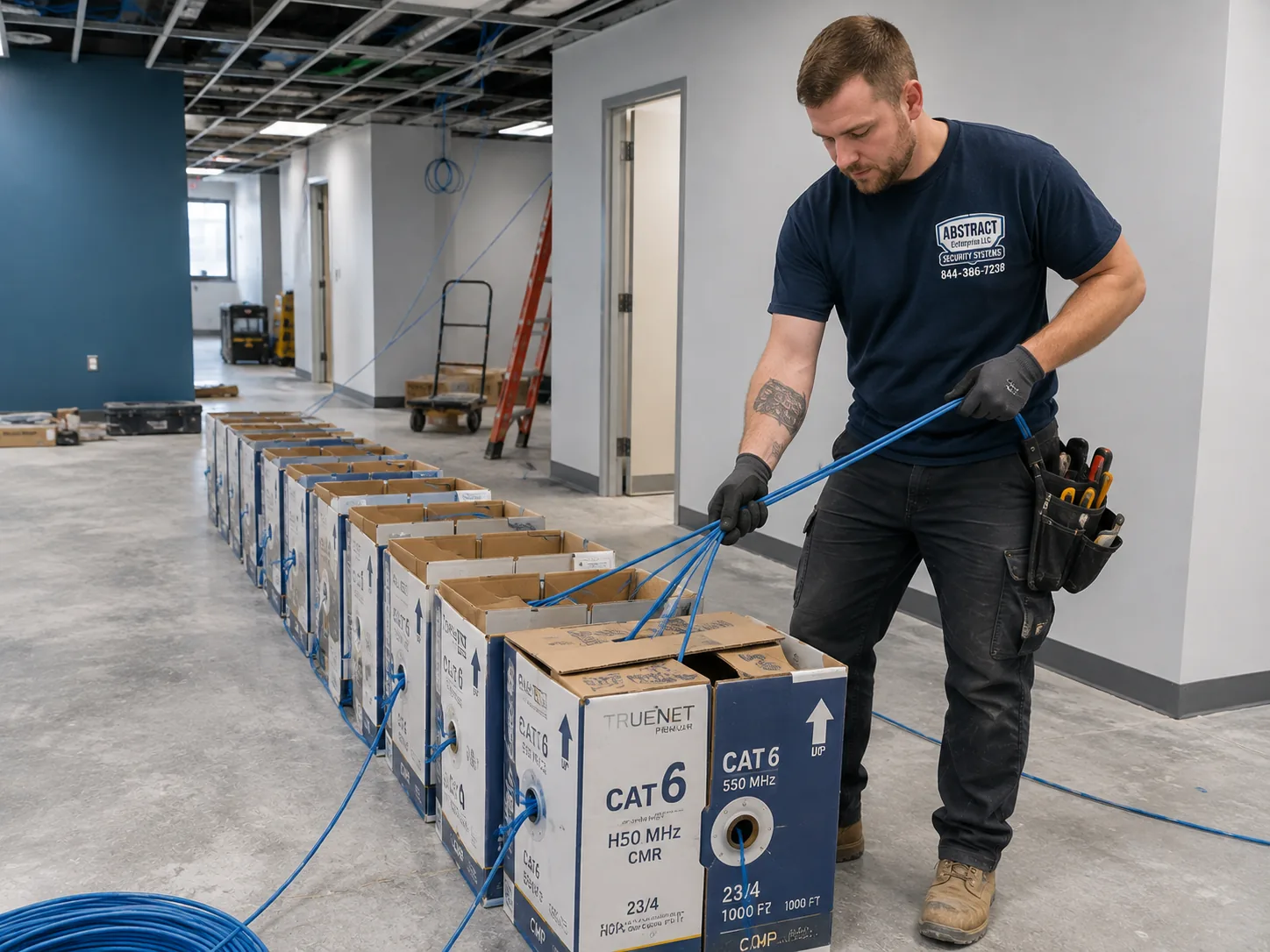
Amcrest camera job planning photo for the Long Island hub, Long Island: boxes of network cable staged on the floor of a working commercial premises for a multi-drop pull
Photo from the AESS job library, not taken on Long Island: boxes of network cable staged on the floor of a working premises before a multi-drop pull. An eight-camera Amcrest system for a Route 110 flex building or a large Suffolk colonial starts the same way, with every box counted and every run measured before the first cable leaves the reel.

Amcrest Cameras Offline, Recorder Beeping or a Break-In Last Night? Fast Help on Long Island

If your Amcrest cameras went dark after a storm, the recorder is showing a disk error, or something happened on the property and you need the footage, call first and touch as little as possible. Do not unplug or factory-reset the NVR, because a reset can wipe recordings you may need. If the power is back but the cameras are not, check whether the PoE switch has lights. Then call (800) 486-0943 and tell us the town, the recorder model and what changed. We book these visits within two hours of the request and tell you honestly when the earliest slot is. If police have asked for video, we can help you export it from the recorder without disturbing the rest of the archive.

Nassau and Suffolk

1955 vs 1970: How the County Line Changes an Amcrest Job on Long Island

This page is the Long Island hub, so it covers both counties. They share an island and a commuter railroad, but the houses in them were built in different decades, and an Amcrest installer feels that difference in the first ten minutes on site. The table below sets the two counties side by side using public figures, then gives our working assumption about what each tends to mean for cable routes. The last column is a planning guide, not a fact about any particular house; we confirm every route on the walk-through.

What we compareNassau CountySuffolk CountyWhat it usually means for the cameras
Housing units (2023 ACS)477,860579,790Suffolk has more homes spread over far more land
One-unit detached364,529463,095Most jobs in both counties are houses, not apartments
Median year built19551970Nassau leans to slab ranches and Capes; Suffolk to raised ranches and colonials, often with basements
Land area (ny.gov)453 square miles2,373 square milesSuffolk lots and driveways tend to be longer, so cable runs and camera distances grow
Local government2 cities, 3 towns, 64 villages, 60+ hamlets10 townsRules are checked by address; village codes are common in Nassau
Police camera programsVillage programs such as Garden City's private camera registration; county-wide program not foundSuffolk Police SHIELD Camera RegistryRegistering is voluntary and does not hand over access to your cameras
AESS pricing1.15 times our Brooklyn base1.20 times our Brooklyn baseEach county has its own Amcrest price page

Nassau: the slab, the attic and the short driveway

Much of Nassau was built in the first two decades after the Second World War, and the median home there dates to 1955. That is the era of the Levittown ranch on a slab, the Cape Cod with a half-story upstairs, and the minimal traditional on a modest lot. For an Amcrest system it creates a very specific puzzle: there is often no basement for the recorder, no crawlspace to route cable under, and a floor you must never drill because it may hold radiant heating pipes. So the cable route goes up. We put the NVR and PoE switch in a closet or utility area with an outlet, take a single bundle up into the attic through a top plate, and fan out across the attic to each eave, where the cameras mount on the soffit or the wall just below it. In a Cape with knee walls upstairs, the space behind those knee walls often becomes the highway between the front and back of the house. The advantage of the Nassau layout is that lots are often compact, so most camera runs are short and well within the distance a PoE camera can be powered over a single cable.

Suffolk: the basement, the long lot and the outbuilding

Suffolk's median home was built in 1970, and the county covers more than five times the land of Nassau. In practice that tends to mean more raised ranches, high ranches and center-hall colonials, many with full or partial basements, on deeper lots with longer driveways. A basement changes everything about the cable plan. The recorder can sit downstairs on a shelf, away from summer attic heat, and cables can run along the basement ceiling to the foot of each outside wall before coming up through the sill. The challenge in Suffolk is distance. A camera at the end of a long driveway, on a shed at the back of an acre lot, or on a detached garage across a yard may sit near or beyond the practical limit of a single Ethernet run, which is about 100 meters including the patch cords. Those are the jobs where we talk about a small outdoor-rated switch in the garage, or a link between buildings, rather than pushing one cable too far.

Where the counties look the same

Some things do not change at the county line. Both counties face salt air on the South Shore and along the Sound, and both lost power widely during Isaias in 2020. Both have office parks and flex buildings where an Amcrest system has to share ceilings and closets with other trades. And in both, the state license law applies in exactly the same way: CCTV used to watch for intrusion, theft or movement is security work that requires a Department of State license. Where the counties differ is in pricing and in the local rules we check, which is why Nassau addresses use our Nassau County Amcrest prices and Suffolk addresses use our Suffolk County Amcrest prices.

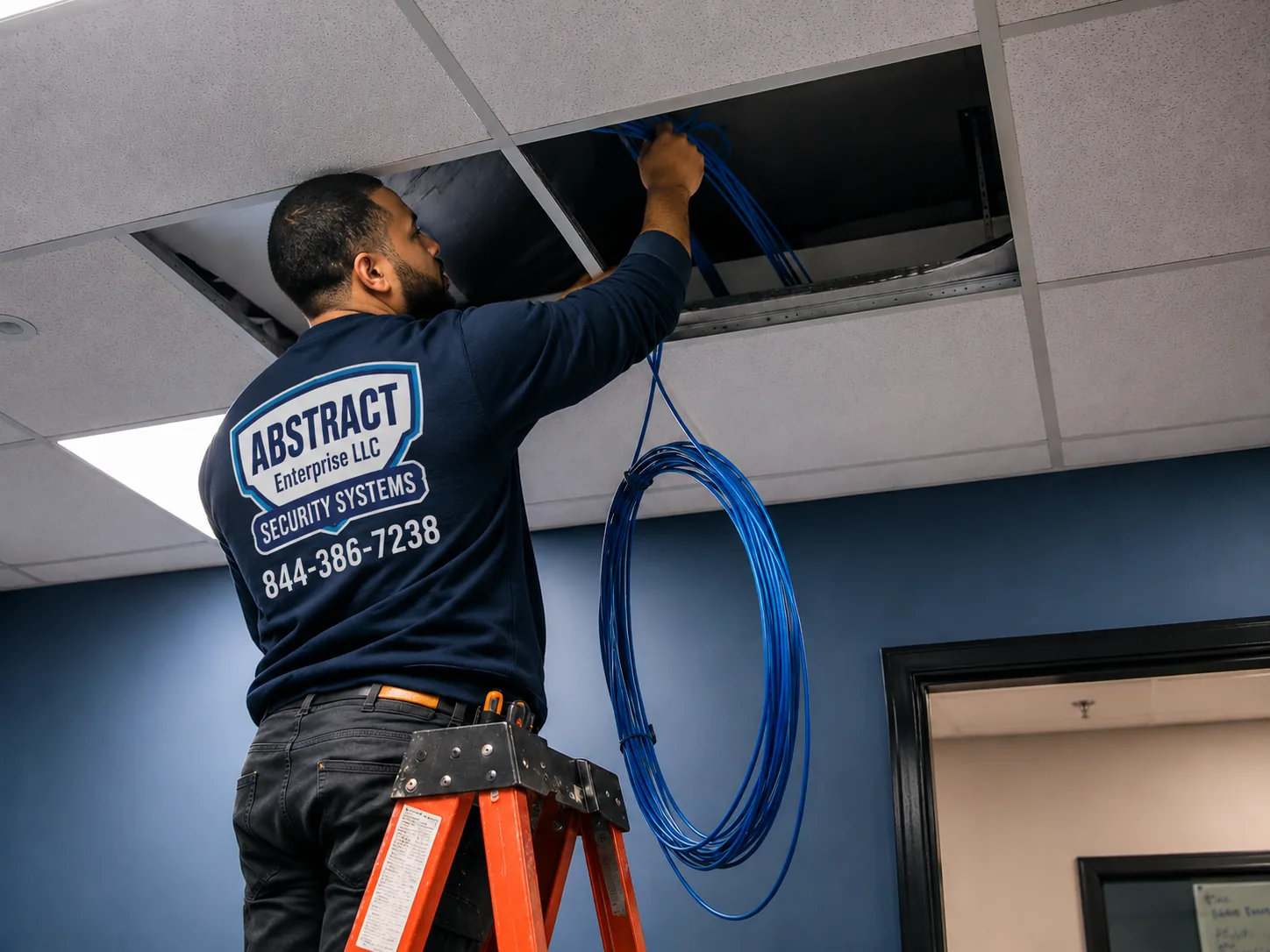
Amcrest cable routing reference for the Long Island hub, Long Island: technician on a ladder feeding cable up through a ceiling opening in an occupied commercial space
Photo from the AESS job library, not taken on Long Island: a technician feeding cable up through a ceiling in an occupied commercial space. In a Nassau slab ranch the same overhead route is the only way to reach the eaves, because the floor below holds the heat and there is no basement to work from.
The Model Check

Before Anything Is Mounted: Checking Your Amcrest Models Against the 2026 Rules

On most camera brands, the first question is where the camera goes. On Amcrest in 2026, the first question is which camera it is. The research behind this page turned up a situation that is real, that is changing, and that is easy to oversimplify in either direction. Some online answers now say Amcrest is banned; others say nothing has changed. Neither is right. Here is what the sources actually say, and what we do about it on a Long Island job.

QuestionWhat the sources sayWhat we do on the job
Is Amcrest on the FCC Covered List?Amcrest itself is not named; Dahua is, limited to equipment for public safety, government facility security, critical infrastructure surveillance and other national security purposes (FCC Covered List)We tell you plainly that the brand is not listed, and then check the model
What changed in July 2026?iCTally reports that from July 16, 2026 the FCC barred continued import and marketing of previously authorized equipment added to the list in 2024 or earlier, for Dahua only for certain security usesWe check whether a model is Dahua-built hardware and whether it is still being sold through normal channels
Do cameras already on my house stop working?Blinkless says the rules do not revoke installed equipment or ban private useWe do not tell homeowners to rip out working cameras because of the rules
Is Amcrest NDAA compliant?An Amcrest representative told The Intercept in 2021 that its products were not; Amcrest's site now says it is shifting to NDAA-compliant AMLINK and HELIX linesFor federally funded sites we raise the question before quoting and suggest an NDAA-compliant line or another brand
Will replacement parts be available?Not answered by any source we foundWe avoid building a large new system on a model that may be hard to replace, and say so in writing

Why the SKU matters more than the logo

Two Amcrest cameras that look alike on a store shelf can be very different products underneath. Amcrest's own site says the brand was built with Dahua, and NDAA compliance lists published by integrators such as Tec-Tel place Amcrest under Dahua as a U.S.-distributed OEM. At the same time, Amcrest says it is moving toward lines it describes as NDAA compliant. So the question for your property is not "is Amcrest allowed," but "what is this exact model, where did its hardware come from, and can I still buy a matching camera if one fails in three years." We look up every model number you send us before the visit. If a model is likely to be hard to source later, we tell you before you pay for it to be installed, not afterward.

Homes, businesses and buildings that take public money

For a family in a Massapequa split-level or a Commack colonial, the practical effect of the 2026 rules is small: cameras already bought keep working, and private use is not banned according to the sources we found. The stakes are higher for a business with an insurer that asks about equipment, a contractor working on a building that takes federal funds, a school, a house of worship applying for a security grant, or a property manager planning a large rollout across several sites. The FCC's Dahua entry is limited to particular security and infrastructure purposes, and NDAA Section 889 restrictions turn on federal money. If your site touches either, tell us at booking. We would rather point you to an NDAA-compliant product than install something you may have to replace to keep a grant or a contract.

What we do with a kit you already bought

Many Long Island calls start with an Amcrest NVR kit bought online or at a store. A buyer review on Adorama for one Amcrest NVR kit put it simply: "I am having a problem finding someone to install my system." We install customer-supplied Amcrest equipment, and the model check still comes first. If the kit is sound, we install it and say so. If a camera in it is a model you may struggle to replace, we tell you, so you can decide whether to install it as is, add spares now, or return part of it while you still can. The decision is yours; our job is to make sure you make it with the facts in front of you.

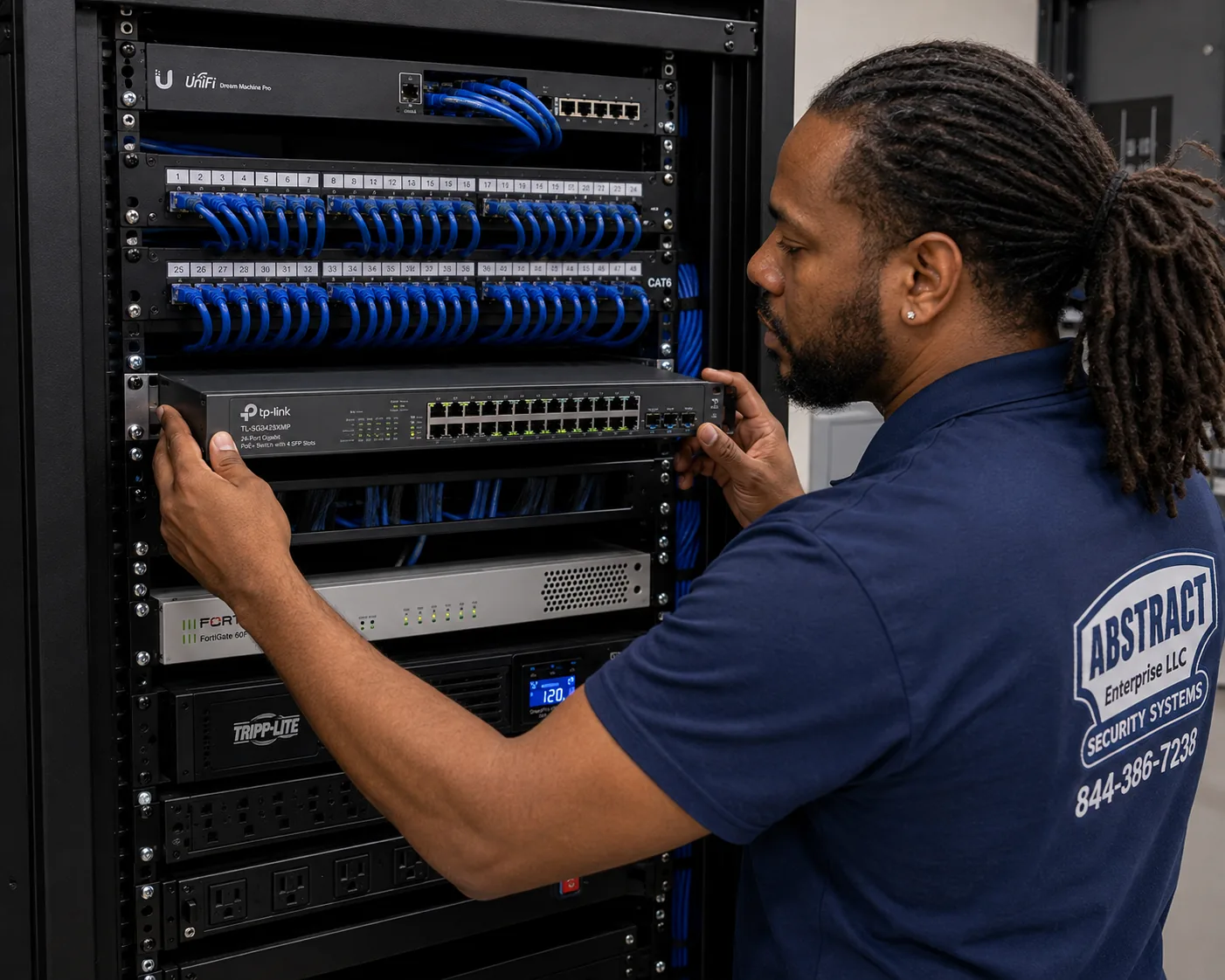
PoE switch mounting photo for the Long Island hub, Long Island: technician mounting a managed PoE switch below patch panels in a commercial network rack
Photo from the AESS job library, not taken on Long Island: a technician mounting a managed PoE switch below patch panels in a commercial network rack. Many Amcrest PoE cameras need a separate PoE switch or injector to power them, so on a Hauppauge office job or a larger Suffolk house the switch is chosen to match the number and type of cameras before the install day.
Before You Book

Driveway to Back Fence: What to Check on a Long Island Property Before We Arrive

A camera job loses most of its time to surprises: a recorder with nowhere to live, a garage with no way in for a cable, a model that does not work with the app you expected, or a router in a spot the cameras cannot reach. A walk around the house with a phone camera before you call fixes almost all of that. Please do not drill holes, open the attic floor or reset any existing recorder yourself. Look, photograph and send.

What to checkWhy it matters on Long IslandWhat to send us
Is there a basement, an attic, or both?Slab ranches route overhead; basement colonials route underneath; split-levels need bothA photo of the attic hatch and the basement ceiling if you have one
Where the router and modem areThe NVR needs a network connection for remote viewing, and the closer the betterA photo of the router location and its brand
The Amcrest model numbersSome models use the Amcrest View Pro app, some only the Amcrest SmartHome app, and some need a separate PoE injectorA photo of the label on each camera or on the box
Detached garage, shed or pool houseEach needs its own cable route across the yard, or a separate switch if it is farThe distance from the house and whether the building has power
Siding typeVinyl, aluminum, cedar shingle, brick and stucco each take different mounts and sealingA close photo of the wall below each eave you want covered
What each camera should seeDriveway cars, the front step, the side gate and the back slider are the usual fourA note of the views that matter most, in order
HOA, landlord or board rulesCondos and garden apartments often restrict exterior hardwareThe management company's contact and any written rules
Waterfront exposureSalt air shortens the life of cheap hardwareHow close the house is to the water and which way it faces

Stand where the camera will stand

It helps more than anything else if you take a photo from roughly where each camera would mount, pointing where you want it to look. A camera under the eave of a ranch sees the driveway at an angle; a camera on a garage corner sees the length of the drive. If the view you photograph includes the street, neighbors' windows or a sidewalk, tell us, because we set motion zones and privacy masks to keep the recording on your property. Long Island lots vary so much that two houses on the same block can need completely different camera positions, and your photos let us plan the right ones.

Count what is plugged in near the recorder

The NVR and the PoE switch both need power, and in a storm they both need a battery behind them if you want recording to continue for a while after the lights go out. Look at the closet, utility room or basement corner where you would like the recorder, and note whether there is an outlet, whether it is on a circuit shared with a freezer or a sump pump, and whether the space gets hot in summer. An attic is a poor home for a recorder for exactly that reason. If there is no good spot, we will suggest one on the walk-through.

Know who else has wired the house

Many Long Island houses already carry cables from earlier jobs: an alarm panel from the 1990s, a cable-TV drop, a previous camera system, a satellite dish. Old cables can sometimes be reused as pull strings and sometimes need to come out. If you know who installed earlier equipment, tell us. If you have an existing recorder of any brand, a photo of its label and of the back with all its cables is the most useful single picture you can send.

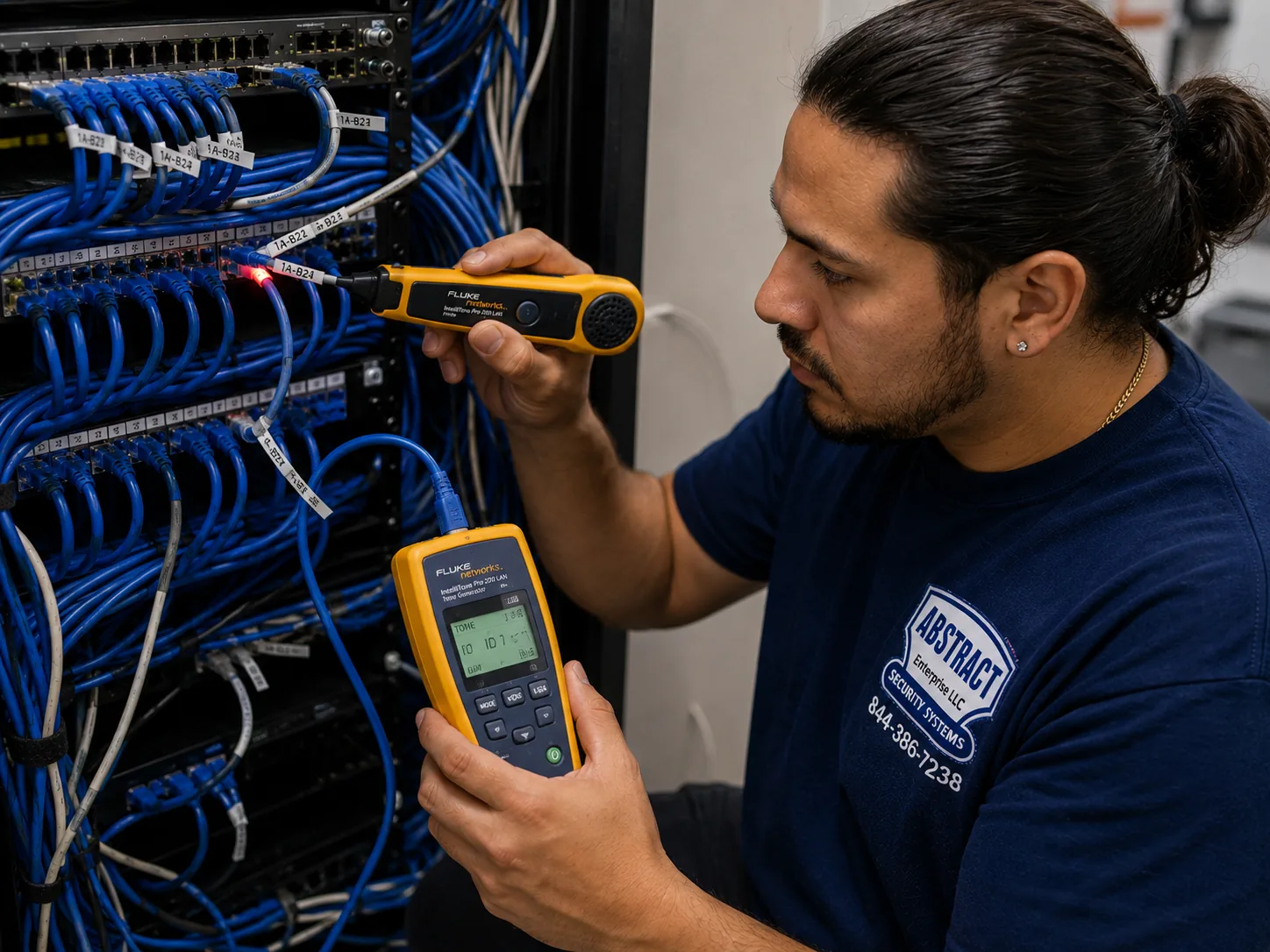
Cable tracing reference for the Long Island hub, Long Island: technician tracing an unidentified cable run at a patch panel with a tone generator and probe
Photo from the AESS job library, not taken on Long Island: a technician tracing an unidentified cable run at a patch panel with a tone generator and probe. When a Long Island house or office already has old camera or alarm cables, this is how we find out which unmarked wire goes to which corner before deciding whether to reuse it.
What We Install

Amcrest Camera Installation Services in Long Island

These are the Amcrest jobs Long Island homeowners, renters, condo owners and businesses book us for. Each is quoted from our Long Island, Nassau or Suffolk Amcrest price page, and every quote names what is included before you pay.

🏠

Whole-House PoE Systems

Amcrest PoE cameras on every side of a ranch, Cape or colonial, wired back to an Amcrest NVR, with attic routes on slab houses and basement routes where there is a cellar below.

🚗

Driveway Coverage

Cameras placed to see cars, doors and the approach from the street, the view police described as the one burglars look for when they choose a Long Island house.

📦

Front Step and Porch

A camera or Amcrest video doorbell that shows the face of whoever comes to the door and the package on the step, mounted at a height that sees both.

🏚

Detached Garages and Sheds

A separate protected cable run across the yard, or a small outdoor-rated switch in the outbuilding when the distance is too long for a single run.

📥

Installing Kits You Bought

Amcrest NVR kits from a store or online, checked model by model, mounted properly and configured, so the system you paid for actually works.

➕

Adding Cameras to an Amcrest NVR

New cameras added to a recorder you already own, after checking channel count, PoE capacity and whether the new models match the old ones and the app.

🔧

Repairs and Takeovers

Cameras that drop offline, recorders that stop saving, systems installed by someone who is no longer around. Because Amcrest shares Dahua hardware lineage, most Dahua repair procedures apply.

🏢

Business and Office Systems

Cameras for stores on Old Country Road, offices in Uniondale and flex units on Route 110, planned with the landlord, the IT provider and the hours the space is closed.

🔍

Model and Compliance Check

A review of the Amcrest models you own or want, against the FCC situation, NDAA questions for funded sites, and the app each model needs.

Every service on the list includes the same basics: cameras mounted on a surface Amcrest's guide says can carry at least three times the weight of the camera and bracket, cables labelled at both ends, fixed network addresses for each camera, recording set to the local recorder, and a walk through the app with you before we leave. If a job needs something beyond the usual, such as a long run to a barn, a lift for a two-story warehouse wall, or a second technician, the quote says so first.

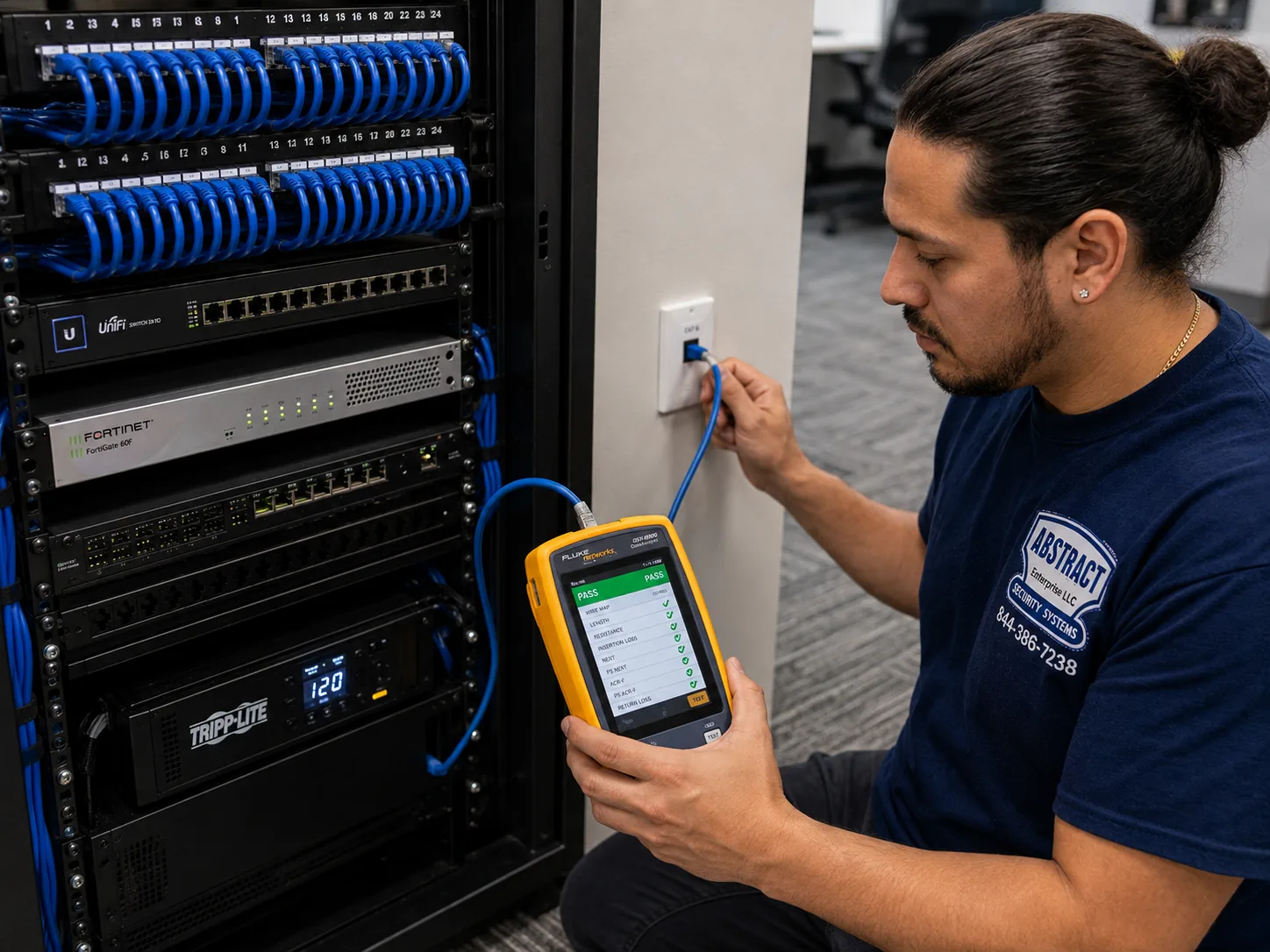
Cable certification photo for the Long Island hub, Long Island: technician holding a cable analyzer showing a PASS result on a data drop
Photo from the AESS job library, not taken on Long Island: a technician certifying a data drop with a cable analyzer that shows a PASS result. A camera run to a detached garage at the back of a Suffolk lot is tested the same way, so a weak connection shows up on the tester instead of as a camera that drops out on a cold night.
Building Specialists

Amcrest Camera Installation for Long Island's Architecture

Long Island's houses look similar from the road, but under the roof and behind the siding they split into a handful of types, and each changes where the recorder goes, how the cable travels and what the camera is fixed to. These are the types the public record and local listings describe, and how we approach each.

Postwar Slab Ranches

The Levittown model: one floor on a concrete slab with radiant heat pipes, no basement, an attic above. The floor is never drilled; every cable goes up and across the attic to the eaves.

Cape Cods and Minimal Traditionals

Common south of Hempstead Turnpike in Uniondale and across Nassau, often with detached garages and private driveways. Knee-wall spaces upstairs and block foundations below shape the routes.

Split-Levels and Hi-Ranches

Described near Hofstra and the Coliseum and common in both counties. Three short levels mean a route that steps between floors, usually through a closet or the garage ceiling.

Colonials and Raised Ranches with Basements

More typical in Suffolk, where the median home dates to 1970. The basement holds the recorder and carries the cables to the foot of each wall.

Waterfront and Seasonal Houses

South Shore homes, North Shore houses on the Sound and East End seasonal places. Salt air, wind exposure and long periods empty, which makes local recording and remote alerts matter more.

Condos, Garden Apartments and Rentals

Shared walls, HOA or board rules on exterior hardware, and, in places like Uniondale where NeighborhoodScout counts about 38 percent renters, a landlord who must agree to any drilling.

How the house type changes the job

HouseWhere the recorder usually livesHow cable usually travelsWhat the cameras mount to
Slab ranchHall or utility closet with an outletUp through a top plate into the attic, across to each eaveSoffits or the fascia board, or the wall just below the eave
Cape CodFirst-floor closet or the basement if there is oneBehind upstairs knee walls front to back, down at the endsEaves on the low side, gable walls on the high side
Split-levelLower level near the garageThrough the garage ceiling and stacked closets between levelsGarage front, eaves on the upper level
Colonial with basementBasement shelf, away from dampAlong the basement ceiling, up through the sill plateWall-mounted on junction boxes at the first-floor line or eaves
Waterfront houseInterior closet, never the garage on a flood-prone lotSealed entries, drip loops, protected exposed runsCorrosion-resistant mounts and stainless fixings
Condo or rentalInside the unit, as the rules allowInside the unit only, or surface raceway with approvalOnly where the HOA, board or landlord has agreed in writing

On slab houses. Kerimurray Architecture records that the original Levittown ranches carried their heat in hot-water pipes in the slab. We assume that any slab house of that era may still have heat or plumbing in the floor, whatever has been renovated since, and we never drill a slab to bring a cable up. The attic route is better anyway: it keeps cables dry, it is short, and it puts every camera at the eave line where it sees the yard from above. The catch is summer heat. Attics on Long Island get very hot, so we keep the recorder and the switch downstairs and only the cables go overhead. Where an attic has old insulation of uncertain type, we look before we crawl, and if anything looks like it could contain asbestos we stop and tell you rather than disturb it.

On detached garages. Homes.com describes detached garages as common in Uniondale's Cape Cod streets, and the same is true across much of Nassau and Suffolk. A detached garage is often the most valuable camera position on the lot, because it sees the length of the driveway and the back yard. It is also the hardest to reach. A cable crossing a yard has to be either buried in suitable conduit or run overhead in a protected way, and it has to enter both buildings cleanly and sealed. Where the garage is far enough away that a single PoE run is marginal, we put a small outdoor-rated switch inside it and feed that switch from the house. We will show you both options and their trade-offs on the walk-through.

On split-levels. Split-levels and hi-ranches are some of the trickiest houses to wire on the island, because there is no single attic or basement that reaches every outside wall. The lower level may sit half underground, the upper bedrooms have their own attic, and the middle level has neither. We usually find a vertical path through a stack of closets or the wall shared with the garage, and use the garage ceiling as a junction where cables split to the front and the side. That planning is the reason we ask for photos of the inside as well as the outside.

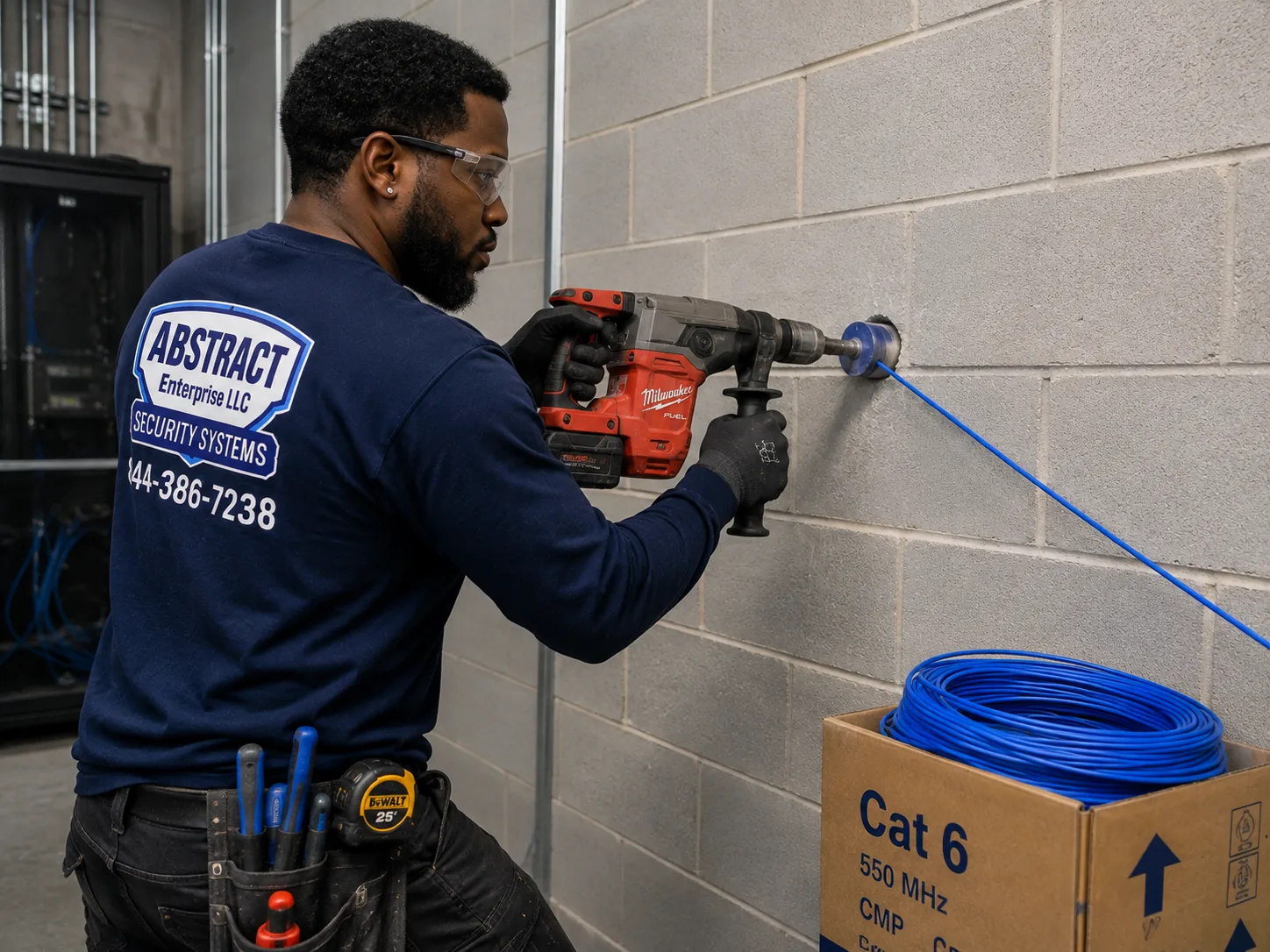
Masonry drilling reference for the Long Island hub, Long Island: technician core drilling a block wall to carry cable through to a network room
Photo from the AESS job library, not taken on Long Island: a technician core drilling a block wall to carry cable through to a network room. A postwar Cape Cod on a concrete-block foundation, or a flex building in an industrial park, sometimes needs a hole like this to get a camera cable from the basement or warehouse floor to the outside wall, always above grade and sealed afterward.
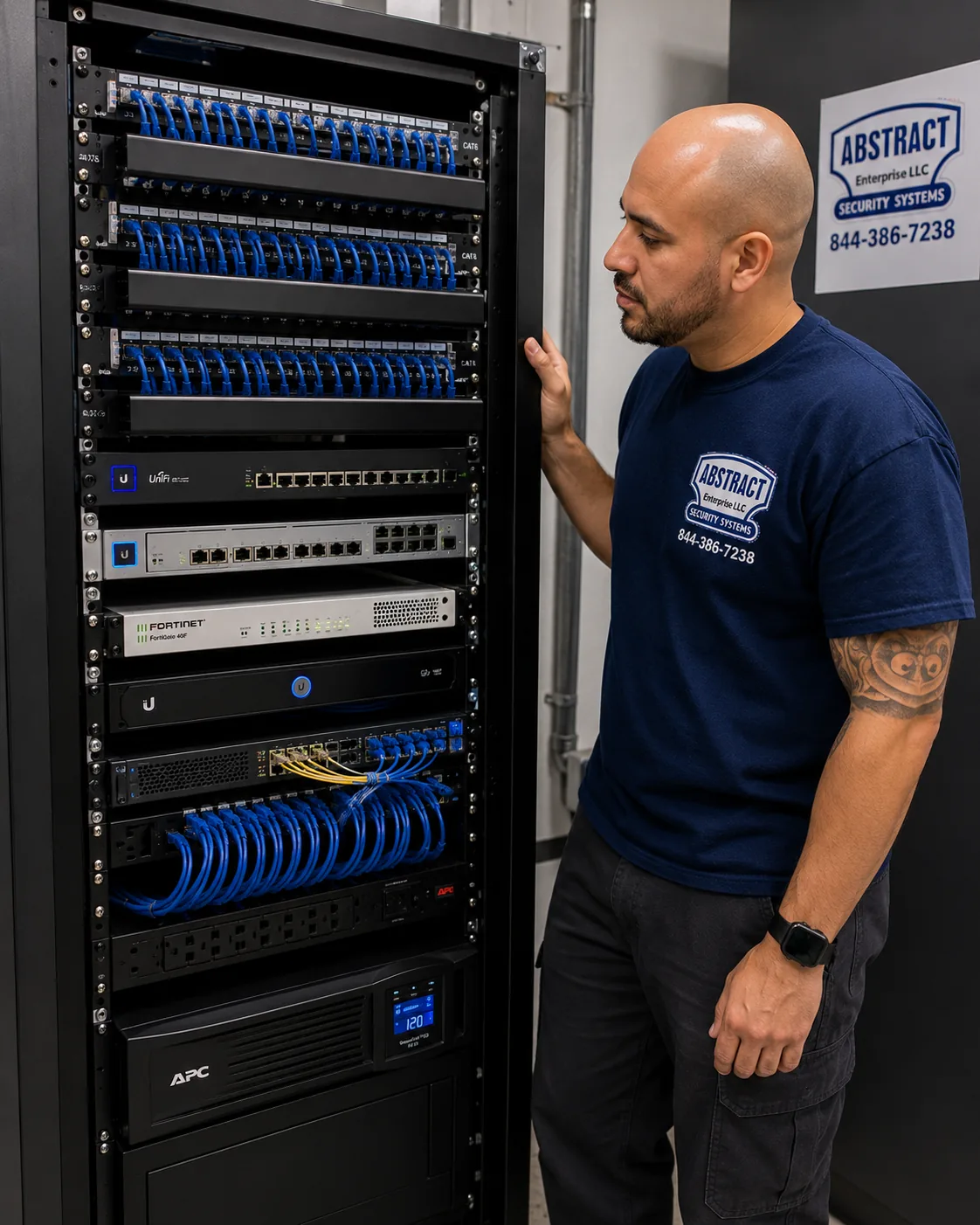
Finished network rack for the Long Island hub, Long Island: patch panels, switching, firewall and battery backup dressed and identified in a rack
Photo from the AESS job library, not taken on Long Island: a finished network rack with patch panels, switching, a firewall and battery backup, all dressed and identified. After Isaias left almost half of PSEG Long Island's customers without power in 2020, the battery at the bottom of a rack like this is what keeps an Amcrest recorder and its cameras running when the house goes dark.
Commercial Amcrest Camera Installation

Business Amcrest Camera Installation in Long Island

Long Island's commerce is concentrated in a few large places: a mall district on the old airfields, office towers off the Meadowbrook Parkway, an industrial park that public reports call one of the largest in the Northeast, and a highway corridor of flex buildings. The cards below describe what our sources say about each. We have no information about the camera systems inside any particular business there, and we do not claim any of them as clients.

Old Country Road and Roosevelt Field

Wikipedia describes Roosevelt Field as the largest mall on Long Island, with 243 stores, built on the former airfield where Lindbergh began his 1927 flight. The surrounding strip is big-box and pad-site retail, where cameras watch entrances, registers and parking.

Uniondale Office Towers

LoopNet describes RXR Plaza as Long Island's largest office building, two 15-story towers with column-free concrete slabs and four-inch raised floors. The Omni at 333 Earle Ovington Boulevard has 10 floors served by nine passenger elevators and key-card access.

The Route 110 Corridor

Farmingdale, Melville and Huntington Station, with warehouse, flex, R&D and office uses and Long Island Expressway access. Melville Corporate Center I at 105 Maxess Road is described at 149,000 square feet.

Long Island Innovation Park at Hauppauge

Formerly the Hauppauge Industrial Park, described in 2017 as about 1,350 businesses on roughly eleven square miles, with about two-thirds under a Town of Smithtown overlay. Loading docks, yards and long exterior walls.

Hempstead Turnpike and Jerusalem Avenue

Uniondale's main roads. Daily Voice reported a robbery at a Jerusalem Avenue gas station where police released surveillance footage of the suspects, the kind of clear image a store camera is installed to capture.

Ronkonkoma and MacArthur

Suffolk County has sought a master developer for 48 acres within a 179-acre redevelopment area between Long Island MacArthur Airport and the Ronkonkoma LIRR station, surrounded by existing commercial and industrial sites.

What a business camera on Long Island has to do

A homeowner's camera usually needs to show a person on a step or a car in a driveway. A business camera is asked to do more: identify a face at a register, read a vehicle at a loading dock, show who came through a rear door after hours, and keep weeks of footage in case a claim arrives later. On Long Island, a lot of that happens across wide parking areas and long exterior walls, which is a very different job from a storefront camera in the city. For an Amcrest system, that means choosing the lens and resolution for each view instead of using the same camera everywhere, putting the recorder somewhere secure and cool, sizing storage for the retention period the business needs, and running cable in pathways that the landlord and other trades will accept. In an office tower like RXR Plaza with raised floors, those pathways may already exist; in a flex building in Hauppauge, cable may need to run on J-hooks or in conduit along an open deck.

Rules and practical limits for business camera systems

  • State license. New York's General Business Law Article 6-D, administered by the Department of State, requires a security and fire alarm installer license for CCTV used to detect or monitor intrusion, break-in, theft, movement, sound or fire. An industry association states that unlicensed installers face fines of up to ten thousand dollars. Our license number is on every quote.
  • Nassau cabling. A Nassau County permit guide notes that the alarm license applies when cabling integrates with camera systems, so a cabling contractor who is not licensed for security work should not be the one wiring your cameras.
  • Home improvement licensing. Nassau County's Office of Consumer Affairs says it is against the law to run a home improvement business in the county without a license, and its FAQ says work only on commercial buildings does not need that license. Homes do.
  • Federal money. Businesses, nonprofits and institutions that take federal funds or work under federal contracts should ask about NDAA Section 889 before choosing Amcrest models, because some Amcrest products have been described as Dahua-built.
  • Audio. New York's recording law is one-party consent for conversations, but a camera that records sound in a place where no party to a conversation consents can still cross the line under Penal Law 250.00. We set business cameras to video only unless the owner has a clear reason and a policy for audio.
  • Private spaces. Penal Law 250.45 makes recording inside a bathroom, changing room or similar private space without consent a felony. Cameras never point into those spaces.
  • Landlord and insurance papers. Many commercial landlords want a certificate of insurance and scheduled hours before contractors work in a suite. Send their requirements with the booking.
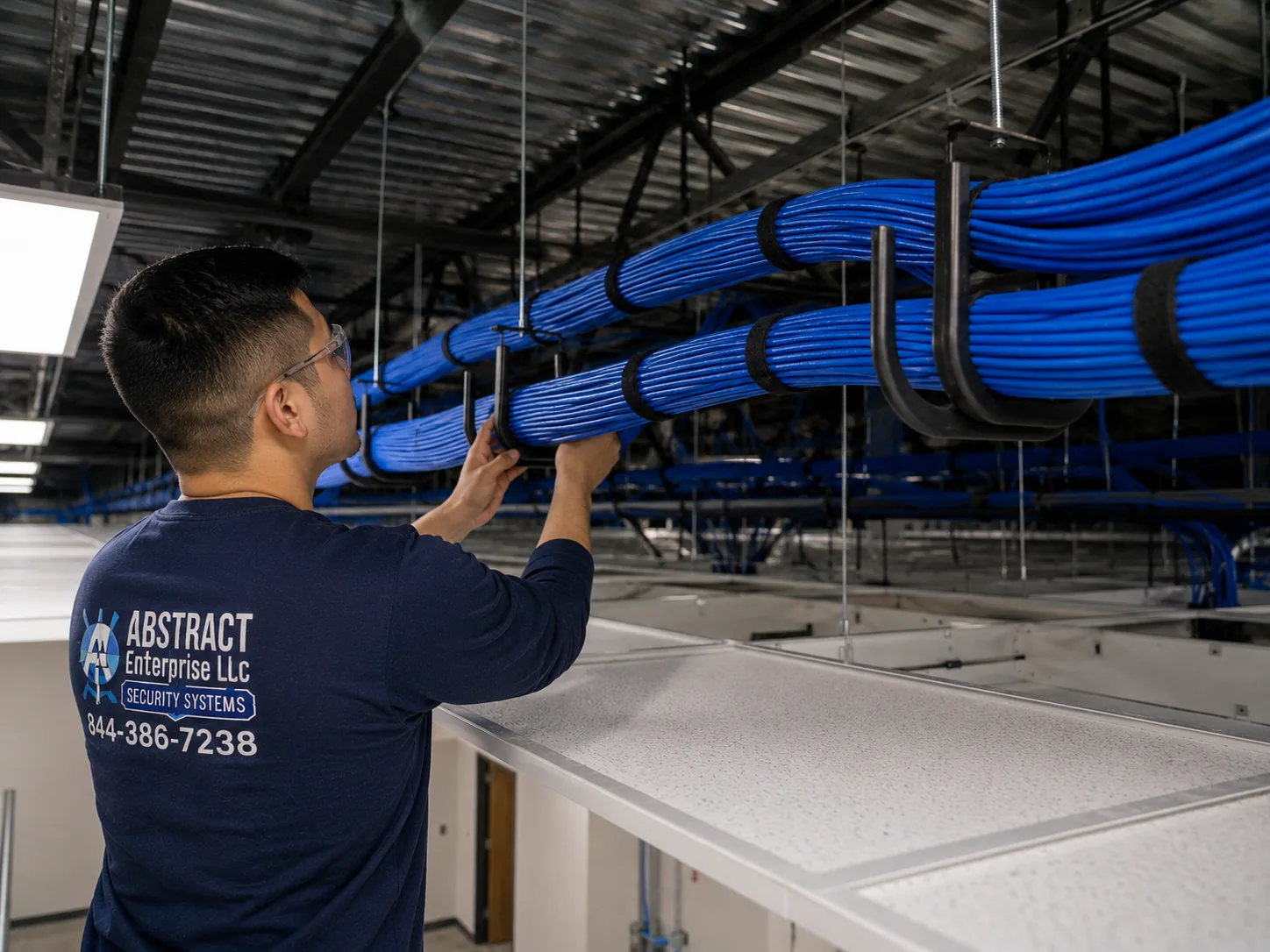
Ceiling cable pathway photo for the Long Island hub, Long Island: J-hook pathway carrying dressed cable bundles across a commercial ceiling
Photo from the AESS job library, not taken on Long Island: a J-hook pathway carrying dressed cable bundles across a commercial ceiling. In an office suite off the Meadowbrook Parkway or a Route 110 flex unit, camera cables travel this way above the ceiling, supported and kept clear of lights and ducts, instead of lying loose on ceiling tiles.
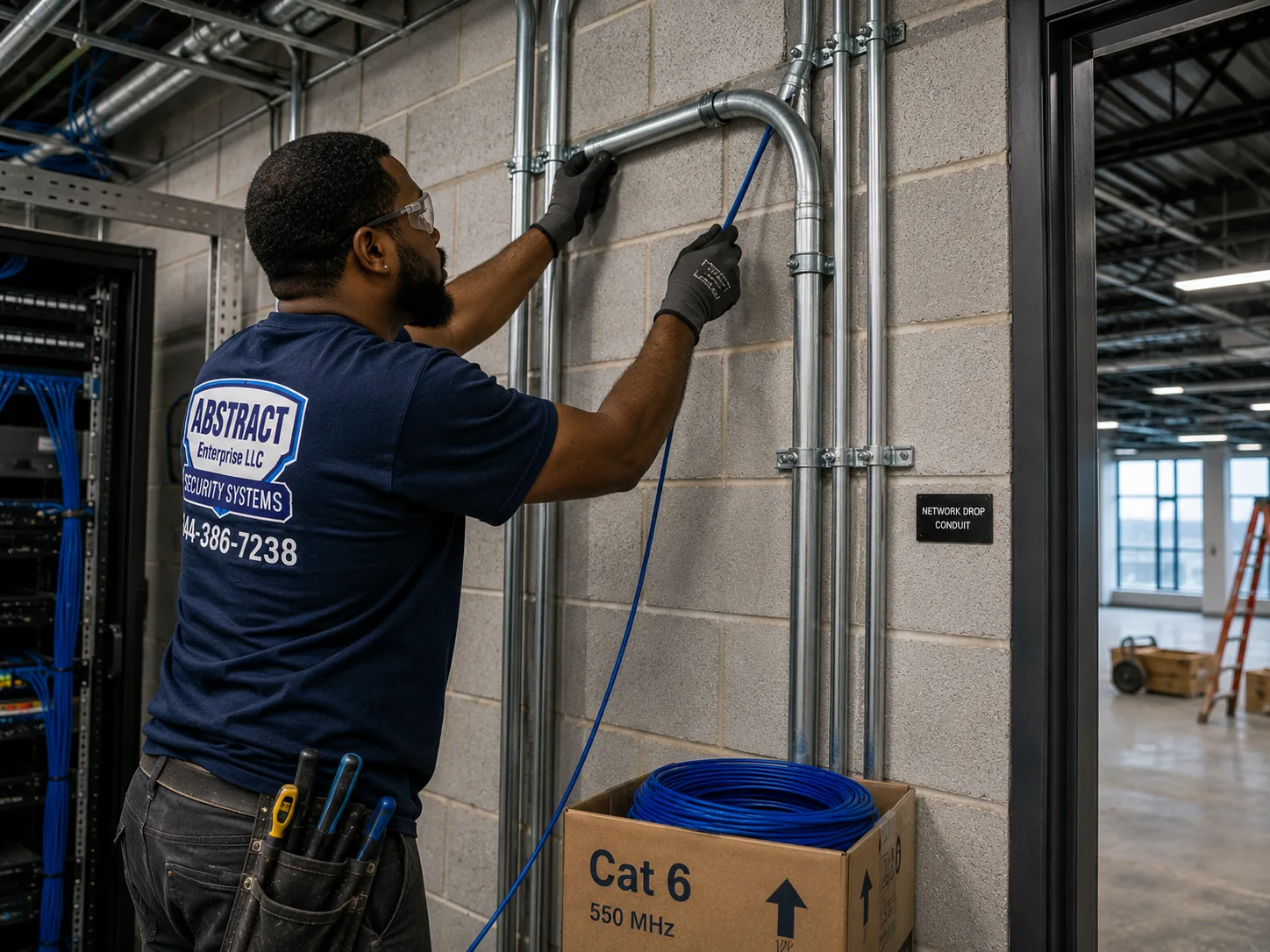
Conduit installation reference for the Long Island hub, Long Island: technician running cable into EMT conduit beside a telecom room in an industrial building
Photo from the AESS job library, not taken on Long Island: a technician running cable into EMT conduit beside a telecom room in an industrial building. In the Hauppauge industrial park or a warehouse near MacArthur, camera cables along exposed walls and loading areas are protected in conduit like this so forklifts and pallets cannot damage them.
Field Notes

Field Notes: The First Walk Around a Long Island Ranch

We do not publish stories about a customer's house unless we can document them, so this is not about one address. It is the routine our technicians follow when they arrive at the kind of house Long Island is full of: a one-story ranch on a slab, a driveway down one side, a detached garage at the back, and a box of Amcrest cameras on the kitchen table.

We leave the box closed. We read the model numbers off the cartons first and check them against what we looked up before the visit. Then we walk the outside of the house with you, slowly, and stand at each corner where a camera might go. We look at the driveway from the eave, from the garage corner and from the front step, and talk about what you actually want to see: the car, the face at the door, the side gate. We look up at the soffits and check whether they are vinyl, aluminum or wood, because that decides the mount. We open the attic hatch and look for a clear path from the closet below to each eave, and for anything that looks like it should not be disturbed. We walk to the garage and measure. Only then do we agree on the number of cameras, where the recorder lives, and which run goes where. That walk usually takes less time than one badly placed camera takes to move, and on Long Island houses it is what keeps the job honest.

Your Questions Answered

Amcrest Camera Installation in Long Island: Questions Answered

Cost and planning

What does a professionally installed Amcrest system cost on Long Island?

It is priced per job from our published Amcrest price pages, and we do not quote a single figure for the whole island because the job changes so much from house to house. Three things move the total: the number of cameras, the cable route each one needs in your type of house, and whether you are supplying the equipment or buying it through us. Nassau addresses use our Nassau County Amcrest prices and Suffolk addresses use the Suffolk County page, because blueprint pricing runs the two counties at different rates against our Brooklyn base. Send photos and model numbers and we will tell you which lines apply before you book.

How many Amcrest cameras does a typical Nassau or Suffolk house actually need?

Most detached houses we expect to see need cameras on four views first: the driveway, the front door, the back door or slider, and the side gate or path. A detached garage adds one or two more. On a compact Nassau lot, four or five cameras often cover everything; on a deep Suffolk lot with a long drive and outbuildings, eight is more common. We would rather plan fewer cameras in the right places than many cameras that all see the same lawn, and we size the recorder with a few spare channels so you can add later without replacing it.

Is a camera system really worth it for a Long Island homeowner?

The local record suggests it can be. In May 2026, Daily Voice reported that a Roslyn Heights homeowner spotted would-be burglars on his surveillance system, called police, and arrests followed. Nassau and Suffolk police have described driveway cars as what draws burglars, and a Suffolk package-theft case in 2025 covered 31 communities. A camera does not stop every crime, but it can alert you in time and give police a usable image. With Amcrest, the absence of a required subscription keeps the running cost down, so the value depends mainly on placement.

The brand and the rules

Are Amcrest cameras banned on Long Island after the FCC's 2026 changes?

No. Amcrest is not named on the FCC Covered List. Dahua is, limited to certain public safety, government facility, critical infrastructure and national security uses, and since July 16, 2026 the FCC has barred the continued import and marketing of previously authorized Dahua equipment for those uses, according to iCTally. One source says installed equipment is not revoked and private use is not banned. Because Amcrest has historically built on Dahua hardware, we check each model before installing it so you are not caught out on replacements later.

Where are Amcrest cameras designed and made, and should that change what I buy?

Amcrest describes its products as designed in Houston, Texas, and says on its own site that it built its brand with Dahua. Compliance lists published by integrators place Amcrest under Dahua as a U.S.-distributed OEM, and Amcrest says it is moving toward NDAA-compliant lines it calls AMLINK and HELIX. For a private home, the origin mostly matters for future parts and firmware support. For a business with federal money or a federal contract, it can matter a great deal. Tell us which you are and we will advise accordingly.

Does whoever installs my Amcrest cameras need a New York license?

If the cameras are there to watch for intrusion, theft or movement, yes. A New York law firm, Kirschenbaum & Kirschenbaum, explains that the state's security and fire alarm installer license covers CCTV used for those purposes, and the license is issued by the Department of State under General Business Law Article 6-D. One permit guide notes that homeowners installing their own system do not need a state license. A paid installer does. Our license is NYS #12000287431, and it appears on our quotes.

How can I check that a Long Island camera installer is properly licensed?

Ask for the state security and fire alarm installer license number and check it with the New York Department of State. For residential work in Nassau, also ask for the county home improvement license; Nassau's consumer checklist gives the Office of Consumer Affairs as the place to check a contractor, and the county requires licensed home improvement contractors to be fingerprinted. In Suffolk, county licensing applies through the Office of Consumer Affairs except in towns and villages with their own rules. Any installer who hesitates over a license number is telling you something.

Recording, internet and the app

If our internet goes down during a storm, do the Amcrest cameras stop recording?

They should not, if the system is installed to record locally. Amcrest's support forum explains that remote viewing usually relies on a peer-to-peer connection through the internet, so you lose the ability to watch from your phone when the internet drops. Recording to the NVR inside the house does not need the internet at all. It does need power, which is why we recommend a battery backup for the recorder, the PoE switch and the router. After Isaias, when almost half of PSEG Long Island's customers lost power, that battery is the difference between footage and a gap.

Do the Amcrest PoE cameras in my kit plug straight into my router?

Usually not directly. PoE cameras take power and data over one cable, and most home routers do not supply power on their network ports. Many Amcrest PoE cameras need a separate PoE injector or switch, as product listings note. In an Amcrest NVR kit, the recorder often has built-in PoE ports, and the cameras plug into those. When you add cameras beyond what the recorder can power, or put a camera far from the recorder, we add a PoE switch sized for the load. We check the power budget on paper before we buy anything.

The property and the weather

How do you get a camera cable out to a detached garage across the yard?

There are two honest options. One is a protected run, buried in suitable conduit or carried overhead in a protected way, entering both buildings through sealed holes. The other, when the garage is far enough that a single run is marginal, is to put a small outdoor-rated switch in the garage and feed it from the house. Long Island installer field notes we reviewed say detached garages need their own cable runs, and that matches what we plan for. We never staple an unprotected indoor cable across a lawn or a fence.

Our ranch is on a slab with no basement. Where does the recorder go and how do the cables get out?

The recorder goes in a closet or utility area with an outlet, inside the heated part of the house, and the cables go up, not down. We bring a bundle up through the top of the closet wall into the attic and run each cable across to its eave, where the camera mounts on the soffit or the wall below. The slab is never drilled, because houses of the Levittown era were built with radiant heating pipes in the floor. The attic route is short and dry, and it puts the cameras high enough to see the yard.

Will Amcrest cameras hold up to salt air on the South Shore and along the Sound?

The camera bodies are rated for outdoor use, but the weak points near salt water are usually the fixings, the junction boxes and the cable entries rather than the camera itself. Long Island installer notes we reviewed say waterfront jobs need weather-rated housings for salt air. We use corrosion-resistant screws and mounts, seal every entry, leave drip loops so water runs off before it reaches the connector, and avoid putting the recorder in a garage on a flood-prone lot. Sandy's damage on the South Shore is the reason for that last rule.

Privacy, police and the law

Can my Amcrest cameras legally record sound around my Long Island house?

Carefully. New York is a one-party consent state for recording conversations, according to the Digital Media Law Project, which means a camera recording a conversation that no one present has agreed to record can be a problem under Penal Law 250.00. A doorbell where you are speaking to a visitor is different from a backyard camera picking up the neighbors over the fence. Video in a bathroom, bedroom or changing room without consent is a felony under Penal Law 250.45. We set outdoor cameras to video only unless you ask otherwise and understand the rule.

Should I register my cameras with the Suffolk police, and do they get to watch them?

Registration is your choice, and it does not give police live access. The Suffolk County Police SHIELD program lets residents and businesses register the locations of their systems so the Department can ask participants to check video for a particular date and time, with retrieval at the owner's convenience. A separate Emergency Remote Camera Access option is opt-in. In Nassau, we found village programs such as Garden City's, which says registration does not give police access to privately owned systems, but no county-wide registry.

Can my Uniondale landlord stop me from putting up cameras on the house I rent?

The landlord controls the building, so drilling into the outside of a rented house needs the owner's agreement, and a lease may say so in writing. We found vendor claims that New York law now requires landlords to allow tenant cameras, but we could not verify any such statute, so we do not rely on it. What a renter can usually do without drilling is a camera inside the unit looking at their own door, or a battery doorbell that replaces an existing one with permission. We ask for the owner's written approval before any exterior work on a rental.
Equipment

Types of Amcrest Camera Installation We Install

These are the Amcrest components we fit on Long Island homes and businesses. We install equipment we supply or equipment you already own, after checking each model number. Installed prices for each type are on the Long Island, Nassau and Suffolk Amcrest price pages.

📹

PoE Turret Cameras

Compact eyeball-style cameras for soffits and eaves on ranches and Capes. Amcrest's guide notes turret models cannot pan or tilt from the app, so the aim is set by hand at install.

🔫

PoE Bullet Cameras

Longer-reach cameras for driveways, side yards and loading areas. Amcrest asks for a mounting surface that holds at least three times the camera's weight.

⚪

PoE Dome Cameras

Tamper-resistant domes for porches, garage ceilings and store interiors. Amcrest describes flush mounting with surface cables and in-wall mounting with hidden cables.

💾

Amcrest NVRs

Network video recorders, often with built-in PoE ports, that keep footage on a hard drive in your house with no required subscription.

🔌

PoE Switches and Injectors

Power for cameras beyond the recorder's ports, for detached garages, and for cameras far from the NVR.

🔔

Video Doorbells

Amcrest doorbells at the front step, tied into the same app and placed at a height that shows faces and packages.

📶

Wi-Fi and SmartHome Cameras

For rooms and spots where no cable can reach. Some Amcrest SmartHome cameras work only in the Amcrest SmartHome app, which we check before mixing them with an NVR system.

🔋

Battery Backup and Storage

Battery backup for the recorder, switch and router, and hard drives or NAS storage sized for the number of days you want to keep.

Amcrest PoE vs Wi-Fi on a Long Island property

QuestionPoE (wired) AmcrestWi-Fi Amcrest
PowerOver the same cable as the videoNeeds an outlet or adapter at each camera
RecordingStraight to the NVRTo a microSD card, cloud or NVR depending on model
Detached garageReliable with a proper run or a switchOften weak at the edge of the house signal
Storm outageKeeps recording on battery backupDepends on the router and each camera's power
Best forWhole-house and business systemsA single room or a spot no cable can reach

A Long Island installer we reviewed recommends wired over wireless and notes that wiring is much harder once walls are closed. We agree: if a house is being renovated, that is the moment to run camera cables, even if the cameras come later.

National security brands vs a local licensed Amcrest installer

People sometimes ask whether they should just call ADT or buy a Ring or SimpliSafe kit instead. ADT is best known for professionally monitored alarm systems sold with a monitoring contract. Ring and SimpliSafe sell self-install cameras and alarms built around their own apps and optional subscription plans. Amcrest sits in a different place: equipment you own outright, recording to a recorder in your own house, with no required subscription. None of those national companies installs and configures an Amcrest NVR system. What makes an Amcrest system work on Long Island is the part a box cannot do: reading a slab ranch, a split-level or a waterfront colonial, choosing the cable routes, setting fixed addresses and making sure the recorder keeps running when the power goes. That is the job of a licensed installer on site.

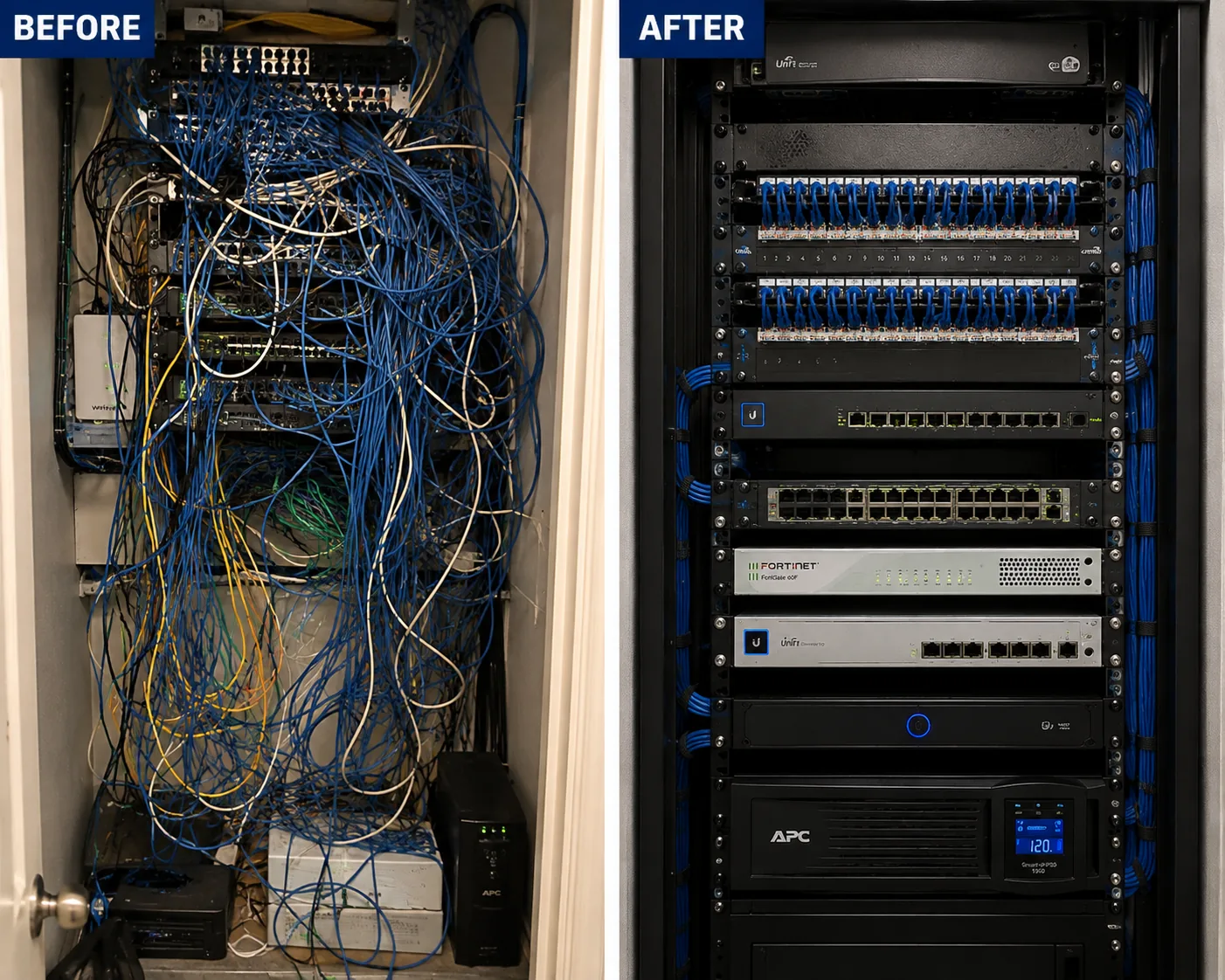
Rack cleanup comparison for the Long Island hub, Long Island: before and after views of an unlabelled tangled network rack rebuilt into a dressed identified one
Photo from the AESS job library, not taken on Long Island: before and after views of an unlabelled, tangled network rack rebuilt into a dressed, identified one. When we take over an Amcrest system someone else installed in a Long Island store or office, the closet often looks like the left side, and the first job is making it look like the right.
AI Overview Reality Check

What AI Gets Wrong About Amcrest Camera Installation in Long Island

We could not capture Google's AI Overview, People Also Ask boxes, Bing or DuckDuckGo results for Amcrest installation on Long Island from our build environment, so we are not quoting any of them. What follows are claims we see repeated in quick online answers about Amcrest and about camera work on the island, set against the sources behind this page and our own field practice. Marketplaces such as Angi, HomeAdvisor and Fixr publish national and New York City cost guides that feed many of those answers; they are a starting point, but they are not a quote for a Long Island house.

"Amcrest is banned in the United States now."

This is the claim we hear most since July 2026, and it overstates the rules. Amcrest is not named on the FCC Covered List. Dahua is, and the FCC limits that entry to equipment used for public safety, the security of government facilities, physical surveillance of critical infrastructure and other national security purposes.

What changed, according to iCTally, is that the FCC barred the continued import and marketing of previously authorized equipment on the list for those uses. Blinkless says installed equipment is not revoked and private use is not banned.

For a homeowner in Levittown or Smithtown, that usually means the cameras on the house keep working. The real risk is supply: a model that cannot be bought later is a problem when one camera fails. That is why we check model numbers, not logos.

"Amcrest cameras need a cloud subscription to record."

Some quick answers lump Amcrest in with doorbell brands that push monthly plans. SafeHome.org notes that most Amcrest cameras need no subscription, and product listings describe recording to microSD, an NVR, a NAS, an FTP server, a local computer or Blue Iris.

On a Long Island job, we almost always set recording to the NVR in the house. It is the option that keeps working when the internet drops and that keeps footage in your hands.

There are optional cloud features for some models, and one Amcrest forum thread asks whether a subscription is needed for push notification snapshots. The answer depends on the model and app, which we check before you rely on it.

"Wi-Fi cameras work just as well as wired on any property."

On a city apartment, maybe. On a Long Island lot with a detached garage at the end of a driveway, not usually. Wireless signal fades through walls and across yards, and every Wi-Fi camera still needs power at the spot where it hangs.

One Long Island installer we reviewed recommends wired over wireless. Amcrest's PoE cameras carry power and video over one cable to the recorder, which is simpler to back up in a storm.

We use Wi-Fi cameras where a cable truly cannot reach, and wire everything else. If you are renovating, we suggest running cables now even for cameras you will add later.

"You don't need a license to install security cameras in New York."

This is true for a homeowner doing their own work and false for anyone paid to do it. A permit guide says homeowner self-installation needs no state license, but New York's security and fire alarm installer license covers CCTV used to watch for intrusion, theft or movement.

The license is issued by the Department of State under General Business Law Article 6-D, and an industry association warns of fines of up to ten thousand dollars for unlicensed work. A Nassau County permit guide adds that the alarm license applies when cabling integrates with cameras.

Ask any installer for the license number before they start. Ours is NYS #12000287431.

"New York is a two-party consent state for recording audio."

We have seen this repeated even on installer pages. The Digital Media Law Project describes New York's wiretapping law as one-party consent, meaning at least one person in a conversation must agree to the recording.

That does not make every audio camera legal. A camera recording the neighbors talking over the fence, with no party to that conversation consenting, is a different matter. Video inside bathrooms, bedrooms and changing rooms without consent is a felony under Penal Law 250.45.

Our default for outdoor Amcrest cameras on Long Island is video only. If you want audio at a doorbell or a store counter, we talk through where it is appropriate before enabling it.

"Camera installation costs the same anywhere around New York."

National guides often give one range for the whole region. Angi, for example, publishes a New York City average for surveillance camera installation, and AI answers sometimes carry that figure out to Nassau and Suffolk without comment.

Our own pricing differs by area. Blueprint pricing puts Nassau at 1.15 times our Brooklyn base and Suffolk at 1.20 times, and each county has its own Amcrest price page. Within a county, the house type and cable routes change the total more than the address does.

A slab ranch with four eave cameras and an attic route is a different job from a Suffolk colonial with eight cameras, a basement route and a run to a barn. We price the job we see, from the published list.

"You can re-aim any Amcrest camera from the app later."

Pan-tilt models can be moved from the app. Many popular Amcrest cameras cannot. Amcrest's own installation guide for turret cameras says they will not pan, tilt or pivot from the app or the web interface, so their aim is fixed by hand when they are mounted.

That matters on Long Island because so many cameras go on soffits and eaves, high above a driveway, where re-aiming means a ladder. Getting the angle right on day one saves a return visit.

We set each fixed camera's aim with you watching the live view, check it after dark, and note the final angle in the handover so anyone who adjusts it later knows where it started.

Have a Box of Amcrest Cameras and No Plan Yet? Talk to a Technician About Your Long Island Property

Send the model numbers, a few photos of the outside of the house and the town you live in, and a technician will tell you whether the models are a sound buy, where the recorder should live, and how the cables can reach each corner. Call (800) 486-0943, message us on WhatsApp, or use the quick form.

Get In Touch

Request a Free Quote

Tell us the town or village, the property type, how many cameras you want and the Amcrest model numbers if you have them. Photos of the outside walls and the attic or basement make the quote exact. Prefer to talk? Call (800) 486-0943.

✅
Request Sent!
We'll call about your Long Island Amcrest system the same business day.
How It Works

Our Installation Process

Every Long Island Amcrest job follows the same eight steps, whether it is a four-camera system on a Nassau ranch or a dozen cameras around a Hauppauge warehouse. The order matters because the two most common failures, a model that cannot be supported and a cable route that does not work, are both decided before anything is mounted.

1. Send the address, photos and models

The town or village, the property type, photos of the outside walls and any existing equipment, and the exact Amcrest model numbers you own or are considering.

2. Model and rules check

We check each SKU against the current FCC situation and confirm its app, then ask about HOA, landlord, village or board rules before the visit is booked.

3. Walk the property and plan the views

On site we stand at each proposed camera spot with you and agree what it will see: driveway, front step, side gate, back slider, garage.

4. Plan cable routes and the recorder spot

Attic routes for slab houses, basement routes for colonials, stepped routes for split-levels, separate runs or a switch for detached garages, and a cool indoor home for the NVR.

5. Pull, protect and label the cable

Outdoor-rated cable, sealed wall entries, drip loops, protection on any exposed run, and a label at both ends naming the camera location.

6. Mount the cameras to Amcrest's guidance

Each camera on a surface that carries at least three times its weight with the bracket, turrets aimed by hand, and corrosion-resistant fixings near the water.

7. Configure the NVR, addresses and remote access

Fixed IP addresses for every camera, recording to the NVR, motion zones away from the street, privacy masks where needed, and the correct Amcrest app on your phone.

8. Test, train and hand over

Every camera checked in daylight and after dark, footage export shown to you, and the passwords, camera map and cable labels left with you.

Two details in step 7 come straight from what Amcrest owners report. A Blue Iris user wrote that a camera kept changing the IP addresses of two cameras, which is why we always set fixed addresses. And one buyer review complained that a camera was communicating with an address that was not on their network, which is why we review each camera's network settings and turn off cloud features you do not want before we leave.

Coverage Area

Amcrest Camera Installation Near Long Island's Landmarks

Long Island is large enough that most people give directions by its big anchors. These are the ones we use when planning visits across both counties.

Roosevelt Field

The largest mall on Long Island per Wikipedia, at 630 Old Country Road in East Garden City, built on the airfield where Lindbergh took off in 1927; buses began serving it around its 1956 opening.

Cradle of Aviation Museum

On land that was once part of Mitchel Air Force Base, which opened in 1918 as Hazelhurst Field #2 and was decommissioned in 1961.

Nassau Coliseum and the Nassau Hub

About 72 acres around the Coliseum at 1255 Hempstead Turnpike, rezoned by the Town of Hempstead in June 2025 after Sands dropped its casino plan.

Hofstra University

About 117 buildings on 244 acres in the Uniondale section of Hempstead, with part of the campus south of Hempstead Turnpike, per Wikipedia.

Long Island Innovation Park at Hauppauge

The renamed Hauppauge Industrial Park, described as about 1,350 businesses on roughly eleven square miles in the towns of Smithtown and Islip.

Stony Brook University

213 buildings over 1,454 acres in the Town of Brookhaven per Wikipedia; the August 2024 flash flood forced the university to cancel move-in day.

We cover all of Nassau and Suffolk from this hub, from the Queens line to the East End. Nassau addresses are quoted from our Nassau County Amcrest camera installation prices, Suffolk addresses from our Suffolk County Amcrest camera installation prices, and the island as a whole from our Long Island Amcrest price page. Next door, we also serve Queens, Brooklyn and the rest of New York City.

Pricing

Amcrest Camera Installation Cost in Long Island

Installed Amcrest pricing for Long Island lives on our dedicated price pages, which are the full price list and calculator, rather than on this page. That keeps one set of numbers in one place, so the price you see when you build a system online is the price we quote. Nassau addresses use the Nassau page and Suffolk addresses use the Suffolk page, because blueprint pricing runs Nassau at 1.15 times and Suffolk at 1.20 times our Brooklyn base. What we can set out here is what drives the total, so you can read your own job before you call.

What drives the priceWhy it matters on Long IslandWhere it is priced
Number of camerasDetached houses usually need four views minimum; deep Suffolk lots often need morePer camera on the county price page
Cable route typeAttic routes on slab ranches, basement routes on colonials, stepped routes on split-levelsIncluded per camera, with longer runs named in the quote
Detached garage or outbuildingA separate protected run, or a switch in the outbuildingNamed as its own line in the written quote
Equipment supplied by us or by youStore-bought kits are installed at labor-only pricing after the model checkLabor-only lines on the price page
Recorder, switch and storage sizeMore cameras and longer retention need more channels and diskEquipment lines on the price page
Battery backupKeeps recording through outages like IsaiasEquipment line, recommended on every system
Waterfront hardwareCorrosion-resistant mounts and sealed entries near salt waterNamed in the quote where it applies

Viewing screen and doorbell-area extras

Many Long Island owners want a TV or monitor that shows every camera at once, in the kitchen, the office or a store's back room. Mounting that screen is priced from our verified TV installation list. The figures below are that list's base rates; your written quote confirms the Long Island rate for your address before you pay.

Item from our TV price listList base rateWhen it applies on a camera job
Wall mount for a viewing screen up to 55 inches, drywall on wood studs (bracket separate)$209.99A monitor showing the camera grid in a kitchen or office
Screen placed on its stand, no wall mount$137.99A viewing screen on a desk or counter
In-wall concealment with code-compliant in-wall power and cable kit$169Hiding the recorder's HDMI and the screen's power in the wall
Paintable cord cover$59Walls that should stay closed, including rentals
Brick or stone wall add$65A screen on a brick wall in a store or a finished basement
Plaster wall add$45Older plaster walls in prewar houses
Take down old TV$85Replacing an old monitor with a new viewing screen

How to read a Long Island Amcrest quote

Take a Nassau slab ranch with a driveway, a front door, a back slider and a side gate. The quote lists four cameras from the Nassau price page, a recorder sized for eight channels so you can add later, a battery backup, and attic routes to all four eaves. If the same family wants the detached garage covered, the run across the yard appears as its own line. Move the same plan to a Suffolk colonial and the routes go through the basement instead, the per-camera lines come from the Suffolk page, and if the lot is long enough that the garage needs its own switch, that switch is named too. If you already bought the cameras, the camera lines become labor-only. Nothing is added on the day unless you ask for it.

Full terms โ€” including 50% deposit, one-year parts-only warranty on AESS-supplied products, and the late-fee schedule โ€” are set out in the service agreement.

Shop Our Systems

Amcrest Camera Installation Packages & Pricing

Three common Long Island Amcrest systems, described by what they include. The installed price for each, at your county's rate, is on our Long Island Amcrest price page and its Nassau and Suffolk versions, where you can adjust the camera count yourself.

Starter: Front and Back of a Ranch or Cape

Four Amcrest PoE cameras covering the driveway, front door, back door and side gate, an Amcrest NVR with spare channels, attic or basement routes, fixed addresses, and app setup. Suits compact Nassau lots and most Capes.

Standard: Whole House with a Detached Garage

Six to eight cameras, including one or two on the detached garage with their own protected run or an outbuilding switch, a recorder sized for the count, battery backup for the recorder, switch and router, and motion zones set away from the street.

Premium: Large Lot, Waterfront or Small Business

Eight or more cameras chosen view by view, corrosion-resistant hardware near the water, extended storage for longer retention, a doorbell at the front step, and a wall-mounted viewing screen priced from our TV list.

Bring your own Amcrest equipment

If you already own an Amcrest NVR kit, cameras or a doorbell, we install them at labor-only prices from the same price pages. Before anything goes on your house, we check each model number against the current FCC situation, confirm which app it uses, and check that the recorder can power and record the number of cameras you want. If a model is one we would not build around, we tell you why and show you the alternative; the choice stays yours. Customer-supplied kits are welcome, and they are the most common way Long Island Amcrest jobs reach us.

Complete Services

Every Amcrest Camera Installation Service in Long Island

Long Island Amcrest Prices

The full Amcrest price list and calculator for the island. Amcrest camera installation prices on Long Island

Nassau County

Installed Amcrest pricing for Nassau addresses, from the Queens line to the Suffolk border. Nassau County Amcrest prices

Suffolk County

Installed Amcrest pricing for Suffolk addresses, out to the North and South Forks. Suffolk County Amcrest prices

New York City

Amcrest pricing for the five boroughs, for families with a city apartment and a Long Island house. NYC Amcrest camera installation prices

AESS Home

Every service we offer, from cameras to intercoms and access control. Abstract Enterprises Security Systems

Get a Quote

Send the model numbers and photos and we will match your job to the list. Request a free quote

FAQ

Long Island Amcrest Camera Installation FAQ

Will I have to pay a monthly fee for my Amcrest cameras after the installation?
+

Not for recording. Most Amcrest cameras need no subscription and record to a microSD card, an NVR or a NAS, according to SafeHome.org. On Long Island we set recording to an Amcrest NVR in your house, so footage stays with you and keeps saving even when the internet is down. Some models offer optional cloud features, and we tell you before the visit which ones your models have.

Do I need a paid plan to see snapshot pictures in my Amcrest View alerts?
+

It depends on the camera and the app version, which is why an owner asked exactly this on Amcrest's own forum. Basic motion alerts usually arrive without a plan, but image previews and some smart features vary by model. We check your models before the install and set up alerts during the visit, so you see on your own phone what arrives with and without any optional plan.

Can our Amcrest system run completely offline, with no app and no internet connection?
+

Yes, for recording and viewing inside the house. The cameras record to the NVR on your local network, and you can watch on a screen connected to the recorder or on a computer at home. Amcrest cameras also work with Blue Iris software. What you give up offline is remote viewing from your phone, because Amcrest's usual remote setup relies on the internet.

Amcrest cameras are inexpensive, so is it worth paying someone to install them?
+

Review sites describe Amcrest as budget-friendly, and that is part of its appeal. The cost of a camera system on a Long Island house is mostly in the cable routes, the mounting and the setup, not the cameras. A cheap camera mounted in the wrong spot, on a weak surface, or on a cable that fails in the first winter costs more in the end. If you are handy, you can install it yourself; if not, the labor is where the value is.

Besides Amcrest, which camera brands do you install on Long Island?
+

We install a range of brands, including Lorex, Dahua, Hikvision, Uniview, Reolink and others, as well as video intercom and access control lines. If you have not bought equipment yet, we will tell you honestly whether Amcrest is the right choice for your property or whether another brand suits it better, especially for a business that needs NDAA-compliant equipment.

Do I need a town or village permit for cameras on my Long Island house?
+

One Long Island installer states that standard residential camera installation usually needs no permit, but that is an installer's claim, not an official ruling. Nassau has 2 cities, 3 towns and 64 villages, and Suffolk has 10 towns, each with its own code, and many neighborhoods also have HOA rules. We check the rules for your address and your association before the visit.

I read that an Amcrest camera talked to an IP address outside the owner's network. Can you lock ours down?
+

That complaint comes from a buyer review on a retailer's site, and it usually reflects the camera's cloud or peer-to-peer features reaching out to the internet. During setup we change default passwords, update firmware where an update is available, turn off cloud and remote features you do not want, and can place the cameras where only the recorder talks to them. You keep control of what leaves the house.

Our cameras keep changing addresses and dropping out of Blue Iris. Can that be fixed?
+

Usually, yes. A Blue Iris user reported exactly this, and the common cause is that the cameras get new addresses from the router after a restart, so the software loses them. We assign each camera a fixed address outside the router's automatic range, update Blue Iris or the NVR to match, and test a full restart of the router to confirm every camera comes back.

Can Amcrest SmartHome cameras and our Amcrest NVR cameras live in one app?
+

Not always. A retailer listing for one SmartHome-series camera says it works only with the Amcrest SmartHome app and has only view-only access through Amcrest View Pro. Mixing product lines can leave you with two apps. We check every model before buying or installing, and if a mixed system is unavoidable we set up both apps and show you which camera lives where.

Will you take over an Amcrest system that another company or a previous owner installed?
+

Yes. Houses on Long Island often change hands with cameras already on them, and installers move on. We trace the existing cables, reset the recorder with you as the owner, check the camera models, replace anything failing and re-label the system. Because Amcrest shares Dahua hardware lineage, most Dahua repair procedures apply, which helps with older recorders.

How do I hand my Amcrest footage to Nassau or Suffolk police if they ask for it?
+

Export only the clip they ask for, by date and time, to a USB drive or a file, and keep the original on the recorder. We show you how to do this during the handover. Programs such as Suffolk's SHIELD camera registry and Garden City's private camera registration ask owners to check video for a time window; they do not give police access to your system.

Our house on the East End sits empty all winter. How should the Amcrest system be set up for that?
+

Plan for the times no one is checking. That means recording to the NVR inside the house, battery backup for the recorder, switch and router, alerts set to your phone for the doors and driveway, and storage sized for the weeks between visits. It also helps to confirm that the internet service stays on over the winter, because remote viewing depends on it even though local recording does not.

More Amcrest Camera Installation near Long Island hub

ยท Amcrest Camera Installation NYC | PoE, NVR & Setup ยท Amcrest Camera Installation | Hudson Valley hub NY

Book Your Long Island Amcrest Camera Installation

From a slab ranch in Nassau to a basement colonial in Suffolk, a waterfront house on the South Shore or a flex building on Route 110, every Long Island Amcrest job starts the same way: the model numbers, a few photos and an honest plan for the cable routes. Call (800) 486-0943, message us on WhatsApp, or send the quote form, and we will book your visit within two hours and tell you exactly what your property needs before anyone climbs a ladder.

Amcrest Camera Installation by neighborhood: Long Island hub, Long Island amcrest camera installation