Alarm.com camera gone offline after a storm, or a new Nassau or Suffolk house with a camera system nobody can log into? Talk to a licensed Long Island installer: (800) 486-0943
Account Checked Before We Mount · Nassau and Suffolk Permit Rules Explained · Wired Where Wire Lasts
Alarm.com camera installation on Long Island starts with three questions that have nothing to do with a drill: which Alarm.com service provider holds your account, whether the video add-on is on that account, and whether the alarm side of the system is registered with the right police department. Alarm.com does not sell systems directly, and its cameras need an active service plan, so a camera screwed to a soffit without that groundwork is just a plastic box with a lens. After that, the building decides the rest. The Census Bureau's 2023 American Community Survey puts the median year built for Nassau County housing at 1955 and for Suffolk County at 1970, which in practice means slab ranches and expanded Capes in one county and colonials, split-levels and new rental buildings in the other. We sort out the account, read the building, wire what should be wired, and test every camera in the Alarm.com app on your phone before we leave.
Reviewed and updated November 5, 2026 by Anwar Timothy, NYS license #12000287431 · Sources: Alarm.com's help, answers and installation-options pages, Alarm.com's Video Installation Wizard article, Alarm.com's business camera page and its March 31, 2026 video portfolio release, Alarm Grid, the Surety support forum, Connextivity, the U.S. Census Bureau 2023 American Community Survey, ny.gov county profiles for Nassau and Suffolk, the Suffolk County Code (eCode360) and Suffolk County Police alarm and SHIELD camera registry pages, GreaterLongIsland, the Nassau County alarm permit form, Kirschenbaum Esq., Low Voltage Nation, the NYS Department of State and NYS Department of Labor licensing pages, Garden City Police, the Governor's office, Long Island Wave, Trite CRE, RentCafe and ApartmentRatings for Station Yards, the Long Island Herald, Long Island Press, Wikipedia entries for East Garden City, Mitchel Air Force Base, Roosevelt Field, Levittown and Stony Brook, Keri Murray Architecture, NeighborhoodScout and Homes.com for Uniondale, ABC7, NBC New York, CBS New York, Daily Voice, News 12 Long Island, Fox 5, Patch, LI Life and Politics, the NYS Department of Financial Services, CBRE, the Digital Media Law Project and RecordingLaw · Dispatched from 1282 Troy Ave, Brooklyn
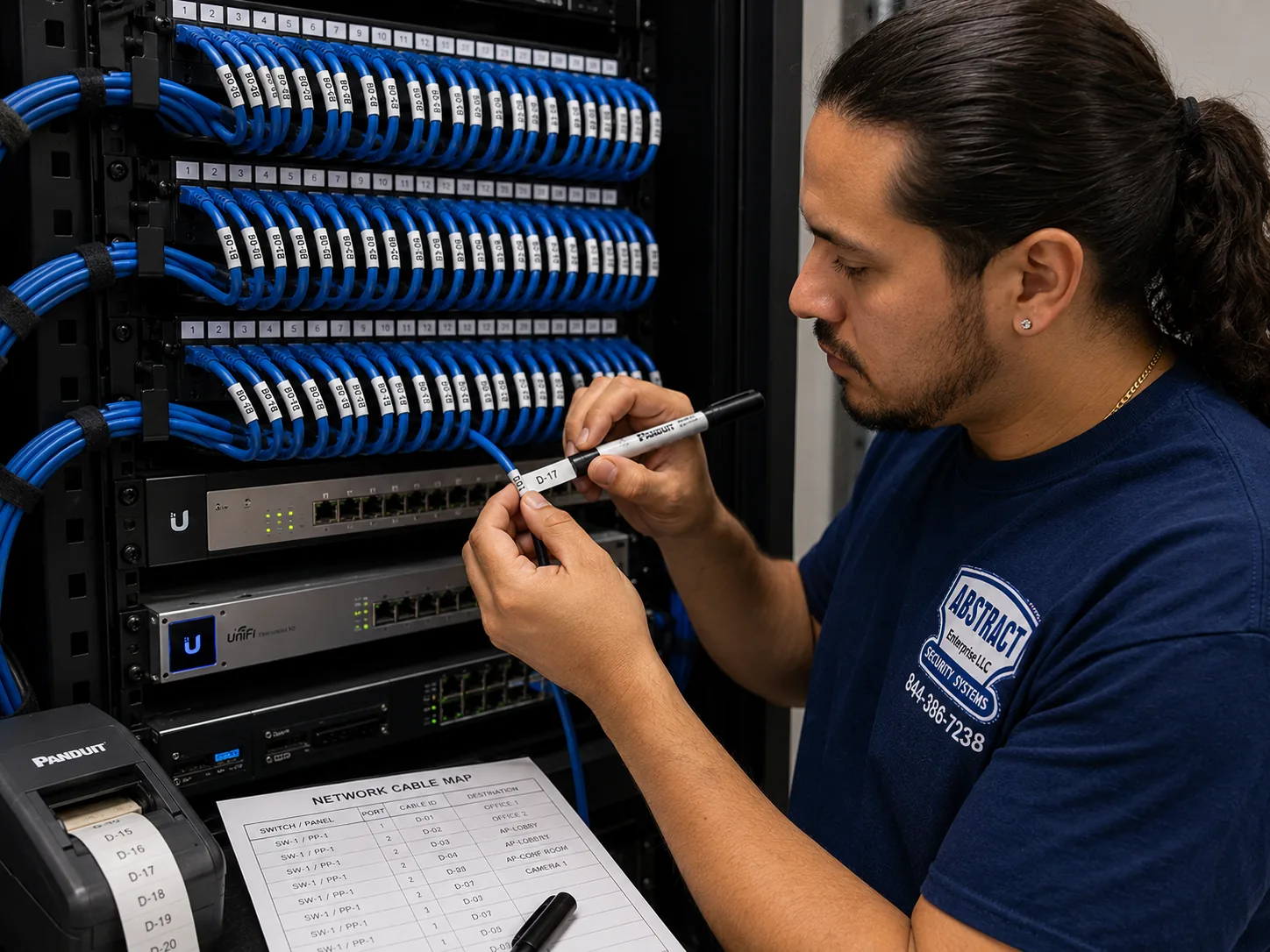
Photo from the AESS job library, not taken on Long Island: a technician printing cable labels at a patch panel, with a printed port map beside the work. On a Long Island office or flex building where a dozen camera runs end in one closet, a labelled panel and a paper map are what let the next person find the driveway camera's cable in seconds instead of an afternoon.
Long Island Alarm.com Cameras
Tell us the town, the building type and who holds your Alarm.com account if you know
✅
Request Sent!
We'll call about your Long Island Alarm.com cameras the same business day.
25+
Years Experience
✓
Same-Day Estimates
100%
Licensed & Insured
4.7★
201 Google Reviews
Owner-operated since 2002 · Thousands of jobs completed · Booked within 2 hours
An Alarm.com camera installation on Long Island is priced from our Long Island price list, with Nassau addresses at 1.15 times our Brooklyn base and Suffolk addresses at 1.20 times, and the exact figures for each camera, run and add-on are on our Long Island Alarm.com camera price page. The installation covers the cable, the mounting, sealing every exterior entry, getting each camera onto your Alarm.com account with your provider and testing it in the app. The monthly Alarm.com service plan is set by whichever provider holds your account, not by us. Requests are booked within 2 hours. Call (800) 486-0943 or use the form.
The account comes first: Alarm.com sells only through authorized providers, and its cameras need an active plan with the video add-on before they will stream or record
The building comes second: a 1950s slab ranch, a 1970s colonial, a managed rental and a flex warehouse each need a different cable route and a different recording plan
The paperwork comes third: Nassau and Suffolk both require police registration for alarm systems, on different terms, and we explain which applies to your address
Why Long Island Properties Need Alarm.com Camera Installation
Long Island is not one place for a camera installer. It is two counties with different houses, different police departments and different permit rules, and an Alarm.com system has to fit all three. The Census Bureau's 2023 American Community Survey counts 477,860 housing units in Nassau County, of which 364,529 are one-unit detached houses, and 579,790 units in Suffolk County, of which 463,095 are detached. That is roughly three in every four homes in Nassau and four in every five in Suffolk standing on their own lot. The same survey gives a median year built of 1955 for Nassau and 1970 for Suffolk. Fifteen years sounds small. On a ladder it is the difference between a low, wide ranch with a shallow attic and no basement, and a two-story colonial with a full basement, a garage under a bedroom and a roof line that puts the soffits twenty feet up. The state's own county profiles add the political map that sits over the houses: Nassau has two cities, three towns, 64 incorporated villages and more than 60 unincorporated hamlets in 453 square miles, while Suffolk is divided into 10 towns across 2,373 square miles. Every camera we mount sits inside one of those municipalities and one of those police jurisdictions.
The Nassau half of that story begins in a potato field. Keri Murray Architecture's history of Levittown records 17,447 homes built there between 1947 and 1951, ranch houses on concrete slabs with an expandable attic, no garage and hot-water radiant heating pipes running through the slab itself. Encyclopedia.com notes that Levitt and Sons dropped the Cape Cod model in 1949 and moved to the ranch, and US History Scene observes that so much remodeling has happened since that very few original Capes survive. Before Levittown, according to History.com, William Levitt had already built 1,080 homes in Westbury and 2,250 in Roslyn. For an Alarm.com job, that heritage means three things. There is no basement to run cable through, so the attic is the highway. The slab carries heating pipes, so nothing is ever drilled downward into the floor. And after seventy-plus years of dormers, extensions and finished attics, no two houses on a block are wired the same way, so the route we used next door tells us nothing about yours.
Uniondale and East Garden City, the area many people mean when they say "the Nassau Hub," show the same pattern a few miles south. NeighborhoodScout reports that single-family detached homes make up 69.74 percent of Uniondale's housing and that 55.45 percent of its homes were built between the 1940s and the 1960s. Homes.com describes the area as split by the Hempstead Turnpike, with East Garden City to the north busy with commercial life and condos, townhouses and apartments, and the residential south made up mostly of Cape Cods and minimal traditional houses, often with detached garages and private driveways. A detached garage is one of the most common reasons an Alarm.com camera job takes longer than the owner expects. The camera on the garage needs power, and it needs a reliable connection back to the house, and the gap between the two is open ground or a driveway that was not built with a conduit under it.
Driveways are also where Long Island break-ins tend to start. When Nassau and Suffolk police, both district attorneys, the NYPD, State Police and the FBI announced a joint burglary and stolen-car task force in January 2024, ABC7 reported that police believed the burglars were attracted by cars in people's driveways and that break-ins while people were home had gone up. In November 2025 NBC New York reported a Jericho break-in in which security cameras showed how quickly a crew of four reached the second floor. In June 2026 Daily Voice described an East Hills case in which a garage door alarm leading into the main floor was triggered and a woman went to investigate and found intruders already in her kitchen. A month earlier the same outlet reported a Roslyn Heights homeowner who spotted would-be burglars on his surveillance system, called police, and saw arrests follow. LI Life and Politics, summarizing Nassau's figures for January through May, reported burglaries up 5 percent, from 234 in 2025 to 245 in 2026, even as overall property crime fell. Those stories are the clearest argument for what Alarm.com is built to do: tie a door sensor that trips to a camera that shows you what tripped it, on the same phone, at the same moment.
Suffolk's pattern in the news is more about the porch. In November 2025 CBS New York reported that the Suffolk District Attorney had charged 14 men in a porch theft ring that worked 31 communities, including Brentwood, Central Islip, Shirley and Deer Park, between October 2023 and February 2025, allegedly hacking systems to learn when carriers were delivering phones and tablets, and taking more than 200 devices. CBS also reported a Patchogue package thief on Rider Avenue who waved at the camera. ABC7 covered a man in Central Islip caught on video using a knife to destroy a doorbell camera. Over the county line, News 12 Long Island reported porch thefts caught on Ring cameras on Walters Avenue in Wantagh and on Atlantic Avenue in Massapequa Park, and Garden City's police log for the week ending September 15, 2026, as published by Patch, recorded packages taken from a front porch and damage to a Flock camera on Clinton Road. A doorbell camera that a thief can reach with a knife, or that only catches the top of a hooded head, is not doing its job. Mounting height, angle and a sturdy fixing are part of an Alarm.com install, not an afterthought.
Then there is the island's newest housing, which is not houses at all. The Governor's office describes Station Yards, also called the Ronkonkoma Hub, as a transit-oriented development spanning 53 acres around the Ronkonkoma Long Island Rail Road station, now expected to cost about $1.2 billion. GreaterLongIsland reported that by March 2020 four vacant industrial buildings on the site had been converted into 489 luxury apartments. Trite CRE's February 2026 update describes a full build-out of up to 1,450 apartments, 195,000 square feet of retail and 360,000 square feet of office space stretching from Ronkonkoma Avenue east to Mill Road, and Long Island Wave's October 2026 report on the latest phase covers three new five-story buildings with 285 apartments and a 30,000-square-foot Northwell medical hub, after The Core at 3 Hawkins Avenue put 388 apartments over 70,000 square feet of retail. RentCafe lists self-service package lockers and a concierge at the Alston at Station Yards, 1000 Mill Road, and a renter review on ApartmentRatings mentions gated parking, common areas, an Amazon Hub and a pool. Renters in managed buildings like these usually cannot run cable through walls, and Alarm.com itself describes self-install as a good fit for renters, small spaces and people who prefer to set things up on their own. Part of our job on Long Island is telling a renter honestly when they do not need an installer at all, and when a single visit to mount and configure saves them a weekend.
Businesses make up the rest of the call list. Long Island's office market stood at 38.45 million square feet with an 11.5 percent total vacancy rate in CBRE's second-quarter 2026 figures, and its industrial vacancy at 7.0 percent. The Long Island Innovation Park at Hauppauge, as Certilman Balin described it in 2017, holds about 1,350 businesses and roughly 55,000 workers in eleven square miles, making it the largest industrial park in the Northeast by number of companies and employees. When a flex building or an office suite changes hands or tenants, the camera system often changes with it, and Alarm.com's commercial recorder, which handles up to 16 cameras at up to 4MP with built-in PoE and works with third-party ONVIF or VAPIX cameras, is one of the systems new tenants ask us to put in or take over.
Weather is the last local factor, and it matters more for a cloud-connected camera than for a standalone recorder in a closet. When Tropical Storm Isaias hit in August 2020, ABC7 reported that almost half of PSEG Long Island's 1.1 million customers were in the dark at the peak. In August 2024, the state Department of Financial Services recorded Suffolk County's first-ever flash flood emergency, the failure of the Stony Brook Mill Pond dam and more than 2,000 residents and business owners with flood damage. Superstorm Sandy left Long Beach with about 150 million dollars in damage, according to Wikipedia's account of the storm in New York. A camera that reports to the Alarm.com cloud needs power and an internet connection to keep sending clips. That is why every Long Island quote we write asks where the router lives, whether it is on battery backup, and whether a camera at the far end of the property should also keep a local copy of its video.
We also want to be clear about what our research could not find. We searched for Reddit threads in r/longisland and r/homesecurity about Alarm.com cameras on Long Island and found none. We found no Yelp reviews specific to Alarm.com camera installers here, and our build tools could not capture Google's People Also Ask boxes, related searches, Bing, DuckDuckGo or AnswerThePublic for this topic. The questions answered on this page come from Alarm.com's own help and answer pages, installer and legal FAQ pages, county code and police pages, and the local news reports named above. Where a source did not support a claim, we left the claim out.
Long Island facts that shape an Alarm.com camera job
Two housing eras: median year built 1955 in Nassau and 1970 in Suffolk, with 364,529 and 463,095 one-unit detached homes respectively, per the Census Bureau's 2023 American Community Survey.
Slabs, not basements, in the Levitt tracts: 17,447 Levittown homes built 1947 to 1951 sat on concrete slabs with radiant heating pipes inside, so camera cable travels through attics and soffits.
Two police permit systems: Suffolk requires an alarm permit inside the Suffolk County Police District, and Nassau requires registration for systems served by the Nassau County Police Department, with different fees, renewals and false-alarm rules.
A false-alarm problem that created the rules: GreaterLongIsland reported that Suffolk's permit law followed 97,000 false alarms police answered in 2015, about 32,000 wasted patrol hours.
A fast-growing rental market around the train: Station Yards in Ronkonkoma is planned for up to 1,450 apartments, with 489 already open in converted industrial buildings by 2020.
Storm exposure: Isaias darkened almost half of PSEG Long Island's 1.1 million customers in 2020, and Suffolk saw its first flash flood emergency in August 2024.
What Long Island owners usually pair with their cameras. Most Alarm.com camera calls on the island come from people who already have, or are about to get, an Alarm.com alarm panel, and the two are worth planning together. A door or garage sensor that trips can trigger a camera clip from the matching view, so the alert on your phone comes with the picture. If you are adding cameras to a system you already have, tell us the panel and the provider when you book, and we will plan the camera positions around the sensors you already own.
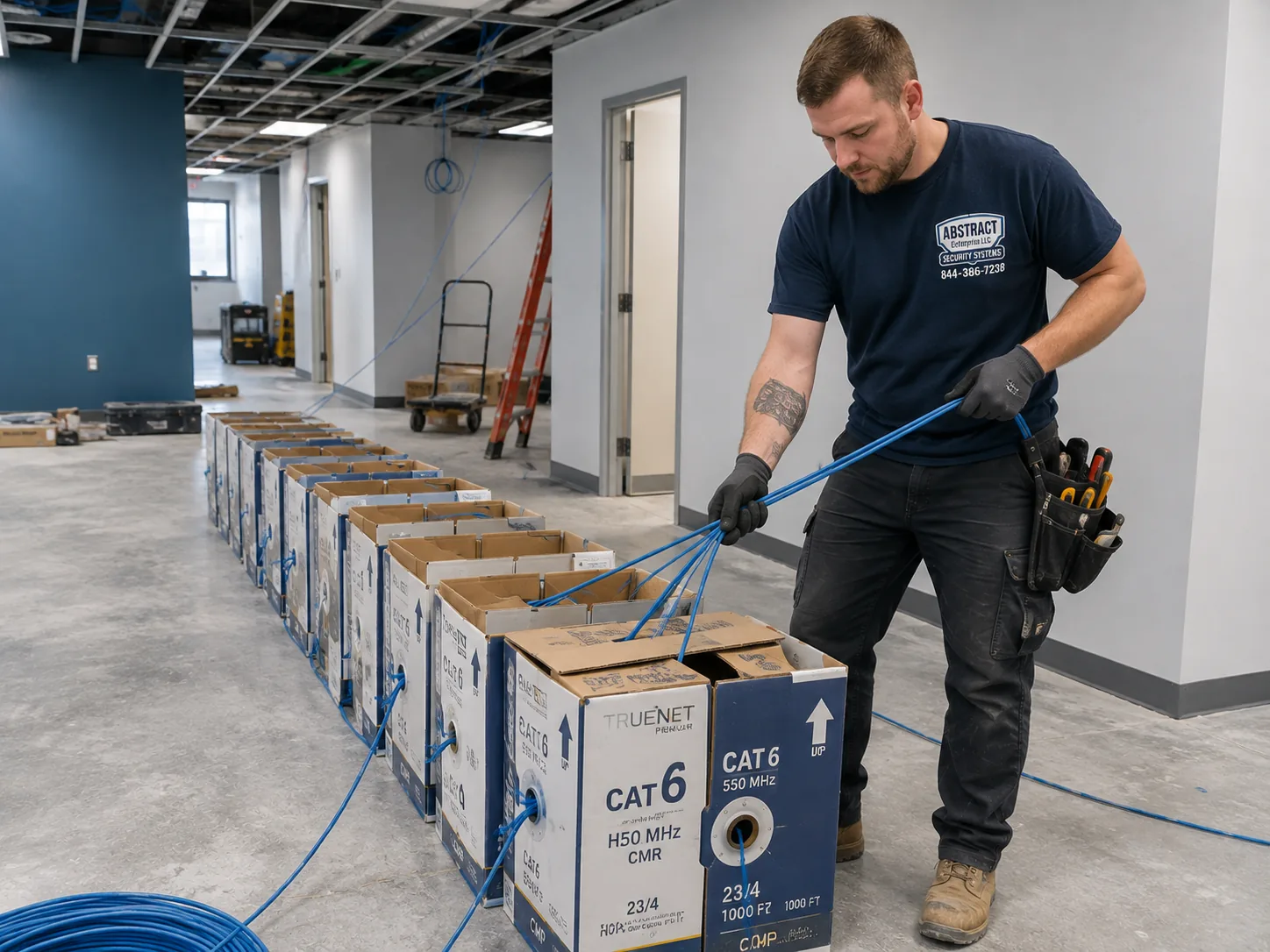
Photo from the AESS job library, not taken on Long Island: boxes of cable staged on the floor of a working commercial premises before a multi-drop pull. A Hauppauge or Route 110 flex building getting a dozen PoE camera runs starts like this, with every box counted and staged where the pull begins, so the work moves quickly while the business stays open around it.
Camera Offline, Footage Missing or a Break-In Last Night? Fast Help on Long Island
The calls we move on first are the ones where something has already happened: a door that was forced, a car gone from a driveway, a package taken, or a camera that went dark at the moment you needed it. If there has been a break-in, call the police first and keep the scene as it is. Then save any clips already in the Alarm.com app before anything overwrites them, and call (800) 486-0943. Tell us which cameras are online, which are not, and whether the power or internet went down recently. A camera that dropped offline after a storm is often a router or power supply problem rather than a dead camera, and we can usually tell which on the phone. If a camera was pulled off the wall or cut, we will remount it in a harder-to-reach spot with a stronger fixing, not just put it back where it failed.
Nassau or Suffolk: How the County Line Changes an Alarm.com Camera Job
An Alarm.com camera is a video device, but on most Long Island homes it lives on the same account and the same app as a burglar alarm, and burglar alarms are regulated county by county. Nassau and Suffolk built their rules for the same reason, too many false alarms tying up patrol cars, but they built them differently. The table sets out what the sources say for each county. It is a summary for planning, not legal advice, and the county police pages and codes are the final word.
Question
Nassau County
Suffolk County
Who requires registration
Residents served by the Nassau County Police Department must register their alarm system, per All Island Security's summary and the NCPD permit form
No alarm owner may operate an alarm system within the Suffolk County Police District without a permit from the department, per the Suffolk County Code
Registration fee
One hundred dollars for a home and two hundred for a business, renewed every two years, per Low Voltage Nation
Fifty dollars for a residential building and one hundred for a nonresidential building, per the county code
What happens if you do not register
Under the "No Police Response" status on the NCPD form, police are not assigned to an unregistered alarm unless independent information suggests a response is needed
Operating without a permit breaks the county code; the department's alarm management program handles enforcement
Allowance for new systems
New installs are exempt for the 90 days after installation, up to three false alarm notifications, provided a permit has been issued, per Kirschenbaum Esq.
Registered owners get two free false alarms a year, after which each residential false alarm costs one hundred dollars, per GreaterLongIsland
How to apply
Through the NCPD alarm registration process
The Suffolk police alarm page says the online portal is down and applications go by mail
Camera registry
Garden City Police run a voluntary private camera registration; a county-wide NCPD registry did not turn up in our research
SCPD's SHIELD Camera Registry is free and voluntary, and the department does not get access to registered cameras
Fire alarm permits
A separate Fire Marshal permit, every three years, per Low Voltage Nation
Not covered in our research for this page
Housing we usually find
Median year built 1955; slab ranches, expanded Capes, minimal traditionals
Median year built 1970; colonials, split-levels, newer rentals around the train lines
Why the permit question belongs in a camera quote
Strictly speaking, a camera on its own is not a burglar alarm, and none of the county sources we read say that a camera-only Alarm.com account needs a police permit. But very few Long Island Alarm.com accounts are camera-only. Most carry door and window sensors, a motion detector or a garage sensor, and those are what the permit rules are about. When we add cameras to a monitored system, we ask whether the system is registered, because the worst time to discover that a Nassau system was never registered is the night a sensor trips and the police dispatcher sees "No Police Response" against the address. Registration is the owner's job, not ours, but it takes us one question to flag it, and we would rather ask than assume.
The Suffolk police district is not the whole county
The Suffolk County Code's wording ties its permit to the Suffolk County Police District, not to every address with a Suffolk ZIP code. Some parts of the county are policed by town or village departments, so the first thing to check is whether your address falls inside the district the code names. If it does, the permit applies before the alarm is operated. If it does not, ask the department that does police your address what it requires. Either way, the cameras go on the same as they would anywhere else; the paperwork is what changes.
How video changes the false-alarm math
Both counties' rules exist because of false alarms, and Suffolk's own figure of 97,000 in 2015 explains why fees start after the free allowance runs out. This is where cameras earn their keep beyond catching a thief. Connextivity, writing about Alarm.com commercial systems, describes video verification as linking camera footage to a triggered alarm so the scene can be checked before anyone is dispatched. On a home system, the same idea works on your phone: the garage sensor trips, a clip from the garage camera arrives with the alert, and you can see whether it is a person at the side door or the wind pushing a loose panel. A camera aimed at each alarmed entry is the simplest way we know to avoid paying for a false alarm you could have spotted yourself.
Camera registries are separate, and voluntary
Registering cameras with the police is a different thing from registering an alarm. The Suffolk police SHIELD program lets residents and businesses list where their cameras are, free, and says plainly that the department does not get access to those cameras; detectives may ask a participant to check video for a date and time, and retrieval is at the owner's convenience. SHIELD also runs an Emergency Remote Camera Access option that partners can opt into or out of at any time. Garden City's police run a similar voluntary registry and also say it does not give them access to privately owned systems. Whether you join is your choice. We mention it because owners often ask, after we have mounted the cameras, whether they should.
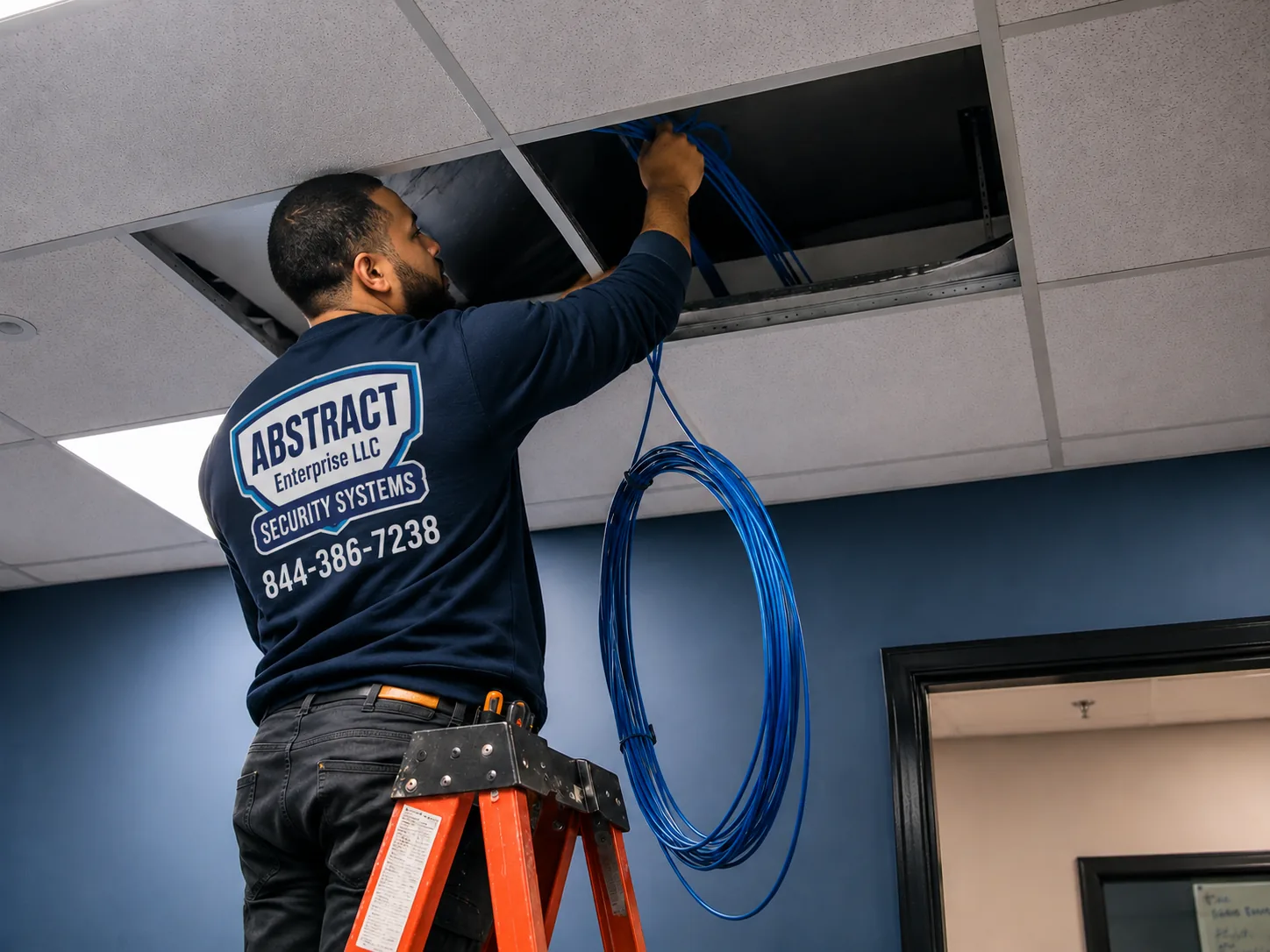
Photo from the AESS job library, not taken on Long Island: a technician feeding cable up through the ceiling of a commercial space that is open around him. Office suites along Route 110 and in RXR Plaza-style towers in Uniondale have the same drop ceilings, and a camera over a reception desk or a back door is wired this way, through the ceiling grid rather than down the wall.
Before You Book
Login, Router, Attic: Six Things to Check at a Long Island Address Before We Arrive
Most of the time lost on an Alarm.com camera job is lost before a camera comes out of its box: nobody can find the account login, the video add-on was never ordered, the router sits in the far corner of the basement, or the attic hatch is behind a closet full of winter coats. Ten minutes with a phone and a flashlight prevents nearly all of it. Please do not open the alarm panel, unplug the router or crawl into an attic you are not used to; just look and send us what you see.
What to check
Why it matters on Long Island
What to send us
Your Alarm.com login and provider
Alarm.com sells through providers; the provider that holds the account controls the video plan
The provider's name, or the name on the app's login screen
Whether video is on your plan
Alarm Grid notes the monitoring company must add the video add-on before cameras will work
A screenshot of the app's menu, or the last bill
Where the internet comes in and where the router sits
In slab ranches the router is often in a living area; in colonials it may be in the basement, far from the cameras
A photo of the router and the room it sits in
How to get into the attic
The attic is the main cable route in Levitt-era and 1950s houses with no basement
Where the hatch or pull-down stairs are, and whether the attic is floored
Outdoor outlets and the garage
Detached garages and side yards need power for cameras and sometimes their own cable run
Photos of the garage, the driveway and any exterior outlets
Landlord, HOA or village rules
Managed rentals and some condo boards limit drilling and exterior hardware
The lease clause or the board's email, if there is one
Picture the camera views from inside the house
Before you count cameras, walk through the house and stand at each door you use, then look out. The front door, the side door into the kitchen or garage, the back slider and the driveway are the four views most Long Island owners end up wanting, and the news stories above show why: thieves come for the car in the driveway, the package on the step, and the door they think nobody is watching. Notice where the sun sets relative to each door, because a camera facing straight into a low western sun at five o'clock in December will struggle. Notice where a tree or a hedge blocks the view of the driveway. Send us a rough sketch, even on the back of an envelope, and we will turn it into camera positions.
Check what your neighbors' windows look like from your doors
On a Levittown or Hicksville block where houses sit close together, a camera aimed at your side yard often looks straight at the neighbor's kitchen window. Vertex Security's guidance on New York camera law recommends privacy masking on exterior cameras so you do not capture a neighbor's backyard in a way that runs into Civil Rights Law section 52-a, which bars video surveillance where someone has a reasonable expectation of privacy. We plan views and masks with that in mind, and it helps if you tell us in advance which neighboring windows face your property.
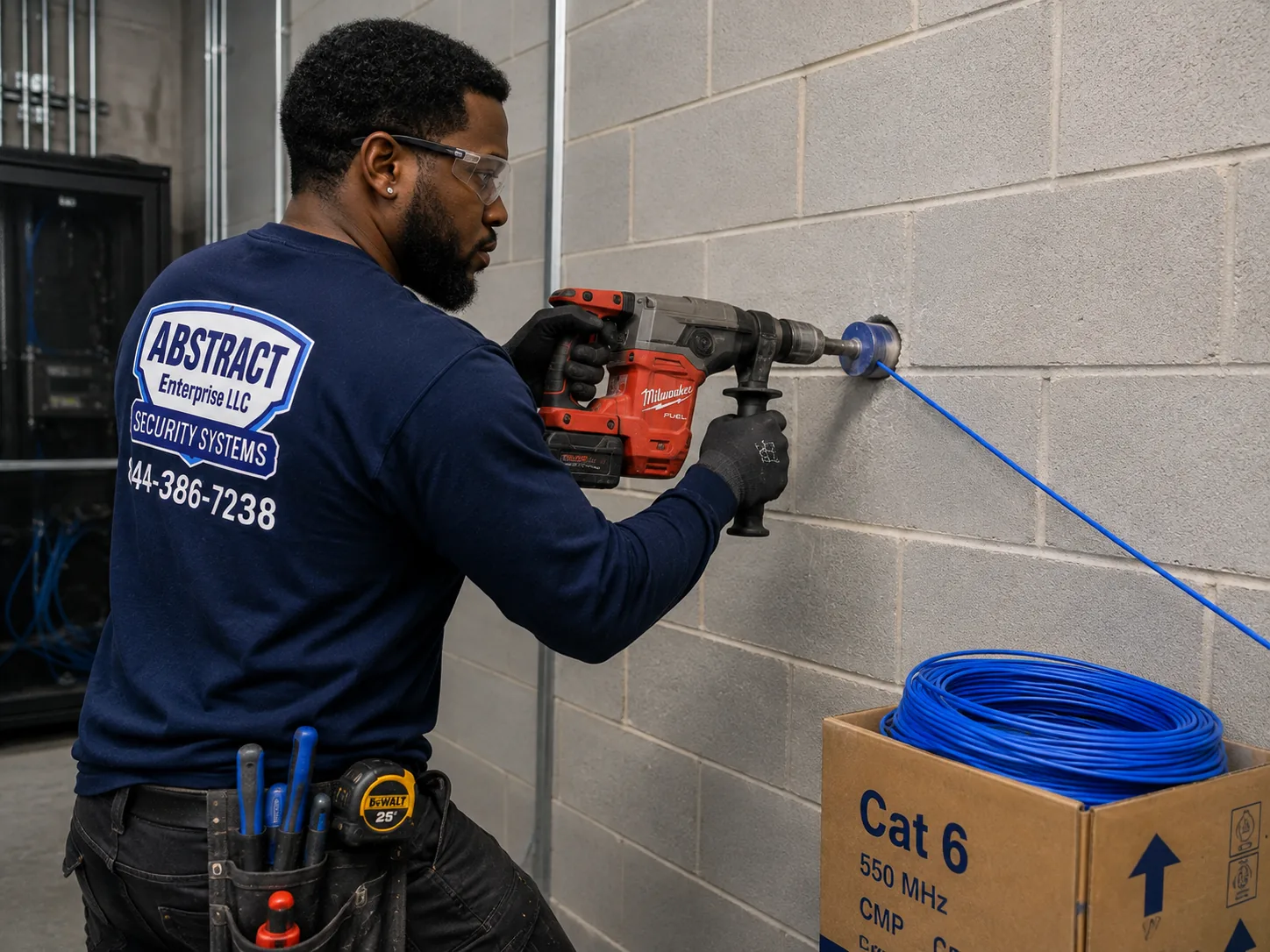
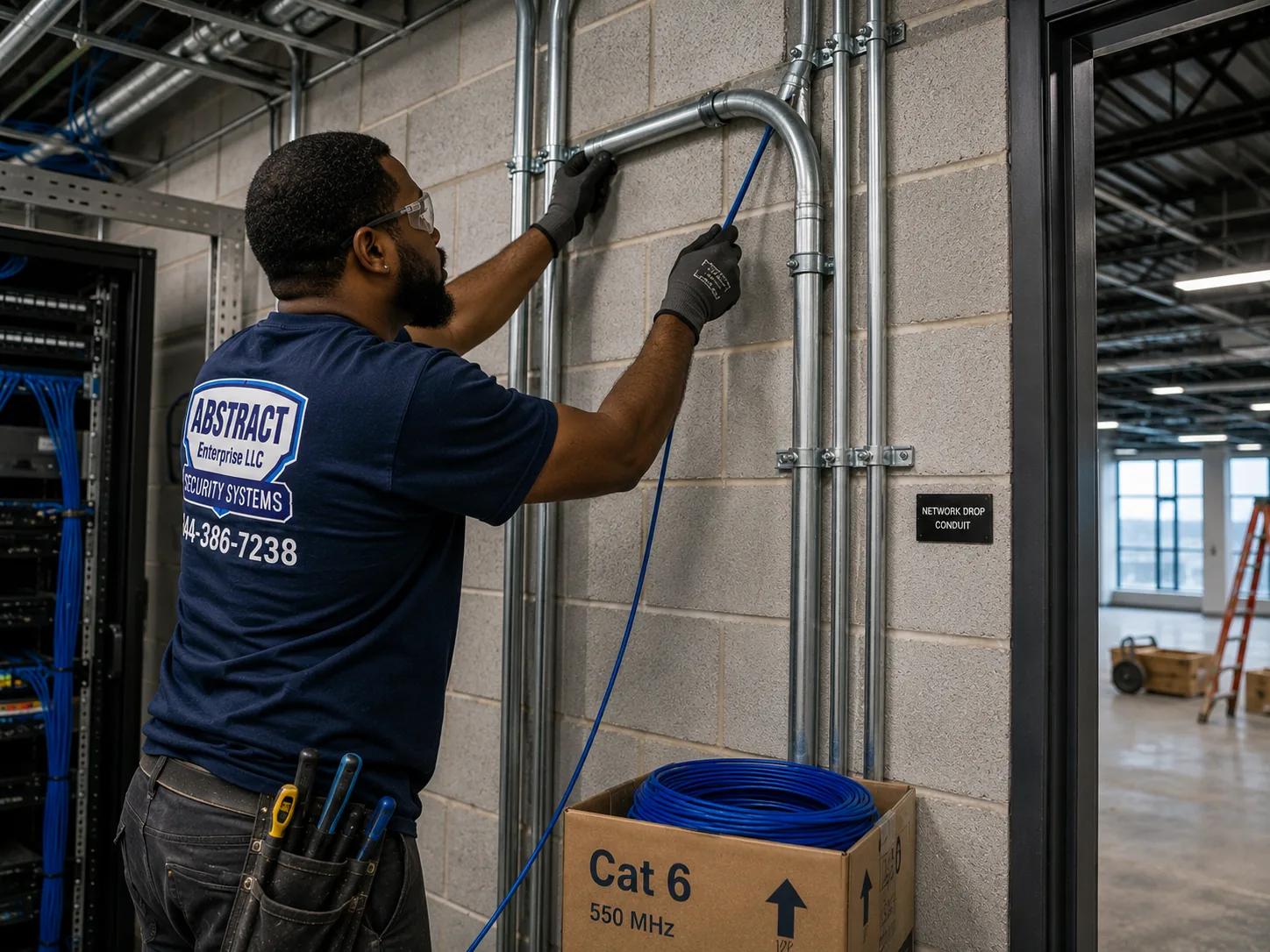
Photo from the AESS job library, not taken on Long Island: a technician core drilling through a block wall so cable can pass into a network room. The block walls of Long Island flex and industrial buildings, and the poured foundations under many Suffolk colonials, need this kind of clean, sized hole, sealed afterward so water and pests stay out.
What We Install
Alarm.com Camera Installation Services on Long Island
These are the Alarm.com camera jobs Long Island homeowners, renters, landlords and businesses book us for. Each one is priced from our Long Island price list, with the Nassau and Suffolk rates shown on their own price pages. Where a job needs something extra, such as a second cable run to a detached garage or a battery backup on the router, the quote names it before you book.
🔔
Video Doorbells on Cape and Ranch Entries
Alarm.com doorbell cameras set at a height that sees faces, not just hoods, with a fixing that resists the kind of knife attack ABC7 reported in Central Islip, and the doorbell power checked before the new unit goes up.
🏠
Soffit Cameras Wired Through the Attic
Outdoor cameras mounted under the eaves of slab ranches and colonials, with cable run through the attic and dropped through the soffit into a sealed box, so nothing hangs on the siding.
🚗
Driveway and Detached Garage Coverage
Cameras that see the cars task-force police said burglars target, plus coverage of detached garages common on Uniondale's Cape Cods, wired where a route exists and battery-powered where it does not.
🗄
Commercial SVR and PoE Systems
Alarm.com's commercial recorder for up to 16 cameras at up to 4MP with built-in PoE, for flex buildings in Hauppauge, offices on Route 110 and stores along Old Country Road.
🔁
Bringing Older Cameras Into Alarm.com
Analog and existing cameras connected through an Alarm.com video server, as Alarm.com's help pages describe, so a working camera on the house does not have to be thrown away.
🔋
Battery Spotlight Cameras Where Wire Cannot Go
For rentals, sheds and fences: battery cameras like the ADC-V731B Battery Spotlight Camera Alarm.com announced in March 2026, which can record continuous video to microSD.
🔑
Taking Over a System in a House You Bought
Cameras left by the previous owner traced, tested and moved onto your own account with a provider, so the old owner no longer sees your driveway and you do.
🚨
Cameras Tied to Alarm Sensors
Camera views lined up with door, garage and motion sensors so a trip sends a clip with the alert, the video verification idea that keeps a Long Island owner from paying for a false alarm.
🛠
Offline Camera Repair and Rewiring
Cameras that dropped after a storm, a router change or a power cut brought back online, with the cause found and fixed rather than the camera simply rebooted.
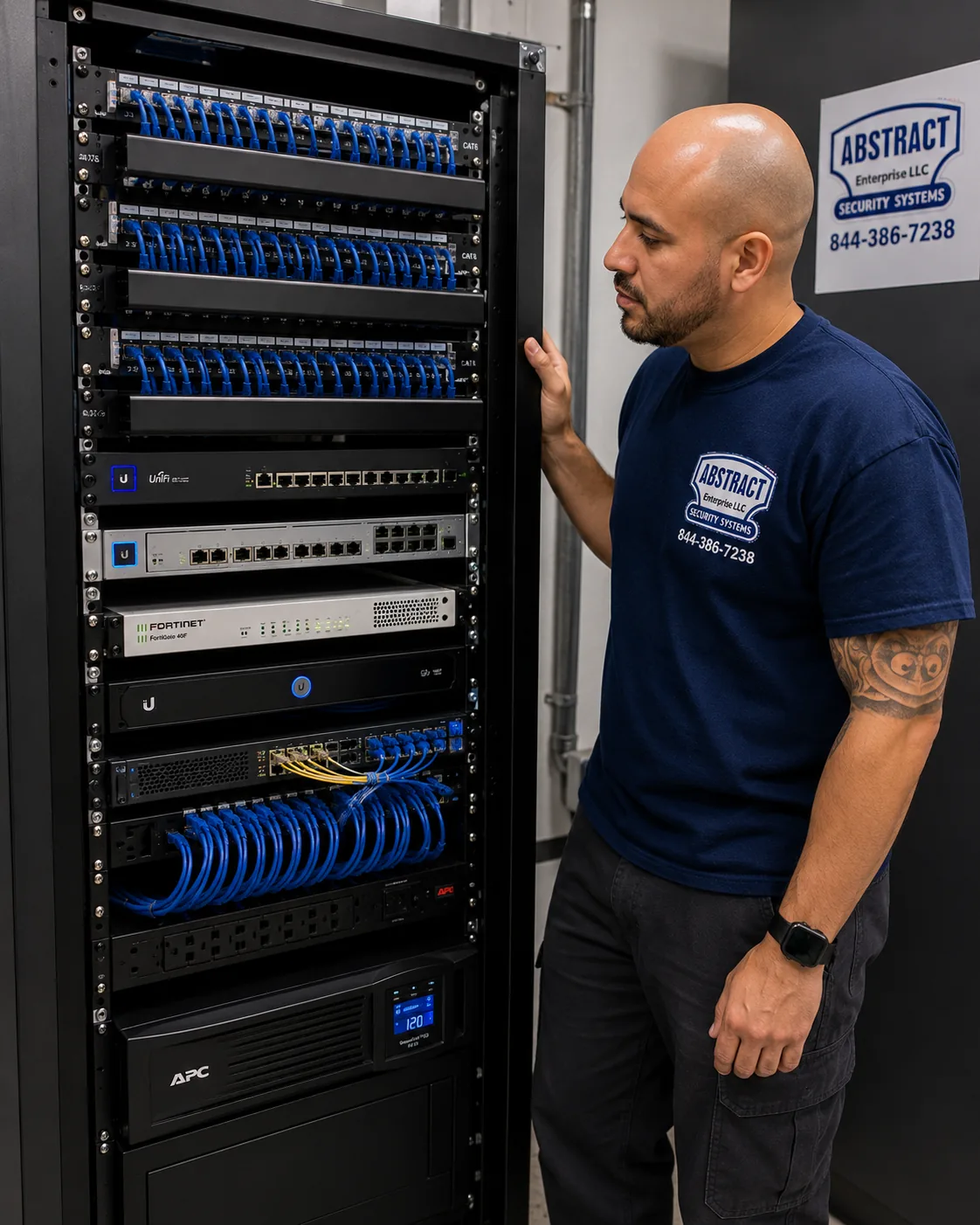
Photo from the AESS job library, not taken on Long Island: a finished network rack with patch panels, switching, a firewall and a battery backup unit, every cable dressed and labelled. A Long Island business running an Alarm.com commercial recorder needs exactly this kind of closet, with the battery backup there for the night the power goes out the way it did during Isaias.
Building Specialists
Alarm.com Camera Installation for Long Island's Architecture
Long Island's buildings fall into a handful of types, and each one changes three things about an Alarm.com camera job: how the cable reaches the camera, where the camera gets its power, and who has to agree before anything is fixed to the outside of the building. These are the types the sources describe, and how we handle each.
Slab Ranches and Expanded Capes
The Levittown model and its neighbors: concrete slab, radiant heating pipes in the floor, an attic that may now be a bedroom. Cable goes up and over, never down, and a finished attic means fishing behind knee walls.
Postwar Capes With Detached Garages
The Uniondale pattern Homes.com describes: Cape Cods and minimal traditionals with private driveways and a garage set back from the house. The garage camera is the hardest one on the property.
1970s Colonials and Split-Levels
Suffolk's median house: two floors or staggered levels, a basement or lower level for the router and recorder, and high soffits that put cameras out of reach of thieves and of short ladders.
North Shore Estates
The Gold Coast, where Wikipedia counts more than 500 mansions built from the 1890s on, with gatehouses, long drives and outbuildings that stretch any camera's connection back to the house.
Managed Rentals by the Train
Station Yards-style apartment buildings with concierges, package lockers and gated parking. Renters cannot drill exterior walls, so indoor cameras and battery units do the work.
Flex, Office and Retail Buildings
Block walls, drop ceilings, telecom closets and parking lots. PoE cameras on a commercial recorder, cable in J-hooks or conduit, and a landlord's approval before anything goes on the facade.
How the building type changes the job
Building
How cable usually travels
How cameras get power
Who signs off
Slab ranch or expanded Cape
Through the attic and down inside the soffit
Wired power or PoE from a switch near the router
The owner
Cape with a detached garage
Attic to the house wall, then overhead or underground to the garage where a route exists
Wired where cable reaches; battery where it does not
The owner
Colonial or split-level
Basement or lower level up through a wall cavity, or attic down to high soffits
PoE or wired power
The owner, plus an HOA if the house is in one
North Shore estate
Long runs to outbuildings, often in conduit
PoE with a switch at the outbuilding, or battery units
The owner and often a property manager
Managed rental apartment
None through walls; cameras stay indoors or on battery
Plug-in or battery
The renter, inside the lease and building rules
Flex, office or retail building
Ceiling J-hooks, conduit, core-drilled block
PoE from the recorder or a managed switch
The tenant and the landlord or property manager
Working in a slab ranch
The Levittown ranch, as Keri Murray Architecture describes it, sits on a concrete slab with hot-water heating pipes running through it. That single fact shapes the whole job. We never drill down into the floor to pass a cable, because a bit that finds a heating pipe in a slab turns a camera job into a plumbing emergency. Instead, everything goes up. From the router, usually in a living room or a front bedroom in these houses, the cable climbs inside a wall cavity or a closet corner to the attic, runs across the ceiling joists, and drops into the soffit above each camera. Where the attic has been finished into a bedroom, as so many have since the 1950s, the route goes behind the knee walls, along the eaves, where there is usually just enough room to work with a fish tape and a light. We check the insulation before we crawl, because pushing through loose fill without care leaves gaps that cost the owner in winter.
Reaching the detached garage
The garage camera is where Long Island jobs most often change shape. A detached garage needs power for the camera and a connection back to the house. If the garage already has a power line and a conduit from the house, cable can usually share the path, as long as data and power are separated the way the code expects. If there is no path, there are three honest choices: trench a new conduit, which is a bigger job and sometimes worth it; mount the camera on the house facing the garage, which often gives a better view of the driveway anyway; or use a battery camera on the garage itself. We lay out those choices with the trade-offs on the first visit rather than picking for you.
Colonials, split-levels and high soffits
Suffolk's 1970s houses are kinder to cable than Nassau's slab ranches, because most have a basement or lower level where the router, a small switch and, for larger systems, a recorder can sit. The challenge is height. A two-story colonial puts its rear soffits high above a deck or a sloped yard, and a split-level puts some eaves low enough to reach from the ground and others well above the driveway. We mount the cameras that watch doors at a height that still sees faces, and the cameras that watch the property line high enough that nobody can reach them from the ground. Ladder work on those rear walls is planned, not improvised, and on a sloped yard it sometimes takes two people.
North Shore estates and outbuildings
The Gold Coast estates, from Old Westbury Gardens' 1906 Phipps house to the private properties around it, bring distance. A gatehouse at the end of a long drive, a pool house, a garage block or a barn may sit hundreds of feet from the main house. Standard copper Ethernet runs have length limits, and a wireless link across a lawn depends on line of sight that summer leaves can block. We look at what is already in the ground, whether there are conduits from earlier work, and whether a switch can live in the outbuilding with its own power. Where an outbuilding has no data path at all, battery cameras with local microSD recording are the fallback.
South Shore and waterfront houses
Houses near the water face salt air, wind-driven rain and, as Sandy and the 2024 flash flood showed, water where it is not supposed to be. Our own Long Island installer notes call for weather-rated housings on waterfront jobs. In practice that means sealed junction boxes behind every camera, drip loops on every cable entry so water runs off rather than into the wall, stainless fixings where the standard ones would rust, and the router, switch and recorder kept off the floor of any lower level that has taken water before.
The Mitchel Field officers' housing
Within East Garden City, the Mitchel Air Base and Flight Line was added to the National Register of Historic Places on May 4, 2018, covering roughly 108 acres around Charles Lindbergh Boulevard, Ellington Avenue and East and West Roads, and the American Airpower Heritage group's description says its northern boundary takes in two rows of officers' housing on Ellington northeast of Selfridge Avenue. We found no local rule about exterior hardware on buildings in the district, and we do not claim one exists. If you live or work in one of those buildings, ask the owner or managing body whether anything applies before we fix cameras to the exterior, and we will plan small, discreet mounts either way.
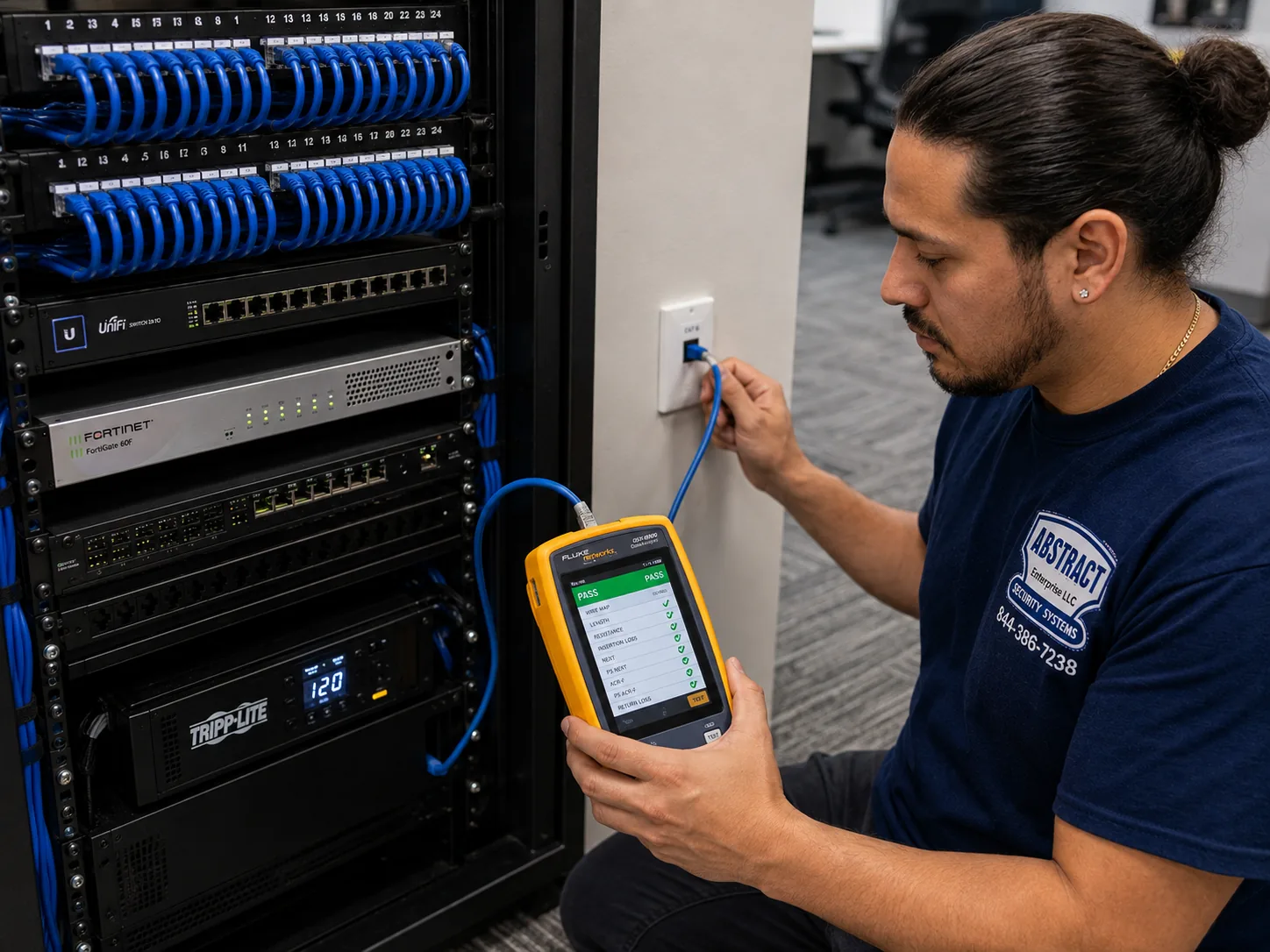
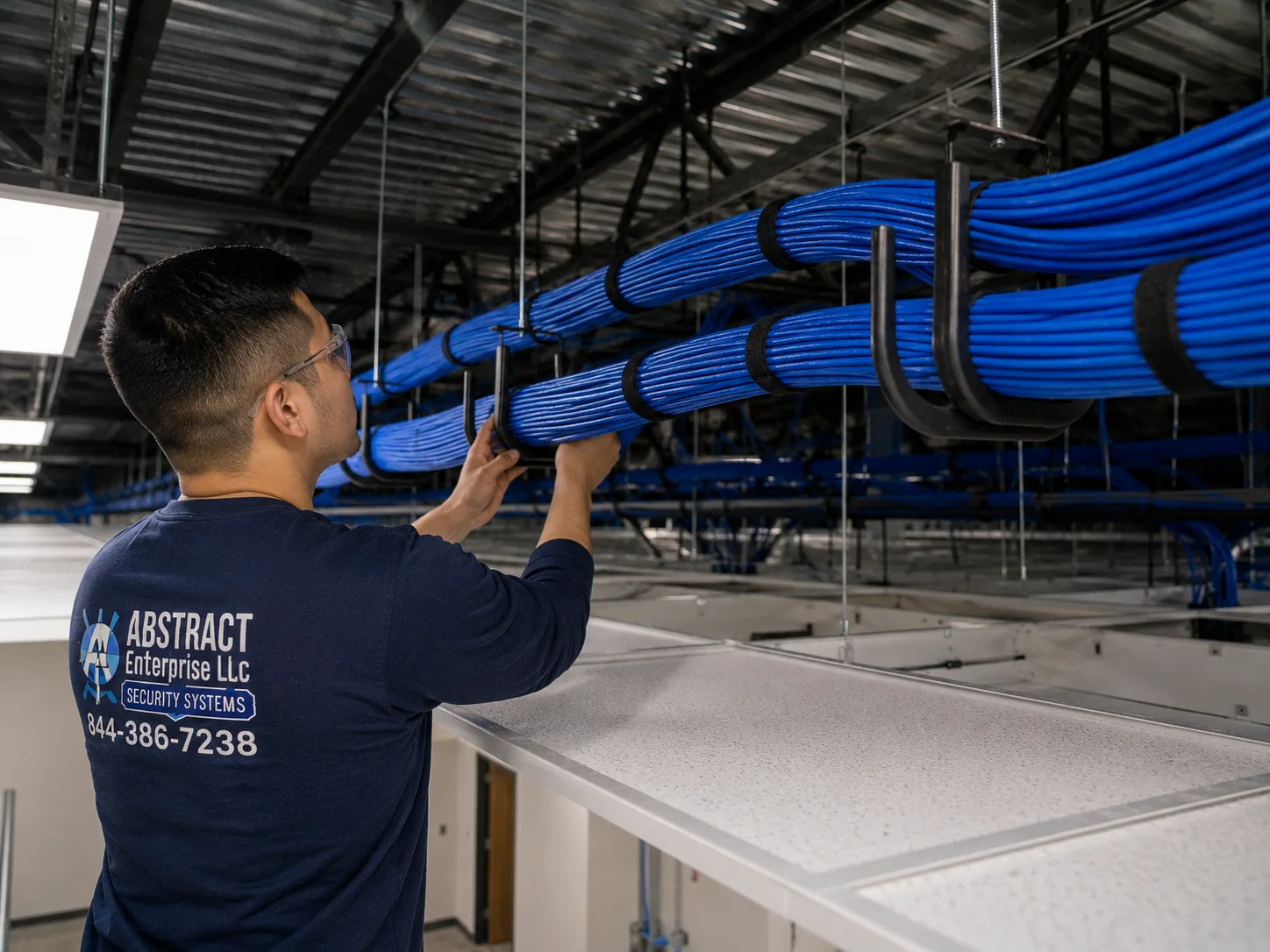
Photo from the AESS job library, not taken on Long Island: a technician certifying a data drop with a cable analyzer that shows a PASS result. Every cable we pull through a Long Island attic for a soffit camera is tested before the camera goes on, because a run nicked on a roofing nail is far easier to fix before the soffit is closed up.Photo from the AESS job library, not taken on Long Island: a J-hook pathway carrying neat bundles of cable across a commercial ceiling. In a Long Island flex warehouse, cable for loading-dock and parking-lot cameras travels this way, supported every few feet so it never rests on lights, pipes or the ceiling grid.
Commercial Alarm.com Camera Installation
Business Alarm.com Camera Installation on Long Island
Long Island's commercial life is spread along corridors rather than packed into a downtown, and the cameras in those buildings do different jobs: watching loading docks in flex buildings, front doors in office suites, registers in stores and parking lots almost everywhere. The corridors below are the ones the sources describe. We describe what each source says about them; we have no information about the camera systems inside any particular business and do not claim any of them as clients.
Long Island Innovation Park at Hauppauge
About 1,350 businesses and 55,000 workers in eleven square miles, renamed from the Hauppauge Industrial Park in 2019, with the Town of Smithtown's overlay covering about two-thirds of it, per Certilman Balin.
The Route 110 Corridor
Farmingdale, Melville and Huntington Station, with a dense mix of warehouse, flex, R&D and office uses near the LIE, per Irace Enterprises; Melville Corporate Center I at 105 Maxess Road is a 149,000-square-foot example.
Old Country Road and Roosevelt Field
Roosevelt Field at 630 Old Country Road is the largest mall on Long Island, with 243 stores and more than 2.3 million square feet of leasable area, per Wikipedia, built on the airfield where Lindbergh's 1927 flight began.
Uniondale and the Nassau Hub
RXR Plaza beside the Meadowbrook Parkway, Hofstra's 244-acre campus, Nassau Community College and the Coliseum, around a 72-acre Hub site whose redevelopment is still unsettled.
Station Yards Retail and Medical
Planned for 195,000 square feet of retail and 360,000 square feet of office space, with 70,000 square feet of retail at The Core and a 30,000-square-foot Northwell medical hub in the latest phase.
The Research Belt
Stony Brook University's 213 buildings on 1,454 acres with its R&D park, and Brookhaven National Laboratory's 5,265 acres at Upton, along with the smaller suppliers and offices that grow around them.
What a business camera system has to do
A home camera mostly sends clips when something moves. A business camera system usually has to record all the time, because the question after an incident is not "did something move" but "what happened at the back door between two and four in the morning." That is the job Alarm.com's commercial recorder, the SVR, is built for. The Surety support forum explains that the SVR is an add-on to Alarm.com cloud video whose main benefit is around-the-clock recording, and that cloud video has to be on the account to use it. Alarm.com's business camera page says the commercial SVR handles up to 16 cameras at up to 4MP, with built-in PoE so each camera gets power and data on one cable, and works with third-party ONVIF or VAPIX cameras. For a flex unit in Hauppauge with a loading dock, a front office and a parking lot, that is usually enough recorder; for a larger building we plan more than one, or a different architecture altogether, and tell you before you book.
Compliance and practical limits for business cameras
The installer needs a state license. New York requires a license from the Department of State to install or maintain security systems, and a trade association course page notes that this includes cameras and CCTV, with unlicensed installers facing fines of up to ten thousand dollars. The Department of Labor's licensing summary lists the requirements: age 18, at least 81 hours of qualifying education, an exam and fingerprints. Our work is done under NYS license #12000287431.
Third-party cameras need the right plan. The Surety forum notes that a commercial SVR can sit on a residential account, but third-party ONVIF and Axis camera support needs a commercial video plan. If a business already owns cameras it wants to keep, the plan has to match.
Audio is a legal decision. New York is a one-party consent state for recording conversations, as the Digital Media Law Project explains, so a camera microphone at a register that records two customers talking, with neither of them consenting, is a problem. We usually leave audio off on business cameras unless the owner has a clear reason and has checked it.
Private spaces are off limits. RecordingLaw notes that a camera recording inside a bathroom, changing room or similar space without consent is a class E felony under Penal Law section 250.45. We will not mount one there, and we check that a camera in a corridor cannot see into one.
Permits come from the town, village or city. Long Island has no single building department. Whether exterior work needs a permit depends on the municipality, so we check per address rather than promising none is needed.
The landlord owns the facade. In a leased building, cameras on the exterior, the roof or the parking lot poles need the landlord's or property manager's written approval, which we ask the tenant to get before we schedule.
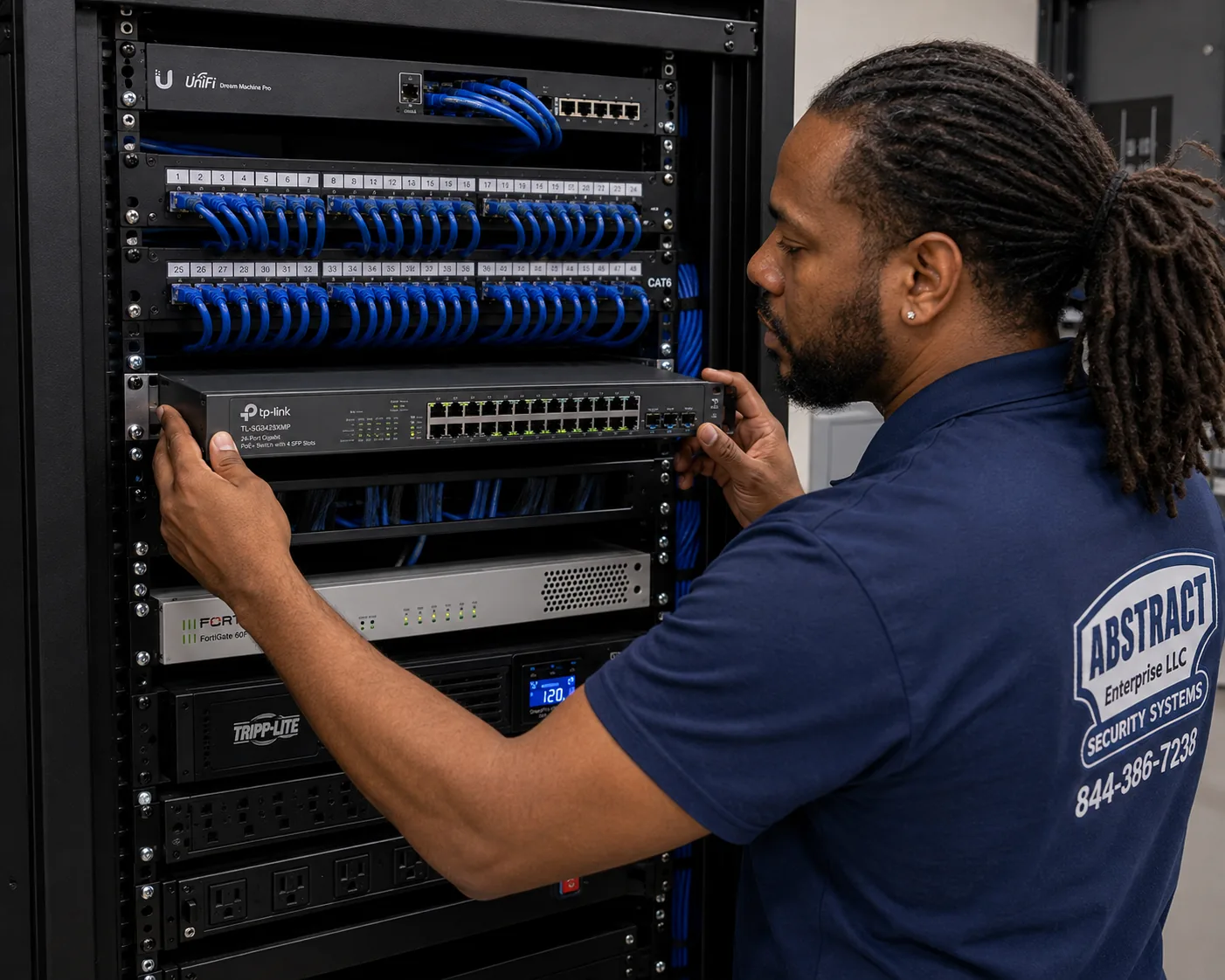
Photo from the AESS job library, not taken on Long Island: a technician mounting a managed PoE switch below patch panels in a commercial network rack. When a Long Island office has more PoE cameras than its recorder's built-in ports, a switch like this powers the extra cameras over the same cable that carries their video.Photo from the AESS job library, not taken on Long Island: a technician running cable into EMT conduit next to a telecom room in an industrial building. Loading docks and forklift aisles in the Hauppauge and Route 110 flex buildings are hard on exposed cable, so runs to dock cameras go into conduit like this where they could be struck.
Field Notes
Field Notes: The First Twenty Minutes in a Long Island Slab Ranch
We do not publish stories about a particular customer's house unless we can document them, so this is not a tale about one address. It is the routine our technicians follow in the kind of house Nassau is full of: a postwar ranch on a slab, an attic somebody may have finished, and an owner who has the Alarm.com app on their phone but has never looked at the video menu.
Before a ladder comes off the van, we sit down with the owner and the phone. We open the app together and check that the video section is there, because if the provider has not added video to the plan, no amount of wiring will make a camera appear. We note the provider's name. We find the router, check how far it sits from the farthest camera position, and run a speed test from the spot where the driveway camera will report. Then we find the attic hatch, look up with a light, and check for floor boards, insulation depth and any wiring that looks newer than the house. We walk outside, look at each soffit we plan to use, and press on it to see whether it is solid wood or a vented panel that needs a backing plate. We look up at where the power and phone lines enter. Only when the account, the network and the attic have all been checked does the first cable come out of the box. In houses this age, those twenty minutes decide whether the job runs smoothly or turns into a second visit.
Your Questions Answered
Alarm.com Camera Installation on Long Island: Questions Answered
Buying and accounts
Can a Long Island homeowner order Alarm.com cameras straight from Alarm.com?
No. Alarm.com's own answers page says it does not sell systems directly and that its services are sold through authorized security professionals who install, monitor and support the system. In practice, your cameras sit on an account held by a service provider, and that provider controls what your plan includes. If you already have an Alarm.com panel at home, you already have a provider, and new cameras go on the same account. If you do not, the provider is the first decision, and we explain on the phone how the account side will be handled for your property before we quote the installation.
If we cancel or pause our monitoring plan, do the cameras keep recording?
Not on their own. Alarm Grid's FAQ says all Alarm.com cameras require active service and that the monitoring company must add the video surveillance add-on to the account before the cameras will work; that page is several years old, but we have seen nothing from Alarm.com that changes the principle. The one partial exception in our research is local storage: Alarm.com's March 2026 release describes the ADC-V731B battery camera recording continuous video to microSD. If you are thinking of dropping your plan, talk to your provider first, because a camera system without an account is not a system you can rely on.
We just closed on a Nassau house and the previous owners left Alarm.com cameras. How do we take them over?
Alarm.com's help pages address exactly this: a new home that already has an Alarm.com system. The cameras stay tied to the previous owner's account until that account is closed or the equipment is released, so the first step is getting the old account ended and a new one opened in your name with a provider. Until then, the old owner may still see your driveway. Once the account side is settled, we trace every camera's cable, test each camera, reset the ones that need it, and add them to your account. We also check that nothing else on the network, such as an old recorder in a closet, is still sending video anywhere you do not expect.
Hardware and recording
Our house has wired cameras from an older system. Can they work with Alarm.com instead of being replaced?
Often, yes. Alarm.com's answers page lists upgrading an existing security system to Alarm.com using existing equipment as one of its standard questions, and its help pages say analog and existing cameras can be connected through an Alarm.com video server. Whether it is worth doing depends on the cameras: a decade-old analog camera with fogged lenses may cost more to keep than to replace. We test each one on site, tell you which are worth keeping, and use the existing cable where it is sound, which in a slab ranch can save a lot of attic work.
Cloud clips or a recorder in the house: which suits a Suffolk family home?
For most homes, cloud clips are enough. Cameras send short videos to Alarm.com's cloud when something triggers them, and you watch on your phone. A recorder, the SVR, adds continuous recording; the Surety forum describes around-the-clock recording as its main benefit and says the SVR works alongside cloud video rather than replacing it. A Suffolk colonial with a basement, a long driveway and a detached shed is a good candidate for continuous recording if you want to review what happened overnight even when nothing triggered an alert. A small ranch with four cameras on its doors usually is not. We explain the difference with your own layout in front of us.
Can a homeowner put the business recorder and PoE cameras on a residential account?
According to the Surety support forum, a commercial SVR can be used on a residential account, but support for third-party ONVIF and Axis cameras needs a commercial video plan. So the recorder itself is not off limits for a home, and its built-in PoE makes wiring cleaner, but if you want to mix in cameras from other makers, the plan has to be the commercial one. Your provider sets the plan, so we confirm it before we buy or mount anything.
What types of Alarm.com cameras are there, and which do Long Island houses actually use?
Alarm.com's help pages list video doorbells, indoor cameras, outdoor cameras and the video server for existing cameras, and its business page adds the commercial recorder. Its March 2026 release added a battery spotlight camera and AI video search. On Long Island houses we most often fit a doorbell at the front door, outdoor cameras on the soffits over the side door and the driveway, and sometimes an indoor camera facing the door from the garage. Renters lean toward indoor and battery cameras. Businesses lean toward PoE cameras on a recorder. The mix depends on the doors you use, not on a package.
Permits and the law
Does adding cameras to our Alarm.com system mean we need a Nassau County alarm permit?
The Nassau rule is about the alarm system, not the cameras. All Island Security's summary says residents served by the Nassau County Police Department must register their alarm system, and the NCPD form explains that unregistered systems are put in a "No Police Response" status. If your Alarm.com account includes door, window or motion sensors that report to a monitoring station, that system should be registered whether or not it has cameras. Our sources do not say that a cameras-only account needs a permit. If your village has its own police department rather than NCPD, ask that department what it requires.
Does whoever installs Alarm.com cameras on Long Island need a license?
Yes. The NYS Department of State licenses anyone who installs or maintains security or fire alarm systems, and the course page from the Nassau-based trade association makes clear that security systems include cameras, CCTV and access control. The Department of Labor's summary lists the requirements, and the fines for unlicensed work run up to ten thousand dollars. Our license number, NYS #12000287431, is on this page and on every quote; any installer you consider should be able to give you theirs just as easily.
Can our outdoor cameras record sound on the front walk?
They can, but the law matters more than the microphone. New York's eavesdropping law is a one-party consent rule, as the Digital Media Law Project explains, which means recording a conversation is lawful when at least one person in it consents. A Justia answer on home cameras puts the practical point simply: disable audio unless you know a consenting participant, including you, will be part of any recorded conversation. A camera on your front walk that records two strangers talking on the sidewalk has nobody consenting. We usually set outdoor cameras to video only and leave audio on the doorbell, where you are a party to the conversation.
Weather, power and planning
When a storm knocks out power on the island, what happens to Alarm.com cameras?
Wired cameras stop when the power or the internet stops, unless something keeps them running. Isaias left almost half of PSEG Long Island's 1.1 million customers without power at the peak, so this is not a theoretical question here. A battery backup on the router, the PoE switch and any recorder keeps a wired system alive through a short outage, as long as the internet service itself is still up. Battery cameras keep recording to their microSD card even when the house loses power. For longer outages, nothing short of a generator keeps a home system online, and we say so plainly rather than overselling the backup.
How many Alarm.com cameras does a typical Long Island house need?
Count the doors and the driveway, not the corners. A slab ranch with a front door, a side door and a driveway usually needs a doorbell camera and two outdoor cameras. A colonial with a back slider, a deck and a detached garage may need five or six. The burglary reports above all start at a door or a car, so cameras that clearly see those spots do more than cameras that cover every inch of lawn. We plan the views on the first visit and you choose how far to go; more cameras is not automatically better, especially on a cloud plan.
Our Station Yards lease bans drilling exterior walls. What can a renter put in?
Quite a lot, without touching the walls. Alarm.com describes self-install as a good fit for renters and small spaces, and providers that offer it ship systems pre-configured. Indoor cameras on a shelf facing the door, a battery camera inside a window, and a doorbell solution the building allows will cover most apartments. In a building with a concierge, package lockers and gated parking, as RentCafe and ApartmentRatings describe at the Alston, the common areas are the landlord's responsibility, not yours. If you want help setting up cameras so they work properly, we can do that in one visit, but we will not drill anything your lease forbids.
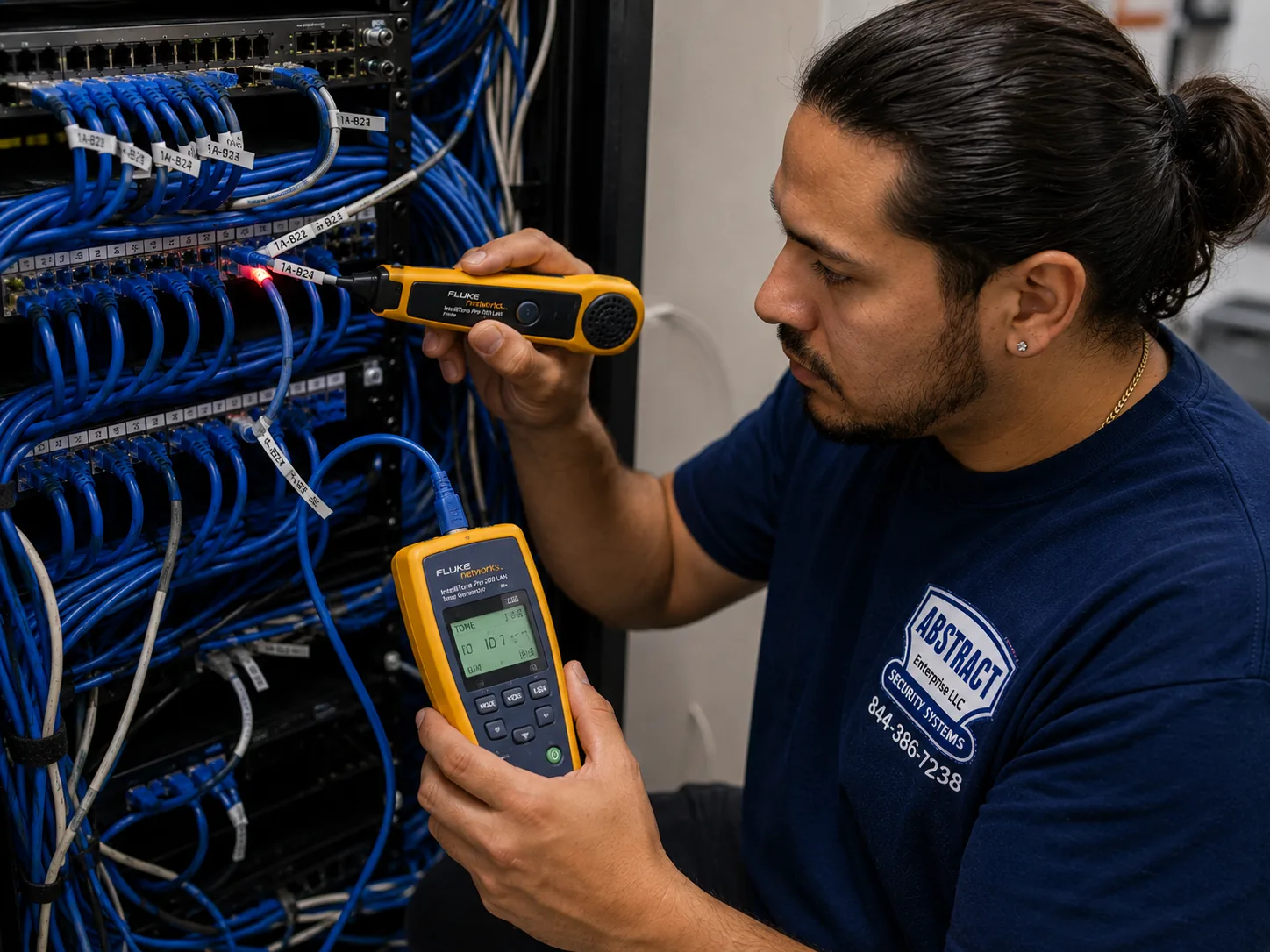
Photo from the AESS job library, not taken on Long Island: a technician tracing an unidentified cable at a patch panel using a tone generator and probe. When a family buys a Long Island house with cameras the previous owners left behind, this is how we find which cable goes to which camera before anything is moved onto the new owners' account.
Equipment
Types of Alarm.com Camera Installation We Install
These are the Alarm.com devices and supporting equipment we fit in Long Island homes and businesses. Which exact models go on your account depends on your provider and your plan, so we confirm availability with them before ordering. Installed pricing for each is on our Long Island price page.
🔔
Video Doorbells
The front door camera on almost every Long Island house, set high enough to see faces and fixed firmly enough to survive a pry bar or a knife, with doorbell power checked first.
📷
Outdoor Wired Cameras
Soffit and wall cameras for side doors, back sliders and driveways, wired through the attic or basement and sealed at every entry point against salt air and rain.
🔦
Battery Spotlight Cameras
The ADC-V731B Battery Spotlight Camera from Alarm.com's March 2026 release, with microSD for continuous video, for garages, sheds, fences and rentals where wire cannot go.
🏡
Indoor Cameras
Cameras facing an entry door, a garage door into the house or a front hall, set with privacy in mind and usually with audio off unless you choose otherwise.
🗄
Commercial SVR
Continuous recording for up to 16 cameras at up to 4MP with built-in PoE, working with third-party ONVIF or VAPIX cameras on a commercial video plan.
🔁
Video Servers for Existing Cameras
The Alarm.com video server that connects analog and existing cameras, for owners who want to keep working cameras from an older system.
⚡
PoE Switches and Battery Backup
Switches that power cameras over their data cable, and battery backup units for the router, switch and recorder so short outages do not take the system down.
🧰
Weather-Rated Boxes and Conduit
Sealed junction boxes, drip loops, stainless fixings and conduit for South Shore exposure, loading docks and runs to outbuildings.
National security brands vs a local Alarm.com installer
People comparing options on Long Island often line Alarm.com up against ADT, Ring and SimpliSafe. The difference is structural. Ring and SimpliSafe each sell their own hardware with their own app, much of it designed for self-install. ADT sells its own monitored systems. Alarm.com is a platform sold only through providers, so the app and the plan come through whoever holds your account; Guardian, for example, advertises an Alarm.com partnership for its New York customers. None of those choices removes the work on the house itself. A doorbell on a Levittown Cape, a soffit camera on a 1970s colonial and a dock camera in a Hauppauge warehouse still need someone on a ladder who knows how to route cable through an attic without touching a slab, seal an entry against salt air and test the run before the soffit is closed. That part is ours, whichever platform you pick.
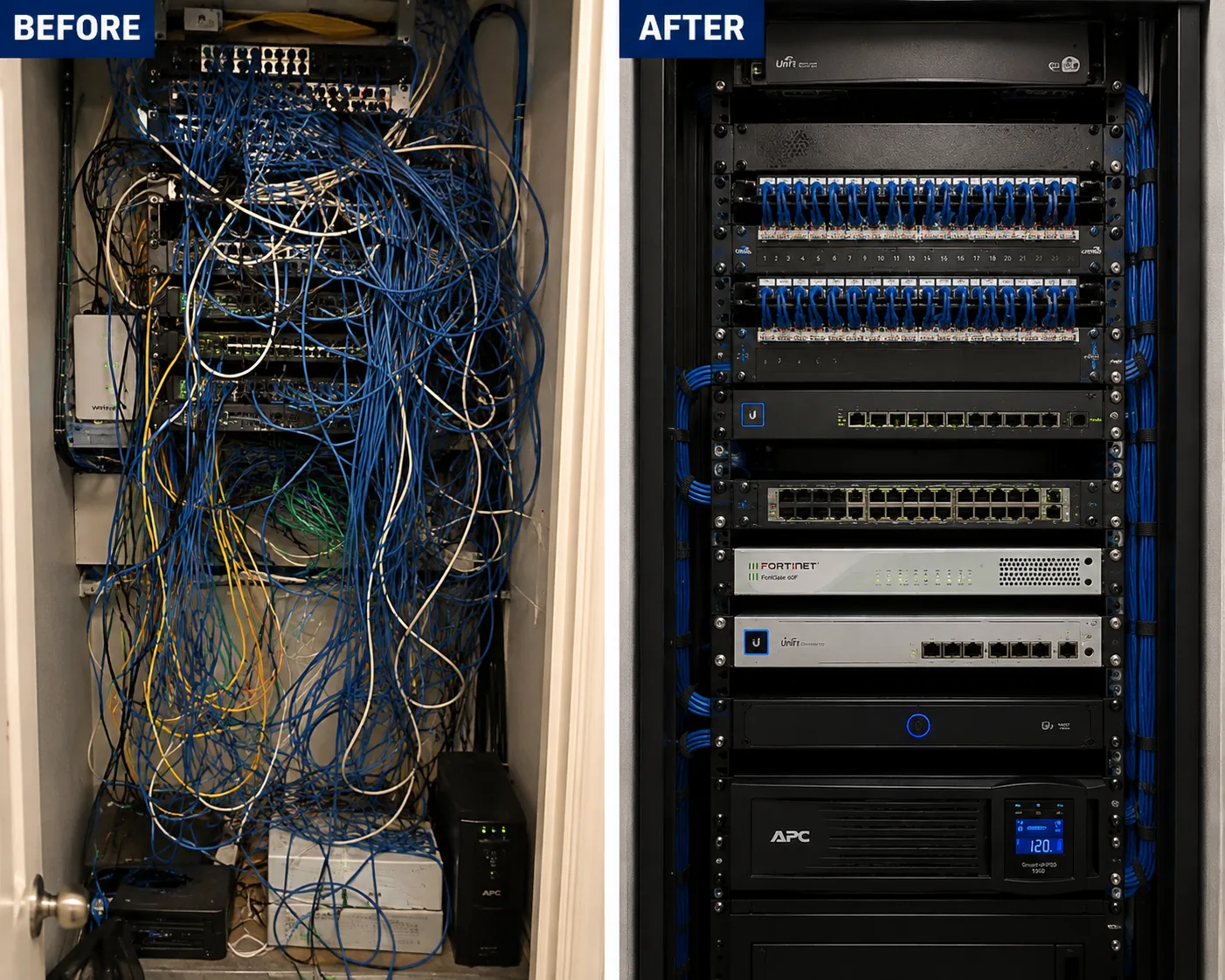
Photo from the AESS job library, not taken on Long Island: before and after views of a network rack, with an unlabelled tangle rebuilt into a dressed, identified rack. Long Island businesses switching an older camera system to Alarm.com often start with a closet like the before picture, and cleaning it up first is what makes the new recorder easy to service.
AI Overview Reality Check
What AI Gets Wrong About Alarm.com Camera Installation in Long Island
Our build tools could not capture Google's AI Overview or the People Also Ask boxes for this topic on Long Island, so we are not going to pretend to quote them. What follows are claims we see repeated in quick online answers about Alarm.com cameras and about this part of New York, set against what the sources and our own field practice say. Marketplaces such as Angi, HomeAdvisor and Fixr publish cost guides and installer lists that feed many of those answers; Angi's Long Island page asks how much security camera installation costs, for instance. Those guides are useful for a rough idea, but they are not a quote for your house or your account.
"You can buy Alarm.com cameras online and plug them in."
This one sends people to the wrong checkout. Alarm.com's own answers page says it does not sell systems directly; its services are sold through authorized professionals who install, monitor and support them. A camera with Alarm.com's name on the box still has to be added to an account with a provider before it streams anything.
The plug-in part is half true. Alarm.com's Video Installation Wizard in the app lets users add video devices to their own accounts, and some providers ship self-install systems pre-configured. For an indoor camera in an apartment, that really can be the whole job.
Where it breaks down on Long Island is outdoors. A soffit camera on a slab ranch needs cable through the attic and a sealed entry, and a garage camera needs a power plan. The app can register the camera; it cannot run the wire.
"Alarm.com cameras record around the clock out of the box."
Quick answers often blur clips and continuous recording. By default, Alarm.com cameras send clips to the cloud when something triggers them. Continuous recording is what the SVR adds; the Surety forum describes around-the-clock recording as its main benefit and says it works alongside cloud video, not instead of it.
The newer battery spotlight camera from the March 2026 release is the other route, recording continuous video to its microSD card. That is local storage on one camera, not a whole-system recorder.
For a family home, clips are usually enough. For a business with a loading dock, they usually are not. We ask what you will want to review after an incident, and plan the recording around that answer.
"Any IP camera will work with Alarm.com."
Not on any plan. Alarm.com's business page does say the commercial SVR works with third-party ONVIF or VAPIX cameras, which is a real advantage for businesses with existing cameras. But the Surety forum notes that third-party ONVIF and Axis support needs a commercial video plan, even when the recorder sits on a residential account.
So a homeowner who buys a cheap camera from a store shelf and expects it to appear in the Alarm.com app may be disappointed. It might, with the right recorder and plan; it might not at all.
Before anyone buys cameras for an Alarm.com system, we check the plan with the provider and the camera's protocol support. It takes a phone call and saves a return.
"Alarm permits work the same way everywhere on Long Island."
They do not. Suffolk's county code requires a permit within the Suffolk County Police District, at fifty dollars for a home and one hundred for a business, with two free false alarms a year. Nassau requires NCPD registration at one hundred for a home and two hundred for a business every two years, with a 90-day grace period for new systems.
Nassau also puts unregistered systems in a "No Police Response" status, while Suffolk's mail-in process currently stands in for an online portal that is down. Villages with their own police departments may have their own rules again.
An answer that gives one Long Island permit rule is wrong for at least one county. We ask for the address and tell you which rules apply before the system goes live.
"New York requires two-party consent to record audio."
Some installer pages, including Long Island ones, say New York is a two-party consent state. The Digital Media Law Project's guide says the opposite: New York's eavesdropping law is a one-party consent rule.
That does not make audio a free-for-all. One-party consent means someone in the conversation has to consent, so a camera recording strangers on the sidewalk is still a problem, and Penal Law section 250.45 makes recording inside bathrooms, bedrooms and similar spaces without consent a felony.
Our practice is simple: audio on the doorbell, where you are part of the conversation, and audio off on outdoor and business cameras unless the owner has a specific, lawful reason.
"The Long Island hub is one place."
Searches for anything near "the hub" on Long Island run into a naming muddle. Long Island Wave warns that two places are both called the Ronkonkoma Hub: Station Yards on the north side of the tracks, which is being built, and the 48 acres to the south, where the Midway Crossing plan is gone and Suffolk issued a new request for proposals on July 3. Then there is the Nassau Hub, the 72-acre site around the Coliseum in Uniondale.
The Nassau Hub was rezoned in June 2025 after Las Vegas Sands dropped its casino plan, and a Garden City lawsuit over the project was dismissed as premature. Its future is still open.
For camera work, the difference is practical: a Station Yards renter, a Uniondale homeowner south of the Hempstead Turnpike and a Hauppauge business are three different jobs under three different rules. We work from the street address, not the nickname.
"Camera installation on Long Island costs about the same per camera everywhere."
Published Long Island prices vary enormously. Competitor pages we read range from a modest labor-only rate per camera, discounted for four or more, to more than three times that for wired, high-end work, and national cost guides add their own ranges on top.
The real drivers are the house and the plan. A doorbell on a ranch with an easy attic is a short job; a camera on a detached garage with no conduit, or a 16-camera recorder in a flex building, is not. The Alarm.com service plan is a separate monthly cost set by your provider.
Our own pricing follows a published list, with Nassau and Suffolk rates set by fixed multipliers, so you can see what your job will cost before anyone climbs a ladder.
Not Sure Which Cameras Your Account Can Take? Talk to a Technician
Send the name of your Alarm.com provider, a few photos of the outside of the house and the town you live in, and a technician will tell you what your plan supports, where the cable can go and which lines of the Long Island price list apply. Call (800) 486-0943, message us on WhatsApp, or use the quick form.
Every Long Island Alarm.com camera job follows the same eight steps, whether it is a single doorbell on a Cape in Uniondale or a recorder and twelve cameras in a Hauppauge flex unit. The order matters, because the account and the network have to be right before the hardware means anything.
1. Check the Alarm.com account
We confirm which provider holds the account, that the video add-on is on the plan, and whether the alarm side is registered with the Nassau or Suffolk police, before anything is ordered.
2. Map the property and the network
We find the router, the attic or ceiling route, outlets and detached structures, and test upload speed where the cameras will report.
3. Agree views and privacy
We mark each camera's view with you, mask out neighbors' windows and yards, and decide where audio is on or off under New York's one-party consent rule.
4. Run and test the cable
Cable goes through the attic, basement, ceiling or conduit, is labelled at both ends and tested before a single camera is mounted.
5. Mount the cameras
Doorbell, soffit, wall and ceiling cameras are fixed with weather-rated boxes and sealed entries, at heights that see faces and resist tampering.
6. Set up recording
With your provider, cameras go onto the account, with cloud clips, an SVR for continuous recording or microSD on battery cameras, as booked.
7. Protect against outages
Where booked, the router, switch and recorder go on battery backup, and we confirm each camera reconnects after a power cut.
8. Test in the app and hand over
Every camera is checked live and in playback on your phone, alerts and rules are walked through, and you get a labelled map of every camera and cable.
Coverage Area
Alarm.com Camera Installation Near Long Island's Landmarks
Long Island is too large to describe by its edges, so we plan visits by the places people already know. These are the landmarks that come up most when we talk through a job.
Roosevelt Field
The largest mall on Long Island, at 630 Old Country Road in East Garden City, built on the airfield Lindbergh flew from in 1927 and opened in 1956, per Wikipedia.
Mitchel Air Base and Flight Line
A 108-acre National Register district since 2018 around Charles Lindbergh Boulevard, near the Cradle of Aviation Museum, Hofstra, Nassau Community College and the Coliseum.
Station Yards, Ronkonkoma
The 53-acre development around the Ronkonkoma LIRR station, from Ronkonkoma Avenue east to Mill Road, planned for up to 1,450 apartments.
Long Island Innovation Park at Hauppauge
About 1,350 businesses in eleven square miles, described by Certilman Balin as the largest industrial park in the Northeast by companies and employees.
Stony Brook University
213 buildings on 1,454 acres in the Town of Brookhaven, near the Mill Pond dam that failed in the August 2024 flash flood.
Levittown
The 17,447 slab houses built from 1947 to 1951 that set the pattern for so much of Nassau's postwar housing, and for how we route camera cable through it.
We do not print a single Long Island number for Alarm.com cameras on this page, because the right number depends on the county, the house and the plan, and we will not publish a figure that is not on our verified list. What we can tell you is exactly how the price is built. Every Long Island job is priced from the same list structure we use across the region, with Nassau addresses at 1.15 times our Brooklyn base and Suffolk addresses at 1.20 times. The current line-by-line figures, and a calculator to add up your own system, are on our Long Island Alarm.com camera installation prices page, with county detail on the Nassau and Suffolk pages.
What moves the price
Why it matters on Long Island
How we handle it
County
Nassau and Suffolk carry different area multipliers
Set by the street address, shown on the county price pages
Number and type of cameras
A doorbell and two soffit cameras is a different job from a 16-camera recorder
Priced per device from the list
Cable route
Slab ranches route through the attic; colonials through the basement; flex buildings through ceilings and conduit
Each run priced by length and difficulty from the list
Detached garages and outbuildings
Common in Uniondale and on North Shore estates
A separate run, or a battery camera, quoted as its own line
Recording
Cloud clips, an SVR, or microSD on battery cameras
Recorder and storage listed separately
Battery backup and PoE switching
Storm outages and larger PoE systems
Listed as add-ons, only when you want them
Existing cameras
Older systems can sometimes connect through a video server
Tested on site; you pay to keep only what is worth keeping
Service plan
Set by the Alarm.com provider that holds your account
Not part of our installation price
How to read the list for a Long Island house
Take a 1950s ranch in Nassau with a doorbell camera at the front, outdoor cameras over the side door and the driveway, and a detached garage. On the price page you would add the doorbell, two outdoor cameras with their attic runs, and either a cable run to the garage or a battery camera for it, all at the Nassau rate. Move the same plan to a 1970s colonial in Suffolk and the runs usually come up from the basement instead of down from the attic, the rate becomes the Suffolk rate, and the garage may be attached and need no separate run at all. Nothing is added on the day unless you ask for it, and if what we find on site differs from what your photos showed, we stop and show you before doing anything that changes the price.
Full terms — including 50% deposit, one-year parts-only warranty on AESS-supplied products, and the late-fee schedule — are set out in the service agreement.
Want the Numbers for Your House? Get the Long Island Price List
Open the Long Island price page to build your own system line by line, or send us photos and the town and we will add it up for you. Call (800) 486-0943 to speak to a technician.
Three common Long Island setups, built only from lines on our price list. Each is priced on the Long Island price page at the Nassau or Suffolk rate for your address; there is no package premium and no hidden extra.
Starter: Front Door and Driveway
An Alarm.com video doorbell at the front door and one outdoor camera covering the driveway, wired through the attic of a ranch or Cape, added to your existing account and tested in the app. Suits the Levitt-era and postwar houses where the car and the porch are the two things worth watching.
Standard: Every Door and the Garage
A doorbell plus outdoor cameras over the side door, the back slider and the driveway, a camera or battery unit for the detached garage, and battery backup on the router. The usual plan for a Suffolk colonial or a Uniondale Cape with a garage set back from the house.
Premium: Continuous Recording
An Alarm.com SVR with PoE cameras around the property, recording around the clock alongside cloud clips, with the recorder and switch on battery backup in a dressed, labelled closet. For estates with outbuildings, and for small businesses in Hauppauge, along Route 110 or on Old Country Road.
Bring your own equipment
If you already bought Alarm.com cameras through your provider, or you have existing cameras you want connected through a video server, we install them at labor-only prices from the same list. The cameras have to be supported on your account and your plan, which we confirm with the provider before the visit, and they have to be in working order, which we test before mounting. If a camera you own will not work on your plan, we tell you before anything goes on the wall, not after.
Complete Services
Every Alarm.com Camera Installation Service in Long Island
Our home page, with every service we offer across the region. AESS home
Get a Quote
Send photos, the town and your provider, and we will match the job to the list. Request a free quote
FAQ
Long Island Alarm.com Camera Installation FAQ
Can I add an Alarm.com camera to my account myself, without an installer?
+
Often, yes. Alarm.com's Video Installation Wizard in the app lets users add video devices to their own accounts, and some providers ship self-install systems already configured. That works well for indoor cameras and battery units. Outdoor wired cameras on a Long Island house still need cable through an attic or basement and sealed entries, which is where an installer earns the visit.
How much does Alarm.com camera installation cost on Long Island?
+
It depends on the county, the number of cameras, the cable routes and the recording you choose. Our Long Island pricing uses 1.15 times our Brooklyn base for Nassau and 1.20 times for Suffolk, and every line is published on our Long Island Alarm.com camera price page. The monthly service plan is separate and set by your Alarm.com provider.
Are cameras actually worth it for a Nassau County homeowner?
+
The local news suggests they are useful. A Roslyn Heights homeowner spotted would-be burglars on his surveillance system in May 2026 and called police, and cameras in a Jericho break-in showed how quickly a crew reached the second floor. Nassau burglaries rose 5 percent in early 2026. Cameras tied to door sensors show you what tripped an alert, which is the practical benefit.
Does it cost anything to list my cameras with the Suffolk police registry, and can they then watch my feed?
+
Registration with the Suffolk police SHIELD Camera Registry is free, and the department says it does not get access to registered cameras. Detectives may ask you to check your video for a particular date and time, and handing it over is at your convenience. A separate Emergency Remote Camera Access option exists, and partners can opt in or out at any time.
What happens in Suffolk once our alarm has had two false alarms in a year?
+
According to GreaterLongIsland's report on the county law, registered owners get two free false alarms a year, and after that each residential false alarm costs one hundred dollars. Cameras aimed at your alarmed doors help here, because a clip arriving with the alert lets you see whether anyone is actually there before the situation escalates.
What if one of our cameras ends up looking into the house next door?
+
We move it or mask it. New York Civil Rights Law section 52-a bars video surveillance where people have a reasonable expectation of privacy, and installer guidance recommends privacy masking on exterior cameras so a neighbor's backyard or window is blocked out of the image. On close-set Long Island blocks we plan masks before the camera goes live.
Can our cameras, alarm sensors and door locks all run in the same Alarm.com app?
+
That is the main reason people choose Alarm.com. Cameras, alarm sensors and other devices on the same account appear in one app, and a sensor trip can trigger a clip from the matching camera. Which devices your account supports depends on your provider and plan, so we confirm that before adding anything.
Do you work out on the North Fork and the South Fork, or only near the city?
+
We work across both counties, from the Queens line to the East End. Suffolk addresses are priced at the Suffolk rate wherever they are. For seasonal houses further east, tell us when the house is occupied and whether someone can let us in, and we will plan the visit around it.
Will my town or village need a building permit before cameras go on the house?
+
Long Island has no single building department, so it depends on where you live. Nassau alone has two cities, three towns and 64 villages, and Suffolk has ten towns plus its own villages. We check the rules for your address rather than promising that no permit is needed anywhere on the island.
We just had a new system installed in Nassau. What if it sends a false alarm in the first few weeks?
+
Nassau gives new systems some room. Kirschenbaum Esq. describes an exemption for the 90 days after installation, covering up to three false alarm notifications, as long as an alarm permit has been issued. That is another reason to register before or right after the system goes live, rather than waiting.
Is a battery camera a sensible choice for a shed or a fence line with no power?
+
Usually, yes. Alarm.com's ADC-V731B Battery Spotlight Camera, announced in March 2026, can record continuous video to a microSD card, so it keeps working where no cable can reach. Battery cameras need recharging or fresh batteries, and they depend on a good wireless signal back to the house, which we check where you want to mount it.
Can the monitoring station look at our camera video before it calls for police?
+
Alarm.com supports video verification, which links camera footage to a triggered alarm so the scene can be checked before dispatch, as Connextivity describes for commercial systems. Whether your monitoring station uses it, and how, depends on your provider and plan, so ask them. We make sure the cameras actually see the doors the alarm protects.
Get In Touch
Request a Free Quote
Tell us the town, the building type, how many cameras you picture and who holds your Alarm.com account if you know. A few photos of the outside of the house make the quote exact. Prefer to talk? Call (800) 486-0943.
✅
Request Sent!
We'll call about your Long Island Alarm.com cameras the same business day.
More Alarm.com Camera Installation near Long Island hub
Book Your Long Island Alarm.com Camera Installation
From a Levittown slab ranch to a Suffolk colonial with a basement, a Station Yards apartment or a flex unit in Hauppauge, the job starts the same way: the account checked, the building read, and an honest match to the Long Island price list. Call (800) 486-0943, message us on WhatsApp, or send the quote form, and we will tell you what your cameras need before anyone climbs a ladder.