What are you looking for?
About Us Contact Us Careers Get a Free Quote (800) 486-0943
Pick a service
✅ Got Your Own System?
🎬 Home TheatreQuote 🎶 AV SoundQuote 🔑 Access ControlQuote
Now pick your area
Pick your area
Long Island
Hudson Valley
Services available
Pricing & Tools
Pick a service for pricing
🚪 Intercom Pricing 🔔 Buzzer Repair Pricing
Calculators
📹 Camera System Calculator 🚨 Alarm Calculator ⚡ Cabling Quote Builder ✅ Got Your Own System?
Select your area
Driveway camera on a Wakefield house gone dark, a gate camera that never caught a face, or video from White Plains Road that the 47th Precinct wants before the recorder writes over it? Call the Bronx line: (646) 490-0629
Home › Security Camera Installation Bronx › Wakefield
Brick Colonials · Detached Victorians and Bungalows · Gated Driveways and Back Garages · Shops Under the El on White Plains Road · The End of the 2 Line · Licensed Low-Voltage

Security Camera
Installation in
Wakefield

The Gate · The Car · The Side Door · The Shop Door Under the Tracks

Security camera installation in Wakefield is mostly a house job. The northernmost neighborhood in the Bronx, running from East 222nd Street up to the Westchester line and from the Bronx River and the Metro-North tracks east across White Plains Road, is built mainly of one-, two- and three-family homes: semi-detached brick colonials, detached Victorians, bungalows and frame houses, most of them standing since before 1940. Many sit behind a front fence and a gate, with a driveway along one side that ends at a garage and a back yard. On White Plains Road the elevated 2 and 5 trains run overhead to the last stop at 241st Street, with beauty supply shops, salons, groceries and food stores underneath. A camera plan here has to show a face at the gate before the latch moves, keep the car in the driveway on record all night, watch the side door the family actually uses, and give shopkeepers a clear picture through the shadow of the tracks. Every camera, mount, cable run and setting is written on a quote before anything is ordered.

Reviewed and updated November 6, 2026 by Abstract Enterprises Security Systems, NYS license #12000287431 · Sources: Bronx Community Board 12 neighborhood profile; NYC Small Business Services Wakefield neighborhood profile; Wikipedia entries for Wakefield, the Wakefield–241st Street and Nereid Avenue stations, White Plains Road and Misericordia Hospital; Kiddle and CityNeighborhoods NYC on Wakefield history; Homes.com Wakefield guide and listings; NeighborhoodScout building-age data; CBS New York on the East 224th Street e-bike theft; Norwood News on the 2026 Bronx car-theft case and 2026 incidents on White Plains Road; News 12 Bronx on a Wakefield bodega burglary and an East 223rd Street shooting; ABC7 on a 2021 White Plains Road shooting; New York YIMBY and Bronx Times on new White Plains Road buildings; Praxis Housing; NYC participatory budgeting; Brick Underground; New York Penal Law §250.45; Civil Rights Law §52-a; General Business Law Article 6-D · Dispatched from 460 E Fordham Rd

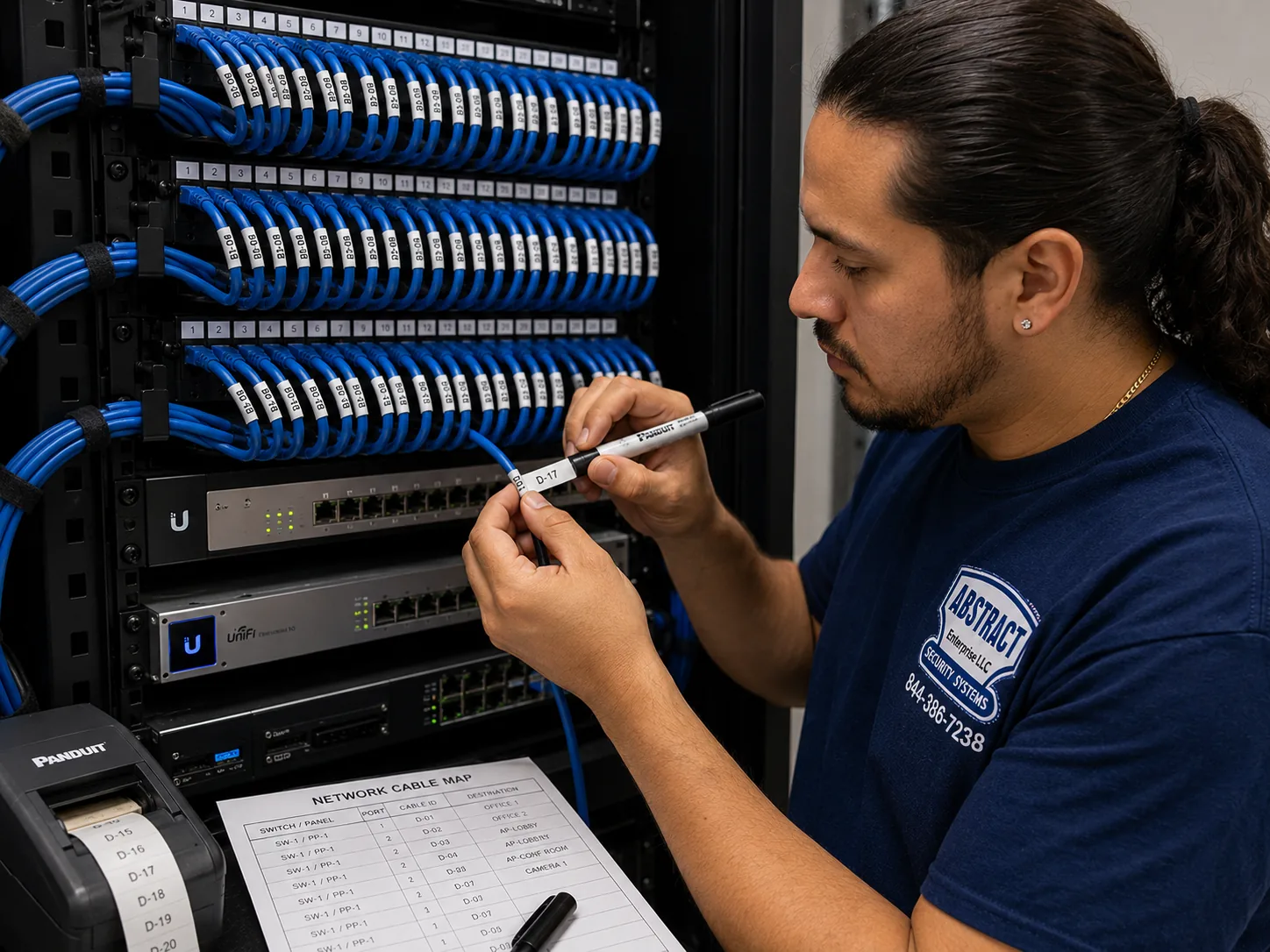
Wakefield, Bronx security camera installation job-library photo: a technician printing cable labels at a patch panel beside a printed port map
Photo from our job library, not taken in Wakefield: a technician printing cable labels at a patch panel beside a printed port map. A Wakefield house with a gate, a long driveway and a back garage ends up with runs that look alike in the basement, so each one is named for what it sees: "front gate, toward the street," "driveway, toward the garage," "side door, from above."
Wakefield Camera Quote
Tell us the house, building or shop, who lives or works there, and which gate, driveway, door, yard or counter you want covered

✅
Request Sent!
We'll call you about your Wakefield cameras the same business day.
25+
Years Experience
✓
Same-Day Estimates
100%
Licensed & Insured
4.6★
390+ Google Reviews

Owner-operated since 2002 · Thousands of jobs completed · Booked within 2 hours

Security camera installation in Wakefield usually comes down to one of four jobs: a wired house system of four to eight cameras that covers the front gate, the driveway and the cars in it, the front and side doors, the back yard and the garage; a shared system for a two- or three-family house where the owner sees the whole lot and each tenant household sees its own entrance; an entry, mailbox, stair and package system for one of the walk-ups, co-ops or newer buildings along White Plains Road; or a door, counter, aisle and back-room system for a shop under the elevated tracks. Each job is priced on our Bronx rate after we see photos or walk the property, and the written quote puts every camera, mount, cable run, wall opening, recorder, drive and setup task on its own line. A camera over a brick colonial's front steps with an open basement right below is quick work; a camera on the back of a garage at the far end of a long concrete driveway is a bigger run, and the quote says so plainly. The one fixed price we publish, a setup-only visit at $225 for the first hour, is in the pricing section below. Estimates are free, requests are booked within 2 hours, and the work is done under NYS license #12000287431 with insurance in place. Call (646) 490-0629 or use the form.

  • Gate, driveway, door, yard and garage cameras aimed at your lot, with masks over neighbors' windows and yards
  • In two- and three-family houses, each household gets its own login and its own entrance view
  • Cable runs through basements, attics and conduit wherever possible, not stapled across brick or siding
The Neighborhood

Why Wakefield Properties Need Security Camera Installation Planned Around the Lot

Wakefield started out as Westchester County farmland and only became part of New York City in 1895. Before that, the old village of Washingtonville was folded into Wakefield when Wakefield became a village on August 8, 1889. By the 1880s, developers were already cutting the farms into house lots for commuters, and the early subdivisions, marketed as "Wakefield Village," were filled with modest wood-frame cottages. The subway arrived in stages: the White Plains Road line reached East 219th Street in March 1917, and the Wakefield–241st Street station opened on December 13, 1920, making this the end of the line it still is today. Sources disagree on where the name comes from; the city's small-business profile ties it to the Virginia plantation where George Washington was born, while another neighborhood history points to Wakefield in Yorkshire.

What that history left behind is a neighborhood of individual houses on individual lots. NeighborhoodScout counts 68.9 percent of Wakefield's residential buildings as built in 1939 or earlier. A local quoted in the Homes.com neighborhood guide sums it up as mostly single-family, two-family and some three-family homes, with very few high buildings. The house styles on the listings are the ones you see walking the side streets off White Plains Road: semi-detached brick colonials, detached Victorians, bungalows, and frame houses that may be listed as two-families but are lived in as one. Many have a front fence with a gate, a driveway along the side, a garage at the back and a yard behind the house. One listing on Wickham Avenue describes a two-family with a detached garage and a driveway that holds four to five cars.

The people who live here have changed over the decades. Irish and Italian families once made up much of Wakefield; from the 1980s, families from Jamaica, Guyana and elsewhere in the Caribbean moved in, and the city's profile says almost 40 percent of residents were born abroad. NeighborhoodScout reports 22 percent of residents with Jamaican ancestry and 15.1 percent with Dominican ancestry. In practice that means many multigenerational households, many two-family houses with relatives or tenants on the other floor, and many homeowners who travel to see family abroad and want to check the house from far away.

For cameras, that combination is the whole story. There is no lobby desk watching a Wakefield house. The things people actually lose here are on the lot: a bike behind a gate, a car in the driveway, a package by the side door, tools in the garage. And on the commercial side, White Plains Road under the el is a long row of small, owner-run shops where a burglary can be over in minutes. The recent cases below are the reason most Wakefield camera calls start the way they do.

Wakefield facts that shape a camera plan

  • Gated driveways get opened. CBS New York reported that near East 224th Street and Carpenter Avenue, three people cut through a chain on a gated driveway, got onto the property and took an e-bike worth about $1,800. Police released surveillance video of the suspects.
  • Cars are the target here more than anywhere else in that case. In the 2026 case where the Bronx District Attorney and the Police Commissioner announced charges against 16 people for 252 thefts of cars, tires, rims and catalytic converters, Norwood News reported that 37 of the thefts took place in the 47th Precinct, which covers Wakefield, the most of any precinct in the case.
  • A shop burglary can take under three minutes. News 12 reported about $7,000 in cash and merchandise taken from a Wakefield bodega. When picking the lock failed, one suspect shattered the glass door, and the owner said the whole thing lasted less than three minutes.
  • Home cameras record what happens on residential blocks. News 12 reported a shooting near East 223rd Street, between White Plains Road and Barnes Avenue, where surveillance video captured the sound of the gunshots.
  • White Plains Road sees incidents under the tracks. Norwood News reported the robbery and assault of a 68-year-old woman in front of 4600 White Plains Road on June 9, 2026, with the NYPD releasing photos of the people it was looking for, and a stabbing on May 1, 2026 at White Plains Road and East 233rd Street, under the elevated station.
  • Residents have asked for more cameras. A participatory budgeting proposal for Williamsbridge, Wakefield and Edenwald put it in one line: "We need more video cameras on the train station."
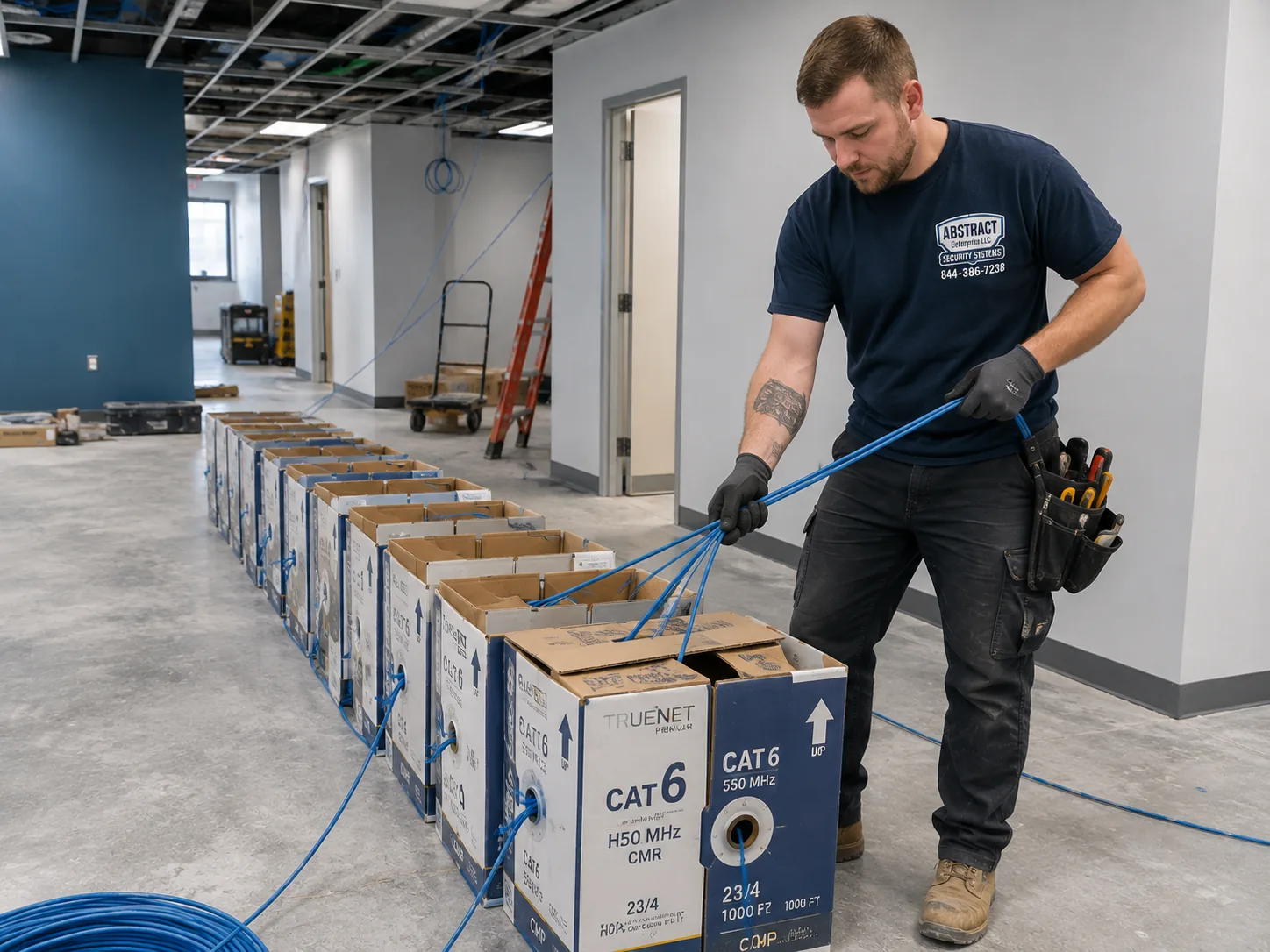
Wakefield, Bronx security camera installation job-library photo: boxes of cable staged together for a multi-drop pull on a working premises
Photo from our job library, not taken in Wakefield: boxes of cable staged together for a multi-drop pull on a working premises. A Wakefield two-family with a gate camera, two driveway cameras, a garage camera and a yard camera needs several long runs from one basement, and staging them before the first hole is drilled keeps a house job to a single visit where the layout allows.

Driveway Camera Dark, Gate View Blurry, or a Detective Asking for Tuesday Night? Quick Camera Help in Wakefield

A lot of Wakefield calls are not for a new system. The house already has cameras, often put up by a relative or a past owner, and one of them has stopped showing a picture, the driveway view went black-and-white and blurry, the phone app stopped connecting, or an officer from the 47th Precinct on Laconia Avenue asked for video of a certain night and nobody knows the recorder's password. Recorders overwrite their oldest video on their own schedule, so the clock is running from the moment something happens. Call with the make of the recorder if you know it and the date and time you need, and we will tell you over the phone whether that video is probably still on the drive and what to do so it is not lost while you wait. A setup-only visit on our Bronx rate is $225 for the first hour. Call (646) 490-0629.

Gates and Fences

After the Chain Was Cut on East 224th Street: Cameras for Wakefield Gates, Fences and the Things Behind Them

The e-bike case near East 224th Street and Carpenter Avenue is the clearest picture of how property leaves a Wakefield lot. Nobody broke into the house. Three people walked up to a gated driveway, cut the chain that held the gate, walked in, and walked out with a bike. Police had surveillance video to release afterward. The question for every owner with a fence and a gate is what their own cameras would have shown in the same minutes.

The approach matters more than the theft

By the time a chain is cut, faces are often turned down toward the work and hidden under hoods. The moments that give a usable face are the seconds before: walking up the sidewalk, stopping at the gate, looking around to see if anyone is watching. A camera that sees only the driveway behind the gate records backs and bikes. The camera that helps is one mounted on the front corner of the house, at a height a person cannot reach but low enough to see under a hood brim, aimed back toward the gate and the sidewalk just outside it.

Two views of one gate

On most Wakefield lots we pair two cameras on the gate. The first is a wide view from the house that takes in the gate, the fence line on each side and a short stretch of sidewalk, so you see who came, from which direction, and whether a car waited at the curb. The second is a tighter view of the gate itself, aimed so a person standing at the latch fills a good share of the frame. The wide view tells the story; the tight view gives the face and the tools in their hands. On a narrow lot a single good camera can do both jobs, and we will say so on the visit rather than sell a second one.

Light at the gate

Gates are often set back from the streetlight and shaded by a hedge or a tree. Infrared night mode will show shapes in the dark, but faces in color need light. A motion-sensing light over the driveway, or a dusk-to-dawn fixture at the gate post, does two things at once: it gives the camera something to record, and it tells anyone at the gate that the lot is not a dark corner. Many cameras now carry their own small white light that comes on when they detect a person; on a deep driveway it helps, though a separate fixture usually lights a wider area.

What sits behind the gate

E-bikes, scooters, grills, tools and cars are what people keep behind a Wakefield gate. A camera can record someone taking them; it cannot stop a person with bolt cutters. Pair the camera plan with simple changes: a heavier chain or a locking gate latch, a ground anchor for the bike, or bringing the bike into the garage or the house at night. When the bike lives in the yard, we aim a camera directly at where it is kept, so the clip shows the moment it leaves, not just someone walking down the driveway.

Alerts that fire at the gate, not the sidewalk

Most of the people who pass a Wakefield gate are neighbors, commuters walking to White Plains Road and kids heading to school. A camera that buzzes for each of them gets ignored within a week. We draw the alert zone on the inside of the gate and along the driveway, or set a line-crossing rule across the gate opening, so the phone reacts when someone actually comes through and stays quiet for the sidewalk traffic. The camera still records the sidewalk in full; it simply does not wake you for it.

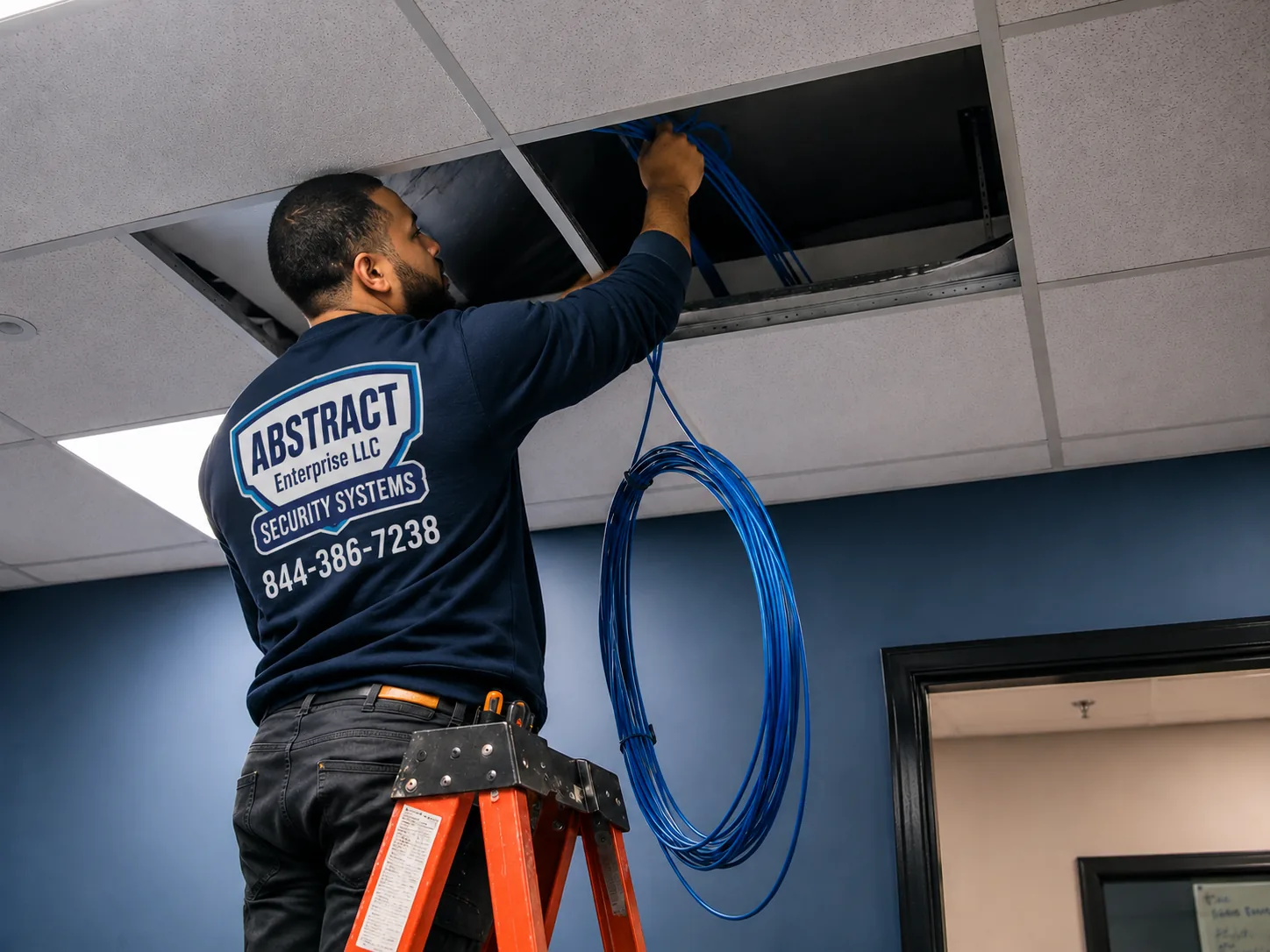
Wakefield, Bronx security camera installation job-library photo: a technician feeding cable through a ceiling in an occupied commercial space
Photo from our job library, not taken in Wakefield: a technician feeding cable through a ceiling in an occupied commercial space. On a Wakefield Victorian or colonial, the same technique carries cable from the attic or the porch ceiling out to the front corner of the house, where the camera that watches the gate and sidewalk needs to sit, without a wire running down the face of the brick or siding.
The Car

The Car in the Driveway: What the 2026 Theft Case Means for a Wakefield Camera Plan

When prosecutors laid out the 2026 Bronx car-theft case, the 47th Precinct, the north Bronx command that covers Wakefield along with Woodlawn and Williamsbridge, came out as the most targeted precinct, with 37 of the 252 thefts. The thefts in that case included whole cars, tires, rims and catalytic converters, and prosecutors said many of the crimes across the Bronx were caught on surveillance video. For a Wakefield homeowner, that is a strong reason to treat the car as one of the main things the camera system is for, not an afterthought.

Where Wakefield cars actually sit

Cars here sit in three kinds of places: in a side driveway between houses, sometimes with two or three cars parked nose to tail; on a parking pad or in a garage at the back of the lot; and at the curb in front of the house. Each needs a different view. A driveway is a corridor, best watched from one end looking down its length. A rear parking pad or garage apron is a small square, best watched from the back corner of the house. The curb is a strip along the street, best watched from the front corner of the house looking along the block.

Seeing the work, not just the car

A view that shows the roof of a car from high above tells you a car is there. It does not show someone working on a wheel, under the body or at a door. Car cameras on a Wakefield driveway are usually mounted lower than people expect, under the first-floor eave or on the garage wall at about nine or ten feet, angled so the camera looks along the side of the car rather than down onto it. That shows hands at the wheel and a person crouched at the side, and it gives a better chance of a face when they stand up.

Plates and the car that waits

Thieves who take parts usually arrive by car and leave the same way. A camera that reads plates needs a narrow view, a good shutter setting for moving vehicles and a fixed point the car has to pass, which on a house lot usually means the mouth of the driveway rather than the street at large. We tell owners honestly when the angle from their house will not read a plate reliably, and suggest the view that will at least show the make, color and direction of the car instead.

Recording all night

For driveway and car cameras we set the recorder to record continuously, with motion events marked on the timeline, rather than recording only when the camera thinks something moved. A person crouched still beside a car may not trigger a motion rule, and continuous recording means nothing is missing between events. A modest drive in the recorder holds weeks of video from a handful of cameras at good quality; we size it on the quote so you know how far back you can look.

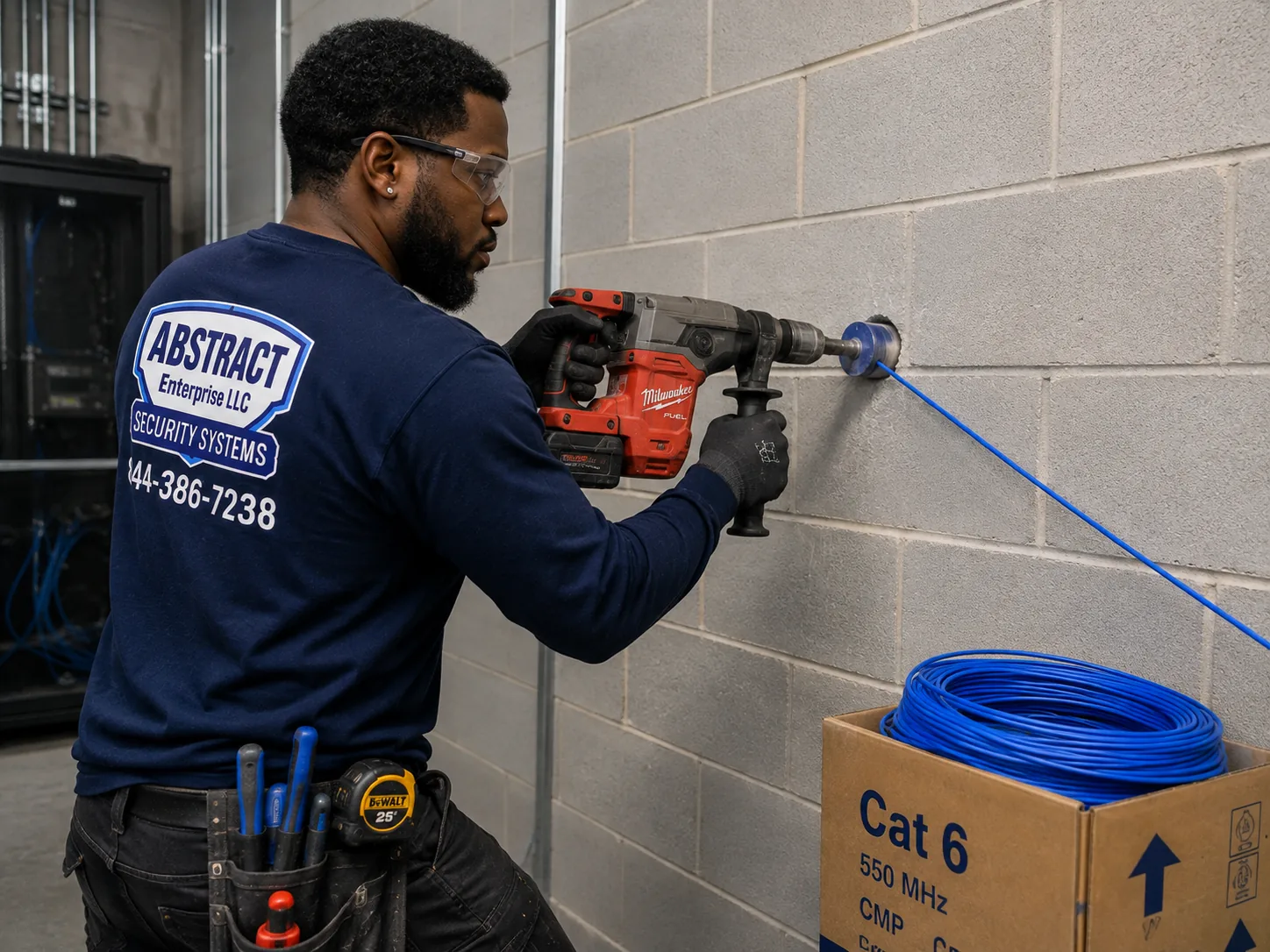
Wakefield, Bronx security camera installation job-library photo: a technician core drilling a block wall to carry cable through to a network room
Photo from our job library, not taken in Wakefield: a technician core drilling a block wall to carry cable through to a network room. Many Wakefield garages at the back of the lot are block or brick, and a clean, sleeved hole like this is how a cable from the house reaches a camera inside the garage or on its wall facing the driveway and the parked cars.
What We Install

Security Camera Installation Services in Wakefield

These are the views Wakefield homeowners, landlords, building owners and shopkeepers ask us to cover most often, each set up for the way lots and storefronts are laid out here.

Front Gates and Fence Lines

A wide view of the gate and sidewalk from the house, and a tighter view at the latch where faces are clearest.

Side Driveways

One camera looking down the full length of the driveway, low enough to see along the sides of parked cars.

Garages at the Back

An outside view of the garage door and apron, and an inside view where tools, bikes or a car are kept.

Front and Side Doors

Wired video doorbells and door cameras, including the side door many Wakefield families use every day.

Porches on Victorians

Coverage for long porches, including wraparound porches that face two sides of a corner lot.

Back Yards

Views of your yard, back door and basement stairs, masked over neighbors' yards and windows.

Two- and Three-Family Houses

One recorder with separate logins, so each household sees its own entrance and the owner sees the lot.

Walk-Ups and Co-ops

Entry door, vestibule, mailboxes, stairs, cellar and roof door for older apartment buildings.

Shops Under the El

Door, counter, aisle and back-room cameras for White Plains Road storefronts in the shade of the tracks.

Takeovers and Repairs

Getting an inherited or relative-installed system back online, replacing dead cameras, or starting over.

Building Specialists

Security Camera Installation for Wakefield's Architecture

Semi-Detached Brick Colonials

Paired houses sharing one wall, each with its own front steps, side driveway and yard.

Detached Victorians

Older frame houses with porches, deep eaves and attics, often on wider lots.

Bungalows and Cottages

One-and-a-half-story houses, some descended from the early "Wakefield Village" cottages.

Frame Two-Families

Wood-frame houses with two units, some used as one family today and rented later.

Older Walk-Ups and Co-ops

Apartment buildings such as the post-war walk-up co-ops on Harper Avenue and East 230th Street.

Mixed-Use Corridor Buildings

A store at street level with apartments above, like the one-store, four-apartment buildings on White Plains Road.

Brick colonials: one shared wall, one private side

A semi-detached colonial is half of a pair. One side wall belongs to both houses, and the other side opens onto your driveway. That makes camera placement fairly simple: the private side carries the driveway camera and the side door camera, and the front corner on the private side carries the gate and sidewalk view. We avoid mounting on the shared wall and aim the front cameras so they cover your steps and gate without looking straight at your neighbor's door. Brick takes a solid masonry anchor; we drill into the brick itself rather than the mortar joints where the mount allows, and seal every hole. Cable usually reaches the front through the basement, up inside the front wall or through the attic, and out at the eave.

Victorians: porches, trim and attic paths

Wakefield's detached Victorians are frame houses, and many have a front porch with its own roof, sometimes wrapping around a corner. The porch ceiling is a good camera spot: protected from rain, high enough to stay out of reach, and easy to feed from inside. Decorative wood trim, brackets and turned posts are not good mounting surfaces; we mount on the flat siding or a solid porch beam instead, on a small block so the base sits flat. Old frame walls often have open bays that run from basement to attic, and the attic usually gives a clear route to every eave, which keeps most of the cable out of sight.

Bungalows and cottages: low roofs and short runs

Bungalows have less height to work with. Eaves can be low enough that a camera mounted there is within reach of someone standing on a step or a trash can. On these houses we use vandal-resistant dome housings at the eave where reach is a concern, or mount on the gable end where the wall is taller. The runs are short, so a small bungalow system is often one of the quicker installs in the neighborhood.

Frame two-families: siding and two front doors

Many frame two-families wear aluminum or vinyl siding over the original wood. Mounts go on a block cut to the siding profile, with a sealed hole through to solid wood behind, so the siding is not dented or cracked. These houses often have two front doors side by side, or one street door with a hall and two apartment doors inside, and each entrance gets its own view.

Walk-ups and co-ops: the familiar four points

Wakefield has fewer apartment buildings than many Bronx neighborhoods, but the older walk-ups and co-ops follow the usual pattern: a street door and vestibule, mailboxes, one stair, a cellar door and a roof door. A camera in the vestibule facing out at the street door, one at the mailboxes, one at the cellar door and one at the top of the stair cover the paths in and out. In a volunteer-run co-op, we set up the board's access so it survives a change of officers.

Mixed-use buildings: two systems under one roof

Along White Plains Road, a building may hold one store and four apartments. We keep the store's cameras and the building's cameras on separate recorders or at least separate logins, so the shopkeeper sees the register and the landlord sees the residential door, and neither sees the other's private spaces.

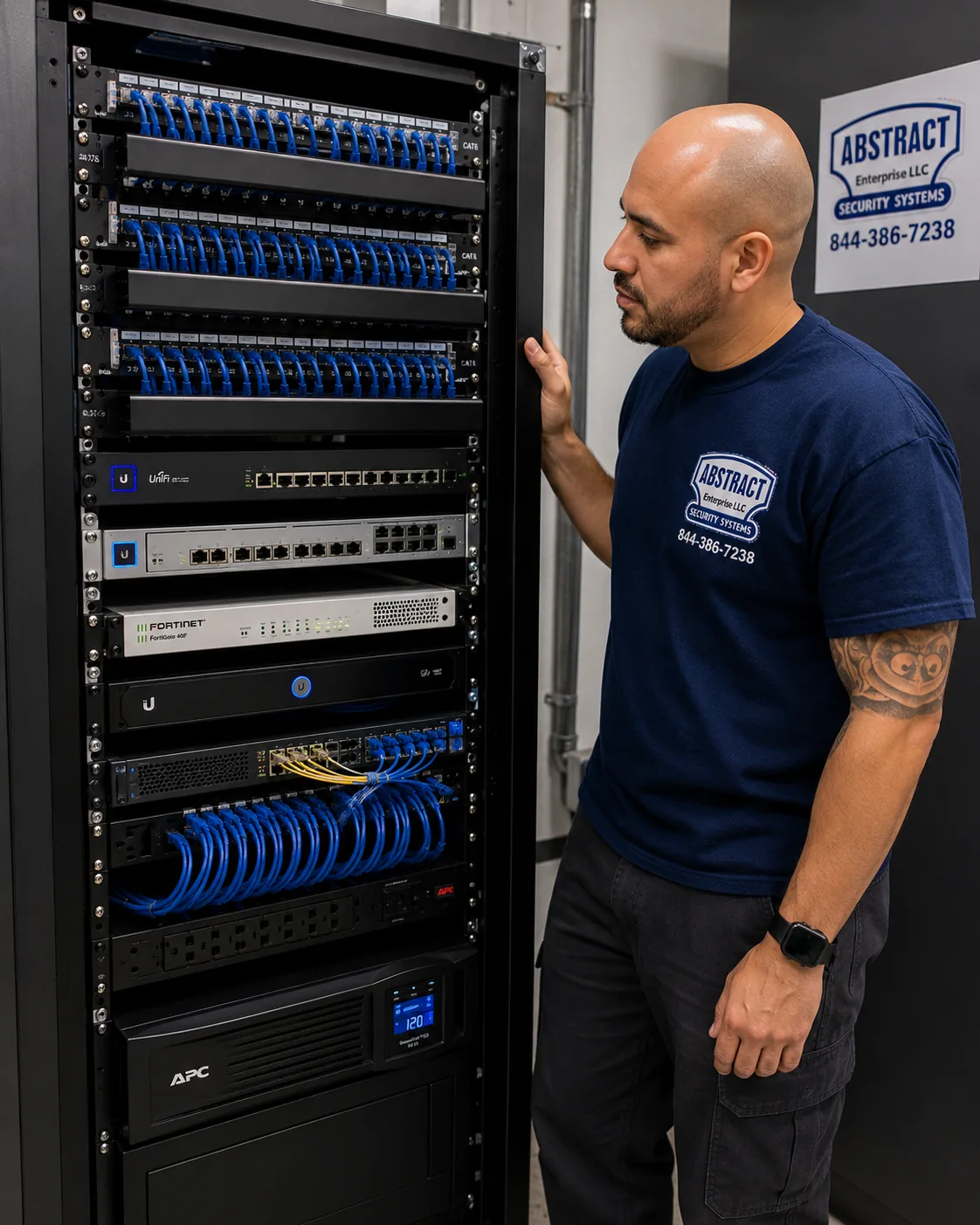
Wakefield, Bronx security camera installation job-library photo: a finished network rack with patch panels, switching, firewall and battery backup, dressed and identified
Photo from our job library, not taken in Wakefield: a finished network rack with patch panels, switching, firewall and battery backup, dressed and identified. A Wakefield house needs a far smaller version, usually a recorder, a small PoE switch and a battery unit on a basement shelf, while a walk-up or co-op on Harper Avenue may need a locked wall cabinet built along these lines.
Owners and Tenants

Two- and Three-Family Houses: A Camera System That Works for Everyone Under the Roof

So many Wakefield houses hold more than one household that the camera plan has to start with people, not equipment. The owner may live downstairs with a tenant upstairs, an adult child and family may have the second floor, or the whole house may be rented. Some houses listed as two-families are lived in as one today and will be rented later. Each of those setups needs a slightly different system, built on the same rules.

Cameras on shared ground only

Cameras belong on the parts of the property everyone uses: the gate, the front walk, the steps, the street door, a shared hall, the driveway, the yard if it is shared, and the garbage area. They do not belong in any apartment, and they should not be aimed so they look through a window or an apartment door when it opens. In a shared hall, we mount at the street-door end and aim at the door, so the picture shows who came in, not who lives behind which door.

One recorder, many logins

A single recorder in the basement can give different people different views. A typical Wakefield arrangement: the owner sees every camera; each tenant household sees the gate, the street door, the driveway if they park there, and their own entrance. Every adult has a personal login on their own phone, so removing a former tenant or a lost phone does not lock anyone else out. Relatives who help with the house from abroad can have a view-only login too.

Planning for the tenant who is not there yet

If you live in a two-family as one household today, it is cheaper to plan for a future tenant now than to rearrange cameras later. We put the second entrance on its own camera, keep the recorder in a space the owner controls, and make sure no camera is aimed at a part of the house that will become a private apartment. When a tenant moves in, it is a matter of adding a login, not moving hardware.

A written list for the household

We leave a one-page list of every camera, what it sees and who can view it. Owners hand it to tenants, and some attach it to the lease. Brick Underground's guidance for New York renters is that installing equipment in common areas, including the hall outside your own apartment, needs the landlord's permission; the list makes it clear to everyone what is already installed and who decided where.

Commercial Security Camera Installation

Business Security Camera Installation in Wakefield

The city's Wakefield profile names White Plains Road as the principal commercial corridor, with more business along East 233rd Street and around the subway stations, and says beauty supply shops and salons dominate the district alongside many grocery and specialty food stores. Community Board 12 adds the produce markets and the Spanish, West Indian and East Indian food shops. Near East 225th Street the listings show national names like Foot Locker, Subway, TD Bank, Metro by T-Mobile, Rainbow and UPS among the independent stores. East 241st Street and Baychester Avenue round out the main arteries, and the end of the line at 241st Street gives the north end of White Plains Road its own late-hour rhythm.

Beauty Supply Stores

Long aisles of small packaged goods, a busy counter and a stock room, all needing clear views.

Salons

Door and reception on camera; chairs only where the owner wants a record and clients know.

Groceries and Produce

Entrance, register, aisles, the cooler wall and the sidewalk display out front.

Caribbean and Specialty Food

Counter, kitchen pass, back door and the alley or yard where deliveries arrive.

Bodegas and Delis

Glass door, counter, register and the late-night hours when one clerk is on.

Offices Above the Shops

Stair door and reception for practices and offices on the upper floors.

The glass door and the first three minutes

The bodega burglary News 12 reported followed a pattern shopkeepers here know: an attempt at the lock, then the glass, then a fast run at the register and shelves. Less than three minutes from start to finish. A shop system built for that has a camera outside the door, under the awning or on the gate box, catching faces during the fumbling at the lock; a camera inside facing the door, catching each person as they come through the broken glass; and a camera over the register and cash area. The recorder sits in a locked spot away from the counter, so the video survives even if the front of the store is ransacked.

Under the 2 and 5 trains

The el keeps White Plains Road in shade most of the day and in a jumble of streetlight, shop light and headlights at night. Door cameras need strong wide dynamic range so a customer's face does not turn into a silhouette against the bright street behind them. The steel columns that hold up the tracks sit right along the curb, so exterior cameras are aimed between them, not across them. Mounts go into solid masonry or the steel sign frame rather than thin storefront cladding, so the picture stays steady when trains pass.

Aisles, not just the register

In beauty supply shops and groceries, the loss happens in the aisles. A camera at the end of each main aisle, aimed down its length and mounted high enough to see over shelving, shows a hand going to a shelf and then to a bag. The register camera is still important, but it does not see what left the store without being rung up.

Compliance callouts for Wakefield businesses

  • Private spaces stay off camera. Restrooms, changing areas and any spot where people undress are off limits; New York Penal Law §250.45 makes recording people without consent where they reasonably expect privacy a crime.
  • Exits stay clear. Cameras and cable never block an exit door, an exit sign or a path to the door, and nothing is fixed to fire-rated doors in a way that stops them closing.
  • Accessible routes stay accessible. Monitors and cameras are mounted so they do not stick out into a path of travel at head height, which matters in a narrow corridor store.
  • Licensed installer. Security system installers in New York are licensed under General Business Law Article 6-D; we work under NYS license #12000287431.
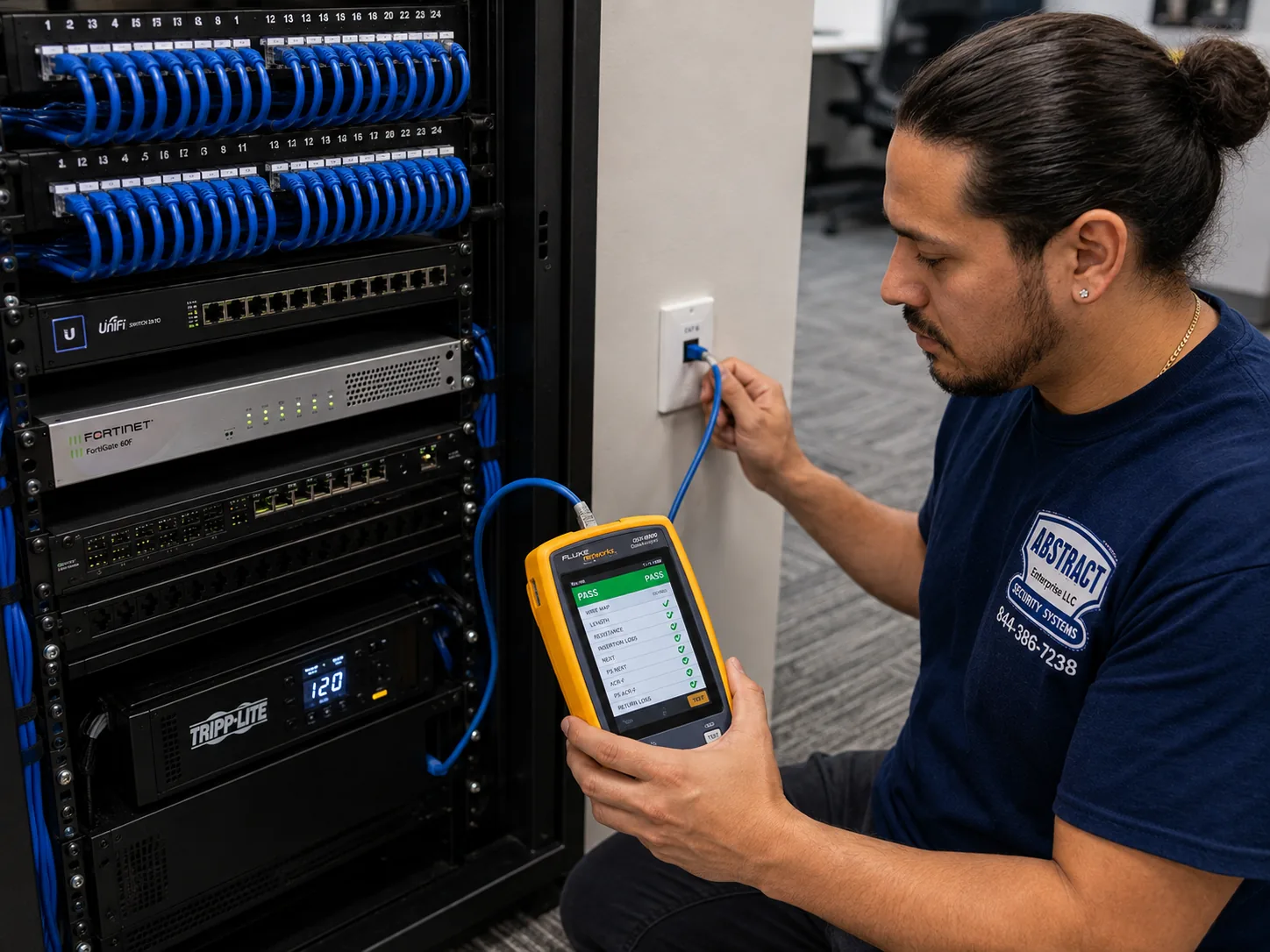
Wakefield, Bronx security camera installation job-library photo: a technician certifying a data drop with a cable analyzer showing a PASS result
Photo from our job library, not taken in Wakefield: a technician certifying a data drop with a cable analyzer showing a PASS result. A run from a White Plains Road shop's back office up to a camera under the awning, or from a Wakefield basement out to the garage at the end of the driveway, gets tested like this before the camera goes on, because a fault is far easier to fix before the ceiling or conduit is closed.
The End of the Line

Living and Working Near the Last Stop: Cameras Around Wakefield–241st Street and East 233rd Street

Wakefield is, as the Homes.com guide puts it, literally the end of the subway line. The Wakefield–241st Street station is the northernmost station in the system, at 241st Street and White Plains Road, and the East 233rd Street station sits a short way south over the same corridor. Every 2 train that heads north ends its run here, and the people on board walk out into the surrounding blocks on foot, at all hours.

That pattern shapes camera work in a few concrete ways. Shops near the stations see a rush of foot traffic after each train arrives, and quieter spells in between. Houses within a few blocks of the stations have steady sidewalk traffic late into the night, which makes motion alerts that would be fine on a quiet block far too frequent. And the station areas are where incidents reported this year took place: the stabbing at White Plains Road and East 233rd Street under the elevated station, and the robbery and assault in front of 4600 White Plains Road. It is also why residents put more cameras on the train station into a participatory budgeting proposal.

For a house near the stations

Keep the cameras recording the sidewalk, because that is the record you will want if something happens on your block, but keep alerts tight to your own gate, steps and driveway. Person detection rather than plain motion keeps cars and blowing leaves out of the alerts, and a schedule can turn up sensitivity for the hours when nobody in the household should be coming home. For households with older relatives who walk home from the train or the bus, a camera that clearly covers the last stretch of sidewalk to the gate, and a light at the gate, are worth more than another camera on the yard.

For a shop near the stations

Station-area shops benefit from an outside camera that takes in the sidewalk in front of the door, because incidents on the sidewalk outside often end up being the clip police ask for. Inside, a camera facing the door at face height catches everyone who comes in during the post-train rush. After closing, an alert rule on the inside cameras, active only between closing and opening, tells the owner when someone is moving in a store that should be empty.

What public cameras do and do not cover

The Bronx Borough President has announced funding for new public cameras aimed at traffic corridors, empty lots, parks and open space, though Wakefield was not named in the report we found. New buildings such as the supportive housing at 4339 White Plains Road list their own cameras, lighting and a 24/7 front desk. None of that covers your gate, your driveway or the aisle in your shop, and you cannot pull that footage yourself. A private system is the only record you control.

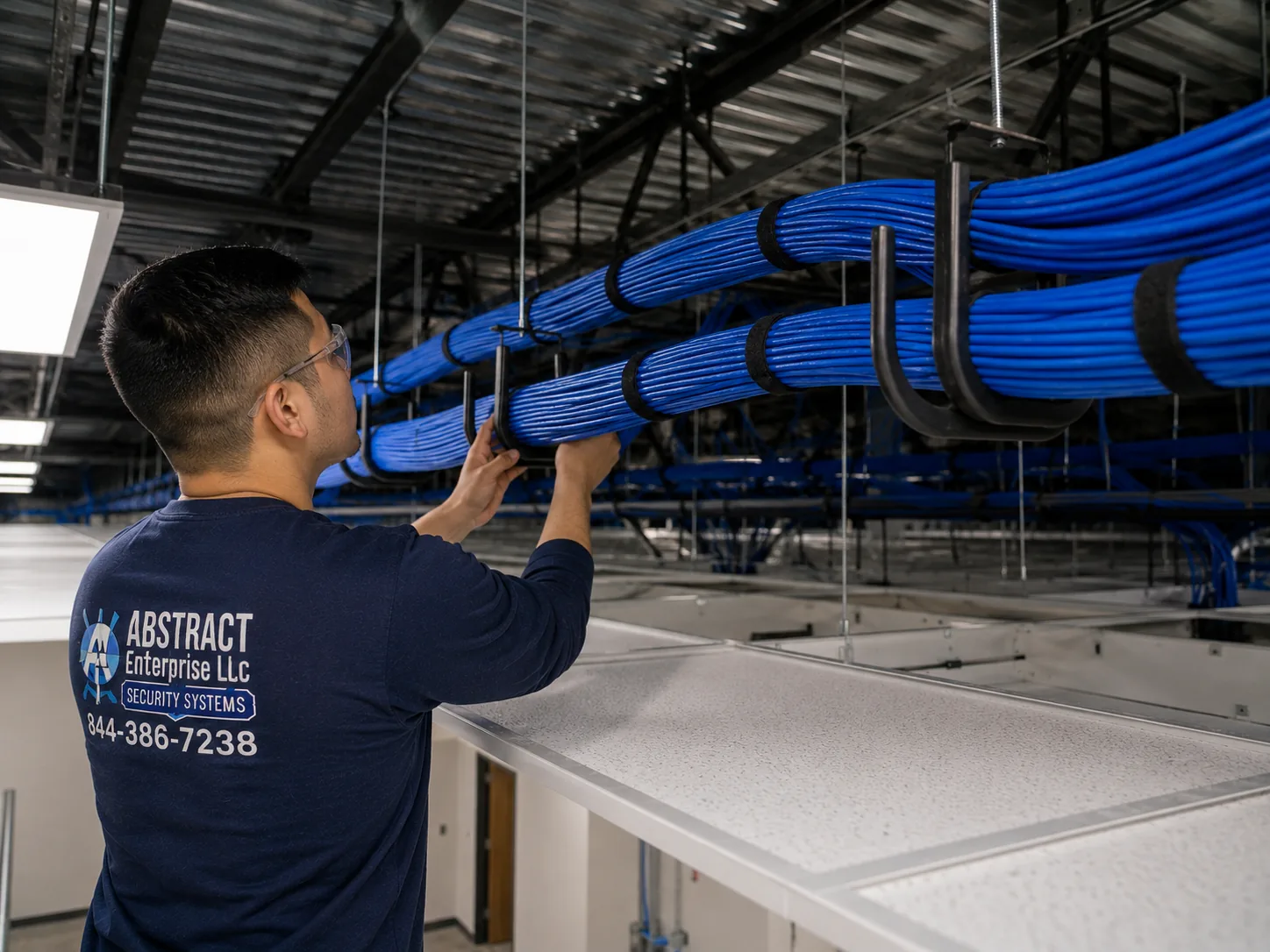
Wakefield, Bronx security camera installation job-library photo: J-hooks carrying dressed cable bundles across a commercial ceiling
Photo from our job library, not taken in Wakefield: J-hooks carrying dressed cable bundles across a commercial ceiling. Above the drop ceiling of a White Plains Road shop near the 241st Street terminal, or along the joists of a Wakefield basement, camera runs travel on hooks like these so each one can be followed and nothing sags onto pipes or lights.
New Buildings

White Plains Road's New Buildings and What They Mean for Camera Work

For a neighborhood of houses, Wakefield has a surprising amount of new construction along its main corridor. New York YIMBY reported that 700 East 241st Street, an 11-story mixed-use building with 416 rental units, finished construction in early 2026 on the block bounded by White Plains Road, East 241st Street and Furman Avenue. The Plains at 4519 White Plains Road is a nine-story affordable and supportive building with 98 apartments and a live-in superintendent. Bronx Times reported 59 new apartments at 4427 White Plains Road for New Yorkers leaving city shelters, opened in September 2024. 4435 White Plains Road is a seven-story mixed-use building that advertised 24-hour surveillance. Wakefield Grace Senior Apartments at 4750 White Plains Road is a newly built six-story building two blocks from the 241st Street station, and Muller Residences at 555 Nereid Avenue has 90 residences including supportive housing for veterans.

More is filed. Permits in 2026 list 4541 Furman Avenue at 12 stories and 220 residences, 610 East 226th Street at 12 stories and 189 residences, and smaller four-story buildings at 622 East 223rd Street with ten residences and 721 St. Ouen Street with 14.

For developers and general contractors

The cheapest camera system in a new building is the one whose cable went in before the drywall. We work from the drawings to set a head-end location with its own circuit, run cable to every planned camera at the entrances, lobby, mailroom, package room, elevator landings, stair doors, cellar, trash and recycling rooms, bike room, parking and the building corners, and leave spare pathway to the roof and the yard. Cameras go up after paint. On sites with stored materials, a temporary camera system on site power covers the gate and the storage area while the building rises.

For small four-story buildings

The four-story buildings filed on side streets like East 223rd and St. Ouen Street sit among houses, and their camera needs are closer to a large house than a tower: a street door, a small lobby, mailboxes, a stair, a rear yard and maybe a parking pad. A compact recorder and six to ten cameras cover most of them. The same privacy rules as on a house apply to the yard side, because the neighbors' yards are right there.

For the houses next door

A house beside a new building gets new neighbors overnight, and often a new wall of windows looking down on its yard. Some owners add a camera to document the condition of their own fence, wall and yard while construction is under way, which gives a dated record if there is a dispute about damage. The view stays on your property.

For tenants in the new buildings

Tenants in a new building usually cannot add cameras in the halls; the lease and the building's own system govern common areas. Inside an apartment, a small indoor camera aimed at your own space is generally a tenant's own business, as long as it does not look out a window into someone else's home. We are happy to set one up and connect it to your phone.

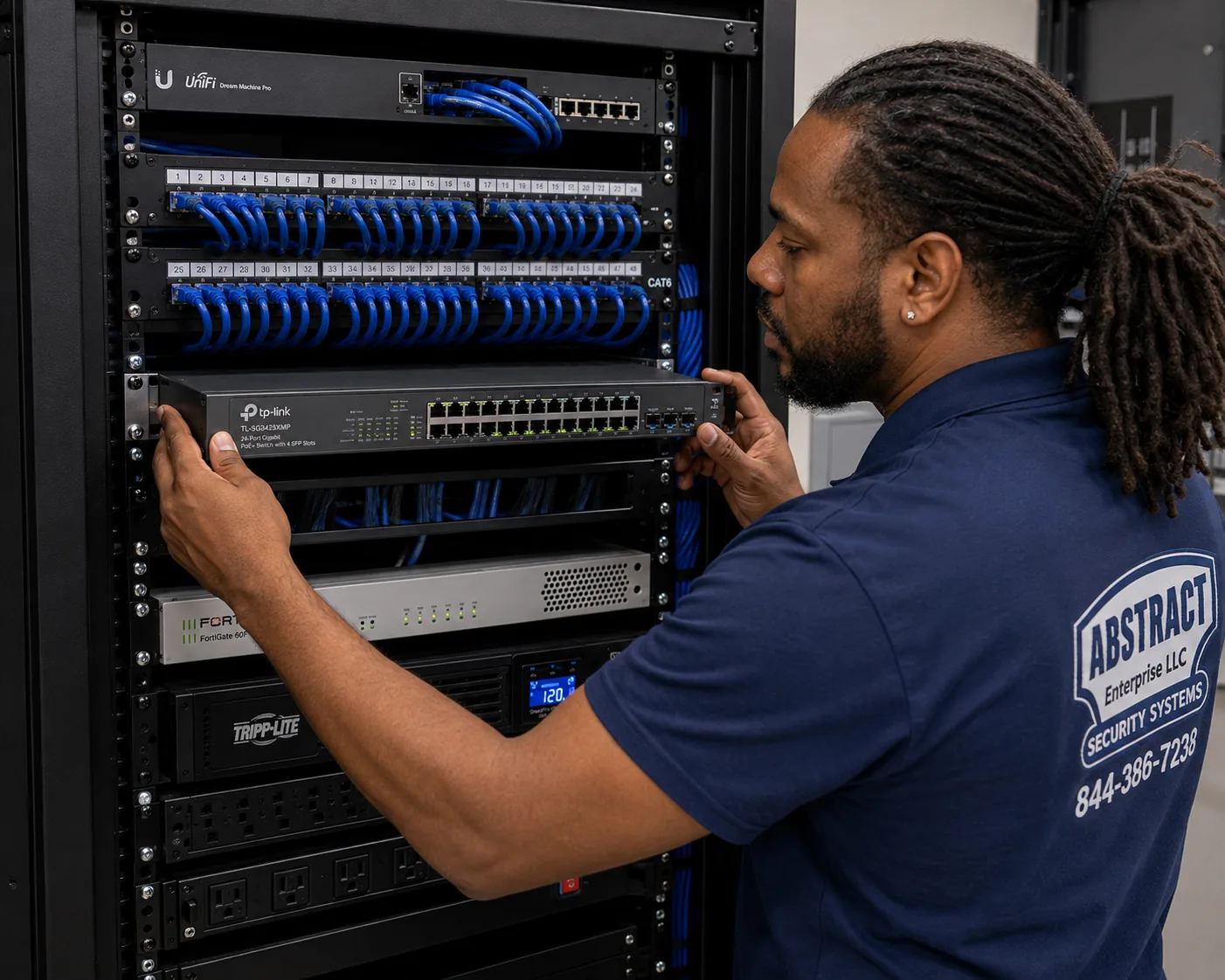
Wakefield, Bronx security camera installation job-library photo: a technician mounting a managed PoE switch below patch panels in a commercial network rack
Photo from our job library, not taken in Wakefield: a technician mounting a managed PoE switch below patch panels in a commercial network rack. In a new building on White Plains Road, a switch like this in the cellar head-end room powers every lobby, stair and parking camera over a single cable each; a Wakefield shop uses a much smaller one in its back office.
The Edges

Houses by Shoelace Park, the Bronx River, Woodlawn Cemetery and the Westchester Line

Community Board 12 describes Wakefield's western edge as the Bronx River, the Bronx River Parkway and the Metro-North tracks, with the Westchester County border at East 243rd Street to the north. Shoelace Park, the northern section of Bronx Park, runs along the river with a kayak launch at East 219th Street. Bissel Garden, a 2.5-acre community garden with a four-block public path, sits in Wakefield. Woodlawn Cemetery, a National Historic Landmark, lies just across the river and the parkway, and Seton Falls Park is next door in Edenwald. To the north, the city simply ends and Mount Vernon begins.

Houses near these edges have a side or back that faces open land, a long fence, a path or a border street rather than another house. That changes camera work. On the plus side, there are fewer neighboring windows to mask on that side, so a rear camera can be aimed wide. On the other side of the ledger, those edges are darker at night, carry less foot traffic, and give someone a quiet way to reach the back of a house.

Watching the openings, not the whole fence

A long fence line cannot be watched end to end by one camera with any detail. We look for the places someone would actually come through: a gate onto a path, a low section of fence, a gap beside a garage, the corner where the fence meets the house. Each of those gets coverage. The rest of the fence is in the background of a wider view, enough to show movement and direction.

Public paths behind the fence

Where a yard backs onto a public path, the camera should cover your fence and gate, not record everyone walking the path. We aim the rear camera at your side of the fence and, where part of the path falls in the frame, draw a mask or lower the angle so the picture stays on your property. Alert zones sit on your side of the fence only.

Darkness and low-light cameras

Without streetlight behind the house, a yard camera depends on its own infrared or on a light you add. Infrared reaches a fair distance but shows the scene in black and white and can flare off fences, foliage and falling rain. For yards that back onto open land, a motion light over the back door and a low-light color camera usually give a more useful picture than infrared alone.

The Westchester line

Wakefield's northern blocks touch Mount Vernon, and many families have property on both sides of the line. We work on both. The Bronx side is on our Bronx rate; work just over the line in Westchester is quoted on that county's rate, and our Westchester security camera installation page covers it.

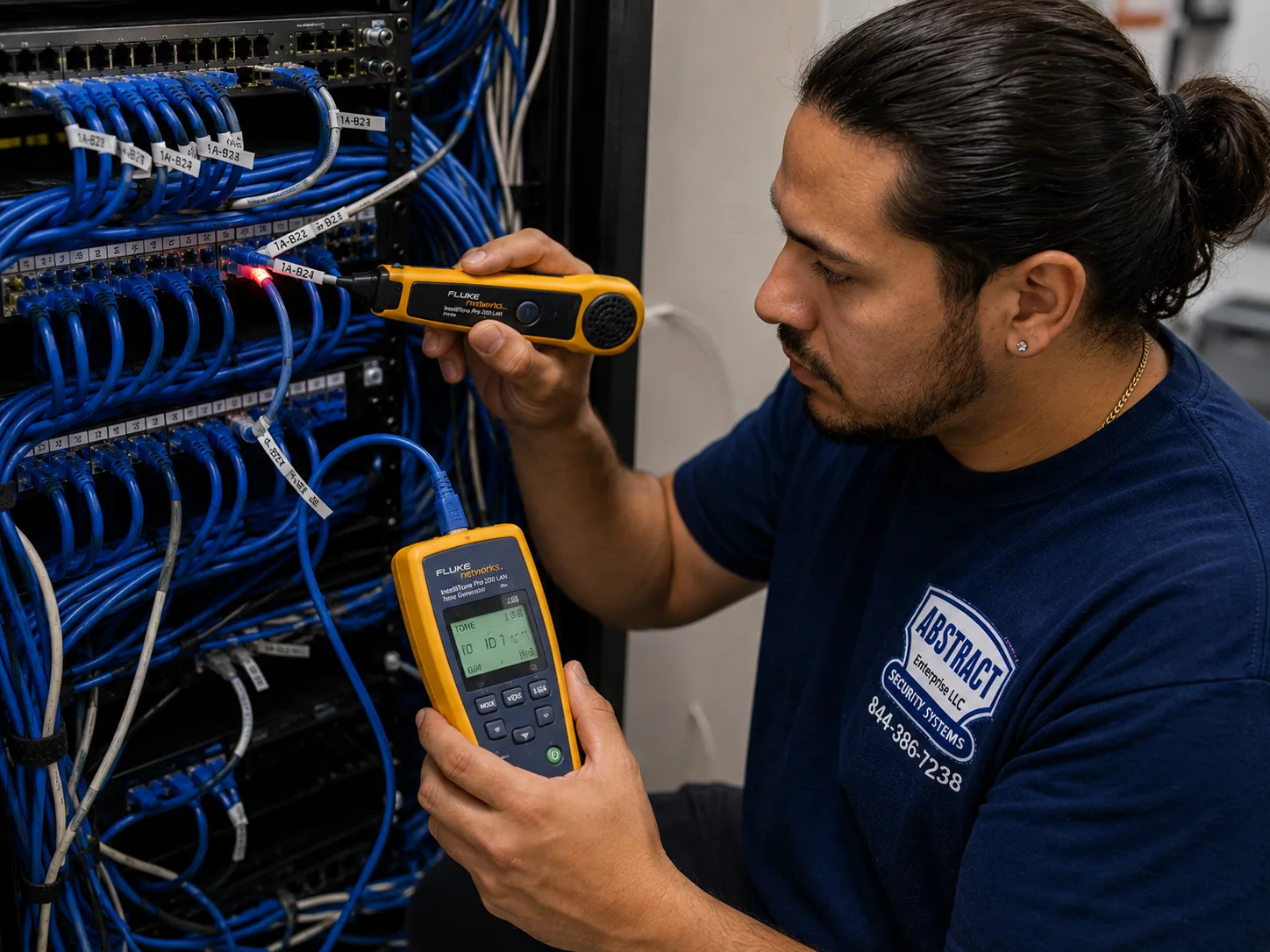
Wakefield, Bronx security camera installation job-library photo: a technician tracing an unidentified cable run at a patch panel with a tone generator and probe
Photo from our job library, not taken in Wakefield: a technician tracing an unidentified cable run at a patch panel with a tone generator and probe. When a Wakefield family inherits cameras a relative put up years ago, with wires disappearing into the basement ceiling and no notes, tracing each run to its camera like this is how we find out which ones are worth keeping.
Field Notes

Field Notes: Reading a Wakefield Lot From the Curb to the Garage

On a Wakefield house visit we start at the curb, because that is where trouble arrives. We look at where the family parks, how far the gate sits from the streetlight, whether the gate is chained or latched, and what a stranger can see over the fence. Then we stand at the gate and look back at the house to find the spot where a camera would see a face under a hood. Next comes the driveway: how many cars park there, whether they park nose to tail, how far the garage is, and whether anything valuable sits in the yard at night. We walk around the back to the yard, noting the neighbors' windows and fences and whatever lies behind the lot. Inside, we find the router, check whether the basement is open or finished, look in the attic if there is one, and work out how cable reaches each corner. Finally we ask who lives in each part of the house, who should see which camera, and whether anyone travels for long stretches and wants to check in from abroad. By the end of that walk we can usually say how many cameras the lot needs and where each will go, and the written quote follows within a business day.

The Footage

Making Wakefield Camera Footage Useful When the 47th Precinct Asks for It

Almost every Wakefield incident in the news this year ended with the NYPD releasing surveillance video or photos: the e-bike theft on East 224th Street, the robbery outside 4600 White Plains Road, the 2021 White Plains Road shooting where bullets ricocheted off a parked car into a second-floor apartment. Private cameras are a large part of how cases in this neighborhood are worked. A system is only useful in that moment if the video is there, findable, and easy to hand over.

The clock and the date

A recorder with the wrong time makes a clip hard to match to a report. We set every recorder to sync its clock automatically and check that each camera's time stamp agrees. When a detective asks for "around 2 a.m.," you can go straight there.

How far back you can look

Recorders overwrite the oldest video once the drive fills. Owners often do not notice a theft from the yard or the garage for a day or two, so a Wakefield house system should hold at least a couple of weeks. We size the drive for the number of cameras and the quality you want, and write the expected number of days on the quote.

Saving a clip the same day

When something happens, save it that day: export the clip to a phone or a USB drive, or lock it on the recorder so it is not overwritten. We show every household how to do that in a few taps. Handing a copy to police does not mean handing over the recorder or your passwords.

Where the recorder lives

A recorder on a shelf next to the front door is the first thing a burglar takes. In a house we put it in the basement or a closet away from the main entrances, on a battery unit. In a shop it goes in a locked back office or cabinet. Where an owner wants extra insurance, the system can also send copies of important events to a phone or a cloud account, so the record survives even if the recorder does not.

The precinct

The 47th Precinct station house is at 4111 Laconia Avenue. A third-party site built from NYPD data lists 13,640 reported crimes, 6,083 arrests and 33 shooting incidents in the precinct in 2025, figures that cover the whole precinct, not just Wakefield. Whatever the numbers, a clear, correctly dated clip from your own camera is one of the most useful things you can offer if something happens on your block.

Your Questions Answered

Security Camera Installation in Wakefield: Questions Answered

Gates, driveways and houses

The thieves near East 224th Street and Carpenter Avenue cut a chain to open a gated driveway. What should our camera record in the seconds before the chain is cut?

The walk up to the gate and the pause at the latch. That is when people look around and lift their heads, so it is when a camera gets a face. Mount one camera on the front corner of the house, out of reach but not so high it looks down on hood brims, aimed back at the gate and a few feet of sidewalk. A light at the gate makes the night picture usable in color. A second, wider view from the same corner shows which way they came and whether a car waited at the curb.

The 47th Precinct had more thefts than any other precinct in the 2026 Bronx car-theft case. Should a Wakefield house camera put the car ahead of the front door?

Treat them as equal, because on most lots one well-placed camera can cover a lot of both. A camera at the back corner of the house looking down the side driveway toward the street shows the parked cars along their sides and the face of anyone walking in from the gate. Add a door camera for the entrance the family uses. If the budget only allows one more after that, put it where the car actually sits overnight.

Our frame house on Monticello Avenue is a legal two-family, but we use it as one home for now. Should the cameras be wired as if a tenant might move in later?

Yes. Give the second entrance its own camera now, keep the recorder in a space the owner will always control, and avoid aiming any camera at rooms or doors that would become a separate apartment. When you do rent the second unit, you simply add a login for the tenant with the views that fit them, and nothing has to be moved or rewired.

Our detached Victorian has a porch that wraps around two sides of the house. How many cameras does a porch that long take?

Usually two: one in the porch ceiling near the front door looking along the front run and down the steps, and one at the far corner looking back along the side run. Mounted in the porch ceiling, both stay dry and out of reach, and cable reaches them through the porch roof from inside. If the side run has its own steps to the yard, the corner camera is aimed to take those in too.

Delivery drivers toss packages over our waist-high front fence instead of opening the gate. Can a camera see a box once it lands behind the fence?

It can if the camera looks down at the inside of the fence rather than out at the street. A camera high on the front of the house aimed at the strip of yard just behind the fence and gate shows where the box landed and anyone reaching over to take it. Pair that with the gate view so you see the driver and the person who comes later.

Our yard backs onto open ground near Shoelace Park and the Bronx River. Should the rear camera watch the public path beyond our fence?

Watch your own fence line and gate, not the path. Aim the camera at the inside of your fence, especially any gate or low section, and mask or angle out the path so you are not recording everyone walking by. Because the land behind is dark at night, a motion light over the back door and a low-light color camera will give you a far better picture than infrared alone.

Shops on White Plains Road

The steel columns of the el stand right in front of our door on White Plains Road. Where does the outside camera go so a column isn't in the middle of the picture?

Close to the door and angled along the storefront rather than straight out at the street. A camera under the awning or on the gate box, a little to one side of the door, looks across the doorway and sidewalk between the columns instead of at them. The inside camera, facing the door from the back of the store, avoids the columns entirely and gives the clearest faces of anyone who enters.

The bodega burglary News 12 reported in Wakefield was over in less than three minutes. What has to be set up ahead of time so those minutes are on record and in our hands by morning?

Continuous recording on the door and register cameras, a recorder locked away from the counter with a battery unit, an after-hours alert to the owner's phone, and the owner already knowing how to export a clip. With those in place, the owner gets the alert, watches it live, and has a copy ready for police before opening. We set the alert schedule to the store's hours and show every keyholder how to export.

Our beauty supply store has long aisles of small packaged goods. How do we get usable video of the aisles, not just the counter?

Put a camera at the end of each main aisle, high enough to see over the shelving, aimed down the aisle's length. That angle shows a hand moving from a shelf to a bag or pocket. A ceiling camera in the middle of the store sees tops of heads; aisle-end cameras see what people do with their hands. Keep the counter camera too, for transactions and disputes.

Our shop is a short walk from the Wakefield–241st Street terminal, and riders come through in waves after each train. What changes for a shop at the end of the line?

The door camera has to handle crowds: mount it inside, facing the door at about face height, so people arriving in a rush are recorded one by one as they come through. Add an outside camera on the sidewalk in front, because station-area incidents often happen just outside a shop. After closing, set alerts on the inside cameras so you hear about movement in an empty store, while the outside cameras keep recording without alerting.

Equipment

Types of Security Cameras We Install in Wakefield

Gate and Sidewalk Turrets

Fixed-lens turrets on the front corner of the house, chosen for clear faces at the gate in poor light.

Driveway Bullets

Narrower-view cameras that look down the length of a side driveway and along parked cars.

Vandal-Resistant Domes

For bungalow eaves, shop awnings and anywhere a camera sits within reach.

Wired Video Doorbells

Powered from the chime circuit, recording to the recorder and ringing every household phone.

Low-Light Color Cameras

For yards that back onto the river, the cemetery or other dark open land.

Wide-Dynamic-Range Door Cameras

For storefronts under the el, where the street behind a customer is brighter than their face.

Network Video Recorders

Four- to sixteen-channel units sized for weeks of video, with separate logins for every person.

PoE Switches and Outdoor Cable

One cable carries power and video to each camera, including the long run to a back garage.

Battery Backup and Lighting

Keeps the system recording through power blips, and motion lights that make night footage usable.

Wired system, battery cameras, or a national brand kit: what fits a Wakefield lot

Many Wakefield households already own a doorbell or a couple of battery cameras from Ring, or have priced a monitored package from ADT or a self-install kit from SimpliSafe. Each has a place. A battery doorbell or a single Wi-Fi camera is quick to put up and suits a renter who cannot drill. Their limits show on a typical Wakefield lot: the driveway and the garage at the back are often too far from the router for steady Wi-Fi through brick and old plaster, batteries drain faster in winter, and saved video history usually depends on a paid plan. Monitored packages add a monthly service that some owners want and others do not. A wired system with a recorder in the basement has no batteries to charge, does not depend on Wi-Fi reaching the garage, records continuously, and does not require a monthly fee. For a house covering a gate, a driveway, two doors, a yard and a garage, wired is usually the better long-term fit; for one apartment door, a good doorbell may be all you need.

QuestionBattery or Wi-Fi kitWired recorder system
Reaches the back garage reliably?Depends on Wi-Fi through the houseYes, over its own cable
Records all night without gaps?Usually clips onlyContinuous, with events marked
Winter performanceBatteries drain in the coldPowered from the recorder
Required monthly feeOften for saved historyNone required
Best fitA renter's door or one hard-to-wire spotA whole house lot or a shop
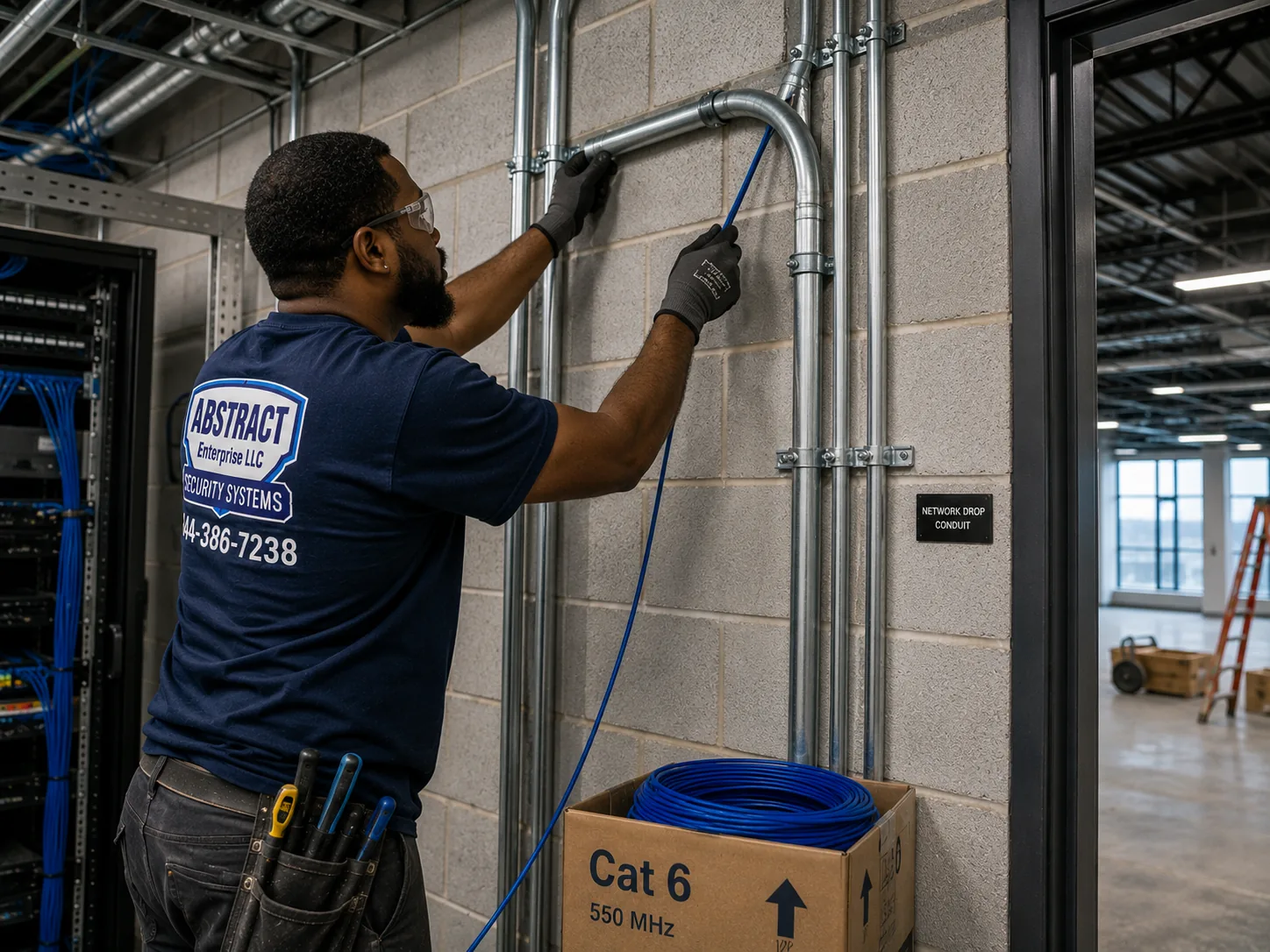
Wakefield, Bronx security camera installation job-library photo: a technician running cable into EMT conduit beside a telecom room in an industrial building
Photo from our job library, not taken in Wakefield: a technician running cable into EMT conduit beside a telecom room in an industrial building. Conduit like this protects camera cable where it leaves a Wakefield basement and runs along a fence or garage wall toward the back of the lot, and it is the standard pathway in the cellar of a new building on White Plains Road.
AI Overview Reality Check

What AI Gets Wrong About Security Camera Installation in Wakefield

People often arrive with a summary from a search engine's AI answer or a chatbot. The general advice is fine as far as it goes, but it is written for an average suburb or an average apartment, and Wakefield is neither. These are the claims we hear most, and what the work actually looks like on these blocks.

"Bronx camera jobs are apartment-building jobs"

AI answers about Bronx cameras tend to talk about lobbies, hallways, supers and mailrooms, because so much of the borough is apartment buildings. That picture does not fit Wakefield. The research we draw on describes it as mostly one-, two- and three-family houses with very few high buildings, and most of those houses were standing by 1939.

A house job is organized around the lot: the gate, the driveway, the side door, the yard and the garage. Cable goes through basements and attics, not risers. Permission comes from the owner, and the privacy issues are neighbors' windows and yards a few feet away, not tenants in a corridor.

Wakefield does have walk-ups, co-ops and a growing row of new buildings on White Plains Road, and we cover them, but the default answer for a Wakefield caller is a house plan, not a lobby plan.

"A video doorbell covers a house"

This is the most common suggestion in AI answers about home cameras, and it misses most of what Wakefield owners lose. A doorbell sees the person who walks up to the front door. It does not see the gate twenty feet away, the driveway along the side, the car parked behind the house or the garage at the back.

The e-bike theft near East 224th Street happened at a gated driveway. The car thefts that put the 47th Precinct at the top of the 2026 case happened where cars are parked. Neither would have been in a doorbell's view on most lots.

A doorbell is a good start for the front door. It is rarely the whole answer for a Wakefield house, where the side door is often the one the family uses and the valuables sit along the driveway.

"Wireless cameras are easier and work everywhere"

AI summaries often recommend wireless cameras as the simple choice. On a Wakefield lot, the router is usually inside a brick or plaster house, and the cameras that matter most are at the far end of the driveway, on the garage or in the back yard. Wi-Fi through old masonry and across a yard is often weak and uneven.

"Wireless" cameras also still need power. Battery models need charging, and they drain faster in winter. Plug-in models need an outlet near where the camera goes, which rarely exists on a garage wall or a gate post.

A wired camera on one cable that carries both power and video is usually the more reliable choice for the far corners of a lot, and that is how we install most Wakefield driveway and garage cameras.

"National cost sites tell you what it will cost"

Cost sites like Angi, HomeAdvisor and Fixr publish national averages per camera, and AI answers often repeat them. Those numbers blend suburban ranch houses, apartments and every kind of wiring condition into one figure.

On a Wakefield lot, the cost of each camera depends mostly on how the cable gets there. A camera over the front steps of a brick colonial with an open basement below is a short job. A camera on a garage at the end of a concrete driveway, or under the porch roof of a Victorian with a finished basement and plaster walls, is a longer one.

That is why we quote from photos or a walk-through, line by line, and publish only one fixed price, the setup-only visit. A national average cannot tell you which kind of lot you have.

"Point your cameras wherever you want on your own property"

AI answers often say a homeowner can aim a camera anywhere on their own property. In New York that is not the whole story. Penal Law §250.45 makes it a crime to record people without consent where they reasonably expect privacy, and Civil Rights Law §52-a gives a neighbor a civil claim over video surveillance of their back yard by an adjoining property without consent.

On Wakefield's closely spaced lots, especially with semi-detached colonials sharing a wall and side driveways a few feet from the next house, a careless angle can easily take in a neighbor's windows or yard.

We aim at your gate, driveway, doors and yard, draw privacy masks over anything that belongs to the neighbors, and show you the masked picture before we leave.

"City law requires camera signs" and "landlords must let tenants install cameras"

We have seen installer blogs, and AI answers that repeat them, say that a "Local Law 50" requires posted notices wherever common-area cameras operate, and that recent changes to the Real Property Law require landlords to let tenants install cameras. Each claim appears in a single source in our research, and we could not confirm either one.

What we can point to is general: Brick Underground's guidance that tenants need landlord permission for equipment in common areas, including the hall outside their own door, and the privacy and backyard laws above. Posting a simple notice that cameras are in use is a reasonable courtesy whether or not a law requires it.

If a legal question matters to a specific building or dispute, check with a lawyer or the agency directly. We build around the rules we can confirm, and we will tell you when a claim you read is one we could not verify.

"Public cameras and police cameras already cover the neighborhood"

Some AI answers suggest that city or police cameras cover busy corridors, so a private system is optional. In Wakefield, residents themselves asked through participatory budgeting for more cameras at the train station, which tells you coverage there was not seen as enough. The Borough President's announced camera funding targets corridors, lots, parks and open space, and Wakefield was not named in the report we found.

Public cameras are aimed for public purposes. They are not pointed at your gate or your driveway, and you cannot open an app and review them.

Your own system covers what belongs to you and keeps a record you control, which is why the incidents in this neighborhood so often end with police releasing private surveillance video.
Not Sure Whether the Gate, the Driveway or the Side Door Comes First? Ask a Technician

Send photos of your gate and fence, the driveway with the cars in it, the front and side doors, the yard and the garage, or of your shop's door, counter and aisles, along with the address and who lives or works there. A technician will tell you which views will help most, how cable is likely to reach them and what the quote will cover, before anyone visits. Call (646) 490-0629, message us on WhatsApp, or use the quick form.

Get in Touch

Request a Free Quote

Tell us the street, the kind of house, building or shop, who lives or works there, and which gate, driveway, door, yard or aisle needs a camera. Prefer to talk? Call (646) 490-0629.

✅
Request Sent!
We'll call you about your Wakefield cameras the same business day.
How It Works

Our Installation Process

Every Wakefield job, from one wired doorbell and a gate camera to a full system for a two-family with a long driveway and a back garage, or a White Plains Road shop, runs through the same eight steps. The third and fourth carry the most weight here: deciding what each camera is for, and aiming it so it covers your lot without looking into the house next door. On install day we park legally, keep the work inside the house wherever we can, and leave the gate closed behind us.

1. Photos and a short call

Photos of the gate, driveway, doors, yard, garage or shop front, and who lives or works there.

2. Walk the lot from the sidewalk inward

Curb, gate, driveway, yard, garage, then basement, attic or back room to plan cable routes.

3. Give every camera one job

Faces at the gate, the car, the side door, the yard, the counter, the aisle: one purpose each.

4. Aim around the neighbors

Each view planned for your lot and the public way, with neighbors' windows and yards masked.

5. Written quote and access plan

Every camera, mount, run and task on its own line, plus who sees which view, in writing.

6. Run cable inside and mount cleanly

Through basements, attics and conduit; sealed holes; the right mount for brick, frame or siding.

7. Test after dark

Night views checked, lights adjusted, masks drawn, alert zones set to the gate, steps and driveway.

8. Phones, logins and handover

A login for each adult, a printed camera list, and a lesson in finding and saving clips.

Coverage Area

Security Camera Installation Near Wakefield's Landmarks

Places our sources tie to Wakefield and its edges, and what camera work near each tends to involve.

Wakefield–241st Street Station

The northernmost stop in the subway, opened in 1920; nearby shops and houses see foot traffic at every hour.

East 233rd Street Station Area

A busy stretch of White Plains Road under the el where shop door cameras must cope with shade and glare.

Bissel Garden

A 2.5-acre community garden and four-block public path; houses nearby keep yard cameras on their own fence line.

Montefiore Wakefield

The former Misericordia Hospital, begun as a three-block medical center in the 1950s; streets around it see shift traffic day and night.

Seton Falls Park

Next door in Edenwald on East 233rd Street; houses along the woods need low-light rear coverage.

Woodlawn Cemetery

A National Historic Landmark across the river and parkway from Wakefield's western blocks, dark land at night.

The 47th Precinct at 4111 Laconia Avenue covers Wakefield. We also install security cameras in neighboring Edenwald, Eastchester, Baychester, Bronxwood, Allerton and Co-op City, as well as Williamsbridge, Woodlawn and Olinville, and across the borough from our Bronx security camera installation page. For a property just over the line in Mount Vernon, see Westchester County camera installation.

Pricing

Security Camera Installation Cost in Wakefield

A single per-camera number posted online would not tell a Wakefield owner much, because the cost of each camera here is mostly about the route its cable takes. A camera over the front steps of a brick colonial, fed from an open basement right below, is quick. A camera on the far wall of a detached garage at the end of a concrete driveway needs a protected run across the lot. A camera on the eave of a Victorian with a finished basement and plaster walls may need to come down from the attic instead. A shop under the el needs mounts in solid masonry and cable above a drop ceiling or through the back office. So we price each property from photos or a walk-through, and the written quote lists every camera, mount, cable run, wall opening, recorder, drive, doorbell and setup task separately, so you can see what each piece costs and drop anything you do not need.

The one price we publish is our Bronx setup-only visit: $225 for the first hour, then 30-minute blocks. It covers service work like getting an inherited recorder back online, setting up phone viewing for each household, re-aiming or masking cameras, fixing alert zones, setting the recorder clock, or exporting a clip for the 47th Precinct.

Estimates are free. Jobs are scheduled with a deposit, and the balance is due on completion, after we have walked you through every view on your phone.

Full terms — including 50% deposit, the 30-day warranty and optional paid extended warranty, and the late-fee schedule — are set out in the service agreement.

What moves a Wakefield quote

  • Distance to the garage. A run to a garage at the back of the lot, through conduit along a fence or the house, is its own line.
  • Brick, frame or siding. Each needs different mounting; finished basements and plaster walls make cable paths longer.
  • Attic access. An open attic often makes eave cameras on a Victorian or colonial much simpler.
  • Lighting. A motion light at the gate or over the driveway can matter as much as a camera for night video.
  • Households. Separate logins for owner and tenants take setup time but no extra hardware.
  • Retention. More days of recording at higher quality means a larger drive.
  • Shop hours. Work in a store that must stay open may be scheduled before opening or after closing.
Shop Our Systems

Security Camera Installation Packages & Pricing for Wakefield

Because every Wakefield lot is laid out differently, we do not sell fixed-price bundles. Instead, most jobs fall into one of three scopes, each quoted line by line after we see the property. They are a way to think about what you need, not a price list.

Starter: The Front of the House

A wired video doorbell on the door the family uses, plus a camera on the front corner covering the gate and sidewalk, on a small recorder in the basement with a battery unit. Suits a bungalow, a renter-friendly owner setup, or a first step on a larger house.

Standard: The Whole Lot

Gate, driveway, front and side doors, back yard and garage, usually six to eight cameras, with continuous recording sized for a couple of weeks, privacy masks, alert zones and logins for each household. The most common Wakefield house system.

Premium: Lot Plus Building or Shop

Everything in the standard scope plus a detached garage interior, extra driveway views for several cars, motion lighting, and either separate tenant views across two or three households or a shop system with door, counter, aisle and back-room cameras.

Bring your own equipment: labor-only installs

If you already bought cameras, a recorder or a doorbell, we can install and set up what you have. We check it first to make sure it suits the spot and will last outdoors, run the cable, mount it properly and connect it to your phones. Labor-only work is quoted the same way as a full job, line by line, and setup-only work on equipment that is already mounted falls under the $225 first-hour visit. Coverage on customer-supplied equipment follows the warranty terms above.

Adding on later

Many Wakefield owners start with the front and add the driveway and garage the next season. We size the recorder and switch with spare capacity when you tell us that is the plan, so adding a camera later is a cable run and a mount, not a new system.

The Law in Plain Words

New York Rules That Shape a Wakefield Camera Job

None of this is legal advice; for a specific dispute, talk to a lawyer. These are the rules we build every Wakefield job around.

Privacy where people expect it

Penal Law §250.45 makes it a crime to install a camera or recording device where a person has a reasonable expectation of privacy without their consent: inside a home, a bedroom, a bathroom or a changing area. Your gate, driveway, steps, yard and the public sidewalk are fair to cover. A tenant's apartment, a salon's changing area or a neighbor's window are not, and privacy masks keep any window that falls inside a view blacked out.

Neighbors' back yards

Civil Rights Law §52-a gives a residential owner or tenant a civil claim against an adjoining neighbor who installs video surveillance of their back yard without consent. With semi-detached houses and side driveways only a few feet apart, this is the rule most likely to matter on a Wakefield lot. Rear and side cameras watch your yard, with neighboring yards masked out.

Landlords, tenants and common areas

Brick Underground's guidance for New York renters is that equipment in common areas, including the hall outside your own apartment, needs the landlord's permission. In two- and three-family houses, owners should tell tenants in writing where the cameras are, what they see and who can view them. Leases govern what tenants may mount on the building.

Sound

News 12's report of an East 223rd Street shooting noted that surveillance video captured the sound of the gunshots. Sound can matter, but recording other people's conversations without consent can be eavesdropping under state law. A doorbell's two-way talk, where you are speaking with the visitor, is different from a camera quietly recording people on the sidewalk. We leave continuous audio off on outdoor and shared-space cameras unless you ask otherwise and understand the limits.

Licensing

Security system installers in New York State are licensed under General Business Law Article 6-D. The Department of State's application notes that some passive devices may fall outside that requirement, and sources disagree on exactly where the line sits for cameras, so ask any installer for their license number before work begins. We work under NYS license #12000287431 and carry insurance.

Permits and landmarks

Installer sources say most residential camera installations need no permit. We found no Landmarks Preservation Commission historic district or individual landmark over Wakefield's residential blocks in our research, so ordinary house cameras here do not go to Landmarks. If your building is individually designated, tell us before we plan.

All Year Round

Seasons, Upkeep and Keeping a Wakefield System Honest

A camera system on an old house is not something to install and forget. A few habits keep it useful from one winter to the next.

Winter

Long nights mean outdoor cameras spend most of their hours in night mode. Infrared bounces off falling snow and rain and fills the picture with bright streaks, and wet snow sticks to camera bodies without a hood. Lights at the gate and over the driveway let cameras stay in color and cut most of that glare. Snow shoveled to the side of a driveway can pile up against a low garage camera, so we mount high enough to stay clear. Battery doorbells lose charge fast in the cold, one more reason to wire them.

Spring and summer

Trees and hedges in front yards leaf out and can creep into the gate view by June. Spiders build webs across warm camera housings and set off alerts at night. A look at every view in late spring and a soft brush over the housings keep summer footage clean. Summer storms bring power flickers, which the battery unit rides through.

Once a month

Open the app, look at every camera, and scroll back to the oldest recording. If it is much newer than it should be, the drive may be failing. We turn on alerts that tell you when a camera goes offline or the drive reports a problem, so you are not relying on memory.

People and passwords

When a tenant moves out, a relative moves away or a phone is lost, remove that login the same day. Relatives who visit from abroad for a few months can have a login you delete when they leave. Nobody shares a password.

Taking over an inherited system

If you bought or inherited a house with cameras, reset the recorder, set a new administrator password, remove every old account and any cloud link to the previous owner, then set up phones fresh. A system someone else can still reach from their phone is a system someone else may be watching.

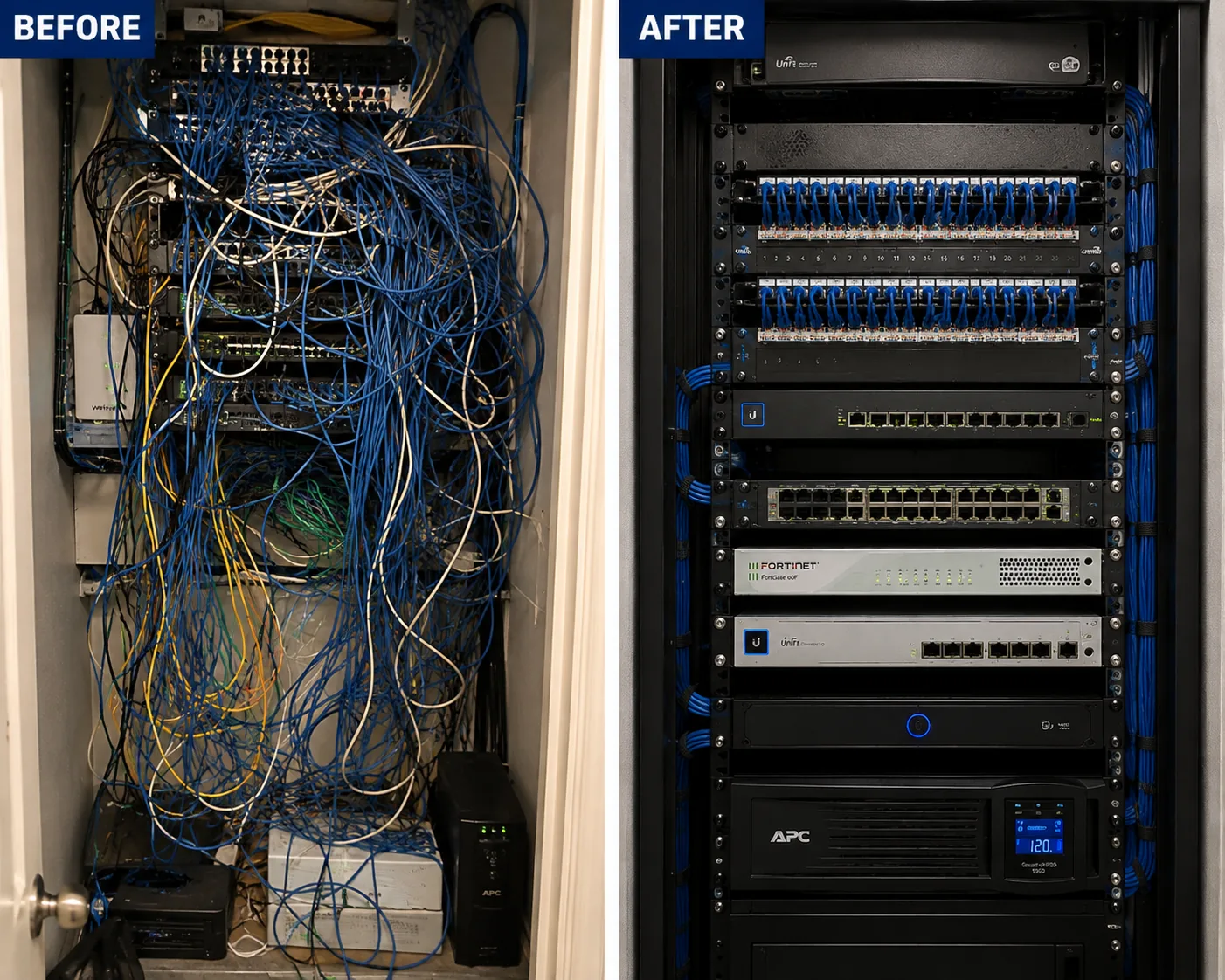
Wakefield, Bronx security camera installation job-library photo: before-and-after views of a network rack, an unlabelled tangle rebuilt into a dressed and identified rack
Photo from our job library, not taken in Wakefield: before-and-after views of a network rack, an unlabelled tangle rebuilt into a dressed and identified rack. Plenty of Wakefield basements hold a small version of the "before" picture, an old recorder, a strip of camera power adapters and a router knotted together on a shelf near the boiler, and turning that into one labeled, battery-backed shelf is often the first job on an inherited system.
Complete Services

Every Security Camera Installation Service in Wakefield

New House Systems

Gate, driveway, doors, yard and garage cameras on a wired recorder, planned from the curb inward.

Two- and Three-Family Setups

Shared-space cameras with separate logins for owner, tenants and relatives.

Shop Systems

Door, counter, aisle and back-room cameras for White Plains Road, East 233rd and East 241st Street stores.

Building Systems

Entry, mailbox, stair, cellar and roof cameras for walk-ups, co-ops and small new buildings.

New-Construction Prewire

Camera cable and head-end planning for buildings going up on the corridor.

Repairs and Takeovers

Dead cameras, lost passwords, inherited recorders and clips for police, starting at the setup-only visit.

For camera work anywhere else in the borough, start at our security camera installation in the Bronx page, or see security camera installation across NYC.

FAQ

Wakefield Security Camera Installation FAQ

Our house is on the northern blocks near East 241st Street, and my mother owns a house a few streets away in Mount Vernon. Can one visit cover both properties?
+

Yes. We regularly work on both sides of the line, and a technician can look at both houses on the same trip. The Wakefield house is quoted on our Bronx rate and the Mount Vernon house on the Westchester rate, each with its own line-by-line quote. If both households want to view each other's cameras, each system can give the other family a view-only login.

We keep an e-bike in the back yard behind a locked gate. Is a camera enough, or should the bike come inside at night?
+

A camera records the theft; it does not prevent someone with bolt cutters from taking the bike, as the East 224th Street case showed when a chain on a gated driveway was cut. The safest choice is to bring the bike into the garage or house at night or lock it to a fixed ground anchor. If it stays in the yard, aim one camera directly at where it is kept and one at the gate, with a light that comes on when someone enters.

We are renovating and the walls in our Wakefield house are open right now. Is this the cheapest moment to run camera cable?
+

Usually, yes. With walls and ceilings open, cable can go straight to every planned camera location without fishing through finished plaster, and we can set boxes at the eaves and by each door. The cameras themselves can go up after painting. Send us the renovation plan or photos of the open framing and we will mark where each run should go before the walls close.

Relatives from Jamaica stay with us for a few months at a time. Can a visitor get camera access that ends when they go home?
+

Yes. We create a separate login for the visitor with only the views you choose, usually the gate and the door they use, and you delete it the day they leave. Because each person has their own login, removing the visitor does not affect anyone else in the house. We can show you how to add and remove a login yourself so you do not need a service visit each time.

Our family comes and goes through the side door off the driveway, not the front door. Can a video doorbell or door camera go on the side entrance instead?
+

Yes, and on many Wakefield houses that is where it belongs. A wired doorbell or a small door camera at the side entrance shows who is at the door the family actually uses, and it often doubles as a view along the driveway. If there is no doorbell wiring there, we run power from the recorder or the existing chime circuit. The front door can still have its own camera or doorbell.

I run a small hair salon from the ground floor of our house. Where can cameras go without making clients uncomfortable?
+

Cover the entrance from outside and the doorway from inside, so you see everyone who comes and goes, and keep cameras out of any area where clients change, wash or expect privacy. If you want the chairs on camera for disputes, tell clients and post a notice. The salon cameras can have their own login separate from the family's house cameras.

The old cameras a relative put up years ago are dead and still hanging off our brick. Can you take them down and patch the holes?
+

Yes. We remove dead cameras, mounts and loose cable, then fill and seal the holes so water cannot get into the brick. Where an old mounting spot happens to be in the right place for a new camera, we reuse it to avoid drilling again. The removal is listed as its own line on the quote so you can see what it involves.

Our driveway camera will see a little of our neighbor's driveway on the other side of the fence. Should we talk to them before it goes up?
+

It is a good idea. Show them where the camera will go and what it will see, and offer to mask their windows, door and any part of their yard that shows in the frame. Many neighbors are glad to have the shared fence line on record, and some ask for a view of it. Talking first avoids a dispute later and keeps you well clear of the state law on neighbors' back yards.

Our Victorian has carved wood brackets and trim around the porch. Will you mount cameras on that decorative woodwork?
+

No. Decorative trim is often old, thin and hard to replace, and it does not hold a camera steady. We mount on a solid porch beam, the porch ceiling or flat siding, using a small block where needed so the base sits flat, and keep cable hidden inside the porch roof. The trim stays as it is.

How does payment work on a Wakefield camera job?
+

The estimate is free. Once you approve the written quote, the job is scheduled with a deposit, and the balance is due when the work is complete and we have walked you through every camera view on your phone. Setup-only service visits are billed at the published Bronx rate of 225 dollars for the first hour, then 30-minute blocks.

If we sell our Wakefield house in a few years, can the camera system come with us to the next home?
+

The cameras and recorder can usually be taken down and reinstalled at the new house, though cable inside walls normally stays behind. Many sellers leave the system for the buyer instead, after resetting the recorder and removing their own accounts. Tell us which you plan when the time comes, and we can quote either the move or the handover reset.

After you install the system, can Abstract Enterprises Security Systems see our cameras?
+

Not unless you want us to. At handover the administrator password is yours, every login belongs to a person in your household or business, and we do not keep remote access. If you later want help, you can give us temporary access for that visit and remove it afterward. Your recordings stay on your recorder and your phones.

More Security Camera Installation near Wakefield

Security Camera Installation Bronx | No Monthly Fees · Security Camera Installation NYC | Licensed Installer · Security Cameras Installed in Manhattan · Brooklyn Security Camera Installation · Security Camera Installation Queens NY · Staten Island Security Camera Installation · Long Island Security Camera Installation NY · Hudson Valley Security Cameras · Security Camera Installation Nassau County NY · Security Camera Installation Suffolk County NY · Westchester Security Camera Installation · Rockland County Camera Installation · Orange County NY Security Cameras · Putnam County Camera Installation · Dutchess County Security Cameras · Ulster County Security Camera Installation | Kingston NY

Security Camera Installation Allerton Bronx NY · Security Camera Installation Bathgate, Bronx NY | Abstract Enterprises Security Systems · Security Camera Installation Baychester Bronx NY · Security Camera Installation Bedford Park Bronx NY · Security Camera Installation Belmont Bronx NY · Security Camera Installation Bronx | No Monthly Fees · Security Camera Installation Bronx River, Bronx NY · Security Camera Installation Bronxdale Bronx NY · Security Camera Installation Bronxwood Bronx NY | Abstract Enterprises Security Systems · Security Camera Installation Bruckner Bronx NY · Security Camera Installation Castle Hill, Bronx NY | Abstract Enterprises Security Systems · Security Camera Installation City Island Bronx NY · Security Camera Installation Claremont Bronx NY | Abstract Enterprises Security Systems · Security Camera Installation Clason Point Bronx NY | Abstract Enterprises Security Systems · Security Camera Installation Co Op City Bronx NY · Security Camera Installation Concourse Bronx NY | Abstract Enterprises Security Systems · Security Camera Installation Country Club Bronx NY · Security Camera Installation Crotona Park East Bronx NY · Security Camera Installation East Tremont Bronx NY · Security Camera Installation Eastchester Bronx NY · Security Camera Installation Edenwald Bronx NY · Security Camera Installation Edgewater Park Bronx NY · Security Camera Installation Fairmount Bronx NY | Abstract Enterprises Security Systems · Security Camera Installation Fieldston Bronx NY | Abstract Enterprises Security Systems

Other services in Wakefield

Alarm Installation Wakefield Bronx NY · Fire Alarm Installation Wakefield Bronx NY · TV Installation Wakefield Bronx NY · Access Control Installation Wakefield Bronx NY · Structured Cabling Wakefield Bronx NY · Intercom Installation Wakefield Bronx NY · Door Buzzer Repair Wakefield Bronx NY | Bells to Mid-Rises

Put Your Wakefield Gate, Driveway and Shop Door on Record

Whether it is a camera that finally shows faces at the gate, a system that keeps the cars in a long side driveway on record all night, separate views for the families in a two-family, or a White Plains Road shop that needs its door and aisles covered under the tracks, the first step is the same: tell us what you have and who lives or works there. We will walk the lot from the curb to the garage, aim every camera at your property and not your neighbors', and send a written quote. Call (646) 490-0629 or use the quick form, and we will book within 2 hours.