What are you looking for?
About Us Contact Us Careers Get a Free Quote (800) 486-0943
Pick a service
✅ Got Your Own System?
🎬 Home TheatreQuote 🎶 AV SoundQuote 🔑 Access ControlQuote
Now pick your area
Pick your area
Long Island
Hudson Valley
Services available
Pricing & Tools
Pick a service for pricing
🚪 Intercom Pricing 🔔 Buzzer Repair Pricing
Calculators
📹 Camera System Calculator 🚨 Alarm Calculator ⚡ Cabling Quote Builder ✅ Got Your Own System?
Select your area
Front camera on the two-family gone dark, a clip from a Castle Hill Avenue counter that has to be pulled before the recorder writes over it, or a building system nobody can log into any more? Call the Bronx line: (646) 490-0629
Home › Security Camera Installation Bronx › Unionport
Semi-Detached Brick Two-Families · Detached Colonial Revival Houses · Prewar Attached Rowhouses · 1940s and 1960s Apartment Buildings · Unionport Road Co-ops · Castle Hill Avenue, Lafayette Avenue and White Plains Road Storefronts · Licensed Low-Voltage

Security Camera
Installation in
Unionport

Two Households Under One Roof · Stores With Apartments Above · Blocks Beside the Cross Bronx and the Bruckner

Security camera installation in Unionport is, more often than not, a two-family job. Bronx Community Board 9 describes the neighborhood, pressed between the Cross Bronx Expressway, Bruckner Boulevard and White Plains Road, as largely made up of two-family homes, and the side streets off Castle Hill Avenue bear that out: semi-detached brick pairs, detached Colonial Revival houses in siding on small lots, and rows of prewar attached houses. Mixed in are 1940s and 1960s apartment buildings, mid-rise co-ops along Unionport Road, storefronts with apartments over them on Castle Hill Avenue, Lafayette Avenue and White Plains Road, and a fresh crop of buildings rising near Bruckner Boulevard. A camera plan here has to settle three things at once: which household sees which camera, how the cable gets through brick, siding or block without leaving a mess, and how a front camera copes with a block where the traffic off the expressways never really stops. We walk the property, give each camera one plain job, and put every camera, lens, mount, cable run, recorder and setup task on a written quote before anything is ordered.

Reviewed and updated November 4, 2026 by Anwar Timothy, NYS license #12000287431 · Sources: Bronx Community Board 9's neighborhood page and its FY2026 District Needs Statement; the CityNeighborhoods, Homes.com, NeighborhoodScout and City-Data profiles of Unionport; NYBits and Redfin co-op listings for Havemeyer Avenue, Ellis Avenue and Unionport Road; Wikipedia entries for Unionport and Castle Hill; the NYPD 43rd Precinct page; New York YIMBY on 1933 Lafayette Avenue, Bruckner Heights at 2070 Chatterton Avenue and 1017 Olmstead Avenue, 2069 Bruckner Boulevard and 900 Castle Hill Avenue; Norwood News and News 12 Bronx on the Haviland Avenue and Newbold Avenue shootings; PIX11 on the Quimby Avenue fire; News 12 Bronx on the Castle Hill Avenue four-alarm fire and on Varsity Army & Navy; PIX11 on Bronx camera funding; Yahoo News on the Throggs Neck BID cameras; the Bronx District Attorney's BronxCAMS enrollment page; the NYS Department of State installer license application and the NYC Business licensing page; NYC Parks on Church Triangle; the Historic Districts Council list of Bronx districts; Brick Underground on landlords and footage; NYC Housing Maintenance Code §27-2045, Multiple Dwelling Law §50-a and NY Civil Rights Law §52-a · Dispatched from 460 E Fordham Rd

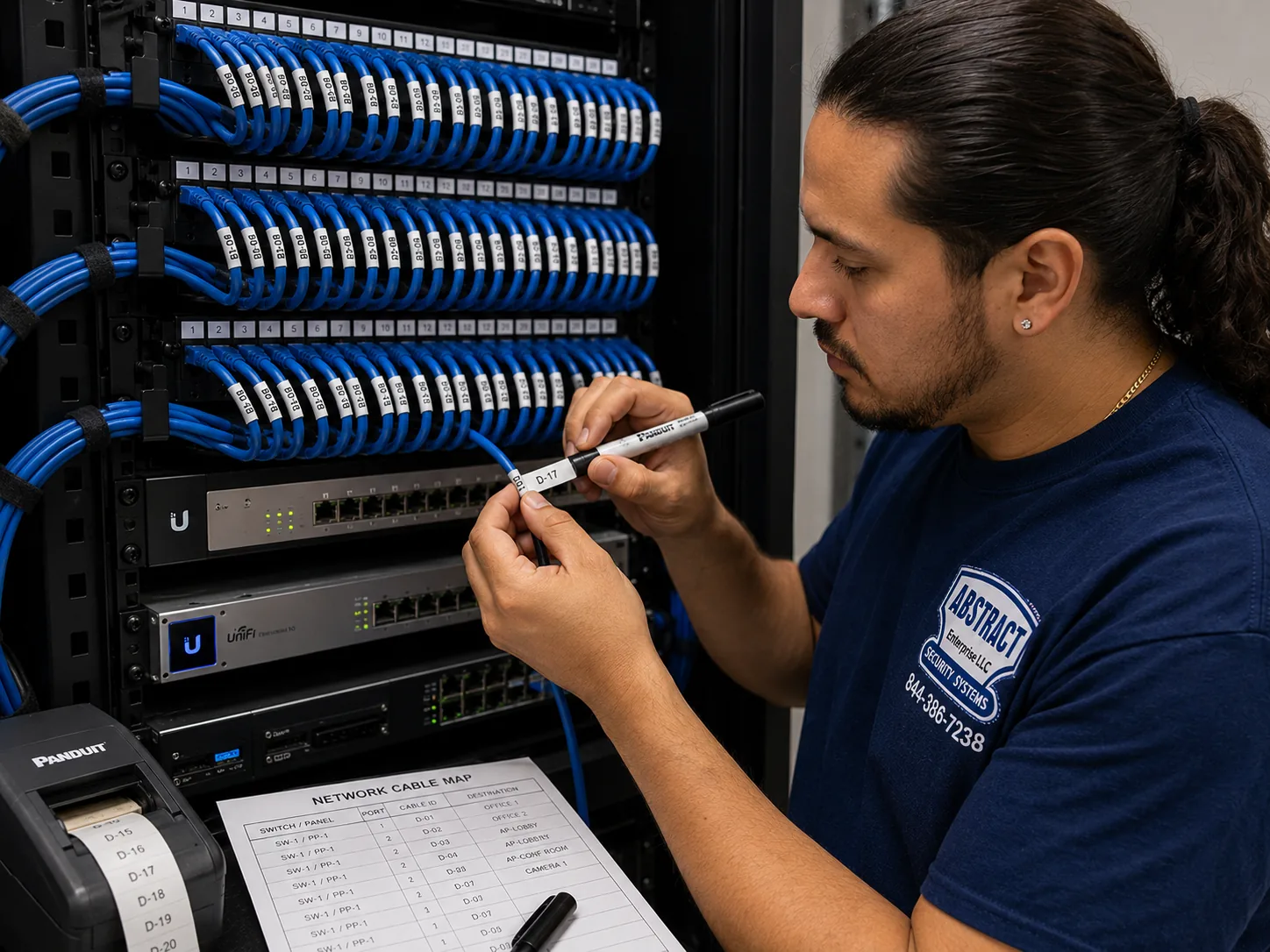
Unionport, Bronx security camera installation job-library photo: a technician printing cable labels at a patch panel beside a printed port map
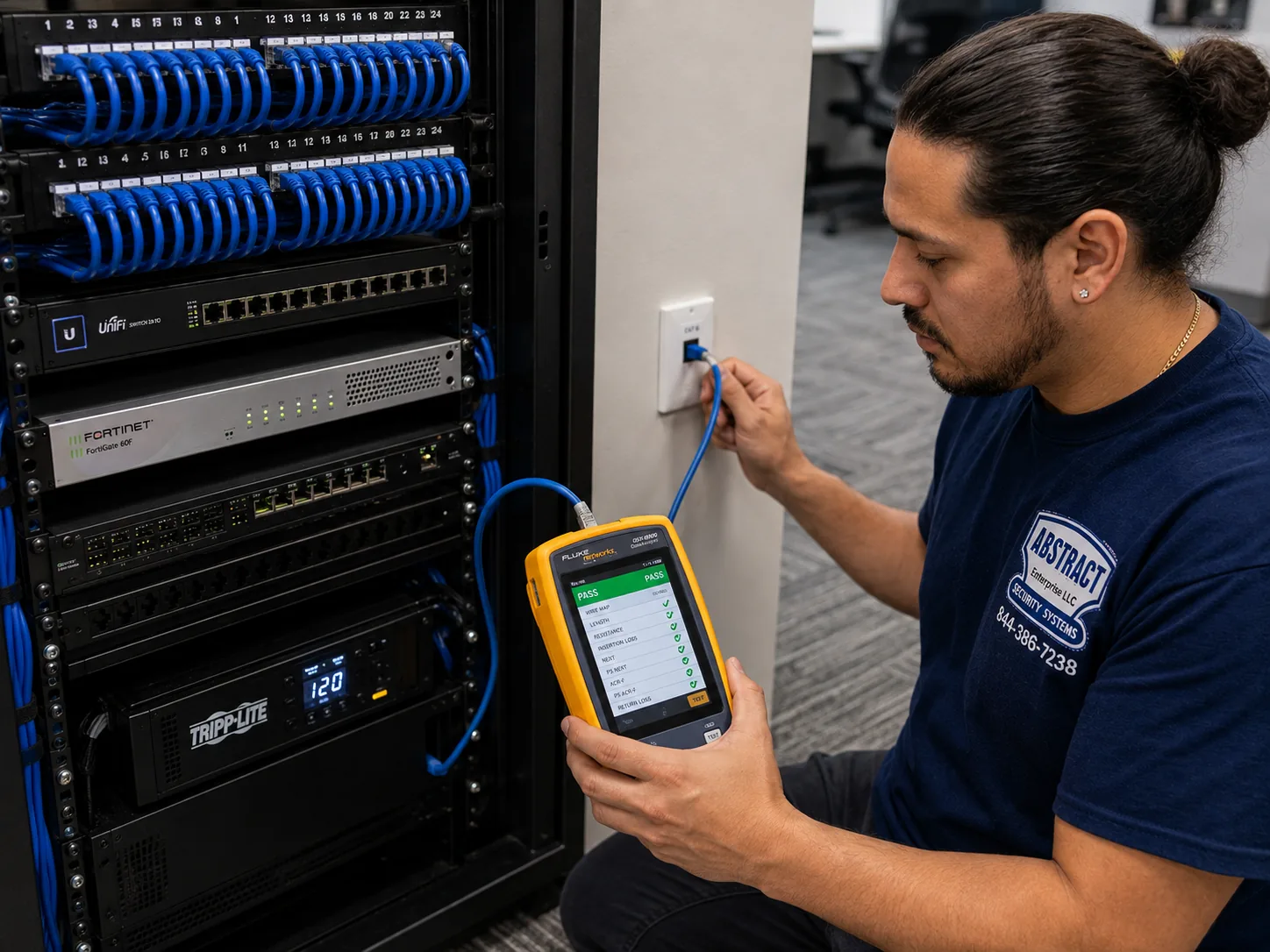
Photo from the AESS job library, not taken in Unionport: a technician printing cable labels at a patch panel beside a printed port map. On a Unionport two-family where the upstairs tenant, the downstairs owner and a store below may all share one recorder, every run gets a plain name like "Front stoop," "Side gap" or "Store register," so nobody has to guess which cable feeds which household's view.
Unionport Camera Quote
Tell us the house, building or store, who approves the work, and which doors, yards, rooms or counters need watching

✅
Request Sent!
We'll call about your Unionport cameras the same business day.
25+
Years Experience
✓
Same-Day Estimates
100%
Licensed & Insured
4.7★
201 Google Reviews

Owner-operated since 2002 · Thousands of jobs completed · Booked within 2 hours

Security camera installation in Unionport usually takes one of three shapes: a wired system for a two-family or rowhouse that covers the front door and stoop, the curb, the side gap, the rear yard and the cellar door, with each household seeing only its own views; a building system for a 1940s or 1960s apartment house or a Unionport Road co-op that covers the street door, vestibule, lobby, laundry room, cellar and stairs, approved by the owner or the board in writing; or a door, counter and back-room system for a store on Castle Hill Avenue, Lafayette Avenue, White Plains Road or Westchester Avenue, often in a building where people live upstairs. Every Unionport job is priced at our Bronx rate and quoted in writing after you send photos or we walk the property, with each camera, mount, cable run, recorder, drive and setup task on its own line. A camera on the front of a semi-detached brick pair fed straight up from the cellar is a short job; a camera on the far wall of a detached garage at the end of a concrete driveway is not, and the quote shows that difference instead of burying it in a per-camera number. The handful of fixed prices we publish, such as a setup-only visit at $225 for the first hour, sit in the pricing section below. Estimates are free, requests are booked within 2 hours, and the work is done under NYS license #12000287431 with insurance in place. Call (646) 490-0629 or use the form.

  • Owner and tenant households get separate logins and separate camera lists, set before the crew leaves
  • Front cameras on highway-edge blocks are tuned so passing traffic does not bury the alerts that matter
  • Store cameras stay on the store; the residential door and the apartments above stay off its recorder
The Neighborhood

Why Unionport Properties Need Security Camera Installation

Unionport is one of the older planned settlements in the East Bronx, and its houses carry that age into every camera job. In 1851 a building association bought a large tract west of Westchester Creek, and Industrial Home Association No. 2 filed its map of Unionport in 1854. The village stayed outside New York City until the 1890s; NY1 gives 1895 for when it joined, while CityNeighborhoods says 1898, and we would rather show both dates than pick one. The IRT Pelham Line arrived in 1918, and the housing boom that followed, running through the 1920s, 1930s and 1940s, filled the blocks with the brick rowhouses and two-family homes that still dominate them. Working-class Irish and German families came first after the subway; Holy Family parish had been founded in 1896 for German Catholics. Then, in the 1950s, the Cross Bronx Expressway was cut through the area. Local accounts describe apartment buildings and single-family homes demolished in its path, and blasting damaged the old Holy Family church so badly that a new one was built in 1962. The expressway was finished in 1963, larger housing replaced smaller buildings in places, and some of Unionport's ordinary streets became exit ramps. The result is a neighborhood where a prewar row, a postwar six-story building and a highway service road can all share a single block, and a camera plan has to work for all three.

What stands here now is mostly small and mostly rented. Community Board 9 calls Unionport largely two-family homes. NeighborhoodScout counts 35.6 percent of the residential real estate as two-, three- and four-unit buildings and reports that most homes are renter-occupied and that many were built by 1939. City-Data's count by year of construction shows 1,205 units from the 1940s, 768 from the 1950s, 1,028 from the 1960s and 1,369 from 2010 to 2019, plus 150 more since 2020, so a technician here moves between plaster-and-brick houses and buildings with modern low-voltage risers in the same week. Homes.com describes postwar high-rises, detached Colonial Revivals with siding on small lots, and large prewar attached rowhouses with seven to nine bedrooms, and puts the median year built at 1945. Along Unionport Road, co-op listings run up to the twelfth floor; on Havemeyer Avenue and Ellis Avenue there are low-rise co-op walk-ups; on Castle Hill Avenue, a 140-unit rental at 1140 Castle Hill Avenue shares the corridor with two-family buildings that have a store at street level and a full basement. Because so many homes are rented, a Unionport camera conversation almost always involves two parties: the owner who pays for the system and the household who lives in front of it. Who sees which camera, who holds the recorder and what the tenant is told are decided at the start, not after a dispute.

The crime picture is mixed and deserves plain words. The 43rd Precinct, which covers Unionport along with Castle Hill, Parkchester and Soundview, names Westchester Avenue, Castle Hill Avenue, White Plains Road and Parkchester as its four main commercial strips. Wikipedia's Castle Hill entry lists the precinct's 2022 totals as 747 robberies, 302 burglaries, 1,039 grand larcenies and 561 grand larcenies of motor vehicles, and a local ranking still places the 43rd among the less safe parts of the Bronx. This year brought two cases on residential blocks: Norwood News and News 12 reported a fatal shooting on Haviland Avenue between Castle Hill Avenue and Havemeyer Avenue on May 24, 2026, and News 12 reported a daytime double shooting in the courtyard of the 124-unit building at 2035 Newbold Avenue on September 26, in which a 19-year-old later died. A camera system does not stop violence, and we will never sell one as if it did. What cameras do well here is narrower and more practical: they record who came through a door, who took what from a store counter or a laundry room, which car stopped at the curb and which way it left, and they give an owner, a board or the police something concrete to work from afterward.

The paperwork side of Unionport is lighter than in some Bronx neighborhoods, and that is worth knowing. None of the Bronx historic districts on the Historic Districts Council's list fall in Unionport, so most houses and buildings here carry no Landmarks review for exterior cameras. No general city law requires cameras in houses or apartment buildings, although multiple dwellings must keep a working intercom or buzzer under the Housing Maintenance Code. Public cameras are arriving slowly: PIX11 reported the Borough President budgeting $1.2 million for NYPD surveillance cameras and $500,000 for sanitation cameras aimed at illegal dumping across the Bronx, and Community Board 9's own FY2026 needs statement includes the blunt line that new cameras are needed and new mailboxes are too small. Owners who want investigators to know their cameras exist can list them, voluntarily, in the Bronx District Attorney's BronxCAMS program, which already holds NYPD and NYCHA cameras and is never published as a public map. None of that watches your stoop, your side gap or your stock room. That is the job a private system does.

Unionport facts that decide where a camera goes

  • Two households per house, often: Community Board 9 describes the neighborhood as largely two-family homes, and NeighborhoodScout counts 35.6 percent of residential property as two- to four-unit buildings.
  • Mostly renters: most Unionport homes are renter-occupied, so owner and tenant permissions shape nearly every camera plan.
  • Four building eras: City-Data counts large groups of units from the 1940s and 1960s and 1,369 built between 2010 and 2019, each with a different path for cable.
  • Stores under homes: Castle Hill Avenue listings include two-family buildings with a store and a full basement, like the one at 1240 Castle Hill Avenue near the train station.
  • Highway edges: the neighborhood is bounded by the Cross Bronx Expressway and Bruckner Boulevard, and the expressway's construction turned some local streets into exit ramps.
  • New buildings arriving: Bruckner Heights finished 330 apartments at 2070 Chatterton Avenue and 1017 Olmstead Avenue in 2026, and permits have been filed for 1933 Lafayette Avenue, 2069 Bruckner Boulevard and 900 Castle Hill Avenue.

What Unionport owners tend to add next. Once the front and rear cameras are working on a two-family, the next request is usually a door station at the street door that rings both floors, or a keypad on the side gate. We leave a labeled spare port on the recorder and, where an entry upgrade looks likely, a spare cable to the front door, so the cellar ceiling only has to be opened once.

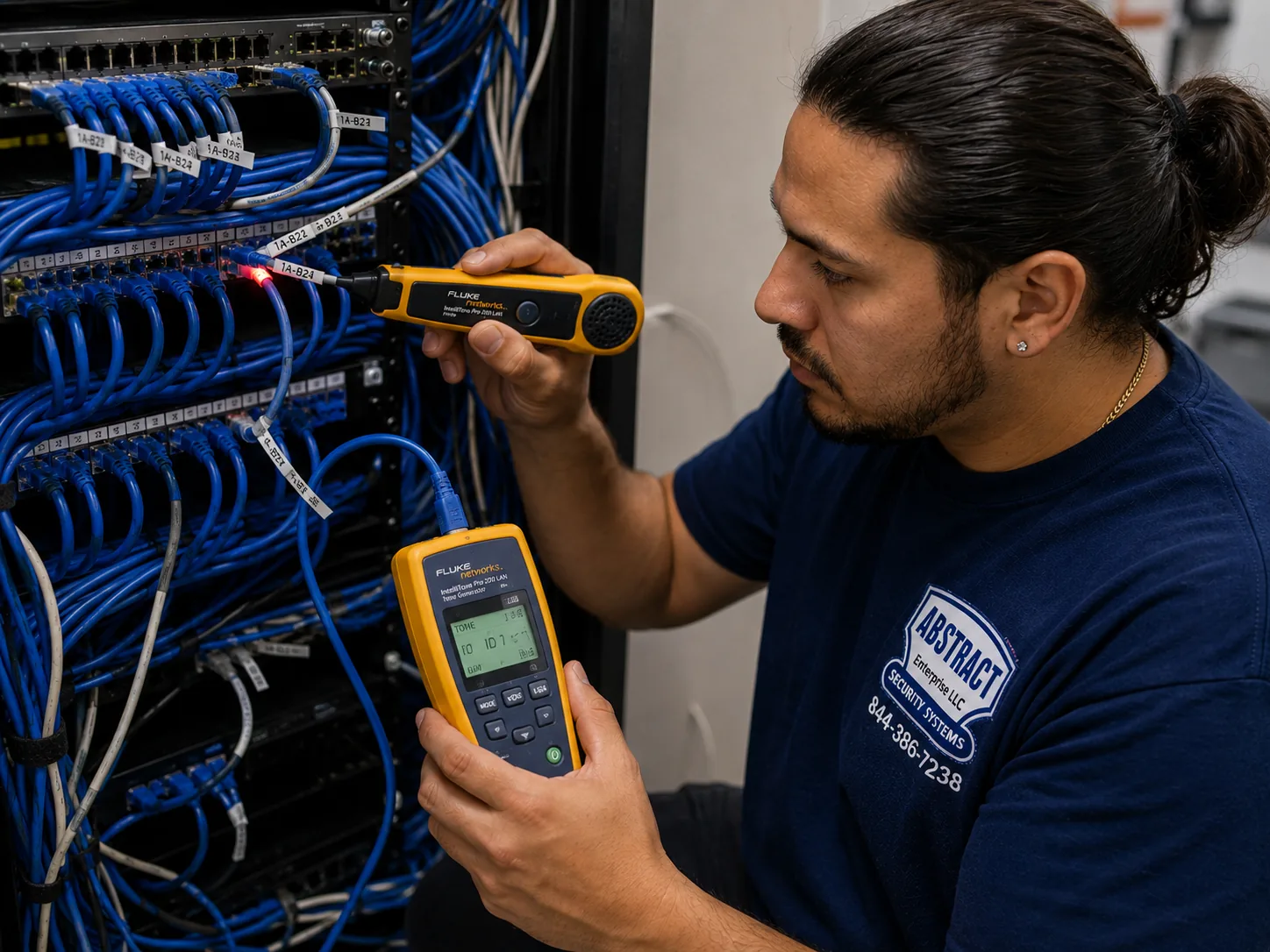
Unionport, Bronx security camera installation job-library photo: a technician tracing an unidentified cable run at a patch panel with a tone generator and probe
Photo from the AESS job library, not taken in Unionport: a technician tracing an unidentified cable run at a patch panel with a tone generator and probe. A Unionport house that has passed through several owners since the 1940s often has old phone, cable TV, alarm and camera wire tangled along the cellar joists, and tracing each run like this shows which ones still lead somewhere before anything is cut or reused.

Front Camera Dark on the Two-Family, or a Store Clip That Has to Be Pulled Today? Fast Camera Help in Unionport

Unionport calls tend to arrive in two forms. In the first, a camera has quietly stopped: the rear-yard view on a two-family after a summer storm, the lobby camera in a 1960s building after the internet provider swapped the modem, the camera over a Castle Hill Avenue register after someone unplugged a power strip to charge a phone. In the second, something has happened, a package has gone from a stoop, a laundry machine has been pried open, a car at the curb has been entered, and the clip has to be saved before the recorder writes over it, which on a small drive can happen within days. For a dead camera, write down which one it is and when it last showed a picture, check whether the recorder and any switch beside it still show lights, and do not reset the recorder to factory settings, which can wipe passwords and remote access along with the fault. For an incident, leave the recorder running, note the camera name and the exact time, and if you know how, copy that window to a USB stick or lock it in the recorder's playback screen. If anyone was hurt or threatened, call 911 first and tell the officers there is video. Then call (646) 490-0629. We book every request within 2 hours, talk you through what can be done over the phone, and send a technician when the fix needs hands on the equipment.

Beside the Expressways

Where the Cross Bronx Meets the Bruckner: Camera Work on Unionport's Highway Edge

Few Bronx neighborhoods sit as close to two expressways as Unionport. The Cross Bronx runs along one edge, Bruckner Boulevard and the Bruckner Expressway along another, and the two meet nearby. When the Cross Bronx was finished in 1963, some local streets became exit ramps and service roads, and houses that once faced a quiet residential block now face traffic that rarely stops. That changes the camera job in ways an installer from elsewhere can miss. A front camera on a highway-edge two-family sees hundreds of vehicles an hour. It is lit, then darkened, by a steady sweep of headlights after sunset. It records a background that is always moving, so a careless motion setting will fire an alert every few seconds until the owner turns alerts off altogether, which is the opposite of what a camera is for. None of these problems needs exotic equipment. They need placement and settings chosen for the block. The table below shows what we look at.

Condition on the blockWhat it does to the pictureWhat we do about it
Constant traffic on a service road or rampEndless motion triggers; alerts become noisePerson-only detection inside a zone drawn on your stoop and walk, with the roadway left outside the zone
Headlights sweeping across the front at nightExposure jumps; faces wash out for a second at a timeAim the camera along the facade rather than straight at the roadway, and use a lens and setting that recovers quickly from bright points
Vehicles moving faster than ordinary side-street trafficPlates and car details blurFaster shutter on the curb camera, and a narrower lens on the stretch where cars actually stop rather than where they pass
A wide road between the house and the far curbThe far side is too small in the frame to identify anythingKeep the far side as context only; identify at your own door, stoop and gate
Wind and pressure from passing trucksLoose mounts drift out of aim over monthsSolid anchors into brick or framing, not just siding, and a re-check of aim during the follow-up
Road grime and exhaust filmA soft, foggy picture over timeMounts under an eave or overhang where possible, and a lens wipe on every service visit

Draw the alert zone on the house, not the road

The single most useful setting on a highway-edge camera is the alert zone. Modern recorders and cameras let us draw an outline on the picture and tell the system to raise an alert only when a person appears inside it. On a Unionport front, that outline usually covers the bottom of the stoop, the walk to the door and the gate, and leaves the sidewalk, the curb lane and the roadway outside. Recording continues across the whole frame all the time, so the street is still on file if anything happens there, but your phone only lights up when someone steps onto your property. On a house where the owner wants to know about cars stopping in front, we add a second, smaller zone on the curb right outside, set to vehicles that stay for more than a short time rather than vehicles passing through.

Aim along the facade, and let the light fall behind the camera

A camera pointed straight out at a busy road stares into oncoming headlights all night. A camera mounted at the corner of the house and aimed back along the front, toward the door, keeps the headlights at its side and sees the faces of people approaching the stoop. Where the front door sits in a shallow vestibule, as it does on many semi-detached brick pairs, we look at whether the porch light falls on the visitor or on the lens, and re-aim or shade it. A steady light that stays on keeps most current cameras in color all night; a light that snaps on only when someone arrives makes the first seconds of the clip the worst ones.

Which vehicles a front camera can really identify

Owners on blocks near the ramps sometimes ask for a camera that reads every plate going by. That is a specialized job with its own camera, lens, angle and lighting, and on a fast multi-lane road it is not realistic from the front of a house. What a well-placed camera can do is show the make, color and shape of a car that stops at your curb, the direction it came from and went, and, at the moment it slows or parks, often the plate. We set the curb camera for that moment, not for the stream of traffic, and we say so on the quote so nobody expects more than the angle can give.

Blocks that end at a fence or a ramp

Where the expressway cut through, a few blocks end abruptly at a fence, a wall or an on-ramp. The last houses on those blocks have a side that faces no neighbor at all, and that side is often dark. We treat it as a second front: a camera on the corner of the house, covering the side yard and the rear gate, with its own alert zone, and lighting checked on the walk-through. The same goes for houses whose rear yards back onto a retaining wall, where the only way into the yard is from a neighbor's yard or over the wall.

Stores Below, Homes Above

What Two Unionport Fires Teach About Camera Work in Mixed-Use Buildings

Two fires in the last few years are part of how many Unionport owners think about their buildings. In October 2022, PIX11 reported three people dead and several injured in a two-alarm fire on the top floor of a multi-use building at 2165 Quimby Avenue near Castle Hill Avenue. In July 2023, News 12 reported a four-alarm fire on Castle Hill Avenue, at 1101 to 1103, that left seven firefighters and a civilian injured, with the roof sagging and partly collapsing. We are not suggesting cameras had anything to do with either fire, or could have prevented them. We bring them up because they are a reminder that the mixed-use buildings on Castle Hill Avenue and the streets around it, with a store at street level and homes above, are exactly the buildings where camera work has to respect fire separation, and where the camera system itself should be planned to survive a bad night.

Every hole through a rated wall or floor gets sealed

In a building where a store sits under apartments, the floor and walls between them, and the walls around the stair, are meant to slow fire and smoke. Camera cable that travels from a store's back room up to a recorder, or from a cellar to a residential landing, has to cross those barriers somewhere. Each crossing is a hole, and an unsealed hole is a path for smoke. We keep crossings to as few as possible, group cables through a single sleeve where we can, and seal every opening through a rated wall or floor with firestop rated for that assembly before we leave the building. On the written quote, firestopping appears as its own line, so an owner can see it was done.

Keep the stair clear and the exit signs visible

Stair and hallway cameras are useful in mixed-use buildings because the residential stair is often the one space the store owner, the building owner and the tenants all share. A camera there is mounted where it does not block an exit sign, a sprinkler head, an emergency light or the swing of a door, and its cable runs in a way that does not hold a self-closing door open or pass through the door frame. We never mount anything that changes how a stair door closes and latches.

Plan the recorder so it is not the first thing lost

A recorder on a top-floor shelf or in a store's back room sits where heat and water may reach it first. Where the building allows, we put the recorder in a locked, dry spot low in the building, away from the boiler and above any floor that has taken water, on a battery unit so a power dip does not corrupt the drive. For owners who want an extra layer, we set the recorder to send copies of selected clips, or of alert clips from the most important cameras, to a phone or a cloud account, so the record of what happened at the door does not depend on one box surviving. That is a choice with its own trade-offs in internet use and privacy, and we walk through those before switching it on.

Cameras are not fire detectors

Some cameras advertise smoke or flame detection. These features can be useful extras, but they are not a substitute for smoke alarms, carbon monoxide alarms or a building fire alarm system, and we never present them that way. If your building needs fire alarm work, that is a separate system with its own rules, handled separately. What a camera system does well in a mixed-use building is record who used the stair, who propped a door, and who went in and out of the store's back door after hours.

What We Install

Security Camera Installation Services in Unionport

These are the camera jobs Unionport homeowners, landlords, co-op boards, managing agents and shopkeepers ask us for most. Each one is quoted in writing after photos or a walk-through, with every item on its own line, and a recorder system you own carries no monthly fee.

🏠

Two-Family Front and Stoop

A head-height camera at the shared street door and a wider view of the stoop and gate, with each household's access set separately.

↔️

Side Gaps Between Houses

Corner-mounted cameras looking down the narrow passage between detached houses, toward the yard where most break-ins start.

🌿

Rear Yards and Fences

Yard, back-door and fence-line views on rowhouses and two-families, framed to stay on your own yard and off the neighbors'.

🚗

Driveways and Garages

Cameras on detached and attached garages and on the cars beside them, with cable taken across concrete without an ugly scar.

🏢

Apartment Building Entries

Street door, vestibule, lobby and mailbox views for 1940s and 1960s buildings, with the recorder in a locked cellar room.

🧺

Laundry Rooms and Cellars

Hard-cased cameras in basement laundry rooms, at cellar doors and outside boiler rooms, where trouble happens out of sight.

🏘️

Co-op and Condo Systems

Board-approved coverage for Unionport Road mid-rises and Havemeyer Avenue and Ellis Avenue walk-ups, with written access rules.

🛍️

Storefronts Under Apartments

Door, counter, floor and stock-room cameras for shops on Castle Hill Avenue, Lafayette Avenue, White Plains Road and Westchester Avenue.

🔧

System Takeovers

Inherited recorders traced, labeled, re-passworded and set up properly, or replaced only where the old equipment cannot do the job.

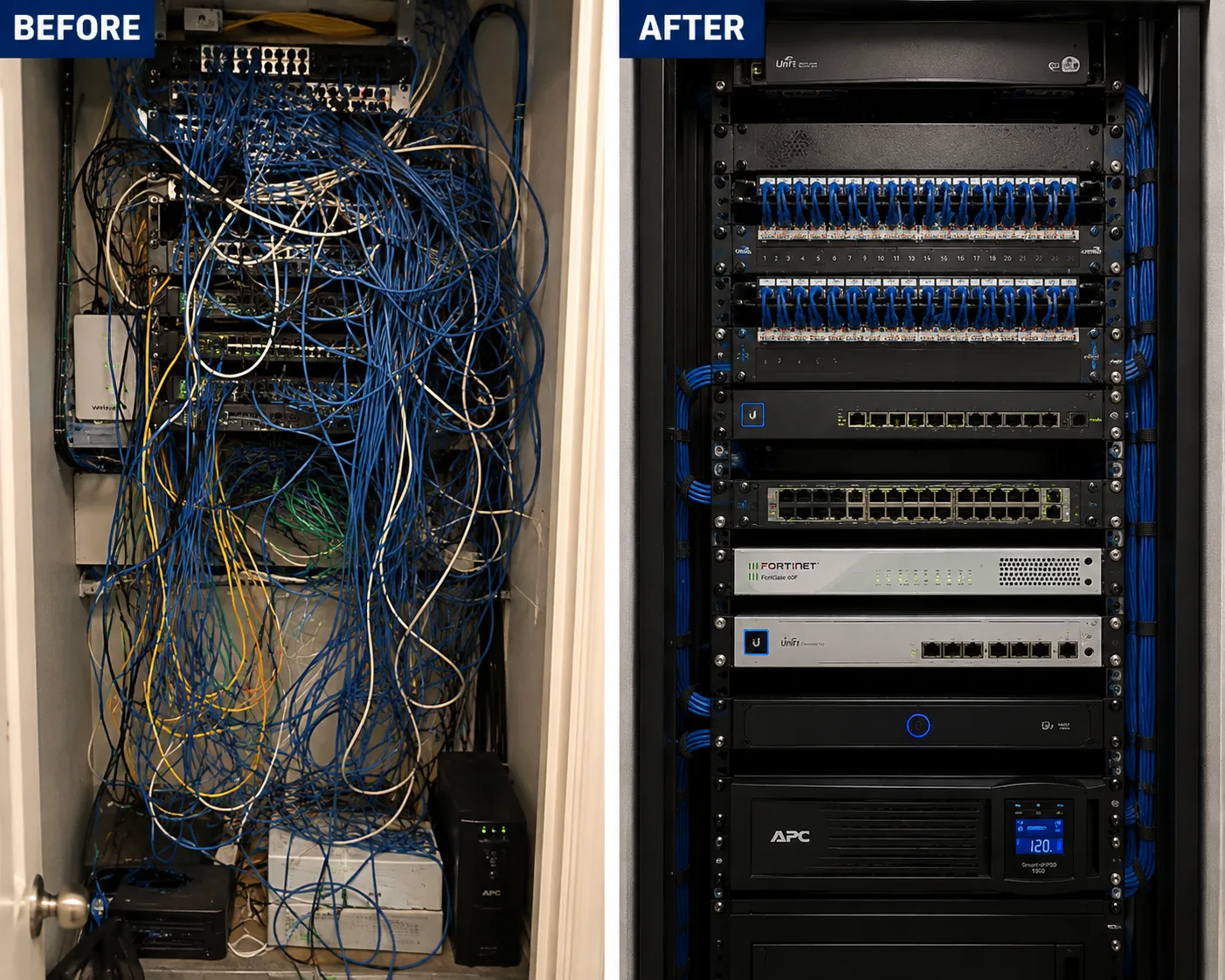
Unionport, Bronx security camera installation job-library photo: before-and-after views of a network rack, an unlabelled tangle rebuilt into a dressed and identified rack
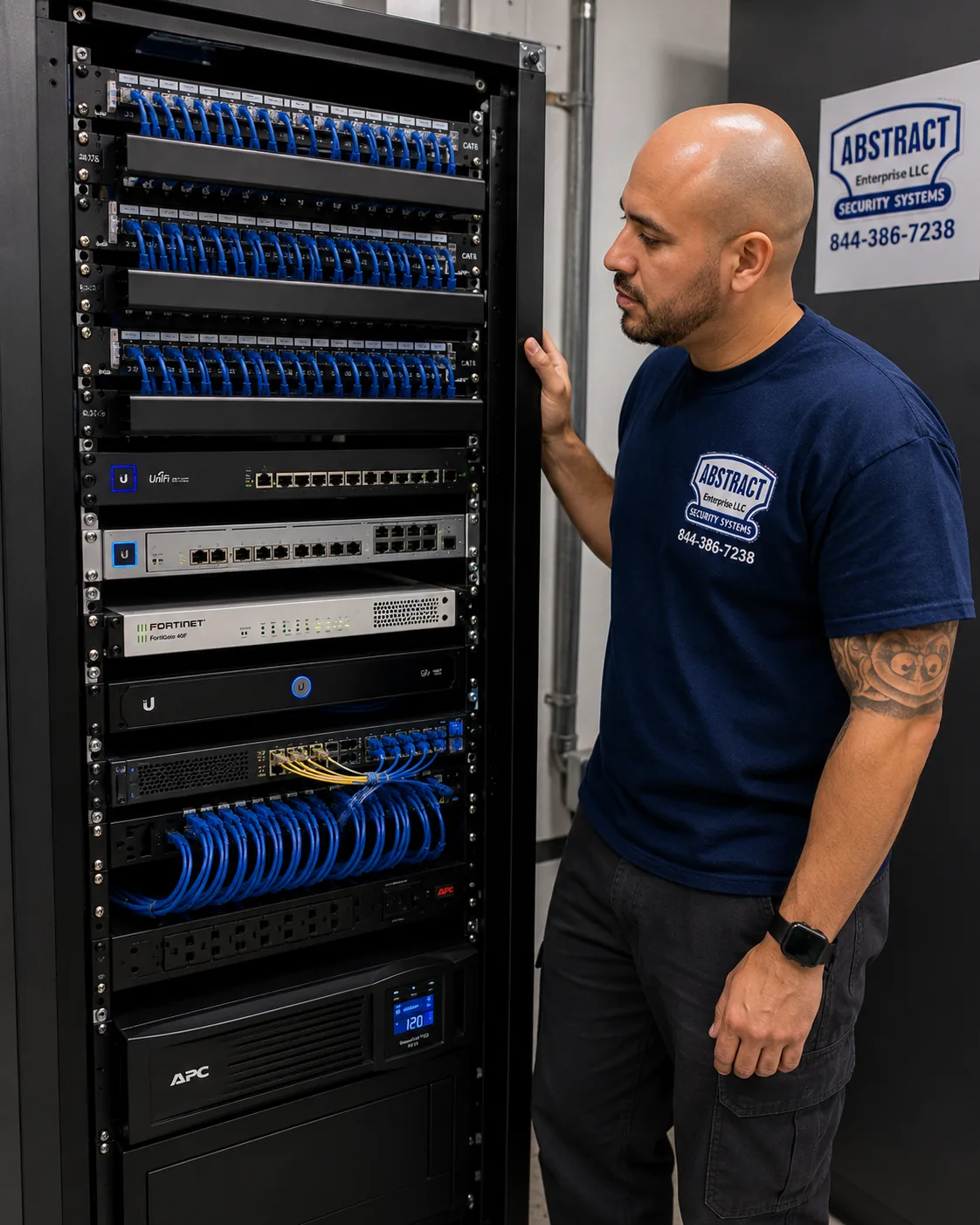
Photo from the AESS job library, not taken in Unionport: before-and-after views of a network rack, an unlabelled tangle rebuilt into a dressed and identified rack. A Unionport apartment building that has had cameras added by a different contractor every few years, or by the super on weekends, often ends up with a cellar closet like the left side, and taking it over starts with getting it to look like the right.
Building Specialists

Security Camera Installation for Unionport's Architecture

The sources describe a neighborhood built mostly between the 1920s and the 1960s, with a newer layer added since 2010: semi-detached brick two-families, detached Colonial Revival houses in siding, large prewar attached rowhouses, 1940s brick apartment buildings, 1960s buildings and mid-rise co-ops, and new construction near Bruckner Boulevard and Lafayette Avenue. Each offers a camera a different surface and a different way back to the recorder.

Semi-Detached Brick Two-Families

Pairs of brick houses sharing a center wall, each with its own stoop, a cellar, and often a narrow driveway or yard on the open side.

Detached Colonial Revival Houses

Frame houses in siding on small lots, with a few feet of side gap, an attic, and frequently a garage at the back.

Prewar Attached Rowhouses

Large attached houses, some with seven to nine bedrooms, with plaster walls, deep cellars and no side access at all.

1940s Brick Apartment Buildings

The single largest group of units by decade in City-Data's count, with cellars, small lobbies and basement laundry rooms.

1960s Buildings and Unionport Road Co-ops

Mid-rise elevator buildings, some cooperative, with block cellars, elevator lobbies and parking areas.

Buildings Finished Since 2010

Newer rentals and mixed-use buildings, such as Bruckner Heights on Chatterton and Olmstead Avenues, with modern telecom rooms and developer-installed systems.

How each building type changes the camera work

BuildingWhat the camera mounts onHow the cable reaches the recorderWho has to say yes
Semi-detached brick two-familyBrick beside the door, the stoop soffit, the rear brick wallUp from the cellar through a sealed opening in the brick, or down from the attic inside the eaveThe owner; the tenant should be told which cameras see shared space
Detached Colonial Revival in sidingA mounting block fixed through the siding into sheathing and framing, or the wood trimAttic to eave, or cellar to the sill, with exterior openings sealed behind the blockThe owner; neighbors consulted if a ladder must stand on their side
Prewar attached rowhouseBrick or stone at the front, brick or stucco at the rearThrough the cellar front to back, then up through closets or a chase to the upper floorsThe owner
1940s brick apartment buildingBrick at the street door; plaster in the lobby and halls; block or brick in the cellarAcross the cellar ceiling to a locked room, up a stair or pipe chase to landingsThe owner or managing agent; tenants notified in writing
1960s building or co-opBrick or block outside; plaster, drywall or block insideCellar ceiling and core-drilled openings in block, then a riser to upper floorsThe co-op board or the owner, through the managing agent
Building finished since 2010Block, panel or masonry outside; drywall and lay-in ceilings insideAbove corridor ceilings to the building's telecom roomThe owner or developer; the commercial landlord for ground-floor stores

Semi-detached brick pairs: a shared center wall, two front doors close together

On a semi-detached pair, your stoop and your neighbor's stoop often sit only a few feet apart, separated by a railing or a low wall. A front camera on your side has to see your door and your visitors without making a habit of recording your neighbor's door. We usually mount it on the brick on the open side of your entrance, aimed back across your own stoop toward the center wall, so the frame ends near the railing. The shared center wall stays clear of mounts; anything fixed there affects both houses. Cable comes up from your own cellar through a single sealed opening low on the front, or down inside the stoop soffit, so nothing runs across the face of the brick. At the rear, these houses usually have a fenced yard and a back door to the cellar; one camera on the rear wall, high enough to be out of reach but low enough to see faces at the back door, covers both.

Detached houses in siding: mount on the framing, not on the skin

The detached Colonial Revival houses Homes.com describes on small Unionport lots are mostly frame houses clad in siding. Siding is a skin, not a structure. A camera screwed only into siding loosens, drifts and lets water in behind the panel. We fit a mounting block designed for the siding profile, fix it through into the sheathing and framing behind, seal the cable opening behind the block, and mount the camera on the block. Where the house has wood trim at the corners or under the eaves, the camera often goes there instead. Cable runs inside: down from the attic into the eave for upper cameras, up from the cellar through the sill for lower ones. On these lots the side gaps are narrow, and the back of the house often holds a garage reached by a driveway, so the typical plan is front, both side gaps from the corners, the rear yard and the garage.

Prewar attached rowhouses: everything comes through the cellar

An attached rowhouse has no side to work from. Every cable for the front and the back has to travel through the house itself, which in practice means the cellar. We run cable along the cellar joists from the front wall to the rear wall, come up through the front foundation or the stoop for the door camera, and through the rear wall for the yard camera. Cameras for upper floors, such as one watching a rear roof or extension, reach the recorder through a closet, a chase or a pipe opening rather than the face of a plaster wall. The large prewar rowhouses in Unionport, some with seven to nine bedrooms, may hold several households or a large family across three floors; the recorder goes wherever the owner wants control to sit, and each floor gets only the views it needs.

1940s brick apartment buildings: the cellar is the backbone

The 1940s buildings that make up the biggest single decade in City-Data's count generally share a layout: a street door into a small vestibule and lobby, a stair or a single elevator, a cellar with the boiler, meters, storage and often a laundry room, and a rear door to a yard or alley. The cellar ceiling is the natural route for camera cable, carrying it from a locked room to the street door, the lobby, the laundry room and the rear door. Landing cameras on upper floors are reached through a stair chase or pipe opening so hallway plaster stays intact. These buildings rarely have staff on site at night, so the cameras that matter most are the ones that show a face at the street door and at the rear and cellar doors, and alerts go to the super or the managing agent after hours.

1960s buildings and Unionport Road co-ops: block cellars and board paperwork

The 1960s buildings and mid-rise co-ops, like those along Unionport Road with apartments up to the twelfth floor, tend to have concrete block in the cellar and around the core, an elevator lobby, and sometimes a parking area. Block is hard on cable routes but good for mounts. We plan one or two core-drilled openings that carry all the cables for a floor or a zone, rather than many small holes, and seal each one. In a co-op, the camera project is the board's decision, usually run through the managing agent with a contractor agreement that names insurance requirements; we supply what that agreement asks for. Because officers, the super and the managing agent all touch the system, each gets a separate account with separate permissions, written down.

Buildings finished since 2010: inheriting someone else's system

Newer buildings, from the 2010s wave City-Data counts to Bruckner Heights finished this year, usually arrive with a telecom room, a riser and some cameras installed by the developer's contractor. The owner or managing agent inherits whatever passwords, licenses and recorder settings that contractor left. Our first job in these buildings is often an inventory: which cameras exist, where they record, who has the logins, how many days of footage the drive actually holds, and whether the system is still under the installer's warranty. Adding cameras then means using the existing pathways above the corridor ceilings and extending the same platform where that makes sense.

Full terms — including 50% deposit, the 30-day warranty and optional paid extended warranty, and the late-fee schedule — are set out in the service agreement.

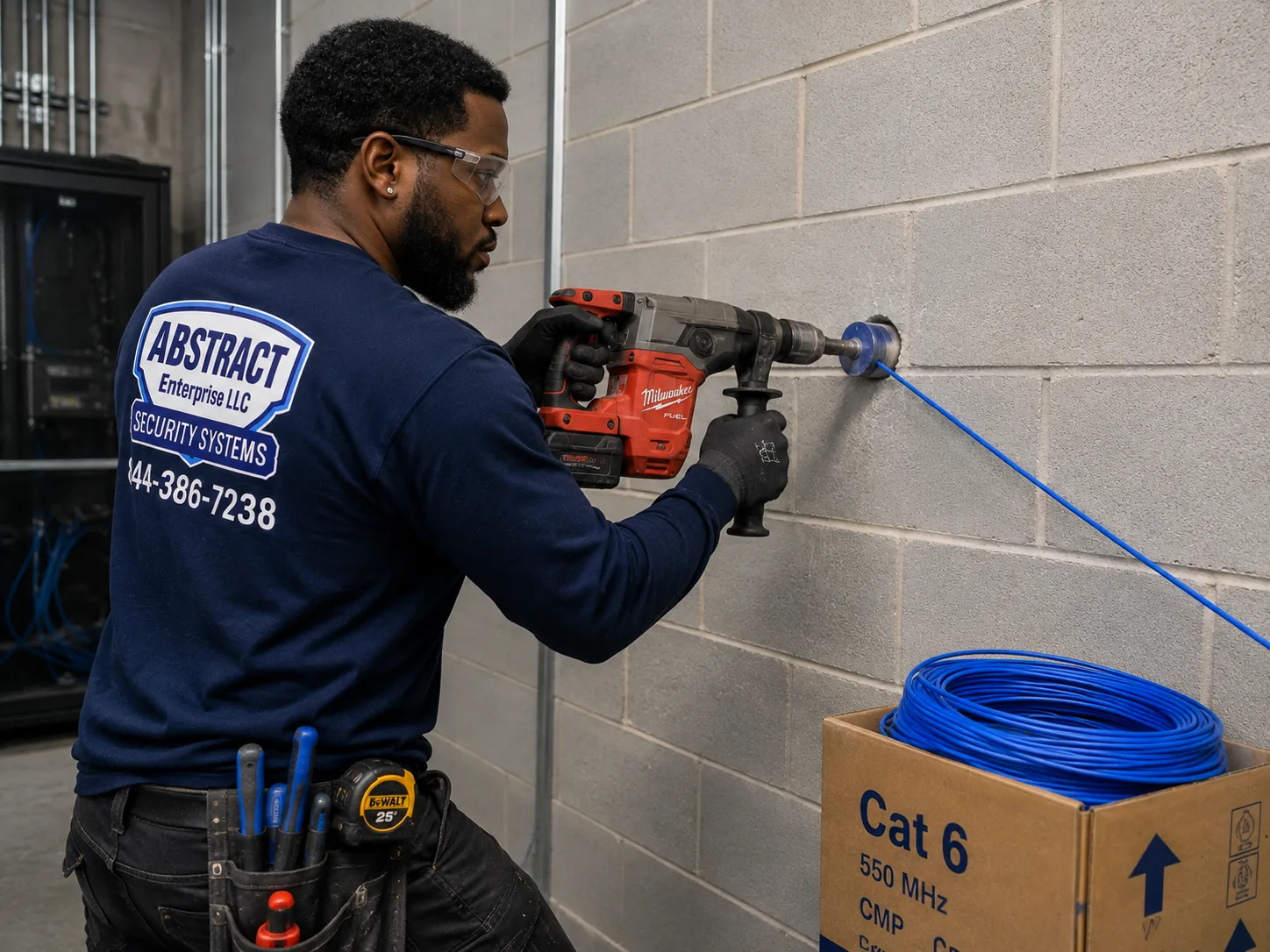
Unionport, Bronx security camera installation job-library photo: a technician core drilling a block wall to carry cable through to a network room
Photo from the AESS job library, not taken in Unionport: a technician core drilling a block wall to carry cable through to a network room. In the block cellar of a 1960s Unionport building or a Unionport Road co-op, one planned opening like this can carry the cables for the street door, the lobby and the laundry room together, sealed with firestop once the cable is through.
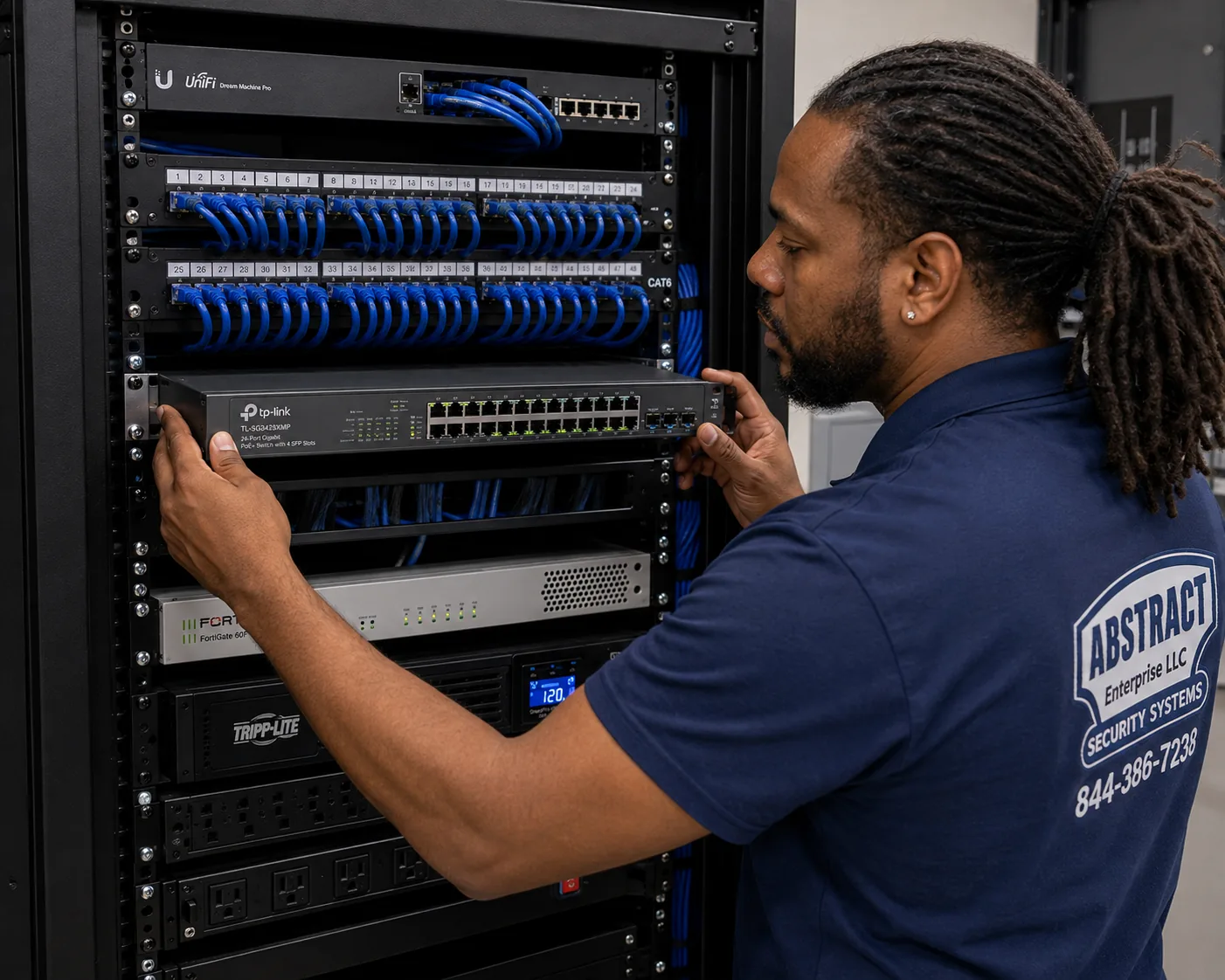
Unionport, Bronx security camera installation job-library photo: a technician mounting a managed PoE switch below patch panels in a commercial network rack
Photo from the AESS job library, not taken in Unionport: a technician mounting a managed PoE switch below patch panels in a commercial network rack. A twelve-story Unionport Road co-op with cameras at the entries, the laundry room, the parking area and the landings needs a switch like this to power them over the same cable that carries the picture; a two-family usually runs on the ports built into the recorder.
Commercial Security Camera Installation

Business Security Camera Installation in Unionport

Unionport's businesses line a few strips. CityNeighborhoods describes corner storefronts along Lafayette Avenue, Castle Hill Avenue and White Plains Road; the 43rd Precinct names Westchester Avenue, Castle Hill Avenue and White Plains Road among its four main commercial strips; the Castle Hill Avenue Business Improvement District started in June 2012; and the Zerega industrial park borders the neighborhood. These are the corridors and kinds of business the sources describe. We do not name any business as a customer.

Castle Hill Avenue

The neighborhood's main street, with stores below apartments, a BID since 2012, and long-running shops such as Varsity Army & Navy, which News 12 reported has sold workwear on the avenue since 1938.

Westchester Avenue

The northern edge, along the 6 train and the Castle Hill Avenue station, with storefronts facing the elevated line.

White Plains Road

The western edge, with corner storefronts and mixed-use buildings toward Lafayette Avenue and the new tower planned at 1933 Lafayette.

Lafayette Avenue

The southern edge, with corner shops at the ends of residential blocks and new construction arriving.

Bruckner Boulevard

Where a nine-story mixed-use building has been filed at 2069 Bruckner Boulevard and the Shops at Bruckner Commons sit nearby.

The Zerega Edge

Light industrial and distribution buildings near the Zerega industrial park, where yards, docks and fences need watching.

Castle Hill Avenue storefronts: the store, the residential door and the stair

On Castle Hill Avenue the typical business occupies the ground floor of a building with apartments above, sometimes a two-family with a store at street level and a full basement used for stock, like the one listed at 1240 Castle Hill Avenue near the train station. The store needs four core views: a camera just inside the front door at head height, recording one clear face per person who enters; a view of the counter and register from behind and slightly to one side; an overview of the floor; and a camera on the back door or basement stair from inside. The residential door beside the store, the hallway and the stair belong to the building and its tenants, not the store, and stay off the store's recorder unless the building owner sets up a shared arrangement in writing. Where the store uses the basement, a camera at the bottom of the basement stair records who goes down and comes up with what, and we keep it aimed at the store's own area of the cellar.

Corner stores on Lafayette Avenue and White Plains Road: two faces, one recorder

A corner storefront has glass on two streets and usually a door on one. The inside door camera and the counter view work the same as anywhere. The difference is outside: a corner shop sees two sidewalks, and anyone loitering or waiting tends to stand where the two meet. A single camera behind the glass at the corner, aimed to take in both sidewalks for a short distance, records who was standing outside and which way they went. Mounted inside the glass, it keeps working if the door is broken. We set it so the low sun and the glare of the store's own lights off the glass do not wash out the picture, which usually means mounting it close to the glass with a hood.

New mixed-use buildings: plan the store's cameras with the fit-out

Permits have been filed for a nine-story mixed-use building at 2069 Bruckner Boulevard and a five-story mixed-use building at 900 Castle Hill Avenue. Stores that move into new buildings like these start with an empty space and a lease. The best time to plan cameras is during the store's own build-out, before the ceilings close: cable pulled while ceilings are open costs far less than cable fished in later. Before we pull anything, we ask for the landlord's rules on the storefront, sign band and any shared telecom room, because in new buildings the landlord often controls where a tenant's cable may run and whether anything can go on the facade.

Houses of worship: the busy hours and the empty ones

Unionport's congregations include the Church of the Holy Family, the Unionport Jame Masjid on Chatterton Avenue and St. Helena's at Olmstead and Benedict Avenues. Buildings like these are full for a few hours a week and quiet the rest of the time. Their camera plans usually begin at the main entrance, any side door used for deliveries or the office, and the parking area or yard, then add the lobby and the office. The design question is who receives alerts and when; we set schedules so alerts go to someone who can act on them during the hours the building should be empty, and stay quiet during services. Worship spaces themselves usually stay off camera unless the congregation decides otherwise.

Light industrial near Zerega Avenue: fences, docks and long runs

Businesses near the Zerega industrial park tend to have a fenced yard, a loading door, a small office and long distances between them. Yard cameras on tall walls cover the fence line and parked vehicles; a camera on the loading door from inside records what goes in and out; the office door gets its own view. Distances on these sites can exceed what a single camera cable should run, so far cameras connect through a switch in an intermediate enclosure or over a fiber link, planned on the walk-through.

Rules and limits for business cameras in Unionport

  • Private rooms stay private. Restrooms, changing areas and treatment rooms are never covered, and we check each view for mirrors or glass that could show one.
  • Screens and card pads stay out of frame. Counter cameras watch hands, faces and the register drawer, not PIN pads or monitors.
  • The building owner controls the outside and the shared spaces. Facades, sign bands, awnings, shared cellars, residential doors and stairs need the owner's written agreement before we mount anything.
  • City property is off limits. Nothing goes on lampposts, street signs, bus shelters or street trees on Castle Hill Avenue or anywhere else.
  • Pictures, not conversations. We set business cameras to record video, not sound.
  • Rated walls stay rated. Any hole through a fire-rated wall or floor between a store and the homes above is sealed with rated firestop before we leave.
  • New outlets are electricians' work. If a camera location needs a new outlet or circuit, a licensed electrician does that part, and the quote says so.
  • Proof on paper. AESS works under NYS license #12000287431 and carries insurance, and we send proof to landlords and managing agents ahead of the visit when they ask.
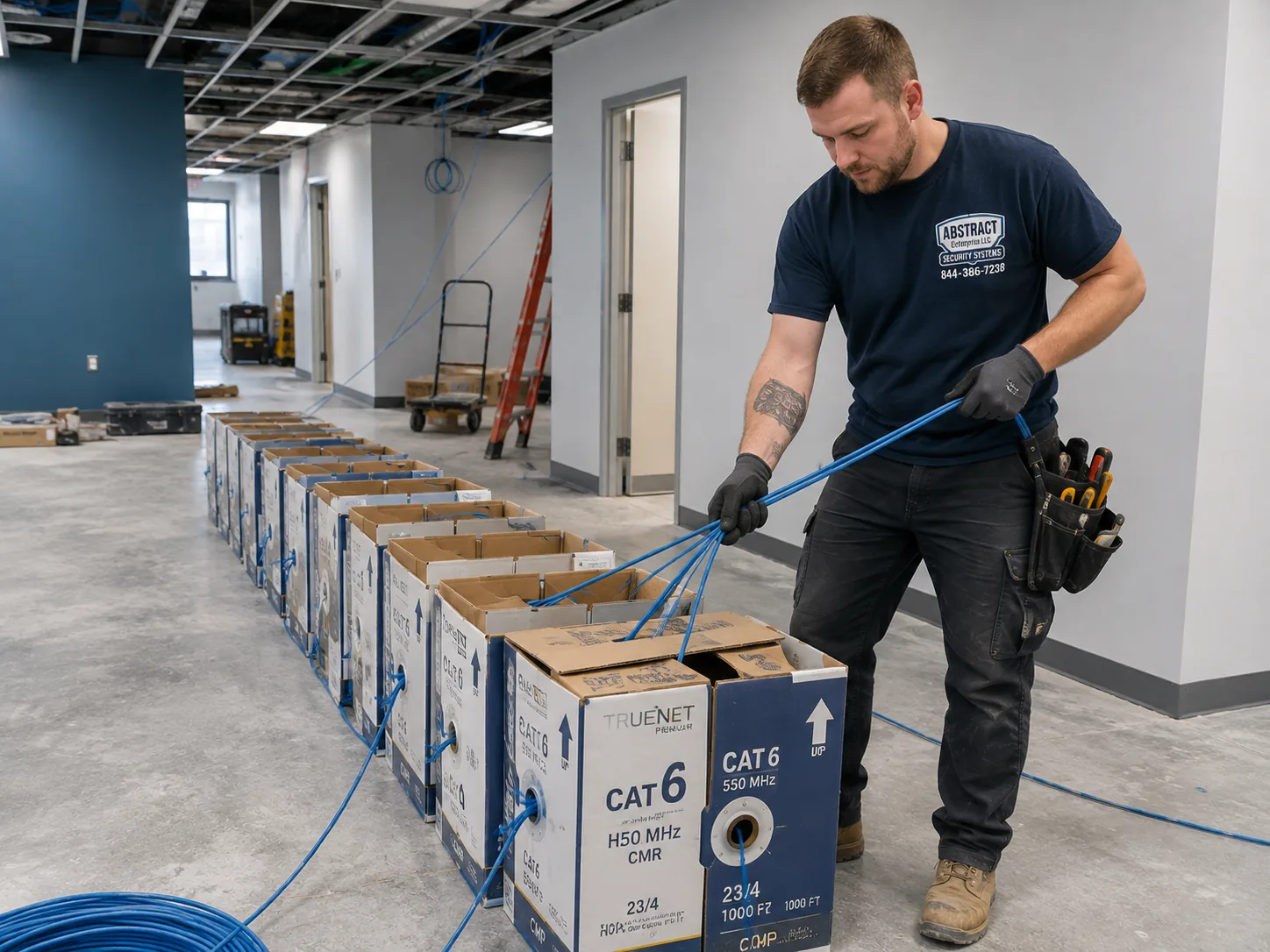
Unionport, Bronx security camera installation job-library photo: boxes of cable staged together for a multi-drop pull on a working premises
Photo from the AESS job library, not taken in Unionport: boxes of cable staged together for a multi-drop pull on a working premises. For a Castle Hill Avenue store with cameras at the door, the counter, the floor, the basement stair and the back door, all the runs are pulled together from boxes staged like this, so the noisy part of the job is done before the store opens.
Unionport, Bronx security camera installation job-library photo: a technician feeding cable through a ceiling in an occupied commercial space
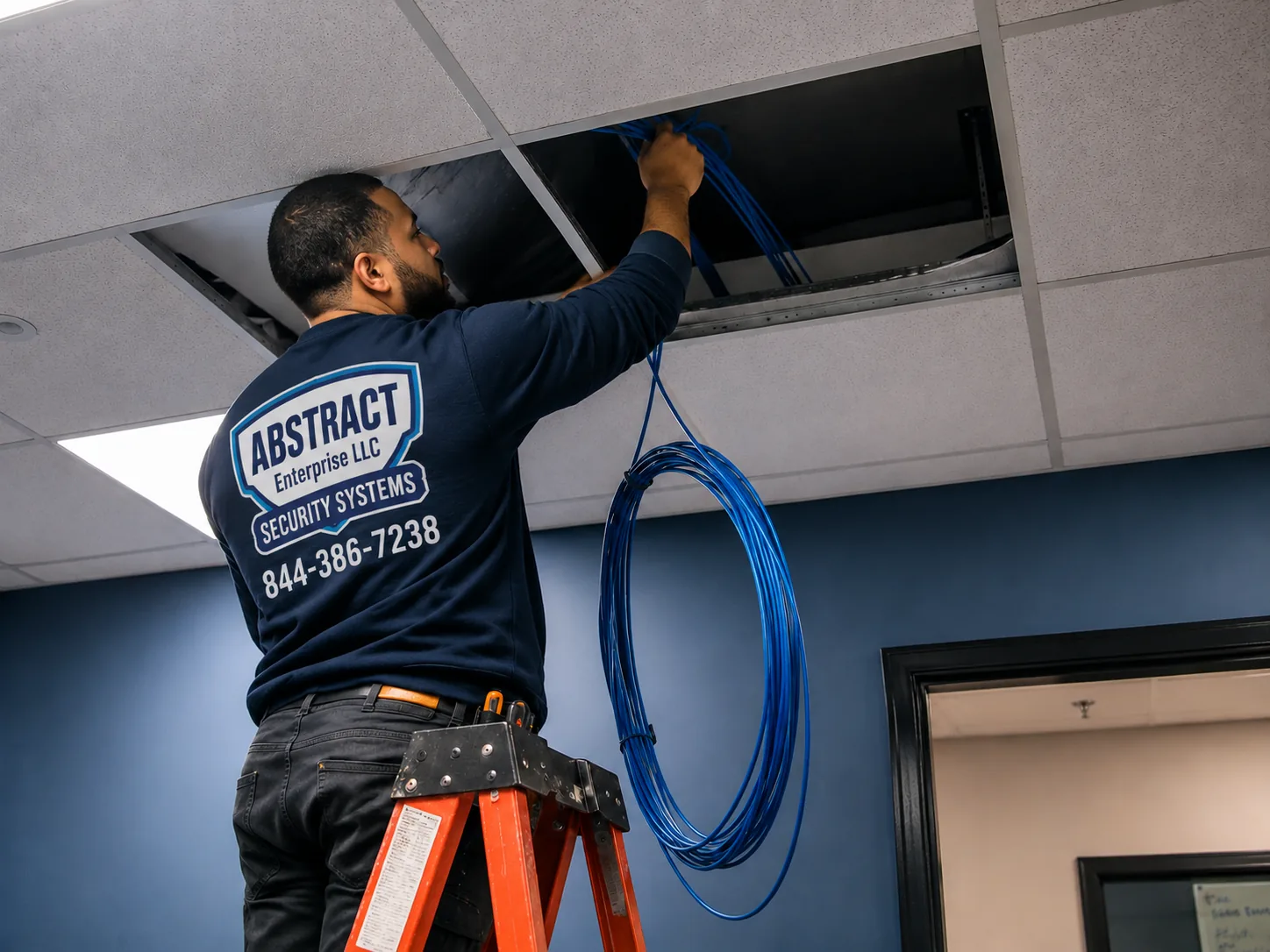
Photo from the AESS job library, not taken in Unionport: a technician feeding cable through a ceiling in an occupied commercial space. An office or shop on White Plains Road or Westchester Avenue that serves customers all day gets quiet ceiling work like this during open hours, with any drilling into brick saved for before opening or after closing.
Field Notes

Field Notes: What We Look At First on a Unionport Walk-Through

A Unionport walk-through begins at the curb, because the curb is where the expressway traffic, the parked cars and the front door all meet. We stand where a visitor stands and look at what a camera on the house could see of the stoop and the gate, and at how far the headlights reach. Then we ask who lives where: which floor the owner is on, which the tenant, whether a store sits below, and whether anyone else, a super, a relative, a managing agent, needs to see anything. On a detached house, we measure the side gaps before anything else, because a gap of a few feet decides whether a ladder can stand there safely or the camera has to go on a corner instead. We go down to the cellar, find where the old phone, cable and alarm wires come in, and check whether the joists run front to back, which decides how easily cable crosses the house. We ask where water has come in, and keep the recorder away from it. In an apartment building we find the laundry room, the cellar door and the rear yard, because those are the spaces nobody sees. In a store we ask where the stock lives, whether the basement is shared, and who holds the key to the back door. And everywhere we ask the same plain question: when do problems usually happen, and where? The answer shapes the alert schedule more than any brochure.

Unionport, Bronx security camera installation job-library photo: a technician running cable into EMT conduit beside a telecom room in an industrial building
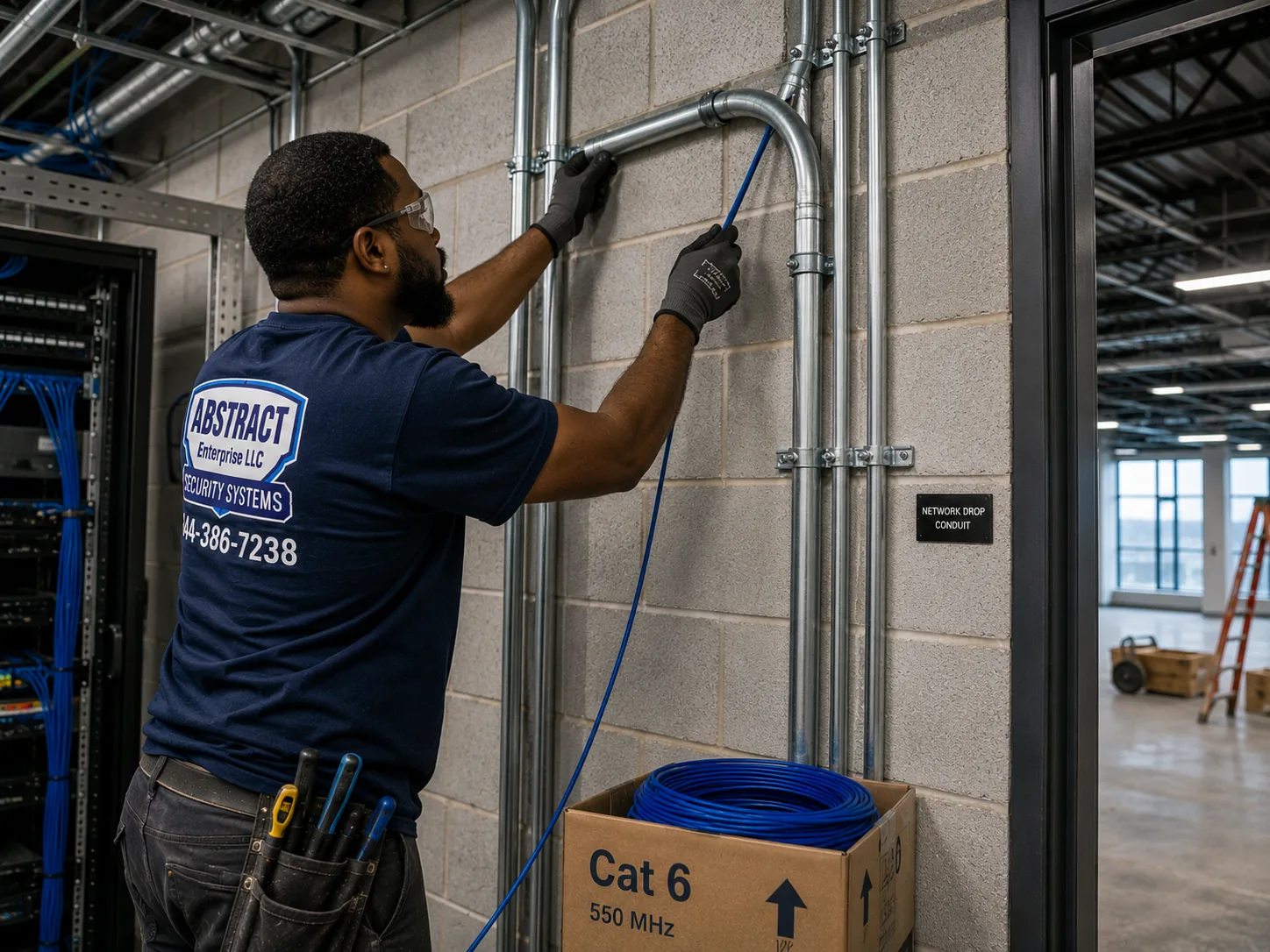
Photo from the AESS job library, not taken in Unionport: a technician running cable into EMT conduit beside a telecom room in an industrial building. Where a Unionport camera run has to cross an open cellar wall, the inside of a detached garage or a light-industrial space near Zerega Avenue with nowhere to hide it, metal conduit like this protects the cable from carts, vehicles and tampering.
Your Questions Answered

Security Camera Installation in Unionport: Questions Answered

Houses, side gaps and driveways

The detached houses on our block stand only a few feet apart. How does a crew reach an eave in a side gap that narrow?

Usually with a narrow-base extension ladder on a leveled, footed base, a stand-off stabilizer that holds the ladder clear of the gutter, and two people, one climbing and one holding the base. When the gap is too tight to angle a ladder safely, we move the camera to the front or rear corner of the house and aim it down the gap instead, which often works better anyway, because it sees faces walking toward it rather than the tops of heads passing under it. If the ladder would have to stand on your neighbor's side of the line or lean near their windows, we ask you to clear it with them before install day, and we never set anything against their siding or gutter. Cable for a side-gap camera is fed from the attic or cellar so the time spent up the ladder is only the time it takes to mount the camera.

Our garage sits at the back of the lot at the end of a concrete driveway. How does camera cable get there without a trench scar across the concrete?

There are four common routes, and we pick after seeing the lot. If there is already conduit to the garage, for power or an old light, we pull outdoor cable through it. If the garage is close to the house, an overhead run on a support wire, high enough to clear any vehicle, can span from the eave to the garage. If there is soil along the edge of the driveway or the fence, a shallow run of direct-burial cable can follow that edge instead of crossing the slab; any digging waits until underground utilities have been marked. Where none of those works, a pair of small wireless bridge radios, one on the house and one on the garage, carries the picture with no cable between them. Cutting a groove in the concrete is the last resort, and we say so plainly on the quote if it is the only option.

On a small Unionport lot, should our cameras have fixed lenses or adjustable zoom lenses?

Mostly fixed, with one or two exceptions. On a two-family or a detached house in siding, most views are short: the stoop, the side gap, a rear yard of modest depth. A fixed wide lens covers those well, costs less and has nothing to drift. The exceptions are views where the thing that matters is farther away or narrower than the frame: the curb across a sidewalk on a wide avenue like Castle Hill Avenue, the gate at the back of a long yard, or the door of a garage at the end of a driveway. For those, a varifocal camera, adjusted on site until the target fills the picture, earns its extra cost. We mark on the quote which cameras are fixed and which are varifocal, and why.

Would a solar battery camera on our back fence save us from running cable to it?

Sometimes, but go in with clear expectations. Rear yards on many Unionport blocks are hemmed in by neighboring houses and trees, and in winter a panel on a fence may get only a few hours of direct sun. Battery cameras also work differently from wired ones: most sleep until they sense motion, then wake and record a clip, so the first moment of an event can be missed and there is no continuous recording to scroll back through. They depend on the house Wi-Fi reaching the fence, which brick walls often block. A solar camera can be a good fit for a secondary view, such as a shed or a garden gate that is rarely used. For the back door, the yard as a whole or anything you might need as evidence, a wired camera on the house is the better choice.

Apartment buildings and co-ops

The coin boxes on the machines in our building's basement laundry room keep getting pried open. Where does a camera go?

Two positions cover it. The first is high in the corner opposite the laundry room door, angled to record the face of every person who comes in; that is the camera that tells you who. The second looks along the row of machines at the coin boxes or card readers, so it shows which machine someone works on and what tool they use. Both should be hard-cased domes, because a laundry room is exactly where a camera gets hit, and the room should be lit well enough at night to keep them in color. If the machines belong to an outside laundry operator rather than the building, tell them before the cameras go in, since they may want copies of footage when their equipment is damaged. As with any common area, the owner or board decides who may review the recordings.

Would one 360-degree fisheye camera on our lobby ceiling do the work of two ordinary cameras?

It does one job very well and another poorly. A fisheye in the middle of a lobby ceiling sees the whole room at once, the street door, the mailboxes, the elevator and the stair, which makes it an excellent overview and hard to dodge. But it spreads its picture across the entire room, so a face near the edge is small and bent, and even with the recorder flattening the image, identifying someone by face is harder than with a camera aimed straight at the door. In the low-ceilinged lobbies of many 1940s and 1960s buildings, our usual answer is both: a fisheye for the overview, and a separate camera at head height facing the inner door, so every person coming in is recorded face-on.

A tenant asked our management office for the lobby clip that shows her package being taken. Do we have to hand it over?

Generally, no: Brick Underground's reporting on landlord footage notes that a landlord is not obligated to share surveillance video with a tenant. Many owners do share in a case like this, because it costs little and settles the matter. The sensible approach is a written policy, decided before the first request. It can say that the owner will save any clip a tenant reports within a set number of days, will give it to police when a report is filed, and will show or give it to the tenant at the owner's discretion. Whatever you decide, save the clip as soon as the request arrives, so it is not overwritten while you think it over. We can show the super how to lock and export a clip during the handover.

Stores on the avenues

Can the sales from our register show up on the camera picture, so we can match each sale or void to the video?

Often, yes. Many recorders can take the text that a point-of-sale system sends, item, price, void, refund, no-sale, and print it on the video from the counter camera as each transaction happens. When you search later for a void or a no-sale opening, the recorder jumps to that moment and you see the drawer and the hands. Whether it works with your register depends on the point-of-sale system and whether it can send that text out; some can, some cannot, and some need an extra interface box. We check your system's make and model before quoting, and if it cannot connect, we say so and set the counter camera so the drawer and the receipt printer are clearly in frame instead.

From Avenue C to Castle Hill Avenue: Reading Unionport's Building Eras Before a Camera Goes Up

Unionport's street grid is older than most of the Bronx's, and that history shows up every time we plan where a camera goes and how its cable gets there. In 1851 a building association bought a large tract of land west of Westchester Creek, and Industrial Home Association No. 2 filed its map of Unionport in 1854. The neighborhood was one of the first Bronx towns laid out on a grid, with lettered avenues running north to south and numbered streets running east to west. The old letters are still here under newer names. Avenue A is now Zerega Avenue, Avenue B is Havemeyer Avenue, and Avenue C is Castle Hill Avenue. When we walk a Castle Hill Avenue storefront or a Havemeyer Avenue two-family, we are working on lots laid out more than 170 years ago, long before anyone thought about running wire to the front of a building.

Sources disagree about where the name came from. One credits a 19th-century real estate and transportation company called the Unionport Company, said to have planned ferry and road links along with docks and lumber wharves on Westchester Creek. Another says the name came from several rail lines meeting here. The village stayed separate from the city for decades. NY1 reports that the Village of Unionport did not join New York until 1895, while another source gives 1898. NYC Parks describes early-1900s Unionport as something like a frontier town, with dirt roads, wooden sidewalks, frame houses and taverns. None of those frame buildings were designed with cameras in mind, and neither were most of the buildings that replaced them.

The real turning point was the subway. The IRT Pelham Line opened in 1918, and working-class Irish and German immigrants followed. Most development clustered near the line along Westchester Avenue and Castle Hill Avenue, and the area went through a housing boom from the 1920s into the 1940s. The numbers reflect that. One housing profile puts the median year built at 1945, and another says many homes went up no later than 1939. City-Data counts 1,205 units built from 1940 to 1949, 768 from 1950 to 1959 and 1,028 from 1960 to 1969. Much of the housing on any given block here is 60 to 100 years old, and its walls, basements and ceilings were built for plaster, knob-era wiring, steam pipes and doorbells, not low-voltage camera runs.

Then the Cross Bronx Expressway came through. Construction in the 1950s hit Unionport especially hard. Apartment buildings and single-family homes were demolished, and the blasting damaged the Church of the Holy Family badly enough that a new church was built in 1962. The expressway was finished in 1963. High-rise housing projects replaced smaller buildings, and some local streets became highway exit ramps. Large parcels south of Bruckner Boulevard stayed vacant into the mid-20th century, and Quonset huts housed returning World War II veterans. This is why a short walk in Unionport can take you from an attached prewar rowhouse to a postwar tower set back behind a parking lot, with very different camera needs on either side.

Here is how those eras break down when we are standing in front of a building with a ladder.

Prewar attached rowhouses. The biggest of these are large. Listings show seven-to-nine-bedroom prewar attached rowhouses selling for $1.25 to $1.5 million. Attached houses have no side yards, so there is no side wall to mount on and no gangway to cover. Coverage has to come from the front facade and the rear, and the cable usually has to get from the street side to wherever the recorder sits inside without cutting through a shared party wall. Brick takes a mount well, but every hole in an old facade is permanent, so we plan the bracket position and cable exit before drilling, not after.

Detached Colonial Revivals with siding. The same listings describe detached Colonial Revival houses with siding on small lots, priced at $600,000 to $700,000. Siding is a different mounting surface from brick. A camera bracket on siding needs a solid backing behind it, and the cable penetration needs to be sealed so water does not get behind the cladding. These houses usually have a driveway or side path, so the coverage question becomes how many sides of a small lot one owner actually needs to see.

Semi-detached brick two-families. Community Board 9 describes Unionport as largely two-family homes, and listings show many semi-detached brick two-families. One housing profile says 35.6 percent of Unionport's real estate is two-, three- or four-unit buildings, a higher share than in 96.3 percent of US neighborhoods. Most homes are rented. That changes the conversation. In a two-family where the owner lives downstairs and rents upstairs, we have to decide who controls the recorder, who sees the app, and whether the tenant's entrance gets its own view. In a three- or four-unit building with an absentee owner, remote viewing and a recorder kept somewhere locked matter more than the camera count.

Postwar apartment buildings and towers. Postwar high-rises stand near the Westchester Avenue subway, and a reader comment on a YIMBY article describes numerous tower-in-the-park developments surrounded by large parking lots near Lafayette Avenue. The comment is not reporting, but it matches what you see from the street. Buildings set back on open land have long walkways, wide lots and parking areas that a doorway camera alone will not cover. Courtyard buildings are their own case. 2035 Newbold Avenue, for example, is a 124-unit multifamily building arranged around a courtyard. In a building like that, the entry door is only one of several places people pass through, and the courtyard itself may need coverage.

Co-ops on Unionport Road and the side streets. Unionport Road has many multi-unit buildings with unit numbers. Redfin lists co-op units in the 1500 block, including 1521, 1540, 1551, 1555 and 1595 Unionport Road, with floors as high as 12F at 1551. Some of these sit in the 10462 ZIP code on the Parkchester side. There are smaller co-ops too. NYBits lists two Unionport co-op buildings, both low-rise walk-ups, at 1023 Havemeyer Avenue and 1962 Ellis Avenue. Camera work in any co-op goes through the board or managing agent, and vendor sources note that conduit in co-op or condo common areas is one of the situations that can bring a Department of Buildings permit into play. We would rather learn the board's rules at the first meeting than halfway through a cable run.

New construction from the 2010s on. City-Data counts 1,369 units built from 2010 to 2019 and another 150 built in 2020 or later. That is a sizable stock of newer buildings with modern low-voltage infrastructure alongside the prewar and postwar ones. More are coming. Bruckner Heights finished construction by March 2026 at 2070 Chatterton Avenue, which is seven stories, and 1017 Olmstead Avenue, which is nine stories. Together they have 330 rental units, 274 of them affordable. Permits were filed in March 2026 for 1933 Lafayette Avenue, a 22-story, 207-unit building on the block bounded by Lafayette Avenue, White Plains Road and Turnbull Avenue. At that point demolition permits had not been filed and no completion date had been announced. Permits have also been filed for a nine-story mixed-use building at 2069 Bruckner Boulevard, and a five-story mixed-use building has been proposed at 900 Castle Hill Avenue. In new buildings like these, the job is usually less about getting cable through old walls and more about fitting into a system already designed for the building, working with management and keeping new cameras consistent with what is already installed.

Mixed-use buildings on the commercial strips. A neighborhood guide lists corner storefronts along Lafayette Avenue, Castle Hill Avenue and White Plains Road. Recent listings include a two-family with a store and a full basement next to the train station at 1240 Castle Hill Avenue, and 847 Castle Hill Avenue, a fully vacant mixed-use building. When there is a store downstairs and apartments upstairs, there are two sets of people with different reasons to watch the building. The store owner wants the register, the door and the sidewalk. The residents want their separate entrance and the stairs. We plan those as separate zones from the start. A vacant building has a different problem: nobody is there to notice when something happens, so remote viewing and alerts matter more than in-person monitoring.

Long-running businesses on these strips sit in buildings that have changed hands and uses many times. Varsity Army & Navy has sold workwear on Castle Hill Avenue since 1938 and moved to 1239 Castle Hill Avenue. A building that has housed several tenants over the decades often carries leftover wiring from each one. Part of our walk-through in an older storefront is figuring out what is still live, what is abandoned and what can be safely reused.

All of this is why we do not quote a Unionport job from an address alone. The same block can hold a 1930s attached house, a 1960s apartment building and a 2010s building with a modern wiring closet. Each needs a different mounting approach, a different cable route and a different decision about where the recorder lives. Knowing the era before we arrive shortens the walk-through. Seeing the building in person is what lets us price it accurately.

Video at the Front Door, Footage for Investigators: How Cameras Fit Unionport's Entries, Tenants and Shared Programs

On many Unionport buildings, the camera and the front door are one job. Owners call us about a dead buzzer and ask for a camera over the entry while we are there, or call about a camera and find the intercom beside it has not worked in months. Entry systems and cameras fall under different rules, so it helps to keep them separate before deciding what to install.

What the city requires at the door, and what it doesn't. According to compliance guides from security vendors, the Housing Maintenance Code, Admin Code §27-2045, requires landlords of multiple dwellings to keep a working intercom or buzzer. The same sources say no general New York City law requires cameras in apartment buildings. Separately, Multiple Dwelling Law §50-a requires Class A multiple dwellings built or converted after January 1, 1968, with eight or more apartments, to have an intercom at the self-locking main entrance door. That intercom must allow two-way speech and let the occupant release the door lock from inside the apartment. Two sources note that the law requires a working intercom, not a video one. A camera over the door is a choice the owner makes, not a legal requirement, even though in practice the two often get installed together.

This matters in Unionport because so many buildings are small. The two-, three- and four-unit buildings that make up about a third of the local real estate are under the eight-unit threshold, and many were built before 1968. Our reading of the text is that many of them may fall outside §50-a. That is an inference from the law's thresholds, not a ruling about any particular building, and the Housing Maintenance Code still requires working entry hardware. If you are not sure which rules apply to your building, check with HPD or your attorney. We will tell you what we see at the door, but we are not giving legal advice.

Violation classes are disputed, so we check before saying anything. Several contractor guides, along with the vendor Connextivity, describe a broken intercom as a Class B hazardous violation. One vendor says such violations carry fines of $250 to $500 per day until fixed. DOBGuard, on the other hand, lists a non-functioning intercom under Class A, which is non-hazardous. Because the sources conflict, we do not tell owners which class applies to them. If an owner has an open violation, the place to confirm its class is HPDONLINE. What is not disputed is HPD's own guidance. Its "ABCs of Housing" tells building managers, supers and owners to immediately repair broken locks or intercoms to keep out drug dealers and vandals. Tenants report building-wide problems like a broken lobby lock, an entrance door that won't close or a dead intercom through 311.

The door, the latch and the closer come first. One compliance source puts it plainly: an intercom next to a door that no longer latches leaves the building out of compliance. The door and the intercom work as one system, and a camera mounted beside them needs to fit into that system without getting in the way. HPD enforces self-closing doors through inspection, and Local Law 71 of 2022 followed the Twin Parks fire in the Bronx. When we mount a camera near an entry, we keep it clear of the door closer's arm, the strike and the frame, and we route the cable so it does not run across a path where the door could pinch or pull it. Entry systems also must not prevent anyone from leaving the building from inside without a key or code. We check that a camera, a video intercom or any new hardware leaves the exit working the way it should, because a camera that makes a door harder to close or harder to leave through causes more problems than it solves.

Stores and apartments sharing one front. On Castle Hill Avenue, White Plains Road and Lafayette Avenue, the residential door often sits a few feet from a storefront. In a building like the two-family with a store at 1240 Castle Hill Avenue, the store's cameras and the residents' entry camera may be visible from the same spot on the sidewalk, but they serve different people. We usually keep them on separate recorders or separate user accounts so the store owner does not see residents coming and going and residents do not see inside the store. When one person owns both and wants a single system, we still set up separate views so each person sees only what they need.

Telling tenants before the camera goes up. Most Unionport homes are rented, so most camera jobs here involve someone besides the owner. For rent-stabilized buildings, one vendor advises landlords to document the security reason for the cameras in writing before installing them and to notify tenants in advance. We think that is good practice in any rental building, regulated or not. A short written notice that says where the cameras are, what they cover and who can see the footage prevents a lot of arguments later. Language matters here. NeighborhoodScout reports that 43.9 percent of Unionport residents were born in another country, a higher share than in 95.4 percent of US neighborhoods. It also reports that 26.3 percent have Puerto Rican ancestry, 19.0 percent have Dominican ancestry and 2.9 percent primarily speak African languages at home, and the area has a growing South Asian community. A notice in English alone may not reach everyone in a building. Owners should plan for notices in the languages their tenants actually read.

Where cameras point, and where they don't. Inside a building, a common-area camera covers the lobby, the mailboxes, the stairwell door and the basement entrance. Outside, it covers the stoop, the sidewalk in front of the door and the side path. We aim cameras at shared space and away from the inside of apartments. In a two-family where the owner's window faces the tenant's door, we adjust the angle or mask part of the image so the camera watches the entrance, not the private space around it.

BronxCAMS: putting a private camera on the DA's list. The Bronx District Attorney's office runs a voluntary program called BronxCAMS. Residents and business owners can register their cameras in a database that already includes NYPD and NYCHA cameras. According to the DA's office, the map will never be released to the public, so registering does not advertise your camera locations to anyone browsing online. Registration is done by mailing in a form. Registering does not mean anyone can see your camera live. It means investigators know there may be footage at your address and can ask you for it. When we finish a job, we can go over the details the form asks for, such as camera locations and what each one faces, so you have what you need to fill it out. Whether to register is up to you.

Where public cameras stop and private ones start. The city and borough are adding cameras, but not everywhere. The Bronx Borough President budgeted $1.2 million for NYPD surveillance cameras and $500,000 for Department of Sanitation cameras targeting illegal dumping. Community Board 9's FY2026 needs statement includes a line saying new cameras are needed, though the excerpt we found does not say for which site. Nearby, the Throggs Neck BID installed about a dozen anti-crime cameras that are monitored in real time by the 45th Precinct and police headquarters. We found nothing about a similar program for the Castle Hill Avenue BID, which started in June 2012. For most Unionport blocks, the camera watching a particular stoop, side door or storefront will be a private one, or there will be none.

Why footage gets asked for here. Unionport is in the 43rd Precinct, whose station house is at 900 Fteley Avenue. The NYPD lists four main commercial strips in the precinct: Westchester Avenue, Castle Hill Avenue, White Plains Road and Parkchester. In 2022 the precinct reported 6 murders, 48 rapes, 747 robberies, 806 felony assaults, 302 burglaries, 1,039 grand larcenies and 561 grand larcenies of automobiles. A local ranking still places the 43rd among the least safe parts of the Bronx. CrimeGrade, an older commercial source, claims a property crime happens in Unionport every 13 hours and that property crime is highest in the northwestern part of the neighborhood. We include that figure with its source because it is commercial and not current. In 2026, a man was shot and killed on Haviland Avenue between Castle Hill Avenue and Havemeyer Avenue on May 24, and a shooting was reported around Castle Hill Avenue and Watson Avenue around October 6. We are not saying cameras would have prevented any of these. The point is that after an incident on a block, investigators often look for private footage, and an owner's system either has the right clip or it doesn't.

Making footage usable when someone asks for it. A recording is only useful if the right clip can be found and copied when someone needs it. Before we leave a job, we check that the recorder's date and time are correct, because a clip stamped with the wrong time is hard to match to an incident. We make sure the owner knows how to find a specific time on a specific camera and export it to a drive or phone without getting stuck in menus. We also talk about how long the recorder holds footage before it overwrites itself, since an owner who learns about an incident days later needs the recording to still be there. In a two-family or a small building, we make sure more than one trusted person knows how to pull a clip, so the recording does not depend on one person being home.

Who holds the recorder. In a building with tenants, the recorder should be somewhere secure that the person who controls the system can reach, such as a locked basement closet, the owner's unit or a management office. It should not be on an open shelf in the lobby where whoever caused a problem can unplug it or walk off with it. In mixed-use buildings, the store and the residential side should each know where their recorder is and who has the password. In a co-op, the board decides who has access, and we set up accounts to match.

Putting it together. A good Unionport entry setup means the door latches and closes on its own, the intercom or buzzer works, exits are not blocked, and the camera above all of it covers the door, the stoop and the sidewalk without looking into anyone's window. Tenants are told in writing, in languages they read. The owner knows how to pull a clip, and if they choose, their camera is registered with BronxCAMS. When we walk a building, we look at all of these together, because fixing only one of them leaves a gap the others cannot cover.
Owners, Tenants and the Law

The Rules Behind a Unionport Camera Job, Laid Out Plainly

Unionport has no historic district, so the Landmarks layer that governs camera work in parts of the Bronx does not apply here. What does apply comes from five places: New York's installer licensing law, the city's building and housing rules, the relationship between owners and tenants, co-op and condo documents, and the state's privacy laws.

Who may install. New York's General Business Law Article 6-D requires a license to be in the business of installing, servicing or maintaining security or fire alarm systems. The Department of State's application explains that the license covers systems that detect intrusion or movement and that installing purely passive, nondetecting security devices does not require one; modern cameras with motion and person detection sit close to that line, and the sources do not settle it cleanly. NYC's business portal notes that master electricians are exempt from the education and exam requirements but must still register. AESS holds NYS license #12000287431 and sends a copy to any owner, board or managing agent who asks. New line-voltage power, such as a new outdoor outlet, is a licensed electrician's work, and the quote says so when a job needs it.

Permits. Most camera installs on Unionport houses and buildings do not need a Department of Buildings permit. Vendor guidance notes that the picture can change when the job includes electrical work, conduit in co-op or condo common areas, or a connection to a fire alarm or access control system. If any of those is part of your job, we raise it before work starts rather than after.

Buildings and intercoms. No general city law requires cameras in apartment buildings. The Housing Maintenance Code requires owners of multiple dwellings to keep a working intercom or buzzer, and Multiple Dwelling Law §50-a sets the rule for buildings of eight or more apartments built or converted after January 1, 1968. Many Unionport two- and three-family houses fall outside that rule. Cameras do not replace an entry system the law requires, and adding them does not fix an intercom that has failed.

Owners and tenants. In a rented two-family or apartment building, the common areas, the shared front door, the stoop and the yard are generally the owner's to cover, while the inside of each apartment is not. We aim every camera at shared space, mask any part of a view that falls on a window, and recommend telling tenants in writing where the cameras are and who can see the footage. If you are unsure how these rules apply to your building, check with HPD or your attorney; we describe what we see on site, but we are not giving legal advice.

Free Estimate

Request a Written Camera Quote in Unionport

Tell us about the house, building or store, who approves the work, and which doors, yards, rooms or counters need watching. We book every request within 2 hours. Prefer to talk? Call (646) 490-0629.

Unionport, Bronx security camera installation job-library photo of camera installation work
Photo from the AESS job library, not taken in Unionport. Every Unionport job is planned on a walk-through and quoted in writing, with each camera, mount and cable run on its own line.
Unionport, Bronx security camera installation job-library photo of cabling and equipment work
Photo from the AESS job library, not taken in Unionport. Cable routes through cellars, attics and chases are chosen so nothing runs across the face of brick or siding.
Unionport, Bronx security camera installation job-library photo of system setup work
Photo from the AESS job library, not taken in Unionport. Before the crew leaves, each household or user gets its own login and camera list, and the owner is shown how to find and export a clip.

More Security Camera Installation near Unionport

Security Camera Installation Bronx | No Monthly Fees · Security Camera Installation NYC | Licensed Installer · Security Cameras Installed in Manhattan · Brooklyn Security Camera Installation · Security Camera Installation Queens NY · Staten Island Security Camera Installation · Long Island Security Camera Installation NY · Hudson Valley Security Cameras · Security Camera Installation Nassau County NY · Security Camera Installation Suffolk County NY · Westchester Security Camera Installation · Rockland County Camera Installation · Orange County NY Security Cameras · Putnam County Camera Installation · Dutchess County Security Cameras · Ulster County Security Camera Installation | Kingston NY

Security Camera Installation Allerton Bronx NY · Security Camera Installation Bathgate, Bronx NY | AESS · Security Camera Installation Baychester Bronx NY · Security Camera Installation Bedford Park Bronx NY · Security Camera Installation Belmont Bronx NY · Security Camera Installation Bronx | No Monthly Fees · Security Camera Installation Bronx River, Bronx NY · Security Camera Installation Bronxdale Bronx NY · Security Camera Installation Bronxwood Bronx NY | AESS · Security Camera Installation Bruckner Bronx NY · Security Camera Installation Castle Hill, Bronx NY | AESS · Security Camera Installation City Island Bronx NY · Security Camera Installation Claremont Bronx NY | AESS · Security Camera Installation Clason Point Bronx NY | AESS · Security Camera Installation Co Op City Bronx NY · Security Camera Installation Concourse Bronx NY | AESS · Security Camera Installation Country Club Bronx NY · Security Camera Installation Crotona Park East Bronx NY · Security Camera Installation East Tremont Bronx NY · Security Camera Installation Eastchester Bronx NY · Security Camera Installation Edenwald Bronx NY · Security Camera Installation Edgewater Park Bronx NY · Security Camera Installation Fairmount Bronx NY | AESS · Security Camera Installation Fieldston Bronx NY | AESS

Other services in Unionport

Alarm Installation Unionport Bronx NY · TV Installation Unionport Bronx NY · Access Control Unionport Bronx | 1851 First Bronx Grid · Door Buzzer Repair Unionport Bronx NY | Two-Family Doors · Structured Cabling Unionport Bronx NY · Intercom Installation Unionport Bronx NY · Fire Alarm Installation Unionport Bronx NY