See every Hanwha camera price in Brooklyn and build your own system →
Wired PoE, Not Guesswork Wi-Fi ยท Mounts Matched to Brick, Brownstone and Block ยท Facade Rules Checked First ยท Licensed Brooklyn Crews
Hanwha camera installation in Brooklyn is mostly a wiring job in old masonry with a camera at the end of each cable. Hanwha Vision, the South Korean company that used to be Samsung Techwin, makes the Wisenet cameras and recorders that many Brooklyn stores, schools and apartment buildings already run, and that more owners are choosing as they move away from Hikvision and Dahua. The camera itself is the easy part. The work is getting Cat6 from a stoop, a rear yard, a stair hall or a loading door back to a recorder through brick party walls, plaster ceilings and risers that were built long before anyone thought about video, and doing it in a way your landlord, your co-op board and, on a landmarked block, the Landmarks Preservation Commission will accept. This page explains how we plan that in each kind of Brooklyn building, which Hanwha series fits which job, what the rules say, and how a quote is put together for your address.
Reviewed and updated November 12, 2026, against Wikipedia's Hanwha Vision article (ownership history and the 2015 and 2023 name changes); Hanwha Vision's and SecurityInformed's 2026 announcements of the 2nd Gen X Series AI compact cameras; the Landmarks Preservation Commission's 2018 rules amendments (Section 2-20) and Permit Guidebook Chapter 11 on security cameras; the NYC Business portal and the NYS Department of State on security installer licensing; the NYC Housing and Vacancy Survey 2021 initial findings from HPD; the Department of Consumer and Worker Protection's biometric identifier rules and Davis Wright Tremaine's summary of Local Law 3; the NYC 311 article on the NYPD camera program; CBS New York on Brooklyn neighborhood cameras and a Lexington Avenue package theft; the Guardian's 2019 report on Atlantic Plaza Towers; Brick Underground and Guzov LLC on co-op camera rules; NYC participatory budgeting proposals for Gowanus Houses; installer guidance from Tec-Tel on Hanwha power and cabling; and public Yelp reviews of Brooklyn camera installers. ยท Abstract Enterprises Security Systems, NYS license #12000287431 ยท crews dispatched from our office at 1282 Troy Avenue, Brooklyn

Quick answer: a Hanwha camera system in Brooklyn is priced per building, because the number of cameras matters less than how far and through what the cable has to travel. A written quote covers the Hanwha cameras chosen for each position, Cat6 cable pulled and labelled, mounts matched to the wall, the PoE switch, the recorder or Wisenet WAVE software, setup of phone viewing, and a certified test of every drop. We book the first call within two hours of a request, estimates are usually same-day, and Brooklyn is billed at our base rate with no borough surcharge.
Brooklyn is already one of the most watched places in the city. When CBS New York reported on cameras going up along Crown Heights streets, former Assemblyman Dov Hikind put it bluntly: "You cannot walk three blocks in Borough Park or Midwood and not be on camera." CBS New York also reported NYPD plans for 100 new cameras across Williamsburg, Crown Heights and Borough Park. That density is not a reason to skip cameras on your own building. It is the reason the cameras you do install have to be good ones. When something happens on your stoop, in your lobby or at your loading door, the footage that matters is the footage you own, from a camera you aimed, recorded on a box you can open. A cheap Wi-Fi camera that buffered at the wrong second, or a twelve-year-old analog system that records a grey smear at night, is no help to you or to the precinct that asks for the clip.
Brand choice has become part of that conversation in a way it was not a few years ago. Hanwha Vision is a South Korean manufacturer. Wikipedia's account of the company traces it from Samsung Techwin, which Hanwha took over on June 29, 2015 and renamed Hanwha Techwin, to the name Hanwha Vision adopted on March 1, 2023. Its US arm, Hanwha Vision America, is based across the river in Teaneck, New Jersey. Because the company is not on the FCC's Covered List, its cameras sit outside the federal restrictions that have built up around Hikvision and Dahua since 2022, and that is why buildings with federal money, institutional owners and contract tenants keep asking for it by name. In our own Brooklyn repair work we also see the other side of that history: Hanwha is common in commercial accounts that specified it in the Samsung era, and many of those systems are now six to ten years old and coming up for planned replacement.
Then there are the buildings themselves. The 2021 New York City Housing and Vacancy Survey, in HPD's initial findings, counted about 2,042,000 homes, 56 percent of the city's units, in buildings built before 1947, and another 974,000, or 27 percent, in buildings built between 1947 and 1974. Brooklyn's share of that prewar stock is mostly small: three- and four-story walk-ups and row houses with lath-and-plaster ceilings, brownstone and limestone fronts, brick two-families, and solid masonry party walls. Wi-Fi does poorly through brick and stone, and a camera that has to be powered from an outlet means extension cords on a facade. A wired Hanwha system, where a single Cat6 cable carries both power and video, is the cleaner answer in nearly every Brooklyn building we walk. The hard part is the route that cable takes, and that is what most of this page is about.

People matter as much as walls. Brooklyn tenants have pushed back hard when cameras turned into something more. At Atlantic Plaza Towers in Brownsville, the Guardian reported in 2019 that tenants fought their landlord's plan for facial-recognition entry at buildings that already had cameras watching the grounds, doorways, elevators and halls; resident Fabian Rogers became one of the faces of that fight, and the City Council later cited his story. On the other side, residents of Gowanus Houses put a 2025 participatory budgeting proposal forward asking for cameras in elevators and near apartment doors. Both are Brooklyn, and both tell an installer the same thing: people want cameras that protect the building, aimed and set up so they do not feel watched in their own hallway. And sometimes neighbors object to cameras too. A house on East 15th Street drew attention for more than 50 CCTV cameras, and news coverage counted at least eight 311 calls about a blocked driveway at that address since 2022. Placement, number and courtesy are part of the job.
Where this page applies. This is our borough page for Hanwha work anywhere in Brooklyn, from Greenpoint and Williamsburg in the north through Bed-Stuy, Crown Heights, Park Slope and Sunset Park to Bay Ridge, Bensonhurst, Borough Park, Flatbush, Canarsie and Coney Island in the south. The rate is the same in every neighborhood. For Manhattan, Queens, the Bronx and Staten Island, start at the Hanwha camera installation NYC hub, which links to each borough.
Most urgent Hanwha calls from Brooklyn come in three shapes. The first is a camera, or a whole row of them, that has dropped off the recorder. In an older system that is often a failing PoE switch port, a power supply that has lost capacity, or a connector on a rooftop or rear-yard run that has let water in over a few winters. The second is the recorder itself: a hard drive that has stopped writing, a box that rebooted after a power cut and came back with the wrong time, or an admin password that left with the installer or the previous super. The third is the one that slows everyone down: a closet full of cables with no labels, where nobody can say which wire goes to which door.
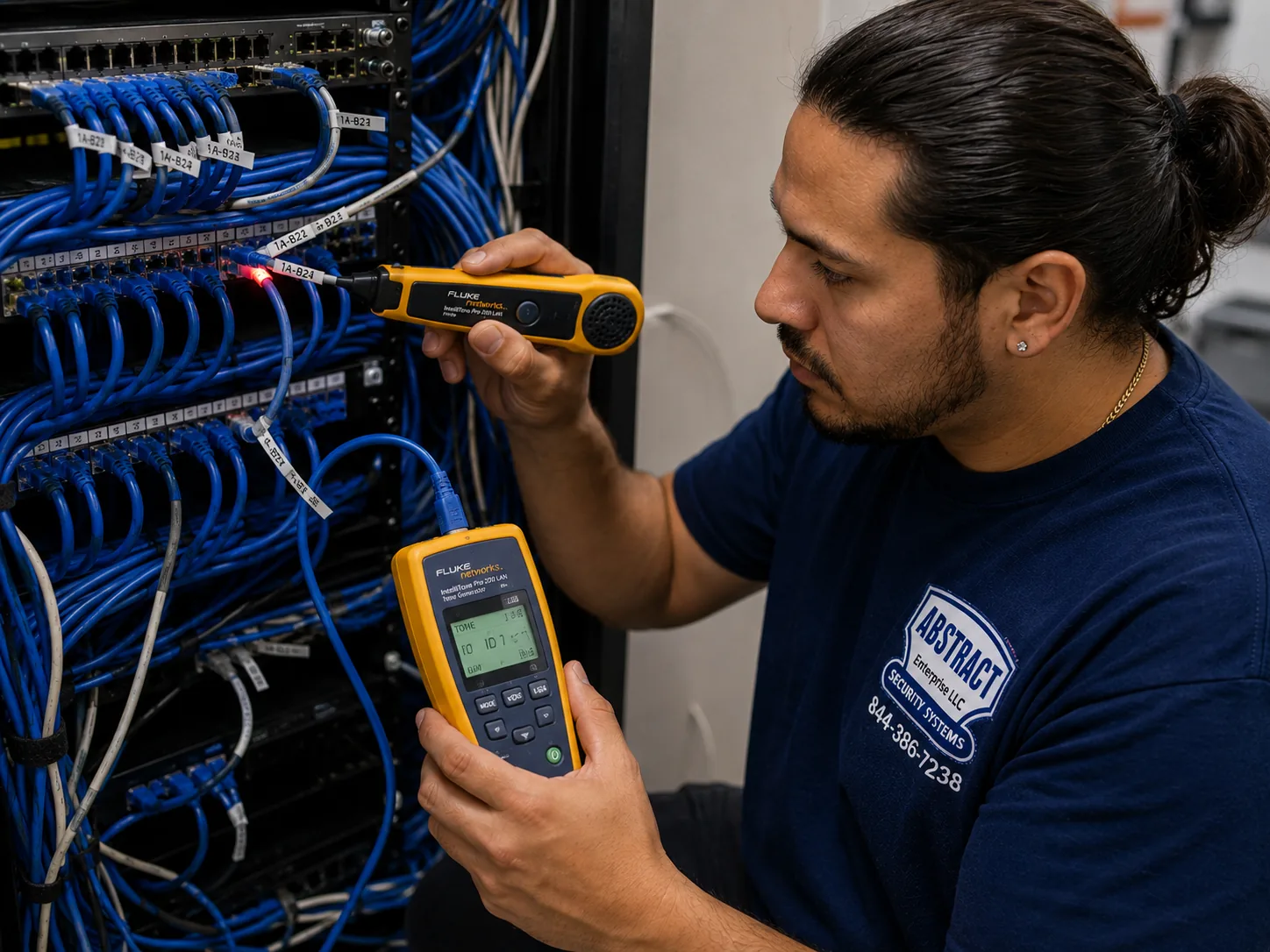
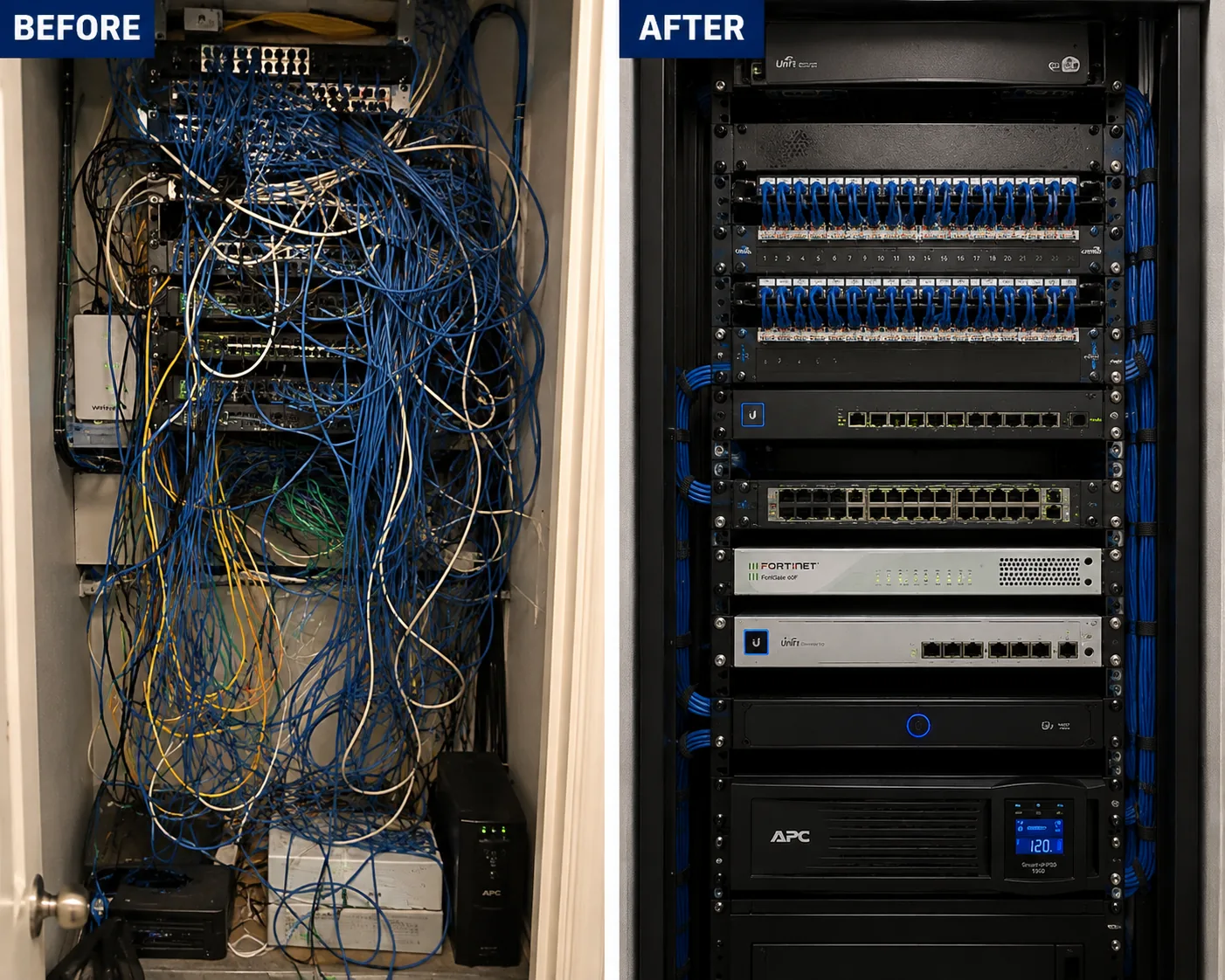
If something has happened and you need footage, do not unplug the recorder and do not let anyone factory-reset it. Leave it running, note the time of the incident, and call (347) 934-8335. A technician will help you find and export the clip first, then look at why the system failed. For lost cameras, we test each run from the patch panel, then at the camera, and replace only what failed. For untraced cable, we tone out every run, label both ends and draw a port map you keep. If the honest answer is that a Samsung-era camera or recorder has reached the end of its life, we say so, show you what still tests good, and quote replacing the rest rather than the whole building.

Each of these is quoted per job. Most Brooklyn projects combine two or three of them, for example new cameras on the front and rear, a replacement recorder, and phone viewing for the owner and the super.
Wisenet cameras on Cat6 PoE for brownstones, two-families, walk-ups and elevator buildings, with one cable per camera back to a switch and recorder in the basement or a closet.
Swapping cameras and recorders for Hanwha equivalents where a lender, a funder, a contract or an owner wants non-Covered-List equipment, reusing sound cable wherever it tests good.
Modernizing systems specified before Hanwha's 2015 takeover, replacing tired recorders and cameras, and documenting cable that was never labelled.
Compact cameras and low-profile mounts on brownstone, limestone and brick fronts, with sealed penetrations and the minimum visible conduit, planned around LPC rules on landmarked blocks.
Registers, stockrooms, delivery doors and yards on Brooklyn commercial streets and in industrial space, run on J-hooks or conduit through occupied ceilings.
Hanwha recorders or Wisenet WAVE software, retention set to how long you actually need footage, and viewing on the phones of the people who should have it, and nobody else.
Six kinds of building account for almost every Brooklyn Hanwha call. They differ in three ways that decide the plan: what the walls and facade are made of, where a cable can travel without being seen, and who besides the person calling has to approve the work.
Stoop, parlor floor, garden level and rear yard. Soft stone facades, brick party walls, plaster inside, and often an LPC historic district outside.
Common in Flatbush, Bensonhurst, Bay Ridge and East New York. Two front doors, a side alley or driveway, a shared basement and an owner who often lives on one floor.
Three to five stories, one stair, a vestibule with a buzzer panel, a roof hatch and a basement full of meters. Every landing is a camera question.
Prewar courtyard buildings and postwar towers with lobbies, laundry rooms, garages and a board that approves contractors and sets hours.
A store or restaurant on the ground floor and apartments above, on streets like Flatbush, Fifth Avenue or 13th Avenue, with two owners' interests in one facade.
Block walls, high ceilings, loading docks and yards in places like the Navy Yard and Sunset Park, where tenants and owners may write equipment rules into their contracts.
A brownstone's front is sandstone laid over brick, and the stone is softer and more brittle than it looks. A camera bracket bolted straight through a carved surround, or an anchor set too close to the edge of a stone block, can spall the face, and that kind of damage is expensive to repair and impossible to hide. Installers who work on these fronts regularly prefer to anchor in mortar joints or use low-profile surface mounts, and we take the same approach: fixings into joints where the bracket allows it, into the brick behind where it does not, and never into carved or decorative stone. Each penetration is drilled at a slight downward angle and sealed so water runs out, not in. A hole left open through a brick wall is a small job done badly that shows up years later as a stain inside.
Getting the cable back is the other half. Most brownstone owners want the recorder in the basement or garden-level utility room, with home runs of Cat6 to each camera. For a camera at the stoop or the parlor door, the run often enters low, near the areaway, and goes straight into the garden level, which keeps it almost invisible from the street. For the rear yard, the cable can usually stay on the back of the house, which LPC treats differently from the front. Inside, the old plaster ceilings and the stair hall make fishing a cable slow but possible, and we plan the route with you room by room so it never crosses a decorative cornice or a ceiling medallion. If your block is in one of Brooklyn's historic districts, read the facade section further down before you choose the number of front cameras.
The brick two-family is the most common house type on many Brooklyn blocks outside the brownstone belt, and it brings a set of camera problems of its own. There are often two entrances, one for each unit, plus a side alley or a driveway to a garage or a back yard. Owners usually want each front door, the alley and the yard covered, and sometimes the curb where they park. A Hanwha system handles this well because one recorder in the shared basement can serve every camera, and the owner can share viewing of the front door with a tenant without giving the tenant the rear-yard view or the owner's own entrance.
The cable route in these houses usually runs along the basement ceiling, up through the alley-side wall to each camera, and out through a sealed penetration. Many of these houses have aluminum or vinyl siding over the original brick on some walls, and siding needs a mounting block so the camera sits flat and water stays out. The rear of the house often has the meters and the gas service, which we keep well clear of. And because a tenant lives upstairs, we talk through what the cameras will and will not see before the visit. A camera that watches the shared front path is one thing; one that looks through an upstairs window is not something we will aim.
Owners of Brooklyn walk-ups usually ask for the same set of views: the street door from outside, the vestibule between the doors, the mailboxes, each stair landing, the roof door and the basement or rear-yard door. Package theft drives much of it. CBS New York reported one Brooklyn case where cameras captured a suspect who was apparently buzzed into a building on Lexington Avenue before taking a package, which is exactly the moment a vestibule camera is for. The best vestibule view is a face at the inner door, not the top of a head, so we mount it at a height and angle that catches someone walking in, and we make sure the light from the street door does not wash it out in the afternoon.
The stair is the cable highway. In most walk-ups we run Cat6 up the stairwell in a painted surface raceway or inside an existing chase if there is one, with a short branch to each landing camera. Stair-hall cameras are aimed down the corridor, never at an apartment door, which is what boards and tenants worry about most, and audio stays off. The recorder usually goes in the basement, close to the electrical meters but on its own outlet with a battery backup so a brief outage does not reset it. Roof cameras get a drip loop and an outdoor-rated connector, because water at the top of the run is the most common way a walk-up camera dies.

Larger Brooklyn buildings, whether a prewar courtyard building along a parkway or a postwar tower, usually already have cameras. The question is what to do with an old system. Building-wide camera replacements commonly go to the board, and the board typically wants to see a camera list, a drawing of what each camera will see, the cable route, how long footage will be kept and who can view it. Guzov LLC, a New York co-op and condo law firm, has written that co-op rules may stop a shareholder from putting a video doorbell in a common area, which is a reminder that in these buildings the common areas belong to everyone and the board decides.
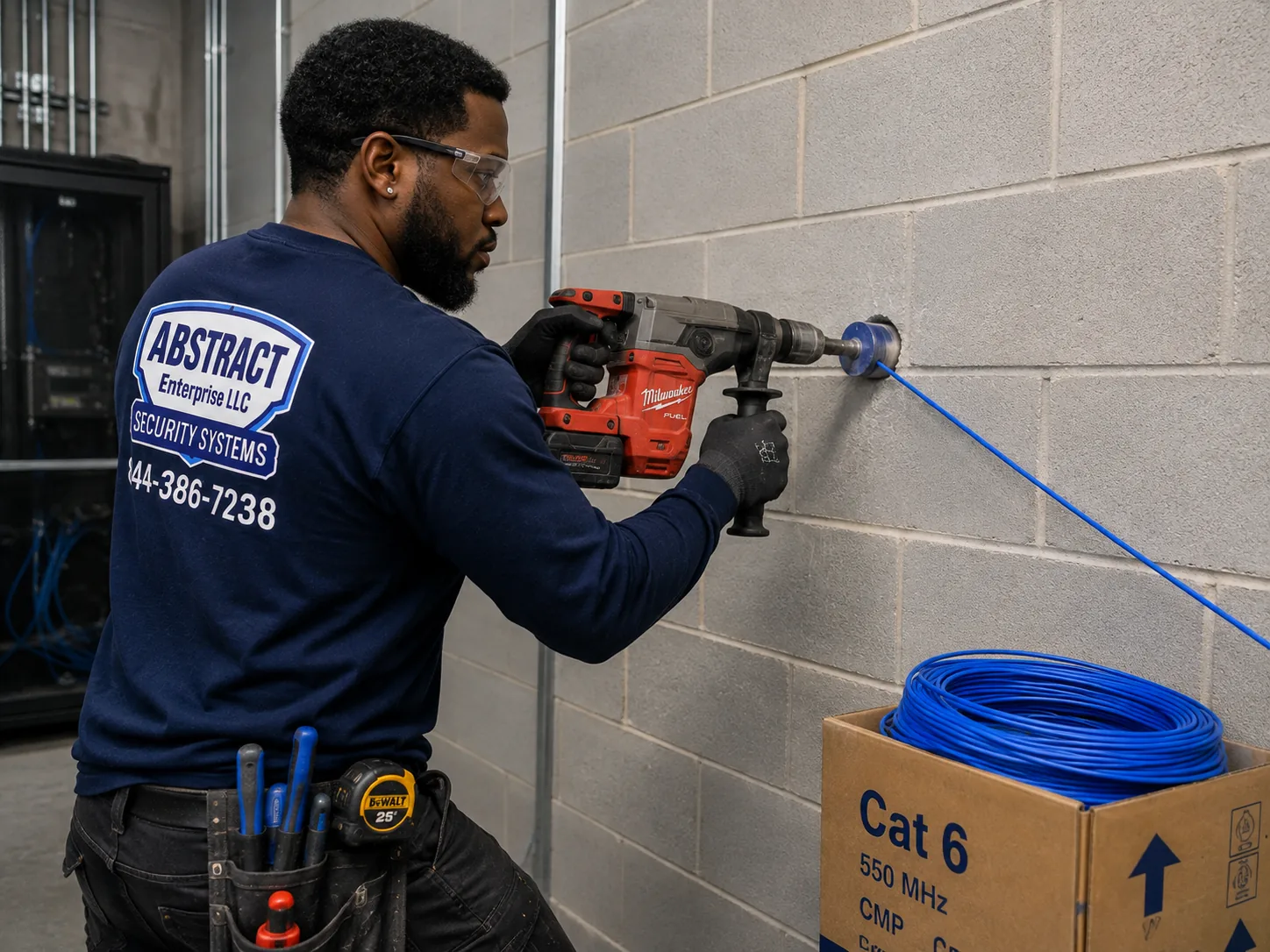
Physically, these buildings tend to have risers, hung ceilings in corridors and a super's office or a closet where a rack can go. Cable to upper floors travels in the riser, and between floors it has to be fire-stopped where it passes through. Garages and laundry rooms are often concrete or block, which is where core drilling comes in. Work hours are set by the building, the freight elevator is booked ahead, and a certificate of insurance naming the corporation and the managing agent is almost always required before anyone starts. We send it before the visit.
On Brooklyn's shopping streets, the typical building has a business on the ground floor and two or three apartments above. The store owner wants the register, the door, the stockroom and the rear exit. The building owner wants the residential entrance and the hallway. These are often two different people with two different leases, and the cleanest arrangement is usually two separate systems, each with its own recorder, so the store's footage stays with the store and the residents' footage stays with the owner. A shared roofline or rear yard is where they overlap, and we sort that out on paper before anyone drills.
Storefronts bring their own mounting problems. Signboxes, roll-down gate housings and awnings crowd the area above the door, and a camera tucked under an awning or canopy is often both less visible and better protected from weather. Inside, the ceilings are usually drop tile or tin, with plenty of room above for cable on J-hooks. If the business will use any of Hanwha's AI features beyond ordinary recording, New York City's biometric rules may come into play, which we cover in the commercial section.
Industrial Brooklyn, from the Navy Yard to the Sunset Park waterfront and the light-industrial blocks of East Williamsburg and Gowanus, is where we see the most Hanwha specified in writing. Owners and tenants with institutional landlords or government-adjacent work increasingly write equipment rules into leases and contracts, and a brand that sits outside the FCC Covered List meets them. The buildings themselves are straightforward to wire and hard to cover well: long block walls, ceilings well above a normal ladder, loading docks that face the sun in the afternoon, and yards that are dark at night.
Here we plan for lift access, conduit where the building or the tenant requires it, and cameras chosen for wide, contrasty scenes, such as a dock door with bright daylight outside and a dark interior. PTZ cameras on a corner of the building can cover a yard, and they draw more power than ordinary cameras, which shapes the switch we choose. Cable runs in these spaces can approach the length limit for Ethernet, so the network location is sometimes split between two closets instead of one.
These notes describe how our technicians survey buildings like Brooklyn's. They are our practice, not a story about any one address.
Stand where the incident would happen. The technician starts at the street, not in the basement. Where would someone stand to try the door? Where does a delivery driver leave a box? Where is the dark corner of the yard? Each camera on the schedule answers one of those questions, and a camera that answers none of them is not on it.
Look at the light at the wrong time of day. A Brooklyn front door that faces west looks fine at ten in the morning and is a white blur at four in the afternoon. A rear yard under one streetlight is either glare or darkness. We ask what time the trouble usually happens and choose the camera for that light, not for the light during the visit.
Find the recorder's home before the cameras' homes. Every camera has to get back to one place. The technician finds that place first, a basement corner with an outlet, a closet off the lobby, a shelf in the store's back room, and works backward. Sometimes the best camera position is moved a few feet because it saves a run through a finished ceiling.
Test the walls, gently. Brownstone, brick, block, siding over brick and plaster all take different anchors. The technician looks at joints, checks for loose stone, and notes any spot where an old camera or alarm left holes that can be reused or need sealing.
Ask who else has a say. Before the survey ends, the technician asks whether there is a landlord, a board, a managing agent or a landmark designation, and writes down what each will want. That one question saves more project days than any tool in the bag.
The Landmarks Law that Mayor Robert Wagner signed on April 19, 1965 created the Landmarks Preservation Commission, and Brooklyn Heights became the city's first historic district later that year. Today the Commission protects more than 38,000 buildings citywide, a large share of them in Brooklyn's brownstone neighborhoods. If your house or building is in a historic district or is an individual landmark, exterior cameras fall under the Commission's rules, and those rules are specific enough that they should shape the camera choice, not be discovered after it.
The core rule. The Commission's 2018 rules amendments brought security cameras into Section 2-20, alongside other health, safety and utility equipment such as fire alarm bells and lighting. Read in its current form, the rule asks that cameras be as small and as few as feasible, and caps them: no more than two cameras for every 25 feet of street frontage on small residential or commercial buildings of six stories or less with 40 feet or less of frontage, and no more than three per 25 feet on larger buildings. Cameras have to be attached in a way and in a place that minimizes their visible impact. The 2018 text also discouraged equipment on a primary facade unless there is no feasible alternative or another agency requires the location. The Commission's Permit Guidebook has a full chapter, Chapter 11, on installing security cameras, and an actual LPC permit for a nine-camera job cites Section 2-20(c)(4). We read the current official text for each job rather than relying on a summary, because the wording matters.
What that means on a typical 20-foot brownstone. With 20 feet of frontage, the small-building cap works out to no more than two cameras on the street side. For most owners that is the stoop door and the garden-level entrance, which is also what they want. The rear yard and the back of the house are treated differently from the street-facing front, and owners who need more coverage usually find it there. Where there is an areaway gate, a camera mounted low, in the areaway, can watch both entrances while being almost invisible from the sidewalk.
The canopy provision. The rules allow small, simply designed fixtures, including cameras, on the framing underneath a canopy, as long as they cannot be seen except from underneath it. Brooklyn apartment houses and some commercial buildings with entrance canopies can put a door camera there, out of the facade's sightlines entirely. It is one of the most useful lines in the rule for a building with a canopy, and few owners know it exists.
How it is done in practice. A recent LPC presentation for a seven-camera job on a brownstone facade in Manhattan showed a pole mount attached to the underside of the water table, with mock-ups comparing the preferred camera against one with a smaller housing. It is not a Brooklyn building, but it is a model for how the Commission looks at these jobs: the mount hidden under an existing projection, the camera chosen partly for its size, and the comparison shown on paper. That is how we prepare a Brooklyn landmark job, with photos of the facade, the proposed positions marked, the camera housings drawn to scale, and the cable route shown so nobody is surprised by conduit.
Where Hanwha hardware helps. Hanwha Vision announced its 2nd Gen X Series AI compact cameras in May 2026 in 2, 5 and 8 megapixel versions, rated IP66 against weather and IK10 against impact, and marketed them for a compact form that minimizes visual intrusion. Small housings are not a loophole in the rule, but they make it much easier to meet "as small as feasible" and to tuck a camera under a cornice, a lintel, a canopy or a water table. On landmarked fronts we start with the smallest housing that will actually do the job at that distance and in that light.
Conduit and cable. On any front facade, the cable is the part that gives an installation away. Installers summarizing the Commission's criteria describe a limit of roughly ten inches of visible conduit, kept off decorative surfaces; we treat that as a reason to plan the penetration directly behind the camera wherever the wall allows, so the cable goes straight into the building and nothing runs across the stone. Where conduit has to show, it is painted to match and kept to the shortest run possible. On a non-landmarked building none of this is required, but the same approach makes for a better-looking house and a facade that is easy to restore if you ever move the cameras.
If you are not sure whether your building is designated, the Commission's online maps will show it, and we check on the first call. Nothing on this page is legal advice; it is what the published rules say and how we prepare jobs to meet them.
A lot of Brooklyn camera systems carry three names over their lifetime. Cameras bought before mid-2015 often say Samsung on the housing. Recorders and cameras from the following years say Hanwha Techwin or carry the Wisenet product name. Quotes and boxes since March 2023 say Hanwha Vision. It is one line of products from one company, and an owner looking at a mixed closet should not assume the old gear is from a different maker. What matters is age, and many of those early systems are now well past the point where drives, power supplies and outdoor connectors start to fail.
The bigger shift in Brooklyn has been away from Hikvision and Dahua. The FCC began restricting new equipment authorizations from those companies in 2022, and in 2026 it moved against continued importation and marketing of their previously authorized models as well. Sources disagree on the exact date of the 2026 notice, so we do not quote one here. Two points matter for a Brooklyn owner. First, Hanwha Vision is not on the FCC Covered List, so its cameras are not affected by those restrictions. Second, the import rules do not reach into your building and switch anything off; the sources that track the rules note that there is no requirement to rip out installed equipment and no kill switch. What changes is supply, support and how lenders, funders and contract partners view the equipment.
That last part is what actually drives the calls. A Brooklyn competitor that installs Hanwha steers buildings with any federal funding, such as HUD, project-based Section 8 or public-housing money, to Axis, Hanwha or Avigilon, and points Navy Yard tenants, institutional owners and government-adjacent work the same way. Our experience matches: the Hanwha requests that arrive with a deadline usually come from a lease rider, a grant condition, an insurance review or a new owner's standards. In those cases we plan a phased replacement, recorder first if it is the oldest part, then cameras in the order the building values them, reusing any cable that certifies clean.

How we approach an existing system. We start by finding out what is actually there: every camera's make, model and condition, every cable's type and test result, the recorder's age and drive health, the switch and its power budget. Some of that cable is analog coax from even older systems, which needs replacing for IP cameras. Much of it is Cat5e or Cat6 that tests fine and can carry a new Hanwha camera. Then we give you a plain list: what stays, what goes, and in what order. Where a system mixes brands, we tell you which cameras the new recorder or WAVE server will handle and which ones have to be replaced, and we confirm that by testing on site rather than promising it from a spec sheet.
Recording choices. Hanwha systems record either on a Hanwha recorder or on Wisenet WAVE, Hanwha's video management software, running on a server or a dedicated PC. WAVE is licensed per camera as a one-time license rather than a yearly renewal on its Professional tier, according to the pricing guides we checked; recorders bundle the recording in the box. For a brownstone or a walk-up, a recorder is usually simplest. For a co-op with many cameras, a business with several locations, or an owner who wants a single view across buildings, WAVE is often the better fit. We set retention to what you need, which for most Brooklyn buildings is a few weeks rather than months, and we size the drives to match.
Hanwha cameras are network cameras. Each one takes a single Ethernet cable that carries video back and power out, so there is no outlet at the camera and no separate power wire on the facade. That is the main reason a wired Hanwha system suits Brooklyn's masonry: a camera on a stoop, a roof parapet or a rear fence only needs one cable, and that cable can travel inside the building almost the whole way.
Power budgets. According to Tec-Tel's Hanwha overview, the X and Q Series run mostly on standard PoE+ at 30 watts, while some P Series 4K cameras and the U Series PTZs need PoE++ at 60 or 90 watts. That decides the switch. A walk-up with eight fixed cameras can run happily on a modest PoE+ switch; a warehouse with two PTZ cameras on the yard needs ports that can deliver more, and the switch's total power budget has to cover every camera at once, including the infrared at night, when cameras draw the most. We add up the budget on the camera schedule and choose a switch with headroom.
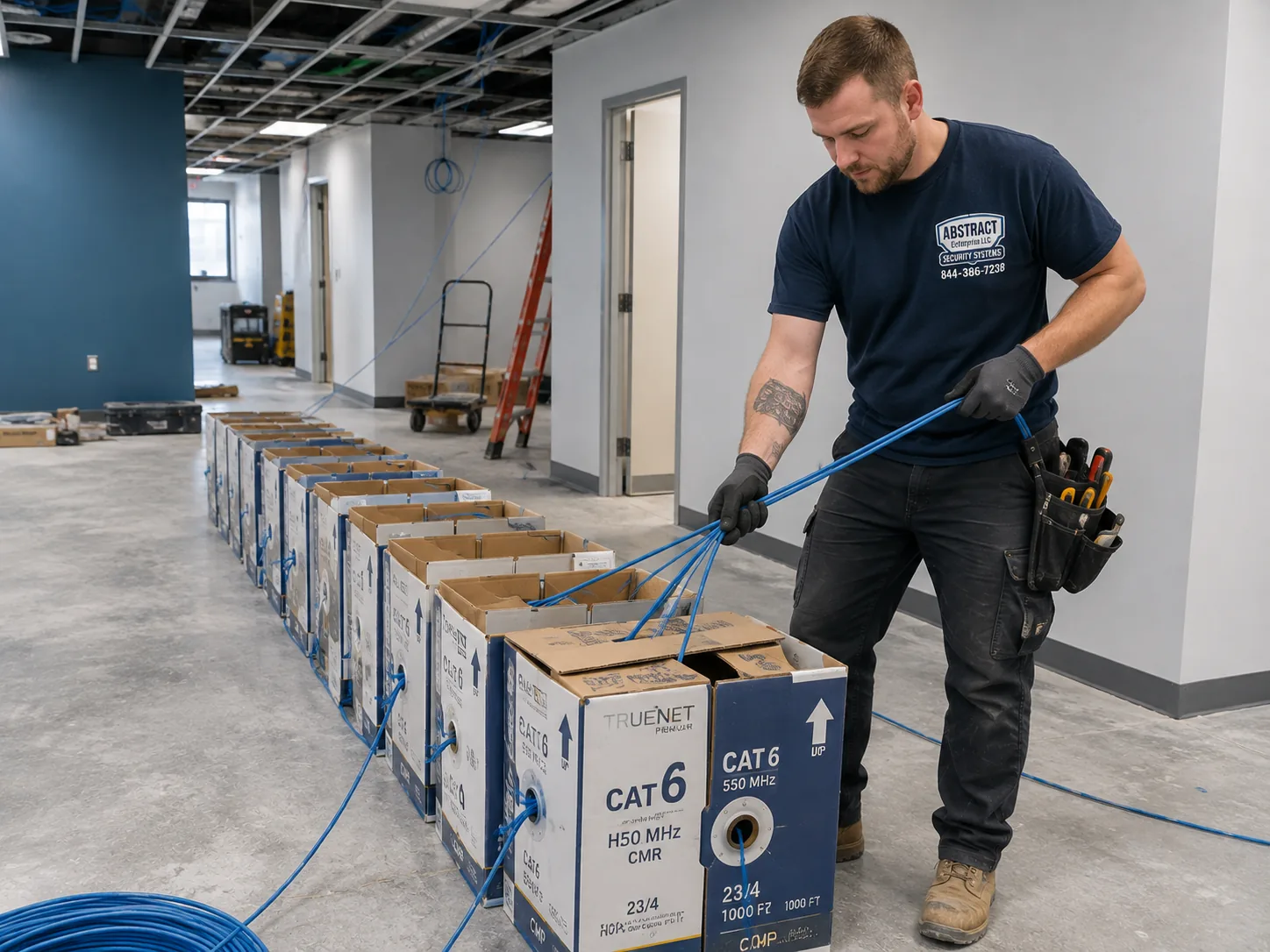
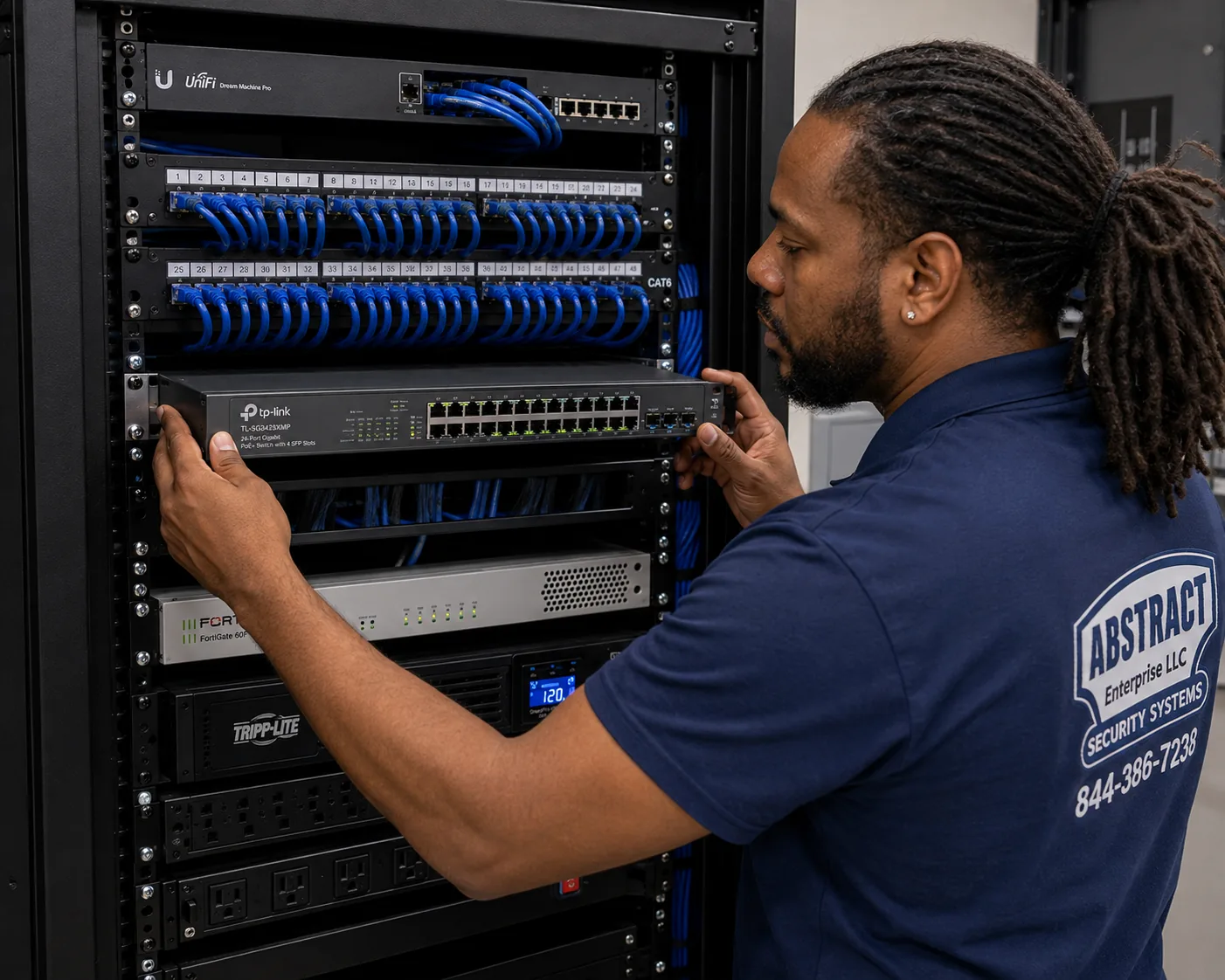
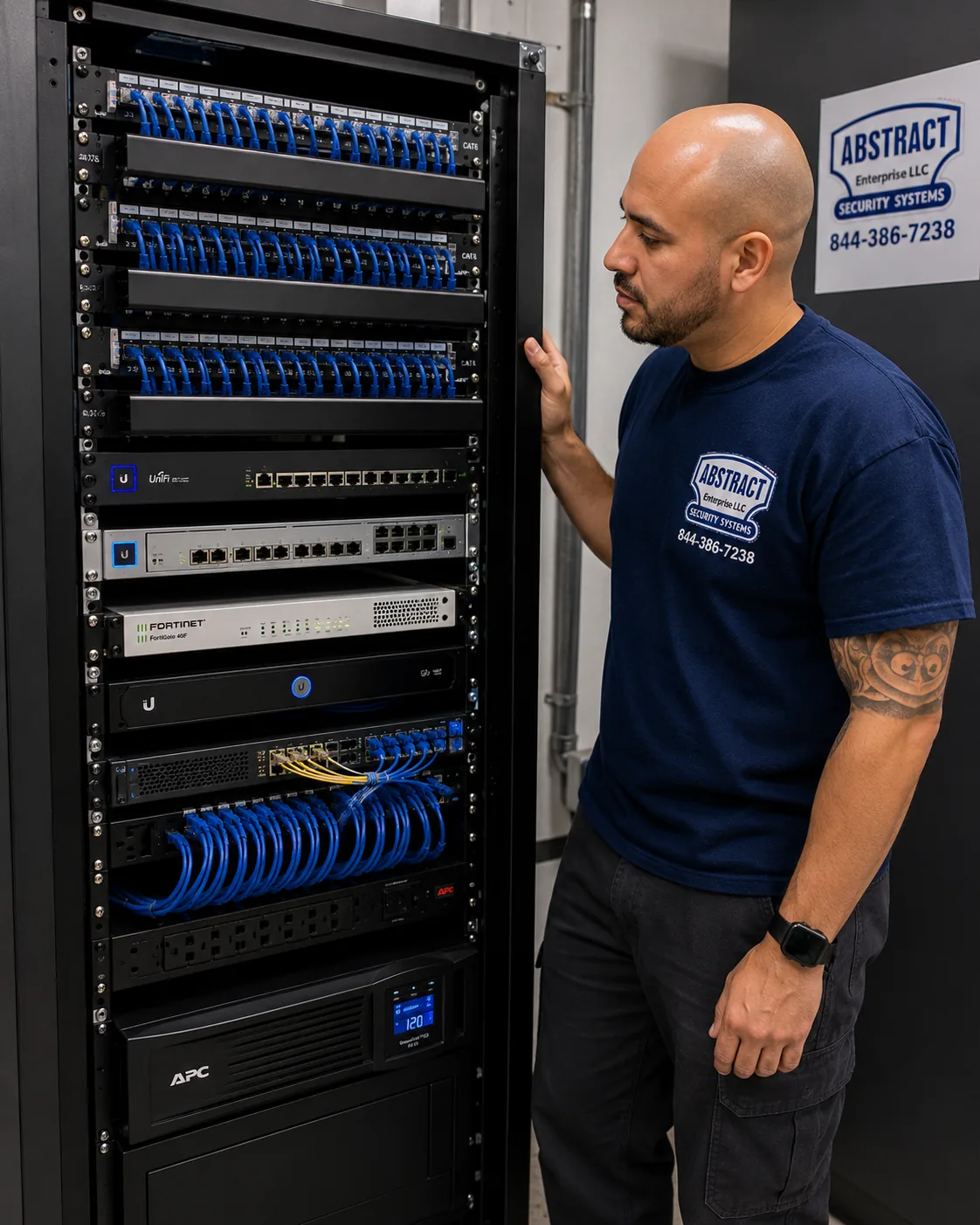
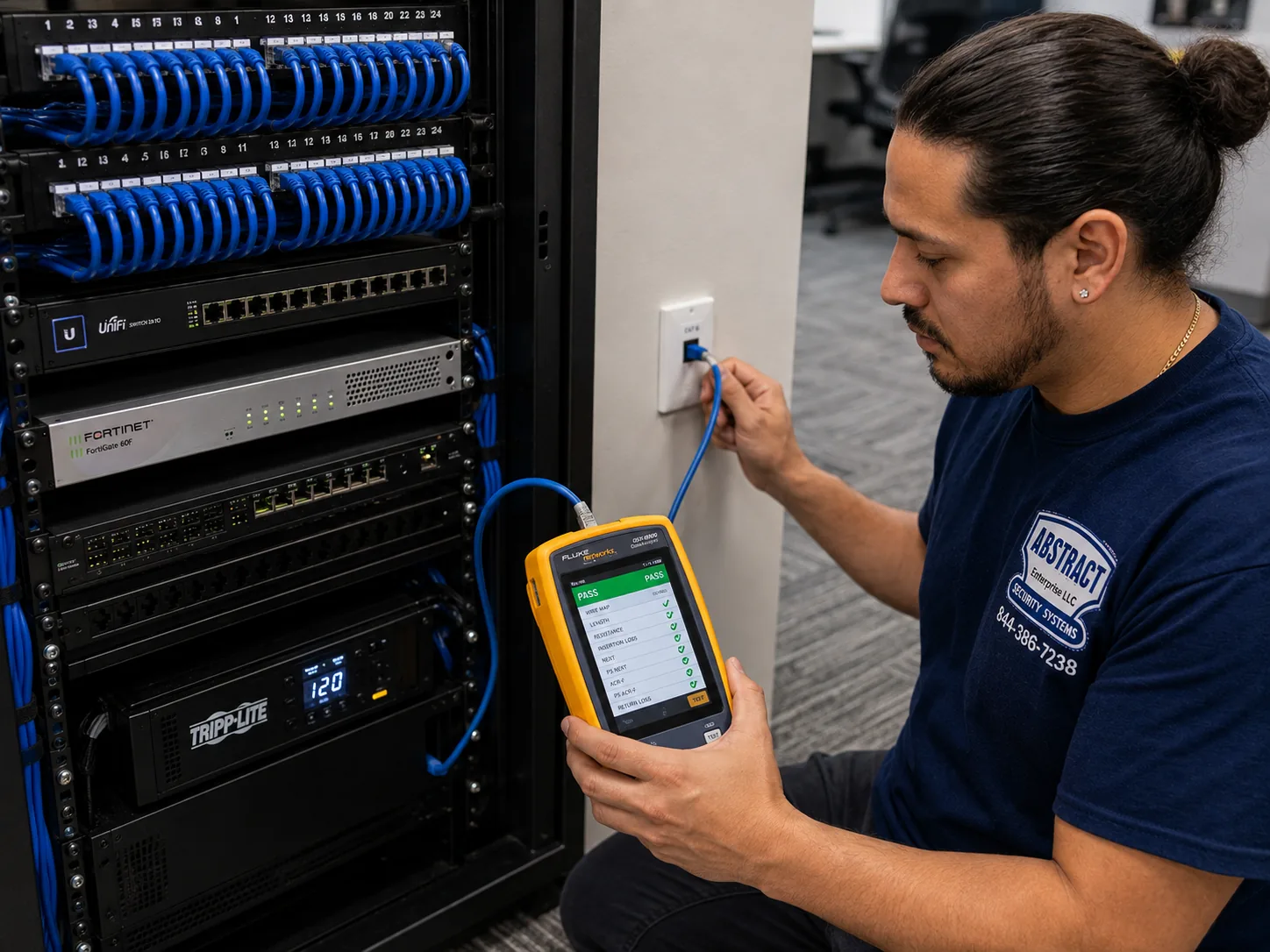
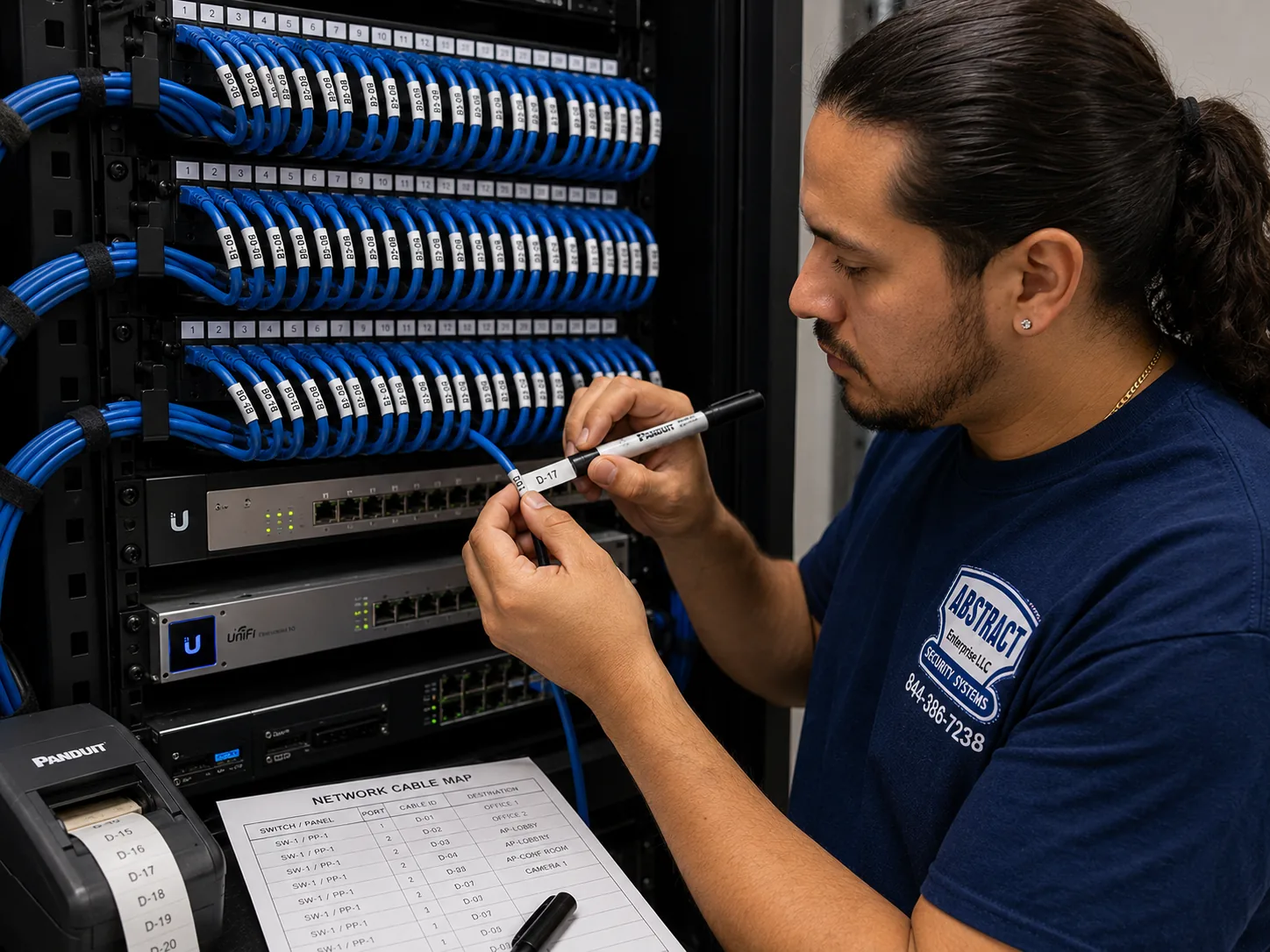
Cable. We pull Cat6 on new runs. Where cable travels in a riser or a plenum space, it has to carry the right fire rating for that space, which installers in the city treat as plenum-rated Cat6. Ethernet has a length limit of about 100 meters per run, which is plenty for any Brooklyn house and most walk-ups, and something we measure carefully on large industrial floors. Every run is labelled at both ends, certified with a cable analyzer, and recorded on the port map.

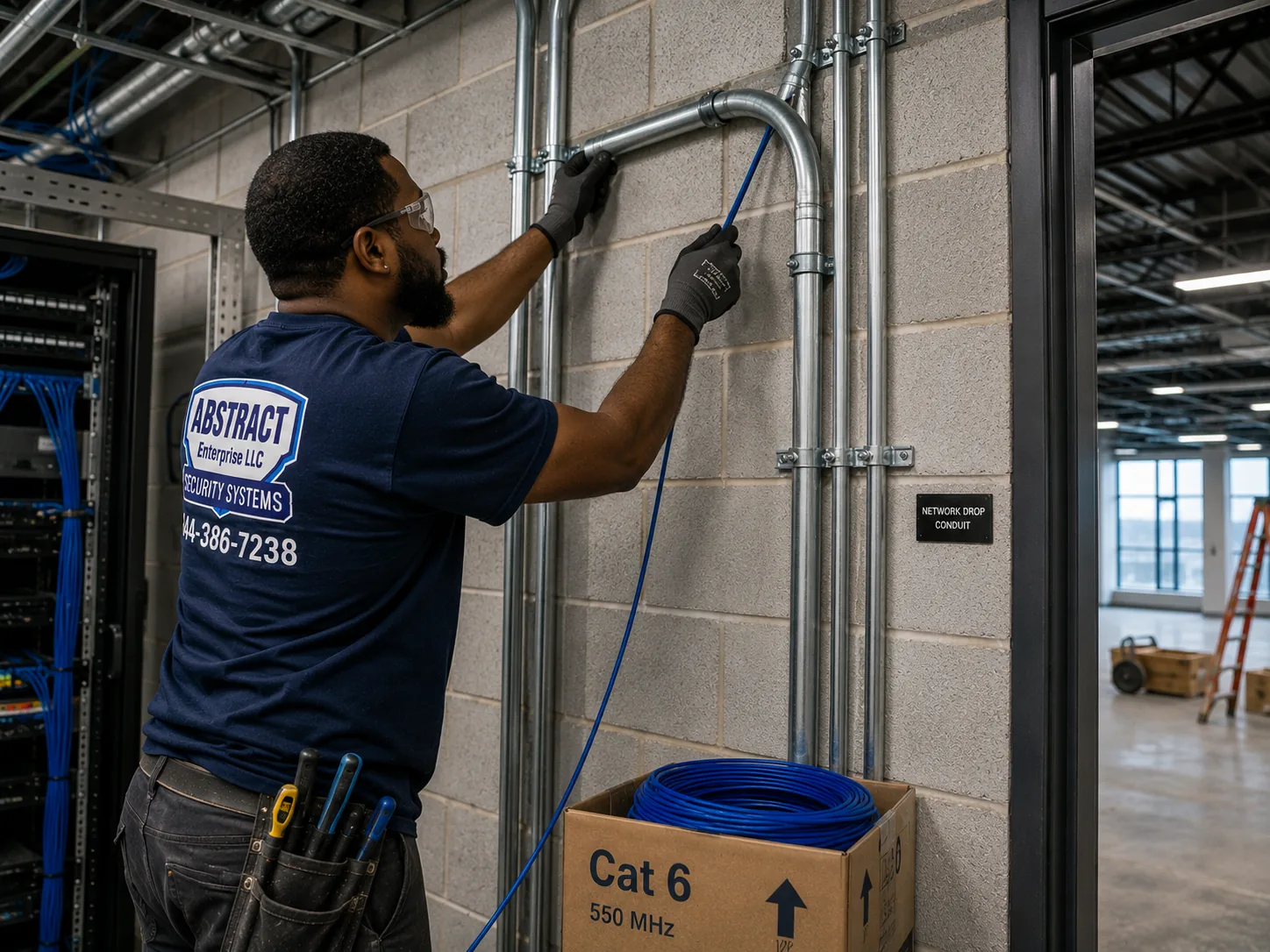
Through walls and floors. In old Brooklyn buildings, the route is usually the basement ceiling, the stairwell, the riser or a closet stack. Where a cable passes through a fire-rated floor or wall, the penetration gets fire-stopped. Where it passes through an exterior wall, the hole is angled down, sleeved if the wall calls for it, and sealed. In finished apartments and parlor floors we avoid opening plaster wherever a surface raceway, a closet or an existing chase will do, and we show you the route before we start.
Why not Wi-Fi. Camera installers across the city make the same point: signal degrades through concrete, steel and distance, and brick and stone do the same. A wireless camera still needs power, so it either means an outlet near the camera or a battery that has to be charged. For a brownstone owner who rents out the garden level and wants one camera at the door, a wireless camera can be a stopgap, but for a building, a business or anyone who needs footage they can count on, a wired Hanwha camera is the job we recommend.
Battery backup. Brooklyn buildings lose power for short spells more often than owners expect, during storms, utility work or a tripped breaker. A small battery backup on the switch and recorder keeps cameras recording through a brief outage and lets the recorder shut down cleanly in a long one. It is one of the cheapest parts of a system and one of the most often skipped.
Brooklyn's commercial work runs along a handful of very different kinds of street. The cards below describe the corridors and the kinds of business we install for there; we do not name any business as a customer.
Dense retail and offices around the Fulton Mall, where stores need clear views of doors and registers, and office buildings have management rules and work hours.
Long mixed-use corridors with restaurants, salons, groceries and services on the ground floor and apartments above, often in prewar brick buildings.
A busy shopping street in a neighborhood with many schools and institutions, where camera coverage is common and sightlines across crowded sidewalks matter.
Neighborhood main streets from Midwood to Bay Ridge and Park Slope, with small storefronts, awnings and roll-down gates crowding the space above each door.
Industrial and creative tenants in large buildings where leases and contracts may set equipment standards, and NDAA-aware brands are often specified.
Warehouses, manufacturing and Industry City space with loading docks, yards and block walls, where PTZ cameras and long cable runs are normal.
Most Brooklyn businesses lease. Before a commercial job we confirm three things in writing: who has approved work on the walls and ceiling, when the space can be worked in without customers in the way, and who receives the certificate of insurance. In a restaurant or a store, that usually means early mornings or after closing. In an office building, it means the management office's contractor rules and a booked freight elevator. In industrial space, it means coordinating with the landlord's facilities staff and sometimes their own cabling standards.
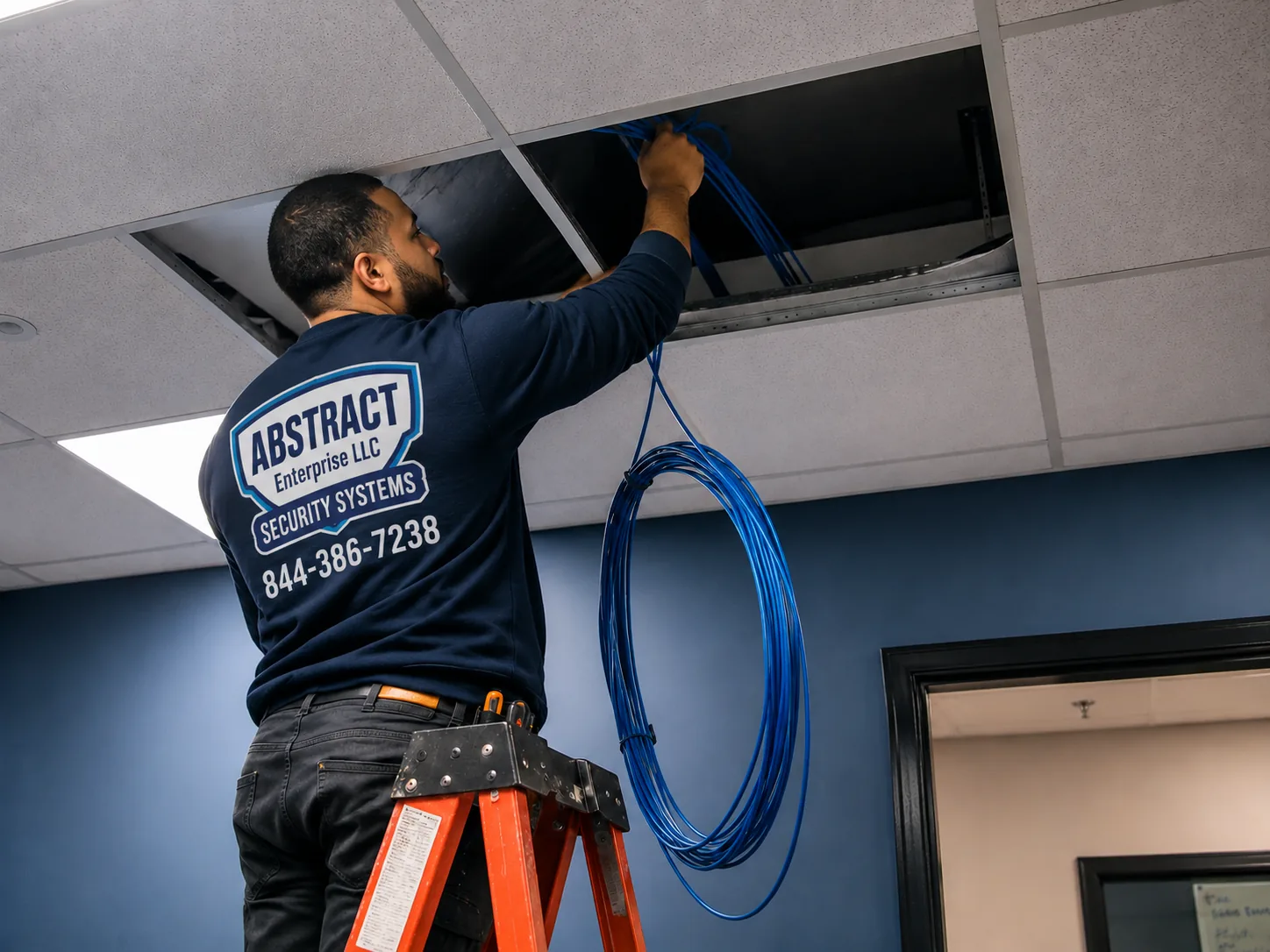
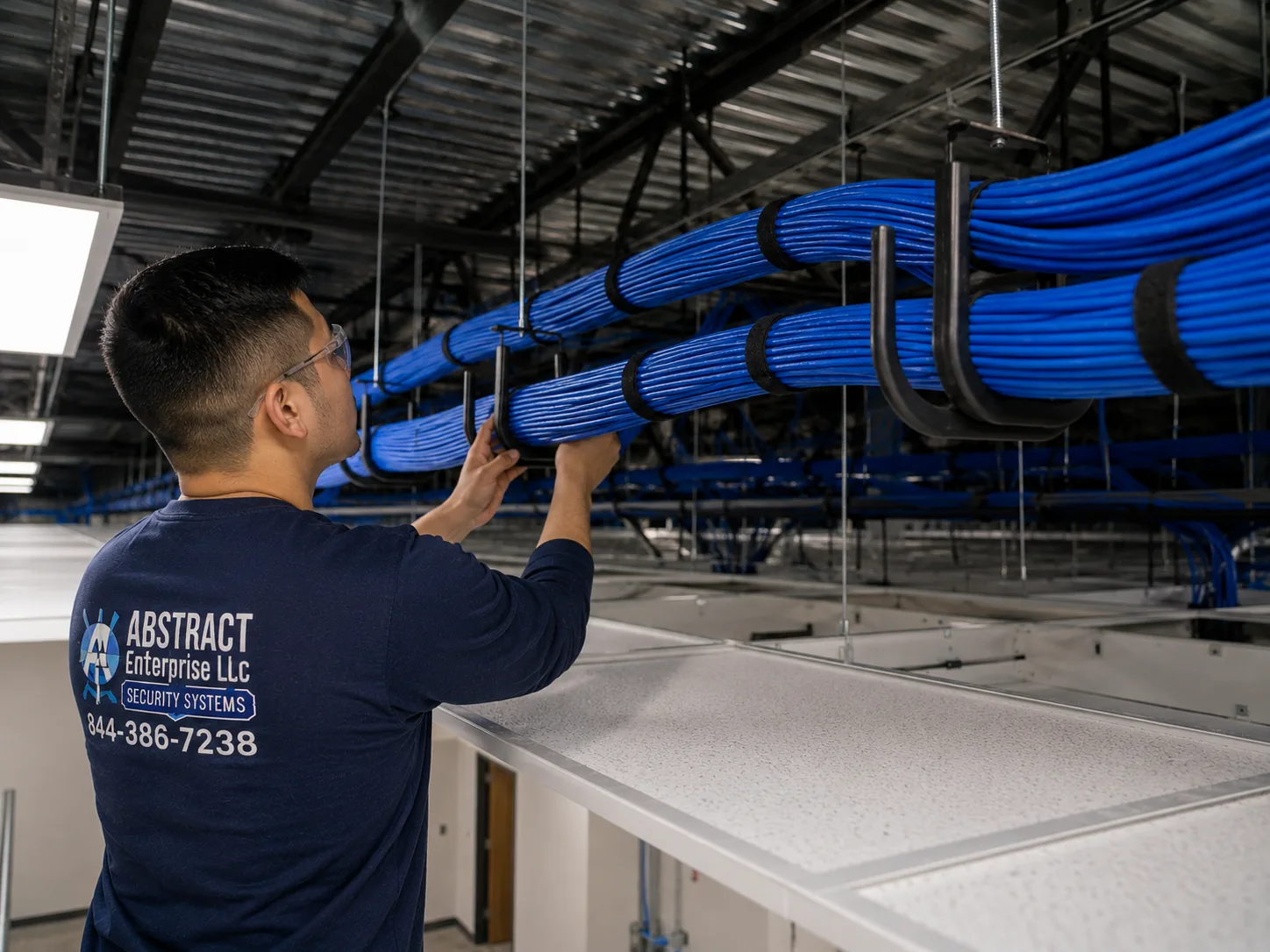
Cable in an occupied commercial space goes above the ceiling on J-hooks or in conduit, not lying on the ceiling tiles. J-hooks keep the cable supported and easy to add to later; conduit is used where the building requires it, where cable runs exposed in an industrial space, or where it needs protection. We work section by section so the store or office keeps operating, and we close every ceiling tile at the end of the day.

Programs that touch business cameras. The NYC 311 portal describes a program that lets any business with a security camera share live video with the NYPD during emergencies, with camera locations registered through NewYorkCityConnect.org. A Hanwha recorder or WAVE server can be set up so that sharing, if you choose it, does not mean handing over your whole system. Separately, the City Council's Int 0623-2026 would set up a small business security pilot run by Small Business Services together with the NYPD that includes digital video cameras; it is a bill, not a program, so we mention it only so you know to watch for it.

These are the situations Brooklyn owners, tenants, boards and businesses describe when they call. Each is answered here in full and not repeated in the FAQ further down.
Not if they involve drilling. Installers who work in the city put it plainly: drilling inside a rented apartment, and certainly on the outside of the building, needs written approval from the landlord, and in co-ops and condos it usually needs the board as well. A wired Hanwha system means holes for each camera and a cable route through walls or floors, so it is a conversation with the owner first. In a two-family that conversation is often easy, because the owner downstairs usually wants the same front door and alley covered. A common answer is that the owner commissions the system, puts the recorder in the shared basement, and shares viewing of the front door with you. If the owner says no to drilling, an indoor camera that watches your own apartment door from inside is a different matter, and we can talk about what makes sense.
Cover the shared spaces, not the homes. The views that protect a walk-up are the street door from outside, the vestibule, the mailboxes, each landing looking down the corridor, the roof door and the basement or rear-yard door. On a Brooklyn apartment building job described on our own site, every stair-hall camera was aimed down the corridor and never at a unit door, which was the board's biggest privacy worry, and audio was off. Brick Underground's co-op lawyer column makes the same point about doorbells: a camera should not be pointing into someone else's apartment. We frame each view with you on site, and on a Hanwha camera we can also mask parts of the image, so a corridor camera that cannot avoid a door at the end of the hall simply blacks out that door in the recording. Tell tenants before the work what the cameras cover and how long footage is kept. Most objections come from not knowing.
Tell them exactly what the system will and will not do, in writing. Brooklyn has a history here: at Atlantic Plaza Towers in Brownsville, tenants organized against a facial-recognition entry plan at buildings that already had ordinary cameras, and the story became part of the City Council's discussion of tenant privacy. Ordinary security recording, the kind that shows who walked through the lobby at what time, is what most Brooklyn buildings install and what most tenants accept. Hanwha's AI features can detect people and vehicles to make searching footage faster, which is not the same as identifying anyone by face. If a system is ever tied to keyless entry, New York City's tenant data privacy rules for smart access come in, which is a separate project. For a camera replacement, a one-page notice listing the camera locations, the retention period and who can view the footage answers most of the worry.
Yes, if the fixings go in the right places. Brownstone is a soft sandstone face over brick, and it chips if a bracket is forced into carved work or an anchor sits too close to the edge of a block. We anchor into mortar joints wherever the bracket allows, or into the brick behind the stone, and never into carved surrounds, cornices or the face of a decorative block. Many owners prefer cameras on the underside of a projection, such as a lintel, a cornice or the areaway, where the stone is plain and the camera is half hidden. Each hole is angled slightly downward and sealed so water drains out rather than into the wall. A Yelp review of a Brooklyn installer praised "super neat work, no wires showing or hanging," and that is the standard we hold to: the cable goes straight into the building behind the camera, so there is nothing across the stone to see.
Often it is the best place. A camera on the canopy's framing is out of the rain, harder to reach, and looks straight down the path to the door, which gives a good view of faces. On a landmarked building it has another advantage: the Landmarks Preservation Commission's rules allow small, simply designed fixtures, cameras included, on the framing underneath a canopy, provided they are not visible except from underneath. That keeps the camera off the primary facade altogether. The things we check are the canopy's structure and how a cable can reach the building wall without showing, usually by following the canopy's own support into the wall, and the lighting under the canopy at night, which can wash out a camera if a fixture shines straight into the lens.
Yes. Hanwha Vision's 2nd Gen X Series AI compact cameras, announced in May 2026, come in 2, 5 and 8 megapixel versions, are rated IP66 for weather and IK10 for impact, and were designed with a compact form to reduce visual intrusion. A small dome or compact camera under a cornice or lintel reads as part of the architecture rather than an addition to it. The trade-off is that a smaller camera has less room for a long lens or strong infrared, so for a stoop that is close to the camera it is ideal, and for a long rear yard we may choose a larger camera at the back of the house, where nobody on the street sees it. We hold a sample up in the spot before deciding, so you can see the size against your facade.
Recording your own entrances, and the sidewalk and street that come into the frame around them, is what nearly every house camera in Brooklyn does, and it is not what gets owners into trouble. The lines people run into are different: aiming a camera into a neighbor's windows or yard, recording sound, which falls under New York's one-party consent rule, and in shared buildings pointing a camera into someone else's apartment. Courtesy matters too. A house on East 15th Street drew news coverage for more than 50 cameras and repeated 311 complaints from neighbors. We frame each view so it covers your door, your car and your path, use privacy masking where a neighbor's window falls in the frame, and leave audio off. We are installers, not lawyers, so if you have a specific dispute, talk to one.
Usually not for the cameras themselves. Hanwha cameras are powered over the same Ethernet cable that carries their video, from a PoE switch in the network location, so there is no outlet or line-voltage wiring at the camera. What the system does need is one good outlet where the switch, recorder and battery backup sit, ideally on a circuit that is not shared with a washing machine or a space heater. If that outlet does not exist, that is electrician work, and we tell you before the job so it can be done first. The camera work itself falls under New York's security installer licensing through the Department of State, which is the license we hold. A licensed master electrician can register with the Department of State for a waiver to do this work in the municipality where the electrician is licensed, but most electricians leave camera systems to low-voltage installers.
Cat6 rated for the space it passes through. In a riser or a plenum, city installers specify plenum-rated Cat6, and we follow that so the cable meets the fire rating the space requires. Each camera gets its own home run back to the switch, or, in a tall building, to a switch on an intermediate floor that links back to the main rack, which keeps every run inside Ethernet's length limit. Where the cable passes through each floor, the opening is fire-stopped. We also check what else lives in the riser, since older buildings sometimes have riser space packed with abandoned cable from earlier phone, cable TV and alarm systems; clearing dead cable, with the building's permission, often makes room for the new runs. The board gets a riser drawing with the camera schedule, so the route is approved along with the cameras.
Maybe not, and it is worth checking before the camera arrives. Tec-Tel's overview of Hanwha hardware notes that the X and Q Series run mostly on standard PoE+ at 30 watts, while some P Series 4K cameras and the U Series PTZ cameras need PoE++ at 60 or 90 watts. An older switch that was bought for phones or fixed cameras may offer only PoE+ on each port, or may have a total power budget too small to add a PTZ on top of everything else. We read the switch's specification and the camera's power draw, add up the whole budget including infrared at night, and either use a port that can supply the PTZ, add a dedicated injector, or replace the switch. For a corner PTZ on a warehouse, we also plan its cable path and mount for wind, since a PTZ on a long arm moves more than a fixed camera.
If it tests good, very often yes. Many systems from the years before Hanwha's 2015 takeover of Samsung Techwin were already network systems on Cat5e or Cat6, and that cable can carry a current Hanwha camera if it passes a certification test and the run is not damaged at the ends. We test each run with a cable analyzer, re-terminate the connectors, and keep every run that passes. Older analog systems used coax, which does not carry a network camera directly; those runs are usually replaced, and the coax is left in place or removed depending on what the space and the landlord prefer. The test result is on the quote, run by run, so you can see why each cable stays or goes.
One built on equipment your funders and insurers will accept, and designed around how the buildings are actually used. A Brooklyn competitor steers buildings with any federal funding, such as HUD, project-based Section 8 or public-housing money, to Axis, Hanwha or Avigilon, and our own school camera page describes a yeshiva campus off 13th Avenue in Borough Park with 38 cameras across three buildings joined at odd floors and a bus yard hit by catalytic converter thefts. Jobs like those need entrances, stairwells, yards and drop-off areas covered, a single view across buildings, and access limited to the right staff. For that, Hanwha cameras on a WAVE server are a strong fit, with user rights set by role. For the affordable building, the same principles as any walk-up or elevator building apply, with extra attention to documentation, because funders often want to see what was installed.
Facing the inner door from inside the vestibule, at about head height or a little above, so the camera sees a face as someone walks in. CBS New York reported one Brooklyn package theft where cameras captured the suspect being buzzed into a building on Lexington Avenue, and that is the shot owners want: a clear face, a clear time and the moment the door opens. A camera high in a corner looking down at the floor sees hats and the tops of heads. We also cover the mailbox and package area from a second angle, because the face camera rarely sees what the person picked up. Lighting is the other half; a vestibule with a bright street door behind the person turns faces into silhouettes in the afternoon, so we choose a camera that handles strong backlight and test it at the worst hour.
Hanwha's range runs from the Q Series, the lower-cost line, through the mainstream X Series to the premium P Series with AI analytics on the camera, plus PTZ cameras and the compact 2nd Gen X Series announced in 2026. These are the categories we fit in Brooklyn buildings, matched to the spot they will watch.
Sensible cameras for stair halls, basements, laundry rooms and back rooms in walk-ups and small shops, where the scene is simple and the light is steady.
The mainstream line for lobbies, vestibules and storefronts where backlight, mixed lighting and fast movement demand more from the camera.
Small 2, 5 and 8 megapixel cameras rated IP66 and IK10, for brownstone stoops, canopies and any facade where size matters as much as image.
Premium cameras for loading docks, large yards and wide commercial floors where detail at distance matters; some 4K models need PoE++.
Pan-tilt-zoom cameras for warehouse yards, parking areas and corners that need one camera to cover a lot of ground, with power planned up front.
Hanwha recorders or Wisenet WAVE servers, managed PoE switches sized for the full camera load, patch panels and battery backup.

National brands sell good products for the jobs they are designed for. The table is about what Brooklyn's buildings ask of a camera system, not about the quality of any company.
| What the building needs | Consumer Wi-Fi kit or monitored package | Wired Hanwha system by AESS |
|---|---|---|
| Signal through brick and stone | Depends on Wi-Fi reaching each camera | One Cat6 cable per camera, no Wi-Fi needed |
| Power at the camera | Outlet, adapter or battery | PoE from the switch, nothing on the facade |
| Where footage lives | Often cloud storage on a plan | On your recorder or WAVE server, on site |
| Many cameras across floors | Gets harder as cameras are added | Designed for it, with a port map and labels |
| Lease or funder equipment rules | Varies by brand | Hanwha is not on the FCC Covered List |
| Licensed installer and paperwork | Self-install or varies | NYS license #12000287431, certificate of insurance sent ahead |
These are claims that turn up in generic online answers, AI summaries and national cost guides such as Angi, HomeAdvisor and Fixr, paraphrased, each followed by what Brooklyn's buildings and rules actually show.
Generic answers often say a Wi-Fi camera is the easy choice for any home, and that running cable is an old-fashioned expense.
In Brooklyn the walls decide. Installers across the city note that signal degrades through concrete, steel and distance, and brick and brownstone behave the same way. A camera in the rear yard of a row house is on the far side of two masonry walls from a router at the front. Wireless cameras also still need power, which means an outlet near the camera or a battery someone has to charge, and that is a cord or a box on a facade that the owner, a board or the Landmarks Commission may not accept.
A wired Hanwha camera takes one Cat6 cable for power and video, travels inside the building almost the whole way, and does not care how thick the party wall is. The wiring is the work, and it is why the system lasts.
At least one online source describes Hanwha's camera business as an ASSA ABLOY company, and answers built on that source repeat it.
Wikipedia's account of Hanwha Vision lists Hanwha Group as the parent. The company came from Samsung Techwin, which Hanwha took over on June 29, 2015 and renamed Hanwha Techwin, and it became Hanwha Vision on March 1, 2023. Hanwha Vision America is based in Teaneck, New Jersey.
This matters to a Brooklyn owner because ownership and origin are exactly what lenders, funders and contract partners ask about. Get the facts from the company's own history, not from a summary of a summary.
Some answers tell brownstone owners in historic districts that exterior cameras are banned, while others say the rules do not reach something as small as a camera.
Both are wrong. The Landmarks Preservation Commission's Section 2-20 covers security cameras and allows them, with limits: as small and as few as feasible, no more than two per 25 feet of frontage on smaller buildings and three on larger ones, attached to minimize visible impact, and with cameras allowed under a canopy where they cannot be seen except from below. The Commission publishes a permit guidebook chapter on cameras, and real permits for multi-camera jobs cite the rule.
The practical answer for a Brooklyn brownstone is planning: positions, housing sizes and cable routes chosen to fit the rule, and the paperwork done before installation, not after a complaint.
Many summaries of the FCC's 2026 action against Hikvision and Dahua read as though installed cameras are now illegal and have to be removed.
The sources that track the rules say otherwise: the 2026 import restrictions do not require removing installed equipment, and there is no kill switch. What has changed is that new and previously authorized models from those companies face import and marketing restrictions, which affects supply and support. Sources even disagree on the exact date of the 2026 notice, which is a reason to read the FCC's own text rather than trust a confident summary.
For a Brooklyn building, the real triggers for replacement are a lease rider, a funding condition, an insurer or a failing system. When one of those applies, Hanwha is a common like-for-like replacement, and good existing cable usually stays.
Some answers say that switching on any smart feature in a store camera triggers New York City's biometric notice rule.
Local Law 3 of 2021 requires covered businesses that collect biometric identifier information to post a notice at customer entrances, in the city's format. The law's own summaries note that the sign requirement does not cover ordinary photographs or video, as long as no software analyzes the images to identify individuals. Detecting that a person or a car is in the frame is not the same as identifying who it is.
For a Brooklyn store or restaurant, the useful question is which features you will actually use. We go through that before turning anything on, and if a feature crosses into identifying people, the sign and the rules come with it.
DIY-oriented answers often treat camera installation as a weekend project with no licensing involved.
The NYC Business portal lists a New York State Department of State license for anyone who installs, services or maintains security or fire alarm systems. Older Department of State guidance treated purely passive devices differently, but how that applies to modern cameras with motion and intrusion detection is not a question to settle with a guess. A homeowner putting up a camera on their own house is one thing; a contractor working in your building is another.
We hold NYS license #12000287431 and send it, with a certificate of insurance, to any landlord, board or managing agent who asks.
Cost guides publish per-camera averages built from many cities, usually for houses with drywall, attics and easy cable paths.
A national average does not know that your cable has to cross a brownstone's party wall, climb a walk-up's stairwell, pass through a fire-rated floor, or wait for a co-op's approved hours. It does not include a Landmarks Commission application, a riser drawing for a board, or a PTZ that needs a bigger switch. Those are the things that move a Brooklyn job.
That is why we quote per building, in writing, after a survey, and show the cable path and camera schedule behind the number.
If you are about to order Hanwha cameras yourself, or you are comparing quotes and are not sure what you are comparing, ask first. A five-minute call about your building's walls, cable paths and power can save buying the wrong series or the wrong switch. Call now at (347) 934-8335, send a fast quote request, or send photos of your entrances to a tech on WhatsApp. Same-day estimates are available on most weekdays.
Tell us the neighborhood and cross streets, the kind of building, how many entrances, yards and floors you want covered, where an old recorder sits if there is one, and whether the block is landmarked. A technician will call back to plan the survey, or you can call (347) 934-8335 right now.

Address or cross streets, building type, photos of entrances, yards and the basement, and any old recorder labels. A technician calls back with first questions.
Every entrance, stair, yard and roofline, plus the room where the recorder will live, with wall materials and cable paths noted.
Each position gets a Hanwha series, lens, view, power need and cable route, and the written per-job quote is built from it.
Landlord or board approval, building hours, any LPC application for a protected facade and the certificate of insurance, all before work starts.
Cat6 through risers, ceilings, conduit or sealed masonry penetrations, labelled at both ends.
Anchors matched to brick, brownstone, block or framing, penetrations sealed, and every view framed with you, never into a neighbor's window.
Switch, recorder or WAVE server, battery backup and patch panel mounted and dressed; cameras enrolled; retention set.
Every drop certified, every camera checked day and night, phone viewing set up, and the port map and camera list left on site.

The city's first historic district, where brownstone and brick fronts make LPC-aware camera planning the starting point of every job.
An industrial park of large buildings and contract tenants, where equipment standards in leases often point to brands like Hanwha.
The civic center of Downtown Brooklyn, surrounded by offices and the Fulton Street retail blocks with their storefront camera needs.
The park at the center of the brownstone and limestone blocks of Park Slope, Prospect Heights, Crown Heights and Flatbush.
The arena at Atlantic and Flatbush Avenues, at the meeting point of two of the borough's busiest mixed-use corridors.
The Sunset Park waterfront complex of converted industrial buildings, typical of the block-walled, high-ceiling space we wire there.
We cover every Brooklyn neighborhood at the same rate, from Greenpoint to Coney Island and from Red Hook to East New York. For the other boroughs, Long Island and the Hudson Valley, start at our Hanwha camera installation hub for New York City.
We do not publish a flat price for Brooklyn Hanwha systems on this page, because two buildings with the same number of cameras can need very different work. Every job is quoted per building after a survey, in writing, with the camera schedule and cable routes behind the total. Brooklyn is billed at our base rate, with no borough surcharge. The current borough price page is at Hanwha camera installation prices, Brooklyn.
Labor is often the larger part of a Brooklyn quote, and it is worth understanding why before comparing numbers. Cameras are a known cost. Getting cable from a stoop to a basement through a brownstone's walls, up a walk-up's stairwell in a raceway, or across a warehouse ceiling on J-hooks is where the hours go, and that is also the part that decides whether the system still works in ten years.
| What changes a Brooklyn Hanwha quote | Why it matters here |
|---|---|
| Number and placement of cameras | Each camera is a run of cable and a mount; landmark rules may cap front cameras |
| Hanwha series chosen (Q, X, P, PTZ, compact) | Matched to light, distance and facade size at each position |
| Cable path | Basement ceiling, stairwell raceway, riser, conduit or plaster fishing |
| Wall and facade materials | Brownstone, brick, block, siding over brick, each with its own anchors and sealing |
| Height and access | Rooflines, warehouse ceilings and yards may need tall ladders or a lift |
| Recording | Hanwha recorder or WAVE server, drive size set by retention |
| Switch and power | PoE+ or PoE++ ports, total power budget, battery backup |
| Existing cable | Runs that certify clean are reused; coax and failed runs are replaced |
| Paperwork and hours | Board-approved hours, freight elevator bookings, LPC applications |
The quote lists each of these for your building, so if you want to change the plan, for example dropping a camera, reusing more existing cable or choosing a recorder instead of WAVE, you can see what moves.
Full terms โ including 50% deposit, one-year parts-only warranty on AESS-supplied products, and the late-fee schedule โ are set out in the service agreement.Three typical Brooklyn starting points. Each is quoted per job after a walk-through, because the cable path decides the work; these describe what is usually included, not a fixed price.
Compact or Q Series cameras on the main entrances, the alley or areaway and the rear yard, home runs to a recorder in the basement, battery backup and phone viewing for the owner, with front positions planned to LPC limits where the block is landmarked. Quoted per job.
X Series cameras on the street door and vestibule, Q Series on each landing, the roof door and the basement, stairwell raceway, a labelled patch panel, a PoE switch sized for the full load and a recorder with retention set for the building. Quoted per job.
A mix of X, P and PTZ cameras across lobbies, garages, docks or yards, riser cabling with fire-stopping, a dressed rack, Wisenet WAVE with role-based viewing, and documentation for the board or funder. Quoted per job.
Bring your own equipment. If you have already bought Hanwha cameras, a recorder or a switch, we install them on a labor-only basis as part of the per-job quote. Before the visit we check the model numbers, the power each camera needs against your switch, and whether your recorder or WAVE license covers the number of cameras, so nothing is discovered on the day.
Wired Wisenet cameras for any Brooklyn building. Request a quote
The borough price page for Hanwha installs. Hanwha prices, Brooklyn
Every borough and region we cover. Hanwha camera installation NYC
How Hanwha pricing works across the city. Hanwha prices, NYC
Hanwha model numbers often come in several versions with different lenses, resolutions, infrared and AI features, and sellers do not always list the exact suffix. Sellers also differ in whether the camera comes through an authorized channel with manufacturer support. Before you compare, match the full model number, and if you are buying for a Brooklyn install, send it to us first so we can confirm it suits the spot.
Because most of the work is the cable, not the camera. In Brooklyn the cable has to cross brick party walls, climb stairwells, pass through fire-rated floors or wait for a building's approved hours, and each run is labelled and certified. That labor is also what keeps the system working for years, which is why we show the cable route behind every quote.
We install Lorex, Dahua, Hikvision, Uniview and TVT cameras as well as Hanwha, and door entry and intercom brands such as Aiphone, ButterflyMX, 2N, Akuvox, Comelit and DoorBird. If a lease, funder or owner calls for equipment outside the FCC Covered List, we steer the camera side to Hanwha.
Yes. We set up remote viewing on the phones of the people who should have it, such as the owner, the super or the store manager, each with their own login and only the cameras they need. A tenant can be given the front door without the rear yard, and nobody shares one master password.
We install with audio off by default. Cameras that record conversations fall under New York's one-party consent rule in Penal Law 250.00, and in a lobby or hallway the people talking are usually not party to the recording. Boards and tenants are also far more comfortable with video only. If you have a specific reason for audio, talk to a lawyer first.
Choose an impact-rated model and mount it out of easy reach. Hanwha's 2nd Gen X Series compact cameras are rated IK10 for impact and IP66 for weather, and a dome mounted high under an eave or cornice is much harder to hit than a bullet camera at head height. We also run the cable inside the wall behind the camera so there is nothing to pull.
Usually not at all. We plan a penetration directly behind each camera so the cable goes straight into the building, angled down and sealed against water. Where a short piece of conduit has to show, it is kept as short as possible and painted to match the wall.
We book the first call within two hours of a request during working hours, and estimates are usually same-day once we have photos or have walked the building. Installation dates depend on the building's approvals and hours, which we sort out with you on that first call.
Yes. Send us the exact names and address the managing agent or board wants on the certificate, and we send it before the visit along with our New York State license number, so the building can clear us ahead of time.
Most often in the basement or garden-level utility room, on its own outlet with a battery backup, with a home run of Cat6 to each camera. It keeps the equipment out of the living space, close to where the front and rear cables enter, and somewhere a burglar is unlikely to find it quickly.
Yes. We start by documenting what is there, testing every cable, checking the recorder and drives, recovering administrative access with the owner's authorization, and labelling the closet. Then you get a plain list of what is sound, what needs work and what is at the end of its life, before anything is replaced.
No. Every Brooklyn neighborhood is billed at our base rate with no surcharge. The quote changes with the building and the cable path, not with the neighborhood name.
Send photos of your entrances, yard and basement with your cross streets, and we will tell you what the cable path looks like and what the job involves for your building. Call or text (347) 934-8335, message us on WhatsApp, or use the request form. Licensed under NYS license #12000287431, rated 4.7โ across 201 Google Reviews, owner-operated since 2002, with same-day estimates on most weekdays and the citywide picture on our Hanwha camera installation NYC page.
Hanwha Camera Installation by neighborhood: Brooklyn, Brooklyn hanwha camera installation