See every Hanwha camera price in NYC and build your own system →
Wired Wisenet Cameras · Built Around the Building's Rules · Priced Borough by Borough
Hanwha Vision, the company that used to be Samsung Techwin, makes the Wisenet cameras that New York buildings increasingly ask for when a board, a landlord or a contract wants equipment from a manufacturer that is not on the FCC Covered List. Putting those cameras into this city is the hard part. More than half of New York's homes sit in buildings finished before 1947, so a Hanwha job here usually means brick and plaster, risers that are already full, coax that nobody has traced, a freight elevator that has to be booked, and sometimes a landmarked facade. We plan each system around the building first, run wired PoE cable wherever the structure allows it, and quote from the Hanwha price page for your borough.
Reviewed and updated November 6, 2026 by Anwar Timothy, NYS license #12000287431 · Sources: Wikipedia's Hanwha Vision entry, the FCC Covered List, FCC import-ban summaries from iCtally, Iron Gate and Coram, Tec-Tel's Hanwha and Axis comparisons, Surveillant's Hanwha pricing guide, the CDW listing for the Wisenet WAVE Professional license, the NYC HPD 2021 Housing and Vacancy Survey initial findings, the Citizens Housing & Planning Council housing stock visualization, the Landmarks Preservation Commission's 2018 rule amendments and the 2026 Preliminary Mayor's Management Report, the NYC rules for Local Law 3 biometric signage, HPD's Tenant Data Privacy Law page, NYC 311's article on the NYPD camera sharing program, City Council Int 0623-2026, NY Senate bill A406, the NYC participatory budgeting portal, CBS New York, and the Guardian's Brownsville report · Dispatched from 1282 Troy Ave, Brooklyn

Owner-operated since 2002 · Thousands of jobs completed · Booked within 2 hours
Hanwha camera installation in NYC is priced per camera position from the Hanwha price page for your borough, and it covers the survey, the cable, the mounting, the recorder or Wisenet WAVE setup, and a handover to whoever runs the building. Hanwha Vision is a South Korean manufacturer that is not on the FCC Covered List, which is why so many city boards, landlords and contractors now name it when they replace Hikvision or Dahua equipment. We book a survey within 2 hours of your request, confirm the building's rules before anyone drills, and run wired PoE cable rather than WiFi wherever the walls are brick, block or concrete. See the NYC Hanwha price list, call (800) 486-0943, or use the form.
New York City was mostly built before anyone imagined a network camera, and that single fact shapes every Hanwha system we put into it. The five boroughs became one city on January 1, 1898, after a consolidation vote so close that it passed 64,744 to 64,467, according to the city's archaeology timeline, and the subway that opened in 1904 tied them together. The housing that followed went up fast. The Citizens Housing & Planning Council's housing stock visualization says more than 80 percent of the city's housing was built more than 50 years ago, and that over half of all units, about two million, were built before 1947. HPD's 2021 Housing and Vacancy Survey gives the same picture in more detail: 2,042,000 units, or 56 percent, in buildings built before 1947, and another 974,000, or 27 percent, in buildings built between 1947 and 1974. In practical terms, five out of six apartments in this city sit in a building that is at least half a century old. A camera system has to be threaded through that building, not designed on a blank sheet of paper.
Hanwha itself has a longer history in this market than its name suggests. The cameras now sold as Wisenet began life at Samsung Techwin. Wikipedia records that Hanwha completed its takeover on June 29, 2015 and renamed the business Hanwha Techwin, and that on March 1, 2023 Hanwha Techwin changed its name again, to Hanwha Vision. The company is headquartered in Seongnam, South Korea, and Tec-Tel's comparison of Axis and Hanwha places its American operation, Hanwha Vision America, in Teaneck, New Jersey, just across the George Washington Bridge from Washington Heights. So when a building manager in Midtown or a co-op board in Queens tells us they want "Samsung cameras" or "Wisenet" or "Hanwha," they are usually asking for the same family of equipment under three names. Part of our job on the first call is untangling which product line they actually mean, because the hardware runs from the lower-cost Q Series through the mainstream X Series to the premium P Series, which Tec-Tel describes as carrying artificial intelligence on the camera itself.
The reason the brand comes up so often now is federal policy, not marketing. The FCC's Covered List names equipment from Hikvision, Dahua and several other Chinese manufacturers, and in 2026 the agency moved from blocking new authorizations to prohibiting the continued import and marketing of previously authorized "legacy" equipment. The sources we reviewed do not agree on the exact date: Iron Gate's NDAA guide gives June 26, 2026, while Coram's replacement guide cites July 16, 2026 and FCC Public Notice DA 26-635. We are not going to pick one for you, and anyone whose contract turns on that date should read the FCC notice itself. What the sources do agree on is twofold. First, iCtally's summary states that Hanwha Vision is not on the FCC Covered List, so its cameras are not caught by the 2022 authorization freeze or the 2026 import ban. Second, Iron Gate states plainly that the ban does not require existing cameras to be ripped out and that there is no "kill switch." That combination produces most of the Hanwha calls we expect across the city: an owner who is not forced to replace anything today, but who knows that replacement parts, firmware support and future purchases of the old brand are getting harder, and who wants the next camera on the wall to be one nobody will question.
The kind of building changes the job far more than the brand does. The prewar stock that HPD counts is not one type. Sky NYC's guide to prewar buildings describes four- to six-story walk-up tenements built before 1929, eight- to twelve-story elevator apartment houses from the 1910s and 1920s, and the larger doorman buildings, and it places many of them on the Upper West Side, the Upper East Side, the Villages, the Lower East Side and East Village, and Harlem. RentReboot's sample of prewar listings found that 47.7 percent had fewer than ten apartments and 41.5 percent listed an elevator, which tells you how many small walk-ups there are. HPD's survey adds that only 12 percent of units in prewar buildings were condos or co-ops, about 70 percent of those being co-ops. Each of those details matters for a Hanwha install. A small walk-up means long cable runs up stairwells and through masonry, with no elevator to carry a ladder. A co-op means a board, a managing agent, rules about hours and a certificate of insurance. An elevator building means risers, and in older buildings, as Seneca Security's guide to choosing a camera system for a city building puts it, "full risers, plaster and coax nobody has traced."
Then there is the outside of the building. The Landmarks Preservation Commission was created when Mayor Robert Wagner signed the Landmarks Law on April 19, 1965, according to Village Preservation, and the city's 2026 Preliminary Mayor's Management Report says the Commission has designated 38,119 buildings and sites, including 1,470 individual landmarks and 157 historic districts and extensions across all five boroughs. LPC's 2018 rule amendments list security cameras, lighting and intercom panels among the objects "commonly used for security measures," and the proposed rules would prohibit installing many of those objects on a primary facade. For an owner on a brownstone block in a historic district, that is the difference between a camera over the front door and a camera tucked under the stoop, in the areaway or on the rear wall. A Hanwha dome in a facade-matched finish is a very different conversation with LPC from a white bullet camera bolted to the cornice.
The people living in these buildings have their own reasons for calling. Security.org's 2026 package theft report found that apartment residents were more than three times as likely as single-family residents to have had a package stolen in the previous three months, 10 percent against 3 percent. CBS New York has reported a lobby thief in Astoria at 36th Avenue and 31st Street who, police said, used a screwdriver to disable a door lock, and thieves in a Park Slope lobby seen cutting packages open inside the building. At the Robeson on Lenox Avenue in Harlem, CBS reported that a key code was required to enter and police said there was no forced entry. Public housing residents are asking for coverage too: a 2025 participatory budgeting proposal for the Gowanus Houses asked the city to install security cameras in elevators and near apartment doors. At the same time, New Yorkers are wary of cameras that do more than record. The Guardian reported in 2019 that tenants at two brick high-rises in Brownsville, which already had cameras watching the grounds, doorways, elevators and halls, fought their landlord's plan for facial-recognition entry. A Hanwha P Series camera can run analytics on board, and a building that switches those features on without thinking about its tenants, or about the city's biometric signage law, is buying itself a problem.
We also want to be plain about what our research could not find. We looked for Reddit threads in r/NYC, r/AskNYC and r/homesecurity about Hanwha installation, for Yelp reviews that praised or complained about Hanwha installers, and for Patch, BKReader or Bronx Times stories about the brand, and none of those searches produced anything we could cite. We did not pull HPD violation, 311 complaint or DOB permit counts tied to cameras. We could not open Google's People Also Ask boxes or its AI Overview for this search from our build environment. Where this page draws a conclusion about what sits behind a wall or inside a riser, it is based on the age and type of buildings in the public record and on what we find in buildings of that age, not on a survey of your building. The only way to know your building is to walk it, which is the first thing we do.
What buildings usually add once the cameras are in. When a building replaces its cameras, the next question is often the front door: a video intercom, key fobs or app entry. That is a separate scope with its own rules. HPD's Tenant Data Privacy Law covers smart access systems in residential buildings with at least three units, so if the door system and the Hanwha cameras are going to share data, tell us at the start and we will plan the two so the camera footage and the entry logs stay separate where the law expects them to.

A recorder that has stopped saving footage is the call we treat as most urgent, because you usually find out the day you need a clip and it is not there. If your screen shows cameras but the playback is empty, or the recorder beeps, or a camera shows "video loss," write down what you see, take a photo of the recorder's front panel and its model label, and do not factory-reset anything that might still hold footage you need. Then call (800) 486-0943. The other urgent calls are buildings with a deadline: an insurer that wants coverage on a loading dock, a tenant moving into a commercial space on a fixed date, or a board meeting where the replacement plan has to be on the table. Tell us the date, the number of camera positions and what is there now, and we will tell you honestly whether the timeline can be met.
Most Hanwha calls in this city will not be for a building that has never had a camera. They will be for a building that has one already, often a Hikvision or Dahua recorder, or a rebrand built on one of those platforms, that was installed years ago and has quietly kept running. Iron Gate's NDAA guide is clear that the 2026 import ban does not force anyone to remove working equipment, and we tell owners the same thing. Replacement is a decision, not an emergency, unless a contract, a lender, an insurer or a government-funded program says otherwise. The question is how to do it without paying twice for work the building already has. The table below is how we think through each part of an older system.
| Part of the old system | What we check | Usual outcome |
|---|---|---|
| Cameras | Make, model and whether the manufacturer is on the FCC Covered List; condition; whether the view still matches what the building needs | Replaced with Hanwha models chosen view by view; iCtally's replacement guide lists Hanwha Vision as a like-for-like swap for Hikvision coverage |
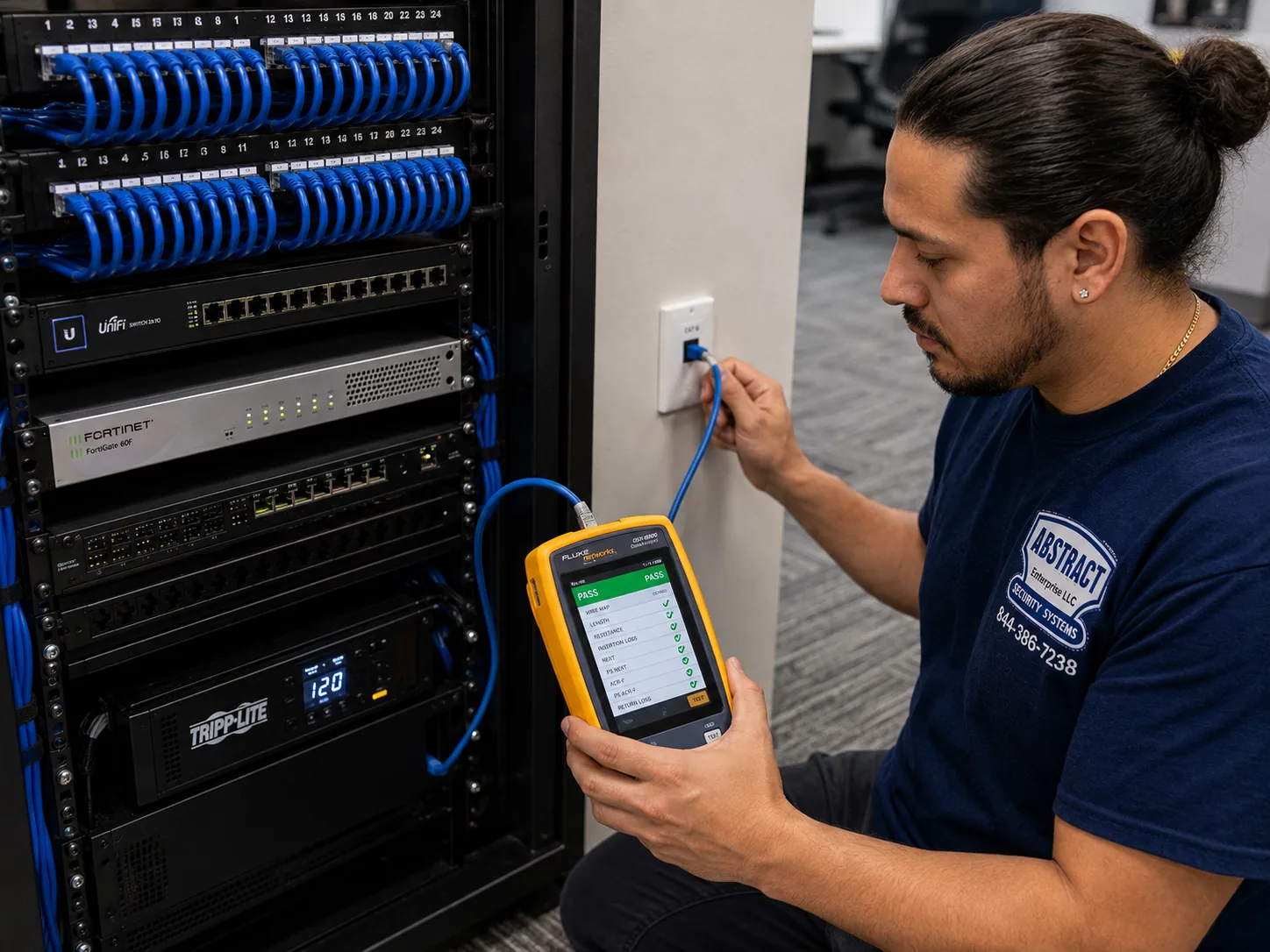
| Network cable (Cat5e or Cat6) | Continuity and certification with a tester, length, damage at the ends, how it was routed through risers and fire-rated assemblies | Often reused if it tests clean, which saves the largest part of the labor in a masonry building |
| Coax from an analog system | Whether it is coax at all, its condition, and whether a path exists to replace it | Usually replaced with network cable, because PoE cameras need it; old coax can sometimes serve as a pull string |
| Recorder (DVR or NVR) | Make, whether it holds footage that must be kept, whether it accepts other brands' cameras | Replaced with a Hanwha recorder or a Wisenet WAVE server; old footage exported first if it is needed |
| PoE switch | Make, available power budget, port count, condition | Kept if it is sound and has power to spare; replaced if it is undersized or on the Covered List |
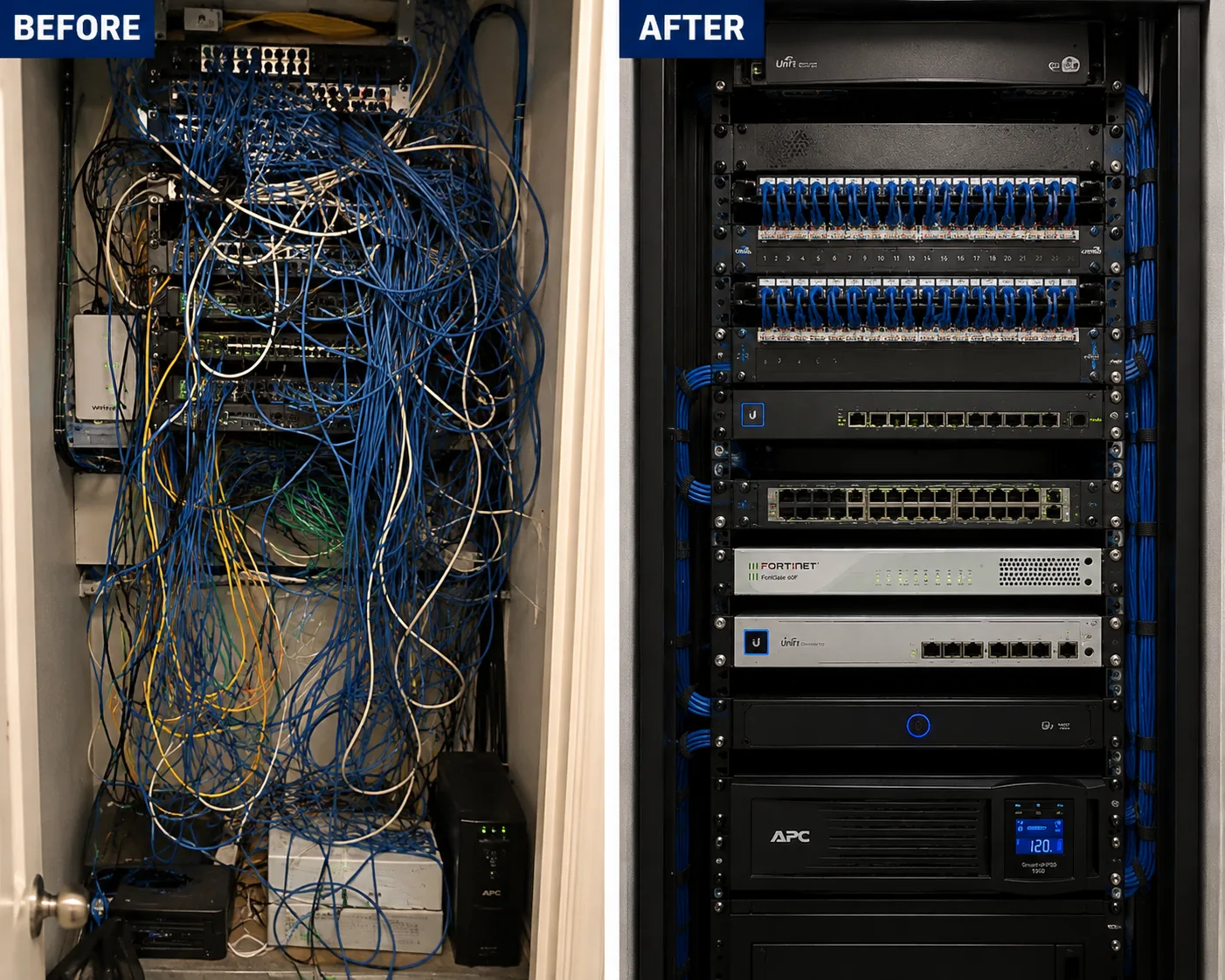
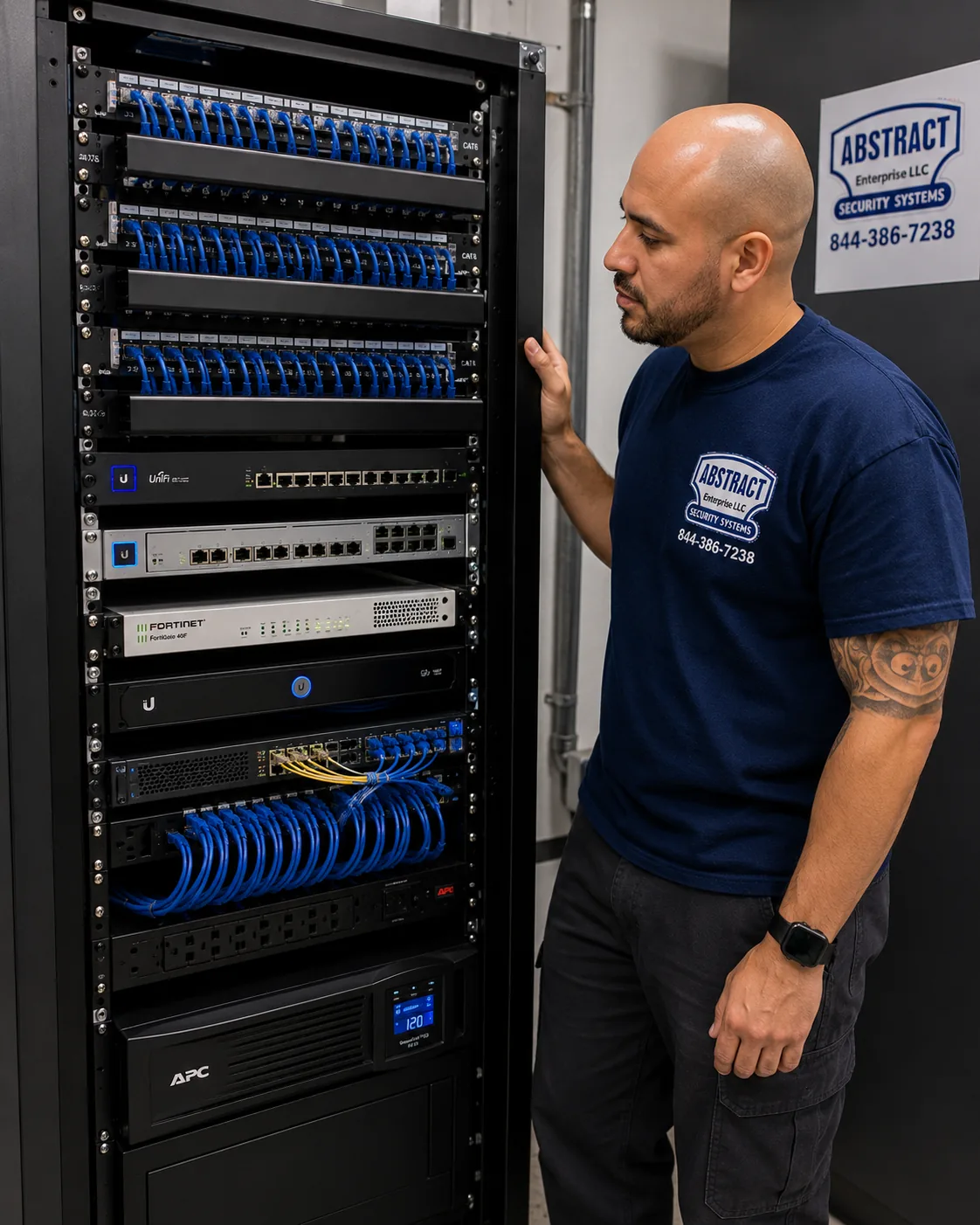
| Battery backup and rack | Battery age, runtime, ventilation, how tidy and labelled the rack is | Batteries replaced if tired; rack dressed and labelled as part of the job |
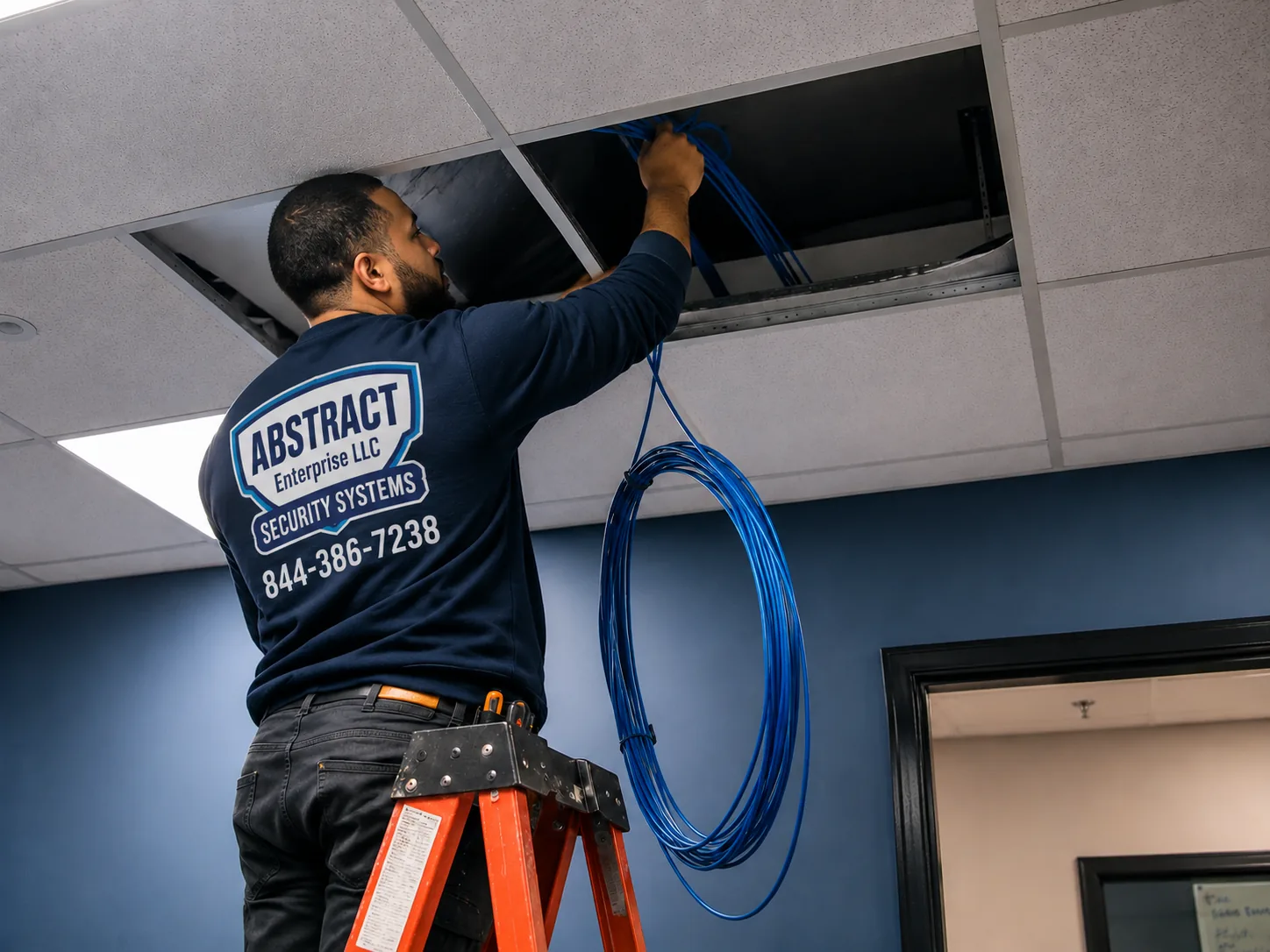
In a modern office with drop ceilings, pulling a new cable to a camera is quick. In a 1920s walk-up with plaster walls, a full riser and a landlord who does not want hallway ceilings opened, the cable is the job. That is why the first thing we do on a replacement survey is test what is already in the walls. A Cat5e or Cat6 run that certifies cleanly can carry a Hanwha PoE camera's power and video on the same cable, as Seneca's technical guide to PoE installation describes, and reusing it means the new camera goes up where the old one was with little more than a new mount. A run that fails, or turns out to be old coax from an analog system, has to be replaced, and the price of that depends almost entirely on the path. We would rather tell you that on the survey than discover it halfway through the install.
Before an old recorder comes off the shelf, we ask whether anyone needs what is on it. A building in the middle of an insurance claim, a commercial tenant with a dispute, or a board that has received a records request may need footage preserved. We export the clips you name before the swap, onto a drive you keep, and we note on the job sheet that the old recorder's disk was handed to you, not wiped. If nobody needs the old footage, we say so on the paperwork too. This step takes minutes, but skipping it is the one mistake in a replacement that cannot be undone.
Because the ban does not force a rip-out, many owners spread the change over time. A common order is to replace the recorder and the cameras covering the most important areas first, usually the entrances, lobby, mailroom and garage ramp, and leave the rest of the old cameras running until a later budget year. Whether that works depends on whether the new recorder can take the old cameras in the meantime, which varies by model and firmware. We check that compatibility on the survey and tell you in writing whether a staged plan is realistic, or whether the two systems would have to run side by side on separate screens until the second stage.
An NYC competitor's warehouse page notes that some builds move to Hanwha, Axis or Avigilon when a contract or landlord requires NDAA-compliant equipment, naming institutional owners, government-adjacent tenants and some records and pharmaceutical contracts as examples. If your building or business falls into that group, the requirement usually arrives as a clause in a lease or contract, and it often names Section 889 of the National Defense Authorization Act. Send us the clause. We will tell you which parts of your existing system it reaches, which parts it does not, and we will list the make and model of every device we install so you can hand that list to whoever is checking compliance.

The time lost on a city camera job is almost always lost before the first cable is pulled: a freight elevator that was not booked, a certificate of insurance with the wrong names on it, a board that meets once a month, or a camera position on a facade that needs LPC review. Ten minutes of gathering information before we arrive saves days later. Please do not open ceilings, unplug recorders or move cameras yourself; just look, photograph and send us what you find.
| What to gather | Why it matters in NYC | What to send us |
|---|---|---|
| Photos of the current recorder and its label | Tells us whether the old system is Hikvision, Dahua, a rebrand or something else, and whether it can take Hanwha cameras during a staged change | A photo of the front panel and the model sticker |
| A rough list of areas to cover | Lobby, mailroom, elevators, stairwells, roof door, rear yard, garage ramp and loading dock each need a different lens and mount | A list, or a phone video walking the route |
| Building rules | Co-ops, condos and many commercial landlords want a certificate of insurance, a scope of work and set work hours | The managing agent's or super's email and any written contractor rules |
| Freight elevator and access | Seneca notes that in occupied towers the freight elevator has to be booked ahead and risers and tenant ceilings need access | Who books the elevator and which hours are allowed |
| Landmark status | LPC rules limit equipment on primary facades of designated buildings | Whether the building is a landmark or in a historic district, if you know |
| Internet connection | Remote viewing through the app or WAVE depends on the building's internet and router | Who the provider is and where the router sits |
| Power at the rack location | The recorder, switch and battery backup need a dedicated outlet in a ventilated spot | A photo of where the old recorder sits and the outlet near it |
| Contract or lease clauses | NDAA or Section 889 language decides which brands may be used | The clause itself, not a summary |
A camera sees only what the light shows it. Seneca's compliance guide points out that the Multiple Dwelling Law requires adequate lighting in vestibules, hallways, stairwells and courtyards, and that a camera pointed at an unlit corridor records nothing useful. Before the survey, walk the areas you want covered after dark and note where the light is weak, where a bulb is out, and where a bright fixture shines straight at the spot a camera would look from. Hanwha cameras handle low light well, but no camera can identify a face lit from behind by a glaring fixture. Your notes tell us where we may need a different angle, or where the fix is a light bulb rather than a camera.
In a one-family brownstone, the owner decides. In a co-op, the shareholder, the board and the managing agent may all have a say, and building-wide upgrades may need board approval, as Seneca's guide notes. In a rental building, the owner decides about common areas, but tenants will notice cameras in the halls, and Seneca's article on tenant objections warns that a camera aimed at a single tenant's door, rather than the broader hallway, can look like harassment in a dispute. In a commercial space, the landlord usually controls the facade, the roof and the shared ceilings. Tell us who owns what before the survey and we will plan each camera position with the right person.

These are the Hanwha jobs we book across Brooklyn, Manhattan, Queens, the Bronx and Staten Island. Each one is priced from the Hanwha price page for its borough. Where a job needs something beyond the usual, such as conduit in a garage, a fire-stopped penetration between a store and the apartments above, or after-hours work in an occupied office, the quote names it before anything is ordered.
Lobby, vestibule, mailroom, elevator, stairwell, roof door and rear yard coverage for walk-ups and elevator buildings, cabled through the building's existing paths wherever they test sound.
Covered-List cameras and recorders swapped for Hanwha equipment, with existing network cable tested and reused where it certifies, and old footage exported before the old recorder leaves.
Small, finish-matched cameras placed under stoops, in areaways and on rear walls, with positions planned around LPC rules for primary facades.
Cameras on ramps, entry gates and drive aisles, where low ceilings, headlight glare and concrete call for wired cameras on solid mounts.
High-mount cameras over docks, racking aisles and yards, with cable run in conduit where the building or the insurer requires it.
Register, entrance, stockroom and back-door coverage, cabled after hours when the space is occupied by day.
A Hanwha recorder or a WAVE server, with one-time per-camera licenses, retention set to what the building needs and remote viewing for owners and supers.
On-camera detection features configured for the areas that need them, with a plain conversation about Local Law 3 signage before any biometric feature is turned on.
New positions added to an existing Hanwha system, cameras re-aimed after renovations, offline cameras traced and failed cable runs replaced.
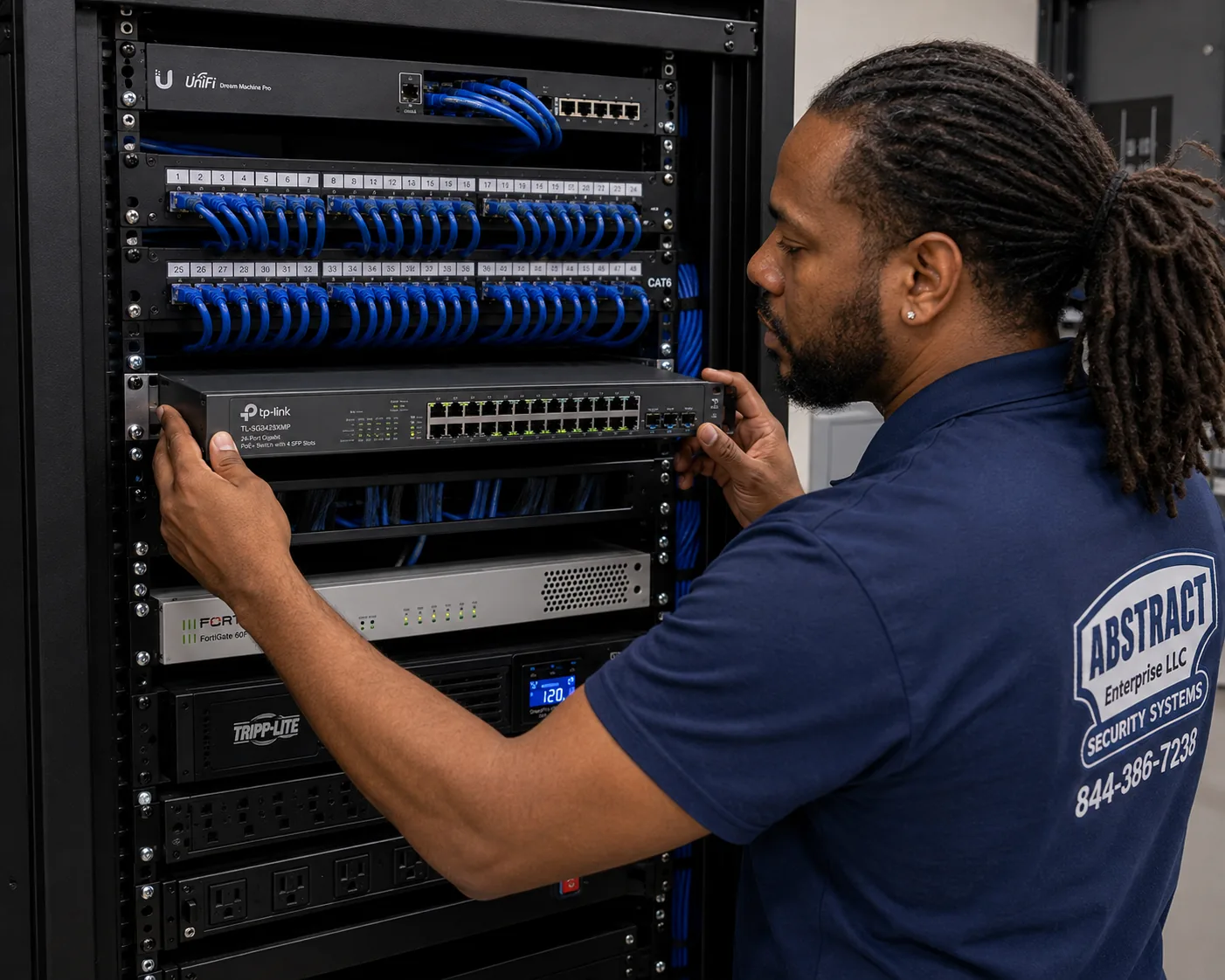
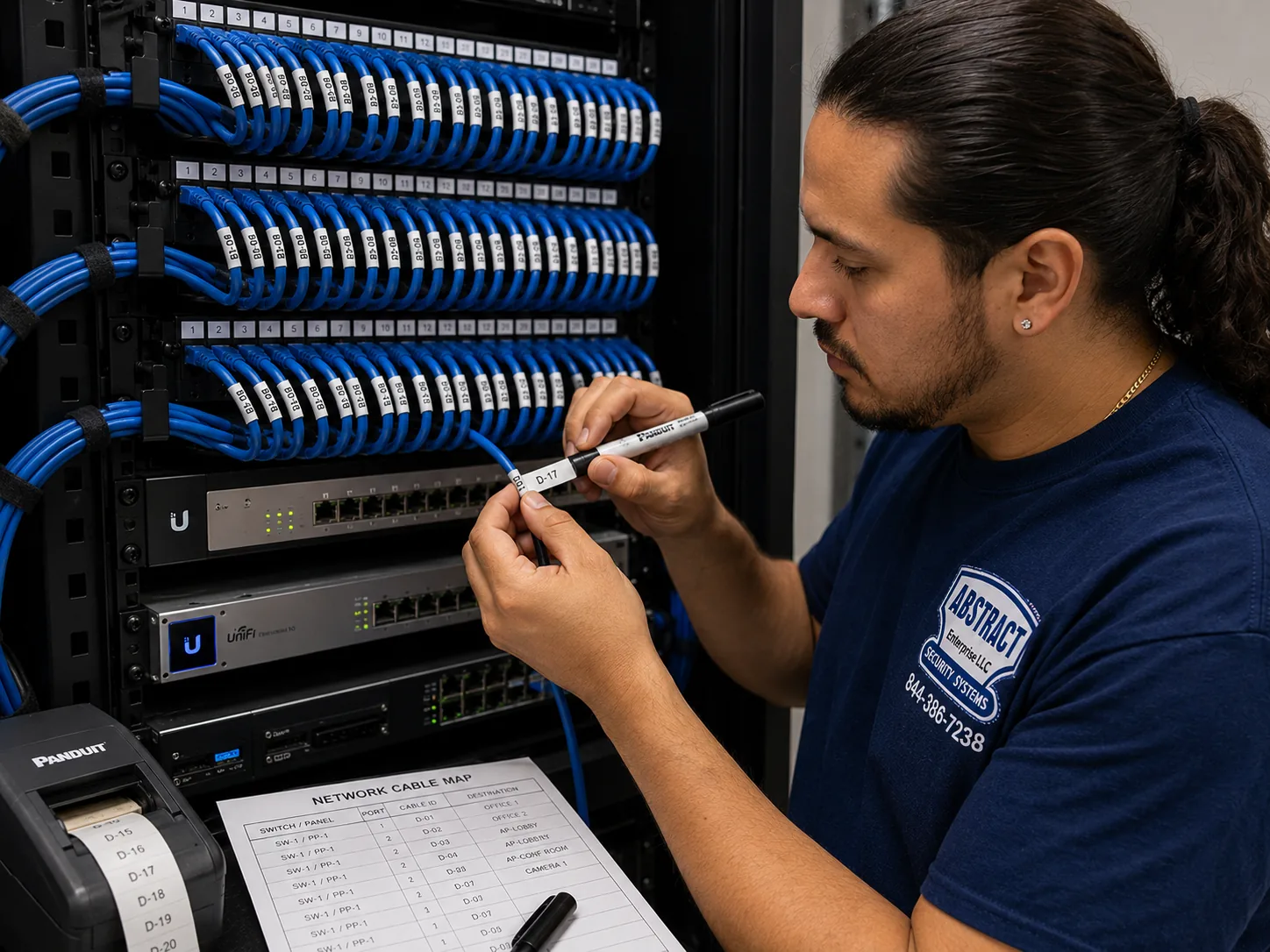
Whatever the building, the job ends the same way. Every camera has a fixed network address so it does not wander off the recorder after a power cut. Default passwords are changed and the new ones are handed to the person the owner names, not left on a sticky note in the basement. Firmware is brought up to date before the system goes live. Every cable is labelled at both ends and on a printed port map. Retention is set so the recorder keeps the number of days the building actually needs, and we show the owner or super how to find a clip, export it to a drive and send it to whoever asks for it. None of that is an extra; it is what makes a camera system useful a year after we leave.

A city with about two million homes built before 1947 does not have one kind of wall. Each building type changes three things about a Hanwha camera job: what the camera is fixed into, how the cable gets from the camera to the recorder, and who has to agree before we drill. These are the types the public record and housing studies describe across the five boroughs, and how we handle each.
Rowhouse neighborhoods went up between the Civil War and World War I, according to the Architectural League. Brick or brownstone fronts, plaster inside, stoops and areaways, and in historic districts, LPC review of anything on the facade.
Four- to six-story buildings built before 1929, many with fewer than ten apartments. Long vertical cable runs, masonry party walls and no elevator for ladders and spools.
Eight- to twelve-story buildings from the 1910s and 1920s and larger doorman buildings. Risers, plaster ceilings, old coax, and often a board or a managing agent with contractor rules.
The 27 percent of units HPD counts in buildings from 1947 to 1974. Concrete and block, which blocks WiFi and calls for hammer drilling, but often better pathways than prewar buildings.
Stores below and apartments above. Seneca notes that cable crossing fire-rated assemblies or floor separations between commercial and residential occupancies needs proper fire-stopping.
Concrete, steel and high ceilings, conduit where it is required, lifts that need landlord approval, and in union buildings, work-hour rules.
| Building | What holds the camera | How cable usually travels | Who signs off |
|---|---|---|---|
| Brownstone or row house | Masonry anchors set in mortar joints, or low-profile surface mounts, as Seneca describes for brownstones | Through the basement and up inside closets, or along the rear wall; front facade runs kept out of sight | The owner, plus LPC for visible facade work in a designated building |
| Walk-up tenement | Sleeve or wedge anchors in brick; ceiling mounts into joists in halls | Up the stairwell in surface raceway, or through an existing shaft if one exists | The owner or landlord |
| Prewar elevator building | Masonry anchors, or fixings into plaster over lath confirmed with a probe | Through the riser where there is space, otherwise in raceway along corridors | The board or owner, the managing agent, often the super |
| Postwar tower | Concrete anchors drilled with a hammer drill | Risers and corridor ceilings; core drilling only with written approval | The owner or board and the managing agent |
| Mixed-use building | Brick or block at the storefront; masonry or framing upstairs | Fire-stopped penetrations between the store and the apartments | The building owner and, for the store, the tenant |
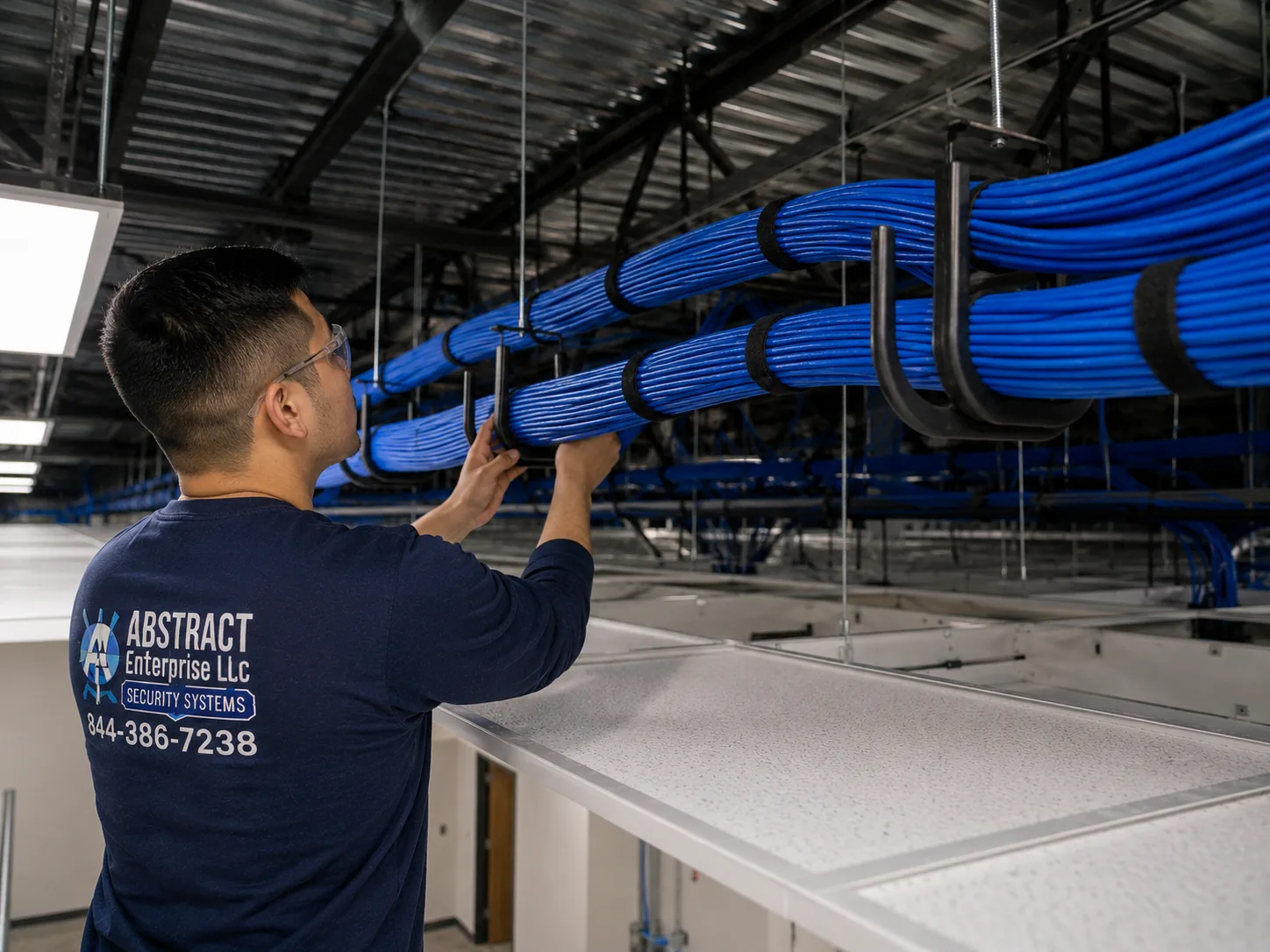
| Garage, warehouse or industrial | Concrete, steel beams with beam clamps, or poles | EMT conduit, J-hooks along the ceiling structure, or cable tray | The landlord, the tenant and sometimes the insurer |
A brownstone owner's first instinct is often a camera above the front door, pointed down the stoop. On a block in a historic district, LPC's rules aim to keep many security objects off the primary facade unless there is no feasible alternative, and secondary sources describe limits on how many cameras may sit along each 25 feet of frontage. We are not the Commission and we cannot promise what it will approve, so we plan the other way round. We start with positions that are not on the primary facade at all, under the stoop looking out at the gate, in the areaway, inside the vestibule looking through the glass, or on the rear wall over the yard, and we use the smallest Hanwha dome or turret that gives the view in a finish that suits the masonry. If a facade position really is the only one that works, we tell you that LPC review is likely needed, and the owner files for it before we mount anything there. The cable comes in through the basement or an existing opening wherever possible, never through ornamental stone.
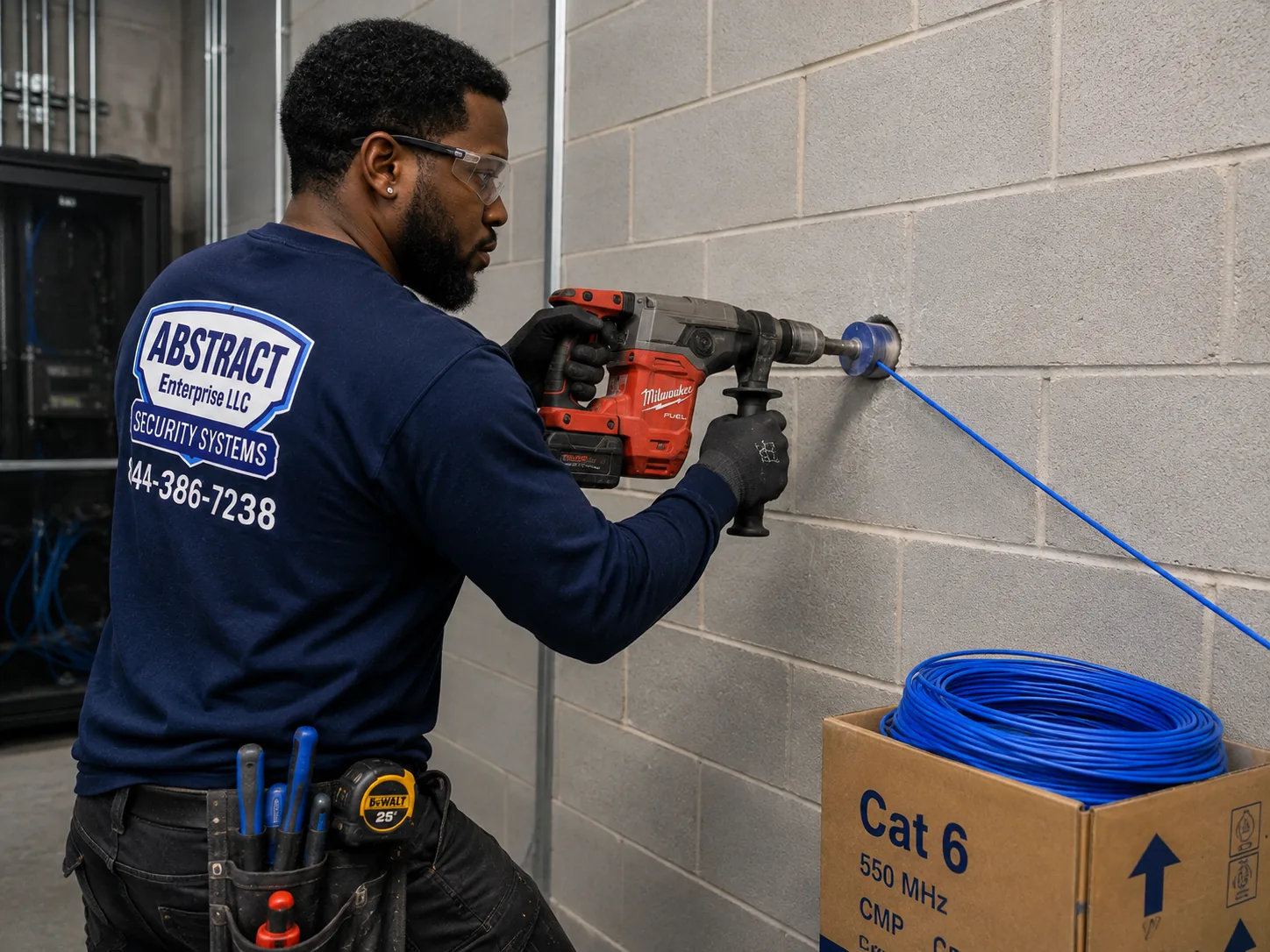
In a five-story walk-up, a camera at the roof door can be a long way from a recorder in the basement, and every foot of that run goes up a stairwell. PoE cable has a limit on how long a run can be before the signal and power fall off, so in tall walk-ups we sometimes place a small PoE switch in a closet or utility space partway up and run the upper cameras to that instead of all the way down. Where there is no shaft, cable travels in painted surface raceway along the stairwell walls, fixed into the masonry, not stuck on with adhesive that lets go in the first humid summer. We carry spools, ladders and tools up by hand, which takes time, and we tell you that time on the quote rather than discovering it on the day.
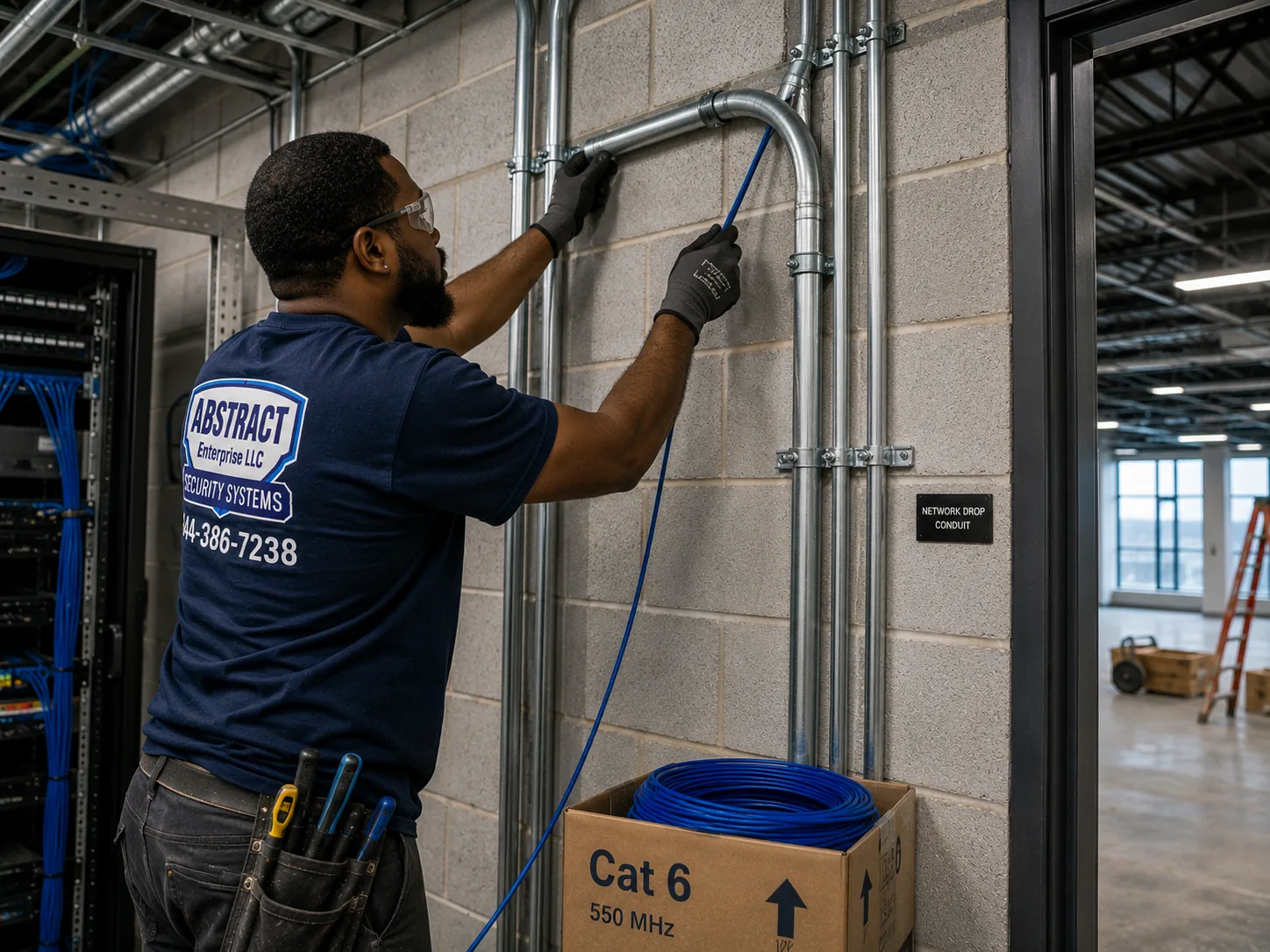
Older elevator buildings usually have a riser, a vertical shaft for telephone, cable and electrical wiring, and it is usually crowded. Seneca's description of "full risers, plaster and coax nobody has traced" matches what anyone working in these buildings expects. Before we plan a single cable through a riser, we look at it with the super, tone out any old camera cable to see if it can be reused, and check whether there is physical room for new runs without disturbing what is already there. Where the riser is full, the alternative is corridor raceway, which is visible but honest, or a carefully planned run through a closet stack. Plaster ceilings in corridors are another reason we prefer surface mounts in halls: opening and patching century-old plaster to hide a cable for one camera rarely makes sense.
Mid-century and later towers are often concrete, sometimes with block partitions. ADR Security's guide to NYC camera installation notes that signal degrades through concrete, steel and distance, and that is the single best argument for wired Hanwha cameras in these buildings. Concrete also means hammer drilling and, for anything that has to pass through a slab or a structural wall, core drilling, which we only do with written approval from the owner or board and, where the work calls for it, a filing. Most of the time we avoid core drilling entirely by using the building's existing sleeves and risers.
Many city blocks are lined with buildings that have a store on the ground floor and apartments above. A camera system for the whole building often means running cable from the storefront up into the residential floors, or from the apartments' lobby down into the store's back room. Seneca's mixed-use guidance is that cable crossing fire-rated assemblies or floor separations between commercial and residential occupancies needs proper fire-stopping. We seal every penetration we make through a rated wall or floor with a listed fire-stopping product, and we do not route camera cable through a store's ceiling into the apartments' stairwell without the owner's agreement. If we find earlier penetrations left open, we point them out.


Our citywide research did not get as far as cataloguing every commercial corridor in five boroughs, so instead of listing streets we cannot vouch for, this section describes the kinds of commercial property where Hanwha systems come up, and what the public record and other installers say about each. Where a specific place is named, it is because a source we can cite named it. We do not claim any business or building below as a customer.
An NYC installer's brand guide positions Hanwha for parking garages, building exteriors, lobbies and properties with difficult lighting. Garages combine headlight glare, dark corners and concrete, which is where a wired camera with strong low-light performance earns its keep.
Our own warehouse page describes certificates of insurance with specific endorsements before a landlord lets a lift through the gate, freight elevator windows, and union buildings with work-hour rules. Hanwha comes up when a tenant's contract calls for NDAA-compliant equipment.
CBS New York's reports from an Astoria lobby on 36th Avenue, a Park Slope lobby and the Robeson on Lenox Avenue all describe theft inside entrances. Lobby and mailroom cameras that identify faces at the door are the core of most residential commercial work.
Registers, entrances and stockrooms, often in mixed-use buildings with apartments above. The 2024–2025 New York retail security tax credit has ended, according to Avigilon, so owners should not plan around it.
Seneca notes that in an occupied tower the building's rules shape the work as much as the drawings: certificates of insurance, noisy work after hours, booked freight elevators and access to risers and tenant ceilings.
Records, pharmaceutical and government-related tenants are among those whose contracts may require NDAA Section 889 compliance, according to our warehouse page, which is the most common reason a business names Hanwha specifically.
A camera in a co-op lobby watches a door. A camera in a city garage watches a ramp where cars brush the walls, exhaust and road salt drift in every winter, and headlights swing across the lens all night. A camera over a loading dock looks out at a yard where trucks back in under floodlights and the weather comes straight at it. Those cameras need wired power that does not depend on a battery, mounts fixed into concrete or steel rather than a wall finish, housings rated for the location, and cable protected in conduit where people and vehicles move. They also need someone at the business who knows how to pull footage the morning after an incident. We plan commercial jobs camera by camera, with the owner or manager, and we include that handover in the quote.
NYC 311 describes the NYPD Community Camera Sharing Program as a way for any business with a security camera to share live video feeds with the NYPD during emergencies, and businesses can register their camera locations at NewYorkCityConnect.org. Whether to join is your decision; we can tell you what your Hanwha system would need on the network side if you choose to. Two proposals are also worth knowing about, though neither should be counted on. City Council bill Int 0623-2026 would set up a small business security pilot run by Small Business Services with the NYPD that covers digital video cameras among other measures, and state Assembly bill A406 from 2025 proposes a tax credit for buying and installing a camera system on residential and commercial property in cities of a million or more. Our research did not confirm that A406 has passed, so do not budget on it.


We do not publish stories about a particular customer's building unless we can document them, so this is not a tale about one address. It is the routine our technicians follow when they open the door to the camera closet in an older New York building, which is where every Hanwha replacement begins.
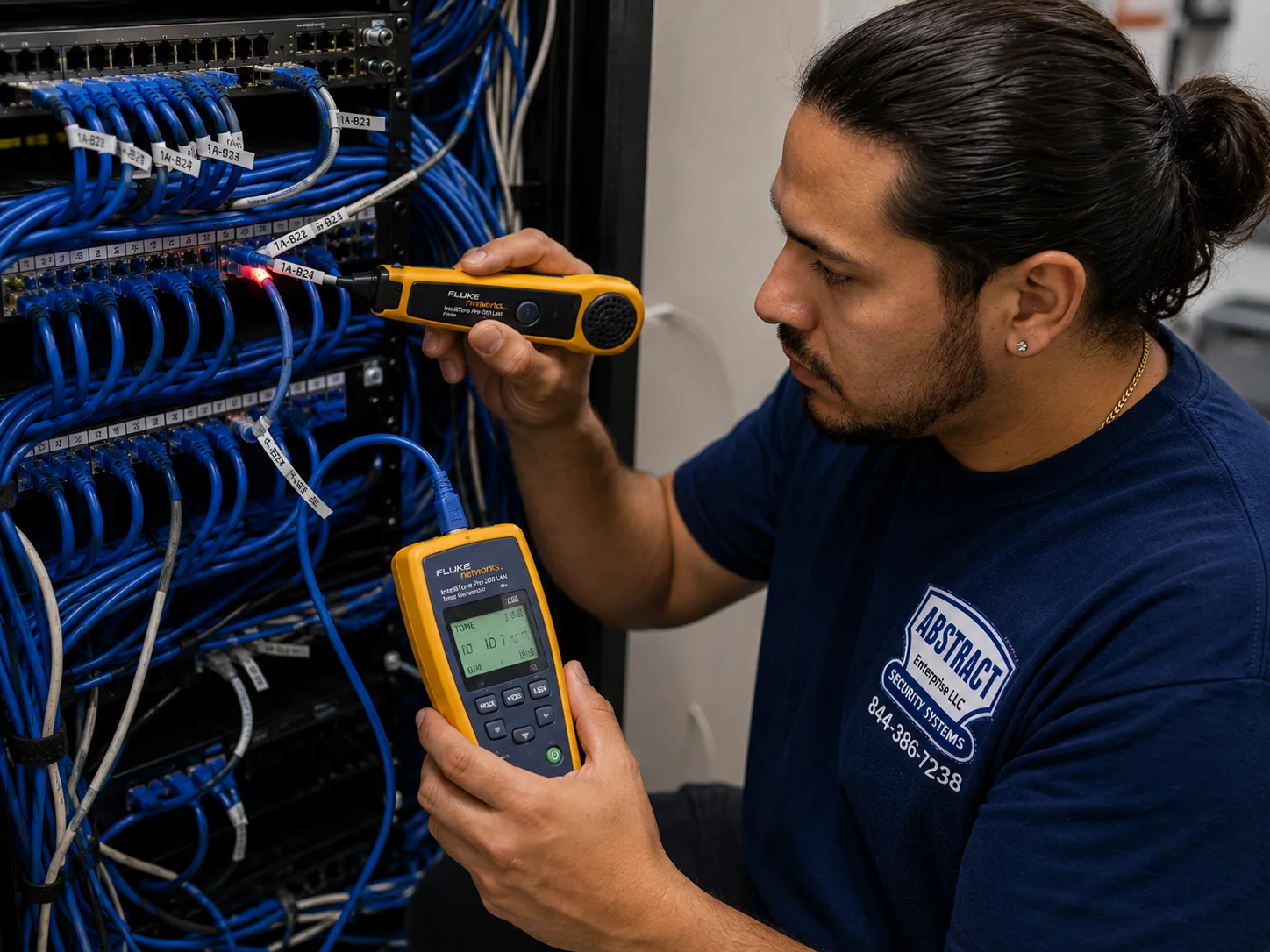
We photograph the closet exactly as we find it before touching anything, because the super will want to know later what was there. We read the recorder's model label and note the date on its screen, which tells us whether it has been recording at all. We count the cables arriving at the back of the recorder or switch and compare that number with the cameras the building thinks it has; the two rarely match. We feel the battery backup for heat and check the date on its battery. We tone out two or three cables to the cameras they serve, starting with the lobby and the front door, and test them. We look at how the cables leave the closet, through a sleeve, an open hole in the ceiling, or a riser, and whether that opening was ever fire-stopped. Only after that do we walk the camera positions. By the time we leave, we know which cables can carry a Hanwha camera, which cannot, and where the new recorder should live, and that is what the quote is built on.
The brand and its product lines
Yes, they are the same family under different names. The camera business that started at Samsung Techwin was taken over by Hanwha, which completed the deal on June 29, 2015 and renamed it Hanwha Techwin, and on March 1, 2023 it became Hanwha Vision, according to Wikipedia. Wisenet is the brand name on the cameras, recorders and the WAVE software. So an older Samsung-labelled camera in a city building, a Hanwha Techwin recorder and a new Wisenet camera all come from the same lineage. That does not mean old and new equipment will always work together; firmware and recorder compatibility still have to be checked model by model, which we do on the survey.
It depends on the view, not the building as a whole. Tec-Tel describes the Q Series as Hanwha's lower-cost line, the X Series as the mainstream line and the P Series as the premium line with artificial intelligence on the camera. In most apartment buildings, stairwells, roof doors and rear yards are well served by Q Series cameras, while lobbies, mailrooms and street-facing entrances, where you want a clear face at the door in mixed light, often justify X Series. P Series makes sense where analytics matter, such as a garage entrance or a loading dock that needs reliable person and vehicle detection. Mixing series on one recorder is normal, and the quote lists the series for each position so you can see why.
Federal rules and older equipment
Hanwha is widely treated as compliant, but the clause is what decides. Hanwha Vision is a South Korean manufacturer and is not on the FCC Covered List, per iCtally, and NDAA compliance guides such as Ring and Ping's and Tec-Tel's list Hanwha among compliant brands. Section 889 is about the manufacturer of the equipment, so the cameras alone are not the whole answer: the recorder, the PoE switch and any other networked device in the system are part of it too. Send us the exact wording of the clause. We will specify every device by make and model, keep anything from a Covered List manufacturer out of the system, and give you a written equipment list you can hand to whoever checks compliance.
They do not have to come out because of the ban. Iron Gate's guide states that the 2026 import ban does not require removing installed equipment and there is no kill switch, and Blinkless notes the FCC rules do not ban private use. Buying more is the problem: the FCC prohibited continued importation and marketing of previously authorized Hikvision and Dahua equipment in 2026, though our sources disagree on whether that took effect June 26 or July 16, so new supply, replacement parts and support will keep getting harder. For a private building with no contract requirement, the sensible approach is to keep what works, plan a Hanwha replacement, and avoid buying new legacy equipment in the meantime.
Recording software
Not in the way a cloud camera subscription does. Surveillant's Hanwha pricing guide describes WAVE as using a one-time license for each camera, with the Professional tier carrying no annual renewal, and CDW lists the WAVE Professional single-camera license as a separate product. So a building that records on WAVE buys one license per camera when the system is set up and owns it. A Hanwha recorder is the other option and handles licensing differently. Internet service for remote viewing is a separate cost the building already pays. We show the licenses as their own line on the quote, so you can see exactly what you are buying and why.
Wiring in masonry
Wired, wherever the building allows it. ADR Security's NYC guide points out that wireless signal degrades through concrete, steel and distance, and nearly every city building is made of at least one of those. A PoE camera gets its power and its network connection over one Cat5e or Cat6 cable, as Seneca's technical guide explains, so it keeps recording through router changes, does not need a battery swapped, and does not drop off the recorder when a neighbor's network crowds the airwaves. WiFi still has a place, for a single camera where no cable path exists at all, but in a masonry building we treat it as the exception and tell you the trade-off before installing it.
Permits, landmarks and boards
Usually not, but the scope decides. Lock and Tech notes that permits are usually not required for low-voltage work in existing settings, while commercial work involving structural penetrations, new conduit runs or significant cabling may need DOB permits. Our low-voltage page explains that under the 2025 Electrical Code and Administrative Code §28-105.4.7, an electrical permit is not required for low-voltage work under 50 volts done by a qualified person, and Vertex adds that touching fire-rated doors, means of egress or a fire alarm system needs filing. A typical Hanwha system with surface or riser cabling falls on the no-permit side. If yours does not, we tell you before work begins.
Possibly, but the front is the hardest place to get approved. LPC's 2018 rules treat security cameras as objects commonly used for security, and the proposed rules would prohibit many such objects on a primary facade unless there is no feasible alternative. Seneca notes that visible exterior mounts and conduit on a brownstone may need a Certificate of No Effect or a Permit to Alter. We plan positions off the primary facade first, under the stoop, in the areaway, inside the vestibule or on the rear wall, using small finish-matched cameras. If a front position is truly needed, the owner applies to LPC before we mount it, and we supply the camera details for the application.
Most boards want the same handful of things. Vertex notes that for co-op boards, condo associations and commercial spaces, the installer should submit a formal scope of work with a compliant certificate of insurance, and Seneca notes that building-wide camera replacements may require board approval and building-specific standards. We provide a written scope listing each camera position and what it covers, the equipment by make and model, the cable paths and any penetrations, the working hours we need, and the certificate of insurance with the names the managing agent asks for. Boards also tend to ask who will hold the passwords and footage, so we put that on the scope as well.
Picture quality and cost
Enough to identify a face at the door, which depends on the distance and the lens more than the headline megapixel figure. A camera with a high resolution and a wide lens can still record faces too small to recognise at the far end of a long lobby, while a well-placed camera with a narrower field of view gets a clear face at the entry. We size each position by measuring the distance from the camera to the spot that matters, usually the inner door or the mailboxes, and choosing a Hanwha model and lens for that distance and that light. Stairwells and yards, where you want to see what happened rather than read a face, can use simpler cameras.
The building, more than the camera. Third-party guides give broad per-camera ranges, and our own prices are listed on the Hanwha price page for each borough. What moves a city quote is the cable path: reusing cable that tests clean in a riser costs far less than new runs up a five-story stairwell or through concrete. Series choice, WAVE licenses, the recorder, mount types, conduit, fire-stopping, after-hours work, freight elevator windows and parking in Manhattan all add or subtract. We price each line separately after the survey, and the quote shows each one so you can see where the money goes.
Analytics and privacy
It depends on which features, and whether you are a covered business. The city's biometric identifier rule, in effect since July 9, 2021, requires covered commercial establishments that collect biometric identifiers to post a notice at every customer entrance, at least 8.5 by 11 inches. Carlton Fields' analysis says the signage rule generally does not apply to identifiers collected through ordinary photographs or video, such as security cameras. Person and vehicle detection is not face matching. Turning on anything that recognises or matches faces is where the obligation begins. We set analytics only to what you ask for, and we recommend talking to your lawyer before enabling any face-related feature in a store or restaurant.
Mixed-use buildings
It can, if every crossing is fire-stopped and the owner agrees. Seneca's mixed-use guidance is that cable crossing fire-rated assemblies or floor separations between commercial and residential occupancies requires proper fire-stopping. We route the run through the fewest possible penetrations, seal each one with a listed product, and label it. We also suggest separating viewing rights on the recorder or WAVE server, so the store owner sees the store cameras and the building's managing agent sees the residential ones, even though they share one system. That keeps tenants' halls out of the store's phone app.
These are the Hanwha components we fit in New York homes, buildings and businesses. We describe them by series and type rather than by model number, because the right model depends on the view, the distance and the light at each position. The quote lists the exact model for every camera before anything is ordered, and the NYC Hanwha price page shows the current figures.
Hanwha's lower-cost line, suited to stairwells, roof doors, rear yards and back corridors in walk-ups and elevator buildings, where you need a reliable record of what happened.
The mainstream line, for lobbies, mailrooms, street entrances and store fronts, where mixed light and a clear face at the door matter.
The premium line with on-camera AI, for garage entrances, loading docks and perimeters where detection that ignores headlights and blowing debris saves hours of footage review.
Low-profile domes for lobbies and landmark-sensitive spots, turrets for halls and soffits, and bullets for long views down a yard or driveway.
A Hanwha network video recorder for straightforward buildings, or Wisenet WAVE with one-time per-camera licenses for multi-building owners and businesses that need flexible viewing.
Managed PoE switches sized for the camera load, with a battery backup so a short outage does not stop recording or reboot the system.
App and WAVE client access for owners, supers and managers, set up with individual logins rather than one shared password.
Masonry anchors, pole and corner brackets, beam clamps, EMT conduit and listed fire-stopping, the parts that make a camera survive a city building.
People sometimes ask whether they should simply call one of the national brands instead. ADT is best known for monitored alarm systems, while Ring and SimpliSafe are best known for doorbells, cameras and self-install kits that rely heavily on WiFi and cloud subscriptions. Those products have their place in a single apartment or a small house. A Hanwha system is a different kind of installation: wired cameras, a recorder or WAVE server the building owns, licenses bought once, and cable that has to be planned through risers, plaster and masonry. The table sets out the practical differences for a New York building.
| Question | Typical self-install doorbell and camera kits | A Hanwha system installed by AESS |
|---|---|---|
| How cameras connect | Mostly WiFi, sometimes battery powered | Wired PoE: power and video on one cable |
| Where footage lives | Mostly in the cloud, on a subscription | On a recorder or WAVE server on the property |
| Behaviour in brick and concrete | Signal degrades through masonry and steel | Unaffected by walls once the cable is in |
| Scale | A few cameras per account | Whole buildings, several buildings on one WAVE system |
| Board and contract paperwork | Usually left to the owner | Scope of work, equipment list and certificate of insurance supplied |
| Who installs | Often the owner | A technician working under NYS license #12000287431 |

We could not capture Google's AI Overview or the People Also Ask boxes for this search from our build environment, so we are not going to pretend to quote them. What follows are claims we see repeated in quick online answers about Hanwha cameras and about camera installation in New York, set against what the sources we reviewed and our own field practice say. Marketplaces such as Angi, HomeAdvisor and Fixr publish national and city cost averages that feed many of those answers; they are a starting point, not a quote for a riser in a 1920s elevator building.
This one comes up because people lump every Asian camera manufacturer together. Hanwha Vision is headquartered in Seongnam, South Korea, and descends from Samsung Techwin, according to Wikipedia and Tec-Tel. Its American arm, Hanwha Vision America, is in Teaneck, New Jersey.
The distinction matters in New York because boards, lenders and contract officers are asking specifically about the origin of the equipment. Mixing Hanwha up with Hikvision or Dahua can lead someone to reject exactly the brand they should be asking for.
When we quote a Hanwha system, we list the manufacturer and model for every device, so nobody has to rely on a guess about where the equipment comes from.
The FCC Covered List names specific companies, not whole countries or regions. iCtally's summary of the 2026 import ban states that Hanwha Vision is not on the Covered List and that its cameras are not affected by the 2022 authorization freeze or the 2026 import ban.
Where answers go further astray is the date. Our sources disagree: Iron Gate gives June 26, 2026 for the legacy import prohibition, while Coram cites July 16, 2026 and FCC Public Notice DA 26-635. If a contract depends on that date, read the FCC notice itself.
What we tell New York owners is simpler: the ban concerns which manufacturers' equipment can be imported and marketed. It says nothing against Hanwha, and it does not, by itself, make any working camera on your wall illegal.
Some quick answers read the ban as an order to remove existing equipment. Iron Gate states plainly that the 2026 import ban does not require rip-out and that there is no kill switch, and Blinkless notes the rules do not ban private use.
The exceptions are contractual or program-driven. A lease clause, a government contract or a funding program can require NDAA-compliant equipment, and that requirement stands on its own regardless of the import ban.
For a private city building without such a clause, we suggest planning a staged move to Hanwha, keeping working cameras until their turn comes, and reusing any network cable that tests clean so the change costs as little as possible.
Video management software is often sold by subscription, so answers assume WAVE is too. Surveillant's pricing guide describes WAVE as a one-time per-camera license, with the Professional tier carrying no annual renewal, and CDW sells the single-camera Professional license as a one-off product.
That changes how a building budgets. The license is bought when the camera is added, not paid again each year, which suits co-ops and owners who prefer a capital cost to a running one.
We put licenses on the quote as their own line and register them to the building, so they move with the property rather than with whoever happened to set the system up.
In a suburban frame house with a strong router, wireless can be fine. In New York, ADR Security's guide notes that signal degrades through concrete, steel and distance, and HPD's survey shows most homes are in older masonry buildings.
A wireless camera in a brick stairwell that drops off the network during a storm, or a battery camera that dies on a cold roof, saves installation effort only until the day footage is needed.
Hanwha's commercial lines are designed as wired PoE cameras, and that is how we install them wherever a cable path exists. Where it truly does not, we discuss the trade-off openly before choosing anything else.
It is true that there is no general city law requiring cameras, and that low-voltage work in existing spaces usually needs no permit, as Lock and Tech and our own low-voltage page describe. But "no permit" is not the same as "no approval."
LPC rules restrict security equipment on primary facades of designated buildings, and the Commission has designated 38,119 buildings and sites. Co-op and condo boards may require approval for building-wide upgrades. DOB filing may be needed when work alters fire-rated doors or egress or ties into a fire alarm, per Vertex, or involves structural penetrations and new conduit in commercial space.
We check all three, landmark status, board rules and DOB scope, on the survey, and the quote states which apply to your building.
Analytics are a selling point of the P Series, and quick answers treat them as a free upgrade. The city's biometric identifier rule, in effect since July 9, 2021, requires covered businesses that collect biometric identifiers to post entrance notices at least 8.5 by 11 inches.
Residential buildings have their own sensitivities. HPD's Tenant Data Privacy Law governs smart access systems in buildings with three or more units, and the Brownsville tenants the Guardian reported on fought a facial-recognition entry plan even though cameras were already there.
We switch on only the analytics you ask for, explain what each one does in plain terms, and recommend legal advice before any feature that recognises or matches faces is turned on in a business or an apartment building.
Send a photo of your current recorder, a rough list of the areas you want covered and the borough, and a technician will tell you which parts of the old system are worth keeping, which Hanwha series fits each view, and what the building's rules will mean for scheduling. Call (800) 486-0943, message us on WhatsApp, or use the quick form.
Every Hanwha job across the five boroughs follows the same eight steps, whether it is four cameras on a brownstone or forty across a garage and the apartment building above it. The order matters most in occupied and older buildings, where skipping the paperwork or the survey is what turns a three-day job into a three-week one.
Borough and address, building type, how many entrances and areas need coverage, and what system is there now, with photos of any old recorder. We book the survey within 2 hours of your request.
Board, landlord or managing agent requirements, the certificate of insurance with the right names, freight elevator bookings and allowed work hours, all settled before the visit.
Every camera position walked, lighting checked, cable paths measured, old cable toned and tested, and landmark or shared-hallway limits noted.
Q, X or P Series matched to each view, a recorder or WAVE server chosen, and licenses listed, all in a written quote before anything is ordered.
Cable pulled along hidden paths, through risers or conduit where required, with every penetration through a fire-rated wall or floor sealed.
Cameras fixed into masonry, framing or ceiling structure with anchors for that material, then aimed and focused on site for the agreed view.
Fixed IP addresses, new passwords, current firmware, retention and analytics set, and each cable run certified with a tester.
App and WAVE access for the people you name, a labelled port map, a camera list with positions, and a walkthrough of finding and exporting footage.
We do not quote a fixed number of hours for "a camera system," because in this city the building decides the schedule. The survey of a brownstone or a small walk-up is usually a single visit; a garage or an elevator building with several floors of risers may need a second look with the super. Paperwork for a co-op can take as long as the board's next meeting. Cable pulling is the longest physical stage and depends on whether the existing runs can be reused. Mounting, configuration and handover are comparatively quick once the cable is in. The written quote includes our time estimate for your building, and if the building's rules change it, such as a freight elevator that is only available for two hours a day, we tell you how.

This page covers the whole city, so instead of one neighborhood's landmarks, these are places named in our sources that show the range of buildings a Hanwha system in New York has to work with, from protected brownstone districts to public housing towers. We have no information about the camera systems at any of them and do not claim them as customers.
Named by Seneca Security among the historic districts with many brownstones, where LPC rules shape what can go on a front facade.
Two more brownstone historic districts on the same list; Park Slope also appears in CBS New York's report of thieves cutting packages open inside a lobby.
A brownstone district on Seneca's list and home to the Robeson on Lenox Avenue, where CBS reported a lobby theft with a key-coded entry and no forced entry.
Where CBS reported a lobby package thief who, police said, disabled the door lock with a screwdriver before taking deliveries.
Public housing in Brooklyn where a 2025 participatory budgeting proposal asked for cameras in elevators and near apartment doors.
Two brick high-rises that, the Guardian reported, already had cameras on the grounds, doors, elevators and halls when tenants fought a facial-recognition entry plan.
We cover all five boroughs at their own rates: see the Hanwha price pages for Brooklyn, Manhattan, Queens, the Bronx and Staten Island. Beyond the city line we also serve Long Island and the Hudson Valley, with the citywide figures on the NYC Hanwha camera installation price list.
Our Hanwha prices are published on a separate price page for each borough, because the same camera on the same wall takes different time and logistics in Midtown than it does in Staten Island. We do not repeat those figures here, so this page never shows a number that has gone out of date; the NYC Hanwha price page and the borough pages are kept current. What this section explains is how a city quote is built, so you can read one and know what each line means.
| Quote line | What it covers | What makes it rise or fall in NYC |
|---|---|---|
| Camera, by series | Each Q, X or P Series camera at its listed price | The view: a long lobby or a garage ramp may need a higher series than a stairwell |
| Installation per camera position | Mounting, aiming, focusing and connecting each camera | Mounting surface: plaster, brick, concrete or steel; height; ladder or lift access |
| Cable runs | New network cable from each camera to the switch or recorder | Reuse of tested existing cable lowers it; long walk-up runs, risers and concrete raise it |
| Recorder or WAVE server | The device that stores footage, with drives sized for retention | Number of cameras and days of footage the building wants to keep |
| WAVE licenses | One-time license per camera if recording on WAVE | Number of cameras; bought once, not renewed yearly |
| PoE switch and battery backup | Power for the cameras and protection from short outages | Camera count and whether existing equipment can be kept |
| Conduit and fire-stopping | Protected runs and sealed penetrations | Garages, warehouses and mixed-use buildings need more of both |
| Building logistics | After-hours work, freight elevator windows, parking | Occupied offices, union buildings and Manhattan streets |
| Certificate of insurance | Paperwork for boards, managing agents and landlords | Issued for the job; ask for it at booking |
Brooklyn and the Bronx share the same base rate on our lists. Queens is slightly higher, Staten Island higher again because every visit crosses a bridge, and Manhattan highest, because parking, loading restrictions and building access add time to every job. Those differences apply to the labor; the camera hardware and licenses are listed at the same figures across the city. If your property sits outside the five boroughs, the Long Island and Hudson Valley price pages apply, and they follow the same structure.
Take a prewar walk-up replacing an old Hikvision system: eight cameras across the vestibule, lobby, mailroom, four stairwell landings and the roof door. If six of the existing cable runs test clean, the quote shows six camera positions with no new cable and two with new runs up the stairwell in raceway. It shows eight cameras by series, a recorder sized for the retention the owner wants, a battery backup if the old one has failed, and the work hours the landlord allows. Move the same eight cameras to a co-op where none of the old cable passes, and the cable lines grow, the riser access line appears, and the certificate of insurance and scope of work are added. Nothing else is added on the day unless you ask for it.
National guides, Angi's city averages and competitor blogs give per-camera ranges for "commercial-grade" or "NYC" installs. They are useful for a sense of scale, but they cannot know whether your riser is full, whether your facade is landmarked or whether your freight elevator is free on a Tuesday. That is why we survey first and quote by line. The survey also tells us whether reusing existing cable is realistic, which in this city is usually the largest single saving available.
Full terms — including 50% deposit, one-year parts-only warranty on AESS-supplied products, and the late-fee schedule — are set out in the service agreement.Three common New York Hanwha jobs, described by scope. Each is priced line by line from the Hanwha price page for your borough, so there is no package premium and nothing is hidden inside a bundle. The figures for each line are on the NYC Hanwha price list.
Four Q or X Series cameras covering the front gate or stoop from below, the vestibule, the rear yard and a basement or side entrance, on a compact Hanwha recorder with battery backup and remote viewing for the owner. Positions planned off the primary facade first for buildings in historic districts.
A Hikvision or Dahua system replaced with eight to twelve Hanwha cameras across the lobby, mailroom, elevator, stairwells, roof door and yard. Existing cable tested and reused where it certifies, old footage exported, rack rebuilt and labelled, and board paperwork supplied.
A larger system mixing P Series analytics at entrances and docks with X and Q Series elsewhere, recorded on Wisenet WAVE with one-time per-camera licenses, cable in conduit and J-hooks, fire-stopped crossings, separate viewing rights for different tenants, and a written NDAA equipment list.
If you have already bought Hanwha cameras, a recorder or WAVE licenses, we install them at labor-only rates from the same price page, as long as the equipment is genuine, new or in sound condition, and suited to the positions you want. We check model numbers, firmware and power requirements before mounting anything, and if a camera is the wrong type for a view, for example a wide-angle model where a face needs to be identified at a distance, we say so and show you the listed price of one that fits. Equipment you supply is installed with the same care, labels and handover as anything we supply, though the warranty on parts you buy yourself stays with the seller.
The full price list for Hanwha cameras, recorders, licenses and installation across the city. NYC Hanwha camera installation prices
Brownstones, walk-ups and mixed-use blocks at the Brooklyn rate. Hanwha camera prices in Brooklyn
Prewar elevator buildings, co-ops and occupied offices at the Manhattan rate. Hanwha camera prices in Manhattan
Apartment buildings, garages and storefronts at the Queens rate. Hanwha camera prices in Queens
Walk-ups, elevator buildings and commercial strips at the Bronx rate. Hanwha camera prices in the Bronx
Houses, small buildings and businesses at the Staten Island rate. Hanwha camera prices on Staten Island
Nassau and Suffolk properties on their own price lists. Hanwha camera prices on Long Island
Westchester and the counties north of the city. Hanwha camera prices in the Hudson Valley
Send photos of the old recorder and the areas to cover. Request a free Hanwha quote
AESS installs Hanwha systems across all five boroughs, working under NYS license #12000287431 and dispatching from 1282 Troy Avenue in Brooklyn. We have been owner-operated since 2002 and book a survey within 2 hours of a request. Several other city firms also advertise Hanwha work, so ask any installer you speak to for their state license number, a certificate of insurance, and a written equipment list by make and model before you sign.
Yes, if they are doing it as a business. NYC's business portal states that installing, servicing or maintaining security systems requires a license from the New York State Department of State, and the state rule at 19 NYCRR 195.2(b) includes closed-circuit television used to detect or monitor intrusion or theft. Ask for the license number and check it. Ours is NYS license #12000287431, printed on every quote.
It depends far more on the building than on the number of cameras. Board paperwork, freight elevator windows, union work-hour rules and whether existing cable can be reused all change the schedule. A small brownstone system is usually a short job once the survey is done, while an occupied elevator building with full risers takes longer. Your written quote includes our time estimate for your building and explains what would change it.
Most owners start with the areas a stranger would use: the front gate and stoop, the vestibule, the rear yard and any basement or side door. That is often four cameras, which is why our starter scope is built around four, but the count follows the house. A brownstone in a historic district may need positions under the stoop or in the areaway instead of on the facade, and a house with a garden apartment may need its own entrance covered.
Yes, as long as the system is planned with room to grow. We size the PoE switch and recorder with spare ports and storage where you expect expansion, and Wisenet WAVE lets you add a camera by buying one more one-time license. We also leave the port map and cable paths documented, so whoever adds the next camera can see where it fits. Tell us about planned expansions at the survey and we will build in the headroom.
For a new system today we recommend Hanwha. Hikvision is on the FCC Covered List and its previously authorized equipment can no longer be imported or marketed in the United States under the 2026 prohibition, so future supply, parts and support are uncertain. Hanwha is not on the Covered List. If you already have Hikvision equipment that works, you are not required to remove it, but new purchases should be planned around a brand you can keep buying.
Both are treated as NDAA Section 889 compliant brands in guides such as Tec-Tel's, so the contract does not decide it. The choice usually comes down to the recording platform the building wants, the camera types needed for each view, budget, and what any existing equipment already uses. Hanwha's Q, X and P Series give a clear ladder from lower-cost to analytics-heavy cameras. We install Hanwha and can explain the trade-offs for your specific positions.
The Tenant Data Privacy Law covers smart access systems in residential buildings with at least three units. Butterfly MX notes it does not apply to ordinary camera feeds, but it does apply when cameras come bundled with keyless entry. Owners must give tenants a plain-language privacy policy, get express consent before collecting data or biometrics, use the data only for access and entry monitoring, and destroy authentication data within 90 days. We keep camera footage and entry logs separate where possible.
It can. Vertex notes that DOB filing or approval is needed when access control work alters fire-rated door assemblies, modifies means of egress under Building Code Chapter 10, or ties directly into the building's fire alarm system. Cameras on their own rarely trigger that. When a project combines Hanwha cameras with door hardware, we identify any door that is fire-rated or part of an exit route at the survey and tell you whether filing is likely before work is scheduled.
NYC 311 describes the NYPD Community Camera Sharing Program as letting any business with a security camera share live video with the NYPD during emergencies, with camera locations registered at NewYorkCityConnect.org. Joining is voluntary and is your decision. If you choose to register, we can explain what your Hanwha recorder or WAVE server would need on the network side, and how to keep sharing limited to the cameras you choose.
Not one you can count on right now. The 2024 to 2025 New York retail security tax credit has ended, according to Avigilon. State Assembly bill A406 from 2025 proposes a credit for buying and installing a camera system on residential and commercial property in cities of a million or more, and City Council bill Int 0623-2026 proposes a small business security pilot, but our research did not confirm that either has become law. Check with your accountant before budgeting on one.
Generally no. Seneca's compliance guide notes there is no general NYC law mandating cameras in apartment buildings, though the law does require intercoms in many buildings and adequate lighting in common areas. Most camera systems are driven by owners, boards, tenants and insurers; Seneca also notes that many commercial insurers set camera coverage conditions for theft and vandalism claims. If your insurer or lender has requirements, send them and we will plan coverage to meet them.
Tell us the borough, the building type, the areas you want covered and what system is there now. A photo of the old recorder's label makes the quote faster. Prefer to talk? Call (800) 486-0943.
From a brownstone in a historic district to a prewar walk-up with a full riser, a co-op replacing an old Hikvision recorder, or a garage that needs wired cameras on concrete, the job starts the same way: a look at what is there now, an honest read of the building's rules, and a line-by-line quote from your borough's Hanwha price page. Call (800) 486-0943, message us on WhatsApp, or send the quote form, and we will book your survey within 2 hours.
Hanwha Camera Installation by neighborhood: NYC hub, NYC hanwha camera installation