Same-Day Service · All Brands · Intercom Repair · Buzzer Repair · All Queens Neighborhoods
Professional door buzzer repair and intercom repair across all Queens neighborhoods. From Astoria walk-ups to Jamaica apartment buildings to Forest Hills co-ops — if your apartment buzzer is not working or your intercom system stopped working, we fix it same day. Most repairs completed in a single visit.
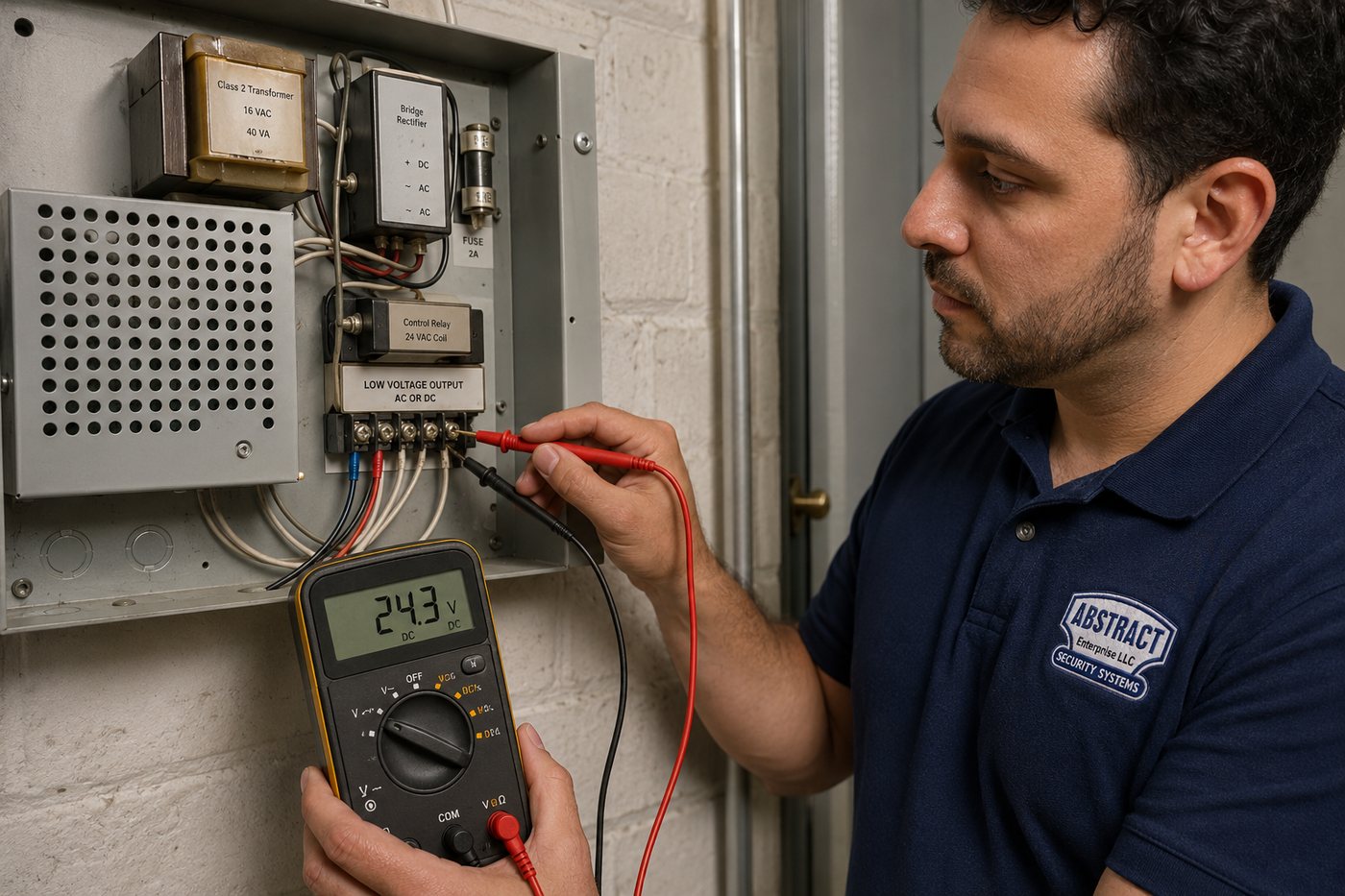
Component-level diagnosis. We isolate the failed part before quoting a replacement.
Certificates of insurance issued to owners, boards, and managing agents before work starts.
Directory panel service on a large multi-unit entrance.
Need Buzzer Repair in Queens Today?
Queens has the widest range of building types of any borough, and the most common buzzer fault here comes from conversions rather than age. A dead entry door is an access and life-safety problem, not a maintenance ticket — tenants get locked out, deliveries stop, and the front door ends up propped, which defeats the system entirely.
Buzzer faults in Queens sort into the same three layers as everywhere: the talk path to your unit, the release path to the door hardware, and the mechanical layer of the door itself. What is distinctive is the housing mix. Astoria walk-ups, Jackson Heights garden co-ops, Forest Hills mid-rise and detached two- and three-family homes across the eastern half of the borough each fail differently.
If the buzzer rings and you can speak, the talk path is intact and the fault is downstream. If nothing rings, the fault is upstream. That single distinction narrows a whole-building mystery to a handful of components, and it is why a proper diagnostic beats a blind replacement quote.
Layer 1 — the talk path
Garden co-ops and mid-rise run conventional risers with basement equipment. Two- and three-family homes usually run a doorbell transformer and chime, often extended once or twice as the house was converted. The extension is where the fault sits far more often than the original run.
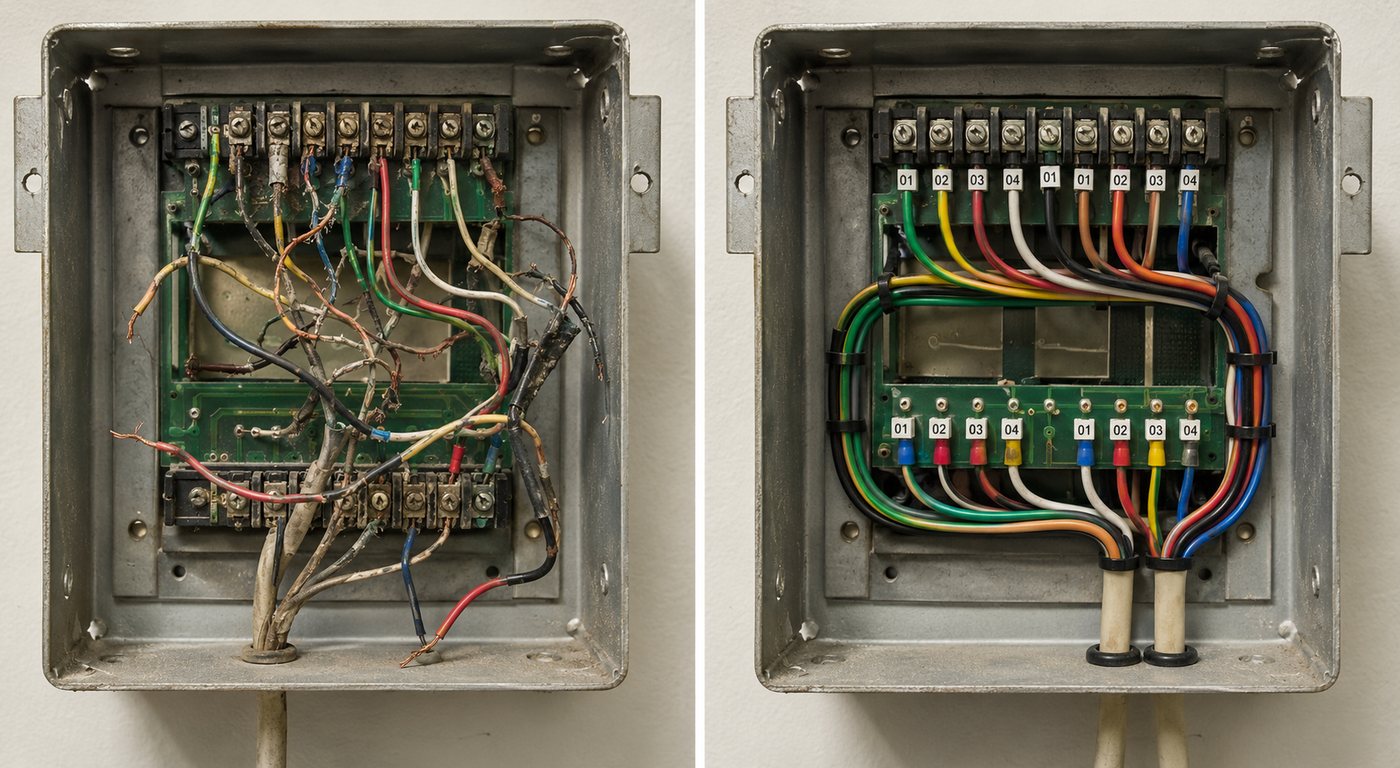
Junction box before and after re-termination and labelling.
Layer 2 — the release path
In a garden complex the strike is close to the panel and preload dominates. In a converted house with a rear or basement unit the run can be substantial and voltage drop becomes the likely diagnosis.
Layer 3 — the mechanical layer
Detached and semi-detached homes have exterior doors that move seasonally with humidity and frost far more than a masonry-framed apartment entrance. A strike aligned in summer can bind in winter.
The Buzzer Works But the Door Stays Locked
Queens splits in two. In a garden co-op the strike is close to the panel and preload dominates. In a converted two- or three-family with a basement or rear unit the run is long enough that voltage drop becomes the likely answer.
The distinguishing question is whether the failure is seasonal. Voltage-drop faults get worse in cold weather as coils draw harder. Preload faults get worse after a wet spring as the frame swells.
Detached and semi-detached exterior doors move far more than a masonry apartment entrance, so alignment here is a recurring maintenance item rather than a one-time correction.
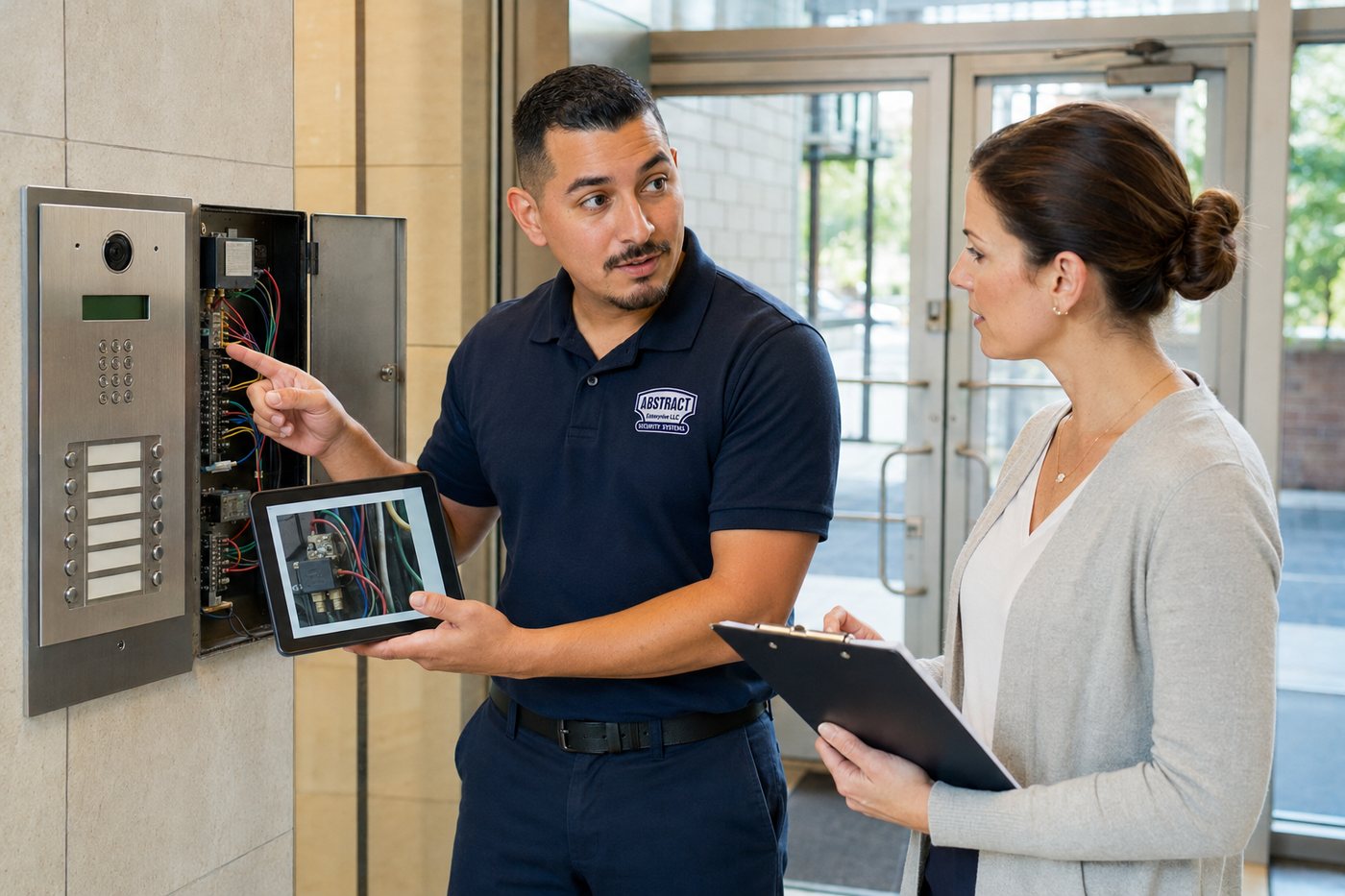
Walking an owner through the diagnostic findings on site.
Not sure whether yours is a part swap or a wiring job? The diagnostic answers that, and the fee applies either way.
No Sound, No Power, or a Buzzer That Will Not Stop
In a converted house the answer is usually an overloaded transformer rather than a dead one. A supply sized for a single bell now feeds two or three units, so everything gets progressively weaker instead of failing outright.
That gradual dimming is the specific Queens signature, and one reading on the secondary confirms it in a minute. Under about six volts and it is finished; sagging under load with three units drawing means it was never sized for the conversion.
In garden co-ops the pattern reverts to the familiar one — a single basement amplifier taking the whole courtyard building weak at once.
Only One Apartment Is Dead
In a Jackson Heights or Rego Park courtyard building one dead unit means the shared equipment is fine and the fault is that circuit.
In a two- or three-family it means something different: the added leg. Each conversion tapped off the original run rather than home-running to the transformer, and the tap is where the splice sits. The unit that fails is almost always the one added last.
That distinction changes the quote entirely, which is why we ask when the building was converted before quoting anything.
Strike plate alignment — preload reads as an electrical fault and is not one.
What We Actually Replace
Buzzer repair is component work. Below is the hardware behind the terms you will see on an invoice, so you can read a quote and tell a genuine part swap from a padded one.
24V transformer
Low-voltage supply for the whole system. Fails gradually — weak buzz, dropped calls, then silence.
Door release relay
Switches power to the strike when you press release. Contacts weld shut or stop making altogether.
Electric strike
The powered keeper in the frame. Fail-secure locks on power loss; fail-safe unlocks.
Magnetic lock
Holds by electromagnet, always fail-safe. Needs alarm integration and a manual release to be compliant.
Riser wiring
The vertical pairs from the basement to each unit. Corrosion here causes static and dead lines.
Apartment station
The in-unit handset. Cord conductors, hookswitch and speaker all wear out.
Lobby panel
Buttons, directory, speaker and microphone at the entrance. Weather and vandalism take these first.
Request-to-exit
Interior release button or sensor. On a maglock this is life-safety hardware, not a convenience.
We service legacy analog hardware including Lee Dan, TekTone and Alpha Communications and keep common stations and transformers for those platforms on the truck. System-wide video, gate and driveway entry and brand-specific catalogs are covered on our intercom pages.
Is Your Queens Landlord Required to Fix It?
For covered buildings, yes — but Queens' housing mix means the answer varies more than in Manhattan or the Bronx.
State Multiple Dwelling Law covers buildings built or converted after 1968 with eight or more units, and the NYC Housing Maintenance Code requires a functioning intercom in residential buildings. HPD treats a dead intercom as a Class B hazardous violation with penalties in the $250 to $500 per day range. That covers the garden-co-op and mid-rise stock across Jackson Heights, Elmhurst, Rego Park, Forest Hills and Flushing.
Buildings with fewer than three dwelling units fall outside that framework, which takes in a large share of the detached and semi-detached housing across Bayside, Whitestone, Fresh Meadows, Ozone Park and the Rockaways. In an owner-occupied two-family the entry system is the owner's.
For covered buildings the path is written notice to management, then 311 or HPD, then an HP proceeding in Housing Court. General information, not legal advice.
Two- and Three-Family Conversions
The single most common Queens fault pattern is a system that was designed for one bell and asked to serve three.
A house built for a single family gets a basement unit, then an attic unit. Each conversion adds a button, a chime and a length of conductor, usually tapped off the original run rather than home-run to the transformer. The transformer sized for one bell is now feeding three, and each added leg is a splice waiting to oxidise.
It presents as one unit failing while the others work, or as everything getting progressively weaker. Both are the same underlying problem: the original supply and the tapped topology are past what they were built for.
The fix is usually not a new intercom. It is a correctly sized transformer and home-run conductors to each unit. That is a specific, quotable job and it is worth asking any contractor whether that is what they intend before agreeing to a system replacement.
Two-point verification: visitor at the panel, technician on the station.
What Buzzer Repair Costs in Queens
Our service call is $250 and includes on-site diagnosis: we identify the failed component and give you the repair number before parts work begins. Most single-fault repairs finish in that visit.
Service call + on-site diagnostic$250
Apartment station replacement$250 – $525
Door release relay or button$250 – $475
24V transformer replacement$325 – $650
Electric strike replacement + alignment$450 – $950
Lobby panel repair or faceplate$650 – $1,800
Riser pair repair / re-termination$850 – $2,400
Aggregator sites quote a national average with no idea whether your fault is a $250 button or a $2,400 riser. The number only means something after someone has looked at the panel.
Repair or Replace?
Queens is the one borough where the honest answer is often neither repair nor replace, but re-engineer.
Repair when the fault is a component on a properly sized system. Stations, amplifiers, strikes and buttons are all straightforward.
Re-engineer when a converted house is running three units off a single-bell supply. The fix is a correctly sized transformer and home-run conductors to each unit — a specific, quotable job that costs a fraction of a new intercom and actually solves the problem.
Replace only when the wiring itself is corroded or the platform cannot be sourced. Ask any contractor quoting a system swap on a converted house whether they have checked the transformer sizing first.
Licensed low-voltage service call at a multi-unit entrance.
Where We Work Across Queens
Western Queens
Astoria, Long Island City, Sunnyside and Woodside. Pre-war walk-ups alongside new high-rise construction in Long Island City, so the same block can hold a 1920s riser and a current IP platform.
Central Queens
Jackson Heights, Elmhurst, Corona, Rego Park and Forest Hills. The borough's garden-co-op belt — courtyard buildings with shared entries, proper basement equipment and largely supportable analog platforms. Jackson Heights' historic district constrains visible exterior hardware.
Lobby panel diagnostics — isolating the fault before any quote.
Flushing and the north
Flushing, College Point, Whitestone, Bayside and Douglaston. Mixed mid-rise and detached, with a high conversion rate in the detached stock and the transformer-and-tap problem that comes with it.
Southeast Queens
Jamaica, St. Albans, Springfield Gardens, Laurelton and Rosedale. Predominantly one- and two-family with pockets of larger apartment buildings around Jamaica centre.
Southern Queens and the Rockaways
Ozone Park, Howard Beach, Broad Channel and the Rockaway peninsula. Coastal exposure through Rockaway Beach, Far Rockaway and Broad Channel makes outdoor-rated hardware the sensible default, and post-Sandy rebuilds mean a lot of newer wiring in older-looking buildings.
The complaint we hear most: the buzzer sounds and the door stays shut.
Field Notes
Three patterns cover most of what we find in Queens.
First: the conversion tap. A two- or three-family where each added unit was tapped off the original bell run. One unit fails, then another. The answer is a properly sized transformer and home-run conductors, not a new system.
Second: garden-complex amplifier failure. In Jackson Heights and Rego Park courtyard buildings, whole-building weakness usually traces to one basement amplifier rather than to the stations, and that is a single component.
Third: seasonal binding on detached homes. Exterior doors move with humidity and frost, and a strike that has been reliable for years starts jamming after a wet spring. Hold the door slack and trigger the release before assuming anything electrical failed.
Door Buzzer Repair Queens — Questions
How much does door buzzer repair cost in Queens?
Service call $250 with diagnosis included. In a two- or three-family most repairs finish at or just above that. Garden-co-op and mid-rise work runs higher: strike with alignment $450–$950, panel work $650–$1,800.
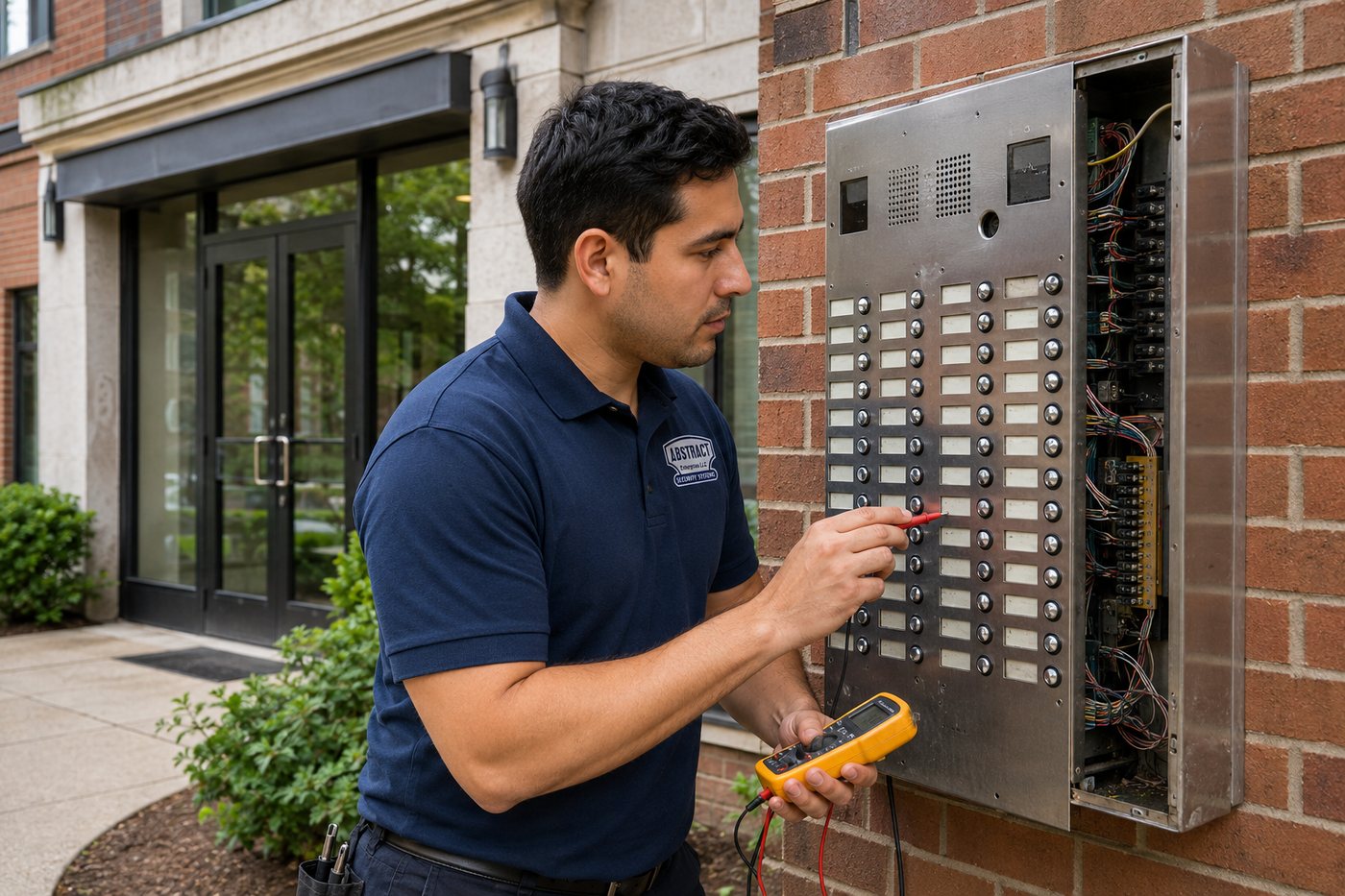
Terminal testing behind a stainless lobby panel.
Our two-family has a basement unit and the bell keeps failing.
That is the classic Queens fault. Each converted unit was tapped off the original bell run rather than home-run to the transformer, so a supply sized for one bell now feeds three and every tap is a splice. The fix is a correctly sized transformer and home-run conductors — not a new intercom.
Why does everything get weaker over time instead of failing outright?
Because the transformer is overloaded rather than dead. Add units, add draw, and the whole system dims. One reading on the secondary tells you whether that is what is happening.
Is my Queens landlord required to fix it?
For covered buildings, yes. State MDL covers post-1968 buildings with eight or more units and the NYC Housing Maintenance Code requires a functioning intercom, with HPD treating failure as a Class B hazardous violation. Buildings under three dwelling units fall outside that, which takes in much of the detached stock in Bayside, Whitestone, Fresh Meadows and the Rockaways. General information, not legal advice.
Basement amplifier cabinet feeding the building riser.
Our whole garden complex is weak.
In Jackson Heights and Rego Park courtyard buildings that usually traces to one basement amplifier rather than to the stations. It is a single component, not a system.
Do the Rockaways need different hardware?
Yes. Rockaway Beach, Far Rockaway and Broad Channel are coastal and standard outdoor panels corrode fast. Post-Sandy rebuilds also mean a lot of newer wiring inside older-looking buildings, which changes the diagnosis.
The buzzer works in summer and fails in winter.
Detached and semi-detached exterior doors move with humidity and frost. A strike aligned in July binds in January. Hold the door slack and trigger release — if it opens, the frame moved and the electronics are fine.
Electric strike service at the frame — the most common failure point.
One apartment in our Forest Hills building is dead.
Then the shared equipment is fine and the fault is that unit's station, terminals or pair. It is the least expensive repair in the category.
Do you offer same-day service in Queens?
Western and central Queens are usually same day on calls before 10 AM. Southeast Queens and the Rockaways are same or next day depending on schedule.
Jackson Heights is a historic district. Does that matter?
For interior repairs, no. For replacing a visible street-facing panel with a different model it can, so we specify hardware appropriate to the district rather than installing first.
The buzzer will not stop.
A stuck button or a welded relay holding the circuit closed. A welded relay holding the strike open leaves the entrance unlocked. Disconnect the panel and call rather than forcing the button.
Can I replace the transformer myself?
No — the primary side is line voltage and that is licensed work. Safe to check: whether other units are affected, whether a button is physically stuck, and whether an accessible chime has an obviously loose wire.
Reviewed and updated September 2026.
Get the Buzzer Fixed
Component-level diagnosis across Queens. We identify the failed part and quote the repair before touching anything — no system-replacement pitch on a $250 fault.