See every ANNKE camera price in NYC and build your own system →
Bench-Tested Before It Goes on Your Wall · Landmark and Board Rules Checked First · Recording That Works Without the Cloud
ANNKE sells PoE cameras, recorders and complete kits that many New Yorkers buy online and then discover are only half the job. The other half is getting cable from a rear yard to a front stoop through a building whose median construction year, citywide, is 1931, past plaster, brick party walls and a co-op board's alteration rules, and doing it without breaking the Landmarks Preservation Commission's limits on what can go on a historic facade. We install new ANNKE systems, finish kits you already own, add cameras to existing ANNKE recorders and replace tired coax DVR setups across Brooklyn, Manhattan, Queens, the Bronx and Staten Island, with every camera tested on the bench before it goes up and every cable labelled at both ends.
Reviewed and updated November 5, 2026 by Anwar Timothy, NYS license #12000287431 · Sources: IPVM's Hikvision OEM Directory as summarized by Coram, FCC Public Notice DA 26-635 as reported by ICTally, the CCTVinfo NDAA database, NYC Administrative Code §28-105.4.7 and Local Law 128 of 2024 as summarized by Low Voltage New York, the New York low-voltage licensing roadmap (Article 6-D), the Landmarks Preservation Commission's 2018 rules amendments, LPC Permit Guidebook Chapter 11, LPC presentation materials for 7 East 7th Street (December 16, 2025), the Mayor's Management Report 2025 LPC section, NYC 311's NYC Connect article, the ANNKE Help Center, Connextivity, Impera Security, Seneca Security, Vertex Security, Tenant-Rights.com, AOL's 2012 Parkside Houses report, NYC Participatory Budgeting 2025, Residential Real Estate Analysis, Sky NYC, NYPAP, Village Preservation, the NYC SBS business improvement district directory, IPCamTalk and Slickdeals · Dispatched from 1282 Troy Ave, Brooklyn

Owner-operated since 2002 · Thousands of jobs completed · Booked within 2 hours
ANNKE camera installation in NYC covers the cable runs, the mounting, the recorder and phone setup, and it is priced by borough on our ANNKE price pages rather than with one number for the whole city. Three things set most of the quote: how many cameras, how far each one sits from the recorder through walls that are often brick or old plaster, and whether the building's owner, board or the Landmarks Preservation Commission has a say over where cameras can go. We book a visit within 2 hours of your request, and you can build your own system on the ANNKE camera installation prices for NYC page before you call (800) 486-0943.
New York is an old city to wire, and that is the first thing anyone installing an ANNKE system here runs into. An analysis of city housing data by Residential Real Estate Analysis puts the median year built for the city's housing at 1931. Borough by borough, it gives 1910 for Manhattan, 1925 for Brooklyn, 1935 for Queens and the Bronx, and 1970 for Staten Island. Those dates matter because the buildings were planned for coal stoves, gas lamps, a single telephone line and, later, a doorbell. Nobody framing a Manhattan tenement in 1910 left a chase for eight Ethernet cables running from the cellar to the roof. So when an ANNKE PoE kit arrives with its recorder and its bundle of pre-made cables, the hard part of the job is not the cameras at all. It is finding a path for each cable through brick, plaster, joists, fire-stopping and other people's apartments, and doing it in a way that the owner, the board and, in a historic district, the city will accept.
The five boroughs were not even one city until recently in the life of their buildings. The New York City archaeology timeline records that on January 1, 1898, Manhattan, Brooklyn, the Bronx, Queens and Staten Island joined into a single metropolis after a referendum that passed by 64,744 votes to 64,467. Each place had already built in its own way, and you still see it on a camera survey. Sky NYC's guide to prewar buildings describes four- to six-story walk-up tenements built before 1929, eight- to twelve-story elevator apartment houses from the 1910s and 1920s, and larger prewar doorman buildings from the 1920s and 1930s. Add the rowhouses and brownstones of Brooklyn and Harlem, the one- and two-family houses of Queens and Staten Island, the mid-century co-ops of the Bronx and the glass-and-steel commercial buildings of Midtown and Downtown Brooklyn, and an ANNKE installation in this city can mean five completely different jobs depending on the address. One installer's marketing, from Seneca Security, describes the range as running from 1890s brownstones with horsehair plaster walls to glass-curtain commercial towers. That is a fair summary of the building stock even if it comes from a competitor.
The age shows most clearly in Brooklyn. A history site citing the city's PLUTO dataset says roughly 57 percent of Brooklyn's residential buildings were built before 1940, and that most are three- and four-story walk-ups with original lath-and-plaster ceilings. We treat that as a rough figure from a low-authority source, but it matches what technicians find. Lath-and-plaster ceilings crack when a fish tape is forced through them, and the cavities above them are often blocked by old fire-stopping or a century of renovation. In the Bronx, the same housing analysis says 79.7 percent of homes are renter-occupied, the highest share in the city. For an ANNKE install, that number changes who we talk to first. A renter can usually put a camera inside their own apartment, but the moment a cable needs to cross a hallway, a lobby or the outside wall, the landlord's agreement is part of the job. Many of the calls we expect from the Bronx and from Upper Manhattan are from landlords and managing agents who want cameras on the entrances and in the halls of buildings full of tenants, which brings its own set of rules covered further down.
Then there are the landmarks. The Mayor's Management Report for 2025 says the Landmarks Preservation Commission has designated 1,464 individual landmarks and 157 historic districts and extensions. Brooklyn Heights became the first historic district on November 23, 1965, according to the New York Preservation Archive Project, and Village Preservation describes the Greenwich Village Historic District, designated in 1969, as the largest by number of buildings, with nearly 2,200. In the LPC's 2018 rules amendments, the Commission grouped security cameras with lighting and intercom panels as objects commonly used for security, and the proposed rules would prohibit installing many of these objects on a primary facade unless there is no feasible alternative. That one sentence changes the plan for thousands of rowhouses. A homeowner on a landmarked block who mounts an ANNKE bullet camera above the front door because that was the easiest spot may have just created a violation. We look up the building before we design the layout, not after.
ANNKE itself brings a second set of questions that most camera brands do not. IPVM, the security-industry research publication, lists ANNKE in its Hikvision OEM Directory of brands it says it verified as selling Hikvision-made hardware. In June 2026, the FCC issued a public notice, effective July 16, 2026, prohibiting the continued import and marketing of certain previously authorized covered equipment for public safety, government facility and national security purposes. Another database, CCTVinfo, describes ANNKE as China-based but not on the FCC Covered List, with some shared lineage with Hikvision-style hardware in older models. Those sources do not agree, and we say so plainly in the brand section below. What they mean in practice for an owner in Queens or a shop on Fordham Road is simpler than the headlines: the FCC notice says continued use of lawfully purchased equipment is not affected, but a building that answers to a government agency, or a buyer who wants to be sure replacement parts will be available for years, should know the brand's background before buying more of it.
The people asking about ANNKE online tell the same story. On Slickdeals, under listings for ANNKE PoE turret and panoramic cameras, buyers ask whether ANNKE is a reputable company for PoE cameras, whether a camera would work with a Uniview recorder they already own, and whether ANNKE cameras will work with a Lorex recorder. On IPCamTalk, a forum for camera enthusiasts, a thread asks whether ANNKE and Hikvision are the same company and whether the Annke Vision app uses the same cloud servers as Hik-Connect. Those are installation questions disguised as shopping questions. A New Yorker mixing an ANNKE camera into an older Lorex or Uniview system, or relying on a phone app for a storefront, needs someone to test that combination before the camera is drilled into a limestone lintel. That is a large part of what we do.
The renting city adds a third layer. A guide from Connextivity on NYC apartment camera law says Wi-Fi cameras that need no drilling and no permanent wiring generally raise no issue with a landlord or a board, but the building usually gets involved once the install becomes permanent, such as drilling into walls or running cable through the building. In 2012, AOL reported that a tenant at Parkside Houses, a public housing complex in the Bronx, received an eviction notice saying she had breached her lease by installing cameras. In the city's 2025 participatory budgeting process, a proposal for Gowanus Houses in Brooklyn asked for security cameras in elevators and near apartment doors to monitor activity and prevent trespassing. People want cameras, and the building decides how they get them. Our job is to find the version of an ANNKE system that the building will accept, whether that is a Wi-Fi camera inside a rented apartment, a wired system for an owner who controls the whole house, or a common-area system designed with the managing agent.
We want to be clear about the gaps in our research for this citywide page. We searched for Reddit threads about ANNKE installs in New York and found none. We found no HPD violation counts, 311 complaint counts or Department of Buildings permit counts that track security cameras specifically, and no local news coverage about ANNKE cameras in the city. We also could not capture Google's People Also Ask boxes, related searches, AnswerThePublic, Bing or DuckDuckGo for this topic. Where this page describes what we expect to find inside New York walls, it draws on the age and type of the building stock in the sources above and on how we work in buildings of that age generally. It is not a survey of any particular address. The only way to know your walls is to see them.
What owners often add once the cameras are in. After an ANNKE system is recording, the next request in an apartment building is usually the front door: an intercom or entry system that the cameras can watch, or access control on a side gate. In a brownstone, it is often a second recorder screen on another floor so someone upstairs can see who is on the stoop. If you think you will want any of that, tell us during the survey, so we can pull a spare cable or leave room in the network rack instead of opening the same walls again later.

The calls we move on first are the ones where a system stopped recording and the owner needs footage, or will need it soon: a recorder that keeps rebooting, cameras that went black after a power cut, a hard drive error, or a phone app that suddenly shows nothing. Do not unplug or reset the recorder if you think it holds footage you need, because a factory reset can erase settings and in some cases recordings. Leave it powered, take a photo of any error on the screen, and call (800) 486-0943. Tell us the borough, how many cameras are down, whether the recorder is an ANNKE NVR or an older DVR, and whether anything changed recently, such as a new router, a new internet provider or work by another trade in the building. We book within 2 hours of your request, and we tell you honestly over the phone if the problem sounds like a dead power supply, a failed drive or a cable that someone cut.
Most people buying an ANNKE kit never think about who made the circuit boards. Since mid-2026, that has become a fair question, and we would rather answer it at the start than have a customer find out halfway through a job. The table sets out what each source we found says, where it says it, and what we do about it on a New York install. We are not lawyers and this is not legal advice; it is how we read the sources and how we run our jobs.
| Question | What the source says | Source | What we do on an NYC job |
|---|---|---|---|
| Who makes ANNKE hardware? | IPVM lists ANNKE in its Hikvision OEM Directory, built from shipping records, documentation or product testing | IPVM, as summarized by Coram | Tell the customer up front, especially when the property has any government connection |
| Is ANNKE on the FCC Covered List? | Described as China-based, not on the FCC Covered List, with some shared lineage with Hikvision-style hardware in older models | CCTVinfo NDAA database | Note that sources disagree; we do not claim either side as settled |
| What changed in July 2026? | An FCC public notice effective July 16, 2026 prohibits continued import and marketing of certain previously authorized covered equipment for public safety, government facilities and national security purposes | FCC Public Notice DA 26-635, as reported by ICTally | Avoid proposing affected hardware for those uses |
| Do I have to remove cameras I own? | The notice says continued use of lawfully purchased equipment is not affected | Coram summary of the notice | Keep working systems running; we service and expand them |
| Will spare parts stay available? | No source we found answers this for ANNKE specifically | None found | Recommend standard PoE cabling so any brand's camera can replace a failed unit later |
For a family in a Staten Island house or a shop owner on Steinway Street, the practical effect of the 2026 notice, as reported, is limited. The FCC language reported by ICTally is aimed at imports and marketing for public safety, government facilities and national security purposes, and the notice says lawfully purchased equipment already in use is not affected. That means an ANNKE system recording the driveway is not suddenly illegal to run. It is different for a building that houses a government tenant, takes part in a publicly funded security program or answers to an agency that has its own purchasing rules. Those customers should ask their agency before buying more ANNKE hardware, and we will happily design the same layout on a different brand if that is the safer route. The cable, the mounts and the recorder location rarely change; only the cameras and recorder on the ends do.
The way to protect yourself from supply questions is in the wiring, not the logo. A wired PoE system runs one standard Ethernet cable from each camera to a PoE switch or a recorder with PoE ports. If an ANNKE turret fails in five years and the exact model is gone, a different camera can usually go on the same cable and the same mounting box, provided it is compatible with the recorder or the recorder is replaced too. So on every ANNKE install we pull good-quality cable, label both ends, leave a little slack at the camera, and document the run. That way a future change of brand is a camera swap, not a rewiring of a prewar building. We also record the exact model numbers and firmware versions on the handover sheet, because a model number is the first thing anyone will need when the question of parts comes up.
Some ANNKE owners worry less about the hardware than about where their video goes. On IPCamTalk, one user asked whether the Annke Vision app and Hik-Connect use the same cloud server. We found no reliable source that answers that, and we will not guess. What we can control is how much the system depends on any cloud at all. According to the ANNKE Help Center, you can view the stream without the internet when the NVR or DVR is connected to a monitor or TV. We set up every system to record locally to the recorder's drive and to show on a local screen, so it keeps working if the internet is down or if you choose not to use remote viewing. If you do want the app, we set strong unique passwords, change default logins, keep firmware current at install, and can put the cameras on their own network segment behind the recorder so they do not talk directly to the internet.

In New York, the camera is rarely the hard decision. The hard decision is who is allowed to put it where. A brownstone owner on an ordinary block can do almost anything on their own walls. The same owner on a landmarked block cannot. A renter can usually place a camera inside the apartment but not in the hallway. A co-op shareholder answers to the board for anything that crosses a common wall. This table sets out the common situations and the sources behind them, so you can see your own position before we visit. None of it is legal advice; it is the map we work from.
| Situation | What the sources say | Who has to agree | How we plan the ANNKE system |
|---|---|---|---|
| Owner of a house on an ordinary block | No general NYC law mandates or bans cameras on your own building; covert cameras inside a unit can support a charge under Penal Law 250.45 | The owner | Wired PoE on the outside, aimed at your own property and entries |
| Owner in a historic district or of a landmark | LPC rules would prohibit many security objects on a primary facade unless there is no feasible alternative; guidance sits in Permit Guidebook Chapter 11 under Rules Section 2-20 | The owner and the LPC | Secondary facades, rear yards and small fixtures first; front-facade cameras only with the permit route checked |
| Renter, camera inside the apartment | A security-company blog says tenants can install cameras inside their own apartment without landlord permission | The tenant, within the lease | Plug-in or Wi-Fi ANNKE cameras, no drilling into structure |
| Renter or shareholder, camera in the hallway | A hallway wall is a common area and typically needs building approval in a co-op or condo; tenants generally cannot install in shared spaces without permission | The landlord, board or managing agent | Written approval first, then a design the building accepts |
| Landlord with tenants | Tenants can raise building surveillance complaints with HPD or 311 | The owner, with care for tenants' privacy | Common areas and entrances, never aimed into a unit |
| Public housing resident | A Parkside Houses tenant in the Bronx got an eviction notice in 2012 for installing cameras, per AOL | The housing authority | We do not drill or wire in public housing without the authority's written approval |
| Business in a rented storefront | Commercial work may involve EMT conduit, fire-rated penetrations and plenum cable, according to one installer | The tenant business and the landlord | Conduit and cable types chosen for the space, landlord sign-off before work |
The single biggest delay on New York camera jobs is not cable or weather; it is waiting for someone to say yes. If you live in a co-op or condo, ask your managing agent now what the building needs for an alteration of this kind: often a written request, a copy of the contractor's insurance, and a description of where cables will run. If you rent, send your landlord a short note with the camera locations and how they will be fixed. If your building is landmarked, tell us the address when you book, so we can look at it against the LPC rules before we design anything. We would much rather lose a week on approvals than drill a facade that has to be patched later.
These are the ANNKE jobs New York homeowners, landlords, co-op boards, renters and business owners call us for. Each one is planned around the building first and the camera second, and each is priced on the borough ANNKE price page that matches your address.
Turret, dome, bullet and panoramic cameras on a single Ethernet cable each, with an ANNKE NVR or PoE switch in a closet or basement, for brownstones, walk-ups and storefronts where Wi-Fi struggles through brick.
For the ANNKE box sitting in the hallway: we bench-test it, replace the short pre-made cables where a run is longer than the kit allows, and install it properly through the building.
An extra camera on the rear yard, the side alley or the basement door, added to the channels your recorder already has, with the new cable labelled to match the old ones.
Coax camera systems from earlier decades replaced with newer recorders, either reusing coax where an ANNKE DVR kit suits the building or pulling Ethernet for a PoE upgrade.
Indoor and plug-in cameras inside the apartment, set up on a 2.4 GHz network close enough to the router to stay connected, without drilling into the landlord's walls.
Camera plans for historic-district rowhouses that favor rear and side elevations, small fixtures and cable hidden inside the building, checked against LPC guidance before drilling.
Lobby, mailroom, stairwell, elevator-landing and entrance cameras for apartment buildings, designed with the owner or managing agent and aimed at shared spaces, never into units.
Registers, doors, stockrooms and sidewalk entrances on shopping streets across the boroughs, with conduit and cable chosen for commercial spaces and recording kept on site.
Dead cameras, rebooting recorders, failed drives, lost passwords, app connections that broke after a router change, and phone viewing set up for owners and managers.

The city's building types change three things about an ANNKE install: where the cable can travel, what the cameras can be fixed to, and who has to approve the work. These are the types the sources describe across the five boroughs, and how we approach each one.
The rowhouse type that, per the Architectural League, spread across neighborhoods between the Civil War and World War I. Stoop, garden-level door, rear yard and roof are the usual camera points; brick party walls block Wi-Fi.
Four- to six-story buildings from before 1929. Cameras on the entrance, the vestibule, each landing and the rear; cable rides the stairwell or a shaft, often in surface raceway where walls are solid masonry.
Eight- to twelve-story elevator houses of the 1910s and 1920s and larger doorman buildings of the 1920s and 1930s. Longer runs, a lobby desk monitor, and boards or managing agents to satisfy.
The wood-frame and brick houses common in Queens and on Staten Island, where median construction dates are later. Attics and basements make cable paths easier; driveways, side yards and garages add cameras.
From Brooklyn Heights to Greenwich Village, the facade belongs to the city's rules as much as the owner's wishes. Cameras go where LPC guidance allows, with cable inside the building.
Storefronts under apartments, offices above shops and newer commercial buildings with drop ceilings, where conduit, plenum-rated cable and fire-rated penetrations come into the plan.
| Building | Usual recorder spot | How cable travels | Wi-Fi or wired | Who signs off |
|---|---|---|---|---|
| Brownstone or rowhouse | Cellar or a closet on the parlor floor | Up through closets and old chases, along cellar joists, out through a small sleeved hole at the back | Wired; masonry kills Wi-Fi between front and rear | The owner, plus LPC in a historic district |
| Prewar walk-up | Cellar or a locked utility closet | Stair hall in raceway, or a vertical shaft if one exists | Wired | The building owner |
| Elevator building, co-op or condo | A locked room off the lobby or the super's office | Above hung ceilings, in conduit through common areas | Wired for common areas; Wi-Fi only inside units | The board or managing agent |
| One- or two-family house | Basement, attic or a home office | Attic down to eaves, basement out to the yard | Wired outside; Wi-Fi indoors if preferred | The owner |
| Landmarked building | Inside, away from the facade | Inside the building; nothing surface-run on a primary facade | Wired | The owner and the LPC |
| Storefront or office | Back office or stockroom | Ceiling space with J-hooks, conduit where required | Wired | The business and the landlord |
A brownstone camera plan almost always covers the same four places: the stoop and the parlor-floor door, the garden-level entrance under the stoop, the rear yard, and sometimes the roof hatch. The trouble is that those four places sit at opposite ends of a long, narrow house with brick party walls on both sides. A Wi-Fi camera on the rear fence may have three or four masonry walls and a couple of floors between it and a router at the front. We plan these houses as wired PoE systems with the recorder in the cellar or a parlor-floor closet, where it is central. The stoop camera's cable usually comes in through the cellar under the stoop, which keeps the front facade clean. The rear cameras come through a small sleeved hole at the back, sealed against water. In a historic district, we keep the front cameras as small as possible and in places the LPC guidance contemplates, and we look at the rear and side first.
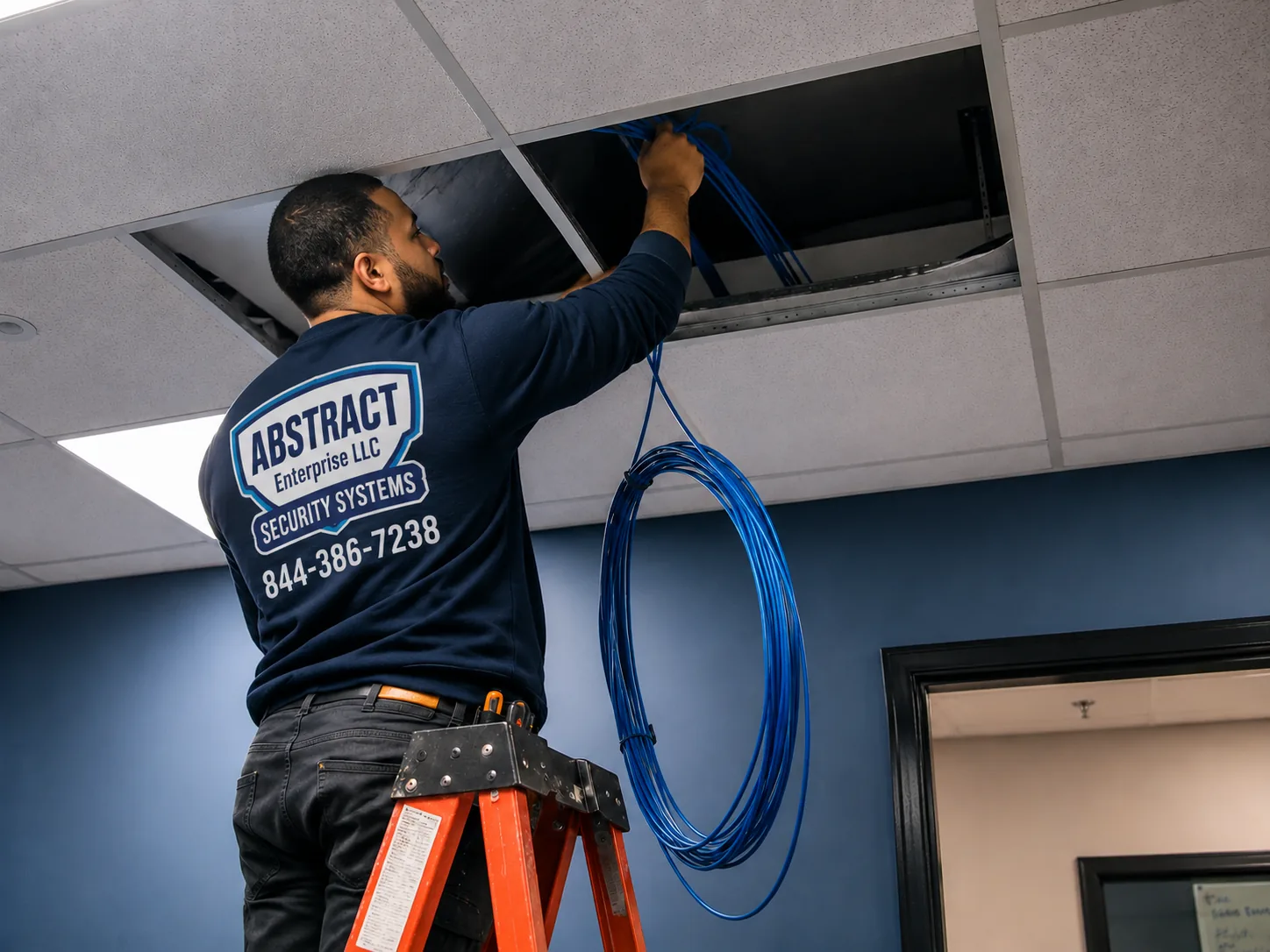
The four- to six-story walk-up is the backbone of much of Manhattan, the Bronx and Brooklyn, and it is a straightforward building to put cameras in once you accept that most of its walls are solid. Owners usually want the front door, the vestibule mailboxes, each stair landing, the cellar door and the rear yard or air shaft. The cable for all of that has to climb the building. Where an old dumbwaiter shaft, a pipe chase or an unused chimney void is available and safe to use, we use it. Where it is not, we run neat surface raceway up the stair hall, painted to match, which is often the honest choice in a building with plaster on solid brick. A mid-run PoE switch on an upper floor can shorten the longest runs. We keep every landing camera aimed at the stairs and the landing as a whole, never at one particular apartment door.
Larger prewar and mid-century buildings bring a lobby desk, a super, a managing agent and, in a co-op or condo, a board. Their camera systems usually cover the lobby, the package or mail area, elevator landings, the laundry room, the garage or courtyard, and the service entrance. The recorder goes in a locked room off the lobby or the super's office, and a monitor at the desk shows live views. Runs can be long, so we measure every one and choose between direct runs to the recorder and a second PoE switch closer to a cluster of cameras. Most of these buildings want cable in conduit through common areas, insurance papers before work, and set hours for drilling. We send what the managing agent asks for and work inside the building's rules, because a board that trusts the contractor is a board that approves the next job.
The city's newer housing, with a median construction year of 1970 on Staten Island and 1935 in Queens, is often the easiest place to install ANNKE PoE cameras. Wood-frame attics let us drop cables down to the eaves, where cameras can cover the driveway, the front walk, the side yard and the back. Basements let us run along joists to the rear. Many of these houses are detached or semi-detached, so there is no party wall and no shared hallway to negotiate. The challenges are different: long driveways that need a camera with enough resolution to see a face at distance, garages detached from the house, and two-family houses where the cable for the upstairs tenant's door camera has to pass through the downstairs apartment. We sort out who controls which space before we design the runs.
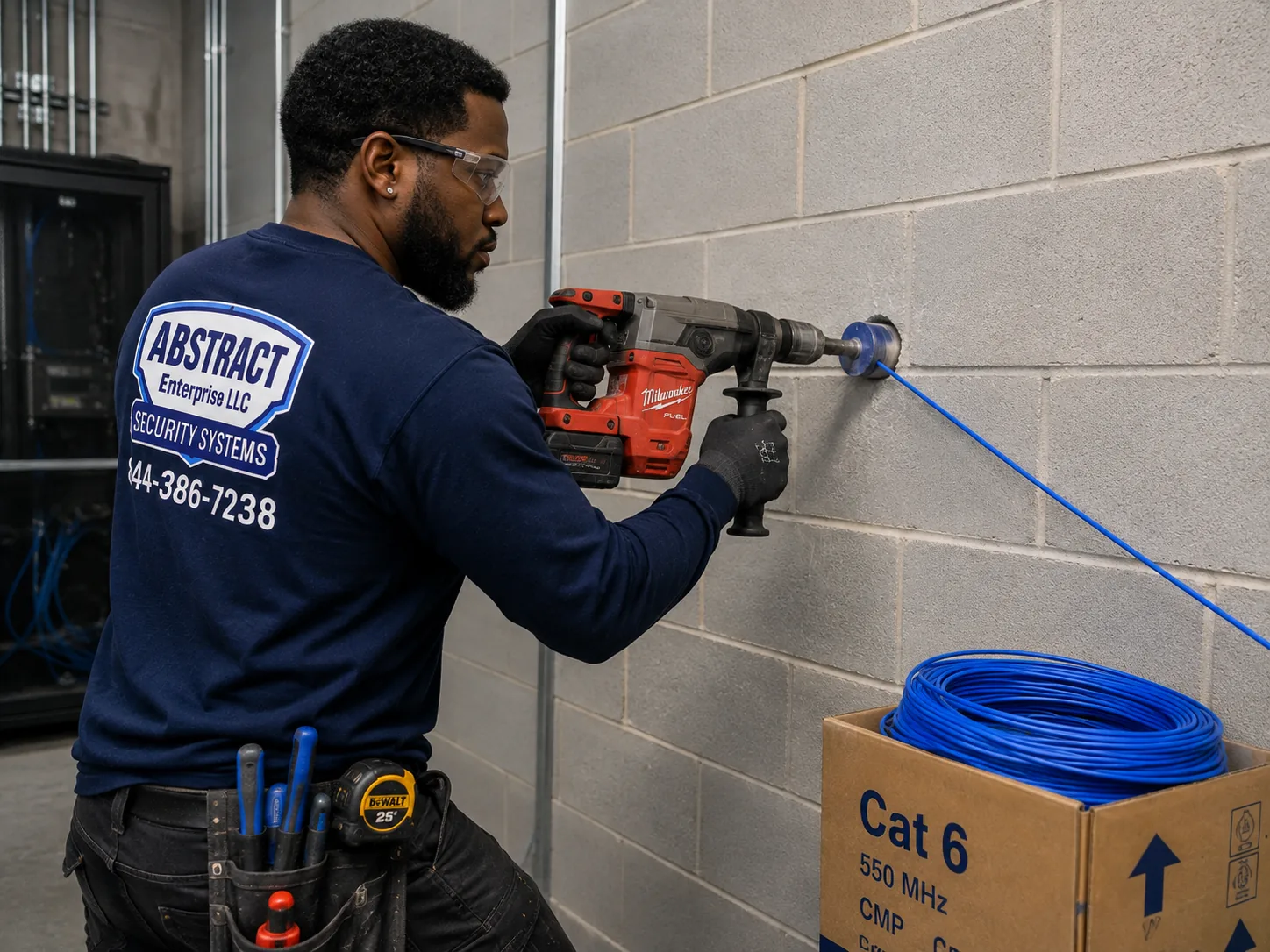
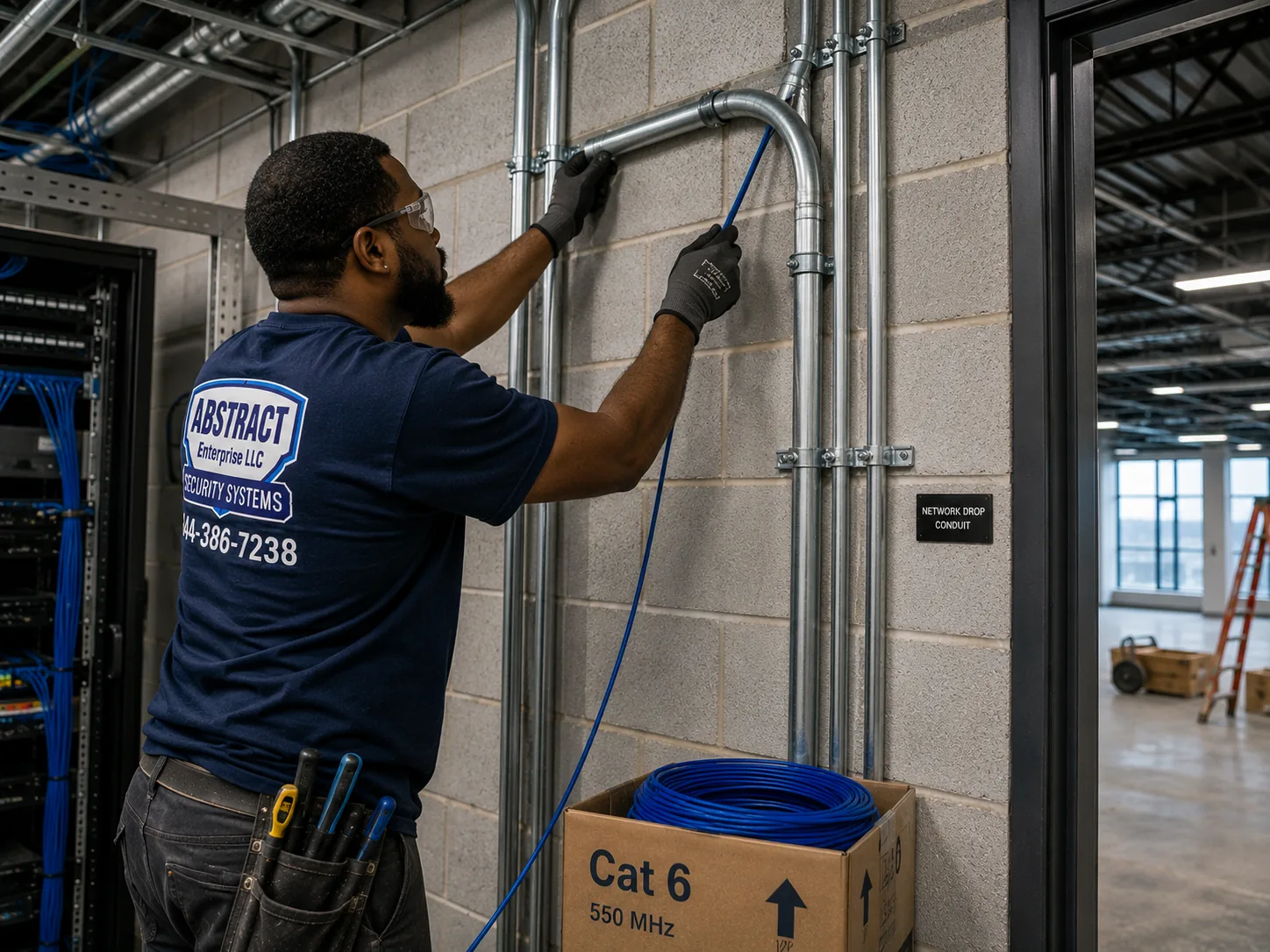
Wherever a cable has to pass through an outside brick or block wall, we drill with a masonry bit or a core bit sized for the cable or conduit, slope the hole slightly downward to the outside so water runs away, sleeve it so the cable is not chafed by brick, and seal it on both sides. The ANNKE camera's base or a junction box covers the outside end, so the hole is not visible. Inside, we fire-stop any penetration through a rated wall or floor with materials suited to it. In old brick, we place anchors in the face of the brick rather than in the mortar joint wherever the mount pattern allows, because joints hold less and crumble sooner. These are small details, but they are what keep a camera from loosening, leaking or letting water into a century-old wall.


New York's shopping streets are long, busy and mostly lined with storefronts under apartments or offices. The corridors below are each served by a business improvement district listed in the NYC Department of Small Business Services directory. We name them because they show the range of commercial streets we cover; we have no information about the camera systems of any business on them and do not claim any as clients.
One of the borough's best-known shopping streets, with its own BID. Storefront systems here usually need clear entry and register views and recording kept on site.
Harlem's main commercial corridor and another BID on the SBS list, where many businesses sit in older buildings with apartments or offices above.
Two Brooklyn shopping districts with their own improvement associations, the Fulton Mall Improvement Association downtown and the Pitkin Avenue BID in Brownsville.
The Steinway Street BID in Astoria and the Downtown Jamaica Partnership, both listed by SBS and both lined with storefronts facing heavy foot traffic.
A commercial corridor with its own BID on the SBS list, where stores, restaurants and services often have parking lots or rear lanes to cover as well.
Brooklyn's 86th Street BID in Bay Ridge, another SBS-listed corridor of storefronts where a camera plan usually covers the door, the floor, the stockroom and the back exit.
A home camera mostly watches doors and yards. A business camera has to answer specific questions after something goes wrong: who took the money from the register, when the delivery actually arrived, whether the slip-and-fall happened the way the customer says, who opened the back door after closing. That changes the design. A register camera needs to be close and overhead enough to see hands and the drawer. A door camera needs to catch faces at the threshold, not the tops of heads. A sidewalk camera should see the approach but, for the owner's own protection, should cover the business's frontage rather than the apartment windows across the street. ANNKE PoE turrets and domes suit most indoor positions; panoramic dual-lens models can cover a wide shop floor from one point. We design commercial systems camera by camera with the owner, test each view with the owner at the screen, and keep recording on an on-site NVR so footage is there when the police or the insurer asks for it.


We do not publish stories about a particular customer's building unless we can document them, so this is not a story about one address. It is the routine our technicians follow when a New Yorker hands us an ANNKE kit they bought themselves, which is one of the most common ways these jobs begin.
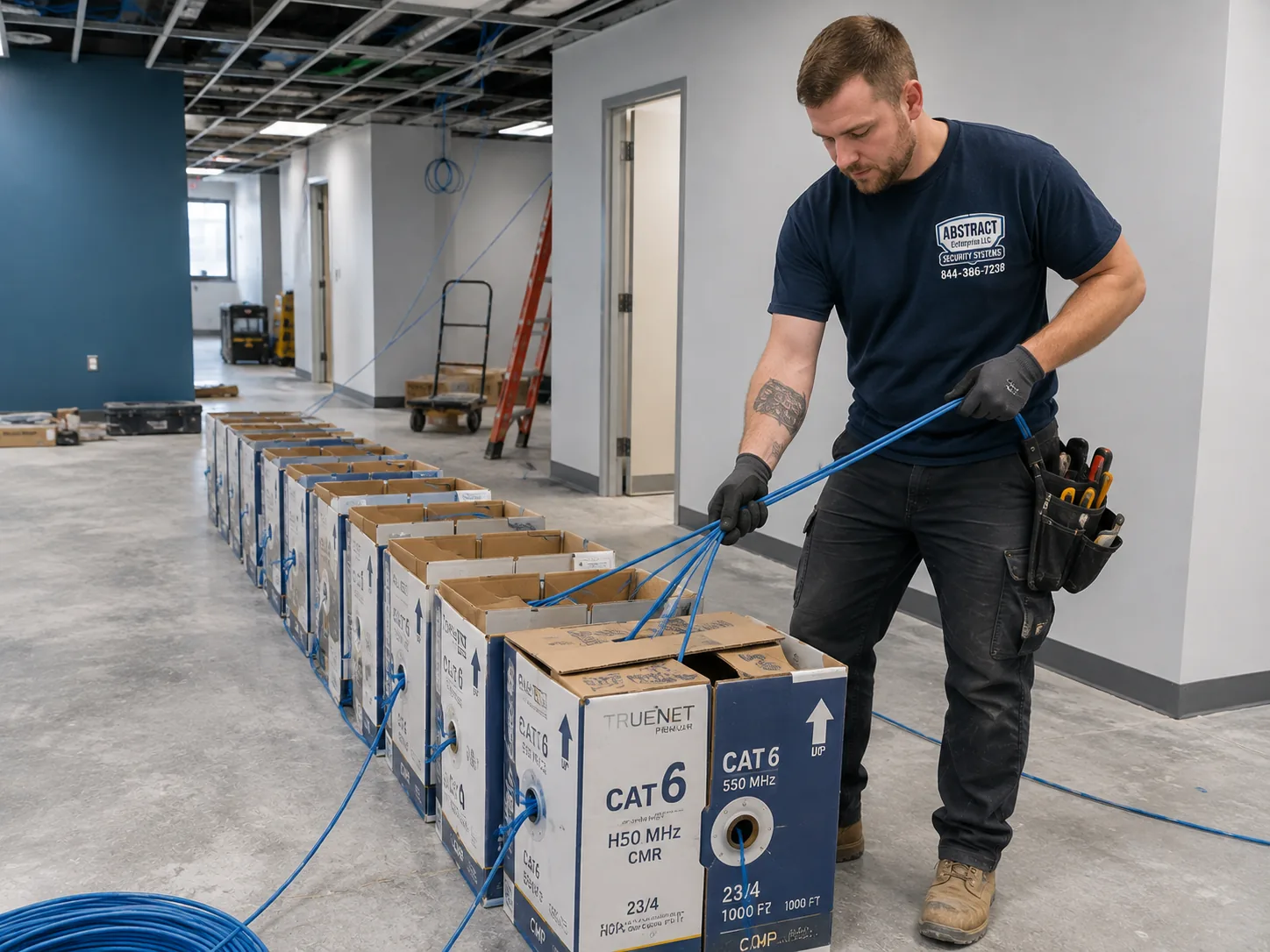
We open the box on a table, not on a ladder. We connect the recorder to a monitor and power, install or check the hard drive, and plug each camera in, one at a time, with a short test cable. We watch for the picture, check the night view by covering the lens, and note every model number and firmware version on the job sheet. A camera that will not power up gets found here, where it costs ten minutes and a phone call to the seller, rather than after it is bolted to a cornice two stories up. Then we lay the pre-made cables that came in the box next to the run lengths we measured on the walk-through. In narrow city buildings, the kit's cables are often too short for the rear yard and too long for the stoop. We tell the owner which runs will need new cable before anyone climbs anything, and only then do we start drilling.
Cost and timing
Four things, in roughly this order: the number of cameras, the length and difficulty of each cable run, the type of wall or facade each camera is fixed to, and whether you are supplying the ANNKE hardware or we are. A four-camera system on a frame house with an open attic is a different job from four cameras on a brick walk-up where every run climbs a stair hall in raceway. Approvals add time but not usually cost. Because labor varies by borough, each one has its own page: our ANNKE price pages for Brooklyn, Manhattan, Queens, the Bronx and Staten Island let you build a system and see the price for your address, and we confirm the final quote after the walk-through.
The visit is booked within 2 hours of your request, and most of the elapsed time after that depends on the building, not the cameras. A house or a small shop where the owner controls everything can usually be surveyed and installed in a single visit. A co-op or a landmarked rowhouse may need days or weeks for the board's paperwork or an LPC review before we can drill. Larger common-area systems in apartment buildings are often installed in phases so stair halls and lobbies are never torn up all at once. We give you a realistic schedule after the survey, including any wait for approvals, rather than a promise on the phone.
The brand and the hardware
The sources disagree on how close the link is. IPVM lists ANNKE in its directory of brands it says sell Hikvision-made hardware, while the CCTVinfo database describes ANNKE as China-based, not on the FCC Covered List, with some shared Hikvision-style lineage in older models. For a private home or most shops, it mainly matters as background: you should know where the hardware comes from. For a building with government tenants or a public-safety role, it matters more, because the FCC's 2026 notice targets covered equipment marketed for those uses. Tell us if your property falls into that group, and we will talk through brand options before you buy.
Based on the notice as reported, no. The FCC public notice that took effect on July 16, 2026, DA 26-635, covers the continued import and marketing of certain previously authorized covered equipment, and the summaries we found say continued use of lawfully purchased equipment is not affected. A working ANNKE system can keep recording, and we can service it, add drives, fix cabling and reset the app. What we suggest is planning for the long run: keep the cabling standard and labelled, so that if a camera fails and an exact replacement is hard to find, another compatible camera can go on the same cable.
A Slickdeals buyer asked exactly that about an ANNKE panoramic turret, and the honest answer is that it depends on the specific models and firmware. Cameras and recorders from different brands can often exchange basic video through common network-camera standards, but brand-specific features such as smart detection, panoramic stitching or two-way audio frequently work only on a matching recorder. We do not promise a mixed system until we have connected your actual recorder and the camera you want on the bench, checked the picture, the recording and playback, and confirmed what features survive. If the combination is unreliable, we tell you before anything is mounted.
Placement and coverage
Outdoor positions need a camera built for outdoor use, sealed at the cable entry and mounted so rain runs off rather than into the junction. In New York that means the stoop, the rear yard, the roofline, the driveway and the storefront canopy, all of which see winter wind and summer sun. Indoor-only models belong in lobbies, hallways, stockrooms and living spaces. The ANNKE Help Center recommends mounting cameras more than 2 meters high, and we follow that wherever the layout allows, high enough to be hard to reach and low enough to see faces. We also avoid aiming outdoor cameras straight into low winter sun or a streetlight, which blinds the picture at the hours that matter most.
For wired PoE cameras, the standard limit for one Ethernet run is about 100 meters, or 328 feet, between the camera and the switch or recorder port. Kits often ship with shorter cables; one install guide notes ANNKE kits include 60-foot PoE cables and that some locations need longer runs. In a brownstone, the run from a cellar recorder to the rear fence can approach that 60-foot length on its own once it climbs and turns. Where a run is longer than the standard allows, we add a PoE switch closer to the cameras. For Wi-Fi models, distance matters less than walls: brick and stone between the camera and the router can cut the signal to nothing in a short distance.
Yes, with care for both the stone and the rules. On an ordinary block, we fix to brick or stone with anchors suited to the material, keep cable inside the building and seal every penetration. On a landmarked building or in a historic district, LPC rules would prohibit many security cameras on a primary facade unless there is no feasible alternative, and the Permit Guidebook's Chapter 11 sets out the criteria. LPC records show what approved work can look like, such as a reviewed proposal for nine ground-floor cameras and a December 2025 proposal for 7 East 7th Street, the Cooper Union Foundation Building, showing pole-mounted cameras attached under the water table. We plan rear and side cameras first, and front cameras only on a permit route that fits.
Apartments, tenants and boards
This was a real question from a Brooklyn renter on JustAnswer, and the sources we found point the same way. Connextivity notes that a camera mounted on a hallway wall sits on a common area, so it typically needs building approval in a co-op or condo, and Impera Security writes that tenants generally do not have the right to install cameras in hallways, lobbies or other shared spaces without the landlord's permission. A camera inside your own apartment is a different matter. So we install hallway-facing cameras only with written building approval, and where that is not available we suggest an indoor ANNKE camera that watches your own entry from inside. This is not legal advice; for a dispute, ask a lawyer.
A question on Justia's lawyer forum in April 2026 asked about landlords using outdoor cameras to monitor tenants in a New York co-op. Owners and boards generally run cameras on entrances, courtyards and common areas, and no general NYC law requires cameras in apartment buildings. What the law clearly prohibits is covert recording inside private spaces, which can support a charge under Penal Law 250.45. Tenants who think a building camera is being misused can raise building security and surveillance complaints with HPD or 311. When we design a common-area ANNKE system for a board or a landlord, we aim every camera at shared spaces and approaches, not into windows or at one resident's door, which protects the owner as much as the tenants.
Licensing and business work
For the camera system itself, the state requirement is an Article 6-D license, which the New York low-voltage roadmap lists for CCTV along with burglar and fire alarm and access control work. AESS holds NYS license #12000287431, and we are happy to show it to a board or managing agent. The city side was simplified in late 2025: Administrative Code §28-105.4.7, effective December 21, 2025 under Local Law 128 of 2024, says no electrical permit is required for wiring below 50 volts for signaling, communication, alarm and data circuits when done by a licensed master electrician, a special electrician or a qualified person. Because one trade source still describes DOB permits for low-voltage work, we check unusual jobs against the current code.
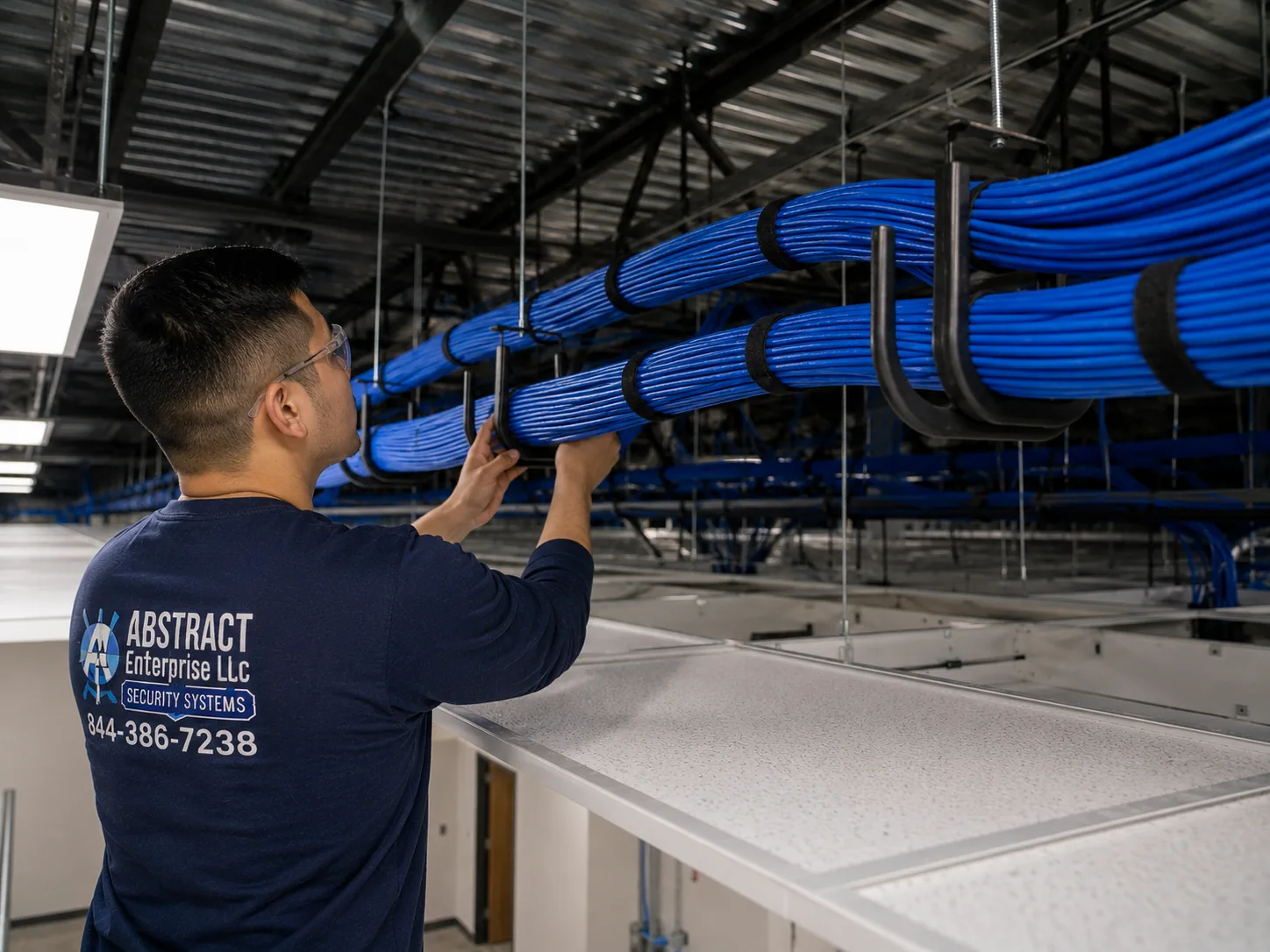
Yes. Retail stores, restaurants, offices and mixed-use buildings are a large share of camera work in the city, from shopping corridors such as Fordham Road and 125th Street to Steinway Street and Forest Avenue. Commercial jobs are planned camera by camera with the owner, with cable types and conduit chosen for the space, plenum-rated cable above return-air ceilings, fire-stopping at rated walls, and the recorder in a back office or stockroom. We schedule drilling for closed or quiet hours, send insurance papers to the landlord when asked, and train the owner and managers on playback and export at the end, so footage can be pulled quickly when it is needed.
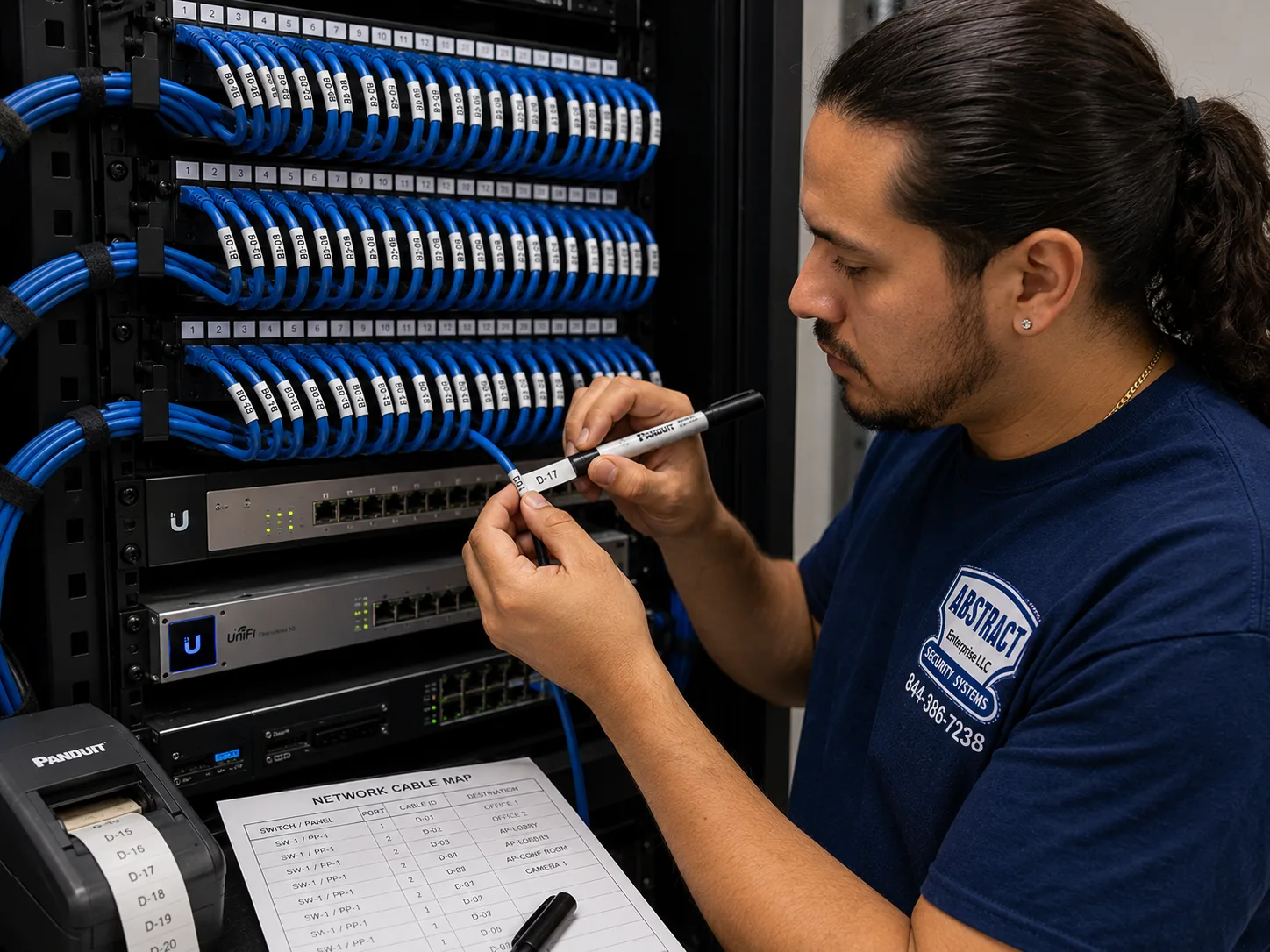
These are the ANNKE products and supporting parts we fit in New York homes, apartment buildings and businesses. Model names below come from real ANNKE listings; we confirm current specifications with the manufacturer and test every unit before installing it. If you already own the equipment, we install it at labor-only pricing as long as it passes the bench test.
The everyday camera for stoops, lobbies, landings and storefronts, such as the ANNKE C800 4K 8MP PoE turret listed on Slickdeals. One cable carries power and video, which suits long masonry runs.
Models such as the ANNKE FCD600, listed as a 6MP dual-lens panoramic turret with a 180-degree view, for wide shop floors, courtyards and rear yards that would otherwise need two cameras.
Longer-reach cameras, including ANNKE's dual-lens panoramic bullet listed at 6MP and 180 degrees, for driveways, parking areas and the long view down a side alley.
Network video recorders that keep footage on site, sized for the number of cameras and how many days of recording you want, with drives fitted and tested before handover.
ANNKE DVR kits where a building already has sound coax runs and the owner wants an upgrade without pulling new cable through solid walls.
Plug-in cameras for renters and interiors, set up on a 2.4 GHz network, which a third-party setup guide says ANNKE cameras require, and placed close enough to the router to hold a signal.
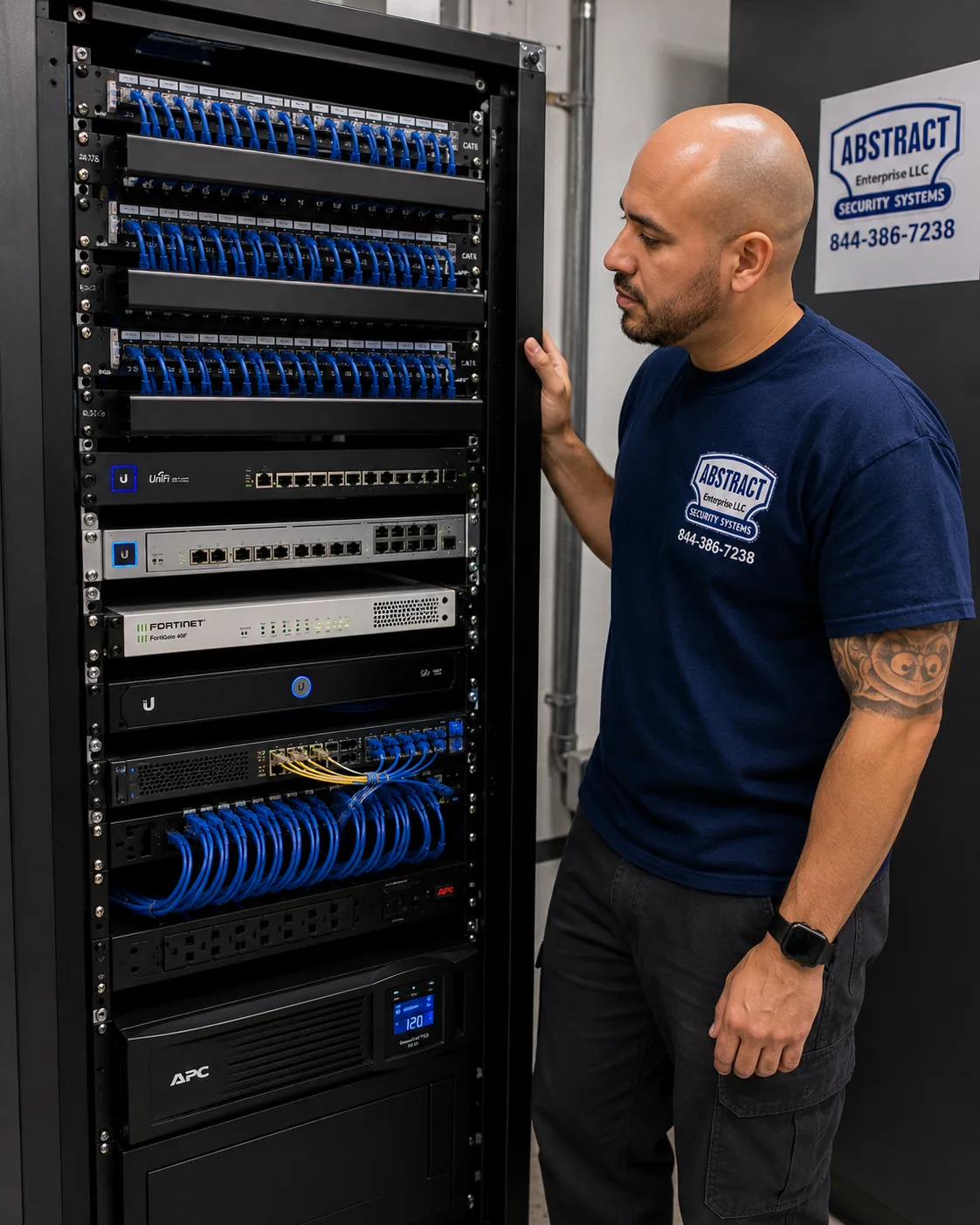
Managed or unmanaged switches that power cameras and shorten long runs, mounted in a rack or a locked closet on an upper floor of a walk-up or elevator building.
A battery backup unit for the recorder and switch so short power cuts do not stop recording or corrupt the drive, especially in older buildings with unsteady service.
A screen at a lobby desk, in a back office or in your hallway, connected directly to the recorder so live view and playback work without the internet.
People comparing options often set ANNKE against the big national names. ADT is best known for monitored alarm systems sold with a service plan. Ring and SimpliSafe are best known for doorbells, cameras and kits designed for homeowners to install themselves and use with the company's app and cloud plans. A wired ANNKE PoE system is a different idea: cameras cabled to a recorder in your own building, recording locally, viewable on a local monitor and on your phone if you choose. None of these is wrong for every New York property. A renter who cannot drill may be better served by a self-install camera inside the apartment. An owner of a brick walk-up who wants every landing covered and footage kept on site usually gets more from a wired system installed by a licensed technician who can get cable through the building. We will tell you which fits your property, even if the answer is not ANNKE.
| Question | Self-install brands (Ring, SimpliSafe) | Monitored alarm company (ADT) | Locally installed ANNKE PoE system |
|---|---|---|---|
| Who installs it | Usually the owner | The company's technicians | A licensed low-voltage installer |
| Where video is kept | Mostly the company's cloud, depending on plan | Depends on the package | On the recorder in your building |
| Works through brick | Wi-Fi models struggle through masonry | Depends on the equipment | Wired cable is not affected by walls |
| Best fit in NYC | Renters and small interiors | Owners who want alarm monitoring | Owners, landlords and businesses who want full coverage and local footage |


We could not capture Google's AI Overview or People Also Ask results for ANNKE installs in New York from our build environment, so we are not quoting them. Below are claims we see repeated in quick online answers about ANNKE and about camera installs in the city, set against the sources we found and our own field practice. Cost guides from marketplaces such as Angi, HomeAdvisor and Fixr feed many of those answers; they help with a rough national idea, but they cannot see a New York building's walls, rules or approvals.
Some quick answers state this as settled fact. The sources we found do not settle it. IPVM lists ANNKE in its directory of brands it says sell Hikvision-made hardware, based on shipping records, documentation or product testing.
The CCTVinfo NDAA database takes a narrower view, describing ANNKE as China-based, not on the FCC Covered List, with some shared lineage with Hikvision-style hardware in older models.
For a New York owner, the useful takeaway is not a slogan either way. Know the background, decide whether it matters for your property, and build the cabling so the cameras can be changed later without opening walls again.
This one causes needless worry. The June 2026 FCC public notice, effective July 16, 2026, as reported by Coram and ICTally, concerns the continued import and marketing of certain previously authorized covered equipment for public safety, government facilities and national security purposes.
The same summary says continued use of lawfully purchased equipment is not affected. A family's ANNKE system on a Queens driveway, or a deli's cameras on a Bronx corner, can keep recording.
Where it does change our advice is for properties tied to government or public-safety uses, and for anyone planning a large expansion, where future supply of the same models is worth thinking about before buying more.
Wireless sounds simpler, but New York masonry disagrees. Brick party walls, stone foundations and several floors between the router and the rear yard can starve a camera of signal.
A third-party setup guide also notes that ANNKE cameras support only 2.4 GHz Wi-Fi, not 5 GHz, which matters in apartment buildings where dozens of neighbors' networks crowd the 2.4 GHz band.
Wi-Fi cameras have a real place inside apartments and close to the router. For the stoop, the garden door and the yard of a rowhouse, wired PoE is the version that keeps working in February.
Kits are designed for a typical suburban house. One install guide notes ANNKE kits include 60-foot PoE cables and that some locations need longer runs.
In a narrow New York building, the run from a cellar recorder up through a closet, along a joist and out to the rear fence can use most of that length before it reaches the camera, while the stoop camera may need only a few feet.
We measure every run on the walk-through, use the kit's cables where they fit, and replace them with bulk cable, terminated and tested, where they do not. A pre-made plug also needs a much bigger hole through masonry than bare cable, which matters on old brick.
On an ordinary block, an owner has wide latitude. On one of the city's 1,464 individual landmarks or inside its 157 historic districts and extensions, the facade comes with rules.
The LPC's 2018 rules amendments would prohibit many security cameras on a primary facade unless there is no feasible alternative, and the Permit Guidebook's Chapter 11 sets the criteria staff use. LPC records show real approvals, such as nine ground-floor cameras reviewed under Section 2-20(c)(4).
We check every address against landmark status before designing the exterior layout, start with rear and side elevations, and use the permit route the rules provide where a front camera is truly needed.
Both extremes appear online. The city code changed on December 21, 2025: Administrative Code §28-105.4.7, under Local Law 128 of 2024, says no electrical permit is required for wiring below 50 volts for signaling, communication, alarm and data circuits when performed by a licensed master electrician, a special electrician or a qualified person.
The state side is separate. The New York low-voltage roadmap lists CCTV work among the systems that require an Article 6-D license, and one trade blog still describes DOB permits for low-voltage work, which shows how confused the topic is.
We work under NYS license #12000287431, and on unusual commercial jobs we check the current code for that specific work rather than relying on any blog, including our own.
Many answers assume a camera mandate exists. Seneca Security's compliance guide says there is no general NYC law mandating cameras in apartment buildings.
That means a landlord's or board's camera system is a choice, and so is its design. It also means the privacy rules matter more than any mandate: covert recording inside a unit can support a charge under Penal Law 250.45, and tenants can raise building surveillance complaints with HPD or 311.
When we design common-area ANNKE systems, we cover entrances, lobbies, mail areas, landings and yards, keep cameras out of private spaces, and leave the owner with a clear record of where every camera points.
Send the address, a few photos of where you want cameras and the inside of your cellar or utility closet, and a technician will tell you whether wired PoE is realistic, whether the ANNKE kit you bought will cover the runs, and whether a board or the LPC needs to see the plan first. Call (800) 486-0943, message us on WhatsApp, or use the quick form.
Every ANNKE job in the city follows the same eight steps, whether it is two Wi-Fi cameras in a rented one-bedroom or thirty PoE cameras across a co-op's lobby, garage and landings. The order matters most in old buildings, where a cable run planned too quickly becomes a cracked ceiling or a wire in the wrong apartment.
Borough and street, the kind of building, how many cameras and where, and whether you already own an ANNKE kit, recorder or older DVR. Photos of the cellar or closet help.
Who owns the walls and the facade, landmark status, board paperwork, landlord approval, and whether any hallway or common area is involved.
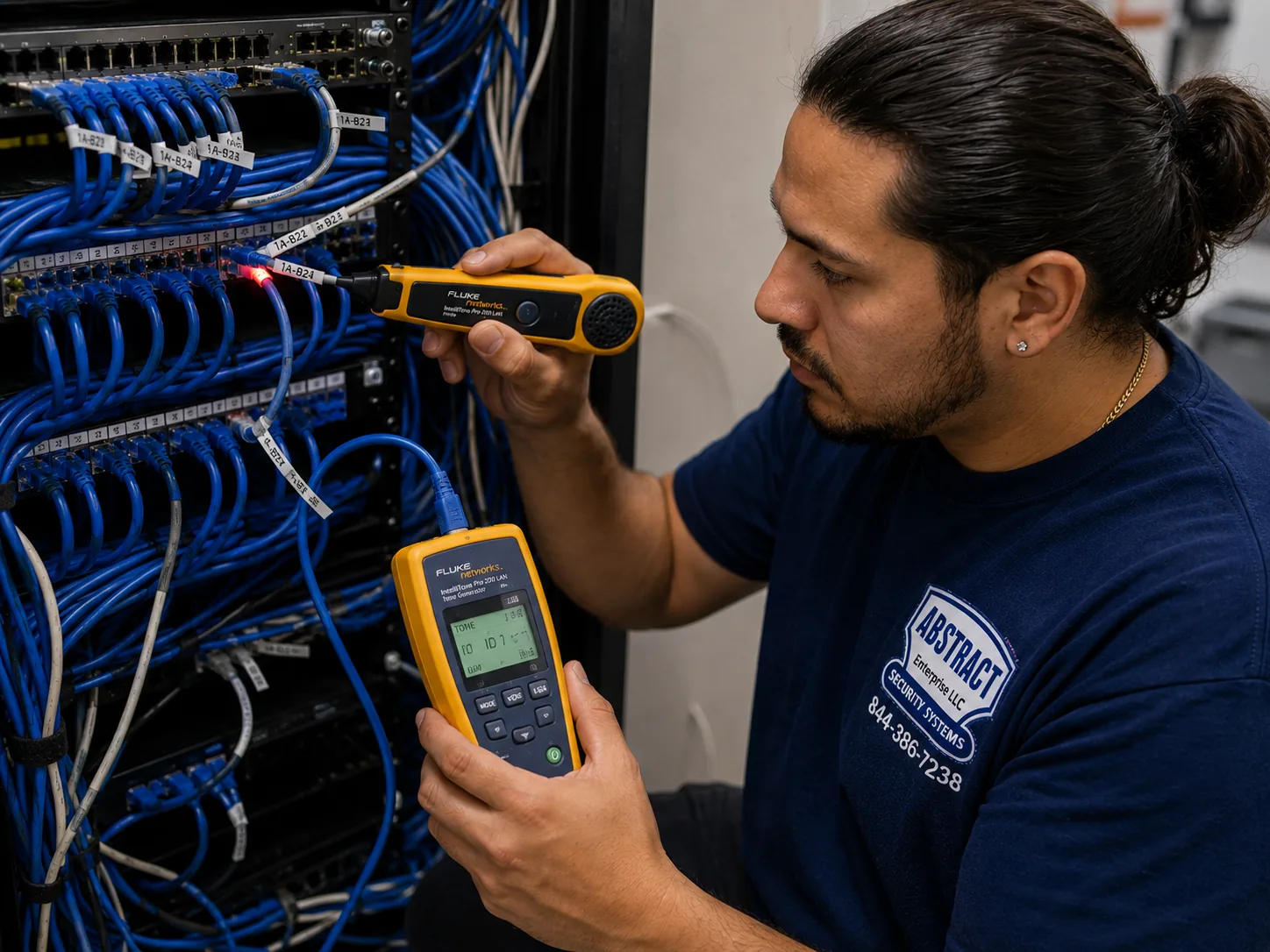
Every camera, the recorder and the drive powered up and checked, with model numbers and firmware recorded, before anything is mounted.
A walk through the building to find chases, closets, ceilings and basements, every run measured, and a cool, secure place chosen for the recorder.
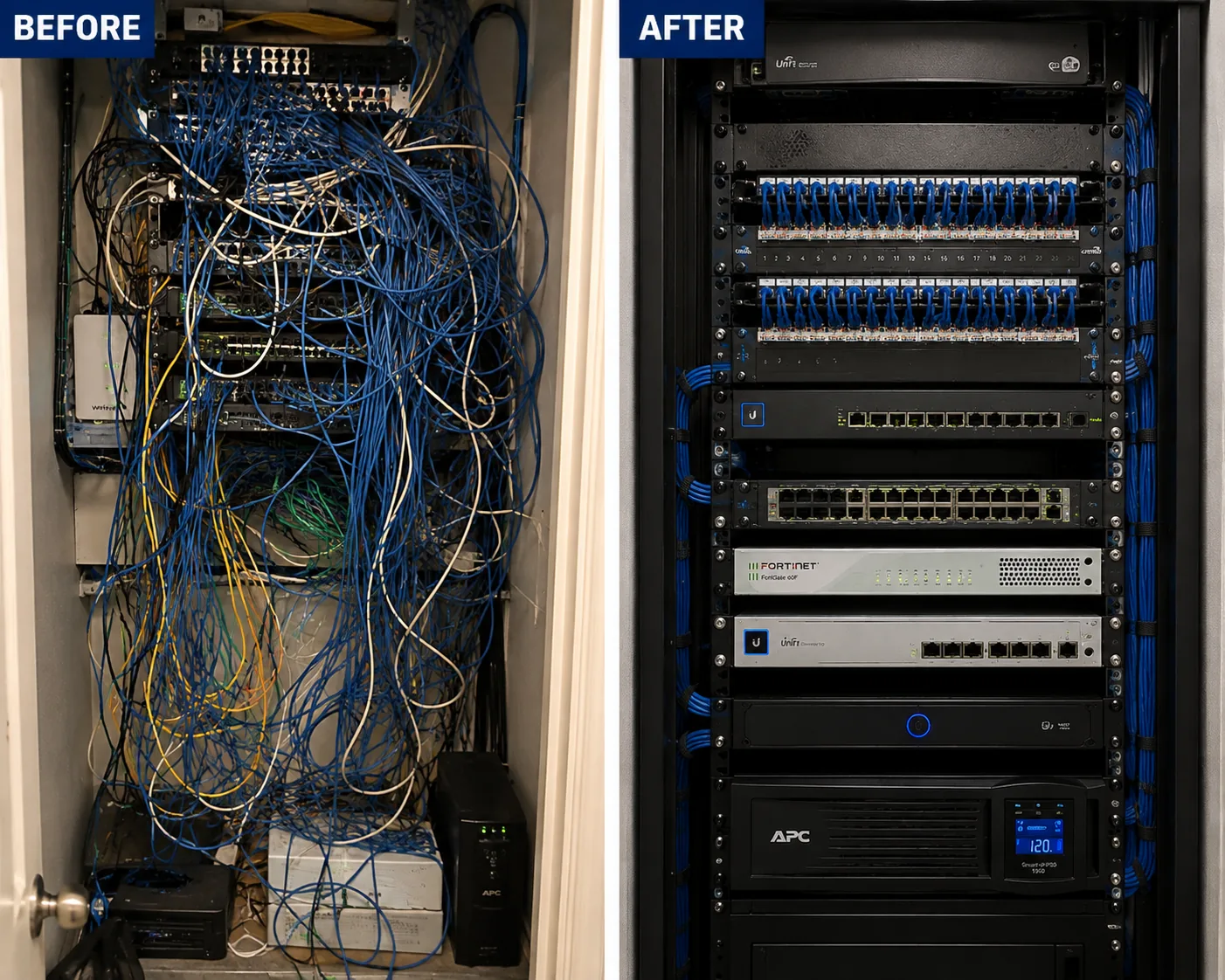
Cable pulled through the agreed paths, sleeved and sealed through masonry, terminated, labelled at both ends and tested before any camera goes up.
Fixed more than two meters up where the layout allows, sealed outdoors, and aimed with you watching the live picture on a screen.
Schedules, motion zones, time and date, strong passwords, fixed network addresses, phone viewing and a local monitor that works without the internet.
Playback and export shown to you, the app set up on your phone, a labelled cable map and the recorder login left with the owner, and the site cleaned up.
It is tempting to mount first and test later, and on a suburban house with a short ladder it might not matter. In New York, the camera might be on a third-story cornice, over a storefront canopy on a busy sidewalk, or above a stair landing that tenants use all day. Finding a dead camera after it is mounted means another ladder setup, another hour of a blocked stair hall and, sometimes, another visit. So every ANNKE unit is powered and checked on the bench, every cable is certified before it is connected, and only proven parts go up.
Network cameras need an address on your network. Left to themselves, they take whatever address the router hands out, and after a power cut or a router replacement those addresses can change, which can leave a recorder looking for cameras that have moved. Setting fixed addresses during configuration, and writing them on the handover sheet, prevents a whole class of "cameras offline" calls after the next storm or the next internet provider switch.

A citywide service is easiest to describe by the places that shape the work. These six come from the sources behind this page; each one stands for a type of building we plan ANNKE systems around.
The city's first historic district, designated November 23, 1965, per the New York Preservation Archive Project. A reminder that brownstone facades here come with LPC rules for cameras.
Designated in 1969 and described by Village Preservation as the largest historic district by number of buildings, with nearly 2,200, from rowhouses to walk-ups.
At 7 East 7th Street, where LPC presentation materials from December 2025 showed pole-mounted cameras attached under the water table on a brownstone facade.
A Mitchell-Lama development of 15,372 units in 35 high-rises and seven townhouse clusters, per the development's own history, the kind of scale where camera work is a board decision.
Home to garden apartments dating from 1917, according to the Jackson Heights Beautification Group, with courtyards and entrances that shape common-area camera plans.
The ferry neighborhood, with apartment buildings near the terminal, on the borough with the city's newest median housing stock, built around 1970.
We cover all five boroughs from our Brooklyn dispatch, with borough pricing on the Brooklyn ANNKE price page, the Manhattan ANNKE price page, the Queens ANNKE price page, the Bronx ANNKE price page and the Staten Island ANNKE price page. Beyond the city line, we also serve Nassau County, Suffolk County, Westchester County and Rockland County, with the full regions on the Long Island ANNKE price page and the Hudson Valley ANNKE price page.
We do not publish one ANNKE price for the whole city, because labor, parking and access differ by borough, and a camera on a Staten Island house is not the same job as a camera on a Manhattan walk-up. Instead, each borough has its own ANNKE price page with a calculator, where you choose the number of cameras, the camera types and the recorder and see the installed price for that area. Start at the NYC ANNKE camera installation prices page, then pick your borough. After the walk-through, we confirm the quote in writing before any work begins, and nothing is added on the day unless you ask for it.
| Factor | Why it matters in New York | How to keep it down |
|---|---|---|
| Number of cameras | Each camera is a cable run, a mount and a channel on the recorder | Cover entrances and approaches first; add more later on spare cable |
| Length and path of each run | Runs through solid brick, stair halls and multiple floors take longer than attic drops | Choose a central recorder spot; tell us about chases and closets |
| Wall and facade material | Brick, stone and old plaster need different drilling and anchors from wood siding | Send photos so we price the real surface |
| Who supplies the hardware | Customer-supplied ANNKE kits are installed at labor-only pricing after a bench test | Buy the kit only after we confirm it fits the runs |
| Conduit and commercial cable | Commercial spaces may need EMT conduit, plenum-rated cable and fire-stopping | Ask your landlord early what the building requires |
| Approvals and access | Boards, landlords and LPC reviews add time; walk-ups add carrying | Start the paperwork as soon as you book |
Many owners want a TV or monitor on the wall that shows the cameras, in a lobby, a back office or a hallway. That work is priced on our TV installation list, and the list we were given for this page uses the Bronx rate; other boroughs follow their own TV price lists. At the Bronx rate, a TV wall mount on drywall over wood studs for a screen up to 55 inches starts at $209.99, with the bracket sold separately. A plaster wall adds $45 and a brick or stone wall adds $65. Hiding the cables in the wall with a code-compliant in-wall power and cable kit is $169, and a paintable cord cover is $59 where the wall should stay closed. Taking down an old TV is $85, and a TV placed on its stand with no wall mount is $137.99. A setup-only visit is $225 for the first hour, then 30-minute blocks. We will tell you which lines apply when we see the wall.
Booking, deposit and payment terms are set out in your written quote and service agreement before work begins. The warranty on AESS-supplied products is below.
Full terms — including 50% deposit, one-year parts-only warranty on AESS-supplied products, and the late-fee schedule — are set out in the service agreement.Customer-supplied ANNKE hardware is installed and tested, but it is covered by the seller's or manufacturer's warranty, not ours, which is one more reason we bench-test it before mounting.
Three common New York ANNKE jobs, described by what they cover. The installed price for each comes from the calculator on your borough's ANNKE price page, so the number matches your address; the viewing-screen lines are from our TV price list at the Bronx rate.
Two to four cameras: Wi-Fi models inside a rented apartment, or PoE cameras on the front door and rear of a house, recording to a compact ANNKE NVR with phone viewing. Priced on your borough's ANNKE price page.
Stoop, garden door, rear yard and roof for a rowhouse, or entrance, vestibule and landings for a walk-up, wired PoE throughout, recorder in the cellar with battery backup, every run labelled and certified.
Common-area or storefront coverage with panoramic cameras where they save a camera, a PoE switch in a rack, conduit where needed, and a viewing screen at the desk, such as a wall mount from $209.99 plus a $169 in-wall kit at the Bronx rate.
If you already bought an ANNKE kit, cameras or a recorder, we install them at labor-only pricing, as long as every unit passes the bench test and the recorder has the channels and the drive space for what you want. If a kit's pre-made cables are too short for your building's runs, we tell you before the job, and you can choose bulk cable from us or a different camera position. If a camera fails the bench test, we stop and let you return it to the seller rather than mounting a faulty unit. Buying the cameras yourself and paying us only for labor is a perfectly good way to do it; the only thing we ask is that you check with us before buying, so the kit suits the building.
The citywide starting point, with links to every borough's calculator. ANNKE camera installation prices in NYC
Brownstones, rowhouses, walk-ups and storefronts at the Brooklyn rate. ANNKE camera prices in Brooklyn
Prewar walk-ups, elevator buildings, co-ops and offices at the Manhattan rate. ANNKE camera prices in Manhattan
Houses, garden apartments and shopping streets at the Queens rate. ANNKE camera prices in Queens
Apartment buildings, co-ops, houses and businesses at the Bronx rate. ANNKE camera prices in the Bronx
Houses, driveways, yards and storefronts at the Staten Island rate. ANNKE camera prices on Staten Island
Nassau and Suffolk homes and businesses. ANNKE camera prices on Long Island
Westchester, Rockland, Orange, Putnam, Dutchess and Ulster. ANNKE camera prices in the Hudson Valley
Send the address and photos and we will match it to your borough's list. Request a free quote
Yes, on site. The ANNKE Help Center says you can view the stream without the internet when the NVR or DVR is connected to a monitor or TV. Recording to the recorder's drive also continues without the internet. What stops is viewing on your phone from outside the building, which returns when the connection does. We connect a local monitor on every system for this reason.
We have not found a reliable source that answers that, and we will not guess. The question was raised on the IPCamTalk forum without a confirmed answer. What we can do is set your system up so it does not depend on any cloud: recording stays on your recorder, a local monitor shows the cameras, and remote viewing is optional, with strong unique passwords if you use it.
Buyers ask this on Slickdeals, and the fair answer has two parts. The cameras are widely sold and many owners use them for years, but the brand's background is debated, with IPVM listing it as selling Hikvision-made hardware and another database saying it is not on the FCC Covered List. We bench-test every unit before mounting and wire systems so another brand's camera can replace one later if needed.
Sometimes, but we never promise it in advance. Mixed-brand setups can pass basic video through common network-camera standards, while features such as smart detection often work only on a matching recorder. We connect your Lorex recorder and the ANNKE camera on the bench, check live view, recording and playback, and tell you what works before anything is mounted.
Physically yes, but in an apartment building the outside of your door faces a hallway, which sources describe as a common area that typically needs building approval in a co-op or condo. A video doorbell raises the same approval question. If the building agrees in writing, we mount a small camera on the door frame with a neat cable path; if not, an indoor camera watching your entry from inside is the usual answer.
Security-company sources we found raise this question but disagree on a city notice rule, and we could not confirm one from an official source, so check with your attorney. Practically, visible cameras and clear signs at entrances avoid disputes, and cameras should cover shared spaces, never inside units. Tenants can raise building surveillance complaints with HPD or 311, so a clear, documented layout protects the owner.
Generally yes, on your own property and aimed at your own entries, yard and driveway. Two limits matter most here: in a historic district or on a landmark, LPC rules can restrict cameras on a primary facade, and covert recording of private spaces can be a crime under Penal Law 250.45. We aim cameras at your property rather than into neighbors' windows. This is not legal advice.
Usually far less than a full install, because the recorder, network and app are already set up. The time goes into the new cable run, which depends on the path through the building, and the mount. We check that the recorder has a free channel and enough drive space, then label the new cable to match the existing ones and add it to your cable map.
A third-party setup guide states that ANNKE cameras support only 2.4 GHz Wi-Fi bands, not 5 GHz. Many New York routers broadcast both under one name, which can confuse setup. We make sure a 2.4 GHz network is available to the camera, place the camera where that signal is strong, and recommend wired PoE where brick walls make the signal unreliable.
NYC 311 describes a safety initiative that lets any business with a security camera share live video feeds with the NYPD during emergencies, with registration at NewYorkCityConnect.org. Joining is the business's decision. If you choose to, we can make sure the recorder and network are configured properly and that the cameras cover the frontage you want to share.
It depends on which ANNKE system you choose. ANNKE sells DVR kits, which work over coax, and we can reuse sound coax runs with a DVR kit. Its PoE network cameras need Ethernet cable instead, so a PoE upgrade means pulling new cable. We test the old coax first; if it is damaged or the runs are poorly routed, new Ethernet is usually the better long-term choice.
The ANNKE Help Center recommends an installation height of more than 2 meters, about six and a half feet. That keeps cameras out of easy reach on a busy sidewalk or a stoop. We balance height against angle, because a camera mounted too high sees only the tops of heads, and we confirm each view on screen with you before tightening the mount.
Tenant-rights sources note that complaints about building security and surveillance can be made through HPD or 311. A tenant can also raise concerns directly with the landlord or managing agent first. For a legal dispute about a specific camera, a tenant attorney or legal aid organization is the right place to go.
Tell us the borough and street, the building type, how many cameras and where, and whether you already own the ANNKE hardware. Photos of the outside and of your cellar or closet make the quote exact. Prefer to talk? Call (800) 486-0943.
From a landmarked rowhouse in Brooklyn Heights to a Bronx walk-up, a Queens house or a storefront on Forest Avenue, an ANNKE job starts the same way: the address, a few photos, an honest look at who has to approve the work, and a bench test before anything is drilled. Call (800) 486-0943, message us on WhatsApp, or send the quote form, and we will book your visit within 2 hours and tell you exactly what your building needs. Prices for your borough are on the NYC ANNKE price page, or head back to our home page for every other service.
ANNKE Camera Installation by neighborhood: NYC hub, NYC annke camera installation
ANNKE Camera Installation by neighborhood: Long Island hub, Long Island annke camera installation
ANNKE Camera Installation by neighborhood: Hudson Valley hub, Hudson Valley annke camera installation