ANNKE kit still boxed in a Dutchess farmhouse, or an older ANNKE recorder in a Kingston shop that stopped showing cameras after a storm? Book a Hudson Valley ANNKE install or check: (800) 486-0943
Recording That Works With the Internet Down · Cable Tested and Labelled End to End · County Price Pages, No Guesswork
ANNKE camera installation in the Hudson Valley is a different job from the same kit in a city apartment. The region runs from the Yonkers line up past Kingston, and across Westchester, Rockland, Orange, Putnam, Dutchess and Ulster the buildings change from office parks and lot-line houses to stone Dutch houses, barns, river-town row houses and distribution warehouses. ANNKE sells affordable PoE and analog-HD kits that many owners buy online; what decides whether they work for years is the wiring, the recorder, the power plan and the settings. We install new ANNKE systems, finish kits you already bought, and test older ones before anything is reused, under NYS license #12000287431.
Reviewed and updated November 5, 2026 by Anwar Timothy, NYS license #12000287431 · Sources: ANNKE's help center (installation guidance for DVR kits and viewing without internet), IPVM's Hikvision OEM directory as summarized by Coram, the June 2026 FCC public notice (DA 26-635) as reported by Coram and iCtally, the CCTVinfo NDAA database, IPCamTalk, Slickdeals and Trustpilot owner comments, the NYS Department of State, Hudson Valley One (September 2, 2026), WPDH, Hudson Valley Post, Times Union, Daily Voice, Central Hudson, Orange & Rockland, NYSEG, Earth Networks' 2020 New York lightning report, USDA 2022 Census of Agriculture county profiles, NYS DEC, the City of Kingston HLPC, the City of Newburgh code and East End design guidelines, the county codes of Westchester, Rockland, Orange, Putnam and Ulster, the Town of Fishkill, Ulster County's ConnectALL announcement, Westfair, REBusiness, HGAR, Hoodline, Think Dutchess, Wikipedia and the Hudson River Valley National Heritage Area · Dispatched from 460 E Fordham Rd
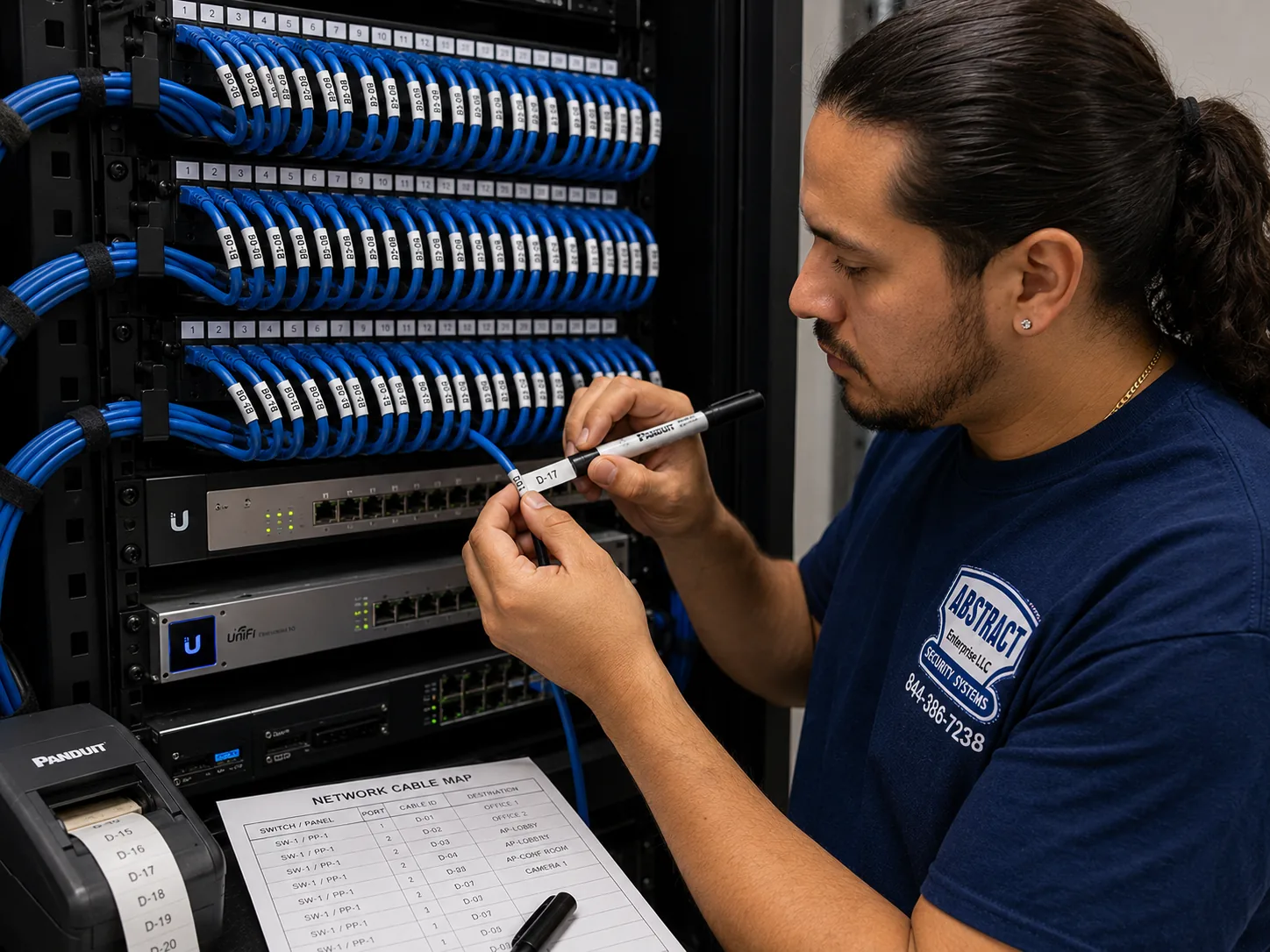
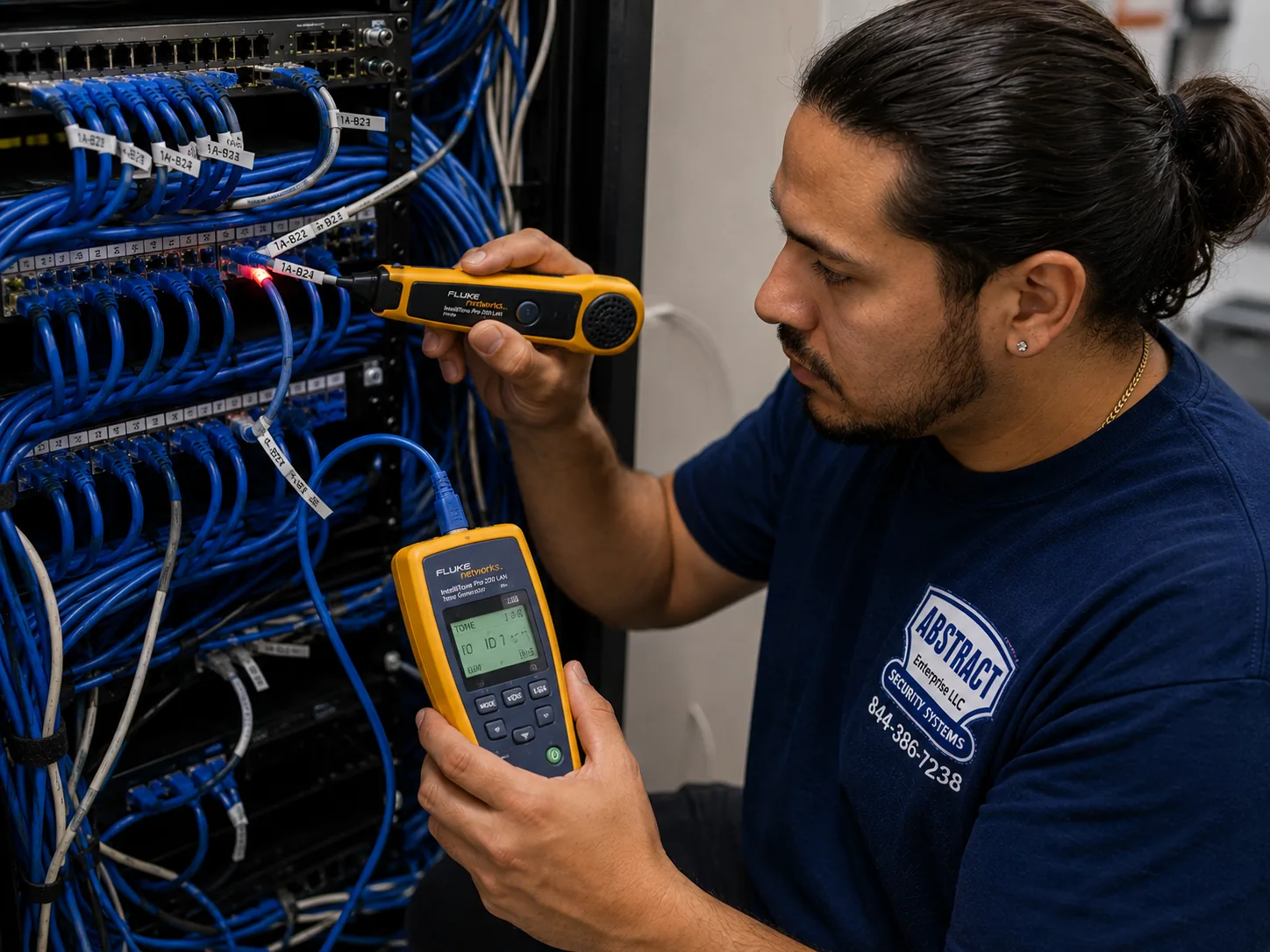
Photo from the AESS job library, not taken in the Hudson Valley: a technician printing cable labels at a patch panel, with a printed port map beside the work. On a Hudson Valley property where camera cables come back from a house, a barn and a gate, that printed map is what lets anyone find the right cable years later without pulling the whole system apart.
Hudson Valley ANNKE Cameras
Tell us the county, the property and whether you already own an ANNKE kit
✅
Request Sent!
We'll call about your Hudson Valley ANNKE cameras the same business day.
25+
Years Experience
✓
Same-Day Estimates
100%
Licensed & Insured
4.7★
201 Google Reviews
Owner-operated since 2002 · Thousands of jobs completed · Booked within 2 hours
Quick answer: an ANNKE camera installation anywhere in the Hudson Valley is priced at the rate for the county the property sits in, and each county's full ANNKE price list is on its own price page. The installed system includes the cameras, the cable run back to an ANNKE recorder, a PoE switch where needed, recording set up to work even when the internet is down, and the ANNKE app on your phone. Requests are booked within 2 hours. Send the county, a few photos and any ANNKE model numbers you already own, and we will tell you what applies before you commit. Call (800) 486-0943 or see the Hudson Valley ANNKE camera installation prices.
County-rate pricing: Westchester, Rockland, Orange, Putnam, Dutchess and Ulster each have their own ANNKE price page, because travel and time on a rural job are not the same as on a suburban one
Local recording first: ANNKE's own help center says you can view the stream without the internet when the recorder is connected to a monitor or TV, so we set every system up to record and display locally before we add remote viewing
Low-voltage camera work under NYS license #12000287431; any new line-voltage outlet is done by an electrician licensed for that county or town, and the written quote says who does what
Why Hudson Valley Properties Need ANNKE Camera Installation
The Hudson Valley is not one neighborhood, and that is the first thing an ANNKE installation here has to respect. The Maurice D. Hinchey Hudson River Valley National Heritage Area, established in 1996, stretches roughly 135 miles from Troy down to Yonkers and contains 107 sites. Our service area is the southern part of it: the six counties the Heritage Area splits into a Lower Hudson Valley, Westchester and Rockland, and a Middle Hudson Valley, Putnam, Orange, Dutchess and Ulster. European exploration of the river began with Henry Hudson's 1609 voyage from the Netherlands, the Dutch settled it first and the English after them, and after the Erie Canal opened in 1825 the Hudson became one of the nation's main arteries of trade. The National Park Service notes that America's wealthy built great estates here in the late nineteenth and early twentieth centuries, and many still stand. All of that history is still in the buildings, and every era asks something different of a camera cable.
ANNKE is a brand many Hudson Valley owners meet the same way: a kit on sale online, four or eight cameras and a recorder in one box, priced well below a lot of installed systems. The equipment itself has a reasonable reputation among enthusiasts. One owner on Slickdeals summed up the common view as "The NVR hardware is OK, the software sucks, but it is still better than most cheap cameras." A Trustpilot reviewer said ANNKE is good, "but having a bit of technical knowledge will help if you run into difficulties." Another advised buyers to think about "the warranty support and lack of local assistance before purchasing." That last point is the gap a local installer fills. The box does not include anyone who will walk out to the barn with you, work out how far a cable can run, or come back when the recorder stops showing a camera after a storm.
The distances are the second reason. A camera system in a Yonkers-edge apartment building is a matter of floors and hallways. A camera system on a Dutchess or Ulster property is often a matter of hundreds of feet between a house, a detached garage, a barn and a gate at the road. The USDA's 2022 Census of Agriculture counted 620 farms covering 99,652 acres in Dutchess County, averaging 161 acres each, and 486 farms covering 73,026 acres in Ulster, averaging 150 acres. Even on a property a fraction of that size, a single network cable has a practical limit of 328 feet, and the 60-foot PoE cables that come in ANNKE kits are a starting point, not a plan. Getting a camera onto an outbuilding means choosing between a long copper run, a buried conduit, a fiber link or a wireless bridge, and each choice changes the price and how the system behaves in bad weather.
Weather is the third. ANNKE's installation guidance lists an operating temperature range of minus 40°C to 60°C, which covers a Catskills January, but cold is not the only test. Earth Networks' 2020 lightning report for New York put Orange County first in the state with 275,059 lightning pulses over 41 thunder days, with Ulster at 182,760, Westchester at 168,634 and Dutchess at 166,641. Power is the other weakness. During Tropical Storm Isaias in August 2020, Daily Voice reported that NYSEG had 34,150 of its 38,693 Putnam customers out at one point; the Times Union reported thunderstorm outages affecting a combined 60,000 Orange & Rockland and Central Hudson customers on June 27, 2024; and Central Hudson said in September 2026 that its crews were restoring power to more than 19,000 homes and businesses after a slow-moving nor'easter. A camera system that comes back by itself after the power returns, and keeps recording on a battery backup while it is out, is worth more up here than a higher resolution number on a box.
Then there is the question of where video goes. Local news in 2026 has been full of it. Hudson Valley One reported on September 2, 2026 that Kingston police presented a map of the city's surveillance cameras, heavily concentrated in Midtown and Uptown, as residents raised privacy concerns. WPDH reported that Dutchess County had already stopped using its Flock Safety license plate readers after a September 23 public forum in Pleasant Valley. Hudson Valley Post reported that Putnam County stores its plate-reader data on a government-owned server controlled by local law enforcement. None of those stories is about home cameras, but they show how many Hudson Valley residents care about who holds the footage. An ANNKE system recording to a hard drive in your own recorder, with no subscription required to keep it, answers that question in a way a cloud-only camera cannot. We set it up so the footage stays on your property unless you choose otherwise.
And there is the reason people buy cameras in the first place. In January 2025 the New York State Police issued a public safety alert about targeted residential burglaries in Dutchess, Westchester and Putnam counties, and among their tips was to install or activate security systems and cameras, alongside motion-sensor lighting. In October 2024, police in Scarsdale confirmed that burglars had hidden camouflaged cameras in bushes outside homes to watch them. Years earlier, state police in Poughkeepsie were asking residents with surveillance cameras to check their footage after a run of car break-ins. A camera system only helps in any of those situations if it was actually recording, pointed at the right place, and clear enough at night to show something useful. That is an installation question, not a shopping one.
We also want to say plainly what the research could not find. We searched for Reddit threads, local news and community posts about ANNKE installations specifically in the Hudson Valley and found none. We found no list of local businesses or blocks that use ANNKE, and we do not claim any business or property on this page as a customer. Where this page describes how ANNKE equipment behaves, it draws on ANNKE's own help center, on owner reports in forums and reviews, and on how the same equipment behaves in our wider work; where it describes the region, it draws on the public sources named in the stamp above.
Hudson Valley facts that shape an ANNKE install
Six counties, two halves: the Heritage Area groups Westchester and Rockland as the Lower Hudson Valley and Putnam, Orange, Dutchess and Ulster as the Middle Hudson Valley; our ANNKE price pages follow those six counties.
Big parcels: 620 Dutchess farms average 161 acres and 486 Ulster farms average 150 acres in the 2022 agriculture census, which is why distance planning comes before camera choice on many jobs.
Storm country: Orange County led New York in lightning pulses in Earth Networks' 2020 report, and Ulster, Westchester and Dutchess each recorded more than 160,000.
Four electric utilities: Con Edison across much of Westchester, NYSEG in parts of northern Westchester and Putnam, Orange & Rockland in Orange and Rockland, and Central Hudson from the northern suburbs of New York City up toward the Capital District, so outage patterns differ by town.
Historic districts with their own review: Kingston's historic districts and Newburgh's East End, whose 2,239 resources are the most of any federally recognized district in the state, both review exterior changes.
Rural internet still catching up: Ulster County announced a ConnectALL grant in September 2025 to bring fiber to nearly 1,300 unserved homes, businesses and facilities, which tells you how many properties still have slow or no internet for remote viewing.
What owners often add once the cameras are in. On Hudson Valley properties the next request after cameras is usually about the gate and the outbuildings: a camera at the end of the drive, a link to a detached garage, or a way to see the barn door from the house. Those additions are far cheaper to plan into the first visit than to add later, because the cable route and the recorder's spare channels are decided on day one. Tell us about every building you might want covered when you book, even if you only want two cameras now.
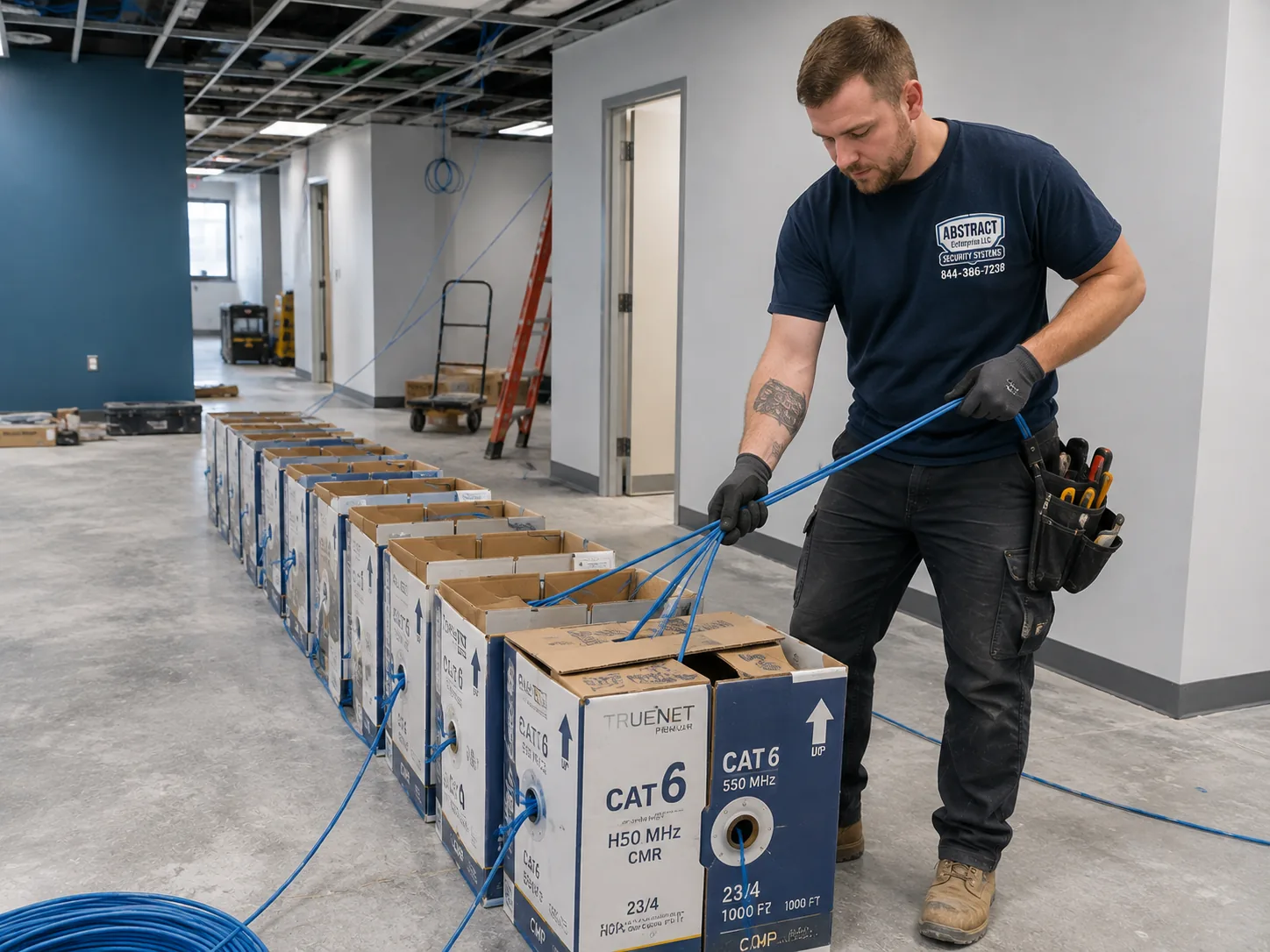
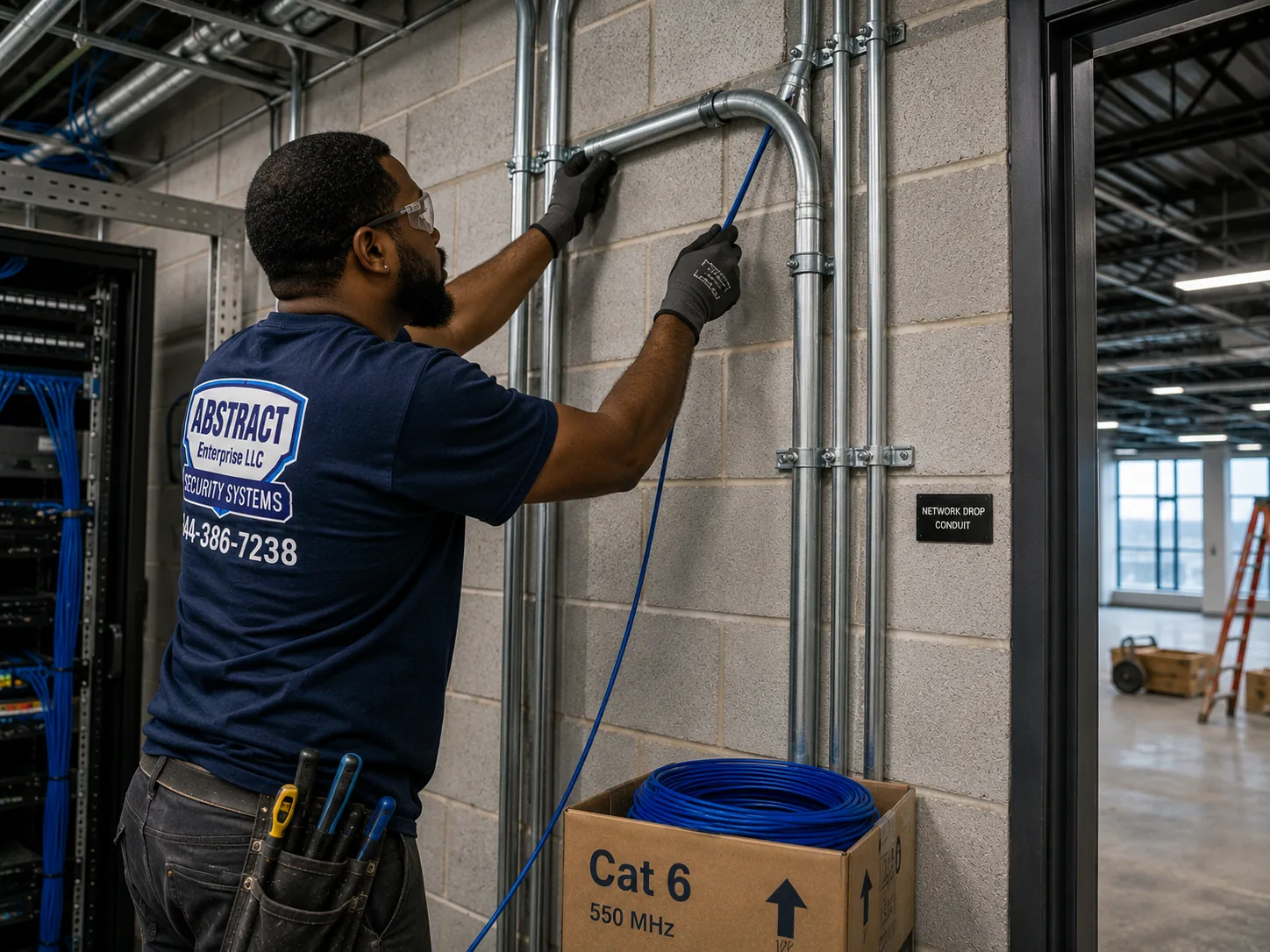
Photo from the AESS job library, not taken in the Hudson Valley: boxes of network cable staged for a multi-drop pull inside a working commercial space. A Hudson Valley property with cameras on a house, a garage and a barn needs the same kind of staging, with each box assigned to one run so no camera ends up on a cable that falls a few feet short.
ANNKE Recorder Showing "No Video" After a Storm? Fast Help Across the Hudson Valley
When an ANNKE recorder comes back from a power cut with blank tiles, a camera on a barn goes dark after a thunderstorm, or the app suddenly says the device is offline, the first job is to find out whether the problem is the power, the cable, the camera or the network. Do not reset the recorder to factory settings; that can wipe the camera list and the recording schedule. Check that the recorder and any PoE switch have power, note which cameras are missing, and take a photo of the screen. Then call (800) 486-0943 and tell us the county, the ANNKE model numbers if you can see them, and what happened just before it stopped. On a property two hours from the city, a good description on the phone often tells us which parts to bring.
Westchester to Ulster: How the Same ANNKE Kit Becomes a Different Job in Each County
An eight-camera ANNKE PoE kit is the same box whether it is delivered to White Plains or to Stone Ridge. What changes is everything around it: the building it goes on, the distance to the farthest camera, the utility that keeps the recorder powered, the licensing rules for any electrical work, and whether a historic commission will look at the facade. The table below is the overview we start from. The county notes underneath explain what we look for first in each one. Each county has its own ANNKE price page, linked in the table.
County
Typical ANNKE job
What we check first
Price page
Westchester
Suburban houses close to neighbors, office parks along the I-287 corridor, river villages
Camera angles that stay on your own property; Westchester's county trade license for electricians if a new outlet is needed
Westchester: close neighbors and corporate corridors
Westchester is the most suburban of the six counties and the closest to the city, and its ANNKE jobs look it. Houses sit closer together than they do upstate, so the first question on a residential job is where each camera's view ends. A panoramic ANNKE camera with a 180-degree view is excellent for a driveway, but on a narrow lot it can also take in the neighbor's side door, which is the kind of thing that starts arguments. We aim cameras at your entrances, your driveway and your yard, and use privacy masking in the recorder where a view has to cross a neighbor's ground. On the business side, the Platinum Mile on Westchester Avenue in White Plains, the Regeneron campus in Tarrytown and the medical campus in Valhalla show how much of the county's commercial property is office and campus space, where cameras tie into an existing network and an IT department has to agree to every port. Westchester also requires plumbers and electricians to hold a county trade license to work in the county, which matters if a camera position needs a new outlet.
Rockland: compact houses and busy corridors
Rockland is small in area and dense along its main roads. The commercial strips we work along most, Route 59, Route 304, Route 202 and the area around the Palisades Center in West Nyack, are full of shops and restaurants where an ANNKE system has to watch a register, a door and a parking area at once. Hoodline reported in February 2026 that a Black Diamond affiliate took over the Palisades Center, at roughly 2.36 million square feet, at a foreclosure auction, so tenants around it may be changing their own security as ownership settles. In houses, Rockland's challenge is usually space: finding a dry, ventilated spot for the recorder and switch that is not a closet full of coats. On the licensing side, Rockland's Chapter 250 defines an electrical contractor as doing wiring for light, heat, power or signaling at 50 volts or more; ANNKE PoE cameras run well below that, but a new outlet for the recorder does not.
Orange: warehouses, river cities and lightning
Orange County is where the scale jumps. HGAR reported in 2020 on two of the largest commercial projects in the county's history, both in the Town of Montgomery: an Amazon distribution center of 1,015,740 square feet at Route 17K and Route 747 on about 187 acres, and a Medline facility of 1.2 million square feet. An advocacy-group compilation published in November 2024 listed about 15 million square feet of major warehouse projects across the county. Stewart International Airport covers 1,552 acres in the towns of Newburgh and New Windsor. Big buildings like those usually have enterprise camera systems chosen by the owner, but the trucking yards, suppliers and small businesses around them often run kits like ANNKE's, and those cameras sit on poles and fences across open lots in the county with the most lightning in the state. Long copper runs between buildings are where surges do damage, so on Orange jobs we plan fiber or surge protection on every run that leaves a building. Inside the City of Newburgh, the question flips to historic facades.
Putnam: woods, lakes and long outages
Putnam is wooded and hilly, with many houses set back from the road and a good number of second homes. The Isaias numbers above are the reason we plan Putnam systems around power first: an ANNKE recorder and PoE switch on a battery backup, a router that comes back by itself, and cameras that rejoin without anyone touching them. Leaves are the other Putnam issue. A camera that looks clear down a drive in March may stare into foliage by June, and wireless bridges between buildings can lose their line of sight when the trees leaf out. Putnam's Chapter 145 sets up a low-voltage and limited-data communications technician license covering cabling, including video surveillance, at 90 volts or less from an outlet installed by a licensed electrician, so the county takes this kind of work seriously; we tell Putnam customers exactly how that applies to their job before we start.
Dutchess: farms, estates and campuses
Dutchess combines the most agricultural land in our area with some of its best-known institutions. The 620 farms in the 2022 census sit alongside estates such as the Vanderbilt Mansion in Hyde Park, now 211 acres of an original 600 or so with a carriage house and its own historic hydroelectric plant, and campuses such as Vassar College, about 1,000 acres with more than 100 buildings, and IBM's South Road site in the Town of Poughkeepsie, where Think Dutchess describes a new quantum facility of about 300,000 square feet with construction starting in September 2026. For an ANNKE job, the farm and estate properties are where we spend our planning time: barns, equipment sheds, gates and long drives. We found no county-level contractor license for this work in Dutchess, but towns there have their own rules; the Town of Fishkill, for example, requires all electrical work to be inspected by an approved independent agency.
Ulster: stone walls, Catskills cabins and slow internet
Ulster has the oldest buildings and some of the most remote ones. Kingston's Stockade District, an eight-block area of Uptown Kingston split between homes and businesses, has colonial Dutch stone houses on all four corners of Crown and John Streets, and the county has nineteenth-century stone houses on large lots in places like Marbletown and Stone Ridge. Drilling through two feet of stone for a camera cable is slow, careful work, and surface routes on those houses have to look right. Further into the Catskills, the challenge is internet. Ulster's ConnectALL fiber project is aimed at nearly 1,300 unserved homes, businesses and facilities, which means many cabins still depend on slow DSL, satellite or cellular service. An ANNKE system there has to record and work locally whether or not the connection is up. Ulster's Chapter 185 electrical licensing law covers signaling, communication, alarm and data work, so we confirm how it applies before any job in the county.
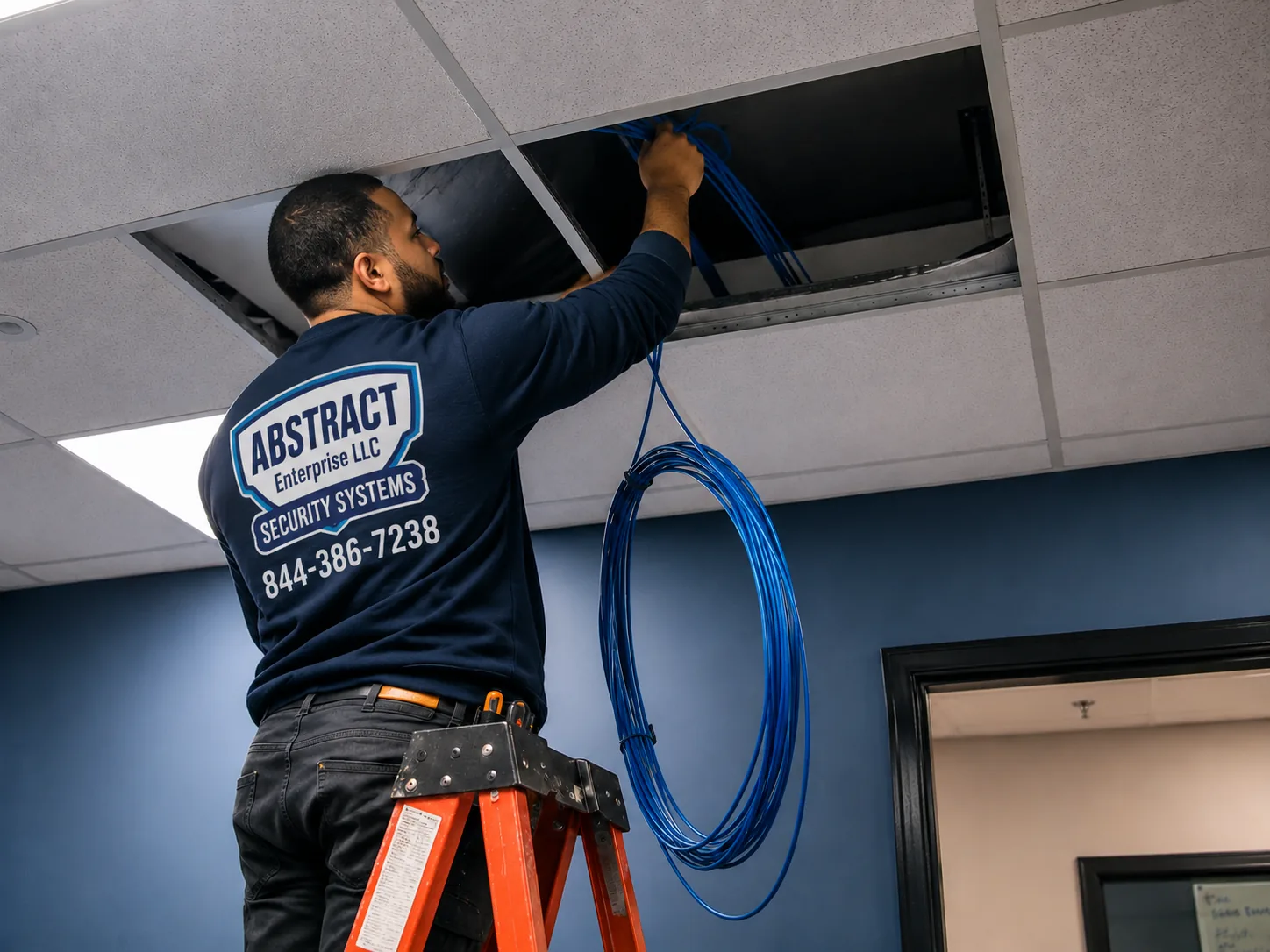
Photo from the AESS job library, not taken in the Hudson Valley: a technician feeding cable through the ceiling of a commercial space while it stays open. A shop on a Rockland corridor or a main-street store in a Dutchess village usually wants its camera cables run the same way, above the ceiling and out of sight, without closing the business for the day.
Before You Book
Kit in the Box or Cameras Already Up: What to Check on a Hudson Valley Property Before We Come
On a Hudson Valley ANNKE job, most of the wasted time comes from three surprises: a camera that is farther from the recorder than anyone measured, an older ANNKE camera that will not power from a new switch, and a property where the internet does not reach the building the recorder is in. A walk around with a phone camera and a few minutes reading labels avoids most of it. Please do not climb ladders, open junction boxes or reset the recorder; just look, measure what you safely can and send us what you find.
What to check
Why it matters up here
What to send us
Model numbers on the box, the recorder and any cameras
ANNKE sells PoE network kits and analog-HD kits; older kits may use a power scheme a standard switch will not run
Photos of the labels on the recorder and one camera
Every building you might want covered
Garages, barns and gate posts decide the cable plan and how many recorder channels you need
A rough sketch or a satellite screenshot with the buildings marked
Distance from the house to the farthest camera
A single copper cable has a 328-foot limit; beyond that we plan fiber, an extender or a wireless link
Paced or measured distance, even a rough one
Where the internet comes in, and how good it is
Remote viewing needs a working connection; local recording does not
Your provider and a speed test from where the recorder will go
Where power is near each camera spot
PoE cameras take power from the cable, but Wi-Fi cameras and the recorder need outlets
Photos of outlets on porches, garages and barns
What sits in front of each view
ANNKE warns that water and other objects that absorb infrared reduce night vision; glass and ponds matter
Photos from each spot looking out
Whether the building is in a historic district
Kingston and Newburgh review visible exterior changes
The address, so we can check the district map
Who has to agree
Tenants, landlords, boards or business partners may need to approve drilling and camera views
Name and email of anyone who signs off
Read the labels before you buy more cameras
If you already own an ANNKE recorder and want to add cameras, read the recorder's label before ordering anything. An ANNKE network video recorder works with IP cameras over network cable; an ANNKE digital video recorder works with analog-HD cameras over coax. The two are not interchangeable, and a camera bought for one will not show up on the other. If the recorder has built-in PoE ports, count how many are free. If it is an older kit, check whether its cameras are powered only by the recorder; owners on IPCamTalk have found that some older Amazon-bought ANNKE kits power their cameras with a non-standard scheme that a regular 802.3af or 802.3at PoE switch will not talk to. Sending us photos of the labels first is the simplest way to avoid buying a camera you cannot use.
Walk the property at night once
Daytime photos do not show what a camera will see after dark, and on a rural property night is usually when it matters. Walk out once after sunset with a phone and look at each place you want covered. Is there any light at all? Does a porch light or a floodlight shine straight toward where a camera would be, which can wash out its picture? Is there a pond, a window or a glass door in the view? Note what you find. It tells us whether an infrared camera will do, whether a color-night model is worth it, and where a motion light would help.
Find the coldest dry spot inside for the recorder
An ANNKE recorder has a hard drive inside, and hard drives prefer a dry, steady room. A damp basement next to a sump, an unheated barn or an attic that bakes in summer are poor homes for it. Look for a closet or shelf inside the heated part of the house, near the router if possible, with an outlet nearby and room for a battery backup. If the only sensible place is far from the router, that is fine; we can run a network cable between them. Tell us where you would like it and we will tell you whether it works.
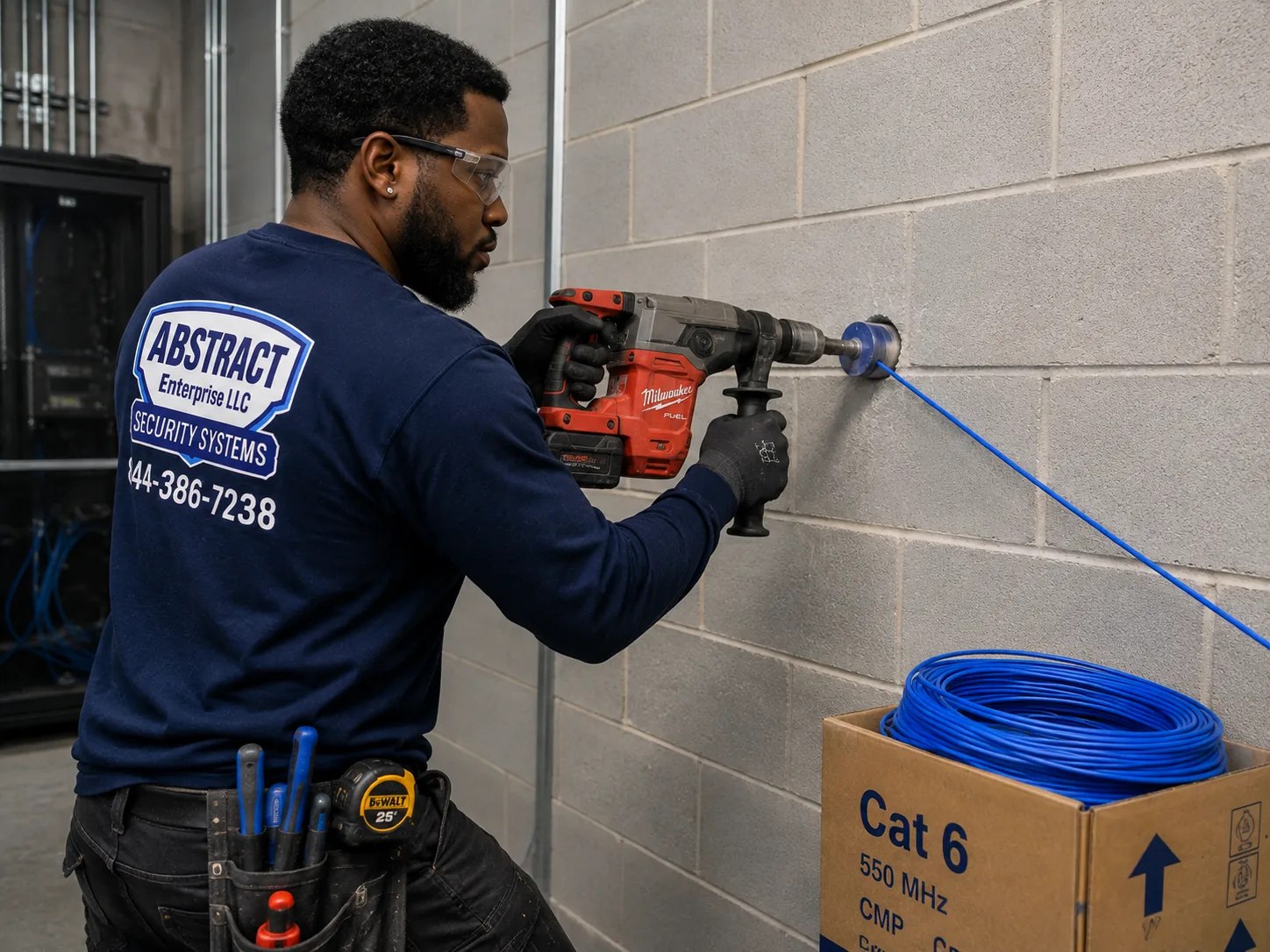
Photo from the AESS job library, not taken in the Hudson Valley: a technician core drilling a block wall to carry cable through to a network room. On a Hudson Valley job the same tool and patience go into a stone or masonry wall, where one clean, sleeved hole is far better than several small ones chipped through an old foundation.
What We Install
ANNKE Camera Installation Services in the Hudson Valley
These are the ANNKE jobs Hudson Valley homeowners, farm owners, second-home owners and businesses book. Each is priced from the ANNKE price page for the county the property is in. Where a job needs something beyond the cameras and the recorder, such as fiber to a barn, a battery backup or an electrician for a new outlet, the written quote names it before you agree to anything.
📹
New ANNKE PoE Systems
Network cameras on one cable each, back to an ANNKE recorder with its own PoE ports or a separate switch, planned around the farthest camera and the coldest wall on the property.
📦
Finishing Kits You Bought
ANNKE kits bought online and still in the box, installed with cable lengths cut to the real runs instead of the kit's 60-foot cables, and set up the way you want them to record.
🔍
Older ANNKE System Checks
Recorders that stopped showing cameras, drives that stopped recording, and older kits with non-standard power, tested piece by piece before anything is reused or replaced.
🏚
Barns, Garages and Gates
Cameras on outbuildings and gate posts, linked back by buried conduit, fiber or a point-to-point wireless bridge depending on the distance and the ground between them.
📺
Reusing Coax With Analog HD
Where an old analog system left coax in the walls, a hybrid recorder can run analog-HD cameras over the existing cable, which saves drilling in stone and plaster houses.
🔋
Power and Outage Planning
Battery backups for the recorder, switch and router, and settings that let the whole system return by itself after a Central Hudson, NYSEG, O&R or Con Edison outage.
📱
ANNKE App and Remote Viewing
The recorder added to the ANNKE app by local address as well as remote access, so you can still see your cameras on the property when the internet is down.
🏪
Shops, Offices and Yards
Cameras over registers, doors, loading areas and parking lots for businesses along the region's corridors, with signs posted where the law expects them.
🧱
Historic and Stone Buildings
Camera positions and cable routes chosen to keep visible wiring to a minimum on historic facades, with painted line covers where a commission expects them.
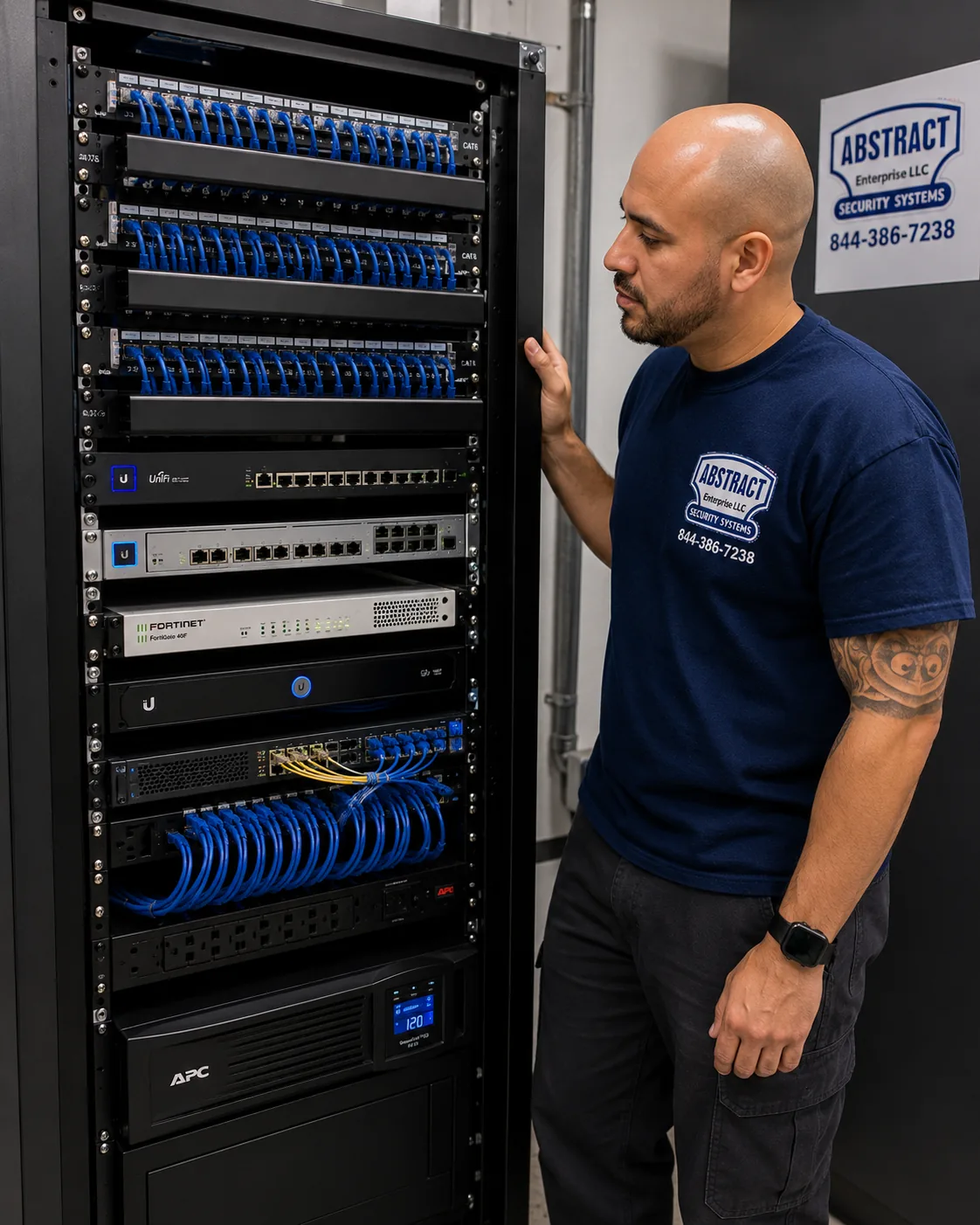
Photo from the AESS job library, not taken in the Hudson Valley: a finished network rack with patch panels, switching, a firewall and a battery backup, every cable dressed and identified. A Hudson Valley business with an ANNKE recorder in its back office ends up with a smaller version of the same layout, so the cameras keep recording through the short outages that summer storms bring.
Building Specialists
ANNKE Camera Installation for the Hudson Valley's Architecture
Across the six counties we see the same handful of building types again and again. Each one decides three things about an ANNKE job: what the cameras are fixed to, how the cable gets back to the recorder, and who has a say in where cameras go. These descriptions come from the historic district records, agriculture data and property descriptions in our sources; the installation notes come from our own practice.
Dutch Stone Houses
The colonial stone houses of Kingston's Stockade and the stone houses on large lots in Marbletown and Stone Ridge. Thick walls, few cavities, and owners who want the facade left alone.
River-City Row Houses
Newburgh's East End, a district of Italianate, Second Empire and Gothic Revival buildings, and similar blocks in other river cities. Shared walls, visible facades and design guidelines.
Farmhouses, Barns and Sheds
The working farms of Dutchess, Ulster and Orange, with outbuildings hundreds of feet from the house, livestock, dust and no internet in the barn.
Suburban Houses
The houses of Westchester and Rockland, closer to neighbors, often with attics, basements and garages that make cable routes simpler but camera angles more sensitive.
Cabins and Second Homes
Lake and mountain houses in Putnam and the Catskills, often empty for weeks, often on slow internet, where a system has to look after itself between visits.
Shops, Offices and Warehouses
Main-street stores, office parks and distribution buildings, with drop ceilings, block walls, metal buildings and open yards.
How the building type changes an ANNKE job
Building
What holds the camera
How the cable usually travels
Who signs off
Dutch stone house
Masonry anchors in the stone face, or a bracket on wood trim or a soffit where one exists
One sleeved hole through the wall, or reused coax with an analog-HD recorder
The owner, and in Kingston's districts the HLPC for anything visible from the street
River-city row house
Masonry or wood trim, often under a cornice or porch roof
Through the rear wall, up through a closet or along a back porch
The owner, and in Newburgh's districts the city's review
Farmhouse and barn
Wood framing or steel posts
Buried conduit, fiber or a wireless bridge between buildings
The owner, plus anyone who leases the farm buildings
Suburban house
Soffits, wood or vinyl siding, garage framing
Through the attic and down into the basement or garage
The owner, or the landlord for a rental
Cabin or second home
Wood siding, log walls or porch framing
Short runs to a recorder inside, with a battery backup
The owner
Shop, office or warehouse
Block, steel or drop-ceiling grid
Above the ceiling, in conduit or on J-hooks
The business owner, the landlord, and the IT team on campuses
Stone houses: one good hole, not many small ones
A colonial stone wall in Uptown Kingston has no cavity to fish a cable through, and every hole in it is permanent. We plan stone houses around as few penetrations as possible. Often that means bringing several camera cables through a single sleeved hole in a less visible wall, then running them along a soffit, under a porch roof or inside the house to each camera. Where a house already has coax from an old analog system, an ANNKE hybrid recorder can use it for analog-HD cameras, which may mean no new holes at all. Camera brackets on stone go into the stone itself rather than the mortar joints wherever the bracket pattern allows, because the joints hold less and can be soft in old walls. In Kingston's historic districts, exterior work visible from the public right-of-way is reviewed by the Historic Landmarks Preservation Commission, and the commission's minutes from January 2025 show staff recommending that an owner paint all externally mounted lines or line covers to match the facade. We plan for that before anyone asks.
Row houses in the river cities: integrate, don't obscure
Newburgh's East End Historic District was designated by the City Council in 1977, enlarged in 1985 and added to the National Register. The city's code says no one may carry out an exterior alteration on a designated landmark or within a designated historic district without first obtaining a certificate of appropriateness, and its East End design guidelines speak directly to security features: integrate them with the architecture, do not obscure architectural features, and do not damage historic building fabric when attaching them. For an ANNKE install on a row house, that points to small turret or dome cameras tucked under a cornice or porch ceiling, cables brought in at the back, and fixings placed where they can be removed without scarring brick or carved trim. We check the address against the district before we quote, and we tell you if an application is likely to be needed.
Farms and barns: distance, dust and animals
A barn camera has to cope with things a house camera does not. Dust and cobwebs collect on lenses and, in front of an infrared camera at night, a spider web lit by its own light can trigger detection over and over. Livestock and wildlife move constantly, which is why we draw detection zones around doors and paths rather than whole fields. The New York State DEC notes that black bears are increasing especially in southern New York, with their range reaching south into Orange and Rockland and the Taconic Highlands south into Putnam, and that bird seed is the most common attractant; on farm and woodland properties, cameras that see the trash area and the feeders often end up recording more bears than people. The bigger issue is distance. When a barn is more than 328 feet of cable from the recorder, or when it has its own electric service, we usually recommend fiber or a wireless bridge rather than one long copper run, because copper between separately grounded buildings is where storms do the most damage.
Second homes and cabins: a system that minds itself
A house in the woods that sits empty from Sunday to Friday needs an ANNKE system that does not depend on anyone being there. That means a battery backup on the recorder, switch and router; settings that let the recorder start recording on its own after a power cut; a hard drive large enough to hold the days between visits; and a remote viewing setup that recovers when the internet does. On cabins with slow DSL or satellite, we set the app to use the recorder's lower-quality stream for remote viewing so it loads, while the full-quality recording stays on the drive. When you arrive, a monitor plugged into the recorder shows everything with no internet at all.
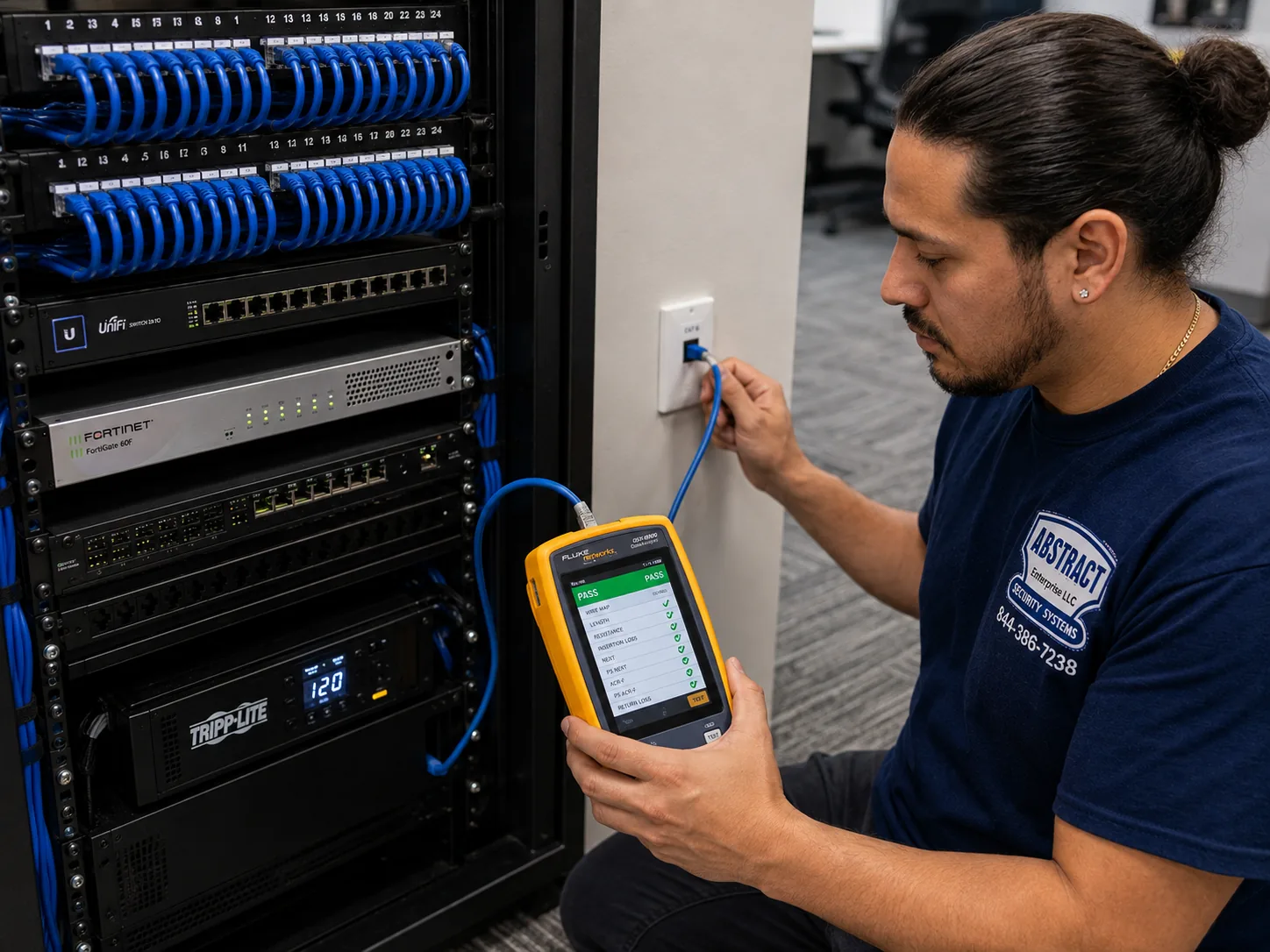
Photo from the AESS job library, not taken in the Hudson Valley: a technician certifying a data drop with a cable analyzer that shows a PASS result. On a long run out to a Dutchess barn or an Ulster gate post, a certified pass is the proof that the cable will carry both the camera's power and its video, not just a hope that it will.
Commercial ANNKE Camera Installation
Business ANNKE Camera Installation in the Hudson Valley
The Hudson Valley's business property ranges from office towers on a highway to a single shop on a village street. ANNKE systems suit the smaller end: stores, restaurants, offices, contractors' yards and suppliers who want a reliable recorder without a monthly fee. The corridors below are named in our sources; we describe what those sources say about them and do not claim any business there as a customer.
Westchester Avenue, White Plains
Westfair describes the Platinum Mile, with buildings such as 1111 and 1129 Westchester Avenue totalling about 335,000 square feet with I-287 visibility. Offices here usually need cameras that fit a landlord's and an IT team's rules.
Tarrytown and Valhalla Campuses
REBusiness reported Regeneron's Tarrytown expansion of about 900,000 square feet and Westchester Medical Center's five-story Critical Care Tower in Valhalla. Contractors and suppliers around such campuses often run their own smaller systems.
Route 17K, Montgomery
HGAR reported the Amazon and Medline distribution centers in the Town of Montgomery. Trucking yards and businesses near them watch gates, docks and open lots in the county with the most lightning in the state.
Route 59 and the Palisades Center
Rockland's busiest retail strip, with Route 304 and Route 202. Stores here need cameras on registers, doors and parking, and signs that tell customers they are recorded.
South Road, Poughkeepsie
Think Dutchess describes IBM's new facility at 2455 South Road. Small businesses along the corridor are the kind that use ANNKE recorders to watch stock and entrances.
Uptown Kingston
The Stockade District is split between homes and businesses, with stone buildings and storefronts under historic review, where camera placement has to respect the facade.
What a business ANNKE system has to do
A home system mostly answers "who came to the door?" A business system has to answer harder questions: who opened the register at closing, which truck backed into the fence, whether the slip-and-fall happened the way the customer says. That changes the installation. Cameras over a register need a close, sharp view, not a wide one. A door camera needs to see faces, which means mounting at a height and angle that catches people as they come in rather than the tops of their heads. A yard camera needs enough resolution to read what matters at the distance it covers, and the recorder needs a drive big enough to hold the footage until someone thinks to look, which in a business is often days later. We plan each camera around the question it has to answer, and we set the recorder's retention so footage is still there when it is needed.
There is also the question of handing footage over. On Long Island, Suffolk County lawmakers proposed in 2026 that businesses where a felony occurs should have to preserve footage and give it to police within a day if asked; that proposal was recessed for negotiation and does not apply in the Hudson Valley. We mention it only because it shows where expectations are heading. An ANNKE recorder can export clips to a USB drive, and we show business owners how to do it before we leave, so the first time they need to is not during an emergency.
Rules and practical limits for business cameras
Cameras stay visible and signed. Security101's summary of New York camera law says business cameras must be overt and surveillance notices should be apparent and visible to employees, visitors, contractors and vendors. We recommend signs at each entrance and mount cameras where people can see them.
No cameras where privacy is expected. New York Penal Law 250.45 makes certain covert recording in private places a felony. We do not install cameras in restrooms, changing areas or similar spaces, and we do not install hidden cameras.
The installer needs a state license. The NYS Department of State licenses people and businesses that install and maintain security systems. AESS works under NYS license #12000287431; ask any installer for their number.
Local electrical rules still apply. Westchester requires a county trade license for electricians; Rockland's Chapter 250, Orange's Local Laws 8 of 2007 and 1 of 2024, and Ulster's Chapter 185 set county electrical licensing; Putnam's Chapter 145 covers low-voltage technicians. New outlets for recorders or cameras are done by a licensed electrician.
Some towns inspect separately. The Town of Fishkill requires electrical work to be inspected by an approved independent agency. Where a business job includes line-voltage work, we build that inspection into the schedule.
Exits and pathways stay clear. Recorders, monitors and cable never block an exit or a walkway, and cable in commercial ceilings is supported on its own pathway rather than lying on the ceiling tiles.
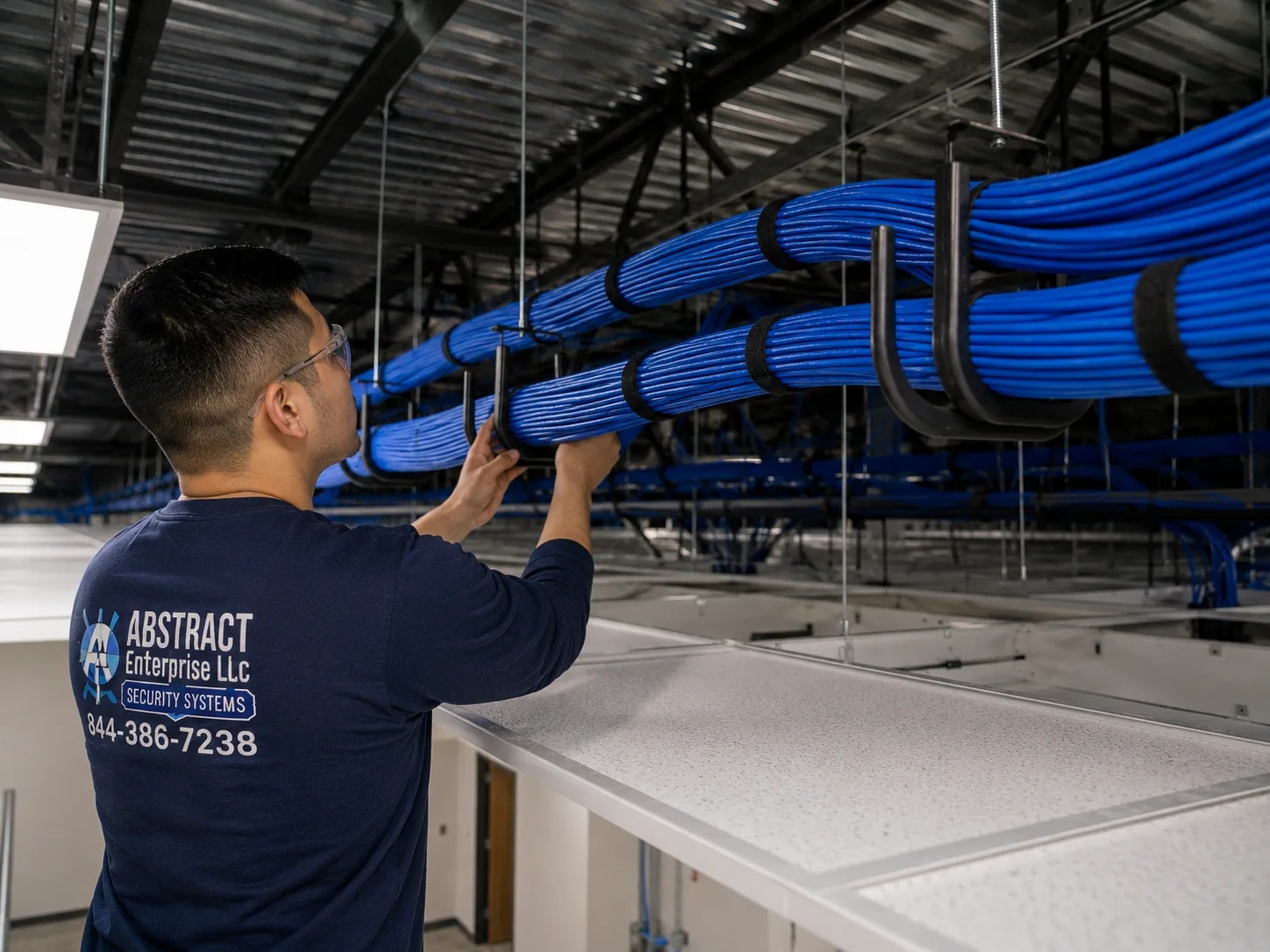
Photo from the AESS job library, not taken in the Hudson Valley: a J-hook pathway carrying neat bundles of cable across a commercial ceiling. In a shop on a Rockland corridor or an office near White Plains, camera cables running above the ceiling should be carried like this, on their own supports, rather than laid loose across the tiles.
Field Notes
Field Notes: Walking a Hudson Valley Property Before an ANNKE Box Is Opened
We do not publish stories about a particular customer's property unless we can document them, so this is not an account of one address. It is the routine our technicians follow on the kind of property the Hudson Valley is full of: a house, a detached garage or barn, a long drive and an ANNKE kit sitting on the kitchen table.
We leave the box closed. We ask where you park, where deliveries are left and which door visitors actually use, because those are the places a camera has to see. Then we walk the route a stranger would take, from the road up the drive to each door, and stand where each camera would go. We pace the distance from the house to the farthest building and compare it to the 328-foot cable limit. We look at what the camera would face at night: a pond, a window, a floodlight, a hedge that will fill in by June. We check where the internet comes in and how fast it is out by the barn. We open the recorder's box last, read its label, count its PoE ports and look for any older cameras you hope to reuse. Only after that walk do we write the quote, because on a property like this the walk decides the price more than the kit does.
Your Questions Answered
ANNKE Camera Installation in the Hudson Valley: Questions Answered
The brand itself
Is ANNKE its own company, or is the equipment really made by Hikvision?
ANNKE sells under its own name, but the security-industry publication IPVM lists ANNKE in its Hikvision OEM directory, which it says is built from shipping records, documentation or product testing. In plain terms, at least some ANNKE equipment has been made with Hikvision hardware. Not every source puts it the same way: the CCTVinfo NDAA database describes ANNKE as China-based, not on the FCC Covered List, with "some shared lineage with Hikvision-style hardware in older models." For an installer, the practical meaning is that ANNKE recorders and cameras often behave much like Hikvision ones, and some firmware and compatibility issues follow from that. We read the model number on each piece and work from its own documentation rather than assuming.
After the FCC's 2026 notice, is it still legal to buy, install and keep using an ANNKE system at our house?
The FCC's June 2026 public notice, effective July 16, 2026, prohibits continued importation and marketing of certain previously authorized covered equipment when used for public safety, security of government facilities, physical surveillance of critical infrastructure and other national security purposes. The same notice says continued use of lawfully purchased equipment is not affected. Sources disagree about whether ANNKE itself is covered, as described above. For a private house, farm or small business, a system you already own can keep running, and we install kits that owners have lawfully bought. What may change is how easy it is to buy new ANNKE stock, so if you plan to expand later, buying the cameras you will need now is sensible.
Our town department and a nonprofit we work with want cameras. Is ANNKE a good fit for them?
Usually not. The CCTVinfo database lists ANNKE as not NDAA compliant, and the FCC restriction is aimed specifically at government facilities, public safety and critical infrastructure. Many grant programs and public agencies require NDAA-compliant equipment for exactly that reason. For a town office, a school district, a library or an organization spending public money, we recommend checking the funding terms first and choosing equipment that meets them. ANNKE remains a reasonable choice for private homes and small private businesses. We will tell you honestly which side of that line a job falls on before you buy anything.
Quality and choosing
Are ANNKE cameras good enough for a rural property, or are we better off spending more?
For many Hudson Valley homes and small businesses, ANNKE hardware is good enough, and the owner reviews in our research mostly agree on that. The common complaints are about software and support rather than the cameras: the Slickdeals owner who called the software poor, the Trustpilot reviewers who mentioned needing technical knowledge and the lack of local help, and one buyer of a specific ANNKE camera who complained of no ONVIF interface and "a lot of false positives with Human detection." Those are exactly the parts an installer controls: careful setup, sensible detection zones, and someone local to call. Where a property needs features ANNKE does not offer, or a business has a compliance requirement, we will say so.
We're torn between ANNKE and Reolink for a Hudson Valley house. Which would you put up?
Both make affordable PoE systems that record locally without a required subscription, and either can work well on a typical Hudson Valley house. We do not publish a blanket verdict, because the right choice depends on what you already own, how many cameras you need, whether you need Wi-Fi cameras on outbuildings, and how you want the app to behave. The FCC and NDAA questions above apply to ANNKE and are worth weighing if you may sell the property to someone who cares about them. If you already have an ANNKE recorder, staying with ANNKE cameras is usually simplest. Tell us what you have and what you want to see, and we will give you our honest call for that property.
Older kits and expanding
We plugged our older ANNKE camera into a new PoE switch and nothing happens. Should it power up and show on the network?
You would expect it to, but with some older ANNKE kits it will not. An owner on IPCamTalk was told that their ANNKE was powered by the recorder with non-compliant "sPOE," and because it was not 802.3af or 802.3at compliant, it would not communicate with a standard PoE switch, so nothing happened. Those cameras only power from their own recorder, or from a power supply at the camera. Before we reuse older cameras on a new switch or recorder, we test each one on its original power and check the model's documentation. If they are the non-standard type, the choices are to keep them on their original recorder, power them locally, or replace them.
Does an ANNKE recorder run off its own power adapter, and does that change what happens in a blackout?
Most ANNKE recorders have an external power adapter or a power cord, and when that power goes, the recorder and any cameras it powers through its PoE ports go dark together. That is the reason we put the recorder, any separate PoE switch and the router on a battery backup in the Hudson Valley. A properly sized battery keeps the cameras recording through the short outages that summer storms bring and gives the recorder time to shut down cleanly in a long one. Just as important, we check that the recorder starts recording again by itself when power returns, which we test before we leave by switching it off and on.
If we start with four cameras now, can we add more later without replacing the recorder?
Yes, if the first installation is planned for it. The two limits are the recorder's channel count and its PoE ports. A four-channel recorder is full with four cameras; an eight-channel one leaves room. If the recorder's built-in PoE ports run out, a separate PoE switch can power more cameras, as long as the recorder still has channels to record them. The other part is cable. On a property with outbuildings, we often pull a spare cable or a spare conduit to the barn or the gate while the trench or the wall is open, because that is far cheaper than opening it again. Tell us what you might add, and we will size the first job for it.
Will ANNKE cameras record on a Lorex or Uniview recorder we already have, or the other way round?
Sometimes, and it depends on the exact models. Mixing brands usually relies on a common standard called ONVIF, and not every camera supports it fully; one ANNKE buyer in our research complained of a camera with no ONVIF interface. Even when a camera does connect to another brand's recorder, features such as person detection may not carry across. We check the specific camera and recorder models against their documentation and, where possible, test one camera before committing to the rest. If mixing brands means losing the features you bought the cameras for, we will tell you that a single-brand system is the better route.
Weather, distance and rural internet
Our cabin's internet drops out for days at a time. Will the cameras still record, and can we watch them when we're there?
Yes on both counts, if the system is set up for it. ANNKE's help center says you can view the stream without the internet when your recorder is connected to a monitor or TV. Recording to the recorder's hard drive does not need the internet either. What needs a connection is remote viewing on your phone and alerts. On properties with unreliable service, we connect a monitor to the recorder, set recording to run from the drive, and add the recorder to the app by its local address as well as remotely, so a phone on the cabin's own Wi-Fi can still see the cameras when the outside connection is gone.
Our north wall gets the full force of a Catskills winter. Will ANNKE cameras keep working through it?
ANNKE's installation guidance lists an operating range of minus 40°C to 60°C, which covers a hard Ulster or Putnam winter. Cold itself is rarely what stops a camera here. Ice and snow on the lens, water getting into a poorly sealed cable joint, and condensation in a junction box are the usual failures. We mount cameras under eaves or soffits where we can, seal every outdoor connection, make drip loops so water runs off before it reaches the camera, and use weather-rated junction boxes. After the first real snow, a quick look at each camera's picture tells you whether any lens needs a hood or a slightly different angle.
Our yard runs down to the river. Why is the night picture over the water so poor?
Because water swallows the camera's infrared light. ANNKE's installation guidance warns that water and other objects that absorb infrared light reduce night vision. An infrared camera lights the scene with its own invisible light and reads what bounces back; open water, and wet surfaces generally, send very little back, so the view looks black and grainy. On river and lake properties we aim cameras at the dock, the path and the shoreline rather than the open water, add a motion light where it helps, and consider color-night models that use visible light. We also keep cameras from facing straight into a window, because glass reflects infrared back into the lens.
How far from the recorder can an ANNKE camera be on our property?
On a single network cable, about 328 feet, which is the standard limit for a copper Ethernet channel including the short cords at each end. The 60-foot cables that come in ANNKE kits cover a house; they rarely reach a barn. Past the copper limit we have three tools: a PoE extender part-way along the run where there is somewhere dry to put it, a fiber link to a small switch in the far building, or a point-to-point wireless bridge where there is a clear line of sight. Wireless bridges need that line of sight all year, and in the Hudson Valley leaves are the usual problem. We pick the tool after walking the route.
Can ANNKE Wi-Fi cameras cover the barn so we don't have to run cable?
Sometimes, but plan carefully. A third-party setup guide notes that ANNKE cameras support only 2.4 GHz Wi-Fi, not 5 GHz. The 2.4 GHz band reaches farther than 5 GHz, but barn walls, metal roofs and distance still weaken it, and a Wi-Fi camera still needs power at its location. Not every ANNKE recorder accepts Wi-Fi cameras alongside PoE ones, either. On many farm properties a better answer is a single wireless bridge or fiber link to the barn feeding PoE cameras there, so the cameras themselves are wired and reliable. We test signal strength at the barn before recommending a Wi-Fi camera.
Rules, privacy and timing
Our house is in one of Kingston's historic districts. Will a camera on the front need approval?
Possibly, and it is worth checking before anything is drilled. Kingston's Historic Landmarks Preservation Commission reviews exterior work on historic properties that is visible from the street before a building permit is issued, and its minutes show it reviewing small facade items, such as a light bar on North Front Street, and expecting externally mounted lines to be painted to match the facade. We found no source saying cameras specifically require a certificate of appropriateness, so we treat it as a question for the city. Where a front camera is needed, we propose a small, discreet model, a route that hides the cable, and placement that does not touch historic trim.
With all the local talk about surveillance, can our footage stay off the cloud completely?
Yes. An ANNKE recorder stores video on its own hard drive, on your property. Remote viewing through the app is optional; without it, the footage never leaves the building unless you export it. Some owners choose a middle path: remote viewing on, cloud storage off. We explain what each setting does, so the choice is yours. That is a real difference from camera systems that only work through a company's cloud. Given the 2026 debates over Kingston's city cameras and Dutchess County's dropped plate readers, many Hudson Valley owners tell us local recording is the reason they chose a recorder-based system in the first place.
How long does an ANNKE installation take on a typical Hudson Valley property?
A four to eight camera system on a house with an attic or basement for cable is usually a one-day job. The time grows with distance and walls: a barn link, a trench or fiber, stone walls that need careful drilling, or a business that wants cable above a ceiling while staying open. Long drives between properties upstate also affect how visits are scheduled. We give you a realistic time on the written quote after the walk-through, and if a job needs a second day, such as an electrician for a new outlet before the cameras go up, the quote says so.
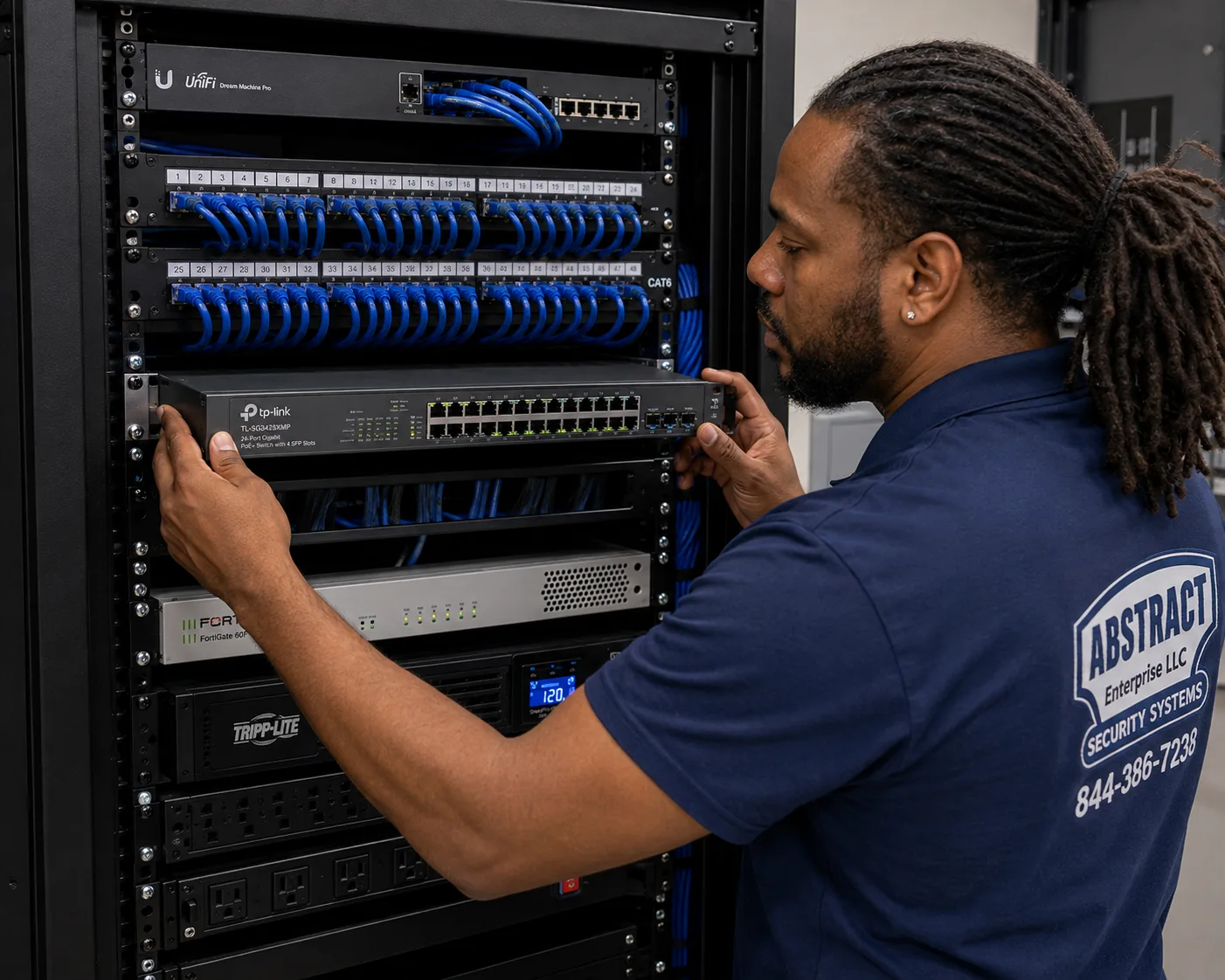
Photo from the AESS job library, not taken in the Hudson Valley: a technician mounting a managed PoE switch below the patch panels in a commercial rack. When an ANNKE recorder's built-in ports are full, a separate PoE switch like this one is how a Hudson Valley office or farm adds cameras without replacing the recorder.
Equipment
Types of ANNKE Camera Installation We Install
These are the ANNKE equipment types we install and service in the Hudson Valley. Model names below are ones that appear in our research sources; we confirm the exact model you have or want against its documentation before quoting. Installed prices for each county are on the county ANNKE price pages.
🎥
4K Turret and Dome PoE Cameras
Compact cameras such as the ANNKE C800, listed as a 4K 8MP PoE dome turret. Good for doors, porches and soffits on houses and row houses, where a small camera suits the facade.
↔️
Panoramic Dual-Lens Cameras
Wide 180-degree cameras such as the FCD600 turret or the dual-lens bullet, listed at 6MP and up. One camera can cover a whole driveway or barnyard, with care taken over what else is in view.
🌐
360-Degree Fisheye Cameras
Ceiling cameras such as the Pano360 Pro, listed as a 6MP fisheye with a built-in mic and SD card slot. Useful in shops and barns where one camera sees the whole room.
💾
ANNKE Network Recorders
NVRs with built-in PoE ports and a hard drive, such as the eight-channel recorder sold with a 2TB drive in ANNKE's panoramic four-pack. The heart of a new system.
📼
Hybrid and Analog-HD Recorders
Recorders that run TVI, CVI and AHD analog-HD cameras over existing coax, for houses where old cable is already in thick or historic walls.
📶
Wi-Fi Cameras
ANNKE wireless cameras on 2.4 GHz Wi-Fi, for spots where a cable truly cannot go and a good signal and an outlet are available.
🔌
PoE Switches and Extenders
Standard 802.3af and 802.3at switches to add cameras past the recorder's ports, and extenders for runs that approach the 328-foot copper limit.
🔋
Battery Backups and Surge Protection
Battery backup for the recorder, switch and router, and surge protection on runs that leave a building, for a region with long outages and frequent lightning.
National security brands vs a local ANNKE installer
People often ask how an installed ANNKE system compares with the national names. ADT is best known for professionally monitored alarm systems, and Ring and SimpliSafe for doorbells, cameras and self-install kits that typically lean on their own cloud services and optional plans. An ANNKE system installed by a local, licensed installer is a different kind of product: cameras and a recorder you own outright, footage stored on your own property, and no requirement to pay a monthly fee to keep recording. The trade-off is that you depend on the quality of the installation and on having someone local to call. The table sets out the practical differences as they usually show up on a Hudson Valley property.
Question
National self-install or monitored brand
Installed ANNKE system
Where is the footage kept?
Often in the company's cloud, sometimes with local options
On the recorder's hard drive at your property
Does it work when the internet is down?
Depends on the product; many features stop
Recording and local viewing on a monitor continue
Who runs the cable to the barn?
Usually you, or a separate contractor
The installer, planned around distance and weather
Is a subscription required to keep recording?
Varies by brand and plan
No
Who comes out when it stops working?
Phone or online support, technician visits where offered
The local installer who wired it
Fit for government or grant-funded sites
Varies by product
Usually not, because ANNKE is listed as not NDAA compliant
Photo from the AESS job library, not taken in the Hudson Valley: a technician tracing an unidentified cable run at a patch panel with a tone generator and probe. When an older ANNKE system in a Hudson Valley house or shop was installed with no labels, tracing each cable like this is how we find which run belongs to the camera that stopped working.
AI Overview Reality Check
What AI Gets Wrong About ANNKE Camera Installation in the Hudson Valley
We could not capture Google's AI Overview or the People Also Ask boxes for this topic from our build environment, so we are not going to pretend to quote them word for word. What follows are claims we see repeated in quick online answers, product listings and cost guides about ANNKE systems and about camera installation in this region, set against ANNKE's own documentation, public sources and field practice. National marketplaces such as Angi, HomeAdvisor and Fixr publish cost guides that feed many of those quick answers; Angi, for example, says its national average is based on 4,027 verified projects. Those guides are useful for a rough idea, but none of them has walked your property.
"The kit comes with everything you need."
An ANNKE kit includes cameras, a recorder and cables, which is enough for many houses on a quiet street. The cables in many kits are 60 feet long, according to an installation guide in our research, and that is the first thing that runs out on a Hudson Valley property.
A camera on a detached garage, a barn or a gate post is often well past 60 feet, and sometimes past the 328-foot limit of any single copper run. The kit also does not include sealed outdoor junction boxes, conduit, surge protection or a battery backup, all of which matter in a region of long outages and frequent lightning.
We treat the kit as the cameras and the recorder, not the whole system. The cable plan, the protection and the power plan come from walking the property.
"Any PoE switch will power any PoE camera."
That is true for cameras that follow the 802.3af and 802.3at standards, and most modern ANNKE network cameras do. It is not true for every ANNKE camera ever sold.
An owner on IPCamTalk found that their older ANNKE camera, bought in a kit, was powered by the recorder with a non-standard scheme and would not work on a regular PoE switch at all. Plugging it in produced nothing, which looks exactly like a dead camera.
Before reusing older ANNKE cameras on new equipment, we test them on their original power and check the model. It saves owners from throwing away working cameras, and from buying a switch that will never run them.
"You need internet for the cameras to work."
Quick answers often blur recording and remote viewing together. ANNKE's own help center says you can view the stream without the internet when your recorder is connected to a monitor or TV, and a recorder writes video to its hard drive whether or not the internet is up.
That matters in the Hudson Valley, where Ulster County's ConnectALL program is still working to reach nearly 1,300 unserved locations and many cabins rely on slow or patchy service. A camera that only works through the cloud is a poor fit there; a recorder-based system is a good one.
What does need internet is remote viewing on a phone and push alerts. We set both up, but we make sure the system keeps recording and can be watched locally when the connection is gone.
"Higher resolution means a better night picture."
A 4K or 8MP label says how many pixels the camera has in good light. At night, the picture depends far more on the lens, the sensor, the camera's own infrared light and what it is pointed at.
ANNKE's installation guidance warns that water and other objects that absorb infrared light reduce night vision. On a river or lake property, a high-resolution camera aimed across open water can still show almost nothing after dark, and a camera facing a window can blind itself with its own reflected light.
We choose positions for the night as well as the day, aim at the paths people actually use, and add light where it helps, rather than relying on the resolution number on the box.
"ANNKE is banned now, so you shouldn't install it."
This one is an overstatement in one direction, and some reassurances overstate it the other way. The FCC's June 2026 public notice, effective July 16, restricts importation and marketing of certain previously authorized covered equipment for public safety, government facilities, critical infrastructure and national security purposes.
The notice also says continued use of lawfully purchased equipment is not affected. Whether ANNKE is covered at all is disputed: IPVM lists it as selling Hikvision-made hardware, while the CCTVinfo database says it is not on the FCC Covered List but is not NDAA compliant.
For private homes and small private businesses, installing a lawfully bought ANNKE kit is not prohibited by that notice. For government, grant-funded or critical-infrastructure sites, we recommend equipment that meets the funding and compliance rules instead.
"Installing cameras yourself saves money with no downside."
It is true that New York lets owners install their own systems: the NYS Department of State says that if an owner personally installs the system, or has an employee install it on their own property or business, a license is not required. Plenty of people mount a few ANNKE cameras themselves successfully.
The downside appears on larger Hudson Valley properties. Long runs to outbuildings, cable between separately powered buildings in lightning country, stone walls, historic facades and new outlets that a county requires a licensed electrician to install are where do-it-yourself jobs tend to fail or need redoing.
Anyone you hire to install a system for you does need a state license; ours is NYS license #12000287431. If you want to do part of it yourself, we can quote just the parts that need us, such as the barn link or the recorder setup.
"Camera installation costs about the same everywhere."
National guides give one number for the whole country, and AI answers repeat it. In practice a Hudson Valley ANNKE job is priced by county, because a property two hours north takes more travel and often more time than one just over the city line.
Within a county, the property matters more than the camera count. Four cameras on a suburban Westchester house with an open attic and four cameras spread across a Dutchess house, a barn and a gate are very different jobs, even with identical ANNKE kits.
That is why each county has its own ANNKE price page, and why our quote follows a walk-through or a good set of photos. We do not quote a number that is not on the county's list.
Not Sure Your ANNKE Kit Fits the Property? Talk to a Technician
Send photos of the buildings, the labels on your ANNKE recorder and cameras, and a rough idea of the distances, and a technician will tell you whether the kit will cover what you want, what else the property needs, and which county price page applies. Call (800) 486-0943, message us on WhatsApp, or use the quick form.
Every Hudson Valley ANNKE job follows the same eight steps, whether it is two cameras on a Rockland house or a dozen across a Dutchess farm. The order matters most on large properties, where a cable plan made in a hurry is the usual cause of a camera that drops out every storm.
1. Send photos, the county and what is already there
The address and county, photos of the buildings and any existing ANNKE kit, recorder or coax, and what you want to see. We match the job to the county price page and tell you what we can reuse.
2. Check the rules for the address
Historic district review in places like Kingston or Newburgh, county or town licensing for any line-voltage work, and whether a landlord, board or tenant has to agree.
3. Walk the property and plan each view
Every camera position checked for height, sun, glass and water, and every cable route marked back to the recorder, including distance to outbuildings.
4. Test older ANNKE equipment
Existing cameras, recorder and drive tested before reuse, including whether older cameras rely on a recorder-only power scheme a standard switch will not run.
5. Run, label and protect the cable
Cable pulled on the planned route, sleeved through walls, kept under the 328-foot copper limit or bridged with fiber, and labelled at both ends.
6. Mount the cameras and the recorder
Cameras above about two meters on fixings rated for the wall, and the recorder, switch and battery backup in a dry, cool place inside.
7. Set up recording and viewing
Recording, detection zones and the ANNKE app configured, with local viewing on a monitor proven to work with no internet before remote viewing is added.
8. Certify, power-test and hand over
Each cable certified, the system switched off and on to prove it recovers by itself, and a walk-through with the labelled port map and logins.
The two-meter height in step 6 comes from ANNKE's own installation guidance, which recommends mounting cameras higher than two meters. In practice we often go higher on outbuildings to keep cameras out of reach, and lower at doors where faces matter. The power test in step 8 is the step people are most surprised by. We switch the recorder, switch and router off, wait, and switch them back on, because in the Hudson Valley the real test of a system is the morning after an outage.
Photo from the AESS job library, not taken in the Hudson Valley: a technician running cable into EMT conduit beside a telecom room in an industrial building. In a warehouse or contractor's shop near Montgomery or New Windsor, camera cable along exposed walls gets the same metal conduit, which protects it from forklifts and stops it being mistaken for something loose.
Coverage Area
ANNKE Camera Installation Near the Hudson Valley's Landmarks
Across six counties, people give directions by the landmarks they know. These are the ones we use when we plan routes and talk through a property, chosen because each one stands for a kind of building or setting where ANNKE installations behave differently.
Kingston Stockade District
Eight blocks of Uptown Kingston, on the National Register since 1975, with Dutch stone houses on all four corners of Crown and John Streets and the Senate House of 1676.
Newburgh East End Historic District
Designated in 1977 and enlarged in 1985, with 2,239 resources in Italianate, Second Empire and Gothic Revival styles, and Washington's Headquarters nearby.
Stewart International Airport
1,552 acres in the towns of Newburgh and New Windsor, with runways of 11,817 and 6,004 feet and the 105th Airlift Wing based there since 1983.
Vassar College, Poughkeepsie
Founded in 1861, about 1,000 acres and more than 100 buildings, with James Renwick Jr.'s Main Building of 1865.
Vanderbilt Mansion, Hyde Park
A National Historic Site of 211 acres from an original estate of about 600, with the 1896–1899 mansion, a carriage house and a hydroelectric plant on Crum Elbow stream.
Palisades Center, West Nyack
About 2.36 million square feet of retail in Rockland, taken over by a Black Diamond affiliate at a February 2026 foreclosure auction, at the center of the Route 59 corridor.
ANNKE Camera Installation Cost in the Hudson Valley
ANNKE camera installation in the Hudson Valley is priced by county. Each county has its own ANNKE price page with the full list and a calculator where you can build your own system, camera by camera. This hub does not repeat those figures, because a single regional number would be wrong for at least five of the six counties. The table shows how each county's rate compares with our Brooklyn base rate, and why.
County
Rate relative to our Brooklyn base
Why it differs
Full ANNKE price list
Westchester
1.25×
Closest to our base, but suburban travel and longer runs than city jobs
Within any county, the number of cameras is only the start. The items that move a Hudson Valley quote most are the ones a kit cannot include. Distance to the farthest camera decides whether a run is simple copper, an extender, a fiber link or a wireless bridge. Walls decide how long drilling takes: an open attic over vinyl siding is quick, a two-foot stone wall is not. Outbuildings with their own electric service usually call for fiber or surge protection between buildings. Battery backups and surge protection add parts but save repeat visits after storms. Any new outlet is electrician's work, quoted separately and done by someone licensed for that county or town. Reusing equipment you already own lowers the parts cost, but only after it has been tested.
Kits you bought yourself
If you already own an ANNKE kit, the county price page shows labor for installing customer-supplied cameras and recorders. We test the kit before mounting anything, and if a piece is faulty or unsuitable, such as an older camera with non-standard power on a new switch, we tell you before it goes on the wall. Parts we supply are listed on the quote at the county price page's rates; nothing else is added on the day unless you ask for it.
Full terms — including 50% deposit, one-year parts-only warranty on AESS-supplied products, and the late-fee schedule — are set out in the service agreement.
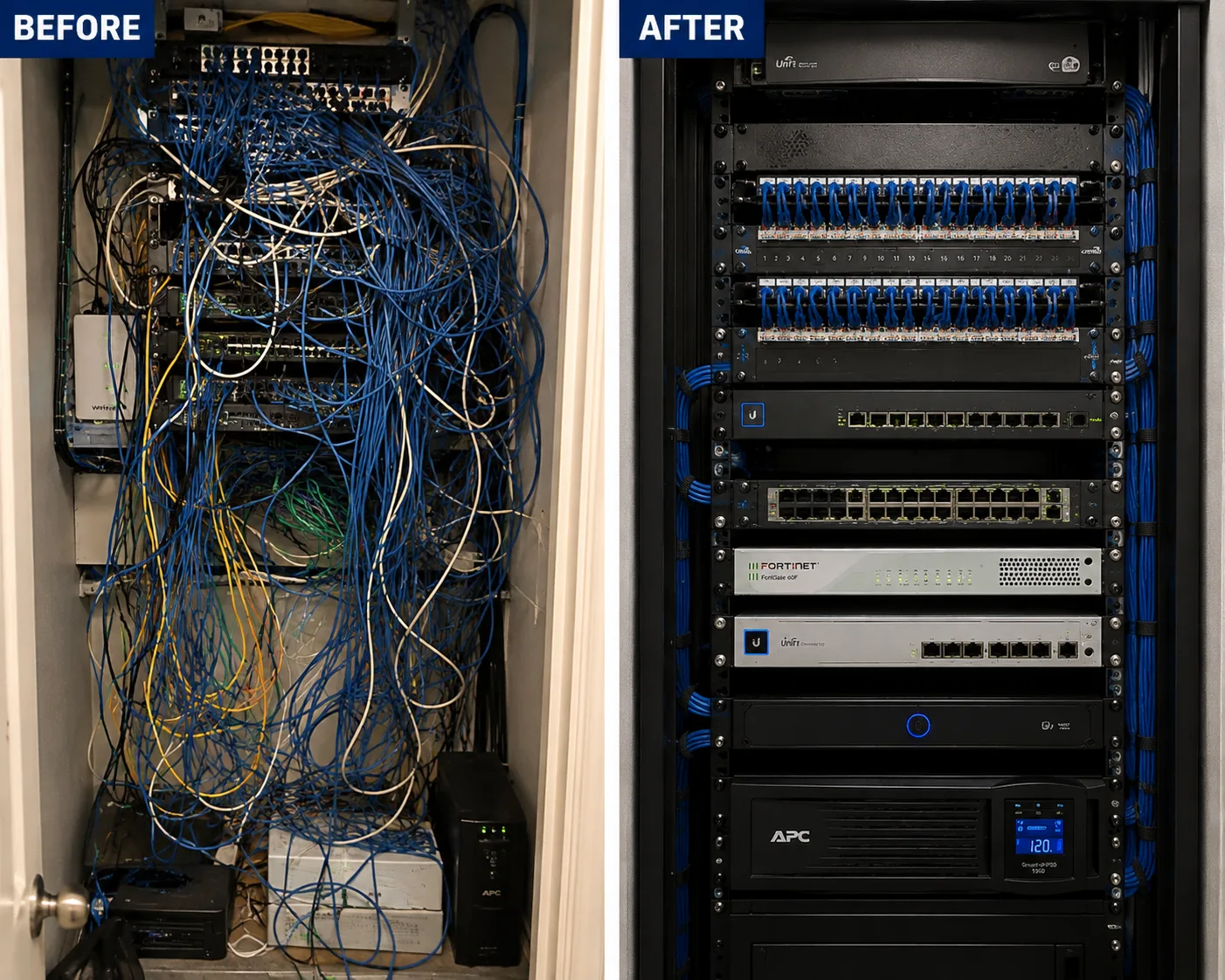
Photo from the AESS job library, not taken in the Hudson Valley: a before-and-after of a tangled, unlabelled network rack rebuilt into a dressed and identified one. When we take over an older ANNKE system in a Hudson Valley shop or farm office, tidying and labelling the recorder corner like this is often what turns a system nobody understands into one the owner can manage.
Shop Our Systems
ANNKE Camera Installation Packages & Pricing
Three common Hudson Valley ANNKE jobs, described by what they include. Installed prices for each come from the price page for your county, because the same package costs a different amount in Westchester than in Ulster. There is no package premium; each is simply the lines from the county list added together.
Starter: House Entrances
Four ANNKE PoE turret or dome cameras covering the front door, back door, driveway and yard, an ANNKE recorder with built-in PoE inside the house, local recording and the ANNKE app. Suits suburban houses in Westchester and Rockland and smaller village houses. See the Westchester ANNKE price page or your own county's.
Standard: House, Garage and Drive
Up to eight ANNKE cameras, including a panoramic dual-lens camera for a wide driveway, a cable run to a detached garage, an eight-channel recorder, a battery backup for the recorder and router, and remote viewing set up to recover after outages. The usual job on Orange and Putnam properties. See the Orange ANNKE price page.
Premium: Farm, Estate or Business
Cameras across a house and outbuildings, with a fiber or wireless link to a barn switch, surge protection on runs between buildings, a larger recorder drive for longer retention, and signage for business use. For Dutchess and Ulster farms and estates and for small commercial sites. See the Dutchess ANNKE price page.
Bring your own ANNKE equipment
If you already bought an ANNKE kit, extra cameras or a recorder, we install it at the labor-only lines on your county's ANNKE price page, as long as it tests sound and suits the job. We check each camera and the recorder before mounting, confirm the cameras and recorder are compatible, and look for the older non-standard power type. If something is not suitable, we say so and show you the list price of a replacement before anything is ordered. The Hudson Valley ANNKE price page links to every county list.
Complete Services
Every ANNKE Camera Installation Service in the Hudson Valley
Does the ANNKE Vision app send our video through the same cloud servers as Hikvision's Hik-Connect?
+
Owners on the IPCamTalk forum have asked exactly that, and we have not found an answer from ANNKE that settles it, so we will not guess. What we can control is how much the system depends on any cloud. We set the recorder to record locally, add it to the app by its local address on your own network, and turn on remote access only if you want it. If you prefer no outside connection at all, the system still records and can be watched on a monitor connected to the recorder.
Should a camera for our mudroom or barn go inside the building or outside it?
+
It depends on what you need to see. An outdoor camera sees people before they reach the door; an indoor one sees what happens once they are in. Outdoor cameras need a weather-rated housing and sealed connections, while indoor ones avoid snow and rain. In barns, dust and humidity make even indoor positions harsh, so we often use outdoor-rated cameras inside. Never aim an indoor camera out through a window at night, because the glass reflects its infrared light.
We ordered an ANNKE kit online. Will you install equipment you didn't supply?
+
Yes. Installing customer-supplied ANNKE kits is a large part of our Hudson Valley work, at the labor-only lines on your county's price page. We test the cameras and recorder before mounting anything, replace the kit's fixed-length cables with runs cut to your property where needed, and set the system up properly. If any part of the kit is faulty or unsuitable for a position, we tell you before it goes up.
Deer and wild turkeys set off our person alerts all night. Can that be fixed?
+
Usually it can be reduced a great deal. One ANNKE buyer complained of a lot of false positives with human detection, and on rural properties animals make it worse. We redraw detection zones around doors, paths and the drive instead of whole fields and tree lines, adjust sensitivity, set the minimum size of a detected object, and keep spider webs and branches away from the lens. Recording can stay on for everything while alerts go only for the zones that matter.
Who helps us if an ANNKE camera fails a year from now?
+
A Trustpilot reviewer warned buyers to think about warranty support and the lack of local assistance before purchasing ANNKE. If we install the system, you call us. We diagnose whether the problem is the camera, the cable, the power or the network, and for equipment we supplied, our warranty terms apply as set out in the pricing section. For a camera you bought yourself, we can help with the manufacturer's process and replace the camera once a new one is in hand.
How high should ANNKE cameras be mounted on a house or barn?
+
ANNKE recommends mounting cameras higher than two meters, a little over six and a half feet. That keeps them out of easy reach. On barns and garages we often go higher, under the eaves, to protect them from tampering and weather. At doors where you want to see faces, we keep cameras at a moderate height and angle so they catch people as they approach rather than only the tops of their heads.
Does a panoramic dual-lens ANNKE camera need a special recorder?
+
It needs a recorder that supports the camera's resolution and its stitched panoramic image, and that is not true of every recorder. Shoppers on Slickdeals asked whether ANNKE panoramic cameras would work with Uniview or Lorex recorders for exactly this reason. ANNKE has sold panoramic cameras bundled with its own eight-channel recorder. We check the specific camera and recorder pair before installing, so the wide view you paid for actually records.
The ANNKE app is confusing. Can you set it up so it is simple for the whole family?
+
Yes, and that is one of the most useful parts of the visit. An owner on Slickdeals said the hardware was fine but the software was poor. We name each camera by place, arrange the views so the important ones show first, set alerts only where they help, and add each family member's phone. We then walk everyone through playing back footage and saving a clip, so nobody has to learn it during an emergency.
Do we need a licensed installer, or can we put the ANNKE cameras up ourselves?
+
New York lets you install a system on your own property yourself without a license, according to the NYS Department of State. Anyone you pay to install it for you must be licensed; AESS holds NYS license number 12000287431. Any new electrical outlet still has to be installed by an electrician licensed for your county or town where that applies. Many owners mount the easy cameras themselves and hire us for long runs, outbuildings and the recorder setup.
Our analog cameras are old, but the coax is still in the walls. Do we have to start over?
+
Often not. Many analog-HD cameras in the TVI, CVI and AHD formats can run over existing coax to a newer hybrid recorder, which keeps the cable already in your walls. That matters most in stone and plaster houses where new holes are hard to make. We test the coax first, because old cable and connectors can be the weak point, and we tell you which runs can stay and which should be replaced.
Can we point an ANNKE camera at the road or our neighbor's driveway?
+
We aim cameras at your own property and use privacy masking in the recorder where a view has to cross a road or a neighbor's land. In the Town of Ulster, residents in a 2023 neighbor dispute over a camera fixed on a backyard cited Civil Rights Law 52-a, which shows how strongly people feel about it. A camera that sees your own entrances and drive is more useful anyway, and it avoids arguments.
How big a hard drive should our ANNKE recorder have?
+
Big enough to hold footage for as long as you might take to notice a problem. For a weekend house that sits empty all week, that means at least a week or two; for a business, as long as it takes someone to review an incident. The camera count, resolution and whether you record continuously or only on motion all change the space needed. We set retention during installation and tell you how many days the drive will hold.
Get In Touch
Request a Free Quote
Tell us the county and town, the buildings you want covered, the distances if you know them, and any ANNKE equipment you already own. Photos of the buildings and of the recorder's label make the quote exact. Prefer to talk? Call (800) 486-0943.
✅
Request Sent!
We'll call about your Hudson Valley ANNKE cameras the same business day.
More ANNKE Camera Installation near Hudson Valley hub
From a stone house in Uptown Kingston to a row house in Newburgh's East End, a farm with a barn in Dutchess or a shop on Route 59, the job starts the same way: the county, a few photos, the labels on any ANNKE equipment you own, and an honest match to that county's price page. Call (800) 486-0943, message us on WhatsApp, or send the quote form, and we will tell you what your property needs before anyone drills.