eufy doorbell gone offline on a brownstone stoop, a battery camera that slid off a brick wall, or a package taken from your vestibule last night? Brooklyn eufy camera line, same-day estimates: (347) 934-8335
Anchored in Brick, Not Mortar · HomeBase Placed for Party Walls · Encryption Switched On · Account Left in Your Name
Brooklyn is a borough of attached brick. The Census Bureau's 2023 survey counts 1,090,187 homes in Kings County with a median build year of 1943, and 513,629 of them date from 1939 or earlier. Most sit in rowhouses, two-families and small walk-ups that share a wall with the building next door, front a stoop or a vestibule, and back onto a narrow yard. That is exactly where eufy cameras get bought and exactly where they struggle: a doorbell that cannot run on a building buzzer, a battery camera whose signal dies in a brick party wall, a plug-in floodlight with no outdoor outlet in the yard, and a brownstone front that may sit inside a landmarked district. This page explains how we place, mount, power and lock down eufy equipment in Brooklyn's buildings, what landlords, boards and the Landmarks Preservation Commission can ask for, what the 2025 New York settlement over eufy's encryption means for your settings, and where to find our Brooklyn prices.
Every price comes from our published Brooklyn eufy price list, and the total is agreed before anyone drills
4.7★ from customers across 201 Google reviews
Reviewed and updated November 6, 2026, against the U.S. Census Bureau's 2023 American Community Survey five-year tables for Kings County; the Landmarks Preservation Commission's Rule 2-20 amendments and Permit Guidebook chapter 11 on security cameras; LPC and Historic Districts Council designation records for Brooklyn Heights, Carroll Gardens, Fort Greene, Stuyvesant Heights, Ditmas Park, DUMBO, Prospect Heights and Willoughby-Hart; Brownstoner on how Brooklyn brownstones were built; eufy's own support articles on wired doorbell power, apartment cameras, the Window Cam and mounting on brick; the New York Attorney General's January 2025 settlement with eufy distributors; the Mozilla Foundation's eufy privacy review; Tom's Guide on eufy feeds shown to strangers; National Today on the March 2, 2026 letter asking for a federal review of Anker; CBS New York reports of package thefts in Bushwick, Crown Heights and Cypress Hills; the Brooklyn Eagle on rear-window burglaries in Bensonhurst and Gravesend; News 12 Brooklyn on citywide package theft; Security.org's package theft report; Brick Underground on cameras in common areas; the New York City Council and NYC rules on biometric signage; and the Brooklyn Navy Yard's FY25 impact report. We found no Reddit threads, Yelp reviews or local news about eufy installs in Brooklyn, and could not capture Google's People Also Ask boxes or AI Overview in our build environment. · Anwar Timothy, NYS license #12000287431 · crews dispatched from our Troy Avenue office in Brooklyn
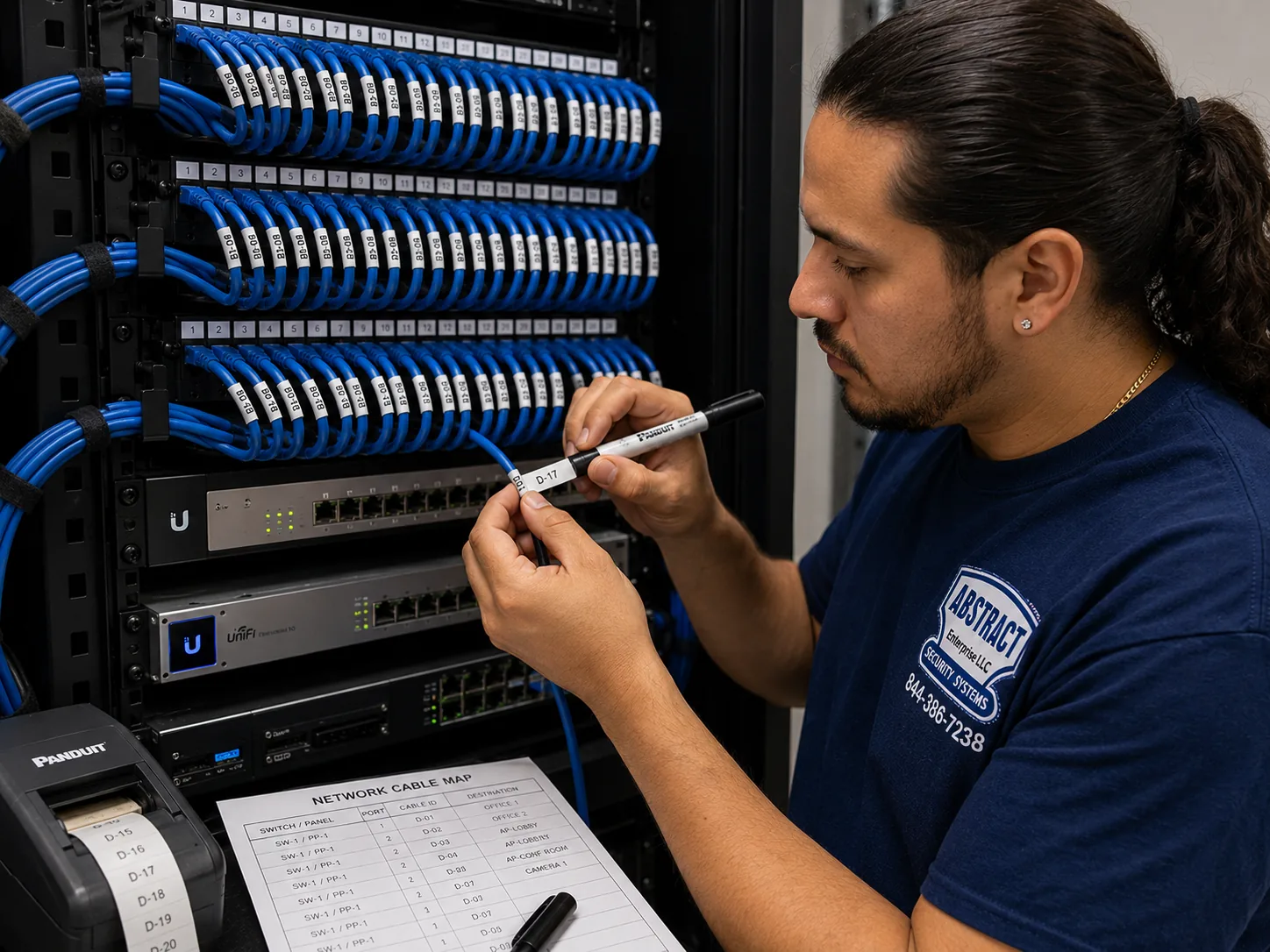
A photo from the AESS job library, not taken in Brooklyn: a technician printing cable labels at a patch panel, with a printed port map taped up beside it. A eufy system in a Brooklyn two-family or walk-up is smaller than this, but the habit is the same. Every wired camera, the HomeBase and the router port it hangs off get named, so the next person who opens the basement closet under a brownstone stoop knows which cable feeds the front door and which one climbs to the rear yard.
Brooklyn eufy Camera Request
Brownstone, rowhouse, two-family, walk-up or shop: tell us the cross streets and what you want to watch, and a technician calls back with the plan and the total
✅
Request Sent!
Thank you. A technician will call you about the Brooklyn address on the same working day.
25+
Years Experience
✓
Same-Day Estimates
100%
Licensed & Insured
4.7★
201 Google Reviews
Owner-operated since 2002 · Thousands of jobs completed · Booked within 2 hours
eufy camera installation in Brooklyn is mostly a job about brick, stoops and permission, not about the camera itself. We mount eufy doorbells, battery cameras, solar panels, floodlights and HomeBase systems on rowhouses, two-families, walk-ups, detached houses and storefronts across the borough at our Brooklyn rate. A full installation is priced line by line from our Brooklyn eufy price list; if you already own the cameras and only need them set up properly, a setup-only visit is $225 for the first hour, then 30-minute blocks. Requests are booked within 2 hours. The quickest way to an exact total is four photos: the front of the building from the sidewalk, the door or stoop where the doorbell would go, the rear yard from your back window, and the spot where your router lives. Add the model names of any eufy equipment you already have, or the one you are thinking of buying, and send it all with your cross streets to (347) 934-8335 or on WhatsApp. You will usually hear back the same day with the wall types we expect, the power option for each camera, and whether anyone besides you has to sign off.
Looking at photos and answering questions costs nothing. The price you agree is the price you pay unless the wall or the power turns out to be different, and if it does, we say so before drilling.
All camera work falls under New York State license #12000287431, and a certificate of insurance for a managing agent, co-op board or landlord is sent before the visit.
We turn on two-step sign-in and, where the model offers it, end-to-end encryption before we leave, and the eufy account stays in your name, not ours.
The Neighborhood
Why Brooklyn Properties Need eufy Camera Installation
Brooklyn was a city before it was a borough. The Dutch West India Company chartered the village of Breuckelen in 1646, and the old town of Brooklyn was one of six in Kings County, alongside Bushwick, Flatbush, Flatlands, Gravesend and New Utrecht. It joined New York City on January 1, 1898, and by the 2020 census it held 2,736,074 people, more than any other borough. What matters for a camera installer is what those people live in. The Census Bureau's 2023 survey for Kings County counts 175,805 homes in two-unit buildings and 170,655 in three- and four-unit buildings, so roughly 346,000 households live in small multi-family houses. Another 93,812 live in one-family attached houses, the classic rowhouse, and only 52,359 in detached houses. Put simply, most Brooklyn front doors open onto a stoop, a shared vestibule or a sidewalk within a few feet of a neighbor's door, and most back windows look across a yard at the back of the next row.
Those houses are old. The same survey puts the median Kings County home at 1943, with more than half a million built in 1939 or earlier. The brownstone belt, which covers Brooklyn Heights, Stuyvesant Heights, Fort Greene, Park Slope, Carroll Gardens, Cobble Hill, Boerum Hill, Clinton Hill and Vinegar Hill, is the famous part, but Brownstoner's architectural history makes a point that changes how we mount a camera: most brownstones are really brick houses with a four- to six-inch facing of brownstone on the street front. Behind that soft stone, and along every side and rear wall, is brick. In Bay Ridge, Bensonhurst, Sunset Park, Flatbush and East Flatbush the fronts are often brick or limestone without the brownstone skin, and in Ditmas Park, Prospect Park South and Kensington, which were laid out as suburbs of detached houses, wood frame and clapboard come back. A eufy camera that simply sticks to vinyl siding on Long Island needs a masonry bit, a sleeve anchor and a careful choice of joint in most of Brooklyn.
The reasons people call are just as local. CBS New York has run footage of package thieves on an apartment building on Eldert Street in Bushwick, inside a lobby on Lawton Street, and walking up the steps of a house near Montgomery Street and New York Avenue in Crown Heights. In Cypress Hills, a homeowner on Crescent Street between Atlantic Avenue and Fulton Street was slashed by a package thief. News 12 Brooklyn reported in December 2025 that around 90,000 packages are stolen across the city every day, using a city Department of Transportation figure, and Security.org's national survey found apartment residents more than three times as likely as single-family residents to have had a package stolen in the previous three months, 10 percent against 3 percent. The New York Attorney General's own advice to residents is to use a doorbell camera or video system to deter thieves or help police identify them. In a borough of stoops and shared vestibules, that advice lands on a lot of doors.
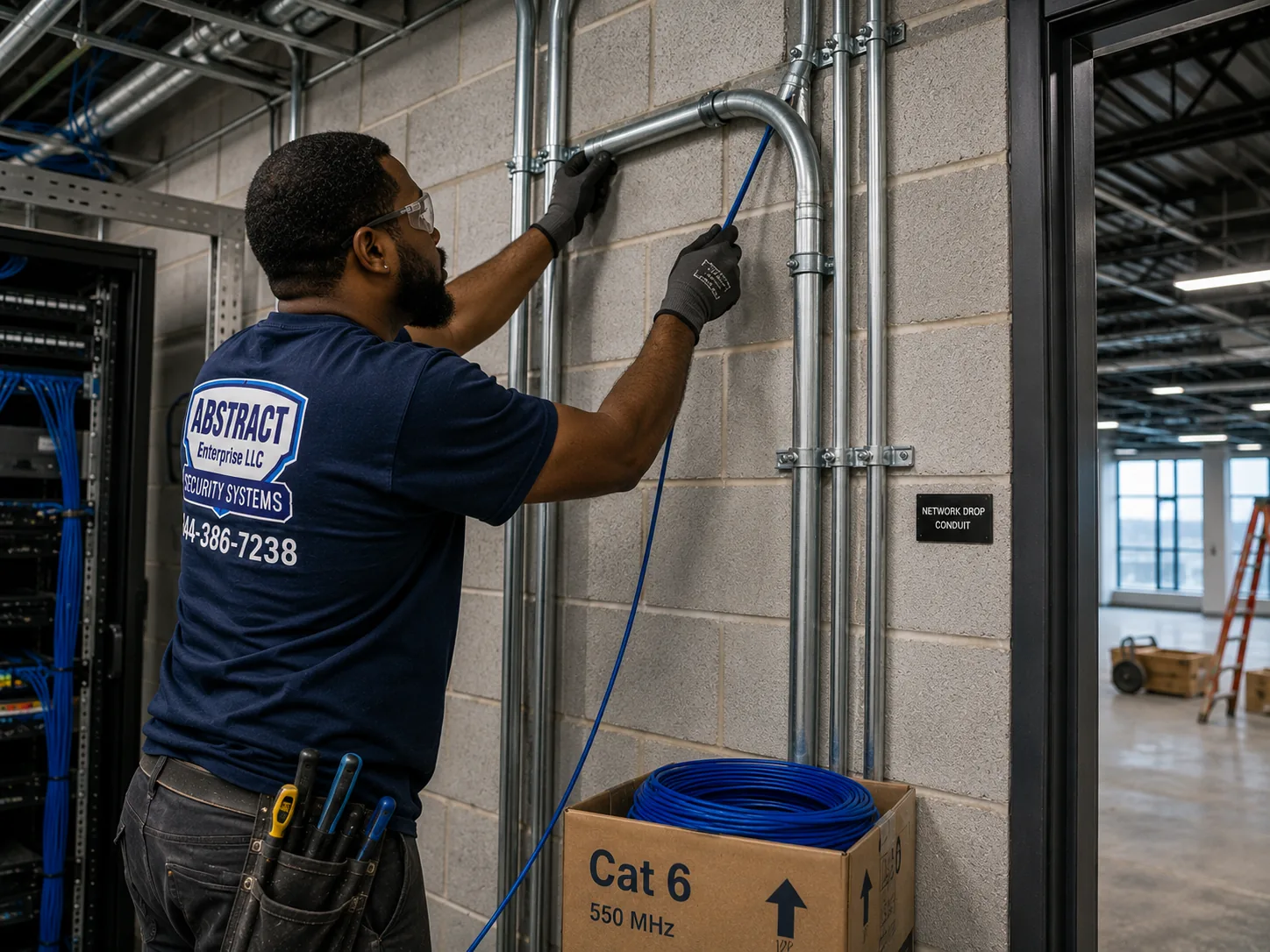
A photo from the AESS job library, not taken in Brooklyn: boxes of cable staged on the floor of a working commercial space before a multi-drop pull. Most Brooklyn eufy jobs are battery and Wi-Fi cameras that need no cable at all, but a small walk-up or a three-family that wants wired cameras at the front, the rear and the cellar door starts exactly like this, with the runs counted and the materials laid out before a single hole goes into the brick.
The back of the house matters as much as the front. In June 2018 the Brooklyn Eagle reported that police were looking for a man linked to at least a dozen burglaries in the 61st and 62nd Precincts, covering Bensonhurst and Gravesend, since August 2017, and that in every known case he had forced open a window at the rear of the house. A CBS report from October 2019 described two people burglarizing a Bushwick home near Central Avenue and George Street while the resident was in the backyard, and the incident was caught on surveillance footage. A rear yard in attached Brooklyn housing is dark, enclosed by fences and the backs of other houses, and invisible from the street. A battery eufy camera is one of the cheapest ways to watch it, but it is also where the HomeBase signal has the furthest to travel through brick, and where a solar panel may see only a few hours of sun between the walls.
Then there is trust. In January 2025, Attorney General Letitia James announced that three companies distributing eufy cameras would pay $450,000 after her office found that, in certain situations, video sent over the internet from eufy products was not protected by end-to-end encryption and at least part of the connection used no encryption at all; one outlet reported a $640,000 figure, so the reports differ. The distributors agreed to proper encryption, regular penetration testing and a vulnerability management program. Earlier, Tom's Guide reported eufy owners seeing live and recorded feeds from strangers' cameras. And on March 2, 2026, Representative Elise Stefanik and Senator Rick Scott asked the FCC and the Commerce Department for a formal investigation into Anker, eufy's parent company. None of that means a eufy camera cannot be set up responsibly, but it does mean the settings matter, and Mozilla's privacy review notes that on at least one indoor model, end-to-end encryption for cloud video is available but not on by default. Turning it on is part of our installation, not an afterthought.
Six Brooklyn facts that shape a eufy installation before we pick a mount
Small multi-family buildings dominate. About 346,000 Kings County homes are in two- to four-unit buildings, by the 2023 census survey. In those buildings the front door, the vestibule and the yard are usually shared, so a camera aimed there affects more than one household.
More than half a million homes predate 1940. With 513,629 units built in 1939 or earlier, solid brick behind plaster or brownstone is the wall we expect first, and a camera bracket has to go into the brick, not the soft mortar between bricks.
Brooklyn holds the most landmarked buildings in the city. LPC's 2018 newsletter put the borough at nearly 15,900 designated buildings and sites, more than any other. Brooklyn Heights became New York's first historic district on November 23, 1965, and the list has kept growing, most recently with Willoughby-Hart in 2024.
Doorbell power is rarely simple. eufy says its wired doorbell needs 16 to 24 volts AC from a transformer rated 30VA or more, and that it does not work with intercom power or signal systems. Many Brooklyn walk-ups and converted brownstones have a building buzzer at the street door, not a doorbell.
Brick eats wireless range. A third-party eufy guide warns that HomeBase range can drop sharply in homes with brick walls, several floors or a lot of electronics, which describes a three-story Brooklyn rowhouse with the router on the parlor floor and a camera in the rear yard.
Outdoor outlets are scarce. eufy's plug-in floodlight runs on an ordinary three-prong cord, but it still needs an outdoor outlet within reach, and those are rare on the bare brick back walls of Brooklyn yards and alleys.
Where this page applies. This page covers the whole borough, from Greenpoint and Williamsburg down to Coney Island and Sheepshead Bay, and from Red Hook and Sunset Park east to Canarsie, East New York and City Line. Every Brooklyn address is billed at the same Brooklyn rate, whether the lease calls it Bed-Stuy, Stuyvesant Heights or Ocean Hill. For the citywide picture, including what we do in Manhattan, Queens, the Bronx and Staten Island, see our eufy camera installation NYC page, which this Brooklyn page sits under.
Same-Day Repair in Brooklyn
Need Repair in Brooklyn? A eufy Camera That Went Offline, Fell Off the Brick, or Stopped Recording the Back Yard
The eufy repair calls we get from Brooklyn tend to fall into four kinds, and the buildings explain most of them. The first is a camera that keeps dropping off the app. In a rowhouse, that is usually a signal problem rather than a broken camera: the HomeBase or router is on one floor, the camera is on the outside of a solid brick wall two floors away, and on a cold or wet evening the link fades just enough to disconnect. Moving the HomeBase, adding a properly placed extender or swapping to a wired unit at that position usually fixes it without buying a new camera. The second is a camera on the ground under its bracket. Adhesive pads that held on a smooth painted wall in spring let go on rough, cold brick in winter, and plastic plugs pushed into a mortar joint work loose as the joint crumbles around them.
The third kind is a wired doorbell that never worked, or worked for a week. We often find it connected to a building buzzer line, which eufy says its wired doorbell cannot use, or to an old doorbell transformer too weak for the 16 to 24 volts and 30VA the doorbell needs. The fourth is a system that records but nobody can see: the person who set it up moved out, the account belongs to a former tenant or a relative, and the current owner cannot sign in. For all four, call (347) 934-8335 or send a photo of the camera and the app screen on WhatsApp. A setup-only visit for equipment you already own is $225 for the first hour, then 30-minute blocks, on our list, and if the fix needs a new mount on masonry we tell you the wall add before we start. If a camera has fallen, do not stick it back on with new pads until we have looked at why the first ones failed; the same wall will usually drop it again.
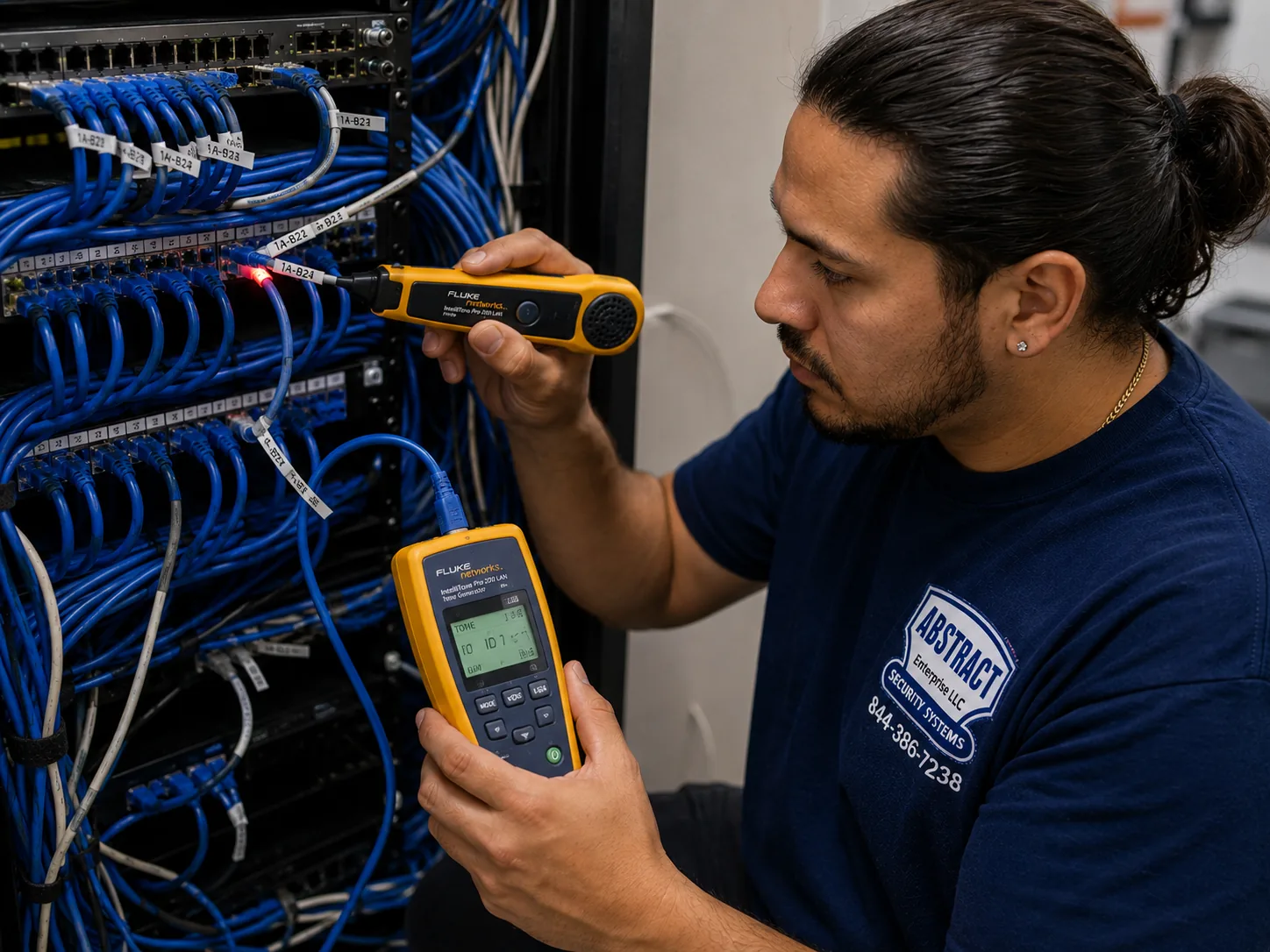
A photo from the AESS job library, not taken in Brooklyn: a technician using a tone generator and probe to find which unmarked cable is which at a patch panel. In an older Brooklyn walk-up, the same tool tells us whether the pair of wires at the front door is a real doorbell circuit or a leftover buzzer line, before a eufy wired doorbell is connected to something that cannot power it.
What We Install
eufy Camera Installation Services in Brooklyn
Each service below is quoted from our Brooklyn eufy list. The building decides the mounting method, the power decides what kind of eufy unit fits each spot, and the people who share the doors and the yard decide how the cameras are aimed and who sees them.
Doorbells at stoops and street doors
eufy wired or battery doorbells at rowhouse and two-family doors, positioned to see the top of the stoop and the parcel spot, with the power checked against eufy's 16 to 24 volt requirement before anything is connected.
Rear-yard battery and solar cameras
Battery eufy cameras on the back wall over the yard and the rear windows, with solar panels placed where the light reaches between the rows, and a signal check from the HomeBase before the bracket goes up.
HomeBase planning through brick
Choosing where the HomeBase sits in a narrow, multi-floor brick house so it can reach both the stoop and the yard, and adding wired links where the walls are simply too thick for wireless.
Floodlight cameras over yards and driveways
Plug-in eufy floodlights where an outdoor outlet exists, and hardwired models on an existing exterior box, aimed down so the light stops at your fence instead of the neighbor's bedroom window.
No-drill setups for renters
Window cameras flat against the glass on first- and second-floor units, indoor cameras facing the apartment door, and doorbell options that do not touch the landlord's façade or a shared hallway wall.
Small-building and storefront systems
Cameras on the street door, vestibule, mailboxes, cellar door and yard of small walk-ups, and eufy setups for shops on the avenues, with account sharing and footage access agreed in writing.
Building Specialists
eufy Camera Installation for Brooklyn's Architecture
Six kinds of building account for nearly every Brooklyn eufy call. They differ in what the outside walls are made of, how far a wireless signal has to travel from the router to the camera, and who besides you gets a say in what goes on the front. Those three things settle the plan long before anyone compares models.
The brownstone rowhouse
A brick house with a soft stone face, a high stoop, a garden floor below and a yard behind. Often inside a historic district, often with the router on the parlor floor.
The brick two-family
The single most common small building in the borough by census count. Two households share the street door, sometimes the vestibule, and nearly always the yard.
The three- and four-family house
Stacked flats with a shared entrance and a buzzer panel, common in Bushwick, Ridgewood's Brooklyn edge, Sunset Park and Bay Ridge. The owner may live in one unit.
The walk-up apartment building
Prewar buildings of five or six stories with a lobby, mailboxes, a cellar and rear yard. Common areas belong to the landlord, and many tenants want a camera on their own door.
The detached house with a driveway
Ditmas Park, Prospect Park South and Kensington's frame houses, and the detached and semi-detached homes of Mill Basin and southern Brooklyn, with driveways and side yards.
The new condo or rental
Towers and mid-rises in Downtown Brooklyn, Williamsburg, Greenpoint and Gowanus, with glass, concrete and a management office that controls every door but your own.
The brownstone rowhouse: soft stone in front, brick everywhere else
A brownstone is the building where the wrong drill bit does the most damage. Brownstone is a sandstone that weathers and flakes, and on most Brooklyn rowhouses it is only a facing a few inches thick over a brick structure, which is why we do not anchor a camera into the face of the stone if there is any alternative. On the front, the usual answer is a doorbell at the door frame or the vestibule, which needs no masonry fixing at all, and a camera tucked under the stoop, inside the areaway or at the door opening where it is hard to see from the street. The rear wall, by contrast, is almost always plain brick, which holds an anchor very well when the hole goes into the brick itself. That front-and-back split also matches what several Brooklyn installers describe for landmarked houses: cameras concealed at the rear, cabling through the yard, the interior stair or the roof bulkhead, and a single discreet unit, often a doorbell, at the front stoop.
Inside, the brownstone works against wireless. The router usually sits on the parlor floor, the rear camera hangs off the back wall of the garden floor or the floor above, and between them are plaster walls, a brick bearing wall or two and a floor. We test the signal at each camera position with a meter before choosing between a HomeBase on the parlor floor, a HomeBase closer to the back of the house, or a short wired run for the hardest spot. If the house is in one of Brooklyn's historic districts, the plan for the front is discussed before the visit, because the Landmarks Preservation Commission's rules cover cameras and intercom panels on a primary façade, and we would rather put the front camera in a place that needs no application than in one that does.
The brick two-family: two households, one stoop, one yard
Brooklyn's two-family houses hold about 175,805 homes by the 2023 census count, and almost every eufy question in them comes back to sharing. The street door, the stoop and the yard usually serve both units, so a doorbell at the street door records the upstairs tenant's visitors as well as the owner's. That is not a reason to skip it; it is a reason to decide, before installation, who gets access to which camera in the eufy app and whether the tenant is told. We set up the owner's account as the main account, share only the cameras each person should see, and leave a short written note of who has access to what. If the tenant has their own entrance, such as a garden-floor door under the stoop, that door can have its own doorbell on the tenant's own account.
The construction of a two-family is usually simpler than a brownstone: brick front or a limestone or brick facing, brick rear, plaster inside. Front cameras go on the door frame, under the cornice or at the side of the entrance, and the rear camera on the back wall above the yard door. Because the owner often lives downstairs and the tenant upstairs, the HomeBase may end up in the owner's unit on the ground floor, which is close to the yard and the front but far from any upstairs window camera. We place it for the cameras that matter most to the owner and check the signal to the others before deciding.
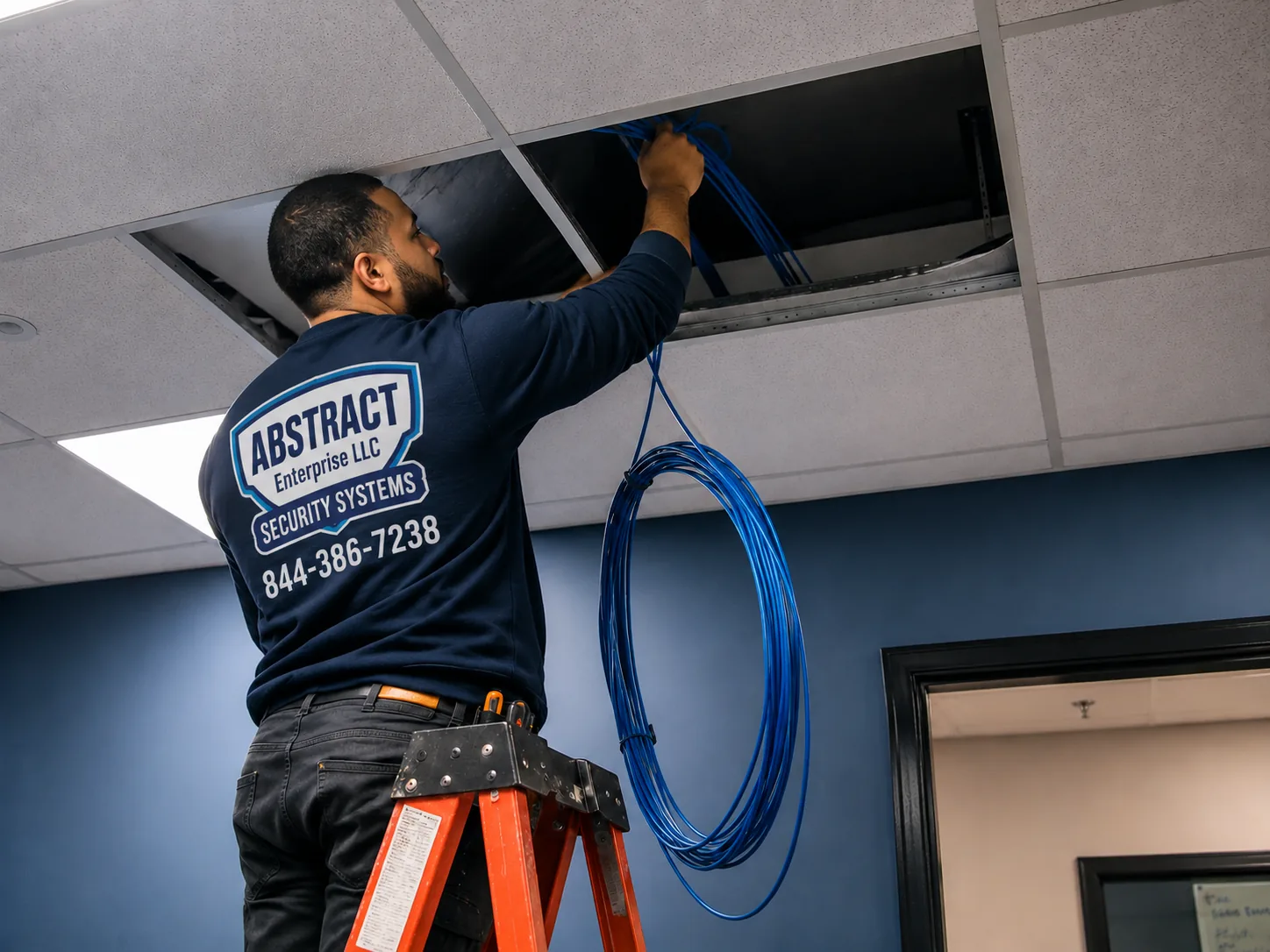
A photo from the AESS job library, not taken in Brooklyn: a technician feeding cable up through a ceiling opening while the space stays in use. In a Brooklyn brownstone the equivalent route for a wired rear camera often runs through the cellar ceiling or up the inside of the stair, so nothing new appears on a landmarked front and the family can keep living in the house while the work goes on.
The three- and four-family house: a buzzer at the door and an owner in the building
Three- and four-unit buildings hold another 170,655 Brooklyn homes, and they are where eufy's doorbell limits show up most. Many have a buzzer panel at the street door wired to each apartment, and eufy states plainly that its wired doorbell does not work with intercom power and signal systems, although the wiring can be reused if the intercom is retired. Few owners want to retire a working intercom for one doorbell, so the usual eufy answer here is a battery doorbell on the owner's own door inside the building, a camera above the street door that watches the stoop and the parcel spot, and the intercom left alone. Where the intercom is already dead and the owner wants it gone, we check the old pair of wires for a proper transformer before reusing them.
The owner of a three- or four-family is also a landlord, and that changes how cameras are aimed. A camera at the street door, in the vestibule or over the mailboxes covers a common area that every tenant uses. Courts and New York's housing agency take any landlord action that could be read as harassment of a rent-stabilized tenant seriously, and hallway footage has been used in stabilized housing disputes. We point common-area cameras at doors, mailboxes and parcels, not at the doors of individual apartments, keep audio off, and suggest the owner tells tenants in writing what the cameras cover. The wall work itself is ordinary brick, and the cellar usually gives an easy indoor route for any wired camera.
The walk-up apartment building: the landlord owns the hallway, the tenant owns the door
In a prewar walk-up we often work for two different customers in the same building: the owner who wants the lobby, mailboxes, cellar and yard watched, and the tenant who wants to see who is outside their own door. For the owner, the job looks like a small commercial system: cameras at the street door and lobby, the mailbox wall where packages pile up, the cellar door and the rear yard, with a HomeBase in a locked closet and wired runs where the brick is too thick for Wi-Fi. For the tenant, the rules are different. Brick Underground's guidance is that a tenant needs the landlord's permission to install equipment in common areas, which includes the hallway outside the apartment, and a doorbell camera on the unit door sits in a gray zone that most landlords tolerate but that a lease's alteration clause technically covers.
So for tenants we usually start with options that touch nothing the landlord owns. An indoor eufy camera facing the inside of the apartment door shows anyone who comes in. A window camera mounted flat against the glass works well on a first- or second-floor front window, as eufy itself recommends, and can watch the stoop and sidewalk. A battery doorbell on the unit door is possible once the landlord agrees, and is easy to remove and patch when you move. The construction of these buildings is masonry outside and often plaster on hollow tile or block inside, which is another reason we prefer not to drill a tenant's hallway walls at all.
The detached house with a driveway: Victorian Flatbush and the southern shore
Brooklyn has only about 52,359 detached homes, but they produce some of our largest eufy jobs. Prospect Park South, Ditmas Park and Kensington were developed as suburbs of freestanding houses, and many are wood frame with clapboard or shingle walls, porches and side driveways leading to a rear garage. In southern Brooklyn, a neighborhood guide to Mill Basin describes mostly detached and semi-detached homes, many with driveways, private outdoor space or waterfront access near Jamaica Bay. These houses need more cameras, cover longer distances and have the daylight that battery and solar cameras need, which makes eufy's wireless line a better fit here than on a narrow rowhouse.
The challenge in a detached house is distance rather than brick. A camera on a rear garage may be fifty feet or more from the router, through an exterior wall and across open air, and a camera on the far side of a porch roof may lose sight of the HomeBase behind a chimney. We plan the HomeBase position for the outermost cameras, not the nearest, and test the signal at the garage before mounting. Frame walls are easy to fix into, so the wall add-ons that apply to brick usually do not apply here, but porches and trim boards mean we choose fixing points carefully so a camera does not end up on a rotting piece of fascia. If the house is in the Ditmas Park Historic District, designated in 1981, the front is handled as a landmark front.
The new condo or rental: glass, concrete and a management office
Since the 2004 Downtown Brooklyn rezoning, the Downtown Brooklyn Partnership counts more than 22,000 new homes in that district alone. The Greenpoint and Williamsburg waterfront was rezoned in May 2005, and Greenpointers reported that 2,306 units were added in that community board in 2023, the most in Brooklyn that year. Gowanus followed with its neighborhood plan adopted on November 23, 2021. Tenants and owners in these buildings almost never control a façade or a hallway wall, and the building usually has its own camera system in the lobby, garage and amenity spaces. The eufy question here is nearly always the apartment door and the inside of the apartment.
That makes these jobs quick and mostly no-drill: an indoor camera facing the door, a battery doorbell on the unit door where the condo board or management allows, and a careful Wi-Fi setup in apartments where concrete floors and glass walls do strange things to signal. A board or management office may ask for a certificate of insurance and set working hours, and we send the certificate before the visit. If the building has a rule against anything on the corridor side of the door, we stop at the inside of the apartment and say so plainly, rather than mounting something that will be removed by the super the next morning.
Field Notes
Field Notes: The First Twenty Minutes at a Brooklyn eufy Job
These notes describe how our technicians start a eufy installation in Brooklyn's attached houses. They are our routine, not a story about any one address.
Walk to the back fence first. Before unpacking anything, the technician goes through the house to the rear yard and looks back at the building. The rear wall is where the trouble usually is: the furthest point from the router, the wall with the least light for a solar panel, and the side of the house that faces twenty or thirty other windows across the yards. Standing at the fence shows what the camera will see and what the neighbors will see of it.
Find the router and the power. Next comes the router, usually in the front room of the parlor floor, and every outlet near the front door and the yard door. A eufy plan in a rowhouse is built backwards from those two things. If there is no outdoor outlet in the yard, a plug-in floodlight is off the table unless an electrician adds one.
Meter the signal at each spot. With the HomeBase or the router in its proposed position, the technician stands where each camera will hang and checks the signal on the phone. Brick party walls and floors make the numbers drop fast, and a camera that connects in the yard at noon may not hold on a wet night. If the number is marginal, the HomeBase moves or the plan changes before any drilling.
Read the stoop and the door. At the front, the technician opens the doorbell or buzzer button and looks at what is behind it. A pair of thin wires to a chime and a small transformer is a doorbell. A multi-wire cable to a panel in the vestibule is an intercom, and eufy's wired doorbell will not run on it.
Mark, check on the phone, then drill. Each camera position is marked with tape, the camera is held there and the live view checked, and only then does the masonry bit come out. Moving tape costs nothing. Moving a hole in a hundred-year-old brick does.
Wall by Wall
Brick, Brownstone, Mortar and Siding: How a eufy Camera Is Fixed to a Brooklyn Wall
eufy cameras are light. A doorbell or a battery camera weighs very little compared with a TV, and that leads many people to treat the mount as an afterthought. The problem is not the weight; it is time, weather and hands. A camera on a Brooklyn stoop gets pulled, knocked by deliveries and soaked by winter rain that freezes in every crack. A camera on a rear wall is baked by summer sun and frozen in January. The fixing has to survive that for years, on walls that are often a century old.
Solid brick. The rear and side walls of almost every Brooklyn rowhouse, two-family and walk-up are brick, and brick is an excellent base when the anchor goes into the brick itself. The common mistake is to drill the mortar joint because it is softer and easier. Mortar in older Brooklyn walls is often crumbly lime mortar, and a plug in a joint works loose as the joint erodes around it. We drill into the face of the brick with a masonry bit, keep the hole away from the brick's edges, and use anchors sized for the bracket. On our list, a brick or stone wall add is $65 where it applies, because the work needs a hammer drill, the right bits and more time than a wood wall.
Brownstone facing. Brownstone is soft, layered sandstone, often only four to six inches thick over the brick behind it. Drilling it risks spalling, where the face flakes away around the hole, and a damaged brownstone face is expensive to repair. On a brownstone front we prefer fixing points that avoid the stone entirely: the door frame, the vestibule, the underside of the stoop or the areaway. If a fixing into masonry is unavoidable, we look for a mortar joint in a part of the front where the Landmarks Preservation Commission's guidance favors it, and we discuss that with you before the visit, especially in a historic district.
Mortar joints, when they are the right choice. There is one situation where the joint is preferred: when the masonry itself is historic and the goal is to make the fixing reversible. LPC's guidance for landmarked buildings generally favors attaching equipment through mortar joints so a later removal can be repaired by repointing rather than by replacing stone. That is a preservation choice, and on a landmarked front we follow it, using anchors suited to the joint and checking the mortar is sound before trusting it.
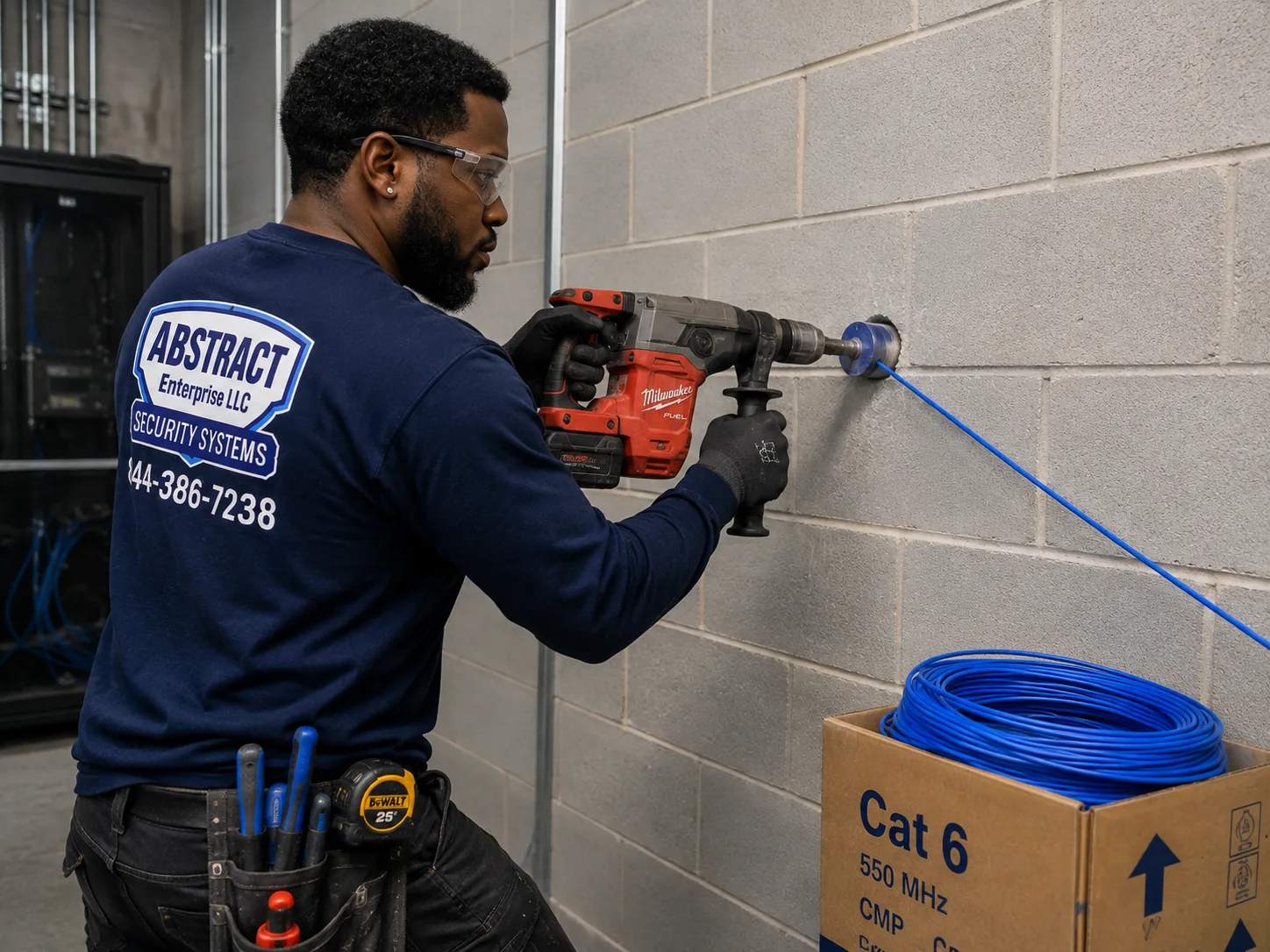
A photo from the AESS job library, not taken in Brooklyn: a technician core drilling through a concrete block wall to carry cable into a network room. A wired eufy camera on the back of a Brooklyn rowhouse rarely needs a hole this size, but the method for getting a cable through a brick rear wall is the same in principle: a clean, sealed penetration placed where it will not be seen from the street and will not let water into the wall.
Plaster inside. Indoor eufy cameras usually sit on a shelf, but some customers want one high in a corner or over the apartment door, and in a prewar Brooklyn building that wall is plaster on lath, plaster on hollow tile, or plaster on brick. A plaster wall add is $45 on our list where we mount into it. Plaster cracks if it is drilled fast, and a plastic plug in plaster alone loosens over time, so we use a slow pilot hole and an anchor that reaches the framing or masonry behind.
Wood siding and trim. In Ditmas Park, Kensington and the frame houses of southern Brooklyn, siding and trim are easy to fix into, but the timber behind a porch ceiling or a fascia board is sometimes rotten. We probe the wood before trusting it, use stainless screws that will not rust streaks down painted siding, and avoid mounting on thin trim that flexes in wind.
Adhesive and clamp mounts. eufy sells adhesive and clamp options and says they can work on brick without drilling, while still recommending drilling for a more secure installation. We agree with both halves. Adhesive can be the right answer for a renter who cannot drill, on a smooth, clean, dry surface such as a painted window frame or the inside of glass. On rough, cold, dusty brick outdoors, adhesive is the most common reason a camera ends up on the ground.
Getting power to a eufy camera on a bare brick wall
Most eufy outdoor cameras are battery powered, which is why they are popular in Brooklyn: no cable has to come through the wall. The trade-off is charging. A camera that faces a busy sidewalk wakes up every time someone walks past, and a battery that would last months in a quiet yard can drain much faster on a stoop facing a commercial street. Solar panels help where the light reaches, which on a north-facing rear wall between tall rows may be only a short part of the day. We test where the sun actually lands before placing a panel, and trim motion zones so a camera is not waking for every passer-by.
Wired doorbells need a transformer delivering 16 to 24 volts AC at 30VA or more, according to eufy. Older Brooklyn doorbells sometimes have transformers below that rating, and walk-ups often have buzzer lines instead of doorbell circuits. Hardwired floodlights need a weatherproof junction box with 120-volt power, and if there is no fixture there already, eufy says a qualified electrician must install the box and wire. Our license covers the camera and network side; we do not run new 120-volt circuits. Plug-in floodlights need an outdoor outlet, and if your yard has none, that is a conversation with an electrician or a reason to choose a battery camera with a solar panel instead.
Renters, Owners and Landmarks
Leases, Boards and the Landmarks Commission: Who Has a Say in a Brooklyn eufy Camera
In most of the borough, the person who wants a camera and the person who owns the wall are not the same. We are installers, not lawyers, and nothing here is legal advice. What follows is what public guidance says and what we have learned from doing this work, so you can ask the right question before booking.
Tenants and their own door. Brick Underground's guidance is that tenants need the landlord's permission to install equipment in the common areas of a building, and that the hallway and the area outside your apartment count as common areas. A doorbell camera on the unit door itself is, as one New York security firm puts it, a gray area: generally tolerated by most landlords, but technically subject to whatever the lease says about alterations. The practical path is to read the alteration clause, ask in writing, and say exactly what the device is and how it is mounted. A battery doorbell held by two small screws and easy to remove is a much easier request than a wired unit.
Landlords and common areas. If you own a two-family, three-family or walk-up, the common areas are yours to protect, and cameras on the street door, lobby, mailboxes and yard are common. But the way they are aimed matters, especially in rent-stabilized buildings. One New York firm notes that any landlord action that could be construed as harassment of a stabilized tenant is taken seriously by the courts and by the state housing agency, and another notes that hallway footage has been used in stabilized housing disputes. In 2018 a Brooklyn landlord's attempt to put a facial recognition camera at the entrance of a rent-stabilized building drew tenant opposition, and New York City Council materials say the landlord backed off. Brownsville tenants fought a similar facial recognition entry plan at two brick high-rises in 2019. Cameras that watch doors, mailboxes and parcels, without audio and without face matching, are the version that keeps the building safer without starting a fight.
Notice and signs. New York's Penal Law section 250.65 exempts security systems from the state's unlawful surveillance offense where a written notice is conspicuously posted or the cameras are installed so they are clearly and immediately obvious. For a building owner, a small sign at the entrance and cameras that are visible rather than hidden is the simplest way to be on the right side of that.
A photo from the AESS job library, not taken in Brooklyn: a technician running cable into metal EMT conduit beside a telecom room in an industrial building. On a landmarked Brooklyn front, visible conduit is exactly what the Landmarks Preservation Commission looks at, which is why wired eufy runs on historic houses go through the cellar, the stair or the rear wall, and conduit like this stays indoors or in a building's back spaces.
Co-ops and condos. Boards and managing agents usually have house rules covering anything mounted on the corridor side of an apartment door and any contractor working in the building. They may ask for a certificate of insurance and limit working hours. We send the certificate before the visit, and if the board allows nothing outside the door, we keep the camera inside.
Landmarked fronts. Brooklyn has more landmarked buildings than any other borough, nearly 15,900 by LPC's 2018 count, out of 38,119 buildings and sites citywide. The districts include Brooklyn Heights, the city's first, designated November 23, 1965, which runs from Atlantic Avenue to Fulton Street and from the East River to Court Street with more than 600 buildings; Stuyvesant Heights (1971); Park Slope (1973, extended in 2012); Carroll Gardens (September 25, 1973); Fort Greene (1978); Ditmas Park (1981); DUMBO (2007); Prospect Heights (2009); and Willoughby-Hart on Willoughby Avenue and Hart Street between Nostrand and Marcy Avenues (2024). LPC's Rule 2-20 treats security cameras, lighting and intercom panels as common safety equipment, and its 2018 rule amendments would generally prohibit installing many of these objects on a primary façade unless there is no feasible alternative or another agency requires the location. One security vendor describes a limit of two cameras per 25 feet of frontage on small buildings; we have not checked that against the rule text, so we treat it as a vendor's summary.
What that means in practice is that the rear of a landmarked house, which is usually not visible from the street, is far easier than the front. LPC's permit guidebook has a section on security cameras, and some changes on a landmarked front, including camera mounts and conduit, may need a Certificate of No Effect or a Permit to Alter. We plan landmarked fronts around a doorbell at the door, a camera under the stoop or in the areaway, and nothing new on the stone, and if you want something more visible, we tell you to check with LPC first.
City permits for the camera itself. A Brooklyn security vendor states that low-voltage camera installation in a residential brownstone typically does not need a Department of Buildings permit, and a New York low-voltage guide notes that wiring under 50 volts for signaling, communication, alarm and data circuits does not need an electrical permit when done by a qualified person. State law, under Article 6-D of the General Business Law, requires a license for security and CCTV installation, which is what our NYS license #12000287431 covers. New 120-volt wiring for a hardwired floodlight is electrician's work.
Privacy and Trust
Setting Up eufy So It Protects Your Privacy as Well as Your Stoop
Customers in Brooklyn ask about eufy's privacy history more than about any other brand detail, and the question is fair. The New York Attorney General's 2025 settlement found that video from eufy products was not always protected by end-to-end encryption and that part of the connection sometimes used no encryption at all. Tom's Guide reported owners seeing strangers' feeds. A Slickdeals commenter complained that the app shows ads for other products before the camera feed, and another that eufy recordings are useless without an internet connection and the app. And in March 2026 two members of Congress asked federal agencies to investigate eufy's parent company, Anker. We tell customers all of that plainly, and then we explain what can be done during installation to reduce the risk.
Encryption switched on. Mozilla's review of a eufy indoor camera notes that end-to-end encryption for cloud video is offered but not on by default. Where a model offers it, we turn it on during setup and show you where the setting lives. The settlement terms required eufy's distributors to implement proper encryption, run regular penetration tests and maintain a vulnerability program, and keeping the cameras' firmware updated is how you benefit from that work. We update every camera and the HomeBase before handover.
Two-step sign-in and your own account. The eufy account is created in your name with your email, two-step verification is turned on, and the password is yours. We do not keep a technician login on your system. If several people need access, they are added through the app's sharing feature rather than by sharing one password, so access can be removed later from one person without changing everything.
Local storage first. Many eufy systems record to the HomeBase or to storage in the camera, which means clips stay in the house unless you choose a cloud plan. We set storage so the recordings you care about are kept, and we explain what you lose if the internet goes down, because live viewing and remote access need the app and a connection.
Aim and mask. In attached Brooklyn housing, nearly every rear camera can see into somebody else's windows. We trim motion zones to your yard, use privacy masks over neighbors' windows where the model supports them, and leave audio off on cameras that face shared spaces. A camera that records only your own property is safer for you, less likely to start a dispute, and less useful to anyone who might one day get unauthorized access to it.
If you would rather not use eufy. Some customers decide, after hearing all of this, that they want a different brand or a wired system that never touches a manufacturer's cloud. That is a reasonable choice, and we install other systems too. We would rather have that conversation before you buy than after.
Commercial eufy Camera Installation
Business eufy Camera Installation in Brooklyn
Brooklyn's businesses mostly sit on avenues and in former industrial districts, and eufy suits the smaller ones: a shop that wants to see the door and the register, a restaurant that wants the back door and the delivery spot, a studio that wants to know who comes in after hours. The cards below describe kinds of space on real Brooklyn corridors where those needs come up; we do not name any business as a customer.
Fifth and Seventh Avenues, Park Slope
The neighborhood's two main shopping streets, lined with ground-floor shops under apartments, where a camera on the storefront usually needs the building owner's permission as well as the tenant's.
Fifth Avenue, Bay Ridge
The Bay Ridge 5th Avenue BID covers 65th to 85th Streets, with small restaurants and shops in mixed-use buildings and back doors on narrow yards.
Fulton Mall, Downtown Brooklyn
The pedestrian shopping street on Fulton Street between Flatbush Avenue and Adams Street, where storefronts face heavy foot traffic all day.
Eighth Avenue, Brooklyn Chinatown
The commercial strip from 39th to 65th Streets in Sunset Park, co-named Brooklyn Chinatown at 60th Street on October 23, 2026, with shops below apartments.
Industry City and the Army Terminal
Industry City's six-million-square-foot complex in the former Bush Terminal and the Brooklyn Army Terminal's four-million-square-foot campus, home to makers, studios and small firms.
The Navy Yard and East Williamsburg
The Brooklyn Navy Yard's 300-plus acres and 550-plus businesses, and the converted lofts of East Williamsburg, where small units share old factory buildings.
The common thread is that small Brooklyn businesses rarely own their buildings. A shop on Fifth Avenue may have three floors of apartments above it and a landlord who wants to approve anything fixed to the front. A studio in a converted loft shares a corridor with a dozen other tenants. Brooklyn Paper once reported four burglary reports at 35 Meadow Street in East Williamsburg, a converted former factory divided into small units, with no forced entry, a police official calling security there very weak, and no security system in the building. That kind of shared building is where a tenant's own eufy camera inside the unit, watching the door and the equipment, makes sense, along with a conversation with the landlord about the entrance.
Larger campuses have their own rules. The Navy Yard is gated and managed by its own development corporation, and campuses like Industry City and the Army Terminal have building management and their own security. A eufy camera inside a tenant suite is usually a tenant matter; anything outside the suite is the landlord's. Before a business job we confirm three things in writing: who has approved the camera positions, when the space can be worked in, and who receives the certificate of insurance. Storefronts on busy avenues also need careful battery planning, because a camera facing the sidewalk can wake up hundreds of times a day, which is often a reason to choose a wired or plug-in eufy unit for the front and save battery cameras for the back door.
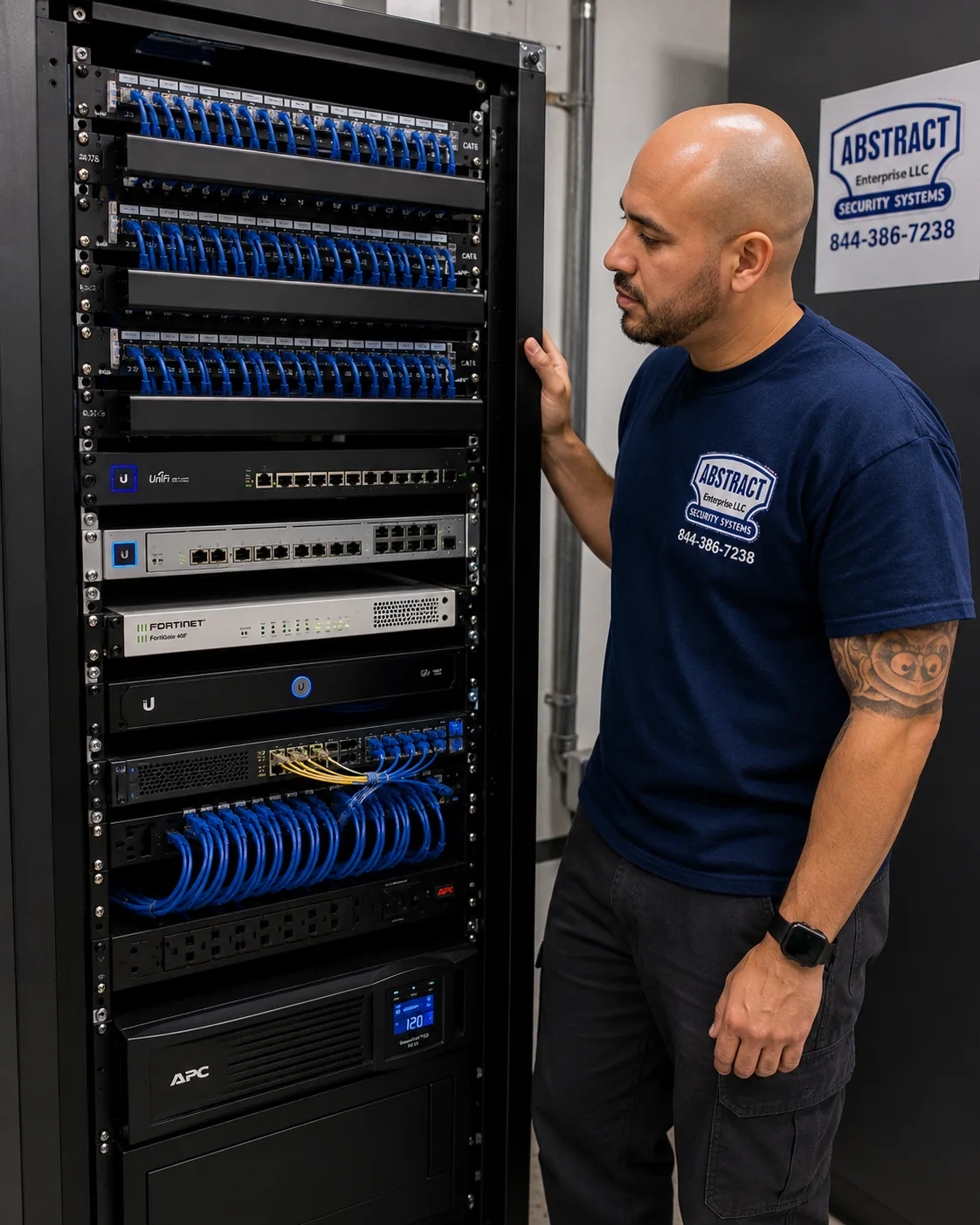
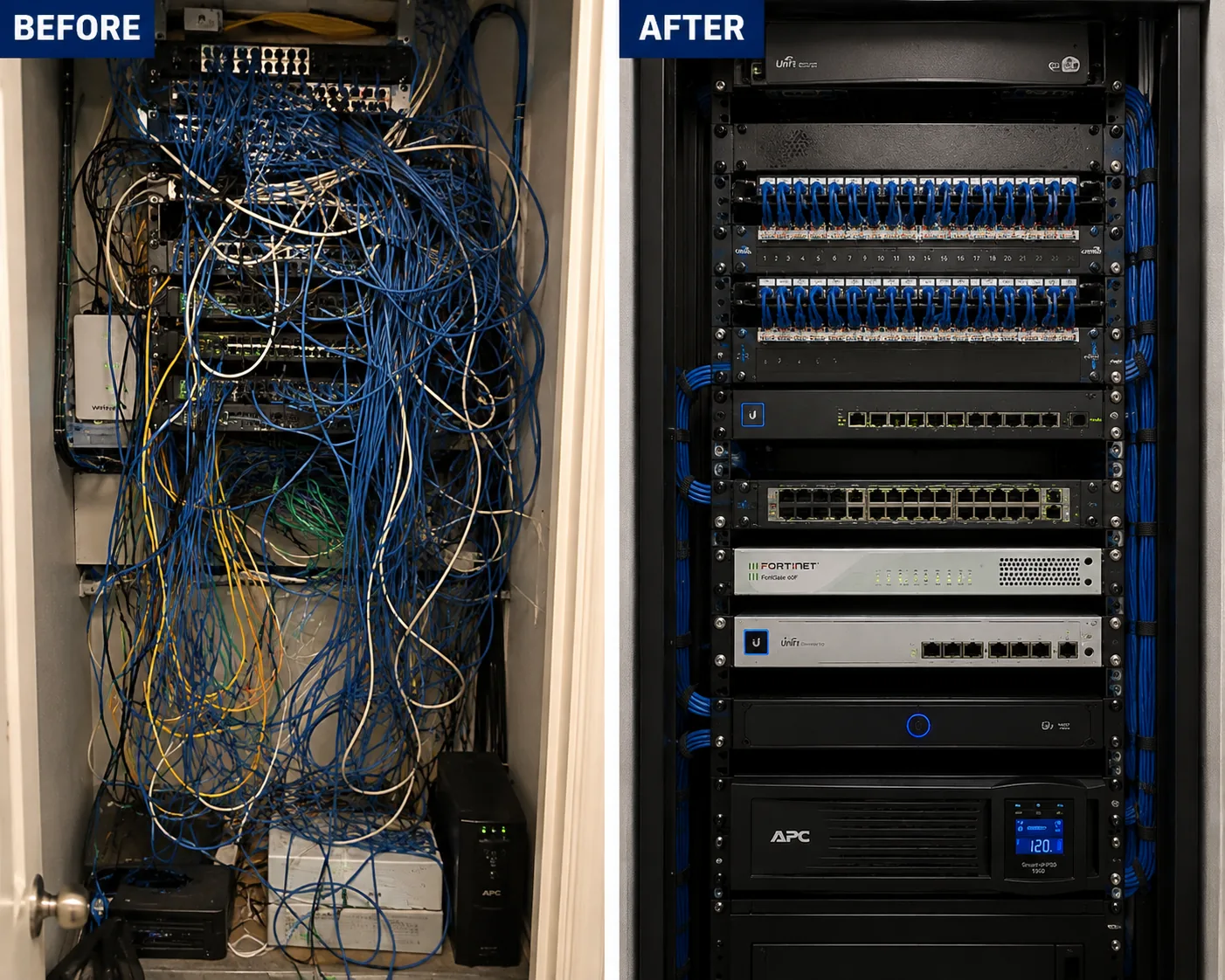
A photo from the AESS job library, not taken in Brooklyn: a finished rack with patch panels, switching, a firewall and a battery backup, all dressed and labeled. A Brooklyn shop's eufy system is far smaller, but the battery backup idea carries over: a HomeBase and router on a small backup unit keep recording through a short power blip on the block, which is when a storefront camera is often needed most.
Compliance notes for Brooklyn businesses using eufy cameras
Face recognition triggers a sign. New York City's Local Law 3 of 2021 requires covered stores, restaurants and venues that collect biometric identifier information to post conspicuous signage at all customer entrances, and the city's rules set the sign at a minimum of 8.5 by 11 inches. Ordinary CCTV is exempt as long as footage is not analyzed to identify people by biological characteristics, as facial recognition does. If a eufy camera's face features are turned on at a shop door, the sign rule applies.
Visible cameras or posted notice. Under Penal Law section 250.65, security systems are exempt from the unlawful surveillance offense when written notice is conspicuously posted or cameras are clearly and immediately obvious. We mount business cameras where they can be seen and recommend a notice at the door.
Audio is a separate decision. Whether a camera that passively picks up conversations counts as eavesdropping has never been cleanly settled, according to one New York guide, which is why business cameras are usually set up with audio off.
Landlord approval in writing. In a mixed-use building, the storefront façade and any shared corridor belong to the landlord. We ask for written approval before mounting anything outside the tenant's own space.
Landmarked storefronts. Shops inside historic districts, such as those in DUMBO or along parts of Brooklyn Heights and Fort Greene, fall under LPC's rules for equipment on a primary façade, so a camera inside the window is often the easier route.
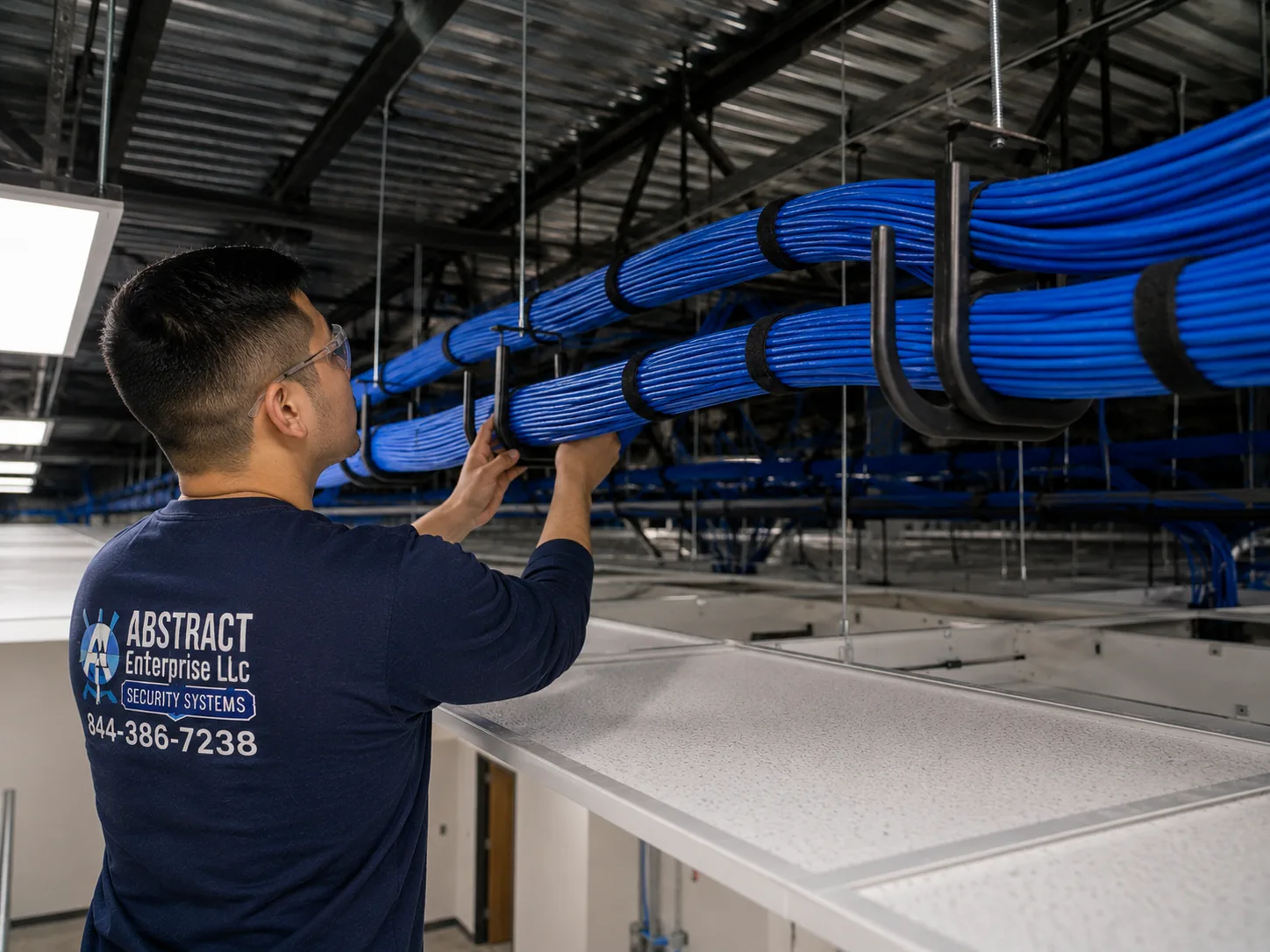
A photo from the AESS job library, not taken in Brooklyn: dressed cable bundles carried across a commercial ceiling on J-hooks. In a Brooklyn loft unit in Industry City or East Williamsburg, a wired eufy camera at the back door can follow an existing pathway like this one instead of being stapled along the ceiling, which keeps the landlord happy and the cable out of reach.
Your Questions Answered
eufy Camera Installation in Brooklyn: Questions Answered
These are the situations Brooklyn owners, tenants and shopkeepers describe when they call about eufy: stoops and parcels, soft stone and hard brick, yards with no outlet, buildings shared with tenants, and rear windows nobody can see from the street. Each is answered here in full and not repeated in the FAQ below.
Stoops, vestibules and packages
Where should a eufy camera sit on a Brooklyn stoop so it actually catches someone taking a package?
Higher and closer than most people think, and aimed at the spot where boxes land, not at the street. On a stoop, couriers usually leave parcels at the top step, inside the vestibule or against the door, so the camera's job is to see that spot and the face of anyone bending over it. A doorbell at chest height beside the door catches faces well but can miss a box left low and to one side; a camera above the door frame looking down sees the box but only the top of a head. On many Brooklyn stoops the best answer is both, or a doorbell with a downward-facing second lens where the model has one. The CBS footage from Crown Heights showed a thief simply walking up the steps, which is the moment you want in frame. We test the view with a box placed where your deliveries actually go.
Packages pile up in our walk-up's lobby every day. Can a eufy camera watch the mailbox wall without filming tenants' apartment doors?
Yes, and it is one of the most common building-owner requests we get. CBS New York has reported thefts from a lobby on Lawton Street in Bushwick, and the pattern in small walk-ups is the same: boxes stacked by the mailboxes, a street door that does not always latch, and no one watching. A eufy camera high on the lobby wall, aimed at the mailboxes and the inside of the street door, records who comes in and who picks up what. We keep the view off the doors of individual apartments and off the stairs leading to them, leave audio off, and suggest a small notice at the entrance. A wired or plug-in unit is better than a battery here, because a busy lobby triggers motion all day.
Brownstone, brick and mortar
Will drilling for a eufy mount crack the brownstone on the front of our house?
It can, which is why we avoid drilling brownstone wherever there is another option. Brownstone is a soft, layered sandstone, and on most Brooklyn rowhouses it is a facing only four to six inches thick over brick. A hammer drill on a weathered face can spall the stone, leaving a flaked patch around the hole that is costly to restore. On a brownstone front we use the door frame, the vestibule, the underside of the stoop or the areaway, none of which needs a hole in the stone. If the house is in a historic district, those locations are also the ones least likely to need anything from the Landmarks Preservation Commission. The brick on the rear and side walls is a different material and takes an anchor well.
Do you fix the bracket into the brick itself or into the mortar line, and how deep does the hole go?
On an ordinary brick rear or side wall, into the brick. Old Brooklyn mortar is often soft lime mortar that crumbles, and a fixing in a joint loosens as the joint wears around it. We drill into the face of a sound brick with a masonry bit, keep away from its edges, and set the hole only as deep as the anchor needs, which for a light eufy bracket is a short depth into a wall that in older Brooklyn houses is much thicker. The exception is a landmarked front, where preservation guidance generally favors fixing through mortar joints so the masonry can be repaired by repointing if the camera is ever removed. In that case we check the joint is sound first. Where the list's brick or stone wall add applies, it is $65.
Is double-sided tape or a clamp strong enough to hold a eufy camera on Brooklyn brick?
Sometimes indoors or on glass, rarely outdoors on brick. eufy says adhesive strips and clamp mounts can work on brick without drilling, and in the same article recommends drilling for a more secure installation. Our experience on Brooklyn rear walls matches the second part: brick is rough, porous and dusty, it gets wet and freezes, and adhesive that grips on day one often lets go after the first cold snap. If you cannot drill, a clamp onto a gutter bracket or a railing you own, or a camera inside a window, is usually more reliable than tape on masonry. If you can drill, a small anchored bracket is cheap insurance against a camera on the ground.
How do you get the cable to a wired eufy camera on a brick rowhouse without it showing on the outside?
By starting indoors and coming out where the camera is. On a Brooklyn rowhouse, the usual routes are through the cellar ceiling to the rear wall, up the inside of the stair to a top-floor window head, or through the roof bulkhead for a camera under the rear cornice. Several Brooklyn installers describe the same approach for landmarked houses: cabling through the rear yard, interior stairwells or roof bulkheads, so nothing new appears on the front. The hole through the brick sits directly behind the camera's base, so the cable is hidden the moment it leaves the wall, and it is sealed against water. Long visible runs of conduit or cable stapled to a façade are what we try hardest to avoid.
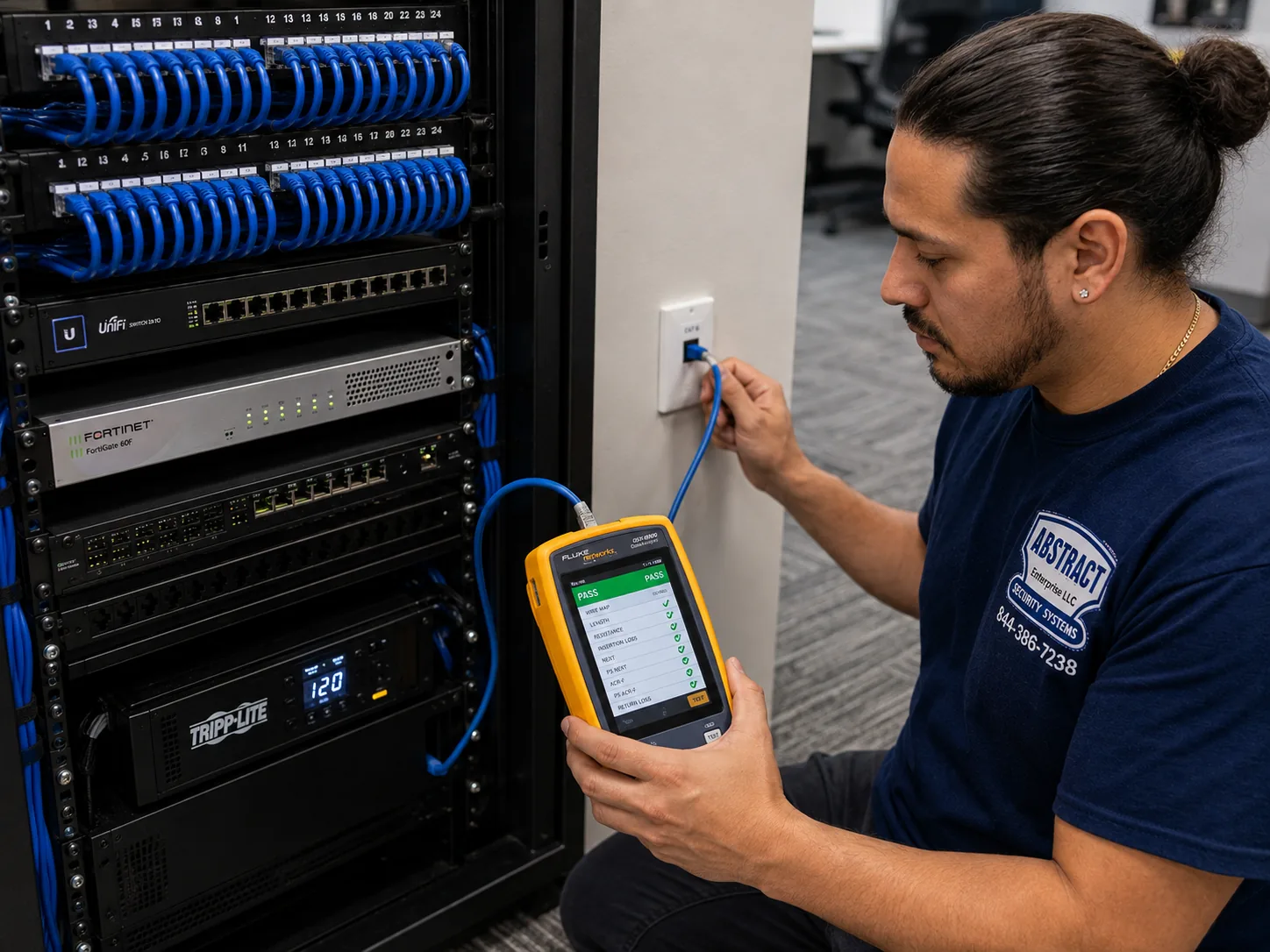
A photo from the AESS job library, not taken in Brooklyn: a technician testing a data drop with a cable analyzer that shows a PASS result. When a wired eufy camera goes on the back of a Brooklyn rowhouse, the cable that runs through the cellar and the brick is tested before the camera is connected, so a fault in the wall is found on the day, not months later when the yard camera goes dark.
Power, batteries and the rear yard
Our rear yard has no outdoor outlet anywhere. Can a plug-in eufy floodlight still go back there?
Not without an outlet, and a long extension cord through a window is not a safe substitute. eufy's plug-in floodlight runs on a standard three-prong cord, which avoids a junction box, but it still needs an outdoor outlet within reach of the cord, and bare brick rear walls in Brooklyn yards and alleys rarely have one. You have three honest choices. An electrician can add a weatherproof outdoor outlet, after which we mount and set up the floodlight. A battery eufy camera with a solar panel can watch the yard without any power at all, though without the floodlight's brightness. Or, if there is already a light fixture on the rear wall on a junction box, a hardwired floodlight may be able to replace it. We look at your wall and tell you which applies.
Our eufy battery camera faces a busy Brooklyn sidewalk. Why does it need charging so often, and what can we change?
Because it is waking up all day. A battery eufy camera sleeps until motion wakes it, records a clip and goes back to sleep, and on a stoop facing a commercial street or a block near a subway stop, people walk past constantly. Each wake-up costs battery, so a camera that would last a long time in a quiet yard drains much faster out front. We reduce the drain by trimming the motion zone to your stoop and door so the sidewalk is ignored, lowering sensitivity, shortening clip length, and turning off features you do not use. If the camera still drains too fast, a solar panel helps where there is light, and a wired or plug-in unit is the real fix for the busiest spots.
Our garden-floor back window faces the yard. Is a camera on the rear wall worth it if nobody can see the back from the street?
That is exactly why it is worth it. The rear of a Brooklyn rowhouse is hidden from the street and from passing police, and the Brooklyn Eagle's 2018 report of a dozen burglaries in Bensonhurst and Gravesend described every known break-in as starting with a forced rear window. A camera on the rear wall, high enough that it cannot be reached from the yard and angled to see the garden-floor windows and the yard door, records anyone who comes over a fence. Pair it with motion zones that stop at your own fence line so the neighbors' yards and windows are not filmed. On a north-facing rear wall, we check where the sun actually falls before relying on a solar panel.
Shared buildings and shared access
We own a two-family. Can our upstairs tenants see the front-door camera too, while the yard camera stays private?
Yes. eufy's app lets the account owner share individual cameras with other people, so the tenant can be given the front-door camera and nothing else. We set up the owner's account as the main account, share only the cameras each household should see, and show both of you how to view clips on your phones. That keeps the yard, the owner's own door and any indoor cameras private. If the tenant later moves out, removing their access takes a moment in the app and does not require changing the owner's password. We also suggest the owner tells the tenant in writing what each camera covers and who can see it.
Can one eufy system mix wired and battery cameras across a small Brooklyn multifamily building?
It can, and for a building with a busy front and a quiet back it often should. One Brooklyn handyman's case study describes a multi-family owner who chose eufy cameras, both wired and wireless, and that matches what we see. Wired or plug-in units belong where motion never stops, such as the lobby, the street door and the mailbox wall. Battery units with solar panels suit the rear yard, the cellar door and the side of the building where no cable runs. They can all appear in the same app, with the HomeBase placed where it reaches the wireless cameras. We check each model's compatibility with your HomeBase before you buy, because not every eufy camera pairs with every base.
We own a rent-stabilized walk-up. What should we avoid when aiming eufy cameras at the hallways and doors?
Avoid anything that looks like watching a particular tenant. One New York firm notes that courts and the state housing agency take seriously any landlord action that could be read as harassing a stabilized tenant, and another notes that hallway footage has been used in stabilized housing disputes. So we aim cameras at the street door, the lobby, the mailboxes, the cellar and the yard, not along a corridor at specific apartment doors; we leave audio off; we do not turn on face recognition; and we suggest the owner posts a notice and tells tenants what is covered. That protects the building and the tenants and keeps the cameras from becoming the next dispute.
Which privacy settings do you actually turn on before you leave a Brooklyn eufy job?
Four things, every time. First, end-to-end encryption where the model offers it, because Mozilla's review found it available but not on by default on at least one indoor camera, and the 2025 New York settlement was about exactly that weakness. Second, two-step verification on your eufy account, created in your name with your own email. Third, a firmware update on every camera and the HomeBase. Fourth, motion zones and privacy masks that keep the cameras on your own property and off your neighbors' windows. We also review sharing so only the people you choose can see the feeds, and we do not keep any login of our own on your system.
Equipment
Types of eufy Cameras and Hardware We Install
These are the kinds of eufy hardware we fit in Brooklyn homes and businesses. You can buy the equipment yourself or we can quote it; either way, we check that each camera pairs with the HomeBase or Wi-Fi it will use before the visit.
Video doorbells
Battery doorbells for doors with no usable wiring, and wired doorbells for doors with a proper 16 to 24 volt transformer, positioned for the top of the stoop and the parcel spot.
Battery outdoor cameras
Wire-free cameras for rear walls, side alleys and cellar doors, the most common choice on attached Brooklyn houses because nothing has to pass through the brick.
Solar panels
Small panels that top up battery cameras, placed where sunlight actually reaches between the rows, which on a north-facing rear wall may take some searching.
HomeBase units
The hub that connects many eufy cameras and stores clips locally, positioned to reach both the stoop and the yard through a narrow brick house.
Floodlight cameras
Plug-in models for walls with an outdoor outlet and hardwired models for an existing exterior box, aimed down to light your yard or driveway without lighting the neighbors'.
Indoor and window cameras
Indoor cameras facing an apartment door and window cameras mounted flat on first- or second-floor glass, for renters who cannot touch the façade or the hallway.
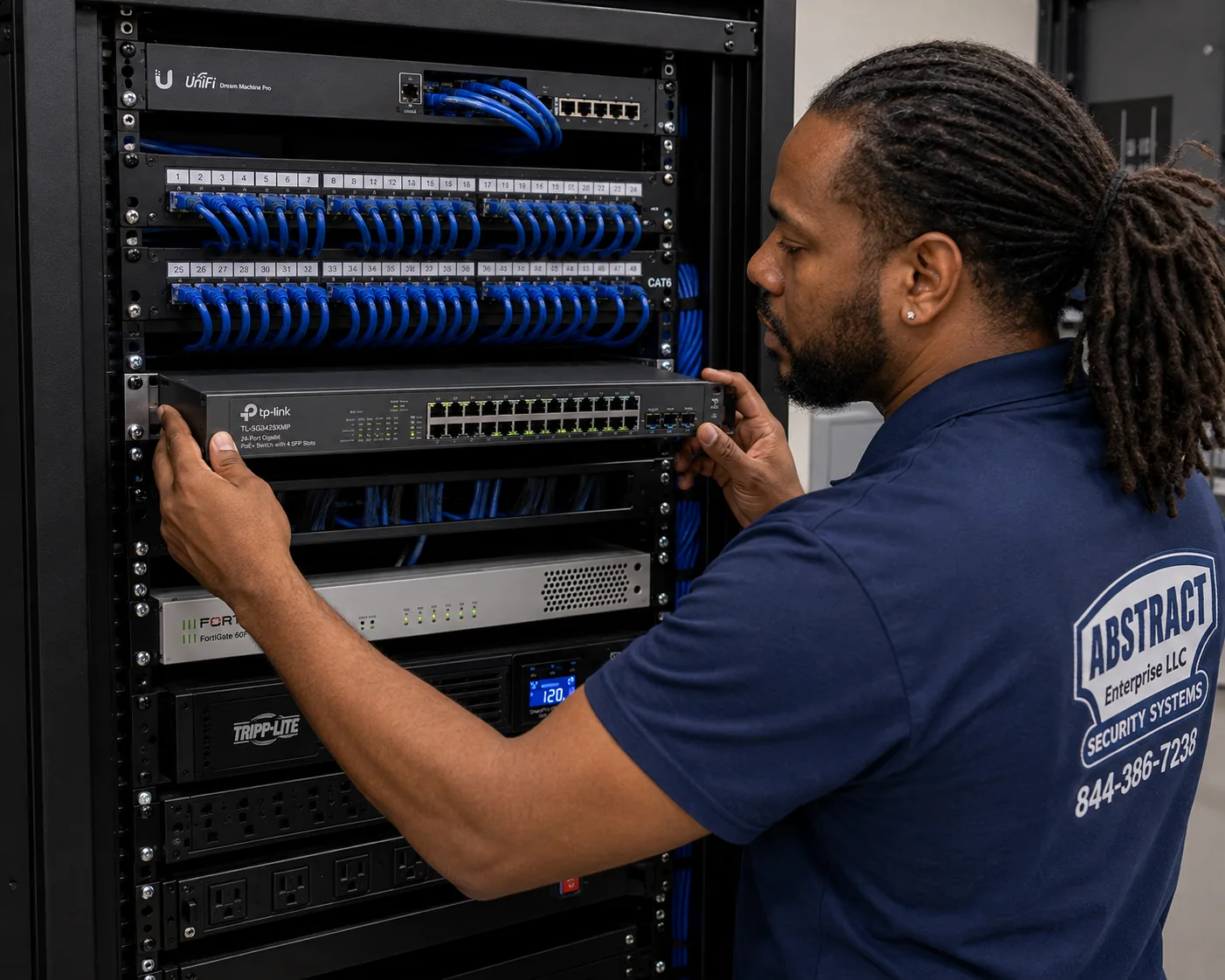
A photo from the AESS job library, not taken in Brooklyn: a technician mounting a managed PoE switch below patch panels in a commercial rack. Most Brooklyn eufy jobs use Wi-Fi and a HomeBase rather than a rack, but in a walk-up or a shop where several wired cameras come back to one closet, a small switch like this is what keeps the router, the HomeBase and the cameras on one tidy, labeled connection.
A national alarm brand, a camera you install yourself, or a local installer for a Brooklyn house
National brands such as ADT, Ring and SimpliSafe each sell their own systems, and plenty of Brooklyn households put up a eufy or Ring camera themselves. For a detached house with wood siding and a clear Wi-Fi signal, either can work well. The table is about the conditions Brooklyn buildings actually present, not the quality of any company.
What a Brooklyn job needs
National brand or do-it-yourself
AESS in Brooklyn
Mounting on brick and brownstone
Often adhesive or plastic plugs
Anchored into brick, stone avoided, mortar only where preservation calls for it
Signal through party walls and floors
Found out after installation
Metered at each camera spot before drilling
Doorbell power in walk-ups
Varies
Buzzer line vs. doorbell transformer checked first
Landmarked fronts
Rarely considered
Front planned around LPC's façade rules
Privacy settings
Left to the owner
Encryption, two-step sign-in, masks and updates done before handover
Building paperwork
Varies
Certificate of insurance sent before the visit
AI Overview Reality Check
What AI Gets Wrong About eufy Camera Installation in Brooklyn
We could not capture Google's AI Overview for this topic in our build environment, so nothing below quotes it. These are claims that appear in generic online answers and in national home-service guides such as Angi, HomeAdvisor and Fixr, paraphrased, each followed by what Brooklyn's buildings actually show.
"eufy cameras are wireless, so installation takes ten minutes"
Generic answers describe eufy as peel, stick and pair, a job anyone finishes before lunch without a tool beyond a screwdriver.
On a Brooklyn rowhouse the ten minutes ends at the brick. Adhesive struggles on rough, cold masonry, plastic plugs loosen in old mortar, and a camera that pairs in the kitchen may not hold its signal on the far side of a party wall two floors away. The wireless part is easy; the wall and the signal path are the work.
We meter the signal at each spot and anchor into the brick itself, so the camera that pairs on day one is still on the wall and still online next winter.
"Any wired doorbell can replace your old button"
Many answers say a wired video doorbell simply connects to whatever wires are behind your current button.
eufy's own support pages say its wired doorbell needs 16 to 24 volts AC at 30VA or more and does not work with intercom power or signal systems. A large share of Brooklyn's small buildings have a buzzer panel at the street door rather than a doorbell circuit.
We open the button and trace the wires before you buy, and where the door has a buzzer, we recommend a battery doorbell on the right door instead.
"Mount the camera wherever it gets the best view"
Generic placement advice is to put the camera high on the front of the house where it sees the most.
Brooklyn has nearly 15,900 landmarked buildings and sites, and LPC's rules would generally keep cameras off a primary façade unless there is no feasible alternative. The best view on a brownstone front is often the one that needs an application.
On landmarked houses we use the door, the stoop and the areaway at the front and save the high, wide views for the rear wall.
"Solar panels keep a battery camera charged forever"
Product pages and generic answers present a solar panel as the end of charging.
A panel needs sun, and a rear wall between rows of three- and four-story houses may get only part of a day's light, less in winter. A front camera facing a busy sidewalk can drain faster than a small panel refills it.
We check where the light actually lands before placing a panel and trim motion zones so the camera is not waking for every passer-by.
"Renters can put a doorbell camera anywhere on their door"
Some answers treat a tenant's front door as entirely the tenant's to modify.
Brick Underground's guidance is that the hallway and the area outside an apartment are common areas that need the landlord's permission, and a doorbell on the unit door is a gray area governed by the lease's alteration clause.
We start renters with an indoor or window camera that touches nothing the landlord owns, and fit a doorbell once the landlord agrees in writing.
"eufy's privacy problems were fixed, so no setup is needed"
Some summaries say the encryption issues were resolved and the cameras are private out of the box.
The 2025 settlement required the distributors to improve encryption and testing, but Mozilla notes that end-to-end encryption on at least one model is offered and not on by default, and federal scrutiny of Anker was still being requested in March 2026.
We switch encryption on where available, enable two-step sign-in, update firmware and leave the account in your name only.
"A camera covers your whole property, so aim it wide"
Generic advice says a wide view is always better, and the more the camera sees the safer you are.
In attached Brooklyn housing a wide rear view takes in dozens of neighbors' windows and yards, which invites complaints and records far more than you need. In a rent-stabilized building, a wide hallway view can look like watching tenants.
We aim each camera at your own doors, parcels and yard, mask neighbors' windows and leave audio off on shared spaces.
Give us the cross streets, the kind of building, which doors and yard you want watched, the eufy models you own or plan to buy, and whether a landlord, board or landmarked front is involved. A technician will call back with the plan and the total for the Brooklyn address, or you can call (347) 934-8335 right now.
✅
Request Sent!
Thank you. A technician will call you about the Brooklyn address on the same working day.
How It Works
Our Installation Process
1. Send photos and the eufy models
The front from the sidewalk, the door or stoop, the rear yard and the router, plus the eufy model names, with your cross streets.
2. Confirm the building and approvals
Who owns the walls, whether a landlord, managing agent, board or LPC is involved, and any certificate of insurance, settled before the visit.
3. Survey Wi-Fi and the HomeBase spot
Signal measured at each camera position and a HomeBase location chosen that reaches the stoop and the yard through brick and floors.
4. Mark positions and check views
Each spot taped and checked on a phone so the view covers your door, parcels or yard and not the neighbors' windows.
5. Mount on the masonry and sort power
Anchors into brick, stone avoided, doorbell power checked, outlets confirmed, solar panels placed where light reaches.
6. Pair, update and secure
Cameras paired, firmware updated, two-step sign-in and end-to-end encryption switched on where the model offers it.
7. Set zones, masks and alerts
Motion zones trimmed to your property, privacy masks on neighbors' windows, alerts tuned so a busy sidewalk does not drain batteries.
8. Test and hand over
Each camera triggered, clips played back on your phone, access shared with the people you choose and the account left in your name.
Coverage Area
eufy Camera Installation Near Brooklyn's Landmarks
Prospect Park
The 585-acre park in central Brooklyn, ringed by the rowhouses of Park Slope, Prospect Heights, Prospect Lefferts Gardens and Windsor Terrace.
Brooklyn Heights Historic District
New York's first historic district, designated November 23, 1965, with more than 600 buildings between Atlantic Avenue, Fulton Street, the East River and Court Street.
Brooklyn Navy Yard
More than 300 acres on the waterfront and over 550 businesses, a gated campus with its own rules for tenant work.
Industry City
The six-million-square-foot complex in the former Bush Terminal in Sunset Park, full of makers, studios and small firms.
Brooklyn Chinatown, Eighth Avenue
The Sunset Park commercial strip from 39th to 65th Streets, co-named Brooklyn Chinatown on October 23, 2026.
Dyker Heights holiday lights
The displays between 11th and 13th Avenues and 83rd and 86th Streets that draw crowds onto residential blocks each December.
Brooklyn is billed at our Brooklyn rate, which matches the Bronx. The full, line-by-line price list for eufy doorbells, battery and solar cameras, floodlights and HomeBase setups in the borough is on our Brooklyn eufy camera installation prices page, where you can add up your own system. The lines below are the ones that come up most often in Brooklyn conversations, taken from our published eufy list.
Item
Brooklyn price
Setup-only visit for eufy equipment you already own (pairing, HomeBase, app, encryption, sharing)
$225 first hour, then 30-minute blocks
Brick or stone wall add, where a mount goes into masonry
$65
Plaster wall add, where an indoor mount goes into plaster
$45
Doorbells, outdoor cameras, solar panels, floodlights and HomeBase installs
Itemized on the Brooklyn price page
What moves a Brooklyn total. Four things change the price more than the camera model does. The wall: brick and stone take the masonry add, wood siding usually does not, and brownstone fronts are planned so they need no drilling at all. The power: a battery camera needs nothing, a solar panel adds a mount, a wired doorbell depends on whether the door has a usable transformer, and a hardwired floodlight depends on an existing box. The signal: a narrow three-story brick house may need the HomeBase moved or a wired link added to reach the yard. And the approvals: a landlord, board or landmarked front can change where the cameras go, which changes the work. We list each of those on the quote before the visit.
Prices for other areas differ because our area rates differ. If you are comparing, see the NYC eufy price list and the Bronx list, which shares Brooklyn's rate.
Full terms — including 50% deposit, one-year parts-only warranty on AESS-supplied products, and the late-fee schedule — are set out in the service agreement.
Shop Our Systems
eufy Camera Installation Packages & Pricing
Three typical Brooklyn eufy jobs. The first has a fixed starting price on our list; the other two are itemized from the Brooklyn price page because the number of cameras, the walls and the power differ from house to house.
Secure what you own: $225 first hour
A setup-only visit for eufy gear you already bought: HomeBase placed and paired, firmware updated, encryption and two-step sign-in switched on, motion zones and sharing set. Then 30-minute blocks if more time is needed.
Rowhouse front and back
A doorbell at the stoop on the right power, a battery camera with a solar panel on the brick rear wall over the yard, and a HomeBase placed to reach both. The $65 brick or stone add applies to the rear mount.
Small building, owner's system
Wired or plug-in cameras at the street door, lobby and mailboxes, battery cameras on the cellar door and yard, all in one app, with tenant sharing set and a notice at the entrance.
Bring your own equipment. If you already own eufy cameras, a HomeBase or a solar panel, we install them at the labor prices on our Brooklyn list, as long as each camera is compatible with the base or Wi-Fi it will use. We check the model names with you before the visit so nothing arrives that cannot pair. Some Brooklyn owners who start with eufy outside also ask about intercom or access control at the street door later; we can talk about that on the same visit.
Complete Services
Every eufy Camera Service in Brooklyn
New installations
Doorbells, outdoor and indoor cameras, solar and HomeBase. Request a quote
Can eufy cameras really cut down on package theft at a Brooklyn front door?
+
They help in two ways: a visible camera deters some thieves, and clear footage helps police identify the ones who are not deterred, which is why the New York Attorney General recommends doorbell cameras for package theft. They do not stop every theft, so pair the camera with a delivery note asking couriers to leave parcels inside the vestibule where possible.
We already have eufy cameras up. Can you just fix the settings and the app without remounting anything?
+
Yes. That is a setup-only visit, $225 for the first hour and then 30-minute blocks on our list. We update firmware, move or re-pair the HomeBase if the signal is weak, switch on encryption and two-step sign-in, trim motion zones and set up sharing.
Do you cover every Brooklyn neighborhood at the same price?
+
Yes. Crews are dispatched from our office on Troy Avenue, and every Brooklyn address, from Greenpoint to Coney Island and from Red Hook to City Line, is billed at the same Brooklyn rate.
Is there an extra charge when a camera goes on brick?
+
Where a mount goes into brick or stone, our list carries a $65 brick or stone wall add, because the work needs a hammer drill, masonry bits and anchors. An indoor mount into plaster carries a $45 add. Wood siding and mounts on a door frame usually carry neither.
How fast will someone get back to me after I send a request?
+
Requests are booked within 2 hours, and estimates from photos are usually same-day on weekdays. The installation date then depends on your building, any approvals needed and the time of year.
What license does AESS hold for camera work in New York?
+
Our camera and security work is done under New York State license #12000287431, and the business has been owner-operated by Anwar Timothy since 2002. New 120-volt circuits for hardwired floodlights are done by a licensed electrician.
What should I have ready on installation day?
+
Your Wi-Fi name and password, access to the email you want the eufy account under, your phone for two-step sign-in, and keys to the yard, cellar and roof if cameras or cable go there. Clear the area under each camera spot.
Where does the video from our eufy cameras get saved?
+
On many eufy systems clips are stored on the HomeBase or in the camera, inside your home, unless you choose a cloud plan. We set storage so the clips you care about are kept and explain what changes if the internet goes down.
Can you move an existing eufy camera from the front of the house to the back?
+
Yes. We take it down, patch or fill the old holes on request, check the signal at the new spot and remount it. If the new position is brick, the brick or stone wall add applies.
The house came with eufy cameras, but the account belongs to the previous owner. What can we do?
+
The cameras have to be removed from the old account, either by the previous owner or through a reset, before they can join yours. We reset them, set up a new account in your name and re-pair everything on a setup-only visit.
Can I see the full Brooklyn eufy price list before booking?
+
Yes. Our Brooklyn eufy camera installation prices page lists every line item at the Brooklyn rate, so you can add up a system yourself before you call. We still confirm the total from your photos.
A photo from the AESS job library, not taken in Brooklyn: a before-and-after of a tangled, unlabeled rack rebuilt into a dressed, identified one. Brooklyn houses rarely have racks, but the closet under a stoop or the shelf beside the router often looks like the "before" side, and tidying the router, HomeBase and cables there is part of a setup visit when a eufy system keeps losing its connection.
Ready to See Your Stoop and Your Yard on Your Phone?
Send photos of the front, the door and the rear yard with your cross streets and any eufy models you own, and we will tell you which walls, power and approvals apply and what the job costs on the Brooklyn list. Call or text (347) 934-8335, message us on WhatsApp, or use the request form. Licensed under NYS license #12000287431, rated 4.7★ across 201 Google Reviews, with same-day estimates on most weekdays. For the citywide view, visit our NYC eufy camera installation page.