Recorders Kept Above the Water Line · Curb, Back Door and Lobby Coverage · Written Line-by-Line Quotes
Security camera installation in Sheepshead Bay has to answer two questions that most Brooklyn neighborhoods only face one of: what the cameras should see, and where the equipment that records them can stay dry. The local record is clear on the first part. In September 2026 a neighbor's home camera recorded a man jumping onto a parked car and shattering its windshield, one of more than 20 cars damaged; in March 2026 a house on East 9th Street was broken into around 2 a.m. and a car was taken; and an older daytime burglary near East 12th Street and Avenue X ended with the burglars leaving through the back door. The second part comes from the ground itself. Bungalow courts north of Emmons Avenue sit lower than the streets around them, the city's own planning report says many basements here sit below the flood elevation, and a water main break in February 2026 put up to 20 inches of water into some basements and garages. So we plan each camera around a curb, a door or a counter, keep the recorder, switch and battery unit high and dry, and put every camera, mount, cable run and setting on a written quote before anything is ordered.
Reviewed and updated November 4, 2026 by Anwar Timothy, NYS license #12000287431 · Sources: ABC7 New York on the September 2026 car vandalism and the December 2024 Q platform shooting; News 12 on the March 2026 East 9th Street break-in and Shmira patrols; CBS New York on the Avenue X burglary, the Brooklyn commercial burglary spree, the Avenue W laundry-room burglary and the DOT ruling on light-pole cameras; Brooklyn Paper on package thefts and the 61st Precinct; the New York Post count of cameras on an East 15th Street house as reported by AOL; the 2021 Hikvision camera count published by S.T.O.P.; New York YIMBY on the Nostrand Houses modernization; NYCHA's 2015 CCTV release and Bklyner on the earlier Sheepshead-Nostrand security plan; NYBits, CityRealty, StreetEasy and HL Residential on co-op buildings; Brooklyn Eagle on the former Lundy's lighting review, the February 2026 water main break and the neighborhood's history; the Historic Districts Council on the Lundy's building; Urban Omnibus on the bungalow courts; the NYC Department of City Planning Sheepshead Bay summary report; the New York State Sheepshead Bay corridor report; City Limits on Hurricane Sandy damage along Emmons Avenue; NYC Parks on the Sheepshead Bay Piers; Wikipedia entries for Sheepshead Bay, Avenue U, the Sheepshead Bay station, the Sheepshead Bay-Nostrand Houses and the Shore Boulevard Mall; CityNeighborhoods and Reinvent NY on boundaries and corridors; News 12 and Pix11 on 2026 incidents; Hoodline on October 2026 incidents; Brick Underground, Justia Answers and Connextivity on camera rules in rentals and co-ops; Kirschenbaum & Kirschenbaum on New York's installer license; NY Civil Rights Law §52-a; Yelp listings for local security installers · Dispatched from 1282 Troy Ave, Brooklyn

Owner-operated since 2002 · Thousands of jobs completed · Booked within 2 hours
Security camera installation in Sheepshead Bay usually means one of three jobs: a wired system for a detached, semi-attached or two-family house that watches the curb and parked cars, the front door and porch, the side yard and the back door; a building system for one of the neighborhood's postwar elevator or walk-up co-ops, covering the lobby, the halls, the laundry room, the garage and the service doors; or a door, counter, office and stock-room system for a restaurant on Emmons Avenue or a shop on Sheepshead Bay Road, Avenue U or Nostrand Avenue. Every job is priced on our Brooklyn rate and quoted in writing after you send photos or we walk the property, with each camera, mount, cable run, recorder, drive, battery unit and setup task on its own line. A back-door camera fed from an open basement ceiling is quick; a curb camera on a raised bungalow, or a lobby camera reached through a 1950s co-op's brick and plaster, takes longer, and the quote says which you have. The fixed prices we publish, such as a setup-only visit at $225 for the first hour, are in the pricing section below. Estimates are free, requests are booked within 2 hours, and the work is done under NYS license #12000287431 with insurance in place. Call (347) 934-8335 or use the form.
Sheepshead Bay is a neighborhood of houses with driveways and back doors, of postwar brick co-ops by the dozen, and of low streets close to the water, and every one of those things changes where a camera does its work. The sources do not agree on exactly where it begins and ends. Wikipedia draws it from Ocean Parkway on the west to Nostrand and Gerritsen avenues on the east, and from Kings Highway on the north down to the water; another neighborhood guide draws a tighter box, from Coney Island Avenue to Nostrand Avenue and from Avenue U down to Emmons Avenue and the inlet. Either way, the heart of it is the same: the bay and its piers along Emmons Avenue, the commercial strip of Sheepshead Bay Road, the Avenue U shopping street, and the house and co-op blocks in between. NYC Parks records that a large farm here was subdivided in the 1870s, with political boss John McKane guiding the development, and that more than 400 houses had gone up by the end of the century. The racetrack that once stood here gave way to the Sheepshead Speedway and then, in 1919, to housing, according to the Brooklyn Eagle, and the city widened and paved Emmons Avenue in the 1930s. In the 1950s brick apartment buildings replaced many of the wooden houses, and by 1960, NYC Parks says, Sheepshead Bay was the fastest growing community in Brooklyn. That history is still visible on the street: a wood-frame bungalow on a walkway, a 1950s brick co-op on the next block, and a detached house with a driveway around the corner.
The building stock is what decides how a camera job runs here. One co-op directory lists 41 co-op buildings in Sheepshead Bay, 24 of them elevator buildings and 17 walk-ups. Most of the elevator buildings are six-story postwar blocks, such as 2620 and 2650 East 13th Street with 192 apartments each, or 1516 Voorhies Avenue, built in 1961 with 95 apartments and a live-in super. Some are older: 2950 Ocean Avenue went up in 1930, four floors and 63 units, while 3060 Ocean Avenue dates from 1956 with 149 units and a full-time doorman. On Emmons Avenue, 1625 Emmons was built in 1962 with 148 units, an evening doorman and a ground-floor apartment with its own private street entrance, and the Atlantis at 3235 Emmons has seven floors and 172 units. Two NYCHA developments, the Sheepshead Bay Houses and the Nostrand Houses, both completed in 1950, sit on the east side of the neighborhood. Then there are the houses: detached homes, semi-attached brick houses, townhouses on Voorhies Avenue, narrow lots off East 22nd Street, and the bungalows near Emmons Avenue, some on streets and some on pedestrian walkways, a few of them raised onto new pilings since Hurricane Sandy.
The incidents in the local press point at the parts of a property a camera has to cover. ABC7 reported that in September 2026 residents were trying to identify a man who damaged more than 20 cars, and that a resident's home security footage showed a person jumping onto a vehicle and shattering the windshield. News 12 reported that in March 2026 a home on East 9th Street was broken into and a car stolen around 2 a.m., and that two days later, a few blocks away in Gravesend, two people entered a home and took two car keys; Shmira Public Safety stepped up its patrols after both. CBS New York reported an earlier burglary, captured on surveillance video, near East 12th Street and Avenue X around 2 p.m. on February 27, where the suspects escaped through the back door. In a Brooklyn commercial burglary spree covered by CBS New York, one burglar at Harvest Grocery in Sheepshead Bay used a broom to try to cover a security camera, and the owner of Lucky 7 Smoke Shop arrived to find the ATM knocked off and the cameras broken. Brooklyn Paper reported package thieves taking boxes from front porches in daylight, naming Bedford Avenue, and noted that the 61st Precinct covers Gravesend, Sheepshead Bay and Manhattan Beach. We found no source that ranks Sheepshead Bay blocks by crime, and we do not offer one.
The ground is the other half of the story. Urban Omnibus describes the bungalow courts north of Emmons Avenue as surrounded by higher ground on all sides, like bathtubs. The Department of City Planning's Sheepshead Bay summary report says many homeowners here have basements below the design flood elevation and subject to flooding. City Limits reported that roughly 85 percent of businesses on Emmons Avenue suffered some form of damage in Sandy. And in February 2026 a water main break left some basements and garages with up to 20 inches of water, according to the Brooklyn Eagle. A camera on an outside wall usually sits well above any of that. The recorder that holds every clip, the network switch that powers the cameras and the battery unit that keeps them running are a different matter, and on too many systems they sit on a basement floor or a garage shelf a foot off the slab. Choosing where they go is part of every Sheepshead Bay quote we write.
What Sheepshead Bay owners tend to add next. Once the curb, the front door and the back door are covered, owners often ask whether the camera picture can show on a screen in the kitchen, or whether the co-op's buzzer panel could carry video too. We leave a labeled spare port on the recorder and, in buildings where a video intercom is likely to follow, a spare cable to the vestibule, so the basement ceiling only has to be opened once.

Two kinds of call come in from houses and buildings here. In the first, a camera has gone blank, often the one at the back door or the one in the garage, after heavy rain, a power cut, a new modem or a basement that took water, and nobody is sure how long it has been out. In the second, something has happened: a windshield has been smashed at the curb, a door has been tried, a package has gone from the porch, and you need the footage before the drive fills and starts over. If a camera is dead, write down which one and when it last showed a picture, look at whether the recorder and any switch beside it still have lights, and if the equipment sat in water, unplug it at the wall only if you can do so standing on a dry floor. Do not reset the recorder to factory settings, which can wipe the passwords and remote access along with the fault. If there has been an incident, leave the recorder running, note the camera and the time, and copy that window to a USB stick if you know how. If anyone was hurt or threatened, call 911 first and tell the officers you have video. Then call (347) 934-8335. We book every request within 2 hours, talk you through what can be done by phone, and send a technician when the fix needs hands on the equipment.
A camera system is only as good as the box that stores what it sees. In most of Brooklyn, nobody thinks twice about putting that box in the basement next to the internet modem. In Sheepshead Bay that habit can cost an owner the whole record at the moment it matters most. The planning department's summary report says many homeowners here have basements below the design flood elevation. The bungalow courts off Emmons Avenue, as Urban Omnibus put it, sit like bathtubs below the ground around them. And flooding here does not only come from storms: the February 2026 water main break the Brooklyn Eagle covered put up to 20 inches of water into some basements and garages. A recorder sitting on the floor, or a power strip on the slab feeding the switch that powers every camera, goes out with the first inch.
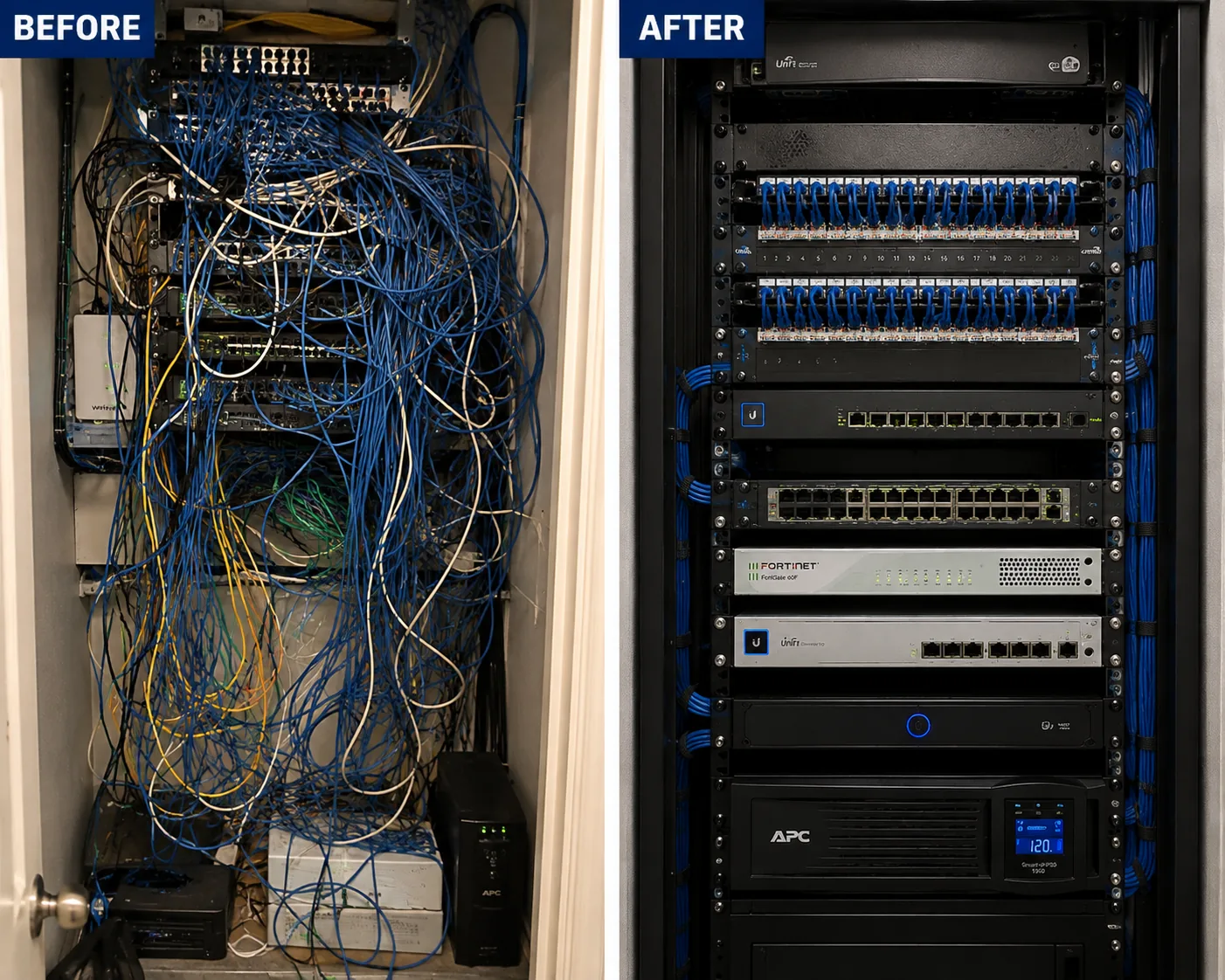
So on a Sheepshead Bay job, choosing where the equipment lives comes before choosing cameras. The outdoor cameras themselves are rarely the problem; they are rated for weather and sit on walls well above the ground. What needs protecting is the recorder and its drive, the network switch if there is one, the battery backup unit, the internet modem and router the remote viewing depends on, and the outlet all of it plugs into. Each of those should sit above the highest water the property has seen, in a spot that stays dry and does not cook in summer, with enough air around it to stay cool. The cable can still travel through the basement or crawl space; cable on the joists is fine. It is the electronics and the power that move up.
| Property | Where the recorder often ends up | Where we would rather put it | What we check first |
|---|---|---|---|
| Detached house with a full basement | On the basement floor next to the boiler or the modem | A closet on the first or second floor, or a high shelf in the basement well above past water marks | Water lines on the basement walls, the outlet height, and where the internet line comes in |
| Bungalow in a low court | Under a bed or in a low cabinet | A high shelf in a closet, or an attic space if there is one with safe access | How high water rose in past storms, and whether the house has been raised |
| House raised on pilings after Sandy | In the open space underneath, with the bikes | Inside the living floor, in a closet | How cable will climb from the cameras on the lower level to the living floor |
| Townhouse with a garage under the living room | On a garage shelf | A closet one floor up | Whether the garage took water in February 2026 |
| Elevator co-op | In the cellar near the boiler or the building's network panel | A locked equipment room or closet above the cellar, or a raised, locked cabinet in the cellar | The building's flood history and the board's rules on equipment rooms |
| Restaurant or shop on Emmons Avenue | Under the counter or on the stock-room floor | A locked cabinet mounted high in an office or storeroom, away from the cash | What Sandy did to the space and where the landlord allows equipment |
Every recorder we leave in Sheepshead Bay sits on a battery backup unit, and the internet modem and router go on the same unit when they are close enough, so a short outage does not leave a gap in the recording or cut off the phone app. A battery unit covers a flicker and a short outage, not a day without power, and we say so plainly. What matters just as much is what happens when the power returns: the recorder should restart on its own, find every camera and resume recording without anyone pressing a button. We test that during the handover by cutting power at the unit and watching the system come back. If a new outlet is needed at a higher spot, a licensed electrician installs it, and that is a line on the quote.
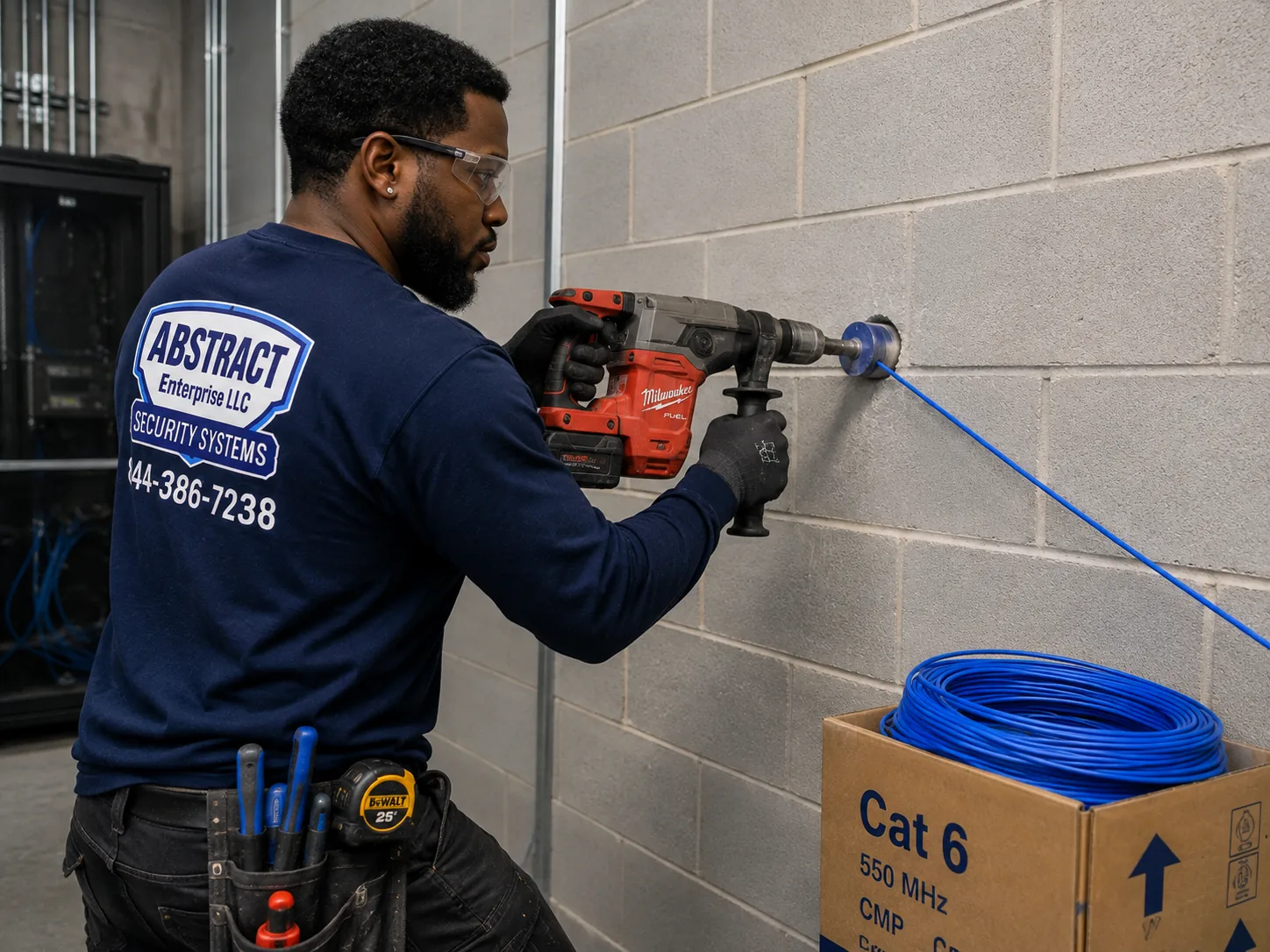
Every hole a camera cable passes through in an outside wall is a place water could follow it. We drill the opening sloped slightly down toward the outside, leave a drip loop in the cable before it enters, seal the opening with an exterior-grade sealant around a grommet or sleeve, and keep junction boxes and connectors above any level that splashes or floods. On a raised bungalow, where cable has to climb from a camera under the house to a recorder on the living floor, it rides in conduit up a post or wall rather than lying loose where water and debris can pull at it.
A recorder on a high shelf is safe from water, but not from a burglar who finds it, and the CBS-reported spree showed people here going after cameras deliberately. For the clips that matter, we show you how to export them to your phone or a USB stick the same day, and where it suits the property we set up a cloud copy of selected cameras' alert clips, so a drowned, stolen or smashed recorder does not take the only copy with it. We name the cloud service on the quote and say plainly whether it carries a subscription; a recorder you own carries no monthly fee from us.
Most of the camera-related stories from Sheepshead Bay in 2026 start or end at a car. The September vandalism was a string of smashed windshields on parked cars, and the useful footage came from a camera on a house. The March break-in on East 9th Street ended with a car being driven away, and the Gravesend case two days later was a home entry to take car keys. A house plan here therefore starts at the curb and the driveway, not at the front door, and asks what a camera would need to see to turn a bad night into something a neighbor, a patrol or a detective can act on.
The answer is rarely "the whole block." A camera framed to take in every car on both sides of the street turns each person into a few pixels, and at night under streetlights it records shapes, not people. The camera that helps is one aimed along your own frontage, at your own car or driveway, low enough and close enough that a person standing at a car door or climbing onto a hood fills a useful part of the frame. If several houses on a block each do that, together they record the whole street in usable detail, which is very close to what happened in September: one resident's footage, plus photos a City Council member shared, pointed to the same person across many cars.
We mount the curb camera on the front of the house or the porch post, usually between eight and ten feet up, aimed so its frame runs from the front of your parking space to the back of it, with the sidewalk in the near edge of the picture. A varifocal lens lets us zoom so the car fills the frame instead of the street. We set a faster shutter at night so a person moving quickly does not smear across the picture, and we record continuously rather than only on motion, because a person approaching a car slowly may never trip a motion setting, and because the seconds before the damage are often the ones that show the face. Alerts are a separate setting: we draw the alert zone around the car itself, so passers-by on the sidewalk do not ring your phone all night.
On a detached house with a side driveway, the driveway camera goes where it sees a face, not a roof: at the house end of the driveway looking toward the street, so anyone walking up the driveway is coming toward the lens. A second, wider view from the street end can show which way a car left. Inside the house, the East 9th Street and Gravesend cases are a reminder that keys hanging by the door are part of the risk; where an owner wants it, an indoor camera can watch the entry hall and key hook while the household is out, set to switch its recording off when the family is home so it never records daily life.
The Avenue X burglars left through the back door in the middle of the afternoon. That is a common pattern on houses with yards: the front faces the street and the neighbors, the back faces fences and garages, and the back door is where someone can work unseen. A camera on the rear wall, placed to look down the yard toward the back door and the gate rather than straight down from the eave, records faces at close range on the way in and on the way out. On semi-attached houses, where the side yard is the only path from the street to the back, a camera at the house corner covering that path does double duty. Each yard camera is framed to stop at your own fence, because Civil Rights Law §52-a gives a neighbor a claim against someone who records their backyard where they reasonably expect privacy, and because nobody wants to be the house that films the whole row of yards.
| Camera | What it is for here | Typical position | How it records and alerts |
|---|---|---|---|
| Curb | The person at your car, like the September 2026 windshield damage | Front wall or porch post, zoomed along your own parking space | Continuous recording, alert zone around the car only |
| Front door and porch | Visitors, deliveries and daylight porch thefts | Doorbell at the door plus a second view from the porch corner or gate | Continuous, alert on a person at the door |
| Driveway | Anyone walking up to the car or garage | House end of the driveway, looking toward the street | Continuous, alert after a set hour |
| Side path | The route from street to back yard on semi-attached houses | House corner, looking along the path | Continuous, alert at any hour |
| Back door and yard | Entry and exit at the rear, like the Avenue X burglary | Rear wall, looking down the yard toward the door and gate | Continuous, alert at any hour while the house is empty |
| Garage or carport | Tools, bikes and the car itself | Inside the garage covering the door, or outside covering the opening | Continuous, alert when the door opens after hours |
These are the camera jobs Sheepshead Bay homeowners, landlords, co-op and condo boards, managing agents, restaurant owners and shopkeepers ask us for most. Each is quoted in writing after photos or a walk-through, with every item on its own line, and a recorder system you own carries no monthly fee.
Views zoomed along your own parking space and driveway, recording continuously, so the person at a car door or on a hood is large enough to recognize.
A doorbell or door camera at the entrance plus a second view from the porch corner or gate, so a daylight porch thief shows a face both arriving and leaving.
Rear-wall cameras looking down the yard toward the back door and gate, framed to stop at your own fence.
Moving an existing recorder, switch, modem and battery unit off a basement floor or garage shelf to a dry, high, locked spot, with power that restarts the system on its own.
Cameras for cottages on walkways and in courts off Emmons Avenue, and for houses lifted onto pilings, with cable carried in conduit up to the living floor.
Lobby, mailbox, laundry room, garage, service door, stair and elevator cameras for postwar elevator co-ops and walk-ups, with a board-approved access list.
Door, bar, register, office, stock room and rear-door cameras along Emmons Avenue, with the recorder kept high and away from the cash.
Counter, door, glass and back-room cameras for stores on Sheepshead Bay Road, Avenue U and Nostrand Avenue, many with apartments above.
Recorders and cameras left by a former owner, a sponsor or a previous installer, traced, tested, given new passwords and firmware, and kept or replaced camera by camera.

The sources describe a neighborhood rebuilt in waves: wood-frame houses and bungalows from the decades after the 1870s subdivision, the 1919 housing on the old racetrack site, brick apartment buildings that replaced wooden houses in the 1950s, six-story postwar co-ops from the 1950s and 1960s, the two NYCHA developments finished in 1950, detached and semi-attached houses, newer townhouses, condos on Emmons Avenue, and mixed-use buildings from the 1920s and 1930s along Sheepshead Bay Road. Each gives a camera a different wall to sit on and a different path back to the recorder.
Brick or sided houses with driveways, porches, side paths and back yards, many with full basements that have taken water.
Small wood-frame cottages near Emmons Avenue, some in low courts, some raised onto pilings after Sandy.
Six- and seven-story brick buildings on Ocean Avenue, Voorhies Avenue, Emmons Avenue and East 13th Street, with lobbies, laundry rooms, garages and live-in supers.
Smaller buildings, including the 1930 four-story co-op at 2950 Ocean Avenue, with a vestibule, stairs, mailboxes and a cellar, and often no staff on site.
Newer townhouses with garages below the living floor, and condos on Emmons Avenue with shared entrances and parking.
1920s and 1930s buildings on Sheepshead Bay Road with stores below and apartments above, and the Avenue U and Nostrand Avenue strips.
| Building | What the camera mounts on | How the cable reaches the recorder | What we keep out of the picture |
|---|---|---|---|
| Detached or semi-attached house | Brick, siding over sheathing, or the porch structure | Through the basement ceiling or the attic, then down an interior wall or closet to the recorder | Neighbors' yards and windows, and the street beyond your frontage |
| Bungalow in a court | Wood siding and trim, fixed into framing behind it | Under the floor or along the eave inside a small cover, to a high closet shelf | Other cottages' doors and the walkway beyond your lot |
| Raised bungalow on pilings | The living-floor walls, and posts below | Conduit up a post or wall to the living floor | The neighbors' raised decks |
| Postwar elevator co-op | Lobby ceilings, corridor walls, laundry-room and garage structure | Through cellar corridors and existing risers to a locked equipment room | Shareholders' doors, staff break rooms and the inside of units |
| Walk-up co-op or rental | Vestibule walls and ceilings, stair walls | Cellar to the stair, inside a painted raceway where no chase exists | Apartment doors when they open |
| Mixed-use corridor building | Inside the store; the building's own hall and rear | Store ceiling or cellar to separate recorders for store and building | The other party's spaces |
Most houses here give us a choice of two clean routes. Where the basement has an open ceiling, cable for the curb, door, driveway and back-door cameras runs along the joists and comes up through small openings at each camera location, so nothing is stapled across the brick or siding. Where the basement is finished, or where it has taken water and the owner would rather keep the system out of it entirely, we come from the attic instead and drop cable down to the eaves and porch. On brick, the mounts go into mortar joints, which are easy to patch if a camera ever moves; on siding, they go through a mounting block into the sheathing and framing behind it, so the camera does not work loose or crack the siding. On semi-attached houses, where the shared wall is off limits, the side and rear cameras sit on the walls that belong to the house alone. The recorder comes up out of the basement into a closet on a living floor, on a battery unit, with the modem beside it if possible.
The bungalows near Emmons Avenue are often only a room or two wide, with low eaves and little attic. The runs are short, which helps, but there are fewer places to hide cable and fewer high spots to put a camera out of reach. We use compact cameras in hard housings on the corners of the eave where there is one, run cable inside small paintable covers along the trim where there is no attic, and keep every connection inside the house. On a court that sits below the street, the camera that matters most is the one that sees the walkway or steps down into the court, aimed up toward the approach so it catches faces against the brighter street rather than the tops of heads. On houses lifted onto pilings since Sandy, cameras for the open space below and the stair go on the structure, and the cable climbs in conduit to the living floor, where the recorder lives.
The six-story co-ops that make up so much of the neighborhood were built with cellars that run under most of the building, central stairs and an elevator, and they usually have a live-in super or a doorman for part of the day. Cable routes are generally good: through cellar corridors and up existing risers or pipe chases to the floors, with every opening through a fire-rated wall or floor sealed with rated firestop. The views that add most are the ones staff cannot see from the lobby: the laundry room, the garage ramp and its door, the service entrance, the mailboxes, the cellar storage doors and the stair doors. The board decides the plan, and before anything is installed it needs to settle in writing who may view live, who may export, and how long footage is kept. Where a building has open HPD complaints about its buzzer or intercom, like the open Bell/Buzzer/Intercom complaint recorded at 2970 Ocean Avenue in June 2026, we note it on the walk-through so the board can decide whether to fix the entry at the same time.
The planning department describes Sheepshead Bay Road as a corridor developed in the 1920s and 1930s with local ground-floor retail and housing above. In buildings like these, the store tenant usually controls the inside of the store, and the building owner controls the facade, the residential door, the halls and the cellar. We plan the store's cameras inside the store and on its own doors, plan the building's cameras on the residential entrance, stair and cellar, keep each party's recorder separate unless both want them joined, and get written approval from the owner before anything goes on the front.


The New York State corridor report describes Emmons Avenue, along the waterfront, as having both retail stores and larger restaurants. The planning department describes Sheepshead Bay Road as ground-floor retail under housing. Wikipedia describes a second Chinatown that grew up on Avenue U, between Homecrest and Sheepshead Bay, in the late 1990s. Nostrand Avenue and Voorhies Avenue carry shops and services too. These are the corridors and business types the sources describe, and we do not name any business as a customer.
Waterfront restaurants, clam bars, shops and charter-boat businesses facing the piers, on the avenue where City Limits reported about 85 percent of businesses were damaged in Sandy.
The 1920s and 1930s corridor near the B and Q station, with stores below apartments and steady foot traffic to and from the trains.
Restaurants, groceries and shops, including the stretch Wikipedia describes as Brooklyn's second Chinatown, under the elevated line near East 15th Street.
The eastern edge, with shops, services and the NYCHA developments nearby.
Businesses on the ground floors of mixed blocks between the co-ops and the townhouses.
Larger commercial lots near the Belt Parkway, including the closed restaurant at 3181 Harkness Avenue that News 12 reported teens vandalized in April 2026.
A waterfront restaurant has the same camera needs as any restaurant, plus one that most do not: the space may have taken water before and could again. The cameras that matter are at the front door from inside, over the bar and register, inside the office covering the whole room including any safe, at the rear or service door from inside, and in the stock room or walk-in area. Kitchen cameras, if wanted, watch the pass rather than the line. The recorder and the switch go into a locked cabinet mounted high in a back office or storeroom, on a battery unit, away from the cash, so a burglar who reaches the office does not also reach the recording and a flooded floor does not reach the electronics. Outdoor seating and the sidewalk get an overview from the restaurant's own frontage, not from a city lamppost. Restrooms are never covered, and audio stays off.
The commercial burglary spree CBS New York covered is the clearest local lesson for a shop owner: at Harvest Grocery in Sheepshead Bay a burglar used a broom to try to cover a camera, and at Lucky 7 Smoke Shop the owner found the ATM knocked off and the cameras broken. A shop plan here therefore assumes someone may go after the cameras. In practice that means a camera high in a corner, out of reach, that covers the lower cameras as well as the floor, so an attempt to cover or break one is itself recorded; hard-cased domes rather than exposed bullets inside the store; cable in conduit or above the ceiling rather than exposed where it can be pulled; a recorder hidden in a locked spot that is not the back office everyone expects; and an alert to the owner's phone when a camera loses video after hours. During the day the job is simpler: a camera at head height just inside the door records each customer's face, and a camera above and slightly in front of the counter records hands and goods. Screens and card pads stay out of frame.
Many stores on these corridors share a building with apartments. The store tenant's lease usually gives the owner control of the outside of the building and the shared spaces, and the residential entrance and cellar belong to the building. We plan the store's cameras inside the store and on its own doors, get the owner's written approval for anything outside, and keep the store's recorder separate from the building's. When the owner wants the building covered too, the residential door, the stair and the cellar get their own cameras on the owner's recorder, so the store owner never sees the tenants coming and going and the building owner never sees the store's register.


This is how we work on these properties, not a story about one job. We start at the curb, standing where the car parks, because the first camera question here is usually about a car. From there we look back at the house to find the height and corner from which a camera would see a person at the car door large in the frame. We walk up the driveway or the path, stand at the front door and at the porch steps, and look for where a doorbell sees a face and where a second camera would catch someone leaving with a box. Then we go down the side of the house to the back door and out to the rear fence, and look back, which shows where a rear camera sees the whole yard and which neighbors' windows and yards it must stop short of. Inside, we go down to the basement and look at the walls for water lines before we look at anything else, then at the ceiling for the clearest cable route, any old wire we will need to trace, and where the internet line comes in. If the basement has taken water, we go up to the attic or to a closet on a living floor and decide where the recorder, switch and battery unit will live. By the end we know how many cameras the property needs, where each goes, how long every cable is and where the equipment stays dry, and that is what the written quote is built from.

Houses, curbs and yards
Your own car and your own frontage, framed tightly. A camera stretched to cover every car on the block makes each person tiny, and at night under streetlights that usually means a shape rather than a face. A camera zoomed along your own parking space records the person at the door or on the hood large enough to recognize, and it records continuously so the approach before the damage is on the clip too. ABC7 reported that the September footage came from one resident's home camera and that a City Council member shared photos indicating the same person was behind many of the incidents; several houses each covering their own frontage well add up to the same kind of record for the whole street.
On most Sheepshead Bay houses with a yard, yes. The front already faces the street, the neighbors and often a doorbell camera; the back faces fences and garages, and it is where someone can work at a door without being seen. CBS New York reported that the February 27 burglary near East 12th Street and Avenue X happened around 2 p.m. and that the suspects escaped through the back door, so the rear camera should record continuously in daylight as well as at night. We place it on the rear wall looking down the yard toward the door and the gate, so faces come toward the lens on the way in and on the way out.
There is. Past a certain point every extra camera adds storage, network load, alerts and upkeep without adding a view anyone uses, and some of those cameras inevitably end up looking at the street, the neighbors' houses or their yards, which is where Civil Rights Law §52-a and simple neighborly relations come in. Most Sheepshead Bay houses are well served by a handful of cameras, each with one clearly named job: curb, front door, porch, driveway, side path, back door, yard, garage. We would rather install six that each earn their place than sixteen that overlap, and we say so on the quote.
Both together, because they see different moments. A doorbell looks straight out from the door at chest height, which is ideal for the face of someone stepping up to the door, but once they turn and leave with a box it mostly records their back. A second camera in the corner of the porch, or on the gate post looking back toward the door, catches the face as the person turns toward the street. Brooklyn Paper reported daylight porch thefts in Sheepshead Bay and the surrounding area, with Bedford Avenue named, so both cameras should record continuously in daylight and alert on a person at the door. Telling couriers where to leave boxes, out of view of the sidewalk, helps as much as either camera.
Co-ops and apartment buildings
In most co-ops the outside of the building, including that street door, is under the board's control, so a camera there needs the board's written approval even though only one shareholder uses the door. There are two clean ways to do it: the board adds the door to the building's system, with the shareholder given a view of that one camera, or the board allows the shareholder to install their own camera to an approved standard, recording to equipment inside the apartment. Which fits depends on the proprietary lease and the board's camera policy. Either way, the camera is framed on that doorway and its steps, not on the sidewalk or the lobby entrance.
Use two views and put the important one out of reach. CBS New York reported the burglar disabling a security camera and stealing from a laundry room inside a residential building near East 3rd Street and Avenue W in Gravesend. A camera in the corridor outside the laundry room, high on the ceiling and in a hard dome, records everyone who walks in before they can reach anything; a second camera inside, mounted high in the corner farthest from the door, covers the machines. The cable for both runs in conduit or above the ceiling, the recorder sits in a locked room elsewhere, and the system alerts the super or the board's chosen contact when a camera loses its picture.
Corridors, landmarks and events
Plan on it. The Brooklyn Eagle describes the former Lundy's as the only city-designated landmark in Sheepshead Bay, and reported in 2017 that the Landmarks Preservation Commission turned down a tenant's lighting proposal for the facade and asked that most of the proposed sconces be removed. That shows the Commission looks closely at exterior hardware on the building, and a camera is exterior hardware. We would check with LPC staff before anything is ordered, prepare the equipment details and photos for the application, and use cameras inside the space for most of the coverage, which needs only the landlord's approval. Nothing goes on the facade until the permit is in hand.
Some of them, if the camera was built for that one job. Reading plates at night takes a dedicated camera with a narrow view of a single lane at a point cars have to pass, angled so headlights do not blind it, with a fast shutter and its own infrared, and even then it reads the plates that pass through its narrow window, not every plate in a crowded intersection. A general overview camera, which is what most buildings have, records the crowd, the cars and the time, but rarely a readable plate. If plate reading matters to you, we pick one lane next to your property, such as the entrance to your own lot or driveway, and set a camera for that alone, mounted on your building and never on a city pole.
The base of the facade and the sidewalk in front of it, with the time right. Pix11 reported the April crash and the evacuation that followed. For an owner, the useful clip shows the vehicle, the moment of impact and what happened afterward, stamped with an accurate time, which is why every recorder we install is synced to a time server. A camera on the building's corner, looking along the front wall and the curb, covers that, and the recorder should sit deep inside the building on a battery unit, because a crash into the front can cut power or damage whatever is behind that wall. Export the clip the same day for the insurer.
Older systems and businesses
Often one or the other, but we test before promising. The 2021 count published by S.T.O.P. found 398 of that brand's cameras in 11229, second only to the ZIP code around Rockefeller Center, so older systems of that kind are common here. Many recorders accept cameras of other brands through a common video standard, and many cameras can record to another brand's recorder, but some features such as person detection or certain alerts may not carry over. On the walk-through we check each camera's picture, the condition of its cable, its firmware and passwords, and whether it works with the equipment you want to keep, and the quote lists which pieces stay and which go.
Overlap and a recorder they cannot find. If one high corner camera covers the lower cameras as well as the floor, then reaching up to cover one is itself recorded from another angle. Hard-cased domes are harder to knock off than exposed cameras, cable inside conduit or above the ceiling is harder to pull, and a recorder in a hidden, locked spot keeps everything already recorded even if every camera is eventually broken. A video-loss alert to the owner's phone after hours turns the moment a camera is covered into a warning rather than a surprise the next morning.
The cameras can stay where they see best, because they are on walls above any likely water and are rated for weather; it is everything else that goes up. City Limits reported that roughly 85 percent of Emmons Avenue businesses suffered some damage in Sandy. The recorder and its drive, the switch, the battery unit, the modem and router, and the outlet they all plug into belong in a locked cabinet mounted high in an office or storeroom, with no connectors or junction boxes at floor level and every wall opening sealed and sloped to the outside. If the only outlet is near the floor, a licensed electrician installs a higher one, and that is a line on the quote.
Sheepshead Bay has only one city landmark, so the rules that shape most camera jobs here are not about facades. They are about who owns which part of a building, who is allowed to record where, and who may do the installing. Here is how each plays out on the houses, co-ops, rentals and shops in the neighborhood.
Who may install. New York's General Business Law Article 6-D, as Kirschenbaum & Kirschenbaum summarize it, requires a security and fire alarm installer license for the installation, maintenance or servicing of a CCTV system used, full-time or part-time, for detecting or monitoring intrusion. Home and business owners putting a system on their own property are not in the business of installing and are not required to be licensed, but a contractor or handyman doing it for pay is. AESS holds NYS license #12000287431 and sends a copy to owners, boards and landlords who ask.
Co-op hallways and lobbies. As Connextivity puts it, in a co-op the hallway is a common area under the board's control, so a shareholder cannot install hardware there on their own. An attorney answering on Justia notes that landlords and co-op boards in New York generally have the right to install cameras in common areas such as hallways, lobbies, stairwells and entrances. With 41 co-op buildings in one local directory, that means most Sheepshead Bay building jobs start with a board vote and a written policy on who may view and export.
Renters. Brick Underground notes that a renter needs the landlord's permission to install any equipment in the common areas of a building, including the hallway outside their own apartment. In a two-family house, the owner decides about the outside, the yard and any shared hall; in a rental building, the landlord does. Inside their own apartment, a renter can generally place a camera aimed at their own door and rooms.
Neighbors. Civil Rights Law §52-a lets a resident sue a neighbor who records them in their backyard where they reasonably expect privacy. On blocks of semi-attached houses with yards side by side, and in bungalow courts where cottages face each other across a walkway, every outdoor camera we install is framed on your own curb, door, path, yard and fence, and anything else that falls in the frame is masked out in the camera settings.
City property. The city's DOT, in a case CBS New York reported, said it does not allow private equipment on city property. Cameras go on your building, your porch or your fence, never on a lamppost, street tree or sign pole.
Public housing. The Sheepshead Bay and Nostrand Houses are NYCHA developments, and their cameras belong to NYCHA. New York YIMBY reported that financing closed in October 2026 for a $607 million modernization of the Nostrand Houses at 2241 Batchelder Street that includes new access control, expanded CCTV and an on-site security guard. A NYCHA tenant's own options are inside their apartment, and anything on a door or in a hallway is a question for NYCHA management.
Walls and openings. Every opening through brick, block or siding is sloped outward and sealed against water. Every opening through a fire-rated wall or floor in a co-op or apartment building is sealed with rated firestop before we leave.
These are the cameras and parts we expect to fit on Sheepshead Bay houses, bungalows, co-ops, apartment buildings, restaurants and shops. For wired systems we install brands including Lorex, Hikvision, Dahua and Uniview, and each item is named on the written quote.
Adjustable lenses zoomed along your own parking space or driveway, so a person at a car door fills the frame instead of the street.
For back doors, side paths, porches and bungalow eaves, aimed for faces at close range and sharp at walking speed.
Hard-cased domes for laundry rooms, garages, store ceilings and anywhere a burglar might try to cover or knock off a camera.
For yards, courts and curbs after dark, keeping clothing and car colors readable with the light already there.
For the front door of a house or bungalow, paired with a second porch view so a person leaving shows a face as well.
Sized for continuous recording on entrance and curb cameras, synced to a time server, with separate accounts for each household or staff role.
Power and picture over one cable for co-ops, apartment buildings and businesses where cameras outnumber the recorder's ports.
Keep the recorder, switch and modem running through a short outage, and let the system restart cleanly when power returns.
Wall-mounted enclosures that keep the recorder and network gear high off a basement, garage or stock-room floor, out of reach and out of sight.
Plenty of owners here start with a video doorbell or a nationally advertised plan, and each has its place. This table compares how they fit the properties in this neighborhood, without putting anyone's prices side by side.
| Question | Doorbell or self-install kit (Ring and similar) | National monitored plan (ADT, SimpliSafe and similar) | AESS as a local installer |
|---|---|---|---|
| Curb and parked cars | Usually a wide view from the door, small figures at the curb | Depends on the devices chosen | A zoomed curb camera recording continuously |
| Back door and yard on a brick house | Wi-Fi often weak at the back of a masonry house | Depends on the plan and add-ons | Wired cameras fed through the basement or attic |
| Basement that has taken water | Base stations and routers often sit low | Panel location varies | Recorder, switch and battery moved to a dry, high, locked spot |
| Owner and tenant in a two-family | Shared access varies by product | Varies by plan | Separate accounts with set limits before we leave |
| Ongoing fees | Optional cloud plans | Usually a monitoring contract | No monthly fee for a recorder system you own |
| Best fit here | A renter's door inside an apartment | Owners who want professional alarm monitoring | Houses, co-ops, apartment buildings and shops |


Quick answers from search tools, cost sites such as Angi, HomeAdvisor and Fixr, and AI summaries tend to treat Sheepshead Bay as either a generic suburban house neighborhood or a generic waterfront. These are claims we see repeated about cameras here, written as summaries rather than quotations, and what the sources and the work show instead.
The worry behind this is fair. Parts of the neighborhood sit low, and the planning department says many basements here are below the flood elevation.
But wireless cameras still need power, and their base stations, routers and any recorder still sit somewhere in the house. Cable on a basement ceiling is not what fails in a flood; the electronics and the power strip on the floor are.
The fix is placement, not radio. Wired cameras with the recorder, switch, modem and battery unit moved to a dry, high spot keep recording through conditions that take a floor-level base station down.
A summary like this sounds reasonable until you meet a system with dozens of cameras no one watches, and the Post's count of at least 51 on one East 15th Street house shows that installs can go that far.
Every extra camera adds storage, alerts and upkeep, and the overlapping ones usually end up recording the street or the neighbors, which is where Civil Rights Law §52-a comes in.
What the local incidents call for is a short list of well-framed views: the curb, the front door, the porch, the back door, the yard, and in a store the door, counter, office and glass.
Sometimes they do, and a camera at the door does make a casual thief think twice.
The CBS New York report on a Brooklyn burglary spree shows the other side: one burglar tried to cover a Sheepshead Bay grocery's camera with a broom, and a smoke shop's cameras were broken during another break-in.
A plan here should assume someone may go after the cameras: overlapping views, a high camera covering the lower ones, hard housings, protected cable, a hidden recorder and an alert when a camera goes dark.
It is an appealing idea for a block that has had cars damaged, and residents elsewhere in Brooklyn have tried it.
In a Boerum Hill case reported by CBS New York, the city's DOT said it does not allow private entities to attach this kind of equipment to city property, and suggested owners mount on their buildings.
Cameras go on your house, your porch post or your fence. Several houses each covering their own frontage record the street better than one pole camera would anyway.
The Nostrand Houses modernization does include expanded CCTV, new access control and an on-site guard, according to New York YIMBY's October 2026 report.
Those are NYCHA's cameras on NYCHA's property, and nothing in the reporting says they will cover neighboring houses or shops. An earlier Bklyner report on a past security plan for the Sheepshead-Nostrand complex noted that nobody would be monitoring the cameras at all.
If you own a house or a store nearby, your own frontage is still yours to cover, on your own building.
An owner putting a camera on their own house is not in the business of installing, and is not required to hold a license.
Anyone installing or servicing a CCTV system used to detect or monitor intrusion as a business needs a New York security installer license under General Business Law Article 6-D, as Kirschenbaum & Kirschenbaum explain.
Ask any installer for their license number before they start. Ours is NYS license #12000287431.
The neighborhood has deep history, from the 1870s subdivision to the racetrack to the 1936 piers, and some summaries assume that means Landmarks rules everywhere.
The Brooklyn Eagle describes the former Lundy's on Emmons Avenue as the only city-designated landmark in Sheepshead Bay. That building's facade does go through the Landmarks Commission, which turned down most of a lighting proposal there.
Everywhere else, the rules that shape a camera job are the owner's, the board's, the landlord's and the neighbors' privacy, not Landmarks.
Send photos of the curb and where the car parks, the front door and porch, the side path, the back door and yard, and the basement with its walls in the shot, or of your shop's door, counter, office and stock room, along with the address and who lives or works there. A technician will tell you which views matter most, where the equipment can stay dry and what the quote will cover, before anyone visits. Call (347) 934-8335, message us on WhatsApp, or use the quick form.
Tell us the address, the kind of property, whether the basement, garage or court has ever taken water, how many households or staff use it, and which doors, cars or rooms need cameras. Prefer to talk? Call (347) 934-8335.
Every Sheepshead Bay camera job, from a single camera on a bungalow to a detached house, a 192-apartment co-op or an Emmons Avenue restaurant, follows the same eight steps. Steps two and four carry the most weight here: finding out who approves and how low the ground sits, then choosing where the recorder will stay dry.
Photos of the curb, doors, yard, basement, lobby or counter, who owns the building, who rents part of it and who will watch the footage. Requests are booked within 2 hours.
The owner, a co-op or condo board, a landlord, or the Landmarks Commission for the former Lundy's building, and whether the basement, garage or court has taken water.
From the parked car to the front door, along the side path, out to the rear fence and down into the basement, or through the lobby, halls, laundry room and garage.
One task per camera, named in plain words, and a dry, high, locked location for the recorder, switch, modem and battery unit.
Each camera, mount, cable run, wall opening, recorder, drive, battery unit, cabinet, viewing screen and setup task listed with its price before anything is ordered.
Cable through the basement, attic, risers or conduit, openings sloped and sealed against water, rated firestop in fire-rated walls, and the recorder on battery backup.
Each cable certified, the clock synced, every view checked in daylight and after dark, alert zones drawn around doors and cars, and a power cut to prove the system restarts on its own.
Each household or staff member gets only their own views, the owner exports a test clip while we watch, and we leave a written map naming every camera.

These are places the sources tie to Sheepshead Bay, and what a camera job near each one tends to involve.
The piers along Emmons Avenue, built in 1936 according to NYC Parks, faced by restaurants and shops that need recorders kept high and doors covered from inside.
The 1934 Spanish Colonial Revival building on Emmons Avenue, the neighborhood's only city landmark, where any facade camera goes to the Landmarks Commission first.
The B and Q station near Sheepshead Bay Road, with elevators that opened in February 2026, at the center of the corridor's shops and mixed-use buildings.
The Avenue U shopping street and its elevated station, where ABC7 reported cameras across the street recorded the December 2024 platform shooting.
On the site of the 1942 to 1954 maritime training station at the eastern tip, near the co-ops and condos of eastern Emmons Avenue.
The two 1950 NYCHA developments, with the Nostrand Houses modernization adding CCTV and access control, beside private houses and shops covering their own frontages.
We also install security cameras in nearby Brighton Beach, Coney Island, Bensonhurst, Flatlands and Bergen Beach, as well as Manhattan Beach, Gravesend and Marine Park, and across the rest of the borough from our Brooklyn security camera installation page.
A camera system for a Sheepshead Bay house, building or business is priced per job, on our Brooklyn rate, after we have seen photos or walked the property. We do not publish a single per-camera figure, because the labor behind each camera varies so much here. A back-door camera fed from an open basement ceiling is quick; a curb camera on a raised bungalow reached through conduit, a laundry-room camera in a co-op cellar that needs a firestopped opening, or a recorder that has to move from a basement floor to a closet two floors up, takes longer. What moves a Sheepshead Bay quote is mostly whether cable can travel through an open basement or has to come from the attic, how far the recorder has to move to stay dry, whether a new outlet is needed at that spot, how many households or staff need their own accounts, how many days of recording you want, and whether any part of the job needs a board or Landmarks approval. Each of those is its own line on the written quote.
A few items have fixed published prices, and they come up often on camera jobs here, especially when an owner wants a screen in the kitchen or living room showing the curb, front door and yard, or wants cameras they already own set up properly rather than replaced.
| Item (Brooklyn rate) | Price | When it applies on a camera job |
|---|---|---|
| Setup-only visit, first hour | $225, then 30-minute blocks | Setting up cameras or a recorder you already own: clock sync, camera names, accounts, alert zones, restart test and an export test |
| TV wall mounting, drywall on wood studs, up to 55 inches | From $209.99 (bracket sold separately) | A wall-mounted screen for watching the cameras |
| TV placed on its stand, no wall mount | $137.99 | A viewing screen set on a counter or cabinet |
| Brick or stone wall add | $65 | Mounting the screen on a brick wall |
| Plaster wall add | $45 | Mounting the screen on plaster |
| Above-fireplace mounting add | $130 | Mounting the screen over a fireplace |
| In-wall concealment with code-compliant in-wall power and cable kit | $169 | Hiding the screen's power and cable inside the wall |
| Paintable cord cover | $59 | Covering the screen's cords where in-wall work is not wanted |
| Take down old TV | $85 | Removing an old screen first |
| Soundbar wall-mounted / placed | $129 / $79 | If the viewing screen doubles as the household TV |
Everything else on a camera job, including cameras, recorders, drives, cable runs, mounts, conduit, cabinets and labor, is priced in writing for your property before any equipment is ordered, and nothing is added later without your agreement.
Full terms — including 50% deposit, the 30-day warranty and optional paid extended warranty, and the late-fee schedule — are set out in the service agreement.Most Sheepshead Bay jobs fall into one of three shapes. Each is quoted in writing for your property, because the cable route, the recorder's dry spot and any approvals decide the labor; the descriptions show what each typically covers.
A zoomed curb camera on your own parking space or driveway, a front-door or porch camera, and a back-door camera covering the yard, on a recorder kept off the basement floor with continuous recording, battery backup and an owner account. Priced in writing after photos.
Curb, front door, porch, driveway, side path, back door, yard and garage cameras for a detached, semi-attached or two-family house, with separate accounts for the owner and a tenant household, a high, locked recorder spot, battery backup and storage for two weeks or more. Priced in writing after a walk-through.
Lobby, mailbox, laundry room, garage, service door and stair cameras for a co-op or apartment building, or door, counter, office, stock room, glass and rear-door cameras for a restaurant or shop, with a PoE switch, a raised cabinet and a viewing screen where useful. Priced in writing after a walk-through.
Some owners arrive with a kit bought online or a system left by a former owner. If the cameras are already mounted and only need proper setup, a setup-only visit is $225 for the first hour, then 30-minute blocks, and covers syncing the recorder clock, naming each camera, setting separate accounts, drawing alert zones around the doors and cars instead of the sidewalk, testing that the system restarts after a power cut, and practicing an export. If the cameras still need mounting and wiring, we quote the labor in writing after seeing the equipment and the property. If a kit's base station or recorder can only sit somewhere that has flooded, or a wireless camera cannot reach the back yard from your router, we say so before any work starts.
Curb, door, porch, path, back door and yard cameras for detached, semi-attached, two-family and raised houses, with the recorder kept dry. Request a quote.
Lobby, laundry room, garage, service door and hall cameras with board-approved access lists and firestopped openings.
Door, counter, office, stock room and glass cameras along Emmons Avenue, Sheepshead Bay Road, Avenue U and Nostrand Avenue, planned for cameras that someone may try to cover.
Older systems tested and kept or replaced camera by camera, and recorders moved off basement floors. More borough options on our Brooklyn camera page and our NYC security camera installation hub.
The published prices are for setup and viewing screens. A setup-only visit for cameras you already own is $225 for the first hour on our Brooklyn rate, then 30-minute blocks. The viewing-screen items in the pricing table above also carry fixed prices. Everything else is quoted in writing after we see photos or walk the property, with each item on its own line before any equipment is ordered. That includes cameras, recorders, drives, cable runs, mounts, conduit, cabinets and labor. Call (347) 934-8335 or use the form.
Brooklyn Security Camera Installation · Security Camera Installation NYC | Licensed Installer · Security Cameras Installed in Manhattan · Security Camera Installation Queens NY · Security Camera Installation Bronx | No Monthly Fees · Staten Island Security Camera Installation · Long Island Security Camera Installation NY · Hudson Valley Security Cameras · Security Camera Installation Nassau County NY · Security Camera Installation Suffolk County NY · Westchester Security Camera Installation · Rockland County Camera Installation · Orange County NY Security Cameras · Putnam County Camera Installation · Dutchess County Security Cameras · Ulster County Security Camera Installation | Kingston NY
Security Camera Installation Bath Beach Brooklyn NY · Security Camera Installation Bay Ridge Brooklyn NY · Security Camera Installation Bedford-Stuyvesant Brooklyn NY · Security Camera Installation Bensonhurst Brooklyn NY · Security Camera Installation Bergen Beach Brooklyn NY · Security Camera Installation Beverley Square Brooklyn NY · Security Camera Installation Boerum Hill Brooklyn NY · Security Camera Installation Borough Park Brooklyn NY · Security Camera Installation Brighton Beach Brooklyn NY · Security Camera Installation Brooklyn Chinatown Brooklyn NY · Security Camera Installation Brooklyn Heights Brooklyn NY · Security Camera Installation Brooklyn Navy Yard Brooklyn NY · Brooklyn Security Camera Installation · Security Camera Installation Brownsville Brooklyn NY · Security Camera Installation Bushwick Brooklyn NY · Security Camera Installation Cadman Plaza Brooklyn NY · Security Camera Installation Canarsie Brooklyn NY · Security Camera Installation Carroll Gardens Brooklyn NY · Security Camera Installation City Line Brooklyn NY | AESS · Security Camera Installation Clinton Hill Brooklyn NY · Security Camera Installation Cobble Hill Brooklyn NY · Security Camera Columbia Street Brooklyn NY · Security Camera Installation Coney Island Brooklyn NY · Security Camera Installation Crown Heights Brooklyn NY
Fire Alarm Installation Sheepshead Bay Brooklyn NY · Structured Cabling Installation Sheepshead Bay Brooklyn NY · Alarm Installation Sheepshead Bay Brooklyn NY · TV Installation Sheepshead Bay Brooklyn · Access Control Installation Sheepshead Bay Brooklyn NY · Intercom Installation Sheepshead Bay Brooklyn NY · Door Buzzer Repair Sheepshead Bay Brooklyn NY | Co-ops